General information, not medical advice. Every baby is different — if anything worries you, speak to your midwife, health visitor or GP rather than waiting.
That first spoonful is a huge milestone — and it’s completely normal to feel excited and a little nervous at the same time.
Choosing the right First Food for Baby 6 Months doesn’t have to be complicated.
According to the American Academy of Pediatrics (AAP), most babies are ready for solids around 6 months of age, and there’s no single “correct” first food — iron-rich purees, single-grain cereals, and soft mashed fruits and vegetables are all safe starting points.
Table of Contents
Is Your Baby Ready for Solid Foods? (Quick Answer)
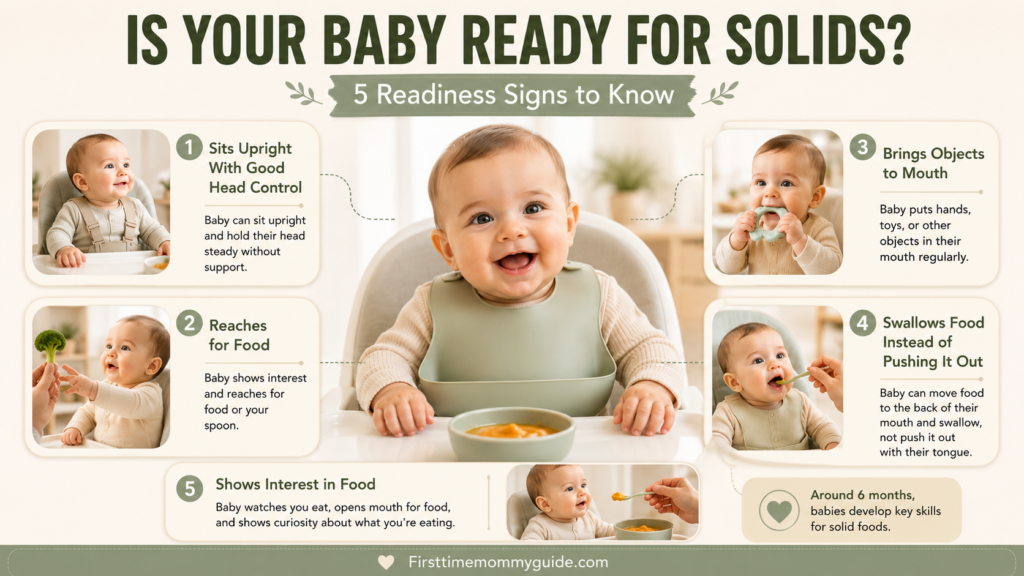
Quick Answer: Most babies show signs of readiness for solid foods around 6 months of age. Key signs include good head and neck control, the ability to sit up with minimal support, loss of the tongue-thrust reflex, and genuine interest in food — such as watching others eat or reaching for your plate.
Signs of Readiness
- Can hold their head steady and upright without support.
- Can sit up with minimal or no support, either independently or in a high chair.
- No longer automatically pushes food out of their mouth with their tongue (loss of the tongue-thrust reflex).
- Shows interest in food — leaning forward, opening their mouth, or reaching for what you’re eating.
- Has roughly doubled their birth weight and weighs about 13 pounds or more.
Why 6 Months, Specifically?
The AAP recommends exclusive breastfeeding or iron-fortified formula for approximately the first 6 months of life, with continued breastfeeding alongside solid foods for at least 12 months, and ideally 2 years or beyond. By around 6 months, a baby’s iron and zinc stores — which are high at birth but decline steadily — start to need supplementing through food, which is one of the key medical reasons solids are introduced at this stage.
Important note: Some organizations describe a slightly broader readiness window of 4 to 6 months, but current AAP guidance centers on approximately 6 months as the target starting point for most healthy, full-term infants. Always confirm timing with your pediatrician, particularly if your baby was born prematurely.
Best First Food for Baby 6 Months
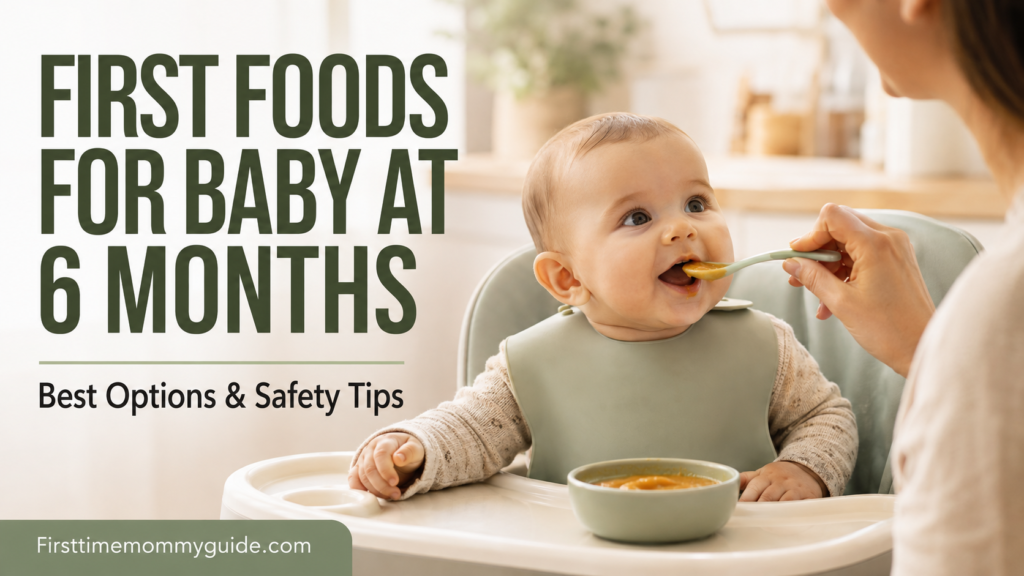
Quick Answer: There is no single “best” first food. Iron-fortified single-grain baby cereal, pureed meats, and pureed or mashed fruits and vegetables are all considered safe, pediatrician-recommended first foods, with iron-rich options often prioritized first.
Top First Food Options
| Food | Why It’s a Good First Choice | Serving Tip |
|---|---|---|
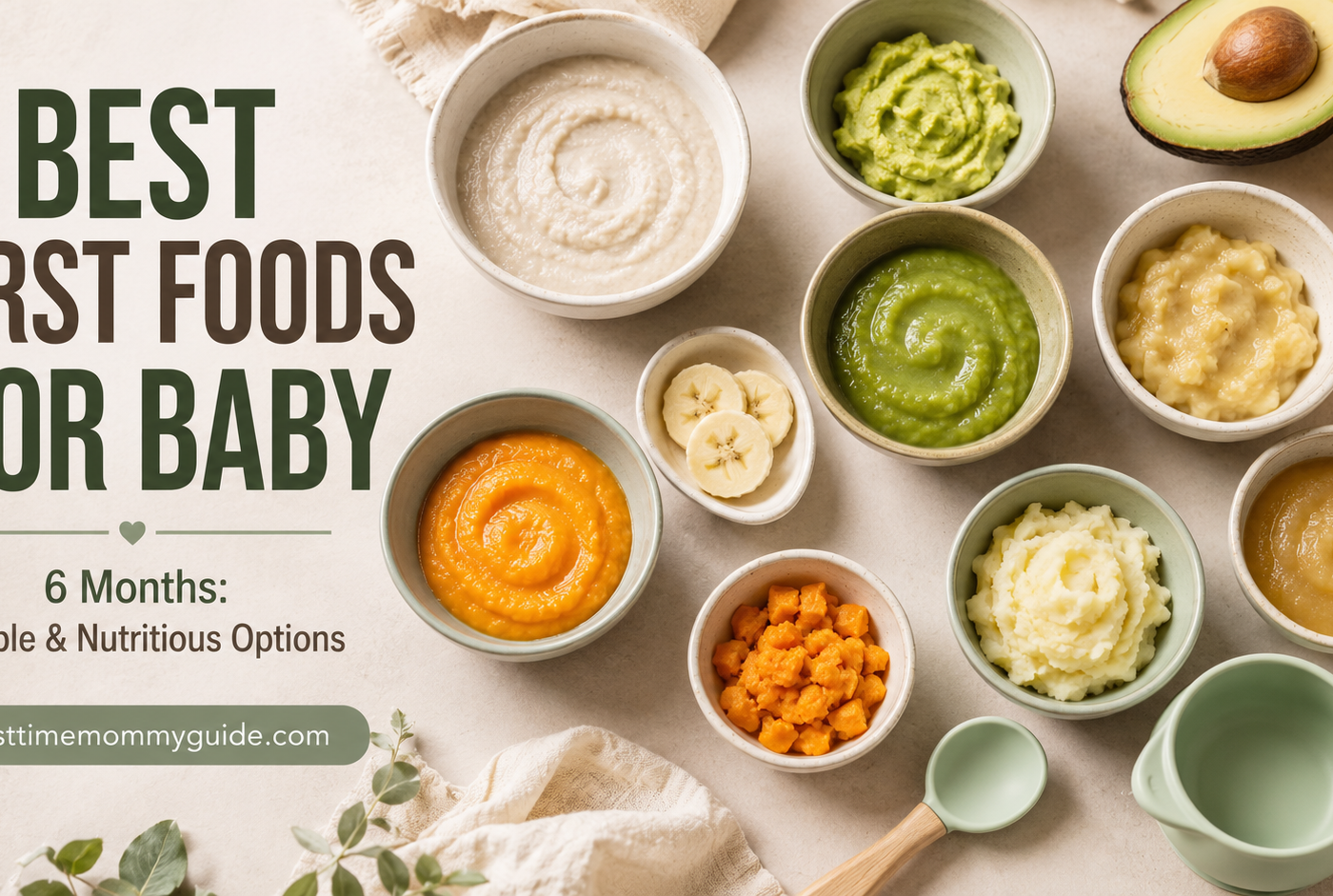
| Iron-fortified single-grain baby cereal (rice or oatmeal) | Traditionally recommended; formulated to meet an infant’s early nutritional needs | Mix 1 tablespoon of cereal with 4–5 tablespoons of breast milk or formula for a thin, familiar texture |
| Pureed meats (chicken, turkey, beef) | Rich in iron and zinc — nutrients that decline naturally after the first few months of life | Blend to a smooth, thin puree; thin further with breast milk or formula if needed |
| Pureed vegetables (sweet potato, carrot, peas, squash) | Introduces new flavors and textures; some, like leafy greens and beans, add iron | Steam until soft, then puree or mash to a smooth consistency |
| Pureed fruits (banana, avocado, pear, apple) | Naturally sweet and easy to digest; vitamin C in many fruits helps the body absorb iron from other foods | Mash ripe fruit with a fork, or blend for a smoother texture |
| Plain yogurt or tofu (if approved by your pediatrician) | Soft texture, protein source, easy to combine with other purees | Serve plain, unsweetened varieties only |
Why Iron-Rich Foods Come First
Quick Answer: Pediatricians often prioritize iron-rich first foods — like pureed meats and iron-fortified cereal — because a baby’s natural iron stores from birth begin to decline around 6 months, right when solids are introduced.
This is one of the most commonly missed details in general “first foods” advice. Babies aren’t just trying new tastes at 6 months — they have a real, measurable nutritional need for iron and zinc that breast milk alone often can’t fully meet at this stage.
How to Introduce Solid Foods: Step-by-Step
- Pick a calm, unhurried time of day. Choose a moment when your baby is alert, happy, and not overly hungry or overtired.
- Start with a very small amount. Offer about half a spoonful, or even less, at first — this is about exploration, not full meals.
- Choose one new food at a time. Offer the same single food for 3–5 days before introducing another, so you can watch for any reaction.
- Talk your baby through it. A simple, encouraging tone (“Mmm, see how good this is?”) helps make the experience positive.
- Watch your baby’s cues. Turning away, closing their mouth, or fussing usually means they’re done — don’t force additional bites.
- Gradually thicken texture over time. As your baby gets used to thin purees, slowly move toward thicker, less diluted textures.
- Continue breast milk or formula as the primary nutrition source. Solids at 6 months are complementary, not a replacement for breast milk or formula.
Expert Tip
It can take 8 to 10 exposures, and sometimes more, before a baby accepts a new food. Don’t interpret an early rejection as a permanent dislike — patience and repeated, low-pressure offers matter more than most parents expect.
Puree vs. Baby-Led Weaning: Which Approach Is Right?
| Approach | How It Works | Pros | Cons |
|---|---|---|---|
| Traditional purees (spoon-feeding) | Parent spoon-feeds smooth, blended foods, gradually increasing texture | Easier to control portion size and consistency; widely studied and recommended | Requires more prep and blending equipment; slower progression to table foods |
| Baby-led weaning (BLW) | Baby self-feeds soft, appropriately sized whole food pieces from the start | Encourages self-feeding skills and independence early on | Higher perceived choking risk if food isn’t prepared safely; requires close supervision |
| Combination approach | Mixes spoon-fed purees with some soft, safe finger foods | Offers flexibility and can suit different babies’ preferences | Requires understanding safe preparation for both methods |
Quick Answer: Both traditional purees and baby-led weaning are considered safe approaches when foods are prepared appropriately for a baby’s age and development. The right choice depends on your baby’s readiness, your comfort level, and guidance from your pediatrician.
Introducing Allergens Safely
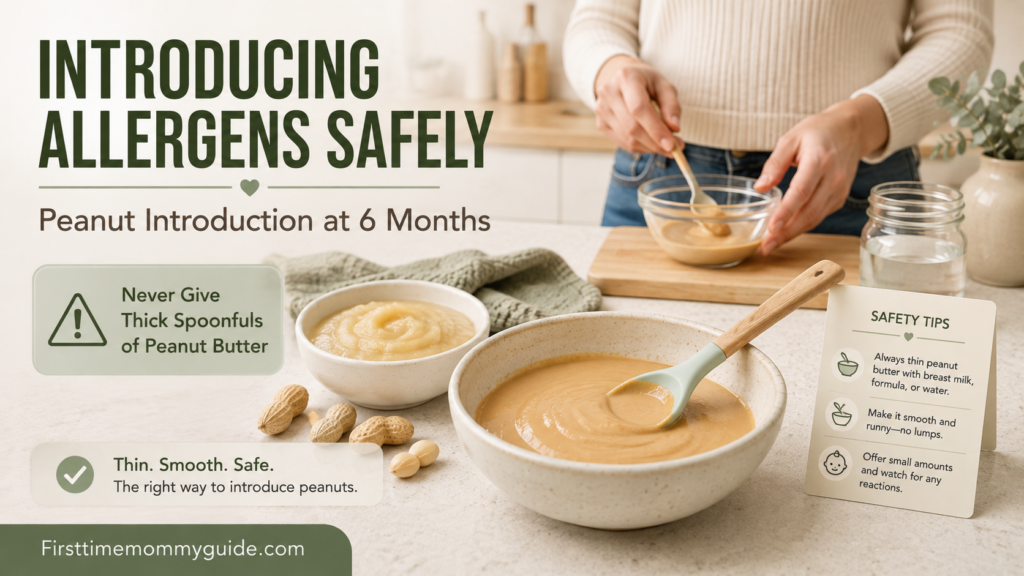
Quick Answer: Current pediatric guidance supports introducing common allergens — including peanut products, egg, dairy, soy, wheat, and fish — around 6 months, once solids have begun, rather than delaying them. Early, consistent introduction has been shown to help reduce the long-term risk of food allergies in many children.
How to Introduce Allergens
- Introduce one allergen at a time, spaced a few days apart, so you can monitor for any reaction.
- For peanut products: never offer whole peanuts or thick peanut butter, both serious choking hazards. Instead, thin a small amount of smooth peanut butter with breast milk, formula, or warm water.
- Watch for reaction signs such as hives, vomiting, swelling, or breathing difficulty, and contact your pediatrician or seek emergency care if these occur.
- Talk to your pediatrician first if your baby has severe eczema, a known food allergy, or a strong family history of food allergies — some babies may need allergy testing or an in-office food challenge before trying high-risk allergens like peanut.
Allergen Introduction Risk Categories
| Baby’s Risk Profile | Recommended Approach |
|---|---|
| No eczema or known food allergy | Introduce allergens along with other foods, based on family preference and cultural practice |
| Mild to moderate eczema | Allergens like peanut can typically be introduced around 6 months; discuss timing with your pediatrician |
| Severe or persistent eczema and/or egg allergy | Pediatrician-guided allergy testing is often recommended before introducing peanut products |
Foods and Practices to Avoid Before 12 Months
- Honey — Can cause infant botulism in babies under 1 year and should never be given, even in small amounts or baked into foods.
- Cow’s milk as a main drink — Whole milk isn’t recommended as a primary drink until around 12 months; breast milk or formula should remain the main source of nutrition before then.
- Added sugar and salt — Babies don’t need extra sweeteners, corn syrup, or added salt in their food.
- Whole nuts, chunks of nut butter, or hard raw foods — Serious choking hazards; nut butters should always be thinned before serving.
- Unpasteurized foods and juices — Increase the risk of foodborne illness in infants.
- Feeding directly from a jar or container that will be reused — Introduces bacteria from saliva into the remaining food; spoon out a small serving into a separate bowl instead.
Sample First Foods Feeding Guide (6–8 Months)
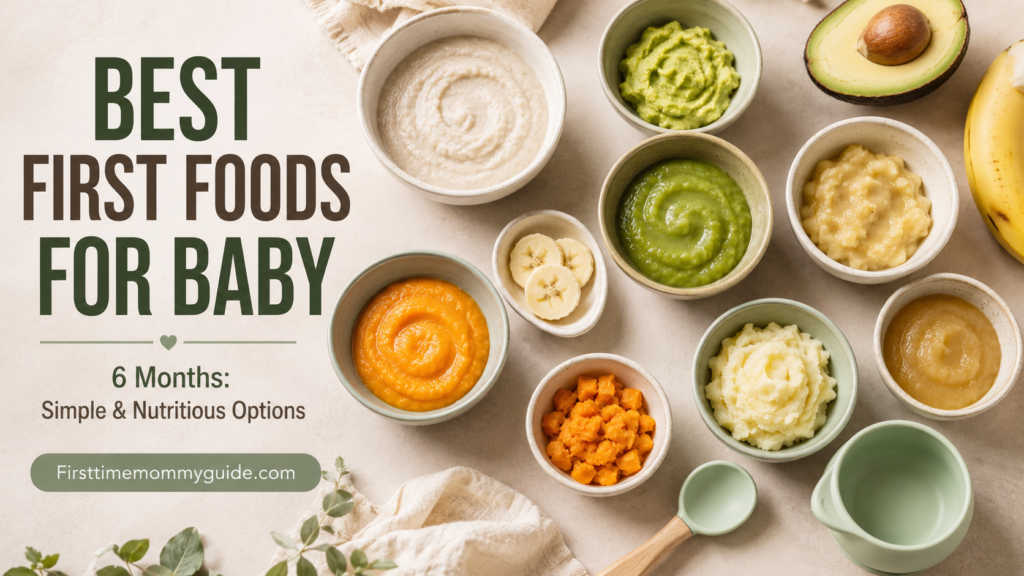
| Category | Examples | Typical Serving (per feeding) |
|---|---|---|
| Cereals & grains | Iron-fortified rice or oatmeal infant cereal | 2–4 tablespoons, twice a day |
| Vegetables | Cooked, pureed, or mashed carrots, sweet peas, green beans, spinach, winter squash | About 2 tablespoons, twice a day |
| Fruits | Fresh or cooked, pureed or mashed banana, peach, applesauce | About 2 tablespoons, twice a day |
| Protein foods | Cooked, pureed, or mashed plain meat and poultry; plain yogurt or tofu | 1–2 tablespoons, twice a day |
| Liquids | Continued breast milk or iron-fortified formula; small sips of water from a cup | Breast milk/formula remains primary nutrition source |
Note: These are general starting-point amounts based on common infant feeding guidance. Every baby’s appetite and pace differ — follow your baby’s hunger and fullness cues rather than strict quantities.
Common Mistakes to Avoid
- Starting too early or without readiness signs. Introducing solids before a baby can sit with support or has lost the tongue-thrust reflex can increase choking risk and offers no nutritional advantage.
- Feeding solids from a bottle. Even thin, runny purees should be offered by spoon, not through a bottle nipple.
- Giving up after one rejection. It often takes many repeated exposures before a baby accepts a new flavor or texture.
- Delaying allergens out of fear. Current guidance favors timely, monitored introduction of common allergens rather than indefinite avoidance.
- Skipping iron-rich foods. Focusing only on fruits and vegetables while skipping iron-fortified cereal or pureed meats can miss a key nutritional need at this age.
- Leaving a baby unsupervised while eating. Always stay close and watchful, even with soft, pureed foods — some coughing or gagging while learning to eat is common, but supervision is essential.
Real-World Feeding Scenarios
- Breastfed baby starting solids: Continue breastfeeding on demand while introducing one new solid food every 3–5 days; solids complement, rather than replace, breast milk at this stage.
- Formula-fed baby starting solids: Keep formula as the primary source of nutrition; introduce solids the same way, watching for both food reactions and changes in formula intake.
- Baby uninterested in solids at first: This is common. Keep offering small amounts at consistent times without pressure, and revisit foods that were initially rejected after a few days.
- Family history of food allergies: Talk to your pediatrician before starting high-risk allergens like peanut or egg — they may recommend a supervised introduction or allergy testing first.
Key Takeaways
- Most babies are ready for solid foods around 6 months, based on developmental readiness signs rather than age alone.
- There’s no single “correct” first food — iron-fortified cereal, pureed meats, and pureed fruits or vegetables are all safe, pediatrician-supported starting points.
- Iron-rich foods are often prioritized first because a baby’s natural iron stores decline around this age.
- Introduce one new food at a time and wait 3–5 days before adding another.
- Common allergens should generally be introduced around 6 months, not delayed, unless your pediatrician advises otherwise.
- Avoid honey, added sugar, added salt, whole nuts, and unpasteurized foods before age 1.
- Breast milk or formula remains the primary source of nutrition through the first year, even after solids begin.
Frequently Asked Questions (FAQs)
1. What is the best first food for a 6-month-old baby?
There isn’t one single best food — iron-fortified single-grain cereal, pureed meats, and pureed fruits or vegetables are all considered safe, appropriate first foods.
2. How do I know if my baby is ready for solid foods?
Look for good head control, the ability to sit with minimal support, loss of the tongue-thrust reflex, and genuine interest in food.
3. Can I start solids before 6 months?
Some babies show readiness as early as 4 months, but the AAP’s core guidance centers on approximately 6 months; always check with your pediatrician before starting earlier.
4. Should I start with cereal, vegetables, or fruit first?
All are acceptable starting points; many pediatricians recommend prioritizing iron-rich options like iron-fortified cereal or pureed meat first.
5. Why is iron important for a 6-month-old’s first foods?
A baby’s natural iron stores from birth begin to decline around 6 months, and solids help meet this increased need alongside breast milk or formula.
6. How much solid food should a 6-month-old eat?
Start with half a spoonful or less, gradually increasing to a few tablespoons per feeding as your baby adjusts, while breast milk or formula remains the main nutrition source.
7. How often should I introduce a new food?
Offer one new food at a time and wait 3–5 days before introducing another, so you can monitor for any reaction.
8. Can I mix cereal with breast milk or formula?
Yes. A common starting mix is 1 tablespoon of iron-fortified infant cereal combined with 4–5 tablespoons of breast milk or formula.
9. Is baby-led weaning safe at 6 months?
Yes, when foods are prepared in appropriately soft, safely sized pieces and the baby is closely supervised throughout feeding.
10. When should I introduce peanut butter and other allergens?
Current guidance supports introducing common allergens, including thinned peanut butter, around 6 months, once solids have begun — talk to your pediatrician first if your baby has severe eczema or a known allergy.
11. What foods should I avoid giving my 6-month-old?
Avoid honey, added sugar and salt, whole nuts or thick nut butter, unpasteurized foods, and cow’s milk as a main drink before age 1.
12. Why can’t babies have honey?
Honey can contain spores that cause infant botulism, a serious illness, in babies under 1 year old.
13. Can I feed my baby directly from the jar?
It’s best to spoon a small serving into a separate bowl rather than feeding directly from the jar, to avoid introducing bacteria from saliva into the remaining food.
14. What if my baby refuses a new food?
This is normal — it can take 8 to 10 or more exposures before a baby accepts a new food, so keep offering it without pressure.
15. Should I stop breastfeeding once solids start?
No. Breast milk or formula should remain the primary source of nutrition alongside solids for at least the first 12 months, and breastfeeding can continue well beyond that if desired.
16. What texture should first foods be?
Start with thin, smooth purees, then gradually progress to thicker purees and, later, soft mashed or finely chopped textures as your baby develops.
17. Can I give my baby water at 6 months?
Small sips of water from a cup can typically be introduced around 6 months, but breast milk or formula should remain the primary drink.
18. Is it normal for my baby to gag while starting solids?
Mild gagging is common as babies learn to manage new textures; however, always supervise feeding closely and learn the difference between gagging and true choking.
19. When can my baby start finger foods?
Most babies can begin managing small portions of soft finger foods, such as well-steamed vegetables or soft fruit, by around 9 months.
20. Do I need to introduce vegetables before fruits so my baby doesn’t develop a “sweet tooth”?
There’s no strong evidence that introduction order affects long-term food preferences; the more important factor is offering a wide variety of foods over time.
21. What should I do if my baby shows signs of an allergic reaction?
Contact your pediatrician promptly for mild symptoms like a rash, and seek emergency care immediately for signs like swelling, vomiting, or difficulty breathing.
22. How many meals a day should a 6-month-old have?
Many babies start with one to two small solid feedings a day at 6 months, gradually increasing frequency as they approach 8–9 months, alongside continued breast milk or formula feedings.
23. Can premature babies follow the same 6-month timeline for starting solids?
Not necessarily — readiness for premature babies is often based on adjusted age and individual development, so timing should always be guided by their pediatrician.
24. Is store-bought baby food as good as homemade purees?
Both can be nutritionally appropriate; choose single-ingredient, unsweetened commercial options if you prefer store-bought, and always check labels for added sugar or salt.
Conclusion
Starting solids is less about finding one “perfect” first food and more about following your baby’s readiness cues, prioritizing iron-rich options, and introducing new foods patiently and safely.
With guidance from your pediatrician and a steady, low-pressure approach, this milestone becomes an exciting step in your baby’s growth rather than a source of stress.
If you’re ever unsure about a specific food, allergen introduction, or your baby’s individual readiness, your pediatrician remains the best resource for guidance tailored to your child.

Dilawar Mughal
Founder and editor, First Time Mommy Guide
I research every guide against what the NHS, the AAP and the WHO publish, then write it in plain English — because most new parents are reading with one hand free, not comparing clinical guidelines. I'm not a doctor or a midwife. Every health claim on this site is sourced and linked so you can check it yourself, and anything urgent belongs with your health visitor or GP, not a blog.