General information, not medical advice. Every baby is different — if anything worries you, speak to your midwife, health visitor or GP rather than waiting.
How to Choose a Baby Formula depends on your baby’s age, nutritional needs, feeding situation, and any specific health considerations.
Infant formulas are available in different types and formulations, including standard cow’s-milk-based formulas, hydrolyzed formulas, and specialized options for certain nutritional needs.
Understanding the ingredients, protein sources, added nutrients, and preparation requirements can help parents make an informed choice.
For babies with allergies, digestive concerns, or other medical needs, a pediatrician or qualified healthcare professional can help determine which formula is appropriate.
Table of Contents
How Do You Choose a Baby Formula?

Short answer: Start with a standard cow’s milk-based, iron-fortified formula unless your pediatrician recommends otherwise. All formulas sold in the US must meet FDA nutrition standards, so no single brand is “best.” Choose based on your baby’s tolerance, your budget and what is easy for you to buy consistently.
Key point: The front-of-can marketing claims matter less than protein type, your baby’s comfort and your pediatrician’s guidance.
Most babies do well on the first formula they try. Give any new formula about a week before deciding it is not working, unless your pediatrician advises a faster switch.
Key Takeaways
- All FDA-regulated infant formulas sold in the US meet the same core nutrition standards.
- Standard cow’s milk-based, iron-fortified formula is the usual starting point.
- Formula comes in powder, liquid concentrate and ready-to-feed forms.
- Protein type (cow’s milk, soy, hydrolyzed or amino acid-based) matters more than brand.
- Never make homemade infant formula. The FDA and AAP strongly advise against it.
- Cow’s milk (the drink, not formula) is not safe for babies under 12 months.
- Call your pediatrician about persistent spit-up, blood in stool, rash, poor weight gain or a baby who seems unusually fussy after feeds.
What Is Baby Formula?
Infant formula is a specially made food designed to give babies the nutrition they need when breast milk is not available or not the family’s choice. It is modeled after the composition of breast milk.
The American Academy of Pediatrics recommends breast milk as the sole source of nutrition for the first six months of life. When that is not possible or not chosen, formula is designed to meet a baby’s full nutritional needs on its own.
What Formula Is Made Of
Formula is built from protein, carbohydrates and fat, which together make up most of its content. Vitamins and minerals, including iron, are added to support growth and development.
Many formulas also add DHA and ARA, fatty acids linked to brain and eye development, along with prebiotics or probiotics to support digestion.
Who Regulates Infant Formula?
The FDA regulates infant formula production sold in the United States. It sets minimum nutrient levels and inspects manufacturing facilities to confirm formulas meet safety and nutrition requirements.
European formulas have become popular with some parents, but they are not FDA-regulated. Their nutrient standards can differ, so talk with your pediatrician before using an imported formula.
Types of Baby Formula by Protein Source
Protein type is the single biggest factor in how a baby tolerates a formula. Here is a comparison of the main categories.
| Type | Made from | Best for | Notes |
|---|---|---|---|
| Cow’s milk-based | Cow’s milk protein, modified to suit babies | Most healthy, full-term babies | The standard starting point for most families |
| Soy-based | Soy protein | Babies with galactosemia, or by family preference | Not typically recommended just for fussiness or gas without a pediatrician’s guidance |
| Partially hydrolyzed | Cow’s milk protein broken into smaller pieces | Babies with mild sensitivity or family history of allergy | Often marketed as “gentle” or “sensitive” |
| Extensively hydrolyzed | Cow’s milk protein broken down further | Babies with diagnosed milk protein allergy | Usually recommended and monitored by a pediatrician |
| Amino acid-based | Individual amino acids, no intact protein | Babies with severe allergies who don’t tolerate hydrolyzed formula | Typically prescribed, not chosen independently |
| Lactose-free | Cow’s milk protein without lactose | Babies with confirmed lactose intolerance (rare in infants) | Not the same as a milk protein allergy |
A Word on “Sensitive” or “Gentle” Formulas
These terms are marketing language, not medical categories. Read the ingredient list and protein type rather than relying on the front label.
If your baby has ongoing digestive discomfort, ask your pediatrician whether a change in protein type makes sense before switching formulas on your own.
Baby Formula Forms: Powder vs Liquid Concentrate vs Ready-to-Feed
Formula also comes in three physical forms. Each has trade-offs in cost and convenience.
| Form | How it works | Cost | Convenience |
|---|---|---|---|
| Powder | Mixed with water, usually one scoop per set amount of water | Most affordable | Requires precise measuring and mixing |
| Liquid concentrate | Diluted with water before feeding | Mid-range cost | Less mixing than powder, but still requires dilution |
| Ready-to-feed | Poured directly into a bottle, no mixing | Most expensive | Most convenient, useful for travel or overnight feeds |
Choosing a Form That Fits Your Life
Powder is the most budget-friendly and works well for most families. Ready-to-feed can be worth the extra cost for travel, nighttime feeds or times when precise mixing is hard to manage.
Some families keep a small supply of ready-to-feed on hand for backup, even if powder is their everyday choice.
How to Read a Baby Formula Label
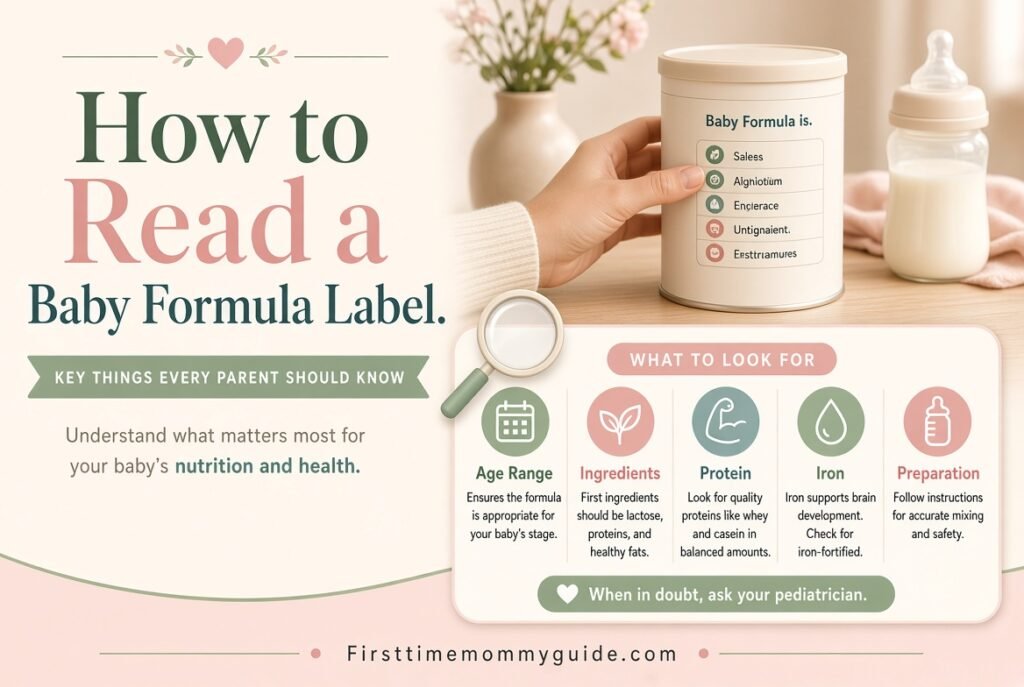
The can’s front makes bold claims. The information that actually matters is elsewhere.
What to Check on Every Can
- Iron content. Iron-fortified formula is recommended for most babies.
- Age range. Make sure it is labeled for infants, not toddlers.
- Expiration date. Never use expired formula.
- Can condition. Skip any can with leaks, puffy ends or rust spots.
- Preparation instructions. Powder and concentrate need exact water ratios.
Ingredients Worth Understanding
| Ingredient | What it does |
|---|---|
| Iron | Supports brain development and prevents anemia |
| DHA and ARA | Fatty acids linked to brain and eye development |
| Prebiotics or probiotics | May support digestive comfort and gut health |
| Lactose | The main carbohydrate in most standard formulas |
| Whey and casein | The two main proteins in cow’s milk-based formulas |
Organic vs Standard Formula
Organic formulas meet the same FDA nutrition standards as standard formulas. The difference is that organic formulas use certified organic ingredients and avoid genetically modified ingredients, which usually raises the price.
Neither type is nutritionally superior for a typical healthy baby. The choice often comes down to family preference and budget.
Generic vs Brand-Name Formula
Store-brand and generic formulas must meet the same FDA nutrition standards as name brands. They are typically less expensive and a reasonable choice for most babies.
How to Choose Based on Your Baby’s Needs
For a Healthy, Full-Term Baby
Start with a standard cow’s milk-based, iron-fortified formula. Most babies tolerate this well, and it is the most affordable and widely available option.
For a Baby With Reflux Symptoms
Talk with your pediatrician first. They can help determine whether a formula change, a feeding adjustment or another approach fits your baby’s situation.
For a Baby With Possible Milk Allergy or Intolerance
Do not switch to a specialized formula on your own. Your pediatrician can help distinguish a true milk protein allergy from normal newborn fussiness or reflux, and recommend an appropriate formula if needed.
For a Premature Baby
Premature babies often have specific nutritional needs. Their care team typically recommends a formula suited to their growth and development.
For a Baby With Galactosemia
Soy-based formula is typically used for babies diagnosed with galactosemia, a rare metabolic condition. This is a medical decision made with your pediatrician.
Signs a Formula May Not Be Working
Track these over several days rather than reacting to a single feeding.
| Sign | What it might mean |
|---|---|
| Frequent spit-up or vomiting beyond typical newborn amounts | Could indicate reflux or intolerance |
| Blood or mucus in stool | Contact your pediatrician promptly |
| Persistent rash, hives or swelling | Possible allergic reaction |
| Excessive gas, bloating or crying after feeds | May suggest digestive discomfort |
| Poor weight gain | Needs pediatrician evaluation |
| Diarrhea or unusually hard stools | Worth discussing at your next visit |
Call your pediatrician promptly for blood in stool, hives, swelling of the face or lips, or breathing difficulty. These can signal a more serious reaction.
How to Switch Formulas Safely
If your pediatrician recommends a switch, a gradual transition can help.
- Talk with your pediatrician first, especially if the switch is due to allergy concerns.
- Mix old and new formula for a few days if advised, gradually increasing the new formula’s share.
- Watch for reactions such as rash, unusual stool changes or excessive fussiness.
- Give it about a week unless your pediatrician says to stop sooner.
- Keep notes on feeding times, amounts and any symptoms to share at your next visit.
Cost of Baby Formula
Formula is a real budget item, and costs add up over a baby’s first year.
| Factor | Effect on cost |
|---|---|
| Form (powder vs ready-to-feed) | Powder is generally the most affordable; ready-to-feed the most expensive |
| Brand name vs store brand | Store brands are typically less expensive with the same nutrition standards |
| Specialized formulas | Hydrolyzed and amino acid-based formulas usually cost more |
| Feeding volume | Babies who drink more formula per day cost more monthly |
Ways to Manage Formula Costs
- Compare price per ounce, not just price per can.
- Look into the WIC program, a federal nutrition assistance program for eligible women, infants and children.
- Ask your pediatrician’s office about manufacturer samples.
- Buy in bulk when a formula that works well is on sale, checking expiration dates.
What Not to Do When Choosing Formula
| Mistake | Why it matters |
|---|---|
| Making homemade formula | The FDA and AAP strongly advise against it due to serious nutritional risks |
| Giving cow’s milk as a drink before 12 months | Cow’s milk lacks the nutrient balance babies need and can strain their kidneys |
| Diluting formula to save money | Can cause dangerous nutrient and electrolyte imbalances |
| Switching formulas repeatedly without reason | Makes it hard to tell what is actually causing symptoms |
| Using a puffy, leaking or rusted can | Formula may be contaminated or unsafe |
| Choosing based on marketing claims alone | Claims about “brain-boosting” or “immune support” are not a substitute for checking protein type and ingredients |
| Ignoring the age label | Toddler formulas are not designed to meet an infant’s nutrition needs |
Expert Tips for Choosing Baby Formula
- Ask your pediatrician’s office if they have sample cans or brand suggestions for your baby’s specific situation.
- Focus on protein and carbohydrate type rather than front-label claims.
- If a formula shortage affects your usual brand, call your pediatrician or local WIC office for guidance on safe substitutes.
- Keep a simple feeding log during any transition so patterns are easier to spot.
- Buy a smaller can first when trying something new, in case your baby does not tolerate it well.
Baby Formula vs Breast Milk: A Quick Comparison
| Feature | Breast milk | Infant formula |
|---|---|---|
| Recommended timing | Sole nutrition source for first 6 months, per AAP | Used when breastfeeding isn’t chosen or possible, or to supplement |
| Nutrient composition | Changes naturally over time and by feeding | Fixed composition, regulated by the FDA |
| Regulation | Not regulated as a product | FDA-regulated for nutrition and safety |
| Cost | No direct product cost | Ongoing cost that varies by form and type |
| Preparation | No mixing required | Powder and concentrate need mixing; ready-to-feed does not |
Many families use a combination of breastfeeding and formula. This is a personal and medical decision best made with your pediatrician.
When to Call Your Pediatrician

Reach out to your pediatrician for any of the following.
- You are unsure which formula type fits your baby.
- Your baby shows signs of allergy, reflux or intolerance.
- You want to switch formula brands or types.
- Your baby has poor weight gain or feeding difficulties.
- You cannot find your usual formula and need a safe substitute.
- Your baby has a diagnosed condition such as galactosemia or a milk protein allergy.
Pediatricians generally do not have brand preferences. Their guidance focuses on your baby’s individual needs rather than any specific product.
Practice Scenarios: What Should You Do?
| Scenario | Likely next step |
|---|---|
| Healthy newborn, no family history of allergies | Start with standard cow’s milk-based, iron-fortified formula |
| Baby has frequent spit-up but is gaining weight well | Mention it at your next checkup; often normal reflux |
| Baby has blood in stool | Call your pediatrician promptly |
| Family history of milk allergy, parent is worried | Discuss options with your pediatrician before choosing a formula |
| Usual formula is out of stock | Call your pediatrician or WIC office for a safe substitute |
| Trying a new formula, mild fussiness on day 2 | Continue for about a week unless symptoms worsen, then reassess |
Also Read:
- Postpartum Bleeding When to Worry: Warning Signs, Normal Lochia & What to Do
- Bleeding After Normal Delivery How Many Days: Typical Timeline, Stages & Warning Signs
Frequently Asked Questions
How do I know which baby formula to choose?
Start with a standard cow’s milk-based, iron-fortified formula unless your pediatrician recommends a different type. All FDA-regulated formulas meet the same core nutrition standards, so focus on your baby’s tolerance rather than the brand.
Is one brand of baby formula better than another?
No single brand is best. The FDA requires all commercial infant formulas sold in the US to meet the same minimum nutrition and safety standards.
What is the difference between formula types?
Types differ mainly by protein source: cow’s milk-based, soy-based, hydrolyzed, or amino acid-based. The right type depends on your baby’s tolerance and any diagnosed allergy or condition.
Should I choose powder, liquid concentrate or ready-to-feed formula?
Powder is usually the most affordable and works well for most families. Ready-to-feed is more convenient, especially for travel, but costs more.
Is organic baby formula better than regular formula?
Organic formula meets the same FDA nutrition standards as standard formula. It differs in using certified organic ingredients, which typically raises the price rather than the nutritional value.
Is generic or store-brand formula as good as name brands?
Yes. Store-brand and generic formulas must meet the same FDA nutrition requirements as brand-name products, and they are usually less expensive.
How do I know if my baby needs a special formula?
Signs like blood in stool, persistent rash, poor weight gain or ongoing digestive distress warrant a call to your pediatrician, who can determine if a specialized formula is needed.
What formula is best for a baby with reflux?
There is no universal answer. Talk with your pediatrician, who can recommend an approach based on your baby’s specific symptoms.
What formula is best for a baby with a milk allergy?
Extensively hydrolyzed or amino acid-based formulas are typically used for diagnosed milk protein allergies, under a pediatrician’s guidance.
Can I give my baby soy formula for gas or fussiness?
Soy formula is not typically recommended just for gas or fussiness without a pediatrician’s evaluation. It is mainly used for specific medical reasons, such as galactosemia.
Can I make homemade baby formula?
No. The FDA and American Academy of Pediatrics strongly advise against homemade formula because it can lead to serious nutritional imbalances.
Can I give my baby regular cow’s milk instead of formula?
No, not before 12 months. Cow’s milk as a drink does not have the right nutrient balance for infants and can be hard on their kidneys.
How long should I try a new formula before switching again?
Give it about a week unless your pediatrician advises switching sooner due to concerning symptoms.
What does iron-fortified mean, and do I need it?
It means vitamins and minerals, including iron, have been added. Iron-fortified formula is recommended for most babies to support healthy development.
What are DHA and ARA in baby formula?
They are fatty acids linked to brain and eye development. Many, but not all, commercial formulas include them.
How much does baby formula cost?
Costs vary widely by form and brand. Powdered formula is generally the least expensive option, while ready-to-feed costs more.
What if I can’t find my usual formula brand?
Contact your pediatrician or local WIC office for guidance on a safe, comparable substitute rather than switching on your own without advice.
Can I use European baby formula in the US?
European formulas are not FDA-regulated, so their standards can differ from US requirements. Talk with your pediatrician before using an imported formula.
What should I check before using a can of formula?
Check that it is not expired, the can is sealed with no leaks, puffy ends or rust spots, and it is labeled for infants, not toddlers.
When should I call the pediatrician about formula?
Call for signs like blood in stool, persistent rash, poor weight gain, breathing difficulty, or if you are unsure which formula type fits your baby.
Conclusion
Learning how to choose a baby formula comes down to a few key factors: protein type, your baby’s tolerance, your budget and your pediatrician’s guidance. No single brand is superior, since all FDA-regulated formulas meet the same nutrition standards.
Start with a standard formula unless there is a specific reason not to, watch for signs of intolerance, and never hesitate to call your pediatrician with questions.
For more feeding, sleep and newborn care guides, visit First Time Mommy Guide.

Dilawar Mughal
Founder and editor, First Time Mommy Guide
I research every guide against what the NHS, the AAP and the WHO publish, then write it in plain English — because most new parents are reading with one hand free, not comparing clinical guidelines. I'm not a doctor or a midwife. Every health claim on this site is sourced and linked so you can check it yourself, and anything urgent belongs with your health visitor or GP, not a blog.