General information, not medical advice. Every baby is different — if anything worries you, speak to your midwife, health visitor or GP rather than waiting.
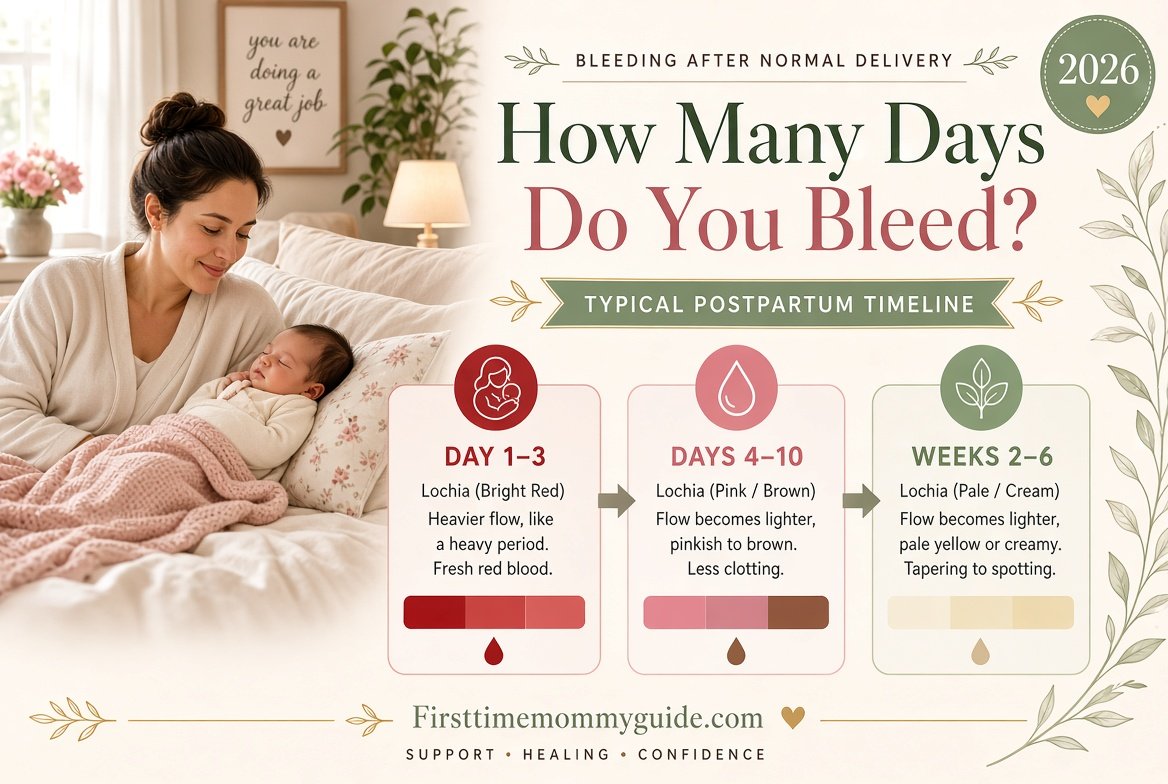
Bleeding After Normal Delivery How Many Days is a common question for new mothers recovering after childbirth. Vaginal bleeding after a normal delivery is called lochia, and it is a natural part of the postpartum healing process.
It usually begins as heavier, bright-red bleeding and gradually becomes lighter in color and flow as the days and weeks pass. The bleeding may change from red to pink, brown, and eventually yellowish or creamy-white discharge before it stops.
The duration can vary from one woman to another, but postpartum bleeding commonly continues for several weeks as the uterus returns to its pre-pregnancy size and the body heals.
Table of Contents
How Many Days Do You Bleed After a Normal Delivery?
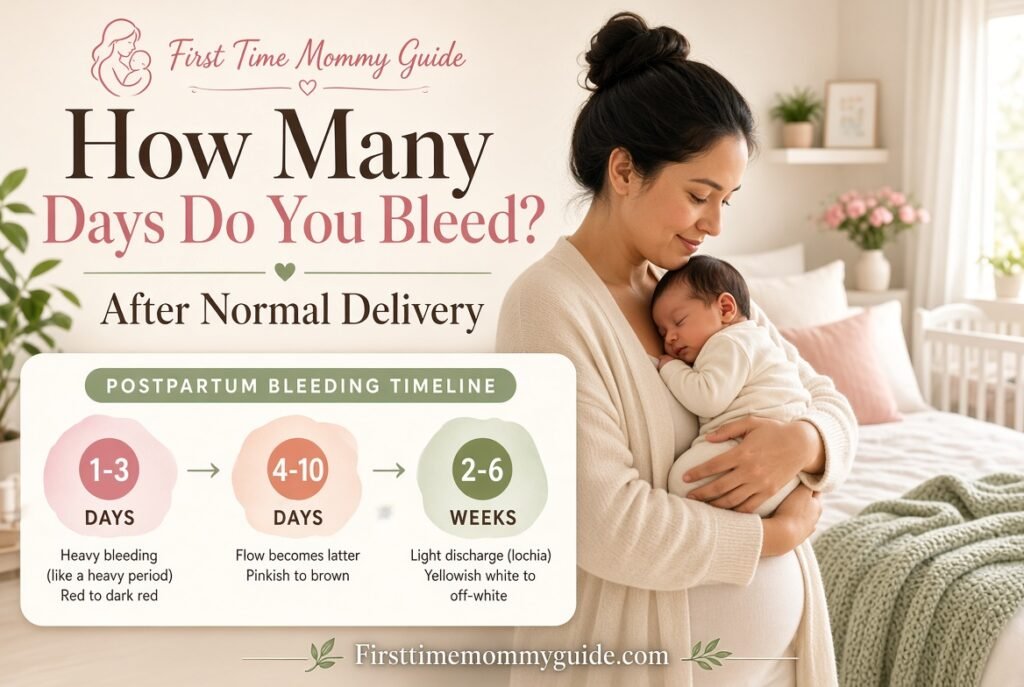
Short answer: Most people bleed for about 4 to 6 weeks (roughly 28 to 42 days) after a normal, or vaginal, delivery. The bleeding is called lochia. It is heaviest in the first 3 to 4 days, then turns pink or brown, then becomes a light yellow-white discharge.
Good to know: Some people stop a little sooner, and some have light discharge for up to about 8 weeks.
The pattern matters more than the exact day. Bleeding should slowly get lighter, not heavier.
Bleeding After Normal Delivery: Week-by-Week Timeline
Every recovery is a little different. Use this table as a general guide, not a strict schedule.
| Timeframe | What is typical | Color | Flow |
|---|---|---|---|
| Days 1 to 4 | Heaviest bleeding, like a heavy period | Bright to dark red | Heavy, with small clots |
| Days 4 to 12 | Bleeding eases | Pink to brown | Lighter and thinner |
| Days 10 to 14 | A short increase is possible | Red or pink-brown | Brief bump, then settles |
| Weeks 2 to 4 | Discharge becomes lighter | Brown, cream or yellowish | Light, may come and go |
| Weeks 4 to 6 | Minimal discharge or spotting | Yellow-white | Very light, ends for most |
| Weeks 6 to 8 | Light discharge continues in some people | Yellow-white | Very light, tapering |
Day-by-Day: What Bleeding Looks Like After a Vaginal Birth
Here is a simple look at what many people notice. Your own pattern may differ.
| Day | What you may see |
|---|---|
| Day 1 | Heavy, bright red flow. You may fill a large pad every 2 to 3 hours. Nurses check often. |
| Days 2 to 3 | Still red, often a bit lighter. Small clots and cramps as the uterus contracts. |
| Days 4 to 5 | Flow lightens. Color moves toward darker red, pink or brown. |
| Days 6 to 9 | Pink to brown, thinner, and less frequent clots. |
| Days 10 to 14 | Mostly pink-brown or yellowish. A brief increase is possible. |
| Week 3 | Light discharge. It may stop and start. |
| Week 4 | Very light. Many people use only thin pads or liners. |
| Weeks 5 to 6 | Minimal yellow-white discharge or spotting. Most people finish by about 6 weeks. |
| Weeks 7 to 8 | Occasional light spotting in some people. Call if it is not tapering. |
What Is Bleeding After Delivery Called?
Postpartum bleeding is called lochia. It is a mix of blood, mucus and tissue from the lining of your uterus.
Lochia is not a period. It comes from the spot where the placenta was attached and from the healing of the uterus.
The Three Stages of Lochia
Lochia changes in a predictable order. The timing overlaps from person to person.
| Stage | Typical timing | Color | What to expect |
|---|---|---|---|
| Lochia rubra | Days 1 to 4 | Bright to dark red | Heaviest flow, small clots, period-like cramps |
| Lochia serosa | About days 4 to 12 | Pink to brown | Lighter, thinner, few or no clots |
| Lochia alba | About day 12 up to 6 weeks | Yellow, cream or white | Light discharge, mostly mucus and white blood cells |
Small Clots in the First Days
Clots about the size of a quarter can be common in the first few days. They should become smaller and rarer.
Clots larger than a golf ball are not expected. Call your provider if you pass one.
Why Does Bleeding Last Several Weeks?
After birth, your uterus has to shrink back toward its usual size. This process is called involution.
The place where the placenta was attached also needs time to heal. Bleeding continues until that area closes and the uterine lining regrows.
Why Bleeding Can Increase at 10 to 14 Days
Many people notice a short increase in flow around days 10 to 14. It is thought to happen when the scab over the placenta site loosens and comes off.
This bump is usually brief. If it stays heavy or bright red, call your provider.
What Changes How Long You Bleed?
Several things can affect how your bleeding looks and how long it lasts.
| Factor | How it can affect bleeding |
|---|---|
| Activity level | More time on your feet can bring back red flow for a while |
| Breastfeeding or pumping | Oxytocin causes uterine contractions, which can cause cramps and a short gush |
| Retained placenta tissue | Can cause heavier or longer bleeding and clots |
| Uterine infection | Can cause foul-smelling discharge, fever and ongoing bleeding |
| Not breastfeeding | A first period may arrive early, as soon as about 4 weeks after birth |
| Birth tears or stitches | May cause some spotting from the perineum, separate from lochia |
| Individual healing | Some people finish earlier and some later |
Bleeding That Stops and Starts
Lochia rarely fades in a straight line. You may have a light morning and a heavier evening.
A few short bursts are common when you are up more, lifting, or nursing. Rest, slow down and watch the trend over the next day or two.
Lochia can also seem to stop and then return. New bright red blood after it had turned pink or brown should be checked if it does not settle.
Vaginal Delivery vs C-Section: Does the Number of Days Differ?
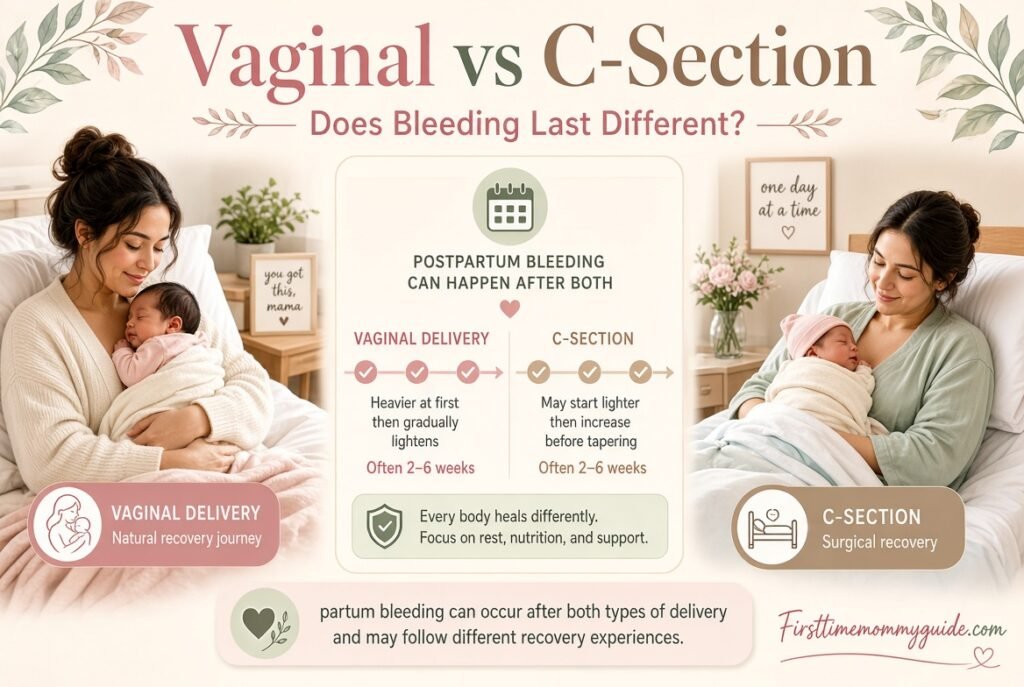
You have lochia after both types of birth. The uterus heals either way.
| Feature | Normal (vaginal) delivery | C-section |
|---|---|---|
| Lochia occurs | Yes | Yes |
| Typical duration | About 4 to 6 weeks | About 4 to 6 weeks |
| Duration differences | Some sources say it can last a bit longer | Some sources say it can be a little lighter |
| Warning signs | Same | Same |
If your bleeding worries you, do not compare it to a friend’s. Compare it to the warning signs.
When Bleeding Lasts Longer Than Expected
Many people still have light discharge at week 6, and some up to about 8 weeks. What matters is that it keeps tapering.
Call your provider if you are past 6 weeks and still have any of these.
- Bleeding as heavy as a period
- Bright red blood
- Clots
- Foul-smelling discharge
- Pain or fever
Possible causes include retained placental tissue, infection or a uterus that is slow to shrink. A provider can check for these.
Lochia vs Your First Period After Delivery
It is easy to confuse the two.
| Feature | Lochia | First period |
|---|---|---|
| How long | About 4 to 6 weeks | Typically 3 to 7 days |
| Start | Right after birth | Weeks to months later |
| Pattern | Heavy, then light, then yellow-white | Returns to a cycle over time |
| Breastfeeding effect | Brief gushes | May delay the first period |
If you are not breastfeeding, a first period can arrive as early as about four weeks after birth. It may be heavier than usual.
Warning Signs: When to Call Your Provider or 911
Most bleeding after birth is normal. Learn these red flags in advance.
| Situation | What to do |
|---|---|
| Bleeding that will not slow, or soaking a heavy pad every hour for 2 hours or more | Call 911 |
| Dizziness, fainting, racing heart, blurry vision, cold clammy skin | Call 911 |
| Chest pain or trouble breathing | Call 911 |
| Fever of 100.4°F (38°C) or higher, or foul-smelling discharge | Call your provider right away |
| Clots larger than a golf ball | Call your provider right away |
| Bright red bleeding returns and stays heavy | Call your provider the same day |
| Bleeding gets heavier instead of lighter | Call your provider the same day |
| Bleeding heavy or bright red after 6 weeks | Call your provider’s office |
Most postpartum hemorrhages happen within the first day. They can also happen later, up to about 12 weeks after birth.
How to Manage Bleeding During the Weeks You Bleed
A few simple habits help you stay comfortable and safe.
- Stock up on large maternity pads before you leave the hospital.
- Use pads only. Do not use tampons or menstrual cups for at least six weeks.
- Change pads often and wash your hands before and after.
- Rest as much as you can and accept help.
- Build up activity slowly. Sudden changes can bring back red bleeding.
- Drink water and eat iron-rich foods such as beans, lentils, lean meat and leafy greens.
- Wait for your provider’s okay before sex, usually around six weeks.
- Keep your provider’s number saved in your phone.
Track Your Bleeding With a Simple Daily Log
A short log helps you see the trend and gives your provider clear facts.
| Day | Color | Pads used | Clots (size) | How I feel |
|---|---|---|---|---|
| Day 3 | Red | 6 | Two small | Tired |
| Day 7 | Pink-brown | 4 | None | Okay |
| Day 14 | Brown | 2 | None | Good |
| Day 21 | Yellow | 1 liner | None | Good |
Postpartum Checkups and Your Bleeding
Do not wait for a routine visit if you are worried. Call right away for any warning sign.
Otherwise, mention your bleeding at your postpartum visits. ACOG advises early contact with your provider within the first three weeks and a full postpartum visit no later than 12 weeks.
Common Mistakes to Avoid
| Mistake | Why it matters | What to do instead |
|---|---|---|
| Waiting to see if heavy bleeding stops | Blood loss can become dangerous quickly | Call 911 or your provider |
| Using tampons or menstrual cups | Raises the risk of infection | Use pads for at least 6 weeks |
| Doing too much too soon | Can bring back red flow | Increase activity slowly |
| Ignoring a fever or foul smell | May signal infection | Call promptly |
| Assuming any heavy bleeding is “just a period” | Can hide a problem | Check the warning signs |
| Skipping postpartum visits | Problems can be missed | Attend your visits |
| Not tracking | Hard to see the trend | Keep a simple log |
Expert Tips for First-Time Moms
- Learn the warning signs before you leave the hospital.
- Ask a partner or family member to learn them too.
- Focus on the trend over several days, not one bad hour.
- Keep extra pads in every room and in the diaper bag.
- Rest when the baby rests. It helps your uterus heal.
- Trust your gut. Calling early is never a bother.
Practice Scenarios: Normal or Not?
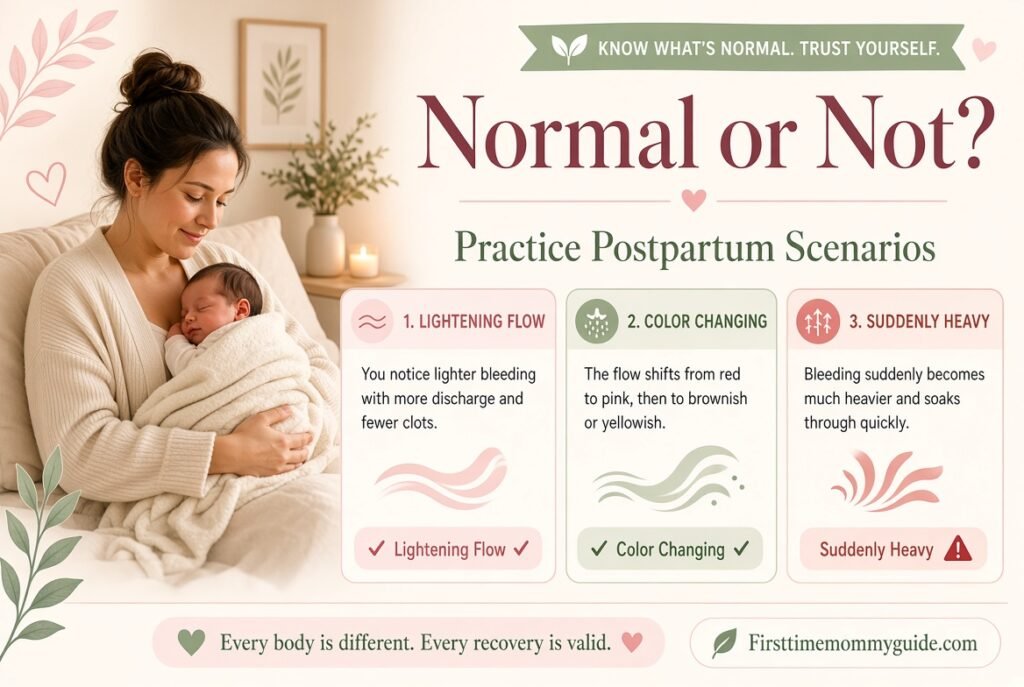
| Scenario | What it likely means |
|---|---|
| Day 4: flow lighter, now pink-brown | Typical progress |
| Day 12: brief increase after a busy day, settles in a day or two | Can be normal. Keep resting and tracking. |
| Day 20: heavy bright red flow that keeps going | Call your provider |
| Week 6: light yellow-white spotting | Common at the end of lochia |
| Week 8: still soaking pads | Call your provider |
| Day 7: fever and foul-smelling discharge | Call your provider right away |
Frequently Asked Questions (FAQs)
Bleeding after normal delivery how many days is normal?
Most people bleed for about 4 to 6 weeks, or roughly 28 to 42 days. It should get lighter over time and change from red to pink or brown to yellow-white.
How long does bleeding last after a vaginal delivery?
Usually about 4 to 6 weeks. Some people finish a little sooner, and some have light discharge for up to about 8 weeks.
When does postpartum bleeding start to reduce?
Flow is heaviest during the first 3 to 4 days. It then eases noticeably over the next week or two.
Is it normal to bleed for 6 weeks after delivery?
Yes. Six weeks is within the typical range, especially if the bleeding is light and getting lighter.
Is it normal to bleed for 2 months after delivery?
Light, tapering discharge up to about 8 weeks can happen in some people. Heavy or bright red bleeding at that point is not expected, so call your provider.
Can bleeding stop and then start again?
Yes. It can pause and return, especially after activity or nursing. Call your provider if new bright red bleeding stays heavy.
Why did my bleeding increase at 10 to 14 days?
Many people have a brief increase around this time. It is thought to happen when the scab over the placenta site comes off. It should settle within a day or two.
What does bleeding look like at one week?
By one week, most people have lighter flow that is pink to brown. Small clots become less common.
How many pads a day is normal after delivery?
It varies. In the first days you may use a large pad every few hours. Soaking through a heavy pad every hour for two hours or more is a warning sign.
What size clots are normal after normal delivery?
Small clots, up to about the size of a quarter, can be common in the first few days. Clots larger than a golf ball need a call to your provider.
Does breastfeeding affect postpartum bleeding?
Nursing can cause cramps and a short gush of flow because it triggers uterine contractions. That alone is not a sign of a problem.
Is bleeding heavier after vaginal delivery than after a C-section?
Both cause lochia. Some sources say vaginal delivery can lead to slightly longer bleeding. The warning signs are the same either way.
Can I use tampons or menstrual cups after delivery?
No. Avoid anything in the vagina for at least six weeks unless your provider says it is safe. It can introduce bacteria and cause infection.
When can I have sex after delivery bleeding?
Most providers advise waiting until your postpartum checkup, usually around six weeks, and until you feel ready.
Is bright red bleeding after a week normal?
Not usually. Lochia typically turns pink or brown by then. Bright red bleeding that returns or stays heavy should be checked.
What are the signs of too much bleeding?
Soaking a heavy pad every hour for two hours or more, clots larger than a golf ball, dizziness, fainting, a racing heart or bleeding that gets heavier all need urgent care.
When will my period return after normal delivery?
If you are not breastfeeding, it can return as early as about four weeks after birth. Breastfeeding often delays it for months.
Does stitch or tear bleeding count as lochia?
No. Tears and stitches may cause some spotting from the perineum, but lochia comes from the uterus. Call if a tear bleeds heavily or looks infected.
What if my bleeding stopped early?
Some people stop bleeding after two or three weeks and feel fine. Call your provider if it stops suddenly and you develop fever or belly pain.
Does exercise or activity make postpartum bleeding worse?
Too much activity too soon can bring back red bleeding. Rest, then build up slowly. If the flow turns heavy, slow down and call your provider.
Conclusion
For most people, bleeding after normal delivery lasts about 4 to 6 weeks. It starts heavy and red, fades to pink or brown, and ends as a light yellow-white discharge.
Watch the trend, track it in a simple log and use pads only. Call your provider or 911 for heavy soaking, large clots, fever, a foul smell, dizziness or bleeding that grows heavier.
For more recovery guides and newborn tips, visit First Time Mommy Guide.

Dilawar Mughal
Founder and editor, First Time Mommy Guide
I research every guide against what the NHS, the AAP and the WHO publish, then write it in plain English — because most new parents are reading with one hand free, not comparing clinical guidelines. I'm not a doctor or a midwife. Every health claim on this site is sourced and linked so you can check it yourself, and anything urgent belongs with your health visitor or GP, not a blog.