General information, not medical advice. Every baby is different — if anything worries you, speak to your midwife, health visitor or GP rather than waiting.
You are lying awake at 2 a.m., listening to your baby. She grunts, squirms, wheezes a little, and then goes quiet again. Your heart is pounding, and one question keeps looping: is this normal?
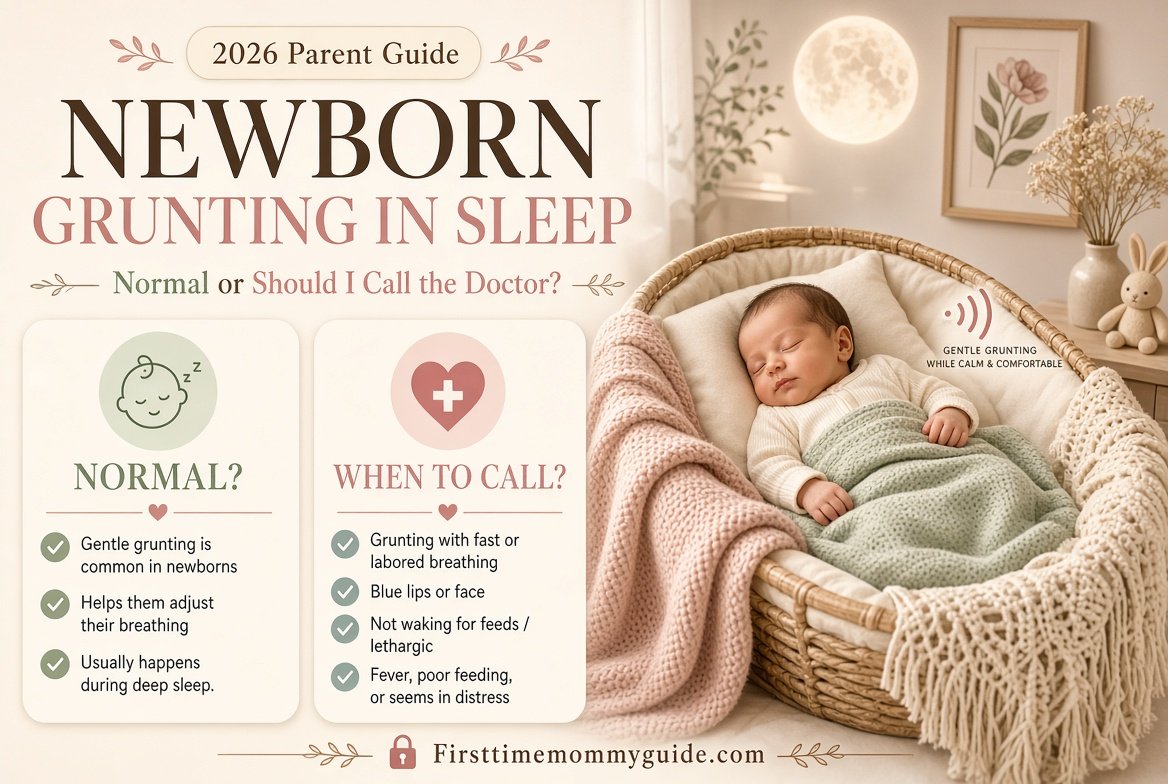
Newborn grunting in sleep is normal in most cases, but a few patterns mean Newborn Grunting in Sleep Normal or Should I Call the Doctor? Occasional grunts with comfortable breathing, normal color, and good feeding are usually harmless, while grunting with every breath, fast breathing, or a blue tint needs medical care right away.
Table of Contents
Newborn Grunting in Sleep Normal or Should I Call the Doctor?

Usually yes. Many healthy newborns grunt, squeak, snort, and squirm while they sleep. It often reflects immature digestion, light sleep, and tiny airways.
Call the doctor when grunting comes with every breath, breathing is faster than 60 breaths per minute, the chest pulls in with each breath, the nostrils flare, the skin looks blue or gray, or your baby has a fever, trouble feeding, or unusual sleepiness.
Call 911 when your baby has blue lips or face, pauses in breathing for 20 seconds or more, or is limp and hard to wake.
Key Takeaways
- Occasional grunting during sleep is common and expected in newborns.
- Normal grunting is brief, comes and goes, and does not affect color or feeding.
- Persistent grunting with each breath is a warning sign of respiratory distress.
- Fast breathing, nostril flaring, chest retractions, and blue skin are red flags.
- Fever of 100.4°F (38°C) or higher in a baby under three months needs urgent care.
- Trust your gut. If something feels wrong, call your pediatrician.
Why Do Newborns Make So Many Noises in Their Sleep?
Newborn sleep is rarely silent. Babies grunt, whimper, sigh, snort, gurgle, and even seem to argue with themselves.
Several normal features of early infancy explain all of that noise.
Newborns Spend a Lot of Time in Active Sleep
Newborns cycle through sleep stages quickly, and they spend a large share of the time in active sleep, the stage similar to REM. During active sleep, babies move, twitch, make faces, and vocalize.
Their sleep cycles are also short, often around 40 to 60 minutes. That means many transitions and many opportunities for noise.
Tiny Airways Make Big Sounds
A newborn’s nose and throat are very narrow. A little mucus or milk residue can turn quiet breathing into snuffles, squeaks, and grunts.
Their nasal passages are so small that even a bit of dried mucus creates sound.
Breathing Muscles Are Still Learning
Newborn lungs and breathing muscles are still practicing. Breathing may look uneven, with fast stretches followed by short pauses.
That pattern has a name, periodic breathing, and it is normal in many newborns.
Digestion Is Still Immature
A baby’s digestive tract is still developing. Gas, milk movement, and bowel activity can cause straining, grunting, and squirming, even during sleep.
Most babies also fall asleep soon after a feed, so digestion is in full swing while they doze.
Babies Have Not Learned to Stay Quiet
Adults learn to keep body sounds quiet while sleeping. Babies have not developed that skill.
They also may simply be exploring their voices, which is why some sounds seem playful rather than distressed.
What Is Grunting Baby Syndrome?
Grunting baby syndrome is a nickname parents use for a common pattern in which a baby grunts, strains, and turns red while trying to pass a stool. The medical term is infant dyschezia.
It sounds dramatic, but it is not a disease.
What Infant Dyschezia Looks Like
- Grunting and straining, often for several minutes.
- Face turning red or purple with effort.
- Squirming, arching, or pulling up the legs.
- Eventually passing soft stool or gas.
- Otherwise a healthy baby who feeds well and gains weight.
Why It Happens
Babies are learning to coordinate the muscles needed for a bowel movement. They tighten their abdomen but may not yet relax the pelvic floor at the same time.
This learning process can take a few weeks to a few months, and it often improves on its own.
How Is It Different From Constipation?
In grunting baby syndrome, the stool is soft when it finally comes. In constipation, stool is hard, dry, or pellet-like, and passing it may be painful.
If your baby has hard stools, blood in the stool, or a swollen belly, talk with your pediatrician.
Does Grunting Baby Syndrome Happen in Sleep?
Yes. Babies often strain during active sleep, and parents hear it clearly at night. A baby may grunt, wriggle, and even pass gas or stool without fully waking up.
Most of the time, you do not need to intervene.
Newborn Grunting and Squirming While Sleeping: Is It Normal?
Yes, grunting and squirming together are extremely common. Many parents notice both during the second half of the night.
Why the Squirming Goes With the Grunting
Active sleep includes twitching, stretching, and leg movements. Gas moving through the intestines adds to the wiggling.
The combination looks uncomfortable but often is not bothering your baby at all.
Does Your Baby Seem Distressed?
Look at the whole picture. A baby who settles again after a moment, stays comfortable, and feeds well is usually fine.
A baby who cries in pain, arches hard, or cannot be calmed needs a closer look.
How Long Does Newborn Grunting Last?
The answer depends on the cause.
| Cause | How Long It Often Lasts |
|---|---|
| Active sleep noises | Often fade as sleep matures, by around 4 to 6 months |
| Grunting baby syndrome (dyschezia) | Weeks to a few months, often improving on its own |
| Gas and digestion | Improves as the gut matures |
| Nasal congestion | Days, or longer with repeated mucus buildup |
| Normal periodic breathing | Usually settles within a few months |
When Do Babies Stop Grunting in Their Sleep?
Sleep cycles become more stable as babies grow, and REM sleep takes up a smaller share of the night. Airways widen, and the digestive system matures.
As a result, most babies become quieter sleepers within the first several months. Some keep making noises longer, which is still normal if they are healthy.
Common Newborn Sleep Sounds and What They Mean
Grunting is only one of many noises. Knowing the others makes every night easier.
Grunting
A short, low sound often linked to digestion, straining, or active sleep. Occasional grunting is normal.
Snuffling and Snorting
These sounds usually come from narrow nasal passages and small amounts of mucus. They often sound worse than they are.
Squeaking and Whistling
Air moving through tiny nostrils can create squeaks or whistles. If your baby is comfortable, this is usually normal.
Persistent whistling when breathing out may need a check, especially if your baby is working hard to breathe.
Gurgling
Gurgles often come from saliva, milk, or gas moving around. They are common after feeds.
Hiccups
Hiccups are normal and often happen after feeding. They do not bother most babies.
Sighing and Deep Breaths
Sighs are common, and some babies take a big breath after a series of fast, shallow ones. This can be part of periodic breathing.
Whimpering and Brief Cries
Some babies whimper or make small crying sounds in active sleep. They often settle without waking.
Snoring
Light snoring can come from congestion. Persistent loud snoring with pauses needs a doctor’s opinion.
Wheezing
Wheezing is a high-pitched whistling sound, usually when breathing out. It is not typical and should be checked by a doctor.
Stridor
Stridor is a harsh, high-pitched sound when breathing in. It can be a sign of an airway problem and needs medical attention.
Understanding Newborn Breathing: What Is Normal?
To judge grunting, you need to know what normal breathing looks like.
Normal Newborn Breathing Rate
Newborns breathe faster than adults. A typical rate is about 40 to 60 breaths per minute when awake. When sleeping, it may drop to around 20 to 40 breaths per minute.
Some sources give a wider healthy range of about 30 to 60 breaths per minute. Rates above 60 at rest are considered too fast.
Breathing Faster When Crying
Babies breathe faster when they are crying or upset. As long as the rate returns to normal after your baby settles, there is usually no concern.
What Is Periodic Breathing?
Periodic breathing is a normal pattern in which a baby takes several quick, shallow breaths and then pauses briefly, often for 5 to 10 seconds. Breathing then starts again on its own.
It can look scary the first time you see it. In a healthy, full-term baby, it is generally normal.
How Long Can a Normal Breathing Pause Last?
Normal pauses in periodic breathing are short, about 5 to 10 seconds. Pauses of 15 to 20 seconds or longer are not normal and need urgent medical attention.
Why Breathing Sounds Irregular
Newborns are still developing the brain control that keeps breathing perfectly regular. That is why rhythm can vary from breath to breath.
Most irregularity settles within a few months.
How to Check Your Newborn’s Breathing at Home
A quick check gives you real information instead of guesses.
Step 1: Wait Until Your Baby Is Calm or Asleep
Crying and movement raise the breathing rate. Count when your baby is quiet.
Step 2: Look at the Chest and Belly
Baby’s belly rises and falls with each breath. That is normal “belly breathing.”
Step 3: Count for a Full Minute
Count breaths for 60 seconds, since newborn breathing is irregular. Counting for only 15 seconds and multiplying may give a false number.
Step 4: Check the Rate
A rate under 60 breaths per minute is generally reassuring. More than 60 at rest is worth a call.
Step 5: Look for Signs of Extra Effort
Watch for nostril flaring, skin pulling in between the ribs or under the ribcage, head bobbing, and a see-saw motion of chest and belly.
Step 6: Check Color
Lips, tongue, and face should look pink. Blue or gray color is an emergency.
Step 7: Listen
Note whether the grunt comes with every breath or only now and then. Persistent, breath-by-breath grunting is a warning sign.
A Tip for Nighttime Checks
Turn on a soft light and keep your voice low. Avoid repeatedly waking your baby, since a healthy baby needs sleep.
Why Newborns Grunt in Sleep: Common Causes Explained
Now let us look at each cause in detail so you can match what you hear to what is happening.
Active Sleep and Sleep Transitions
Babies shift between light and deep sleep more often than adults. During the lighter stage, they grunt, twitch, and move.
You may also notice grunting when a baby is moving from one sleep cycle to the next. Many settle without waking.
Gas and Digestion
Swallowed air during feeds and normal gut activity produce gas. When gas moves through the intestines, a baby may grunt or squirm.
This is very common in the first weeks and usually harmless.
Straining to Pass Stool
Newborns strain when learning to poop. They may grunt, turn red, and draw their legs up, even in sleep.
As long as the stool is soft and your baby feeds well, this is usually normal.
Nasal Congestion
Mucus, dry air, or a small amount of milk residue can block tiny nasal passages. Babies may grunt, snort, or breathe noisily.
Newborns breathe mostly through the nose, so a stuffy nose can be very noticeable.
Reflux and Spit-Up
Many babies bring up small amounts of milk after feeds because the muscle at the top of the stomach is still maturing. Milk moving upward can cause gurgling, grunting, and a cough.
If your baby is happy, gaining weight, and not in pain, reflux is usually not a problem.
Immature Breathing Control
The part of the brain that controls breathing is still developing. This can create irregular rhythm, brief pauses, and noisy breathing.
Being a Newborn in a New World
In the womb, your baby lived in fluid. After birth, the lungs are learning to work with air.
Some early grunts are part of that adjustment.
Overheating or Being Too Cold
Being too hot or too cold can make a baby restless and noisy. Dress your baby in a light layer and keep the room comfortable.
Newborn Grunting After Feeding
Many parents notice grunting shortly after a feed. This is one of the most common times it happens.
Why Grunting Happens After Feeds
Feeding fills the stomach and starts digestion. Air swallowed during a feed can add pressure.
Also, babies often fall asleep right after eating, so the sounds show up in their first sleep cycle.
How to Help
- Burp your baby during and after feeds.
- Keep her upright for 15 to 30 minutes after eating if possible.
- Feed in a calm environment with a good latch or a slow-flow nipple.
- Try paced bottle feeding.
Always place your baby on her back for sleep.
When Grunting After Feeds Needs a Call
Call your pediatrician if grunting comes with forceful vomiting, refusal to feed, poor weight gain, arching in pain, or breathing trouble. Also call if spit-up is green or bloody.
Newborn Grunting and Reflux
Reflux is common in newborns and can sound like grunting or gurgling.
Normal Reflux vs. a Problem
A “happy spitter” spits up but is comfortable, feeds well, and gains weight. This is normal and usually improves with time.
Gastroesophageal reflux disease, often shortened to GERD, involves pain, poor feeding, and poor weight gain.
Signs of Reflux That Need Medical Advice
- Frequent forceful vomiting.
- Refusing feeds.
- Crying or arching during or after feeds.
- Poor weight gain.
- Coughing or choking with feeds.
- Blood in vomit or stool.
Do Not Use Positioners or Wedges
Do not use sleep positioners or inclined sleepers to manage reflux. Follow safe sleep guidance and ask your doctor about safe options.
Newborn Grunting From Gas and Constipation

Gas is a top cause of night noise. It rarely means anything serious.
Signs of Gas
- Passing gas frequently.
- Squirming or drawing up the legs.
- Grunting that eases after burping or passing gas.
- A soft belly.
Safe Ways to Ease Gas
- Burp during and after feeds.
- Try bicycle leg movements while awake.
- Give gentle tummy massage in a clockwise direction.
- Hold your baby upright.
- Offer tummy time while awake and supervised.
Talk to your pediatrician before using gas drops or any medicine.
Signs of True Constipation
Constipation involves hard, dry stools and difficulty passing them. Your baby may cry with bowel movements and may have a firm belly.
Ask your pediatrician for advice before trying any remedies. Do not give water, juice, or laxatives to a newborn without medical guidance.
Newborn Grunting and Nasal Congestion
Stuffy noses are common and can sound dramatic.
Why Newborns Get Stuffy
Their nasal passages are tiny, and they cannot blow their noses. Dry air, milk residue, and normal mucus make noises.
Safe Ways to Help
- Use a cool-mist humidifier and clean it daily.
- Use saline drops as directed by your pediatrician.
- Use a bulb syringe or nasal aspirator gently, and not too often.
- Keep your baby upright when awake.
Avoid over-suctioning, which can irritate the nose.
When Congestion Needs a Call
Call your pediatrician if congestion comes with fever, poor feeding, fast breathing, or signs of labored breathing.
When Newborn Grunting Is Normal: A Checklist
Use this checklist to feel more confident.
Grunting Is Likely Normal If Your Baby
- Grunts occasionally, not with every breath.
- Has pink lips and skin.
- Breathes at a rate of 60 breaths per minute or less.
- Has no nostril flaring or chest retractions.
- Feeds well.
- Has plenty of wet and dirty diapers.
- Wakes easily for feeds.
- Has no fever.
- Settles quickly after grunting.
- Is gaining weight.
A Simple Rule of Thumb
Intermittent noise with comfortable breathing is usually fine. Persistent noise with signs of effort is a problem.
When to Call the Doctor About Newborn Grunting
Now the most important part of this guide. These are the signs that mean grunting is more than normal newborn noise.
Call Your Pediatrician Right Away If
- Your baby grunts with every breath.
- Grunting continues after she wakes up and settles.
- Breathing is faster than 60 breaths per minute at rest.
- The nostrils flare with each breath.
- The skin pulls in between or under the ribs.
- Your baby has a fever of 100.4°F (38°C) or higher and is under three months.
- She feeds poorly or refuses feeds.
- She is unusually sleepy or hard to wake.
- She has wheezing or a harsh noise when breathing in.
- She has a wet, rattling cough.
- She has fewer wet diapers than expected.
- Her belly looks swollen or hard.
- You are worried, even without clear signs.
Call 911 or Go to the Emergency Room If
- Lips, tongue, face, or nails look blue or gray.
- Your baby pauses breathing for 20 seconds or longer.
- She is limp or unresponsive.
- She is struggling hard to breathe.
- She cannot be woken.
- She is choking and cannot cry or breathe.
Do not wait to see if it improves. Emergencies in newborns can progress quickly.
Trust Your Instincts
Parents often sense that something is wrong before they can name it. If your gut says something is off, call the doctor.
Doctors and nurses expect calls from worried parents of newborns. You will not be bothering them.
Signs of Respiratory Distress in Newborns
Respiratory distress means a baby is working harder than normal to breathe. Grunting is one of several signs.
The Key Signs
- Grunting with breathing: A short, low sound heard when your baby breathes out, often with every breath.
- Fast breathing: More than 60 breaths per minute at rest.
- Nasal flaring: The nostrils widen with each breath.
- Chest retractions: The skin sucks in around the ribs, collarbone, or belly with each breath.
- Color changes: Bluish or gray tint on lips, tongue, or skin.
- Head bobbing: The head moves with each breath.
- See-saw breathing: Chest and belly move out of sync.
- Poor feeding: She struggles to eat because breathing takes so much effort.
Why Grunting Happens in Respiratory Distress
A baby who struggles to breathe may close the voice box briefly while breathing out. This helps keep the tiny air sacs in the lungs open.
That sound is the grunt. It is a body signal that the lungs need extra help.
Conditions That Can Cause Respiratory Distress
Doctors consider several causes, including transient tachypnea of the newborn, respiratory distress syndrome, pneumonia, infection, and problems with lung development or the heart.
Viral infections like RSV and bronchiolitis can also cause labored breathing in young babies.
Only a medical professional can tell which cause is at work.
Premature Babies Need Extra Care
Preemies are more likely to have breathing problems. If your baby was born early, ask your doctor what sounds are expected and when to call.
Normal Grunting vs. Concerning Grunting
This table gives a quick comparison.
| Feature | Usually Normal | Call the Doctor |
|---|---|---|
| Frequency | Occasional, comes and goes | With every breath, persistent |
| Breathing rate | 60 or fewer breaths per minute | More than 60 at rest |
| Color | Pink lips and skin | Blue or gray tint |
| Nostrils | Calm | Flaring with breaths |
| Chest | Belly rises and falls smoothly | Skin pulling in around ribs |
| Feeding | Eats well | Poor feeding or refusal |
| Alertness | Wakes easily and settles | Very sleepy, limp, or hard to wake |
| Temperature | Normal | Fever of 100.4°F or higher under three months |
| Sound after waking | Quiets down | Continues while awake |
| Pauses | Short, 5 to 10 seconds | 15 to 20 seconds or longer |
How to Use This Table
If your baby fits the left column, you can usually relax. If any item fits the right column, call your pediatrician.
If the item is serious, such as blue color or long pauses, call 911.
Newborn Grunting With Every Breath: Why It Is Different
Grunting with every breath deserves special attention. It is the most important pattern to recognize.
What It Sounds Like
You hear a short “uh” or “hnn” at the end of each breath. It does not fade when your baby wakes, and it may get worse over time.
Why It Matters
Occasional grunting is a sleep sound. Grunting with each breath is often a sign that your baby’s lungs or airways are under strain.
What to Do
Check breathing rate, color, and effort. Call your pediatrician immediately, or go to the nearest emergency room if your baby looks distressed.
Do not wait until the next day.
Special Note for the First Days of Life
In the first hours after birth, some babies breathe fast and grunt briefly while their lungs clear fluid. Hospital staff watch for this closely.
If it happens after you are home, treat it as a reason to call your doctor.
Newborn Grunting With Fever or Illness
Sleep noises are one thing. Grunting plus signs of illness is another.
Fever in a Newborn
A rectal temperature of 100.4°F (38°C) or higher in a baby under three months old needs urgent medical care. Do not give fever medicine before speaking with a doctor.
Call your pediatrician or go to urgent care immediately.
Signs of a Respiratory Infection
- Fever or unusually low temperature.
- Cough or wheeze.
- Runny nose with fast breathing.
- Poor feeding.
- Unusual sleepiness or irritability.
- Grunting, flaring, or chest retractions.
RSV and Bronchiolitis
RSV is a common virus that can cause bronchiolitis, an infection of the small airways. In young babies, it can cause fast breathing, wheezing, and trouble feeding.
If your baby has cold symptoms and starts to breathe with effort, call your pediatrician right away.
Protecting Your Newborn From Infection
- Wash your hands before touching your baby.
- Ask sick visitors to stay away.
- Limit crowded places in the first weeks.
- Make sure caregivers are up to date on recommended vaccines, as advised by your doctor.
Newborn Grunting and Skin Color
Color is one of the quickest ways to check that your baby is getting enough oxygen.
Normal Color Changes
Newborn hands and feet may look bluish or mottled when cold. This is common and usually improves with warmth.
Skin color may also flush red when a baby strains.
Concerning Color Changes
Blue or gray color on the lips, tongue, face, or the center of the body is not normal. This can signal low oxygen and needs emergency help.
Pale, gray, or ashen skin with weak breathing also needs urgent care.
Check in Good Light
Look at your baby’s lips and tongue in a well-lit room. A dim room can make color hard to judge.
Newborn Grunting and Safe Sleep
Noise in sleep can make you want to change your baby’s position or setup. Stay with proven safe sleep practices.
Safe Sleep Basics
- Place your baby on her back for every sleep.
- Use a firm, flat sleep surface with a fitted sheet.
- Keep the crib or bassinet bare, with no pillows, blankets, bumpers, or toys.
- Room-share without bed-sharing, ideally for at least the first six months.
- Dress your baby in light layers and avoid overheating.
- Do not let your baby sleep on a sofa, armchair, or in a car seat outside of travel.
Do Not Prop Your Baby Up
Do not prop your baby on pillows or use wedges to reduce grunting or reflux. These setups can be dangerous.
Avoid Sleep Products That Claim to Reduce Noise
Products marketed to stop grunting or reflux may not be safe. Ask your pediatrician before using any sleep product.
If Your Baby Sleeps on Her Side or Stomach
If your baby rolls, gently move her to her back if she is still too young to roll on her own reliably. Once she can roll in both directions, you do not need to keep flipping her, but keep the sleep space clear.
Monitors and Your Peace of Mind
Consumer baby monitors that track breathing may reassure some parents, but they do not replace safe sleep practices or medical care. They can also cause false alarms that add stress.
Talk with your pediatrician before relying on any device to monitor health.
Should You Wake a Grunting Newborn?
This is one of the most common worries at night.
If Breathing Looks Comfortable
If your baby is grunting occasionally but breathing comfortably, her color is normal, and she settles, let her sleep. Waking a healthy baby is unnecessary.
If You Are Unsure
Gently check her. Look at her chest, count her breaths, and observe her color. You can lightly touch her to see if she stirs.
If You See Warning Signs
If she shows signs of distress, wake her fully and call your doctor. If she is limp or unresponsive, call 911.
Feeding Schedules in the First Weeks
Young newborns need regular feeds, often every two to three hours. Your pediatrician may advise waking your baby for feeds until she is back to birth weight.
Follow their guidance for your baby.
How to Soothe a Grunting Newborn Safely
Most of the time, you do not need to do anything. Still, there are gentle ways to help if your baby seems uncomfortable.
Burp Well
Burp after each feed and again if she seems gassy. A good burp can prevent much of the night grunting.
Try Gentle Motion
Hold your baby upright against your shoulder and pat her back. Swaying slowly may help her settle.
Tummy Massage and Leg Movements
While your baby is awake, gently rub her belly in clockwise circles. Bicycle her legs slowly.
Skin-to-Skin Contact
Holding your baby against your bare chest can calm her breathing and help her relax. Stay awake and alert while holding her.
Warm Bath Before Bed
A warm bath can relax your baby. Keep the water comfortably warm, never hot, and never leave her alone.
Swaddling Safely
A swaddle can help some babies sleep better. Wrap the arms and chest but leave room for the hips and legs. Stop when she starts trying to roll.
Keep the Room Comfortable
A room that is too hot can make your baby restless. Dress her lightly and keep the room at a comfortable temperature.
Use a Humidifier If Air Is Dry
A clean cool-mist humidifier may ease dry nasal passages. Clean it daily to prevent mold.
Do Not Overreact
Rushing to pick up your baby at every grunt may wake her and disrupt sleep. Give her a moment to settle first.
Newborn Grunting vs. Other Sleep Concerns
Different problems can look alike at night. Here is how to tell them apart.
Grunting vs. Snoring
Snoring is a rhythmic, low-pitched sound from the nose or throat. It often comes from congestion.
Grunting is short and comes at the end of a breath. If loud snoring has pauses or gasping, tell your doctor.
Grunting vs. Wheezing
Wheezing is a whistling or musical sound, usually when breathing out. It can signal narrowed airways and needs a doctor’s check.
Grunting vs. Stridor
Stridor is a harsh, squeaky sound when breathing in. It suggests a narrowed upper airway and needs prompt evaluation.
Grunting vs. Crying in Sleep
Crying in sleep is a normal part of active sleep. Babies often resettle on their own.
If your baby wakes crying and cannot be consoled, check for hunger, diaper, or discomfort.
Grunting vs. Sleep Apnea
Sleep apnea in newborns is rare. Signs include long pauses in breathing, gasping, color change, and unusual sleepiness.
If you see pauses of 15 to 20 seconds or more, seek medical care.
When Grunting Is a Sign of Something Else
A few conditions can include grunting among their symptoms. Only a doctor can diagnose them.
Transient Tachypnea of the Newborn
This is a common breathing problem soon after birth. Extra lung fluid leads to fast breathing and sometimes grunting. It often improves within a few days with medical care.
Respiratory Distress Syndrome
More common in premature babies, this condition happens when the lungs lack a substance that keeps the air sacs open. It needs hospital care.
Pneumonia and Infection
Lung infections can cause fast breathing, grunting, fever, and poor feeding. Newborns can become sick quickly.
Heart Conditions
Some heart problems show up as fast breathing, poor feeding, and color changes. Newborn screening helps catch some of them early.
Meconium Aspiration
This happens when a baby inhales meconium around the time of birth. It is usually recognized in the hospital.
Other Causes
Airway problems, sepsis, and other conditions can also cause respiratory distress. Symptoms depend on the cause.
Why This List Matters
You do not need to memorize these conditions. You only need to know that persistent grunting with breathing effort is a reason to seek care, so a doctor can find the cause.
Special Situations: Premature Babies, C-Section Babies, and Twins

Some babies have different risks.
Premature Babies
Preemies have immature lungs and breathing control. They may have more irregular breathing and pauses.
Ask your neonatal team what is normal for your baby and when to call.
Babies Born by C-Section
Babies born by cesarean delivery may have more lung fluid at first, which can cause early fast breathing and grunting. Most settle within a day or two.
Twins and Multiples
Twins are more likely to be born early and to be smaller. Each baby may have different sleep sounds and different needs.
Check each baby separately.
Babies With Medical Conditions
If your baby has a heart or lung condition, follow your medical team’s advice about monitoring and calling.
What to Tell the Doctor When You Call
Clear information helps a nurse or doctor assess your baby quickly.
Details to Share
- Your baby’s age.
- Whether she was born full-term or early.
- How often she grunts and when it started.
- Whether it happens with every breath.
- Her breathing rate over a full minute.
- Any nostril flaring or chest retractions.
- Skin and lip color.
- Temperature, taken rectally if she is under three months.
- Feeding and diaper output.
- Any cough, congestion, or vomiting.
- Exposure to sick contacts.
If You Can, Record a Short Video
A short video of your baby’s breathing can help the doctor see what you see. Record with the chest and belly visible.
Do not delay care to take a video if your baby looks in distress.
Write Down Questions
Keep a list handy so you do not forget anything during the call or visit.
Parent Anxiety About Newborn Sleep Noises
Worry is part of new parenthood. Listening to every breath at night is very common.
Why It Feels So Scary
Newborn babies are tiny and fragile. Their sounds, pauses, and movements can seem alarming compared with the quiet sleep you expected.
Your protective instincts are working. That is a good sign, not a flaw.
Ways to Feel More at Ease
- Learn the normal sounds and warning signs.
- Do a calm breathing check and then rest.
- Avoid searching online in the middle of the night, which often increases fear.
- Keep your pediatrician’s after-hours number handy.
- Share nighttime checks with your partner when possible.
When Anxiety Becomes Too Much
If you cannot sleep, keep checking your baby many times, or feel constant dread, talk to your doctor. Postpartum anxiety is common and treatable.
Symptoms that last more than two weeks or affect your ability to function deserve attention.
Get Rest When You Can
Sleep deprivation makes worry louder. Ask a partner or helper to take a shift so you can sleep.
Newborn Grunting: Myths vs. Facts
Misinformation makes worry worse. Here are common myths.
Myth: A Quiet Baby Is a Healthy Baby
Fact: Newborns are noisy sleepers. Silence is not always a sign of health, and noise is not always a sign of illness.
Myth: Grunting Means Your Baby Is in Pain
Fact: Many grunts are just part of active sleep and digestion. Most babies are not bothered by them.
Myth: Grunting Means Constipation
Fact: Straining and grunting are common even with soft stools. True constipation involves hard stools.
Myth: You Should Wake Your Baby Every Time She Grunts
Fact: If breathing looks comfortable and she settles, let her sleep.
Myth: Propping Your Baby Up Stops Grunting
Fact: Propping is not safe for sleep. Follow safe sleep guidance instead.
Myth: Grunting Means a Serious Lung Problem
Fact: Occasional grunting is usually normal. It is persistent grunting with breathing effort that raises concern.
Myth: You Can Ignore Grunting Because It Is Always Normal
Fact: Most grunting is harmless, but grunting with every breath, fast breathing, or color change needs care.
Mistakes to Avoid When Your Newborn Grunts in Sleep
A few common missteps can make things worse.
Ignoring Warning Signs
Do not dismiss fast breathing, chest retractions, or color changes. These need prompt care.
Overreacting to Normal Noise
Picking up your baby at every grunt may disturb her sleep and increase your stress.
Using Unsafe Sleep Setups
Pillows, wedges, and soft bedding raise the risk of suffocation. Keep the sleep space clear.
Giving Medicine Without Advice
Do not give gas drops, herbal remedies, or fever reducers to a newborn without talking to a doctor.
Waiting Too Long to Call
If you are worried, call. Newborns can worsen quickly.
Relying on Apps or Devices Alone
Monitors and apps are not medical devices for diagnosing problems. Do not let them replace observation and medical advice.
Comparing With Other Babies
Every baby has a different sound. Your baby’s normal may not match someone else’s.
Real-Life Examples of Newborn Grunting
These examples show what normal and concerning patterns can look like. They are not medical cases.
The Noisy Sleeper
A three-week-old grunts, squirms, and snorts through most of the night. She wakes to feed, has plenty of diapers, and is gaining weight.
Her parents count her breaths at 48 per minute with no flaring and normal color. Her pediatrician confirms it is normal newborn noise.
The Strainer
A five-week-old turns red and grunts for several minutes before passing soft stool. She is happy afterward and feeds well.
This is a classic case of infant dyschezia. Her parents keep track and continue as usual.
The Baby Who Needed Help
A two-week-old begins grunting with every breath after a cold in the house. Her nostrils flare, and her chest pulls in between the ribs.
Her parents call the doctor right away and are told to go to the emergency room. She is treated and recovers.
What These Examples Show
The difference is not the presence of grunting. It is the pattern, the effort, and the extra signs.
Week-by-Week Guide: What to Expect With Newborn Sleep Sounds
Sleep noise changes as babies grow.
First Week
Babies adjust to life outside the womb. Fast, irregular breathing and grunts can occur, especially in the first hours and days.
Hospital staff monitor breathing closely.
Weeks 2 to 4
Digestion and gas become more noticeable. Grunting baby syndrome may show up. Congestion is common.
Weeks 5 to 8
Sleep noises often continue. Some babies become more active in sleep. Gas may peak, and evening fussiness may add noise.
Weeks 9 to 12
Sleep cycles lengthen a little. Grunting and straining often lessen as the digestive system matures.
3 to 4 Months
Many babies are quieter sleepers. Breathing patterns become more regular.
4 to 6 Months
Sleep noise usually settles further. REM sleep takes up a smaller share of the night.
Beyond 6 Months
Most babies sleep more quietly. Occasional sounds remain normal.
Newborn Grunting FAQ Snapshot: What Every Parent Should Remember
Here is a short summary you can return to at 3 a.m.
The Five Questions to Ask
- Is she grunting with every breath?
- Is she breathing faster than 60 breaths per minute?
- Is her color pink and healthy?
- Are her nostrils and chest calm?
- Is she feeding and waking normally?
How to Interpret Your Answers
If the answer to the first four is no and the last is yes, this is probably normal sleep noise. If any answer points to a problem, call your doctor.
If your baby is blue, limp, or not breathing normally, call 911.
Building a Nighttime Plan for Noisy Sleepers
A little structure calms both you and your baby.
Before Bed
- Feed and burp thoroughly.
- Change the diaper.
- Dress your baby in a light layer.
- Set up a bare, safe sleep space.
- Keep the room comfortably cool.
During the Night
- Give her a moment to settle when she grunts.
- Check her breathing if you are concerned.
- Feed on demand and burp again.
- Keep lights dim and voices soft.
When You Are Worried
- Turn on a soft light.
- Look at her color and breathing.
- Count breaths for a full minute.
- Call your doctor if warning signs appear.
In the Morning
Note anything unusual and share it with your pediatrician at the next visit. A short log can help spot patterns.
Preparing for Your Pediatrician Visit About Grunting
A visit can settle your questions.
Questions to Ask
- Is my baby’s breathing pattern normal?
- Should I be doing anything for gas or congestion?
- What signs mean I should call after hours?
- Should I check for reflux or constipation?
- Are there safe products for stuffy noses?
What to Bring
- A short log of grunting episodes.
- Notes on feeding and diapers.
- A video of your baby’s breathing if you have one.
- A list of questions.
Follow-Up Visits
Regular well-baby visits track growth and development. They are a good time to raise any ongoing concerns.
Understanding Active Sleep vs. Deep Sleep in Newborns
Knowing the two main sleep stages makes the noises easier to understand.
What Active Sleep Looks Like
In active sleep, your baby’s eyes may move under the lids. Her breathing can be fast and uneven, and her arms and legs may twitch.
She may grunt, whimper, smile, or make sucking motions. These are all signs of a brain that is busy developing.
What Deep Sleep Looks Like
In deep sleep, your baby is still and quiet. Her breathing is slow and regular, and she barely moves.
Newborns have less deep sleep than older children and adults, which is why they seem so restless.
Why This Matters for Grunting
Most harmless grunts happen during active sleep. If your baby grunts and squirms but her breathing is comfortable, you are probably watching normal active sleep.
If she grunts with every breath even when she seems to be in a quiet stage, that pattern deserves attention.
How Long Do Cycles Last?
Newborn sleep cycles last about 40 to 60 minutes. Babies often wake or stir between cycles, which is a common moment for noise.
Cycles slowly lengthen as your baby grows.
Newborn Grunting in the Hospital and the First Days at Home
The first hours and days of life are a special time for breathing sounds.
Grunting Right After Birth
Some babies grunt briefly after birth while their lungs clear fluid and adjust to air. Nurses watch breathing rate, color, and effort closely during this time.
If grunting continues or gets worse, the medical team will check your baby further.
Ask Questions Before You Leave the Hospital
Before you go home, ask the nurse or doctor what sounds are normal for your baby. Ask when to call and what to do in an emergency.
Write down the after-hours phone number and keep it where you can find it at night.
The First Night at Home
The first night home is often the loudest for a parent’s worry. Every sound seems new, and you may not sleep.
Take turns with your partner if you can. Remember that the hospital sent you home because your baby is stable.
Newborn Grunting While Awake vs. Asleep
Where and when your baby grunts can offer clues.
Grunting While Awake
Awake grunting can happen during bowel movements, when your baby stretches, or when she is exploring her voice. It is often normal.
Grunting with fast breathing, poor feeding, or color changes when awake is more concerning.
Grunting During Diaper Changes
Lying flat can shift gas or trigger a bowel movement. Many babies grunt during or right after a diaper change.
Grunting While Feeding
Some babies grunt while nursing or drinking a bottle, especially with a fast flow. If your baby chokes, coughs, or struggles to breathe during feeds, tell your pediatrician.
Grunting While Waking Up
Many babies grunt while stretching as they wake. It usually passes in a few moments.
Newborn Grunting and Feeding Method
Feeding may influence how much your baby grunts.
Breastfed Babies
Breastfed babies often feed frequently and may swallow air with a fast let-down. Burping and a comfortable position help.
If your baby gulps or coughs during let-down, a laid-back nursing position can slow the flow.
Formula-Fed Babies
Formula-fed babies can also swallow air, especially with a fast-flow nipple. Paced bottle feeding lowers the amount of air taken in.
If you think formula might be bothering your baby, talk with your pediatrician before changing anything.
Overfeeding
A baby who is fed too much or too fast may spit up and become gassy. Follow hunger and fullness cues rather than a strict amount.
Signs of fullness include turning away, slowing down, and relaxed hands.
Growth Spurts
Growth spurts bring extra feeds and more gas. You may hear more grunting for a few days.
Newborn Grunting in a Car Seat, Swing, or Bouncer
Some seats can affect breathing, especially in young babies.
Car Seats
A car seat is for travel. A newborn who sleeps in a car seat outside a moving car may slump, which can narrow the airway.
Take your baby out of the seat as soon as you arrive, and check that the harness fits properly during rides.
Swings and Bouncers
Swings and bouncers are not safe for unsupervised sleep. If your baby falls asleep in one, move her to a firm, flat surface.
Inclined Products
Avoid inclined sleepers and any product that holds your baby at an angle for sleep. Follow current safe sleep guidance.
Babywearing
If your baby sleeps in a carrier, keep her face visible, her chin off her chest, and her airway clear. Check her often.
Newborn Grunting and Overheating
A baby who is too warm may be restless, sweaty, and noisy.
Signs Your Baby Is Too Warm
- Flushed face.
- Sweaty neck or chest.
- Fast breathing.
- Fussiness.
How to Prevent Overheating
- Dress her in a single light layer plus a sleep sack if needed.
- Skip hats and heavy blankets indoors during sleep.
- Keep the room at a comfortable temperature.
Overheating is also a risk factor for sudden infant death syndrome, so it deserves attention.
How Doctors Evaluate Newborn Grunting
If you call or visit for grunting, here is what may happen.
The Phone Call
A nurse will ask about your baby’s age, breathing, color, feeding, and temperature. Based on your answers, they may tell you to come in, go to the emergency room, or watch at home.
The Physical Exam
The doctor checks breathing rate, effort, color, heart and lung sounds, temperature, and hydration. They will also weigh your baby and review feeding.
Tests
If needed, the doctor may order a pulse oximetry check, which measures oxygen levels with a small sensor. They may also order a chest X-ray, blood tests, or other tests depending on the situation.
Treatment
Treatment depends on the cause. Some babies only need reassurance and observation. Others need oxygen, fluids, or medication in the hospital.
Follow-Up
If your baby is sent home, you will get guidance on warning signs and follow-up visits. Follow the plan carefully.
What Parents Can Expect When Grunting Is Normal
If your doctor confirms that your baby’s noises are normal, here is what the coming weeks may look like.
Sounds May Continue for a While
Many babies stay noisy for weeks or months. This does not mean something is wrong.
Keep Watching the Pattern
Notice any changes, such as more grunting, new symptoms, or poor feeding. Report changes to your pediatrician.
Keep Up With Well-Baby Visits
Regular checkups track growth, feeding, and development. They are a good time to ask about sounds you are unsure about.
Enjoy the Little Sounds
Newborn noises fade quickly. Many parents later miss the snuffles and squeaks.
Room-Sharing With a Noisy Newborn: Tips for Better Sleep
Room-sharing is recommended for safety, but a noisy baby can keep you awake.
Use White Noise Carefully
A white noise machine can mask small sounds for you and help your baby sleep. Keep the volume low and the machine several feet from the crib.
Learn Your Baby’s Normal Sounds
After a few nights, you will recognize her usual noises. Your brain will start to tune them out while staying alert to changes.
Take Turns With Your Partner
If your partner is also home, alternate nights or shifts. One of you should sleep in a quiet room when possible.
Sleep When Your Baby Sleeps
Rest during the day if you can. Even short naps help.
Keep a Small Light Ready
A dim nightlight lets you check your baby without fully waking her or yourself.
Do Not Move the Baby to Another Room Too Early
Room-sharing is recommended for at least the first six months. Do not move your baby to a separate room because of noise.
Your Newborn Grunting Cheat Sheet
Keep this handy for late nights.
| Situation | What It Often Means | What to Do |
|---|---|---|
| Occasional grunts, comfortable breathing | Active sleep or gas | Let her settle, burp after feeds |
| Grunts with straining and red face | Infant dyschezia | Watch, soft stool is normal |
| Snorts and squeaks | Nasal congestion | Saline and humidifier as advised |
| Gurgling after feeds | Milk or saliva movement | Keep upright, burp |
| Grunting with every breath | Possible respiratory distress | Call doctor immediately |
| Fast breathing over 60 per minute | Possible respiratory distress | Call doctor immediately |
| Blue or gray color | Low oxygen | Call 911 |
| Pause 20 seconds or longer | Possible apnea | Call 911 |
| Fever 100.4°F or higher under three months | Possible infection | Urgent medical care |
| Poor feeding with noisy breathing | Possible illness | Call doctor promptly |
Emergency Plan: What to Do If Your Newborn Struggles to Breathe
Having a plan before you need it lowers panic if something goes wrong.
Step 1: Stay Calm and Act Fast
Take one slow breath, then focus on your baby. Speed matters more than perfection.
Step 2: Check Responsiveness and Breathing
Look at her chest, listen for breath sounds, and check her color. Gently stimulate her by rubbing her back or tapping her feet.
Step 3: Call 911 if She Is Blue, Limp, or Not Breathing Normally
Put the phone on speaker so you can follow the dispatcher’s instructions while you care for your baby. Give your address clearly.
Step 4: Follow the Dispatcher’s Guidance
Dispatchers can talk you through infant CPR or choking rescue if needed. Stay on the line until help arrives.
Step 5: Do Not Drive Alone if Your Baby Is in Severe Distress
If your baby is in severe distress, an ambulance is usually safer than driving alone. If you must drive, bring another adult to watch your baby.
Step 6: Bring Information
Bring your baby’s birth details, feeding schedule, and a list of symptoms. Tell the team when the grunting started and what else you noticed.
Be Prepared: Simple Steps Every New Parent Can Take
A few preparations give you confidence.
Learn Infant CPR and Choking Rescue
Take a class through a hospital, the American Red Cross, or the American Heart Association. Many classes are short and offer hands-on practice.
Encourage partners, grandparents, and babysitters to take one too.
Keep Key Numbers Handy
Save your pediatrician, the after-hours nurse line, poison control, and emergency numbers in your phone. Post them on the fridge too.
Know Your Nearest Emergency Room
Find the closest hospital with pediatric care. Know the route so you do not need to search in a panic.
Have a Thermometer Ready
Keep a digital thermometer at home and know how to take a rectal temperature. Practice before you need it.
Keep a Simple Baby Log
Write down feeds, diapers, and any symptoms. It helps you spot changes and gives your doctor useful facts.
Line Up Backup
Know who you would call if you need to go to the hospital at night, whether for a ride or to watch other children.
A Gentle Reminder for Worried Parents
If you have read this far, you clearly care a great deal about your baby. That care is what keeps babies safe.
You Do Not Have to Be a Doctor
You only need to notice patterns, check a few signs, and ask for help when something seems off. Medical professionals are there to do the rest.
Most Newborn Noises Are Harmless
Most of the grunts, squeaks, and snorts you hear are simply part of being a newborn. They are the sounds of a baby growing.
It Is Okay to Call More Than Once
If your worry returns after a call, call again. Nurses and doctors would rather hear from you than miss something.
Take Care of Yourself Too
Eat, drink, and rest whenever you can. A rested parent notices more and worries less.
Trusted Sources for Newborn Breathing and Sleep Guidance
Good information supports good decisions. Reliable places to check include:
- American Academy of Pediatrics (HealthyChildren.org)
- Centers for Disease Control and Prevention
- KidsHealth from Nemours
- Safe to Sleep campaign from the National Institute of Child Health and Human Development
- American Academy of Family Physicians
- Your baby’s pediatrician
Guidance can change, so confirm important decisions with your own healthcare team.
Frequently Asked Questions (FAQs)
Is newborn grunting in sleep normal?
Yes, in most cases. Occasional grunting during sleep is common and usually reflects active sleep, digestion, and tiny airways. It is normal when your baby breathes comfortably, has good color, and feeds well.
When should I call the doctor about newborn grunting?
Call if your baby grunts with every breath, breathes faster than 60 breaths per minute, has nostril flaring or chest retractions, or has a fever of 100.4°F or higher under three months. Also call for poor feeding or unusual sleepiness.
When is newborn grunting an emergency?
Call 911 if your baby has blue or gray lips or skin, pauses breathing for 20 seconds or longer, is limp, or struggles hard to breathe.
Why does my newborn grunt so much in her sleep?
Newborns spend a lot of time in active sleep, have tiny airways, and have immature digestion and breathing control. These factors combine to create many noises.
What is grunting baby syndrome?
It is a nickname for infant dyschezia, when a baby strains and grunts while learning to pass stool. The stool is soft, and the baby is otherwise healthy.
How long does grunting baby syndrome last?
It often improves within weeks to a few months as the baby learns to coordinate her muscles. Ask your pediatrician if it continues or worries you.
Is it normal for a newborn to grunt and squirm all night?
Some grunting and squirming are normal, especially in active sleep. If your baby seems in pain, cannot settle, or shows breathing effort, call your doctor.
Is grunting with every breath normal?
No. Grunting with each breath is a warning sign of respiratory distress and needs prompt medical attention.
How fast should a newborn breathe?
A typical newborn breathes about 40 to 60 breaths per minute when awake, and slower when asleep. More than 60 at rest is too fast.
What is periodic breathing?
It is a normal pattern in which a newborn takes several rapid breaths followed by a brief pause, often 5 to 10 seconds, before breathing resumes.
How long can a newborn stop breathing normally?
Normal pauses are short, about 5 to 10 seconds. Pauses of 15 to 20 seconds or longer need urgent medical attention.
Why does my newborn grunt after feeding?
Feeding fills the stomach and triggers digestion, and swallowed air can add pressure. Burping and keeping your baby upright afterward often help.
Can gas cause newborn grunting in sleep?
Yes. Gas moving through the intestines can cause grunting and squirming. It is common and usually harmless.
Can reflux cause grunting in sleep?
Yes, milk moving upward can cause gurgling and grunting. If your baby is comfortable and gaining weight, reflux is usually not a problem.
Can nasal congestion cause grunting?
Yes. Newborns breathe through their noses, and tiny passages can create snorts and grunts. A cool-mist humidifier and saline drops as advised by your doctor may help.
Should I wake my baby if she is grunting?
If breathing looks comfortable and she settles, let her sleep. Wake her and call your doctor if you see signs of distress or long pauses.
How can I tell if my baby is struggling to breathe?
Watch for fast breathing, nostril flaring, chest retractions, persistent grunting, head bobbing, and blue or gray color. Any of these needs medical care.
What color should my newborn’s lips be?
Pink. Blue or gray lips, tongue, or face is an emergency.
Is grunting a sign of RSV?
It can be. RSV and bronchiolitis may cause fast breathing, wheezing, and grunting along with cold symptoms. Call your pediatrician if your baby has these signs.
Can I give my baby gas drops for grunting?
Talk to your pediatrician first. Do not give medicine, herbs, or drops to a newborn without medical advice.
Is it safe to prop my baby up to stop grunting?
No. Propping and wedges are not safe for sleep. Place your baby flat on her back on a firm surface.
Do premature babies grunt more?
Preemies may have more irregular breathing and noise because their lungs and breathing control are less mature. Ask your neonatal team what is normal for your baby.
When do babies stop grunting in their sleep?
Many babies become quieter by 3 to 6 months as sleep cycles mature and airways grow. Some noises can continue longer and still be normal.
Can a newborn grunt from being too hot?
Overheating can make a baby restless and noisy. Dress her lightly and keep the room comfortable.
What should I do if I am not sure whether grunting is normal?
Count her breaths for a full minute, check her color, and look for extra effort. If you are unsure or worried, call your pediatrician or nurse line.
Conclusion
Newborn grunting in sleep is normal in most cases, and it is usually caused by active sleep, gas, tiny airways, and a digestive system that is still learning. If your baby grunts now and then, breathes comfortably, has healthy color, and feeds well, you can relax.
Call your doctor when grunting comes with every breath, breathing is faster than 60 breaths per minute, the nostrils flare, or the chest pulls in with each breath. Also call for fever in a baby under three months, poor feeding, or unusual sleepiness.
Call 911 for blue or gray skin, long pauses in breathing, or a limp, unresponsive baby.
Keep the sleep space safe, count breaths when you are unsure, and trust your instincts. No one knows your baby better than you do, and no pediatrician will mind a call from a worried parent.
Most noisy sleepers grow into quiet ones within a few months. Until then, learn the sounds, know the warning signs, and rest when you can.

Dilawar Mughal
Founder and editor, First Time Mommy Guide
I research every guide against what the NHS, the AAP and the WHO publish, then write it in plain English — because most new parents are reading with one hand free, not comparing clinical guidelines. I'm not a doctor or a midwife. Every health claim on this site is sourced and linked so you can check it yourself, and anything urgent belongs with your health visitor or GP, not a blog.