
General information, not medical advice. Every baby is different — if anything worries you, speak to your midwife, health visitor or GP rather than waiting.
Rolling over is your baby's first real taste of freedom. Until now, wherever you put them down is where they stay. The first time they roll from tummy to back — or, more impressively, from back to tummy — the whole world opens up. They can reach the toy that was just out of range. They can change their own view. And they have taken the first step toward crawling, sitting, and walking.
For a first-time mum, the wait for that first roll can feel long. You watch other babies in your group flip over and wonder whether you should be doing more. The good news is that rolling over is a skill your baby is already practising every time they spend time on the floor — and there are simple, playful ways to help it along.
This guide covers when babies usually roll over, the stages that lead up to it, practical exercises and games that build rolling strength, what to do if your baby is not rolling yet, and the safety rules that change the moment your baby can roll.
Quick answer: Most babies learn to roll over between 4 and 6 months — usually from tummy to back first (around 4 months), then from back to tummy (around 5–6 months). You can help with daily tummy time, reaching games, side-lying play, and gentle assisted rolls. If your baby is not rolling by 6–7 months, or shows no interest in moving, mention it to your health visitor or paediatrician.
When Do Babies Roll Over?
Most babies roll over for the first time between 4 and 6 months. The usual order is:
- Tummy to back (around 4 months). This direction is easier, because it uses gravity and the arm strength your baby has already built during tummy time. Many babies roll from tummy to back almost by accident the first time — they push up, tip sideways, and flop onto their back.
- Back to tummy (around 5–6 months). This direction is harder. Your baby must lift their legs, twist their body, and push with their arms. It takes more coordination and core strength, so it usually comes a few weeks later.
By 6 months, most babies can roll both ways. By 7 months, most roll easily and use rolling as their main way of getting around the floor.
The CDC lists rolling over in both directions as a key milestone for babies around 6 months. HealthyChildren.org (AAP) describes the same window and notes that rolling usually comes before sitting and crawling.
The normal range is wide
Some babies roll at 3 months. Others take until 7 months. Both can be completely normal. A baby who is a little slow to roll but is making progress in other areas — holding their head up, reaching for toys, babbling, smiling — is usually just taking their own path. What matters is steady progress, not the exact date.
Premature babies may roll later. Use their adjusted age (counted from their due date) when judging milestones. A baby born 6 weeks early who rolls at 6 months after birth is really 4.5 months adjusted — right on track.
Why Rolling Over Matters
Rolling is not just a cute trick. It is a foundational motor skill that unlocks several areas of development:
- It is the first independent movement. Before rolling, your baby depends on you to change their position. Rolling gives them control over their own body for the first time.
- It builds the muscles for sitting and crawling. Rolling uses the neck, shoulders, core, and hips — the same muscles your baby needs to sit up and crawl. Our guide to when babies start crawling explains what comes next, and our baby milestones at 6 months guide covers the skills that arrive around the sitting window.
- It develops coordination. Rolling requires both sides of the body to work together, which builds the brain connections needed for later skills like crawling and walking.
- It changes how your baby sees the world. A baby who can roll can choose what to look at, reach a toy, and explore their surroundings. This drives curiosity and learning.
- It is a safety milestone. Once your baby can roll, they can also roll in their sleep, which is why safe sleep guidance changes at this stage (see the safety section below).
The Stages of Learning to Roll Over
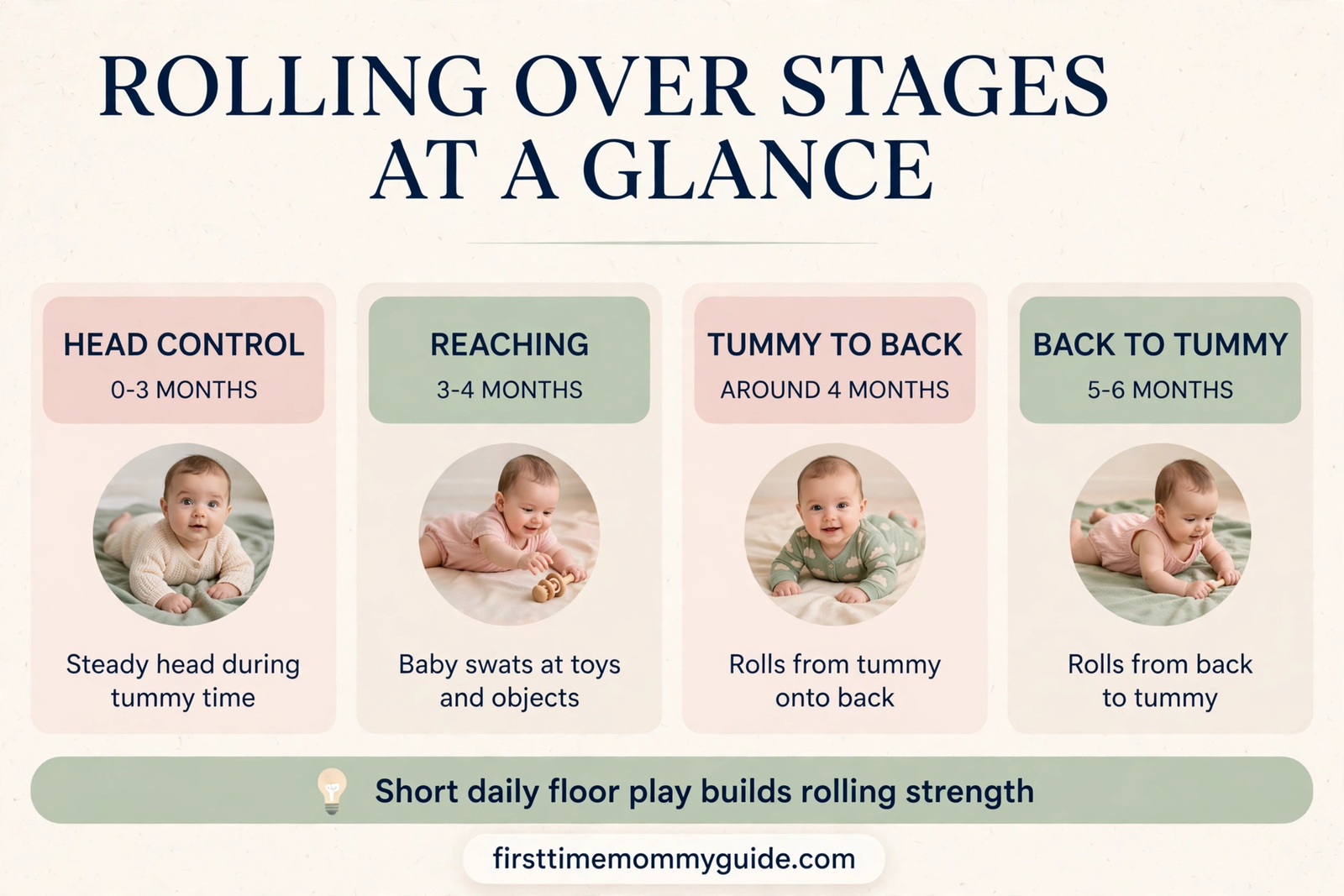
Rolling does not happen all at once. It builds through a series of smaller skills:
Stage 1: Head control and tummy time strength (0–3 months)
Your baby learns to lift their head during tummy time and hold it steady. They push up on their forearms and begin to bear weight through their arms. This is the foundation of everything that follows.
Stage 2: Reaching and weight shifting (3–4 months)
Your baby starts reaching for toys while on their tummy. Reaching to one side shifts their weight, and that weight shift is the beginning of a roll. They also start to bring their hands together, kick their legs, and twist their body.
Stage 3: Rolling to the side (4 months)
Your baby rolls onto their side, often while reaching for a toy. They may get stuck on their side and need help getting back, or they may complete the roll. Side-lying is a valuable stage — it teaches your baby how their body moves through space.
Stage 4: Tummy to back (around 4 months)
The first full roll. Your baby pushes up on their arms during tummy time, tips to one side, and lands on their back. The first time is often accidental. Within days or weeks, it becomes deliberate.
Stage 5: Back to tummy (5–6 months)
Your baby lifts their legs, twists their hips, and pushes with their arms to roll from their back onto their tummy. This is the harder direction and usually comes second.
Stage 6: Rolling both ways, on purpose (6–7 months)
Your baby rolls smoothly in both directions, uses rolling to get to toys, and rolls as a way of moving around the room. Rolling becomes a tool, not just a trick.
Our guide to when do infants roll from tummy to back covers the first direction in more detail, including what it looks like and when to expect it.
How to Help Your Baby Learn to Roll Over: 10 Practical Activities
You cannot force a roll, but you can create many small opportunities for your baby to discover it. The best activities are playful, short, and part of ordinary days.
1. Daily tummy time — the single most important activity
Tummy time builds the neck, shoulder, arm, and core strength that rolling depends on. The AAP recommends starting tummy time from the first days at home and building up to 15–30 minutes total per day by 2–3 months, spread across short sessions.
Tips to make tummy time work:
- Start with 2–3 minutes and build up gradually.
- Place a toy or mirror just out of reach to encourage lifting and reaching.
- Get on the floor face to face — your face is the best motivation.
- Try tummy time on your chest or across your lap if your baby dislikes the floor.
- Keep sessions short and positive. A few happy minutes beat a long unhappy session.
Our tummy time guide for babies has a full week-by-week plan and ideas for babies who hate tummy time.
2. The toy-to-the-side game
Place your baby on their tummy. Put a favourite toy just to one side, slightly out of reach. Your baby will reach for it, shift their weight to one side, and may tip over onto their back — the first roll. Repeat on both sides so both directions get practised.
3. Side-lying play
Place your baby on their side, supported by a rolled towel behind their back if needed. Put a toy in front of them at eye level. Side-lying is a comfortable middle position between back and tummy, and it teaches your baby the weight shift that rolling requires. It is also a lovely position for play and interaction.
4. Gentle assisted rolls
With your baby on their back, gently guide one leg across the body while supporting the shoulder, helping them roll onto their tummy. Go slowly, let your baby feel the movement, and let them do as much of the work as they can. This teaches the movement pattern. Never force a roll or pull on your baby's arms.
5. The leg-lift game
While your baby is on their back, encourage them to lift their legs and grab their feet. This strengthens the abdominal muscles used for rolling from back to tummy. Sing a song, tickle their feet, and make it a game. Babies who discover their feet are on the path to rolling.
6. Reach across the body
Place a toy on one side of your baby while they are on their back, so they must reach across their body to grab it. Reaching across the midline encourages the twist that starts a roll. This is also excellent for brain development, because it builds connections between the two sides of the body.
7. Tummy time with a rolled towel
Place a small rolled towel under your baby's chest during tummy time. The slight elevation makes it easier to lift the head and reach for toys, and it helps babies who find tummy time hard. Remove the towel as your baby gets stronger.
8. Mirror play
Prop a baby-safe mirror in front of your baby during tummy time. Babies are fascinated by their own reflection, and they will lift their head, reach, and shift their weight to see it better. The mirror is a powerful motivator for movement.
9. Change the scenery
Move the play mat to different rooms. Put your baby on the floor in the garden (on a blanket, in the shade). New surroundings spark curiosity, and a curious baby moves more. Even a change of view from the same room can encourage reaching and rolling.
10. Floor time, not container time
Babies build rolling strength by moving freely on the floor. Time in bouncers, swings, car seats, and activity centres does not build the same muscles. The AAP and paediatric physiotherapists recommend limiting container time and prioritising supervised floor play. A good rule: for every hour in a seat or container, aim for at least as much free floor time.
A Simple Daily Routine for Rolling Practice
You do not need a formal programme. A few short sessions spread through the day are enough:
| Time of day | Activity | Duration |
|---|---|---|
| After the morning feed | Tummy time with a mirror or toy | 5–10 minutes |
| Mid-morning | Side-lying play with a book or toy | 5 minutes |
| After the midday feed | Toy-to-the-side game on the play mat | 5–10 minutes |
| Afternoon | Free floor time with toys scattered around | 10–15 minutes |
| Before bath time | Gentle assisted rolls and leg-lift game | 5 minutes |
| Evening | Tummy time on your chest while you chat | 5 minutes |
The total is around 30–45 minutes of floor play per day, broken into short, happy sessions. If your baby is tired, hungry, or upset, skip the session. Practice works best when your baby is alert and content.
Rolling Over and Sleep Safety: What Changes
The day your baby can roll over, your sleep safety rules change. This is important, and many parents miss it.
Stop swaddling
Once your baby shows signs of rolling — even the first attempt — stop swaddling immediately. A swaddled baby who rolls onto their tummy cannot use their arms to push up or turn their head, which increases the risk of sudden infant death syndrome (SIDS). Switch to a sleep sack or wearable blanket, which keeps your baby warm while leaving their arms free.
Keep the cot clear
Your baby's sleep space should have a firm, flat mattress, a fitted sheet, and nothing else — no pillows, blankets, bumpers, or toys. This rule stays the same, but it matters even more once your baby can roll, because they can move around the cot and press their face against soft items.
If your baby rolls in their sleep, do not panic
Many parents wake to find their baby asleep on their tummy for the first time and feel alarmed. The guidance from the AAP and the NHS is reassuring: always place your baby on their back to sleep, but if they roll onto their tummy on their own, you do not need to keep turning them back. A baby who can roll both ways has the strength to protect their own airway. Keep placing them on their back at the start of every sleep, and keep the cot clear.
For a full guide to safe sleep, see our article on safe sleep for newborns.
Never leave a rolling baby on a raised surface
A baby who can roll can roll off a bed, a changing table, or a sofa in seconds. Never leave your baby unattended on any raised surface, even for a moment. Always keep one hand on your baby during nappy changes.
Common Mistakes That Slow Down Rolling
Mistake 1: Too much time in containers
Bouncers, swings, car seats, and activity centres are useful, but they restrict movement. A baby who spends most of the day in a container gets less floor time, and floor time is where rolling is learned. Make free movement the default.
Mistake 2: Always placing toys directly in front
If every toy is right in front of your baby, there is no reason to reach, twist, or roll. Place toys to the side, slightly out of reach, and at different heights. A little challenge is what drives movement.
Mistake 3: Helping too much
It is tempting to roll your baby over for them, or to rescue them the moment they get stuck on their side. But struggle is learning. Let your baby work at it, stay close, and step in only if they are upset or truly stuck. A baby who is allowed to try will learn faster than one who is always helped.
Mistake 4: Skipping tummy time because your baby hates it
Tummy time is the engine of rolling development. If your baby protests, shorten the sessions, try tummy time on your chest, or make it a game with a mirror and songs. A few minutes, several times a day, is better than one long unhappy session.
Mistake 5: Comparing your baby to others
The baby in your group who rolled at 3 months is not ahead. The baby who rolled at 7 months is not behind. Milestone ages are ranges, not deadlines. Comparison adds stress and nothing else.
Mistake 6: Using walkers, jumpers, or floor seats to "help"
Baby walkers do not help babies roll, crawl, or walk sooner. They are associated with injuries and delayed motor development, and the AAP recommends against them. Floor seats that prop a baby upright do not build rolling strength either. Free floor play is the safe alternative.
When to Worry: Red Flags
Most babies who roll a little late are simply taking their time. But some signs are worth a conversation with your paediatrician or health visitor:
- No rolling by 6–7 months. Your baby cannot roll in either direction by 6–7 months.
- Only rolls one way. Your baby rolls from tummy to back but never from back to tummy (or vice versa) by 7–8 months.
- No head control by 4 months. Your baby's head still flops when held upright.
- Stiff or floppy muscle tone. Your baby's body feels unusually stiff or unusually floppy.
- Only uses one side. Your baby consistently reaches, rolls, or pushes with one side and not the other.
- Lost a skill. Your baby could roll and then stopped. Any lost milestone deserves prompt medical attention.
- No interest in moving. Your baby does not try to reach, kick, or push up during tummy time.
- Head always turns one way. A persistent head tilt or flat spot can affect movement and balance.
None of these signs alone means something is wrong. They are prompts to ask, not reasons to panic. Early support — such as a referral to a paediatric physiotherapist — makes a real difference when it is needed.
What If My Baby Is Not Rolling Over Yet?
First, check the adjusted age if your baby was premature. Second, look at the whole picture: is your baby making progress in other areas? Head control, reaching, smiling, and babbling all count.
Practical steps:
- Increase floor time. Give your baby more supervised time on a play mat, with interesting toys placed to the side.
- Do more tummy time. Build up gradually, in short sessions, several times a day.
- Try side-lying play. This is a gentle middle step that many babies find comfortable.
- Practise assisted rolls. Gently guide your baby through the rolling movement so they learn the pattern.
- Talk to your health visitor. If your baby is 6–7 months old and not rolling, or if you have any worry at all, mention it at your next check or book a visit. Asking early is always the right move.
If your baby is referred to a physiotherapist, do not worry. Most babies who are referred turn out to be developing typically, and the exercises a physiotherapist teaches are simple, play-based activities you can do at home.
Rolling Over vs Other Milestones
| Milestone | Typical age | How it relates to rolling |
|---|---|---|
| Holds head up steadily | 3–4 months | Foundation for rolling |
| Rolls over both ways | 4–6 months | The milestone in this guide |
| Sits without support | 6–8 months | Builds on rolling strength |
| Crawls | 7–10 months | Rolling often becomes crawling |
| Pulls to stand | 8–10 months | Next big gross motor step |
| First words | Around 12 months | Language develops alongside movement |
Some babies roll before they sit. Others sit before they roll. A few skip rolling almost entirely and go straight to sitting and crawling. All of these paths can be normal. The sequence matters less than steady progress across all areas of development.
Expert Tips for Encouraging Rolling
- Make it a game, not a lesson. Sing, play peekaboo, and roll a ball to your baby. If practice feels like play, your baby will want more of it.
- Use your baby's favourite toy as motivation. A beloved rattle or crinkly book placed just out of reach is the best rolling coach there is.
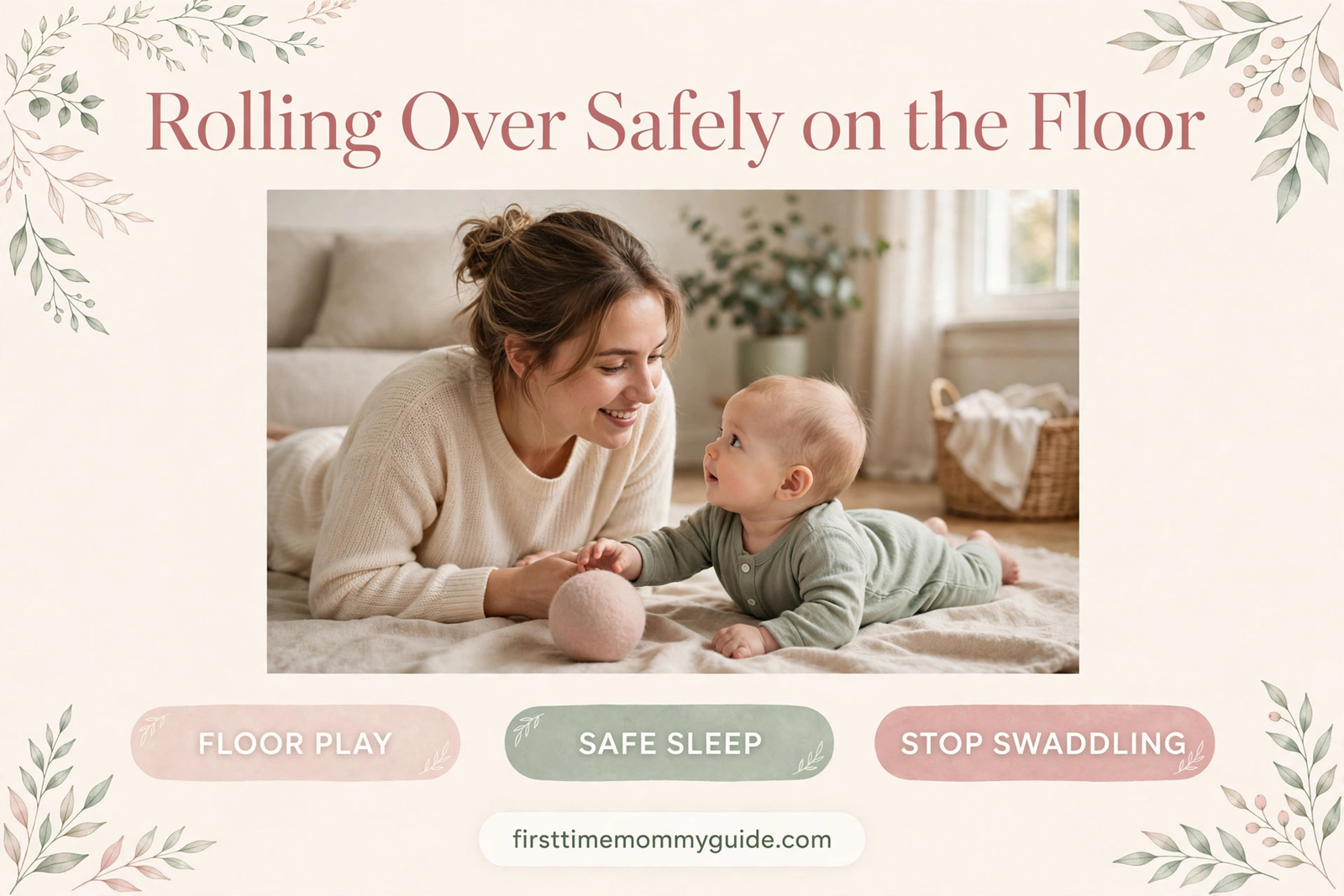
- Get on the floor with your baby. Lie down opposite them, talk to them, and make faces. Your presence is the most powerful motivator.
- Vary the surface. Practise on a rug, a play mat, and a firm mattress on the floor (supervised). Different surfaces challenge balance and movement in different ways.
- Celebrate every attempt. Cheer when your baby rolls, and stay calm and cheerful when they get stuck. Your reaction shapes whether they try again.
- Practise both directions. It is easy to focus on the direction your baby finds easiest. Make sure toys are placed on both sides so both directions get equal practice.
- Watch for tiredness. A tired baby cannot practise well. Choose times when your baby is fed, rested, and happy.
- Be patient with the process. Some babies roll once and then do not do it again for weeks. That is normal. The skill consolidates in its own time.
FAQs: How to Help Baby Learn to Roll Over
1. When do babies start rolling over?
Most babies roll from tummy to back around 4 months and from back to tummy around 5–6 months. By 6 months, most can roll both ways.
2. Which way do babies roll over first?
Usually from tummy to back first, because gravity helps and it uses the arm strength built during tummy time. Back to tummy usually follows a few weeks later.
3. How can I help my baby roll over?
Daily tummy time, placing toys to the side to encourage reaching, side-lying play, gentle assisted rolls, and plenty of free floor time are the most effective ways to help.
4. How much tummy time does my baby need to learn to roll?
Aim to build up to 15–30 minutes of tummy time per day by 2–3 months, spread across short sessions. The strength built during tummy time is the foundation of rolling.
5. My baby is 6 months old and not rolling over. Should I worry?
Not necessarily, but it is worth mentioning to your health visitor or paediatrician. If your baby is making progress in other areas, they may just be taking their time. A check gives you peace of mind and early support if it is needed.
6. Can I teach my baby to roll over?
You cannot force a roll, but you can teach the movement pattern through gentle assisted rolls, and you can create many opportunities to practise through tummy time, reaching games, and side-lying play.
7. Is it normal for a baby to roll one way but not the other?
Yes, for a while. Most babies master one direction first. If your baby still only rolls one way by 7–8 months, mention it at your next check.
8. My baby rolled over once and never did it again. Is that normal?
Yes, very normal. The first roll is often accidental. It can take days or weeks before your baby repeats it deliberately. Keep offering floor time and reaching games.
9. Should I stop swaddling when my baby starts rolling?
Yes — stop swaddling as soon as your baby shows any sign of rolling, even the first attempt. A swaddled baby who rolls onto their tummy cannot use their arms to push up. Switch to a sleep sack.
10. What if my baby rolls onto their tummy in their sleep?
Always place your baby on their back to sleep. If they roll onto their tummy on their own, you do not need to keep turning them back, provided they can roll both ways and the cot is clear of soft items.
11. Do baby walkers help babies learn to roll over?
No. Baby walkers do not help babies roll, crawl, or walk sooner, and they are linked to injuries and delayed motor development. The AAP recommends against them.
12. How do I know if my baby is ready to roll over?
Look for steady head control, pushing up on straight arms during tummy time, reaching for toys to the side, and twisting the body. These signs usually appear together before the first roll.
13. Does my baby need to roll over before sitting up?
Usually, but not always. Most babies roll before they sit, because rolling builds the core strength sitting needs. Some babies sit first, and a few skip rolling almost entirely. All of these paths can be normal.
14. What exercises help a baby roll over?
Tummy time, side-lying play, reaching across the body, leg lifts, gentle assisted rolls, and mirror play are all effective. The key is short, frequent, playful practice.
15. My baby hates tummy time. How can I help them roll?
Try tummy time on your chest, across your lap, or with a rolled towel under the chest. Use a mirror, sing songs, and keep sessions to 2–3 minutes. Even a few minutes several times a day helps. See our tummy time guide for more ideas.
16. Can rolling over be delayed by too much time in a bouncer?
Yes. Babies who spend long periods in bouncers, swings, or car seats get less floor time, and floor time is where rolling is learned. Limit container time and prioritise free movement on the floor.
17. When should I worry about my baby not rolling over?
Mention it to your doctor if your baby is not rolling by 6–7 months, only rolls one way by 7–8 months, has no head control by 4 months, shows stiff or floppy muscle tone, only uses one side of the body, or has lost a skill they previously had.
18. Do premature babies roll over later?
Yes, often. Use your baby's adjusted age (counted from their due date) when judging milestones. A baby born 6 weeks early who rolls at 6 months after birth is 4.5 months adjusted — right on track.
19. What toys help a baby learn to roll over?
Toys that encourage reaching are best: rattles, soft balls, crinkly books, and baby-safe mirrors, placed to the side and slightly out of reach.
20. Is side-lying play safe for my baby?
Yes, supervised side-lying play on a firm, flat surface is safe and valuable. It is a comfortable middle position that teaches the weight shift rolling requires. Always supervise and never leave your baby unattended on their side.
21. How long does it take for a baby to learn to roll over?
The process takes weeks to months. Your baby may show the first signs at 3 months, roll tummy to back at 4 months, and roll both ways confidently by 6–7 months. Each baby's timeline is different.
22. My baby rolls over during nappy changes. How do I keep them safe?
Never leave your baby unattended on a changing table or bed. Keep one hand on your baby at all times, have everything you need within reach before you start, and consider changing your baby on the floor on a mat once they can roll.
Conclusion
Learning to roll over is your baby's first great adventure in movement. Most babies roll from tummy to back around 4 months and from back to tummy around 5–6 months. The path there is built from daily tummy time, reaching games, side-lying play, and plenty of free time on the floor.
Your job is simple: give your baby the floor, the time, and the encouragement, and let them discover rolling in their own way. Place the toys just out of reach, get down on the floor with them, and cheer every wobble and tip. If your baby is a little slower than the charts, remember that ranges are wide and progress matters more than dates. And when that first roll happens — the flail, the tip, the triumphant landing on their back — enjoy it. Your baby has just discovered they can move, and there is no going back.
One safety note to carry with you: the moment your baby shows signs of rolling, stop swaddling and never leave them on a raised surface. Rolling changes the rules, and knowing that in advance keeps your baby safe.
Medical disclaimer: This article is for general information only and is not a substitute for professional medical advice. Every baby develops at their own pace. If you have concerns about your baby's development, speak to your paediatrician, health visitor, or GP. Seek urgent care if your baby loses a skill they previously had, or if you notice unusual stiffness, floppiness, or one-sided movement.
Sources: CDC Milestones — 6 Months · HealthyChildren.org (AAP) — Movement 4 to 7 Months · NHS — Reduce the Risk of SIDS · AAP Safe Sleep Guidance

Dilawar Mughal
Founder and editor, First Time Mommy Guide
I research every guide against what the NHS, the AAP and the WHO publish, then write it in plain English — because most new parents are reading with one hand free, not comparing clinical guidelines. I'm not a doctor or a midwife. Every health claim on this site is sourced and linked so you can check it yourself, and anything urgent belongs with your health visitor or GP, not a blog.


