
General information, not medical advice. Every baby is different — if anything worries you, speak to your midwife, health visitor or GP rather than waiting.
Your baby lies on their tummy, lifts their head for a few seconds, then drops it and cries. You wonder whether you are doing it right, whether it matters, and how much is enough. You are not alone. Most new parents ask the same questions.
This tummy time guide for babies covers the essentials in full. You will learn what tummy time is, why it matters, how much to do at each age, step-by-step positions, how to help a fussy baby, safety rules, and the milestones tummy time supports.
It is written for first-time moms in plain language. It gives general information only. It does not replace advice from your own clinician. If your baby has a medical condition, was born prematurely, or has developmental concerns, discuss tummy time with your clinician before you start.
Quick Answer
Tummy time is supervised time spent on the stomach while awake. It strengthens neck, shoulder, arm, and back muscles, and it helps babies learn to lift their head, roll, sit, and crawl.
Start in the first days at home, with short sessions of a few minutes, several times a day. Build up gradually. By 3 to 4 months, aim for a total of at least 20 to 30 minutes across the day. By 6 months, many babies manage an hour or more in total, in short sessions.
Always supervise tummy time. Place your baby on a firm, flat surface, on their tummy, while awake. Never use tummy time for sleep. Babies must always sleep on their backs, on a flat, firm surface.
Key Takeaways
- Tummy time is awake, supervised time on the stomach. It is not sleep time.
- Start early, start short, and build up little by little.
- Benefits include stronger neck and shoulders, head control, rolling, sitting, and crawling.
- Short, frequent sessions work better than one long session.
- Use your chest, lap, and the floor, with toys, mirrors, and your face for motivation.
- A fussy baby needs shorter sessions, a different position, or a different time of day.
- Stop if your baby is tired, hungry, unwell, or distressed. Try again later.
What Is Tummy Time and Why Does It Matter?
Tummy time means placing your baby on their stomach, on a firm surface, while they are awake and you are watching. It is play, exercise, and learning combined. It is also one of the simplest things you can do to support development.
Babies spend much of their early life on their backs, in cots, prams, and car seats. That back time is essential for safe sleep, but it does not strengthen the muscles used for lifting the head, pushing up, and moving. Tummy time balances back time with front time.
The American Academy of Pediatrics, via HealthyChildren.org, advises tummy time from the first day home, in short sessions, building up as babies grow stronger. The NHS Start for Life guidance gives similar advice: start with a few minutes, several times a day, and increase gradually. Both sources stress supervision and awake time only.
Tummy time benefits
The main benefit is muscle strength. Tummy time works the neck, shoulders, arms, back, and core. Those muscles support head control, which comes first, then rolling, sitting, and crawling. Each milestone builds on the last.
Tummy time also helps prevent flat head syndrome, called plagiocephaly, and neck tightness, called torticollis. Spending all awake time on the back can flatten one side of the head and tighten neck muscles. Varied positions, including tummy time, side-lying, and upright carrying, reduce that risk.
Tummy time supports sensory and visual development. On their tummy, babies see the world from a new angle. They reach for toys, track faces, and learn about their hands. That exploration supports hand-eye coordination and curiosity.
Tummy time can also help with gas and digestion. Gentle pressure on the tummy, combined with movement, can help wind pass. It is not a treatment for reflux or colic, but many babies settle after short tummy sessions. Schedule tummy time before feeds or well after feeds, when the stomach is emptier, to avoid spit-up.
Tummy time and safe sleep: the distinction
Tummy time is for awake time only. Sleep must always be on the back. The American Academy of Pediatrics safe sleep guidance, summarised by HealthyChildren.org, recommends a flat, firm sleep surface on the back, with no pillows, blankets, or positioners. That guidance protects against sudden infant death syndrome.
Do not confuse the two. A baby who can roll onto their tummy during sleep, and who is developmentally ready, may stay there, but you should always place your baby on their back to start sleep. Discuss rolling and sleep with your clinician if you are unsure.
Tummy time during the day actually supports safe sleep. Stronger babies roll, move, and reposition themselves more easily. Daytime tummy play and nighttime back sleeping work together, not against each other.
Myths about tummy time
Myth: tummy time must be on the floor from day one. Reality: chest and lap tummy time count, especially for newborns. Start where your baby feels safe, then move to the floor as strength grows.
Myth: crying during tummy time means it is harmful. Reality: crying often means tiredness, frustration, or a need for a break. Short sessions, a different position, or a different time often help. Persistent distress deserves discussion with your clinician.
Myth: tummy time must last a set number of minutes in one go. Reality: totals across the day matter more than single sessions. Five sessions of three minutes beat one session of 15 minutes for a young baby.
Myth: babies who hate tummy time will be delayed. Reality: many babies dislike tummy time at first, then grow to enjoy it. Consistent, gentle practice, with varied positions, usually helps. If concerns persist, seek advice early.
How Much Tummy Time by Age
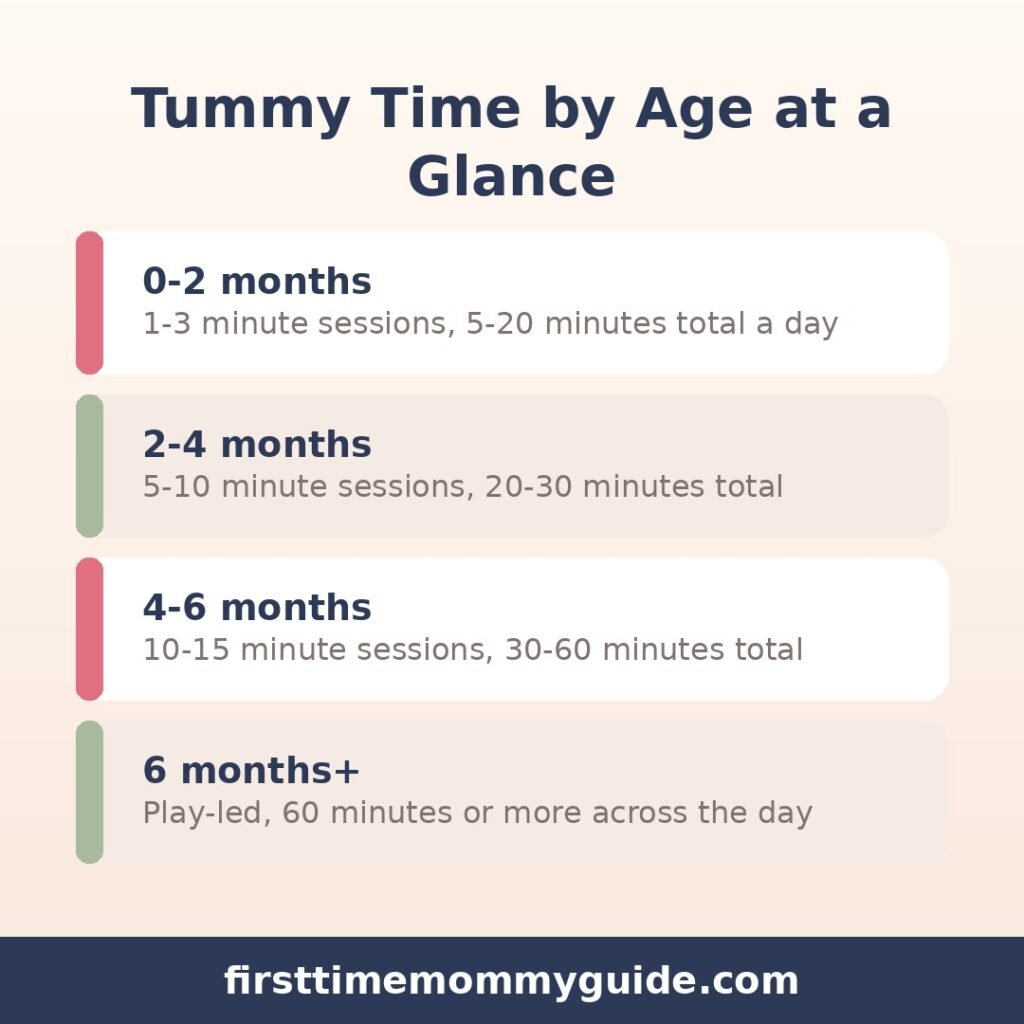
How much tummy time your baby needs depends on age, strength, and tolerance. The amounts below are guides, not rules. Build up gradually, watch your baby’s cues, and total the minutes across the day.
Newborn: 0 to 2 months
Start in the first days at home, once your baby is settled after feeds. Offer 1 to 3 minutes at a time, several times a day. Aim for a total of 5 to 10 minutes across the day in the first weeks, building to 15 to 20 minutes by 2 months.
Newborn tummy time is often on your chest. Lie back, place your baby tummy-down on your chest, and talk, sing, and make eye contact. That contact motivates head lifting and feels safe. Lap tummy time, with your baby across your knees, also works.
Watch for head lifting. Newborns lift their head briefly, turn it to the side, and tuck their arms close. That is normal. Do not expect pushing up on arms yet. Short, frequent practice builds strength without exhaustion.
2 to 4 months
By 2 to 3 months, many babies lift their head to 45 degrees and hold it for longer. By 4 months, many push up on forearms, lift their chest, and look around. Aim for a total of 20 to 30 minutes across the day by 3 to 4 months, in sessions of 5 to 10 minutes.
Floor tummy time becomes more useful now. Place your baby on a firm play mat, with toys, a mirror, or your face in front. Get down to floor level yourself. Your face is the most interesting toy for a young baby.
Vary the time of day. Try tummy time after a nappy change, before a feed, or in the middle of a wake window. Avoid straight after feeds, when spit-up is likely, and avoid when your baby is tired or hungry.
4 to 6 months
By 4 to 6 months, babies push up on straight arms, reach for toys, pivot in a circle, and begin to roll. Aim for 30 to 60 minutes total across the day, in sessions that your baby enjoys. Some babies manage longer sessions now, especially with toys and interaction.
Offer toys at different distances and angles. Place a toy just out of reach to encourage reaching and pivoting. Offer a mirror, a rattle, or a crinkly book. Change toys often to keep interest fresh.
This is also the age when rolling begins. Rolling from tummy to back often comes before rolling from back to tummy. Both are supported by tummy time. Keep the play area safe, with no pillows, blankets, or loose objects that could cover the face.
6 months and older
From 6 months, tummy time blends into play, crawling, and sitting. Babies may spend long periods on their tummies, reaching, rolling, and pushing up to crawl. Totals of an hour or more across the day are common, but play, not counting minutes, is the goal.
Encourage movement. Place toys out of reach, create safe obstacles with cushions under supervision, and let your baby explore. Crawling, bottom shuffling, and cruising all build on tummy time strength.
Keep tummy play going even after your baby sits and crawls. Floor play remains valuable for strength, coordination, and exploration. Our guide to baby milestones at 6 months explains what to expect at this age, including rolling, sitting, and babbling.
| Age | Session length | Daily total | Typical skills |
|---|---|---|---|
| 0–2 months | 1–3 minutes | 5–20 minutes | Brief head lift, head turn |
| 2–4 months | 5–10 minutes | 20–30 minutes | Head to 45–90 degrees, forearm push-up |
| 4–6 months | 10–15 minutes | 30–60 minutes | Straight-arm push-up, reach, pivot, roll |
| 6 months + | Play-led | 60 minutes + | Crawl, sit, explore, cruise |
Signs you are building up too fast, or too slowly
Building up too fast looks like distress at every session, crying within a minute, head dropping repeatedly, and refusal to try. Shorten sessions, change position, and build more slowly. Progress is not linear. Sick days, growth spurts, and teething can all cause setbacks.
Building up too slowly looks like very little tummy time, always on the back, and little head control by 3 to 4 months. If your baby has had almost no tummy time, start gently now. It is never too late to start, and small steps add up.
If you are worried about head control, rolling, or movement, discuss it with your health visitor or GP. Early advice is better than waiting. Most concerns have simple solutions, such as varied positions and more frequent short sessions.
Tummy Time Positions: Step-by-Step
Different positions suit different ages and moods. Start with the easiest position, then progress as your baby grows stronger. Always supervise, and always keep your baby awake.
Position 1: Chest tummy time (newborns)
Lie back on a sofa or bed, supported by pillows, at about 45 degrees. Place your baby tummy-down on your chest, with their head near your chin. Support your baby’s bottom and back with your hands.
Talk, sing, and make eye contact. Your baby will lift their head to look at you, then rest it. That lift-and-rest cycle builds neck strength. Keep sessions to a few minutes, several times a day.
Chest tummy time is ideal for newborns, for babies after feeds once settled, and for skin-to-skin contact. It feels safe, warm, and familiar. It also counts as bonding time, not only exercise.
Position 2: Lap tummy time
Sit comfortably, with your knees bent. Lay your baby tummy-down across your lap, with their head turned to one side and supported. Place one hand on their back for security.
Gently rub their back, talk, and offer a toy or mirror in front. Lap tummy time gives a slightly different angle from chest time, and it works well after a nappy change. Alternate which way your baby’s head turns, to avoid neck tightness.
Keep your lap stable, and never leave your baby unattended on your lap. Lap time is a supervised, awake activity, not a way to hold a sleeping baby.
Position 3: Floor tummy time (classic)
Place a firm play mat on the floor, in a safe, warm area. Lay your baby tummy-down on the mat, with arms forward, elbows under shoulders. Get down to floor level, face to face.
Offer toys, a mirror, or a book at eye level. Talk, sing, and encourage reaching. Start with a few minutes, and build up. Floor time gives your baby freedom to move, pivot, and roll as strength grows.
Keep the floor clear of pillows, blankets, cords, and small objects. Use a firm mat, not a soft duvet or beanbag. A soft surface makes pushing up harder and can cover the face.
Position 4: Tummy time with a rolled towel
Place a small rolled towel or muslin under your baby’s chest and armpits, with arms forward over the roll. The roll lifts the chest slightly, making head lifting easier. This position helps babies who struggle to lift their head on the flat floor.
Use a small, firm roll, not a large pillow. Keep your baby’s face clear, and supervise closely. Remove the roll as strength grows, so your baby practises without support.
Do not use a Boppy, pillow, or nursing pillow for unsupervised tummy time. Pillows can slip, cover the face, or tip a baby over. A small towel roll, used with supervision, is safer and simpler.
Position 5: Tummy time in a carrier and upright play
Carrying your baby upright in a sling or carrier, while awake and supervised, also strengthens neck and core muscles. It is not a replacement for floor tummy time, but it adds variety. Follow carrier safety guidance, with airways clear and face visible.
Upright play in a bouncer or seat, for short periods, also varies position. Keep upright seats to short, supervised periods, and balance them with floor play. Too much time in containers, such as seats, swings, and bouncers, can limit movement and development.
Vary positions across the day. Chest, lap, floor, and upright carrying each work slightly different muscles. Variety prevents flat head, neck tightness, and boredom.
Step-by-step: a first floor session
Choose a time when your baby is awake, alert, and content, ideally before a feed or well after one. Lay a firm mat on the floor, in a warm, safe area. Place your baby tummy-down, arms forward.
Get down to floor level. Talk, sing, and smile. Place a toy or mirror just in front, at eye level. Encourage your baby to lift their head and look. Keep the session to 1 to 3 minutes for a newborn, longer for an older baby.
End the session before your baby becomes distressed. Lift your baby up, cuddle, and offer a feed or rest if needed. Repeat several times a day, building up gradually. Note what worked, and try again later.
Baby Hates Tummy Time: Fussiness Fixes
Many babies dislike tummy time at first. That does not mean you should stop. It means you need to adjust position, timing, or motivation. The fixes below help most families.
Try a different time
Timing matters more than technique. A tired, hungry, or just-fed baby will cry during tummy time, whatever you do. Try tummy time after a nap, after a nappy change, or in the middle of a wake window, when your baby is alert and content.
Avoid straight after feeds, when spit-up and discomfort are likely. Avoid late in a wake window, when tiredness takes over. Short, well-timed sessions beat long, badly timed ones.
Keep a simple note of when tummy time goes well. You may find a pattern, such as mid-morning working best. Use that pattern, and build a routine around it.
Try a different position
If floor tummy time fails, try chest or lap tummy time. Many babies prefer the warmth and contact of a parent’s chest. Start there, build strength, then try the floor again in a week or two.
Try the rolled towel position. A small lift under the chest can make head lifting easier and less frustrating. Try tummy time on a play mat with a mirror, or outdoors on a blanket in the shade, for a change of scene.
Try short sessions on your forearm, holding your baby tummy-down along your arm, with their head near your elbow, while you walk around. This airplane hold gives a new view and gentle movement. Supervise closely, and support your baby securely.
Use motivation: face, voice, and toys
Your face is the best motivator. Get down to floor level, make eye contact, talk, sing, and make funny faces. Babies lift their heads to see you. A parent’s face beats any toy in the early months.
Use high-contrast toys, mirrors, and rattles. Black-and-white patterns, mirrors, and crinkly books attract attention. Place toys at eye level, not flat on the mat. Move a toy slowly from side to side to encourage head turning.
Sing songs with actions, read a short book, or narrate what you see. Keep your voice calm and encouraging. Avoid over-stimulating a baby who is already frustrated. Calm interaction works better than loud excitement.
Shorten, repeat, and build slowly
Shorten sessions to one minute, or even 30 seconds, if needed. Repeat often across the day. Five successful one-minute sessions build more strength and confidence than one distressing 10-minute session.
Praise effort, not duration. Comment on head lifts, reaching, and looking around. End on a positive note, with a cuddle, before distress takes over. Your baby will learn that tummy time ends safely and calmly.
Be patient. Some babies take weeks to enjoy tummy time. Consistent, gentle practice usually works. If fussiness persists, or your baby seems in pain, discuss it with your clinician. Pain, reflux, or neck tightness can make tummy time harder, and early help matters.
Tummy time, gas, reflux, and teething
Gas can make tummy time uncomfortable. Gentle pressure on the tummy can help wind pass, but it can also cause fussiness if wind is trapped. Try bicycle legs and burping before tummy time. Our guide to baby gas relief remedies gives step-by-step techniques.
Reflux can also make tummy time harder. Pressure on a full stomach can push milk up. Schedule tummy time before feeds or well after feeds. If reflux is severe, discuss timing with your clinician. Do not stop tummy time without advice, but do adjust timing.
Teething can reduce tolerance for any activity, including tummy time. A teething baby may cry sooner, lift less, and need more comfort. Keep sessions shorter during teething, and offer comfort measures. Our guide to baby teething signs and remedies explains safe comfort steps.
Tummy Time Safety
Safety rules for tummy time are simple, but they must be followed every time. Supervision, surface, and sleep rules protect your baby while they learn.
The non-negotiable rules
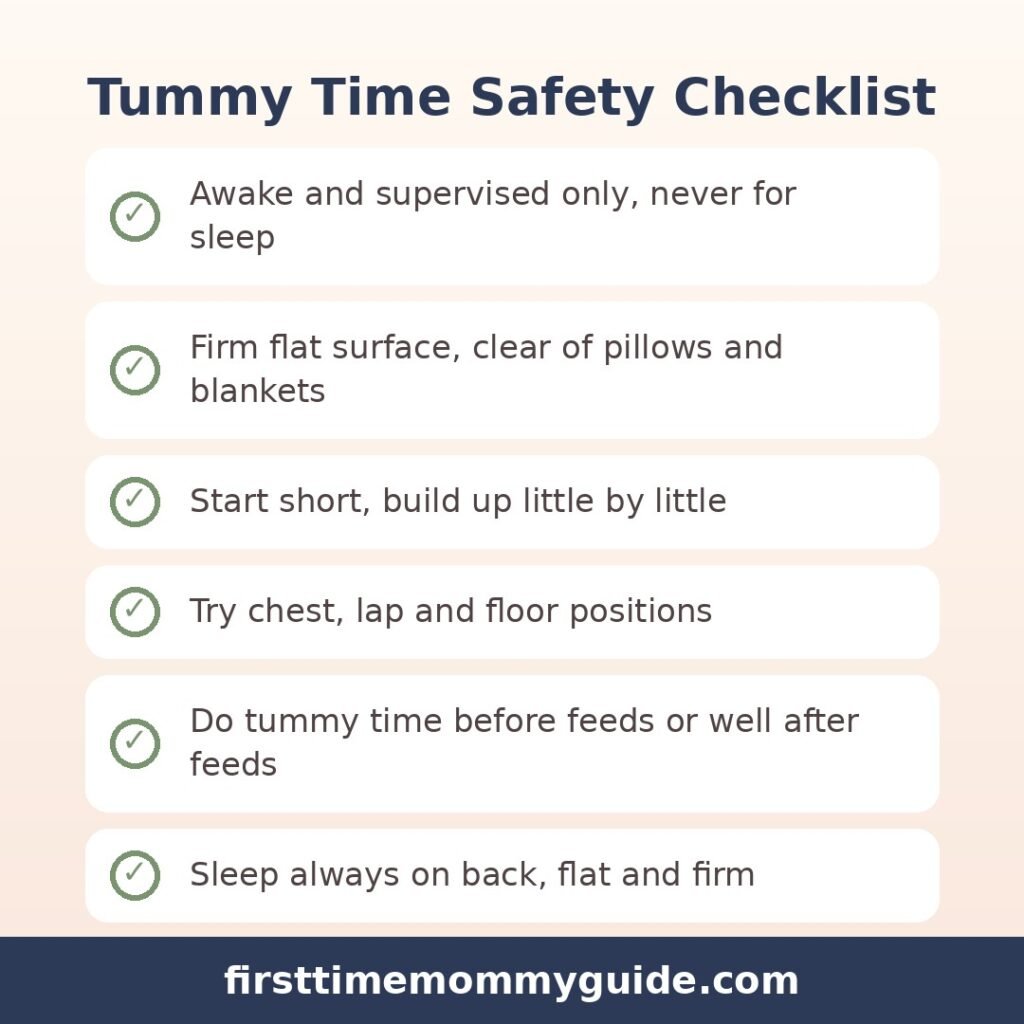
Always supervise tummy time. Stay within arm’s reach, awake, and watching. Never leave a baby alone on their tummy, even for a moment. Never use tummy time as a way to settle a baby to sleep.
Always use a firm, flat surface. A play mat on the floor is ideal. Avoid soft bedding, duvets, beanbags, sofas, and adult beds, which can cover the face or tip a baby over. Keep the area clear of pillows, blankets, cords, and small objects.
Always keep your baby awake. If your baby falls asleep during tummy time, move them to their back, on a flat, firm sleep surface, following safe sleep guidance. Never let a baby sleep face down on a play mat or on your chest unsupervised.
Equipment safety
Do not use tummy time pillows, wedges, or positioners unsupervised. Small towel rolls, used with supervision, are safer than large pillows. Remove any support as soon as your baby can manage without it.
Keep toys safe and age-appropriate. Avoid small parts, long strings, and toys that could cover the face. Check toys for damage, and clean them regularly. Offer toys at eye level, not on top of your baby.
Avoid tummy time in water, in a bath seat, or near water. Avoid tummy time in a moving car, pram, or bouncer. Tummy time is a floor, chest, or lap activity, in a safe, stationary place.
When to stop and seek advice
Stop tummy time if your baby vomits repeatedly, seems in pain, has breathing difficulty, or becomes limp or unusually floppy. Seek medical advice promptly for those signs. Do not assume they are normal tummy time fussiness.
Seek advice if your baby shows a strong preference for turning the head one way only, has a flat spot on the head that worsens, or has a tight neck muscle. Early physiotherapy advice can help with torticollis and plagiocephaly.
Seek advice if head control, rolling, or movement seems delayed compared with the age guides above. Every baby develops at their own pace, but persistent delay deserves review. Your health visitor or GP can assess and refer if needed.
Milestones Supported by Tummy Time
Tummy time supports a sequence of milestones. Each one builds on the last, and each one needs practice. The ages below are guides, not deadlines. Wide variation is normal.
Head control and neck strength
Head control comes first. Newborns lift briefly, then hold longer. By 3 to 4 months, most babies hold their head steady when upright, and lift to 90 degrees on their tummy. Strong neck muscles support feeding, looking around, and later sitting.
If head control is weak at 4 months, increase tummy time gradually, vary positions, and discuss it with your clinician. Early, gentle practice helps, and early advice prevents worry.
Rolling, sitting, and crawling
Rolling often starts with tummy-to-back rolling, at around 4 to 6 months, followed by back-to-tummy rolling. Tummy time builds the shoulder and core strength needed for both. Place toys to encourage rolling, and keep the floor safe.
Sitting follows rolling. Babies sit with support, then tripod sit, then sit alone, usually between 6 and 8 months. Tummy time strength, plus upright play, supports sitting balance. Our guide to baby milestones at 6 months explains sitting, rolling, and babbling at this age.
Crawling, usually between 7 and 10 months, builds directly on tummy time. Pushing up, pivoting, rocking, and reaching all lead to crawling. Some babies bottom-shuffle or skip crawling, and that can be normal. Discuss movement concerns with your clinician if you are worried.
Flat head and neck tightness: prevention
Flat head syndrome happens when a baby’s head rests in one position for long periods. Tummy time, varied carrying, and alternating head direction during sleep and feeds reduce the risk. If a flat spot appears, increase varied positions and discuss it with your clinician.
Neck tightness, or torticollis, causes a baby to prefer turning one way. Tummy time, gentle head-turning play, and varied carrying help. Physiotherapy may be advised if tightness persists. Early help works best, so do not wait.
What if milestones are delayed?
Development varies widely. A baby who rolls at 7 months, not 5, may be completely normal. Look for steady progress, not exact dates. Progress across motor, language, and social skills matters more than speed in one area.
Seek advice if your baby loses a skill, shows no interest in people or toys, does not lift their head by 4 months, or does not roll by 7 to 8 months. Your clinician can assess, reassure, or refer. Early support helps babies catch up, and it helps parents feel confident.
Keep a simple record of milestones, with dates and notes. That record helps at health reviews, and it helps you see progress over time, even on slow weeks.
Common Mistakes, Expert Tips, and Daily Routine
Most tummy time problems come from timing, position, or expectations. Small adjustments usually fix them. The tips below help you build a routine that lasts.
Common mistakes to avoid
Doing one long session a day is a common mistake. Short, frequent sessions work better. A young baby tires quickly, and a long session ends in tears. Aim for several short sessions, totalling the daily guide amount.
Doing tummy time straight after feeds is another mistake. A full stomach, pressure, and movement cause spit-up and fussiness. Schedule tummy time before feeds or well after feeds, and keep the upright pause after milk.
Leaving a baby unsupervised, or using tummy time for sleep, is unsafe. Always supervise, always keep your baby awake, and always move a sleeping baby to their back on a firm surface. Safety rules are not optional.
Expecting too much too soon is also common. Newborns lift briefly, not for minutes. Progress is gradual. Celebrate small lifts, and build up slowly. Comparing your baby with others adds pressure without helping development.
Using only one position, usually the floor, can cause frustration. Vary chest, lap, floor, and upright positions. Variety builds different muscles, prevents boredom, and helps babies who dislike one position.
Expert tips
Tip 1: Pair tummy time with a routine cue. Try tummy time after every nappy change, or before every feed. A cue helps you remember, and helps your baby expect it. Routine beats willpower.
Tip 2: Get on the floor yourself. Your face, voice, and touch motivate more than any toy. Lie face to face, talk, sing, and encourage. Your baby works harder to look at you than at a plastic toy.
Tip 3: Change the scene. Try tummy time outdoors on a blanket, in a different room, or with a new toy. A change of view can restart interest when a baby is bored. Keep the surface firm and safe, wherever you go.
Tip 4: Keep a simple log for two weeks. Note session length, position, time of day, and your baby’s response. Patterns emerge quickly. Use the log to find the best time and position, and to share progress with your clinician.
Tip 5: Involve partners and family. Anyone can do tummy time, with supervision. Shared responsibility reduces parental exhaustion, and varied faces and voices keep babies interested. Teach all caregivers the safety rules first.
A sample daily routine
Morning, after waking and a nappy change: 3 to 5 minutes of chest tummy time, with talking and singing. Mid-morning, before a feed: 5 minutes of floor tummy time with a mirror and toys.
Afternoon, after a nap: 5 to 10 minutes of floor or lap tummy time, with a rolled towel if needed. Evening, before bath: a short, calm session on your chest, with gentle back rubs. Keep evening sessions short and soothing, not stimulating.
Adjust times to your baby’s age and tolerance. A newborn routine will be much shorter. An older baby’s routine will be play-led, with longer floor sessions. Follow cues, not the clock.
Tummy time and other daily care
Tummy time fits well with other care. Pair it with nappy changes, dressing, and play. Use it as a break from back time in seats and prams. Balance container time with floor time across the day.
Swaddling, if you use it, should be for sleep only, and should stop when your baby shows signs of rolling. Our guide on how to swaddle a newborn explains safe swaddling, hip health, and when to stop. Do not swaddle for tummy time. Arms need to be free to push up.
Feeding, sleep, and play work together. A baby who feeds well, sleeps safely on their back, and plays on their tummy during the day develops well. Our guide on newborn feeding schedule helps you plan feeds, play, and sleep across the day. Our guide on newborn sleep routine helps with safe, predictable sleep.
Frequently Asked Questions
When should I start tummy time?
Start in the first days at home, once your baby is settled after birth. Begin with 1 to 3 minutes, several times a day, on your chest or lap. Build up gradually. Supervise always, and keep your baby awake. Never use tummy time for sleep.
How much tummy time does a newborn need?
Aim for a total of 5 to 10 minutes across the day in the first weeks, building to 15 to 20 minutes by 2 months. Use short sessions of 1 to 3 minutes. Totals across the day matter more than one long session. Build up as strength grows.
How much tummy time by 3 to 4 months?
Aim for 20 to 30 minutes total across the day by 3 to 4 months, in sessions of 5 to 10 minutes. Many babies lift their head to 45 to 90 degrees and push up on forearms by this age. Floor tummy time with toys and mirrors works well now.
Does tummy time count on my chest?
Yes, chest tummy time counts, especially for newborns. Lying tummy-down on your chest, while you recline, builds neck strength and encourages head lifting. It also supports bonding. Move to floor tummy time as strength grows, and vary positions across the day.
What if my baby hates tummy time?
Try a different time, position, or motivator. Shorten sessions to a minute, try chest or lap time, and use your face, voice, and toys. Build up slowly, and end on a positive note. If distress persists, discuss it with your clinician. Pain or neck tightness can make tummy time harder.
Is crying during tummy time normal?
Crying is common, especially when a baby is tired, hungry, or frustrated. It usually means a break is needed, not that tummy time is harmful. Shorten sessions, change position, and try again later. Seek advice if crying is intense, inconsolable, or accompanied by other symptoms.
Can tummy time be done after feeding?
Wait until well after a feed, or do tummy time before a feed. Pressure on a full stomach can cause spit-up and discomfort. A 20 to 30 minute upright pause after feeds helps. Schedule tummy time in the middle of a wake window, when the stomach is emptier.
Is tummy time safe for premature babies?
Discuss timing with your neonatal team or clinician, using corrected age. Start gently, with chest tummy time, and build up slowly. Premature babies may need extra support and monitoring. Individualised guidance protects growth and safety. Do not apply term-baby timelines without advice.
How do I know if tummy time is working?
Look for steady progress: longer head lifts, higher chest lifts, pushing up on arms, reaching, pivoting, and rolling. Progress is gradual, not daily. Keep a simple log of sessions and skills. Discuss concerns with your health visitor if progress stalls.
Can tummy time prevent flat head syndrome?
Tummy time helps, as part of varied positioning. It reduces time spent on the back of the head, and strengthens neck muscles. Also vary carrying, alternate head direction during sleep and feeds, and limit time in seats and swings. Discuss a worsening flat spot with your clinician.
Should I use a tummy time pillow or mat?
Use a firm play mat on the floor. A small rolled towel under the chest, with supervision, can help babies who struggle to lift their head. Avoid large pillows, wedges, and positioners unsupervised. A firm, flat surface is safest and most effective.
Can my baby sleep on their tummy?
No, babies must sleep on their backs, on a flat, firm surface, with no pillows or blankets. Tummy time is for awake, supervised play only. If your baby falls asleep during tummy time, move them to their back for sleep. Safe sleep guidance protects against sudden infant death syndrome.
Does tummy time help with rolling and crawling?
Yes, tummy time builds the neck, shoulder, arm, and core strength needed for rolling, sitting, and crawling. Pushing up, reaching, pivoting, and rocking all lead to movement. Floor play, varied positions, and encouragement support each step.
What toys are best for tummy time?
Your face is best, followed by mirrors, high-contrast toys, rattles, and crinkly books. Place toys at eye level, and move them slowly to encourage head turning. Change toys often. Keep toys safe, clean, and age-appropriate, with no small parts or long strings.
How long until my baby enjoys tummy time?
It varies. Some babies enjoy it within weeks, others take months. Consistent, gentle practice, with varied positions and good timing, usually helps. Celebrate small progress, and keep sessions positive. If enjoyment does not improve, seek advice early.
Can I do tummy time if my baby has reflux?
Usually yes, with adjusted timing. Do tummy time before feeds or well after feeds, when the stomach is emptier. Keep sessions short and calm. Discuss severe reflux with your clinician. Do not stop tummy time without advice, but do adjust timing and position.
When should I worry about tummy time milestones?
Seek advice if your baby does not lift their head by 4 months, shows no rolling by 7 to 8 months, loses a skill, or shows a strong head-turning preference. Also seek advice for a worsening flat spot or neck tightness. Early assessment and support help most.
Do I need special equipment for tummy time?
No, you need a firm play mat, a safe floor area, and supervision. A small rolled towel can help, and a mirror or rattle can motivate. Expensive equipment is not essential. Calm supervision and varied positions matter more than kit.
Conclusion
Tummy time is simple, short, and powerful. It builds the neck, shoulder, arm, and core strength your baby needs for head control, rolling, sitting, and crawling. It also helps prevent flat head syndrome and supports sensory development.
Start early, start short, and build up little by little. Use your chest, lap, and the floor. Vary positions, toys, and times of day. Keep sessions positive, and end before your baby becomes distressed.
If your baby hates tummy time, do not stop. Shorten sessions, try a different position, and try again later. Consistent, gentle practice usually works, and most babies improve with time.
Follow the safety rules every time. Supervise, use a firm surface, keep your baby awake, and keep sleep on the back. Seek advice early if you are worried about head control, rolling, movement, or head shape.
Tummy time is a small daily habit with a large effect. A few minutes, several times a day, add up to strength, confidence, and movement, one head lift at a time.
This article is for general information only and does not replace professional medical advice. If you have concerns about your baby’s development, consult your clinician.

Dilawar Mughal
Founder and editor, First Time Mommy Guide
I research every guide against what the NHS, the AAP and the WHO publish, then write it in plain English — because most new parents are reading with one hand free, not comparing clinical guidelines. I'm not a doctor or a midwife. Every health claim on this site is sourced and linked so you can check it yourself, and anything urgent belongs with your health visitor or GP, not a blog.


