General information, not medical advice. Every baby is different — if anything worries you, speak to your midwife, health visitor or GP rather than waiting.
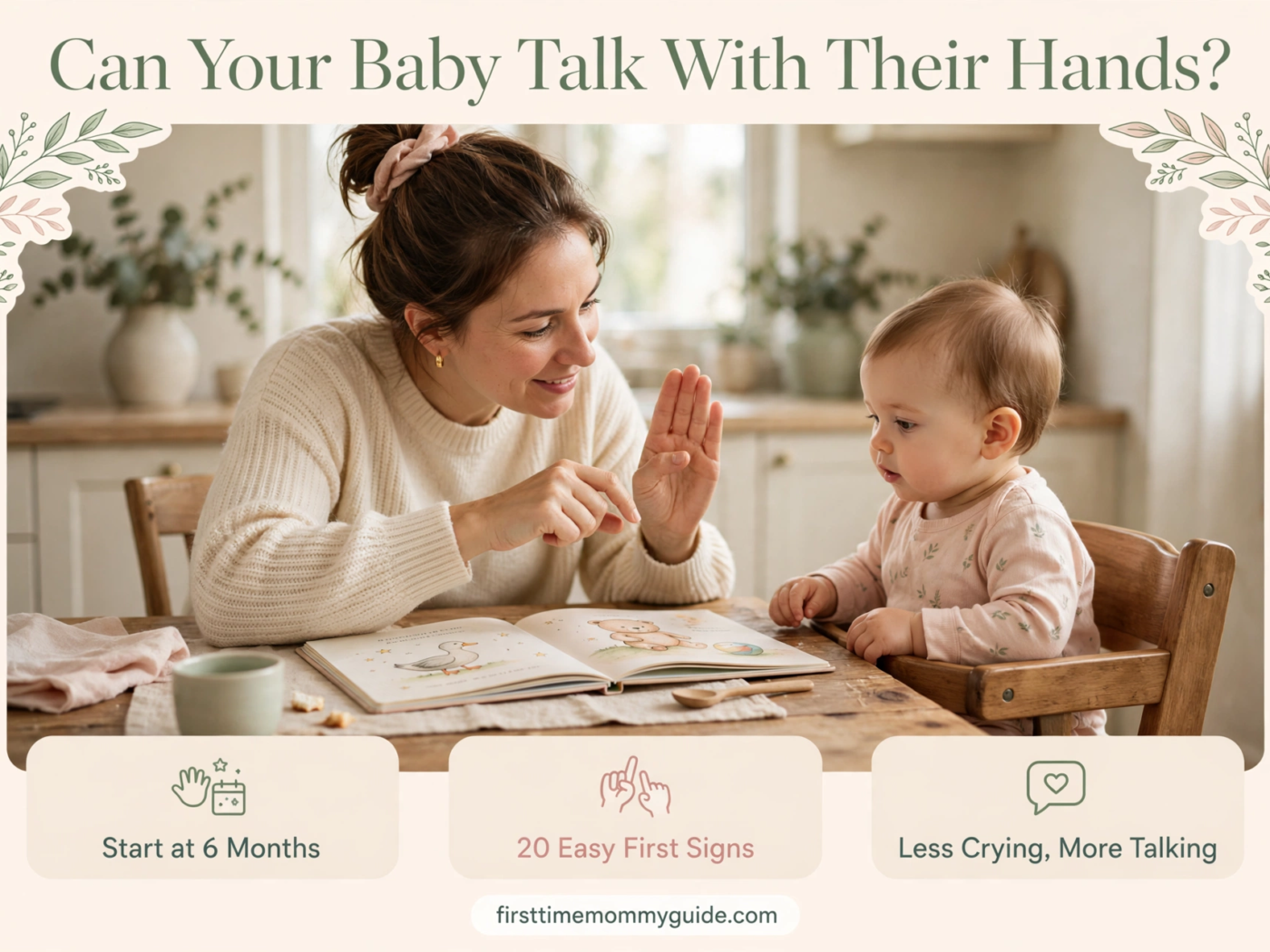
Your baby knows what they want long before they can say it. They know when they are hungry, when they want more, when they are finished, and when they need a cuddle. The frustration comes when they cannot tell you. That gap between understanding and speaking is where baby sign language basics make a real difference.
Baby sign language is a simple system of hand gestures that babies use to communicate before they can talk. It is not a replacement for speech. It is a bridge to speech. A baby who can sign “more” or “milk” cries less, feels understood, and often starts talking earlier, because signing builds the same communication skills that speech needs.
This guide covers everything a first-time parent needs to know: when to start, the 20 easiest first signs, how to teach them in daily routines, and what the research actually says about signing and speech development. No special training is needed. If you can wave and clap, you can teach your baby to sign.
Key Takeaways
- Baby sign language is a set of simple hand gestures that babies use to communicate needs and wants before they can speak.
- The best age to start is around six to nine months, when babies begin to understand words and can control their hands. You can start earlier, but signs usually appear later.
- Most babies produce their first sign between eight and twelve months, after several weeks of watching you sign.
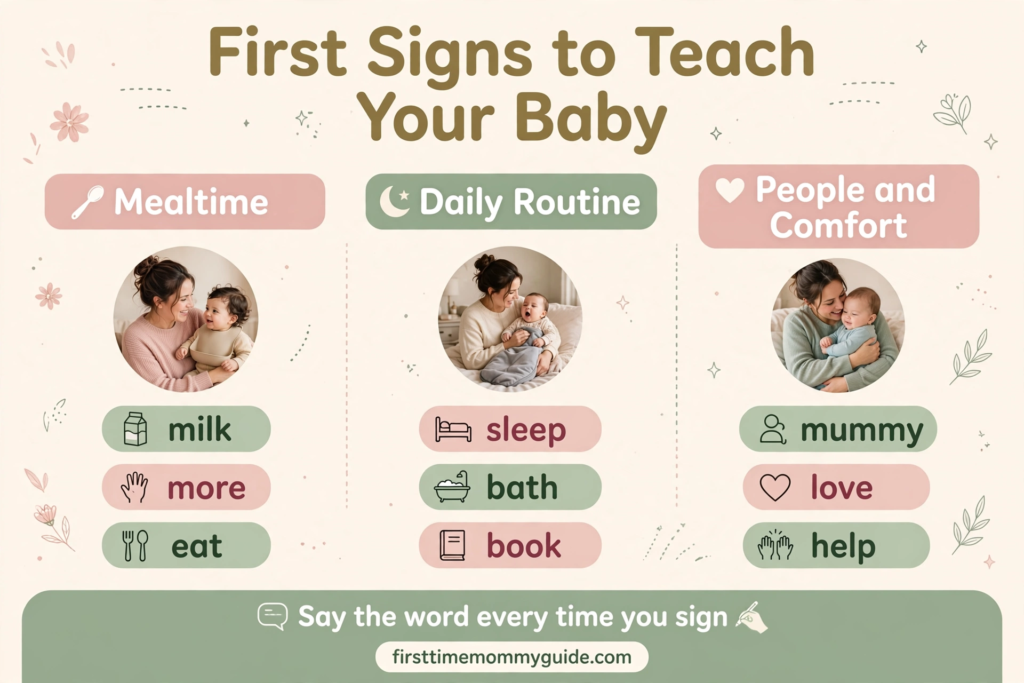
- Start with five signs only: milk, more, eat, all done, and help. Add new signs slowly, one or two at a time.
- Signing does not delay speech. Research shows that babies who sign reach speech milestones at the same time or earlier than babies who do not sign.
- Sign at your baby’s eye level, say the word as you sign, and repeat the sign in daily routines. Consistency matters far more than the number of signs you know.
- Celebrate every attempt. A baby’s first signs are approximate. A wobbly wave for “more” counts, and your praise is what makes them try again.
What Is Baby Sign Language?
Baby sign language uses simplified gestures borrowed from American Sign Language (ASL) or British Sign Language (BSL) to represent common words. The signs are adapted for small hands and developing motor skills, so they are simpler than the formal signs used by deaf communities.
A baby who signs “milk” is not learning a second language. They are learning that a hand shape plus a word plus a result go together. That is the same lesson speech teaches, just with hands instead of a voice.
Baby sign language vs formal sign language
Formal sign languages such as ASL and BSL are complete languages with their own grammar and vocabulary. Baby sign language borrows individual signs from these languages but does not teach grammar or full sentences. Parents usually choose signs from their country’s sign language, because the signs are standardised, widely documented, and useful if the family later needs them.
You do not need to learn formal sign language to teach your baby. You need twenty or so signs, a consistent routine, and patience. Many parents learn the signs alongside their baby, which is part of the fun.
Why babies can sign before they can speak
Babies develop hand control months before they develop the mouth and tongue control needed for speech. A six-month-old can wave, point, and clap. Those same hand skills can make signs. Speech requires precise coordination of the lips, tongue, jaw, and breath, which takes much longer to develop.
This is also why babies understand words before they can say them. A nine-month-old understands “milk”, “mummy”, “dog”, and “no” long before they can pronounce them. Signing gives them a way to use that understanding.
When to Start Baby Sign Language
The ideal time to start is between six and nine months, but there is no wrong time. Here is what to expect at each age.
| Age | What to expect |
|---|---|
| 0–6 months | You can sign, but your baby will not sign back yet. You are building the habit of signing for yourself. |
| 6–9 months | The best time to start. Your baby understands words, watches your hands, and is developing the motor skills to imitate. |
| 9–12 months | Most babies produce their first signs in this window. Expect approximate signs and celebrate every attempt. |
| 12–18 months | Your baby’s sign vocabulary grows quickly. Many babies use 10 to 20 signs and combine a sign with a word. |
| 18–24 months | Speech catches up. Your baby may drop signs as words take over, which is normal and a sign of progress. |
Starting earlier than six months is fine, but it takes longer to see results. Parents who start at three months often wait five or six months for the first sign, which can feel discouraging. Parents who start at eight months often see the first sign within four to eight weeks, which is much more motivating.
If your baby is already twelve months or older, it is not too late. Start with the same five first signs and follow the same routine. Older babies often learn faster because their motor skills and understanding are more developed.
Signs your baby is ready
- Your baby watches your hands and face when you talk.
- Your baby waves, claps, or points.
- Your baby understands simple words such as “milk”, “mummy”, or “no”.
- Your baby tries to imitate sounds or movements.
- Your baby gets frustrated when you do not understand what they want.
If several of these are true, your baby is ready. If your baby is not yet showing these signs, keep signing anyway. The exposure builds understanding, and the first sign will come when your baby is ready.
The 20+ First Signs Every Parent Should Know
Start with five signs. Once your baby uses those, add new ones one or two at a time. The signs below are ordered by usefulness, not by difficulty.
The first five signs
1. Milk. Make a fist and open and close it, like milking a cow. Use it every time you offer a feed. This is the single most useful sign for babies under one, because hunger is their most frequent need.
2. More. Bring the fingertips of both hands together, then tap them together twice. Use it at mealtimes, during play, and whenever your baby wants something repeated. This is often the first sign babies learn.
3. Eat or food. Bring your fingertips to your lips, as if putting food in your mouth. Use it before meals, when you offer a snack, and when you talk about food. Our guide to the signs your baby is ready for solid foods can help you time this sign with the start of weaning.
4. All done or finished. Hold both hands up, palms facing out, and twist them back and forth. Use it at the end of meals, bath time, and play. This sign reduces frustration enormously, because it lets your baby tell you they are finished instead of throwing food.
5. Help. Place one hand flat, palm up, and tap it with the other fist. Use it when your baby is struggling with a toy, a zip, or a puzzle. This sign teaches your baby to ask for help instead of crying in frustration.
Daily routine signs
6. Drink or water. Make a C-shape with your hand and bring it to your mouth, like holding a cup. Use it at mealtimes and when you offer water.
7. Sleep or tired. Hold your hand flat and bring it to your cheek, then close your eyes briefly. Use it at bedtime and nap time. This sign pairs well with our guide to how to establish a newborn sleep routine.
8. Bath. Make fists and move them up and down, as if washing your chest. Use it before bath time. Many babies learn this sign quickly because bath time is fun.
9. Book. Hold your hands flat, palms together, then open them like a book. Use it at story time. Babies love this sign because it leads to something enjoyable.
10. Play. Hold both hands up with fingers spread and wiggle them. Use it when you start a game or offer a toy.
People and comfort signs
11. Mummy. Tap your chin with your thumb. Use it when talking about yourself or when your baby is looking for you.
12. Daddy. Tap your forehead with your thumb. Use it when talking about your partner.
13. Love or cuddle. Cross your arms over your chest and squeeze gently. Use it at bedtime, after a fall, and whenever you want to offer comfort.
14. Hurt or pain. Touch your two index fingers together, then point to the sore spot. Use it when your baby bumps themselves or seems uncomfortable. This sign is especially valuable during teething, and our guide to baby teething signs and remedies explains how to tell teething pain from other causes.
15. Sorry. Make a fist and rub it in a circle on your chest. Use it after a bump or a disagreement, even with a very young child. The gesture teaches empathy early.
Animal and fun signs
16. Dog. Pat your thigh with your hand, as if calling a dog. Use it when you see a dog on a walk or in a book.
17. Cat. Pinch your thumb and index finger together and pull them away from your cheek, like whiskers. Use it when you see a cat or read about one.
18. Bird. Flap your hands at your sides, like wings. Use it when you see birds outside or in a picture book.
19. Ball. Make a round shape with both hands. Use it during play.
20. Car. Move your fists up and down, as if holding a steering wheel. Use it before a car journey or when playing with toy cars.
Bonus signs
21. Please. Rub your flat hand in a circle on your chest. Use it when your baby asks for something.
22. Thank you. Touch your fingertips to your chin, then move your hand forward. Use it after receiving something, and model it every time.
23. Change or nappy. Make a small twisting motion with both hands. Use it before nappy changes. Our guide to baby diaper rash causes, treatment, and prevention explains how to keep nappy changes comfortable.
24. Outside. Point up and out, or hold your hand flat and move it forward. Use it before going out for a walk.
25. Banana. Peel an imaginary banana with one hand. Use it at snack time. Food signs are especially motivating because they lead directly to something your baby wants.
How to Teach Baby Sign Language: A Step-by-Step Method
Teaching signs is simple, but it requires consistency. Follow these steps, and most babies produce their first sign within four to eight weeks.
Step 1: Learn five signs yourself
Choose the first five signs above and practise them until they feel natural. Watch a video or look at a picture guide for each sign. You do not need perfect form. Your baby will copy your version, not the textbook version, so consistency matters more than accuracy.
Step 2: Sign at eye level
Get down to your baby’s level, make eye contact, and sign where your baby can see your hands clearly. Signs made at waist height or behind your baby’s head are invisible to them. Hold your hands near your face, so your baby sees the sign and your expression together.
Step 3: Always say the word as you sign
Every sign must be paired with the spoken word. Say “milk” as you sign milk. Say “more” as you sign more. The word and the sign together teach your baby that the gesture means something. Never sign silently. The goal is speech, and the spoken word is part of the lesson.
Step 4: Use the sign in real moments
Sign when the thing is actually happening. Sign “milk” when you offer a feed, not at random times during the day. Sign “more” when your baby is eating and you offer another spoonful. Sign “all done” when the meal is actually finished. Real moments give the sign meaning. Random repetition does not.
Step 5: Repeat, repeat, repeat
Babies need many repetitions before they imitate a sign. Sign the same five signs dozens of times a day, in the same situations, with the same words. It will feel repetitive to you. It is exactly what your baby’s brain needs. Most parents report signing for three to six weeks before the first sign appears.
Step 6: Respond immediately to any attempt
When your baby makes any gesture that looks like a sign, respond as if it were perfect. If your baby waves their hands vaguely at mealtime, say “More! You want more!” and give them more food. Your response teaches your baby that signing works. A baby who signs and gets what they want will sign again.
Step 7: Add new signs slowly
Once your baby uses the first five signs regularly, add one or two new signs at a time. Do not introduce ten signs at once. Your baby will be overwhelmed, and so will you. A slow, steady expansion builds a vocabulary that lasts.

Building Signing Into Daily Routines
The easiest way to teach signs is to attach them to routines you already have. You do not need extra lessons or special time. You need to sign during the moments that already happen every day.
Mealtimes
Mealtimes are the richest signing opportunity, because food is motivating and meals happen several times a day. Sign “eat”, “more”, “milk”, “drink”, “all done”, and “banana” during every meal. Offer choices: hold up two foods and sign each one, then let your baby point or sign their choice. This turns mealtime into a communication lesson without any extra effort.
Bath time
Sign “bath”, “water”, “all done”, and “play” during bath time. Babies love water play, and the routine is predictable, which helps them learn. Sing a bath song and sign the key words as you sing. The combination of music and movement makes the signs memorable.
Bedtime
Sign “sleep”, “book”, “love”, and “all done” during the bedtime routine. Reading a story and signing the key words turns a familiar routine into a signing lesson. Keep the signs consistent every night. Repetition at the same time each day is the fastest way to build a habit.
Playtime
Sign “play”, “ball”, “car”, “dog”, and “more” during play. Follow your baby’s lead. If your baby is playing with a ball, sign “ball”. If they are pushing a toy car, sign “car”. Signing about what your baby is already interested in is far more effective than signing about something they are ignoring.
Out and about
Sign “dog”, “bird”, “car”, “outside”, and “more” on walks and outings. Point to the thing, say the word, and sign it. Outdoor signing is especially powerful because the world provides endless new things to label. A walk becomes a vocabulary lesson.
Does Baby Sign Language Delay Speech?
This is the most common worry parents have, and the answer is clear: no. Signing does not delay speech. Multiple studies have found that babies who sign reach speech milestones at the same time as, or earlier than, babies who do not sign.
What the research says
A well-known study by Goodwin and Acredolo at the University of California followed babies who were taught signs and compared them with babies who were not. The signing babies had larger spoken vocabularies by age two and scored higher on language tests. Later research has confirmed that signing supports language development rather than replacing it.
The reason is simple. Signing teaches the same skills that speech needs: understanding that symbols represent things, taking turns in conversation, and connecting a word to a meaning. A baby who signs “more” has learned that a gesture can communicate a want. That lesson transfers directly to speech.
Why some babies sign and speak less at first
Some parents notice that their signing baby speaks slightly later than other babies. This is usually because the baby is communicating so effectively with signs that they feel less urgency to speak. This is not a delay. It is a baby who is already communicating well. When speech does arrive, it often arrives in a burst, because the baby already understands language and simply needs to practise the sounds.
When to seek advice
Talk to your paediatrician if your baby is not babbling by twelve months, not using any gestures by twelve months, not understanding simple words by fifteen months, or not saying any words by eighteen months. These are general communication milestones, and they apply whether or not your baby signs. Our guide to when babies say their first words explains the full timeline of speech development.
The Benefits of Baby Sign Language
Fewer tears and tantrums
The most immediate benefit is less frustration. A baby who can sign “milk” or “all done” does not need to cry to be understood. Parents consistently report fewer meltdowns and calmer mealtimes once signing starts. This is especially valuable during the toddler years, when frustration peaks.
Stronger parent-baby bond
Signing requires you to watch your baby closely, make eye contact, and respond to their attempts to communicate. That attention strengthens the bond between parent and child. Many parents say signing made them feel more connected to their baby, because they could finally understand what their baby wanted.
Earlier communication
Babies who sign can communicate specific needs months before they can speak. A baby who signs “hurt” can tell you they are in pain. A baby who signs “help” can tell you they are stuck. This early communication is empowering for the baby and reassuring for the parent.
Better language development
Signing builds vocabulary, understanding, and conversational skills. Babies who sign learn that communication is a two-way exchange, and they practise taking turns. These skills transfer directly to speech, which is why signing babies often have larger vocabularies by age two.
Support for bilingual families
Families raising bilingual children sometimes worry that signing will confuse their baby. The opposite is true. Signing gives the baby a single, consistent gesture for a concept, while the family can use different spoken words in each language. The sign becomes a bridge between the two languages.
Inclusion and empathy
Learning signs teaches children that people communicate in different ways. Children who sign are often more aware of deaf people and more comfortable with difference. That awareness is a valuable social skill that lasts well beyond babyhood.
Common Mistakes to Avoid
- Teaching too many signs at once. Five signs are enough to start. Ten signs overwhelm your baby and you. Add new signs one or two at a time.
- Signing without saying the word. A silent sign teaches nothing about speech. Always say the word clearly as you sign it.
- Signing at random times. Signs need context. Sign “milk” when you offer milk, not while you are doing the laundry. Real moments give signs meaning.
- Expecting perfect signs. A baby’s first signs are approximate. A wobbly hand flap for “more” is a success. Correcting your baby’s form discourages them from trying again.
- Giving up too early. Most babies take four to eight weeks to produce their first sign. Parents who stop after two weeks never see the result. Keep signing even when nothing seems to be happening.
- Forgetting to respond. When your baby signs, respond immediately and enthusiastically. A sign that gets no response teaches your baby that signing does not work.
- Making it a test. Do not ask your baby to perform signs on demand for visitors. Signing is communication, not a party trick. Pressure makes babies reluctant to sign.
- Stopping when speech starts. Keep signing as speech develops. Signs support new words, and a baby who can sign and speak has two ways to communicate. The signs will fade naturally when your child no longer needs them.
Baby Sign Language vs Speech Delay: What Parents Should Know
Some parents worry that signing will mask a speech delay. The opposite is true. Signing gives you more information about your baby’s communication, not less. A baby who signs twenty words is communicating well, even if they are not speaking yet. A baby who neither signs nor speaks by eighteen months needs assessment, and the absence of both is a clearer signal than the absence of speech alone.
Signs of typical development
By twelve months, most babies use gestures such as waving, pointing, and clapping. By fifteen months, most babies understand simple instructions such as “give me the ball”. By eighteen months, most babies say at least a few words. If your baby is meeting these milestones, whether through signs or speech, their communication is developing well.
Red flags to discuss with your paediatrician
- No babbling by twelve months.
- No gestures, including pointing, waving, or signing, by twelve months.
- No understanding of simple words by fifteen months.
- No spoken words by eighteen months.
- Loss of skills your baby previously had, such as stopping signing or babbling.
- No interest in communicating or interacting with others.
Early intervention makes a significant difference for speech and language delays. If you are concerned, ask for a referral to a speech and language therapist. A therapist can assess your baby, reassure you if development is typical, or start support early if it is needed.
Signing with babies who have hearing loss
If your baby has hearing loss, baby sign language is not enough on its own. Formal sign language, hearing aids, or cochlear implants may be needed, and early support is critical. If you suspect your baby cannot hear well, ask your paediatrician for a hearing test immediately. The earlier hearing loss is identified, the better the outcome.
A Week-by-Week Plan for the First Month
Week 1: Learn and start
Learn the first five signs: milk, more, eat, all done, and help. Practise them until they feel natural. Start signing them during meals and daily routines. Say the word every time you sign. Do not expect any response from your baby yet.
Week 2: Build the habit
Keep signing the same five signs in the same situations. Add “drink” and “sleep” to your routine if they feel natural. Watch your baby’s face when you sign. You may notice your baby watching your hands more closely, which is the first sign of learning.
Week 3: Look for imitation
Your baby may start to imitate your hand movements, even if they are not yet signing with intent. They may wave their hands at mealtime or open and close their fist randomly. Respond to every attempt as if it were a sign. Say the word, give them what they want, and celebrate.
Week 4: Celebrate the first sign
Most babies produce their first recognisable sign in weeks four to eight. It will probably be “more” or “milk”, because those are the most motivating. When it happens, respond immediately and enthusiastically. Your baby has just discovered that their hands can change the world.
Month 2: Expand slowly
Add one or two new signs at a time. Start with signs that match your baby’s interests: animals, food, or play. Keep the first five signs in daily use. Your baby’s sign vocabulary should grow to five or ten signs by the end of the second month.
Month 3 and beyond
By three months of signing, many babies use ten to twenty signs. Keep adding signs that match your baby’s life. Follow their interests. If they love dogs, teach dog, cat, and bird. If they love food, teach banana, apple, and cheese. The signs that matter are the ones your baby wants to use.
Frequently Asked Questions
1. What is baby sign language?
Baby sign language is a set of simple hand gestures, borrowed from formal sign languages, that babies use to communicate before they can speak. It covers common needs such as milk, more, eat, and all done.
2. When should I start teaching baby sign language?
The best age to start is six to nine months, when babies understand words and can control their hands. You can start earlier, but the first signs usually appear later. It is never too late to start.
3. How long does it take for a baby to sign back?
Most babies produce their first sign after four to eight weeks of consistent signing. Starting at eight months usually gives faster results than starting at three months, because the baby’s motor skills are more developed.
4. Does baby sign language delay speech?
No. Research shows that babies who sign reach speech milestones at the same time as, or earlier than, babies who do not sign. Signing builds the same communication skills that speech needs.
5. What are the easiest first signs to teach?
Start with milk, more, eat, all done, and help. These cover the most common needs and are the most motivating for babies. Add new signs one or two at a time once your baby uses these five.
6. How many signs should I teach at once?
Start with five signs only. Once your baby uses those regularly, add one or two new signs at a time. Teaching too many signs at once overwhelms your baby and makes it harder to learn any of them.
7. Should I use American or British Sign Language?
Use the sign language of your country. In the United States, use ASL-based signs. In the UK, use BSL-based signs. The specific signs do not matter as much as consistency. Use the same sign for the same word every time.
8. My baby signs but does not speak. Is that normal?
Yes, it is normal for signing babies to speak slightly later, because they can already communicate effectively with signs. When speech does arrive, it often arrives quickly, because the baby already understands language. Talk to your paediatrician if your baby says no words by eighteen months.
9. Can I teach sign language if I do not know any signs?
Yes. Most parents learn the signs alongside their baby. You only need twenty or so signs, and there are free videos and picture guides online. Your baby will copy your version, so consistency matters more than perfect form.
10. Do I need to buy a course or an app?
No. A free online video guide and this article are enough to start. Courses and apps can help if you want more structure, but they are not necessary. The most important ingredient is daily repetition in real routines.
11. What if my baby does not seem interested?
Keep signing anyway. Some babies watch for weeks before they try a sign. Make sure you are signing in real moments, saying the word every time, and responding to every attempt. If your baby is over twelve months and shows no interest in gestures of any kind, mention it to your paediatrician.
12. Should I sign with my toddler too?
Yes. Toddlers benefit from signing as much as babies do. Signs help toddlers communicate when they are frustrated, tired, or upset, and they support vocabulary growth. Keep signing as speech develops.
13. Can baby sign language help with tantrums?
Yes. Many tantrums happen because a toddler cannot communicate what they want. A child who can sign “help”, “more”, “all done”, or “hurt” has a way to tell you what is wrong, which reduces frustration and meltdowns.
14. What if my partner or grandparents do not sign?
Teach them the five first signs. Consistency across caregivers helps your baby learn faster. Even if grandparents only use two or three signs, that is better than none. A short demonstration is usually enough to get them started.
15. Do babies invent their own signs?
Yes, many babies invent their own gestures. A baby might pat their tummy for hungry or flap their arms for excited. Treat these as real signs. Respond to them consistently, and your baby will use them to communicate. You can also teach the standard sign alongside their invented one.
16. When will my baby stop signing?
Most babies drop signs gradually between eighteen and twenty-four months, as speech takes over. This is normal and a sign of progress. Some children keep a few signs for longer, especially for words they find hard to say. Let the signs fade naturally.
17. Is baby sign language useful for bilingual families?
Yes, signing is especially helpful for bilingual families. The sign gives the baby one consistent gesture for a concept, while the family can use different spoken words in each language. The sign becomes a bridge between the languages.
18. Can signing help a baby with speech delay?
Signing is often recommended by speech and language therapists for children with speech delays, because it gives the child a way to communicate while speech develops. If your child has a speech delay, ask your therapist about incorporating signs.
19. What are the best resources for learning baby signs?
Free video guides from the NHS and the American Academy of Pediatrics (AAP) are good starting points. Look for videos that show the sign clearly, say the word, and demonstrate it in a real situation with a baby.
20. How do I know if signing is working?
You will see your baby watching your hands, trying to imitate movements, and eventually producing a recognisable sign in the right situation. The clearest sign that it is working is when your baby signs and you understand what they want. That moment, when communication clicks, is the whole point.
Conclusion
Baby sign language is one of the simplest, most rewarding things you can do with your baby. It costs nothing, it needs no special equipment, and it works with the skills your baby already has. Start with five signs, use them every day in real moments, say the word as you sign, and celebrate every attempt. Most babies produce their first sign within a few weeks, and the frustration that used to end in tears starts to end in communication instead.
The benefits go beyond fewer tears. Signing builds vocabulary, strengthens your bond, and gives your baby confidence that their voice, even before it finds words, will be heard. And when the first words do arrive, they arrive on a foundation of understanding that signing helped to build.
If you are ready to start, begin today at the next meal. Sign “milk” as you offer a feed. Sign “more” as you offer another spoonful. Sign “all done” when the meal is finished. Three signs, one meal, every day. That is all it takes to open a conversation with your baby months before they can speak.
For more help with your baby’s communication journey, read our guides on when babies say their first words and how to soothe a crying baby, because understanding what your baby is trying to tell you is the first step to helping them feel calm, safe, and heard.

Dilawar Mughal
Founder and editor, First Time Mommy Guide
I research every guide against what the NHS, the AAP and the WHO publish, then write it in plain English — because most new parents are reading with one hand free, not comparing clinical guidelines. I'm not a doctor or a midwife. Every health claim on this site is sourced and linked so you can check it yourself, and anything urgent belongs with your health visitor or GP, not a blog.