General information, not medical advice. Every baby is different — if anything worries you, speak to your midwife, health visitor or GP rather than waiting.
Quick answer: To swaddle: lay a thin blanket in a diamond, fold the top corner down, place baby face-up with shoulders at the fold, wrap one side snugly across the chest and tuck, fold the bottom up loosely, wrap the other side and tuck. Keep it snug at the arms, loose at the hips, always back-sleeping — and stop swaddling at the first sign of rolling, usually around 3–4 months.
The nurse did it in the hospital in about four seconds flat — a perfect, snug little burrito, and your baby instantly calmed. Then you got home, tried to recreate it at 2 a.m., and produced something resembling a lumpy tortilla that unraveled before you even laid her down. Sound familiar?
Swaddling is one of the first skills every new parent wants to master, because when it’s done right, it genuinely works: the snug wrap calms the startle reflex, mimics the cozy confinement of the womb, and helps newborns sleep longer stretches. But “done right” matters — a swaddle that’s too tight, too loose, or used too long can be unsafe. This guide gives you the exact step-by-step technique, the safety rules from the American Academy of Pediatrics, how to choose the right blanket, and a clear plan for when (and how) to stop. Let’s wrap this up — pun fully intended.
What Is Swaddling and Why Does It Work?
Swaddling is the age-old practice of wrapping a newborn snugly in a thin blanket with arms contained and legs free to move. It’s been used across cultures for centuries, and modern pediatricians still recommend it for the newborn weeks — with clear safety boundaries.
Why it works comes down to three things:
- It tames the Moro (startle) reflex. Newborns jerk their arms outward at sudden noises or movements — and often startle themselves awake. A snug wrap keeps those flailing arms contained so the reflex doesn’t wake her.
- It mimics the womb. For nine months, your baby lived in a snug, warm, constantly-moving space. A swaddle recreates that contained feeling during the huge transition to life outside.
- It helps babies sleep longer. With fewer startle-wakeups, swaddled newborns often link sleep cycles better — which means longer stretches for both of you. (It also helps during colic episodes — swaddling is one of the classic “5 S’s” soothing techniques.)
Is swaddling safe? Yes — when done correctly. The AAP’s 2022 safe sleep recommendations state that if infants are swaddled, they must always be placed on their backs, the swaddle must not be too tight or restrict hip movement, and swaddling must stop when the baby shows signs of attempting to roll (usually 3–4 months, sometimes earlier). Weighted swaddles are explicitly not safe and not recommended.
How to Swaddle a Baby: Step-by-Step Instructions
You’ll need a thin, breathable blanket — a large muslin or cotton swaddle blanket (about 40–47 inches square) works best. Stretchy jersey blankets are forgiving for beginners. Practice on a doll or stuffed animal first if you like — no judgment.
Step 1: Lay the blanket in a diamond
Spread the blanket flat on a safe surface (bed, couch, changing table) in a diamond shape, with one corner pointing up. Fold the top corner down about 6 inches, creating a straight folded edge at the top.
Step 2: Place your baby on the blanket
Lay your baby face-up on the blanket with her neck and shoulders right at the folded edge — her head stays above the blanket, never covered. Her arms can start at her sides or slightly bent.
Step 3: Wrap the first side
Gently straighten your baby’s right arm alongside her body (or leave it slightly bent — comfort matters more than geometry). Take the right corner of the blanket and bring it across her body and chest, tucking it snugly under her left side. The wrap should feel secure around her torso — you should be able to fit 2–3 fingers between the blanket and her chest. This is your snugness gauge: less than two fingers is too tight, more than three is too loose.
Step 4: Fold up the bottom
Take the bottom corner and fold it up and over her feet, tucking it loosely under one side or behind her shoulder. Critical: leave plenty of room around the hips and legs. Her legs should be able to bend up and out naturally — like a frog, not like a straightjacket. Tight wrapping of straight legs is linked to hip dysplasia (more on that below).
Step 5: Wrap the second side and secure
Straighten her left arm alongside her body, then bring the left corner across her chest and tuck it under her right side. Smooth out any bunching. The finished swaddle should look like a neat little package: snug around the arms and chest, loose and roomy around the hips, head completely free.
Step 6: The safety check (every single time)
Before you lay her down, run through this 10-second check:
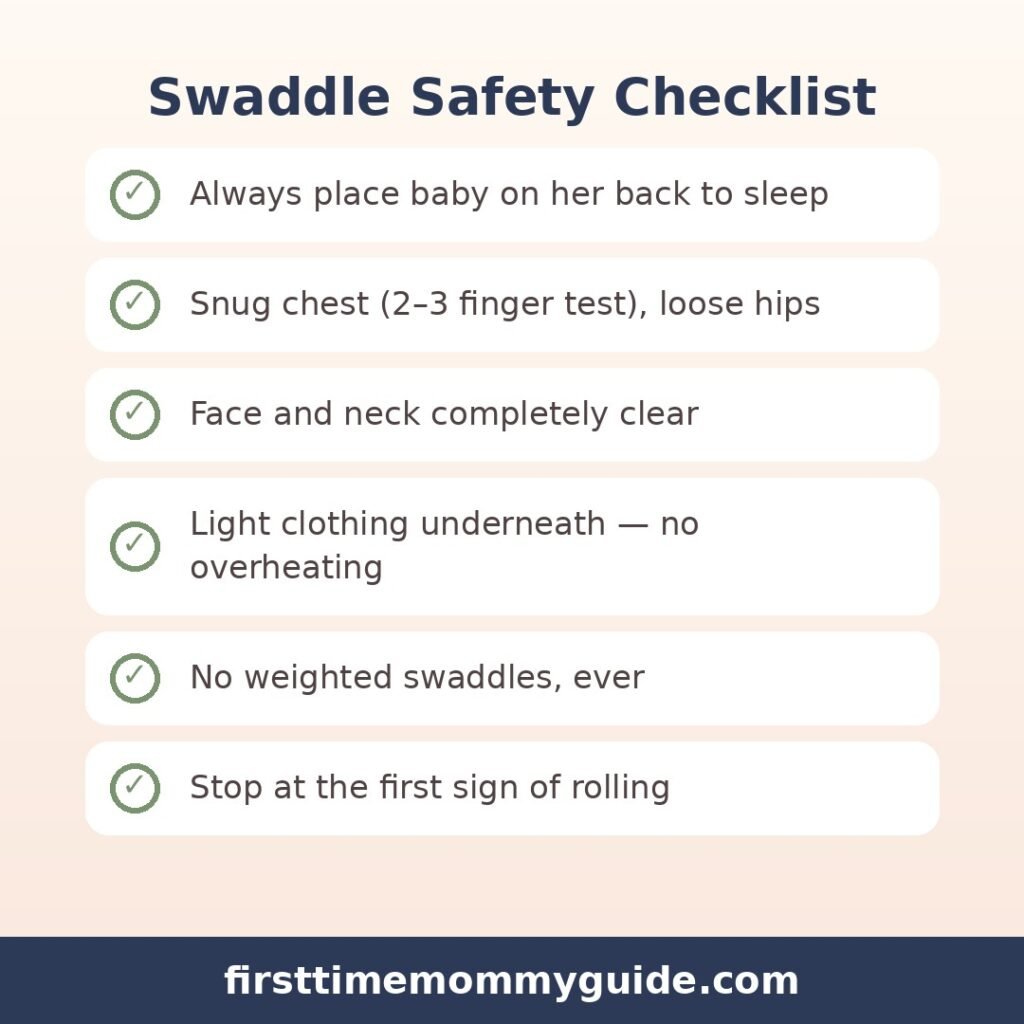
- Back sleeping only. A swaddled baby always sleeps on her back. Never on the side or tummy.
- Face and neck clear. No fabric near her face; she can breathe freely.
- 2–3 finger test. You can slip 2–3 fingers between blanket and chest — snug, not strangling.
- Hip room. Her legs bend up and outward freely; hips aren’t forced straight.
- Not overheated. She’s in light clothing underneath (a onesie is usually enough); her chest feels warm, not hot or sweaty; no flushed cheeks or damp hair.
- Nothing else in the sleep space. Firm flat mattress, fitted sheet, baby — that’s it. No loose blankets, pillows, bumpers, or toys.
Troubleshooting: why your swaddle keeps failing
It unravels in minutes. You’re not wrapping tightly enough around the torso, or the blanket is too small/stretchy in the wrong way. Try a larger blanket, or switch to a Velcro or zip-up swaddle wrap — there’s zero shame in the cheat-code versions.
She fights it and screams louder. Some babies hate having their arms pinned. Try swaddling with arms up (hands near face) instead of arms down, or swaddle with one arm out. If she consistently fights it after a few tries, she may just be a non-swaddle baby — move to a sleep sack.
She startles anyway. The swaddle is probably too loose around the arms. Re-wrap with a firmer chest wrap (still passing the 2–3 finger test).
She’s sweaty. Strip a layer. Swaddling counts as a layer — in a warm room, a diaper plus the swaddle may be enough. Overheating is a genuine safety risk, not just a comfort issue.
Swaddling Safety: The Rules That Matter
Let’s put the safety guidance in one place, because this is the section that actually keeps babies safe:
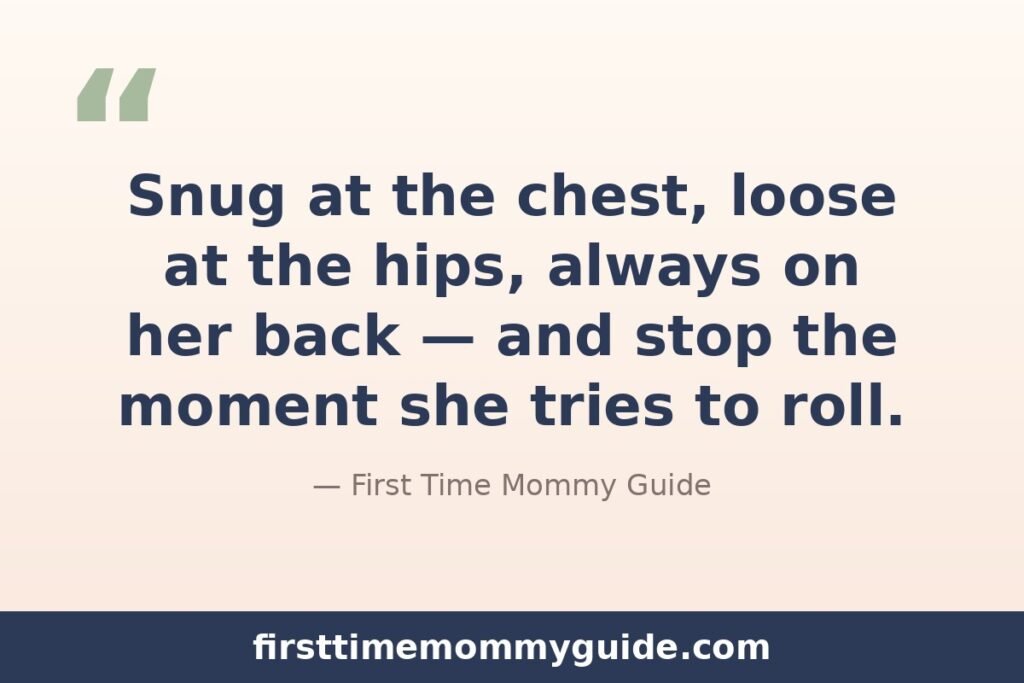
Always back to sleep. Every sleep, every time. A swaddled baby who rolls to her tummy cannot push herself back — which is exactly why the rolling milestone ends swaddling.
Snug at the chest, loose at the hips. Tight leg wrapping is associated with hip dysplasia (the hip joint developing abnormally). The International Hip Dysplasia Institute recommends “hip-healthy swaddling”: legs free to bend up and out.
Stop at the first sign of rolling. Not when she can roll — when she tries. The AAP says swaddling is no longer appropriate once an infant exhibits signs of attempting to roll, which usually occurs at 3–4 months but can happen earlier.
No weighted swaddles, ever. The AAP explicitly warns against weighted swaddles, weighted sleep sacks, and weighted objects on or near the baby.
Don’t overheat. Dress her in no more than one light layer under the swaddle; keep the room 68–72°F (20–22°C); check for sweating, damp hair, or flushed cheeks.
Head and face always free. No hats or hoods on a swaddled sleeping baby indoors, no fabric near the face.
Secure enough not to unravel. A loose swaddle that comes undone becomes loose bedding in the crib — a suffocation risk. If you can’t get it secure, use a purpose-made swaddle wrap.
Quick safety summary
| Rule | Why it matters |
|---|---|
| Back sleeping only | A swaddled baby can’t recover from rolling to tummy |
| Snug chest, loose hips | Prevents breathing restriction and hip dysplasia |
| Stop at first rolling signs (~3–4 months) | Suffocation risk if a swaddled baby rolls prone |
| No weighted products | AAP: not safe, not recommended |
| Avoid overheating | Overheating is a SIDS risk factor |
| Secure wrap, clear face | Unraveled fabric = loose bedding hazard |

Choosing a Swaddle: Blanket vs. Wrap vs. Sleep Sack
You have three main options, and the “best” one is whichever you can wrap securely at 3 a.m.:
Traditional swaddle blankets
Large, thin, breathable squares (muslin, cotton, or bamboo). Pros: versatile, breathable, inexpensive, multi-use. Cons: learning curve; some babies Houdini out of them. What to look for: at least 40×40 inches, lightweight and breathable fabric, no heavy quilting.
Velcro / zip-up swaddle wraps
Shaped wraps with Velcro tabs or zippers. Pros: foolproof, fast, consistent snugness; great for exhausted parents and grandparents. Cons: pricier; baby outgrows sizes quickly. These are the best option if traditional wrapping frustrates you.
Sleep sacks (wearable blankets)
Sleeveless sacks that zip up over pajamas — arms free, legs contained but roomy. Pros: no wrapping skill needed; safe for the whole first year; the natural post-swaddle transition. Cons: don’t suppress the startle reflex as firmly (which is fine after the newborn weeks).
Swaddle vs. sleep sack: when to use which
| Swaddle (blanket/wrap) | Sleep sack | |
|---|---|---|
| Best age | 0–3 months (pre-rolling) | 3–12+ months |
| Arms | Contained (calms startle reflex) | Free |
| Skill needed | Wrapping technique (or Velcro/zip) | Just zip it |
| Safety window | Ends at first rolling signs | Safe through infancy |
| Hip health | Must wrap hips loosely | Naturally roomy |
The smart sequence: swaddle (or swaddle wrap) for the newborn weeks → transition to a sleep sack when rolling signs appear. Many parents keep both on hand from day one.
When to Stop Swaddling: Signs and Timeline
This is the question parents ask most — and the answer is refreshingly clear: stop swaddling as soon as your baby shows any sign of trying to roll over. Not when she completes a roll. Not at a specific birthday. At the first attempt.
Signs it’s time to stop
- She rolls from tummy to back (or tries to) during playtime — this usually comes first, around 3–4 months
- She rolls onto her side while swaddled or in her sleep space
- She breaks out of the swaddle consistently and seems frustrated by it
- She fights the swaddle every time, arching and crying until freed
- She’s past 3–4 months even without clear rolling — most pediatricians advise stopping by 4 months regardless
Why the rule is strict
A swaddled baby’s arms are pinned. If she rolls onto her tummy while swaddled, she cannot push herself back to clear her airway. The AAP is explicit: once rolling is attempted, swaddling “could increase the risk of suffocation if the swaddled infant rolls to the prone position.” This isn’t a gray area — it’s the single most important swaddling rule.
What about naps?
Be consistent: if she’s showing rolling signs, stop swaddling for all sleep — naps and nights. A baby who can roll at 2 a.m. can roll at 2 p.m.
How to Transition Out of the Swaddle
For babies who love being swaddled, quitting cold turkey can mean a few rough nights. A gradual transition is kinder:
Step 1: One arm out (3–5 nights). Swaddle with one arm free. She gets used to having a limb loose while still feeling contained.
Step 2: Both arms out (3–5 nights). Swaddle the torso only, arms completely free. This is essentially a torso wrap — most babies adjust quickly.
Step 3: Sleep sack. Move to a wearable sleep sack. It keeps the cozy contained-legs feeling without restricting the arms she now needs for rolling safely.
Alternative: cold turkey. Some babies genuinely don’t care — you switch to a sleep sack one night and nobody notices. If your baby is in the “fights the swaddle anyway” camp, just make the switch.
Transition tips
- Time it well. Don’t start the transition during a sleep regression, illness, or travel week. (Speaking of which — the 4-month sleep regression often arrives right as swaddling ends. Fun timing, we know.)
- Keep everything else the same. Same bedtime routine, same white noise, same sleep space — only the wrap changes.
- Expect 3–5 bumpy nights. That’s normal adjustment, not failure. Most babies settle within a week.
- Offer extra comfort. A dream feed, extra rocking, or a few minutes of shushing can bridge the gap.
What Research Says About Swaddling
Swaddling isn’t just tradition — it’s been studied, and the findings are worth knowing:
Sleep: Multiple studies find swaddled newborns wake less often from the startle reflex and sleep for longer continuous stretches than unswaddled newborns. The effect is strongest in the first 8–12 weeks.
Crying: Research on soothing techniques (including Dr. Karp’s “5 S’s,” of which swaddling is one) shows combined soothing methods significantly reduce crying duration in fussy newborns. Swaddling alone helps; swaddling plus rhythmic motion and shushing helps more.
Pain response: Studies in hospital settings have found swaddled newborns show calmer physiological responses (steadier heart rate, less crying) during minor painful procedures like heel pricks — evidence that the contained feeling genuinely regulates a newborn’s stress response.
Hip development: The cautionary research is real too — tight leg swaddling has been associated with higher rates of hip dysplasia in populations where straight-leg wrapping is traditional. The protective factor is simple: hips flexed and free. This is why every modern guideline emphasizes the loose-hips rule.
SIDS and arousal: Some researchers note that swaddling slightly reduces arousability from sleep — which is part of why back-sleeping and stopping at rolling are non-negotiable companions to swaddling. The safety rules aren’t arbitrary; they’re the guardrails that keep a helpful practice safe.
The honest summary: swaddling is a well-supported soothing and sleep tool within its safety boundaries. The boundaries are the point.
Special Situations: Twins, Preemies, and Hot Climates
Swaddling twins
Yes, swaddle both — but as individuals, not as a pair. Each baby gets their own wrap and their own sleep surface (the AAP recommends twins sleep on separate surfaces). Twin A may love the swaddle while Twin B stages a nightly jailbreak; that’s normal. Buy a few extra wraps — twin laundry math is unforgiving.
Swaddling preemies
Preemies often spend their first weeks in the NICU, where staff will guide you. Once home and medically cleared, the same technique and safety rules apply — but be extra vigilant about temperature regulation and breathing, and confirm timing with your pediatrician, since “rolling age” follows adjusted age.
Swaddling in hot weather
Swaddling in summer or warm climates is absolutely fine with adjustments: use the thinnest muslin you own, dress baby in just a diaper underneath, keep the room cool (fan + 68–72°F / 20–22°C), and check her neck and chest for sweat every time she wakes. If she’s consistently sweaty, switch to a lightweight sleep sack earlier.
Swaddling and breastfeeding
There’s no conflict — but time feeds around the wrap, not through it. Unswaddle (or loosen) for feeds so she can use her hands and root effectively, then re-wrap for sleep. Many moms find the feed → burp → swaddle → sleep sequence becomes the backbone of the newborn routine.
When baby is sick
Skip the swaddle when your baby has a fever — she needs to release heat, not trap it. A light sleep sack or just pajamas is safer until the fever passes. Same goes for any illness where you’re monitoring her breathing or temperature closely.
Swaddling FAQs: The Questions Every New Parent Asks
Arms up or arms down — which is better?
Whichever your baby prefers. Arms-down (classic) contains the startle reflex most firmly. Arms-up (hands near face) lets babies self-soothe by sucking their hands and suits babies who fight the classic wrap. Many Velcro swaddles offer both positions. There’s no medically “correct” choice — watch your baby.
How tight should a swaddle be?
Snug around the chest and arms — firm enough not to unravel — but passing the 2–3 finger test (you can slip 2–3 fingers between blanket and chest). Around the hips and legs: loose, with full freedom to bend. Tight = chest; loose = hips. That’s the whole formula.
Can I swaddle with a regular blanket?
Yes, if it’s thin, breathable, and large enough (40+ inches square). Avoid thick quilts, heavy fleece, or small receiving blankets that unravel easily. Muslin is the gold standard for a reason.
Is it okay if my baby sleeps with arms out from day one?
Yes. Some newborns simply prefer it. An arms-out swaddle (torso wrapped, arms free) or a newborn-size sleep sack are both fine from birth as long as all other safe-sleep rules are followed.
How many swaddles do I need?
4–6 blankets or 2–3 wraps in the newborn size. Blowouts and spit-up go through them fast, and you’ll want clean ones while others are in the wash.
Can swaddling cause hip dysplasia?
Improper swaddling — wrapping the legs tightly straight — can contribute to hip problems. Hip-healthy swaddling (legs bent up and out, free to move) does not. If your baby was breech or has a family history of hip dysplasia, mention swaddling technique at your pediatrician visits.
Should I swaddle for naps or just nighttime?
Both, in the newborn weeks — consistency helps her learn that swaddle = sleep. Once rolling signs appear, stop for both.
My baby hates being swaddled. Now what?
She’s telling you something — listen. Try arms-up, one-arm-out, or skip straight to a sleep sack. Plenty of babies sleep beautifully unswaddled from day one. The “must swaddle” advice is a guideline, not a law.
Can I swaddle a preemie?
Check with your NICU team first. Preemies often need extra monitoring for temperature and breathing, and swaddling guidance may differ. Once home and cleared, the same safety rules apply.
Does swaddling increase SIDS risk?
Correct swaddling (back sleeping, not overheated, stopped at rolling) is not associated with increased SIDS risk. What does raise risk: swaddled babies placed on tummies or sides, overheating, and continuing to swaddle after rolling begins. Follow the rules in this guide and you’re in safe territory.
When can I stop worrying about the transition?
Most babies are fully adjusted to the sleep sack within a week. If sleep falls apart for longer than 10–14 days after stopping the swaddle, look for other culprits — the 4-month sleep regression, teething, or a schedule issue — rather than blaming the unswaddling.
Is it safe to swaddle with a blanket in the crib?
The swaddle is the blanket — worn snugly on the baby, not lying loose. That’s the distinction. A secure swaddle on a back-sleeping baby is fine; any additional loose blanket in the crib is not. Once she outgrows the swaddle, the sleep sack replaces it — still no loose blankets until after the first birthday.
Can I double-swaddle for extra snugness?
No need — one secure layer is enough, and doubling up adds overheating risk. If one layer won’t stay put, the blanket is too small or too slippery; size up or switch to a Velcro/zip wrap instead of adding layers.
My baby sleeps longer unswaddled — should I still swaddle?
No! Longer sleep is the goal, and your baby just told you how she gets there. Swaddling is a tool, not a requirement. Move to a sleep sack and enjoy the extra sleep.
Do I need to swaddle during the day?
Only for sleep. Awake babies need free movement — tummy time, kicking, stretching, and skin-to-skin all build strength and development. Think of the swaddle as pajamas: for sleep times only.
What if grandparents swaddle differently?
Show them this guide — or better, do one supervised practice run together. The non-negotiables to communicate: back sleeping, snug chest / loose hips, head free, and stop at rolling signs. Everything else is style.
Can swaddling help with the startle reflex during the day?
For naps, yes — same technique. For awake time, no — let her startle, flail, and learn. The Moro reflex fades on its own by 4–6 months, and awake practice helps her nervous system mature.
How long can my baby stay swaddled at a stretch?
As long as a normal sleep stretch — there’s no separate time limit. Newborns sleep 2–4 hours at a time, and staying swaddled through a full nap or night stretch is fine. The rule is about developmental stage (stop at rolling signs), not about hours per session. Just make sure she gets plenty of unswaddled floor and tummy time while awake.
Swaddling Mistakes to Avoid
- Continuing past rolling signs. The #1 safety mistake. When in doubt, stop early — a few nights of adjustment beats the risk.
- Wrapping the legs straight and tight. Frog legs, always. Hips need room.
- Overdressing underneath. The swaddle is a layer. Onesie + swaddle in a 70°F room is plenty; footie pajamas + swaddle + warm room = overheating.
- Covering the head. Never. Heads stay out for temperature regulation and breathing.
- Using weighted swaddles. Explicitly not recommended by the AAP. Skip them entirely.
- Side or tummy sleeping “because she sleeps better.” She might — and it’s not worth the risk. Back sleeping, every time.
- Leaving a loose, unraveling swaddle in the crib. If it won’t stay wrapped, it’s loose bedding. Re-wrap or switch to a Velcro/zip wrap.
- Swaddling all day long. Babies need unswaddled awake time — tummy time, kicking, stretching, skin-to-skin. Swaddling is for sleep, not for storage.
Swaddle blanket care (so they last)
Wash new muslin blankets before first use — they get softer with every wash. Skip fabric softener (it reduces breathability), wash on warm, and tumble dry low or line dry. Inspect Velcro tabs regularly; worn Velcro that won’t grip is a sign to replace the wrap, since a swaddle that won’t stay closed is a swaddle that shouldn’t be used.
The Bottom Line
Swaddling is beautifully simple when you know the formula: diamond, fold, baby down, wrap-tuck-fold-wrap-tuck, safety check. Snug at the chest, loose at the hips, back to sleep, head free — and the moment she starts thinking about rolling, the swaddle retires and the sleep sack takes over.
Don’t stress about hospital-nurse perfection. A slightly lopsided swaddle that passes the safety check beats a Pinterest-perfect one that unravels. And if your baby turns out to be a proud member of the anti-swaddle club? Congratulations — you just skipped a transition entirely.
One more thing, mama: the fact that you’re reading a step-by-step guide to wrapping your baby safely instead of just winging it? That’s exactly the kind of careful, loving parent she got. She’s in good hands — snug, safe, frog-legged hands.
This article is for information only and isn’t medical advice. For questions about your baby’s sleep, hips, or development, talk to your pediatrician. Safe sleep guidance referenced from the American Academy of Pediatrics 2022 recommendations.

Dilawar Mughal
Founder and editor, First Time Mommy Guide
I research every guide against what the NHS, the AAP and the WHO publish, then write it in plain English — because most new parents are reading with one hand free, not comparing clinical guidelines. I'm not a doctor or a midwife. Every health claim on this site is sourced and linked so you can check it yourself, and anything urgent belongs with your health visitor or GP, not a blog.