General information, not medical advice. Every baby is different — if anything worries you, speak to your midwife, health visitor or GP rather than waiting.
You made a beautiful bowl of sweet potato and lentils. Your baby took one look, turned their head, and clamped their mouth shut. Yesterday they loved it. Today it is the enemy. If this sounds familiar, you are not alone.
Picky eating is one of the most common worries for parents of babies and toddlers. It can make every mealtime feel like a negotiation. It can also make you question yourself. Are you doing something wrong? Is your baby getting enough nutrients? Will they ever eat a vegetable again?
Take a deep breath. Most picky eating in babies and toddlers is a normal part of development. It does not mean you have failed. It does not mean your baby will be a fussy eater forever. With patience, the right approach, and a calm mealtime routine, most babies gradually expand what they eat.
This guide explains why babies become picky eaters, what is normal at each age, and what actually helps. You will find practical tips for encouraging eating, foods worth trying, mistakes to avoid, and clear guidance on when to talk to your paediatrician.
Quick Answer: Why Is My Baby a Picky Eater? Most babies become picky eaters because of normal development. Around 12 to 24 months, babies naturally become wary of new foods — a phase called food neophobia — and their growth slows, so their appetite drops. Teething, illness, tiredness, texture sensitivity, and pressure at mealtimes can all make refusal worse. The best approach is to keep offering a variety of foods without forcing, let your baby decide how much to eat, and repeat exposure many times. The American Academy of Pediatrics (AAP) and the NHS both note that repeated, calm exposure to new foods is normal and important, and that most picky phases pass with time. If your baby is losing weight, eats fewer than a handful of foods, or shows signs of a feeding difficulty, talk to your paediatrician.
What Is Picky Eating, Really?
Picky eating means a baby or toddler refuses certain foods, eats only a small range of foods, or rejects foods they used to enjoy. It can look different from one child to the next. Some babies refuse all green foods. Others will only eat pasta and bananas. Some eat well at breakfast and refuse everything by dinner.
It is important to know what picky eating is not. It is not the same as a food allergy. An allergy causes a physical reaction, such as a rash, swelling, or vomiting. Picky eating is a behaviour, not an immune response. It is also not the same as a serious feeding disorder, although the two can overlap and a paediatrician can help you tell them apart.
Most picky eating is selective, not total. Your baby may reject broccoli but happily eat carrots, peas, and sweet potato. That is still a varied diet, even if it feels narrow. True refusal of all foods is rare, and it is a reason to seek help quickly.
It also helps to separate picky eating from a low appetite. Babies eat less when they are unwell, teething, tired, or simply not hungry. A baby who skips one meal is not necessarily a picky eater. The pattern matters more than any single meal.
Is Picky Eating Normal? What Development Tells Us
Yes, picky eating is very common and usually normal. Many parents are surprised to learn that fussiness about food is a predictable stage of development, not a parenting failure.
In the first year, most babies are open to new tastes. They will try almost anything you offer, often with enthusiasm. This is a window of opportunity. The AAP and NHS both encourage introducing a wide variety of flavours and textures during weaning, because early exposure helps build acceptance later.
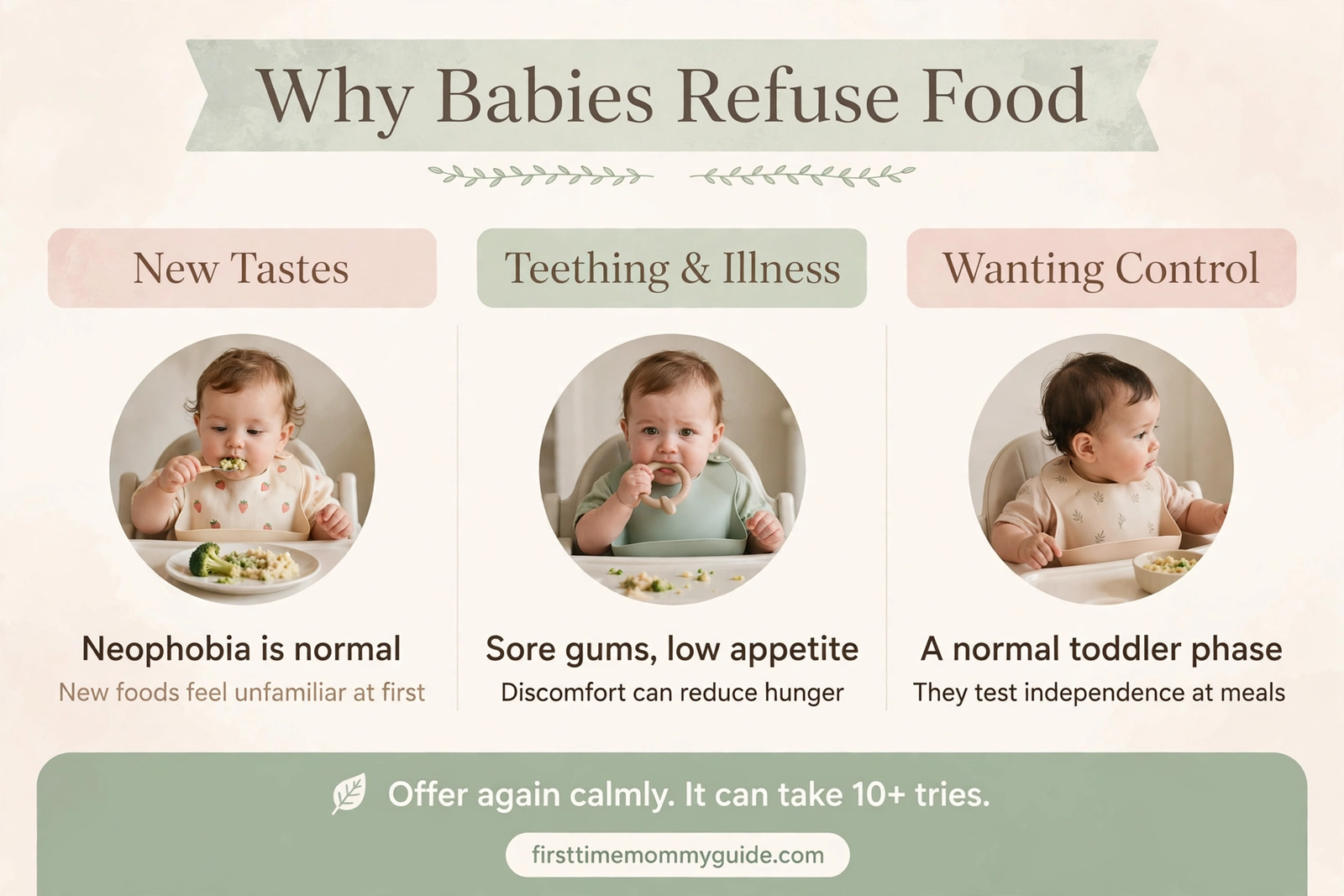
Then something changes. Around 12 to 18 months, many toddlers start refusing foods they once ate happily. This is the age when food neophobia peaks. Neophobia is a natural wariness of new or unfamiliar foods. It is thought to be an evolutionary safety mechanism. Once babies could walk and pick things up for themselves, caution about unknown foods kept them safe.
At the same time, growth slows down. A baby's first year involves rapid growth and a big appetite. In the second year, growth slows, and appetite drops with it. Your toddler simply needs less food than they did as a baby. Parents often interpret this smaller appetite as pickiness, when it is actually normal.
Toddlers are also developing independence. Saying "no" to food is one of the first ways they exercise control. Food refusal can be less about the food and more about autonomy. Your toddler is learning that they can choose, and they are testing that power at the table.
None of this means you should ignore picky eating. It means you can relax about it. The phase is normal, and your job is to guide your child through it calmly, not to force your way out of it.
Picky Eating by Age: What to Expect
Picky eating changes as your baby grows. What is normal at six months is different from what is normal at two years. The table below shows what to expect at each stage.
Picky Eating by Age
| Age | What is normal | Common triggers |
|---|---|---|
| 6–9 months | Eager to try most foods; some gagging on new textures is normal | New textures, lumps, strong flavours, tiredness at meals |
| 9–12 months | Preferences emerge; may reject foods they ate before | Teething, illness, wanting to self-feed, strong flavour preferences |
| 12–18 months | Food neophobia begins; appetite drops as growth slows | New foods, mixed textures, wanting independence, less hunger |
| 18–24 months | Strong opinions; may eat only a few favourite foods | Neophobia peaks, autonomy, routine changes, nursery or daycare |
| 2–3 years | Narrow food range is common; likes and dislikes change weekly | Power struggles, pressure at meals, snacking too close to meals |
| 3+ years | Most children gradually widen their diet; some remain selective | Habit, sensory sensitivities, family mealtime patterns |
If your baby is under twelve months and refusing solids, the cause is often different from toddler pickiness. Young babies may need more time with textures, or they may be full from milk. Our guide to signs your baby is ready for solid foods can help you check whether the timing is right.
The 6 to 12 Month Stage
In the early months of weaning, refusal is usually about texture or timing rather than taste. A baby who gags on lumps is not being fussy. They are learning how to move food around their mouth. Gagging is a normal reflex that protects the airway. It usually fades as your baby gains experience.
Some babies refuse a food once and accept it the next day. Others need many exposures before they accept it. This is normal. Keep offering small amounts alongside foods they already like. Do not remove the rejected food from the menu entirely.
The 12 to 24 Month Stage
This is the peak picky period for most families. Neophobia is at its strongest, appetite has dropped, and independence is rising. Your toddler may eat three spoonfuls and declare themselves done. They may eat only beige foods for a week. They may refuse a food they loved yesterday.
This stage tests every parent's patience. It helps to remember that your toddler's stomach is small — roughly the size of their fist. A few spoonfuls can genuinely be enough. Focus on what they eat across a whole week, not a single meal.
The 2 to 3 Year Stage
By two or three, many children have a clear set of likes and dislikes. They may insist on the same meal every day. They may separate foods on their plate and refuse anything that touches. This is still within the range of normal, especially if they eat foods from several food groups.
At this age, social influences start to matter too. Toddlers watch what siblings, friends, and parents eat. Eating together as a family becomes a powerful tool. Your child is more likely to try a food they see you enjoying.
Why Is My Baby a Picky Eater? The Main Causes
There is rarely a single cause. Picky eating usually comes from a combination of development, physical factors, and mealtime dynamics. Understanding the cause helps you choose the right response.
1. Food Neophobia
Neophobia is the fear or wariness of new foods. It is strongest between 18 months and 2 years, and it is a normal developmental phase. Your toddler is not being difficult. Their brain is doing what it evolved to do: treating unfamiliar foods with caution.
Neophobia can make your child reject a food before even tasting it. The colour, shape, or smell may be enough to trigger a refusal. This is why repeated exposure matters so much. Each time your child sees a food on the table, it becomes a little less unfamiliar. Over time, familiarity turns into willingness to taste.
2. Slower Growth and Lower Appetite
After the first birthday, growth slows sharply. A toddler may gain only a few kilograms in their entire second year. Their calorie needs drop accordingly. Many parents expect their toddler to eat as much as they did as a baby, and worry when they do not.
This mismatch between expectation and reality is one of the biggest drivers of mealtime stress. If your baby is growing steadily along their own curve and is active and well, a smaller appetite is usually fine. Your health visitor or paediatrician can confirm this at check-ups.
3. Teething
Teething can turn a good eater into a reluctant one overnight. Sore gums make chewing painful. Some babies refuse hard or chewy foods and prefer soft, cool foods instead. Others refuse food altogether for a few days during a bad teething spell.
This type of pickiness is temporary. It should pass once the tooth comes through. Offer soft foods, chilled fruit, yoghurt, and smoothies during teething. Do not worry if your baby eats less for a few days. For more on normal patterns, see our guide to baby growth spurts, which explains why appetite naturally rises and falls.
4. Illness and Recovery
A baby with a cold, an ear infection, or a stomach bug often eats very little. Congestion changes how food tastes and smells. A sore throat makes swallowing uncomfortable. Nausea kills appetite completely. After an illness, appetite can take a week or more to return to normal.
Do not push food during illness. Offer fluids, milk, and small amounts of easy foods. Appetite usually returns on its own. If your baby refuses fluids as well as food, or seems unusually lethargic, contact your paediatrician promptly.
5. Sensory Sensitivities and Texture Aversions
Some babies are more sensitive than others to the feel of food in their mouth. A texture that feels fine to you may feel strange or unpleasant to them. Lumpy, slimy, sticky, or mixed textures are the most common triggers. A baby who loves smooth purees may gag on mashed food with lumps.
Texture aversion is not stubbornness. It is a genuine sensory experience. The answer is gradual exposure, not force. Offer the texture in tiny amounts alongside familiar foods. Let your baby touch and play with it first. Many children outgrow texture sensitivities as their oral motor skills mature.
If texture aversion is severe — your baby gags or vomits with most textures, refuses entire food groups, or cannot progress beyond smooth purees well into toddlerhood — talk to your paediatrician. A feeding therapist or occupational therapist can help.
6. Gagging
Gagging is common when babies encounter new textures. The gag reflex sits further forward in a baby's mouth than in an adult's, so it triggers easily. Gagging is noisy and dramatic, but it is not choking. Your baby is learning to manage food in their mouth.
Gagging becomes a problem when it happens so often that your baby starts to fear eating. If your baby gags every time they try a lump, they may begin to refuse food altogether. In that case, step back to smoother textures for a while, then reintroduce lumps very gradually. Let your baby control the pace.
7. Pressure and Power Struggles
This is the cause parents can influence most. When adults pressure a baby to eat — coaxing, bribing, pleading, or forcing spoonfuls — the baby often pushes back harder. Mealtimes become a battle. The baby learns that refusing food gets a big reaction, and the refusal becomes a habit.
Pressure can take subtle forms. "Just one more bite." "No pudding until you finish your vegetables." "Mummy will be sad if you don't eat." All of these link food to emotion and control. The research on feeding is clear: pressure backfires. Children who are pressured to eat tend to eat less of the pressured food and develop more negative feelings about it.
8. Too Many Snacks or Too Much Milk
A baby who fills up on milk or snacks has little appetite left for meals. This is one of the most common and most fixable causes of picky eating. Toddlers who drink large amounts of milk, juice, or snack constantly through the day often refuse dinner simply because they are not hungry.
The NHS advises that toddlers need only about 350 ml of milk a day after twelve months, and that water should be the main drink between meals. Our guide to introducing a sippy cup to your baby can help you shift towards water and regular meal patterns. Keep snacks structured — a morning snack and an afternoon snack — rather than grazing all day.
9. Tiredness and Timing
A tired baby does not eat well. If dinner is served at 6 p.m. and your baby is already overtired, they will refuse food no matter how delicious it is. Mealtimes that clash with nap times or bedtime are a common cause of refusal.
Try moving meals earlier, or offering the main meal at lunch when your baby is freshest. Keep mealtimes short — around 20 to 30 minutes. A baby who sits at the table for an hour will become restless and frustrated.
10. Changes and Stress
Big changes can disrupt eating. Starting nursery, moving house, a new sibling, a holiday, or a change in caregiver can all make a baby clingier and fussier about food. This is usually temporary. Keep mealtimes as calm and predictable as possible during transitions, and offer familiar favourites alongside new foods.
Picky Eating vs Normal Development: How to Tell the Difference
Not every refusal is picky eating. Sometimes your baby is simply being a baby. This table can help you tell the difference between normal fussiness and something that needs attention.
| Behaviour | Usually normal | Worth discussing with a doctor |
|---|---|---|
| Refuses a food sometimes | Yes — tastes change daily | No |
| Eats only a few favourites for a week | Yes — very common in toddlers | No, if they eat from more than one food group |
| Refuses a whole food group (e.g. all vegetables) | Often normal for a phase | Yes, if it lasts many months |
| Eats fewer than 10 foods in total | Sometimes, in toddlers | Yes — especially if the list keeps shrinking |
| Gags occasionally on new textures | Yes — a normal reflex | No, unless it happens with every texture |
| Gags or vomits with most foods | No | Yes — seek advice |
| Skips meals but eats at others | Yes — appetite varies | No |
| Refuses all food and fluids | No | Yes — seek help promptly |
| Losing weight or dropping growth percentiles | No | Yes — see your paediatrician |
| Coughing or choking often while eating | No | Yes — seek advice |
If your baby is otherwise well, growing, and eating some variety, the fussiness is most likely normal. If several items in the right-hand column apply, book an appointment. Trust your instincts. You know your baby best.
The Division of Responsibility: Your Job and Your Baby's Job
One of the most helpful frameworks for picky eating comes from feeding specialist Ellyn Satter. It is called the Division of Responsibility, and it is widely recommended by paediatric dietitians.
The idea is simple. You decide what food is offered, when meals happen, and where your baby eats. Your baby decides whether to eat, and how much. That is all. You do not decide how much your baby eats. Your baby does not decide what is on the menu.
This sounds simple, but it is hard in practice. It means offering broccoli without insisting your baby eats it. It means letting your baby leave food on the plate. It means trusting that your baby knows their own hunger.
Parents who follow this approach often find mealtimes become calmer within a few weeks. The power struggle disappears because there is nothing to struggle over. Your baby cannot refuse a food you are not forcing. Over time, most children start trying foods on their own terms.
How to Apply It at Home
You choose the menu. Offer a balanced meal with at least one food you know your baby likes. This guarantees there is something they can eat, and it takes the pressure off the new food.
You set the schedule. Meals and snacks happen at roughly the same times each day. Your baby learns that food is available at these times, and that the kitchen is closed in between.
Your baby chooses how much. Do not comment on how much they eat. Do not praise a clean plate or criticise a full one. Let the amount be their decision.
You stay neutral. If your baby refuses a food, say nothing or say something calm like, "That's okay, it's here if you want it." Then move on. Your reaction is the reward. A big reaction to refusal teaches your baby that refusal works.
Repeated Exposure: The Secret That Actually Works
If there is one evidence-based strategy for picky eating, it is this: keep offering the food. Children often need to see a new food many times before they will taste it, and taste it many times before they accept it. The AAP and NHS both emphasise that repeated exposure is normal and necessary.
Research and clinical guidance suggest that children may need ten or more exposures to a new food before accepting it. For some children it takes more. This does not mean ten forced bites. It means ten calm, low-pressure encounters with the food on the table.
What Counts as Exposure
Exposure does not have to mean eating. Every one of these counts:
- Seeing the food on your plate while you eat it.
- Having the food on their plate, even if they do not touch it.
- Touching, squashing, or smearing the food.
- Smelling it or licking it.
- Taking one tiny bite and spitting it out.
- Watching a sibling or parent enjoy it.
Each of these steps makes the food more familiar. Familiarity reduces neophobia. Over time, familiarity leads to tasting, and tasting leads to liking. The process is slow, but it works.
How to Offer Without Pressure
Offer the new food in a very small amount — one pea, one sliver of carrot, one tiny piece of chicken. A big pile is overwhelming. A tiny amount is easy to ignore or try.
Put the new food next to a favourite food. Your baby can eat the favourite and see the new food beside it. There is no demand. The food is simply there.
Do not make a separate meal for a picky eater. Serve the same meal to the whole family, with one safe food included. Making a special meal teaches your baby that refusing the family meal gets them something better.
Rotate rejected foods back onto the menu every week or two. Do not drop a food after three refusals. It may take ten or more tries. Keep a simple note of what you have offered and when, so you do not lose track.
Food Play: Let Your Baby Get Messy
For babies and young toddlers, playing with food is learning. When your baby squashes a pea, smears avocado, or drops pasta on the floor, they are exploring texture, temperature, and smell. This sensory play is a step towards eating.
Many parents find food play stressful. It is messy, and it feels wasteful. But food play is one of the most effective ways to help a picky eater become comfortable with new foods. A baby who has played with broccoli is far more likely to taste it than a baby who has only seen it on a spoon.
Ways to Encourage Food Play
Let them touch their food. Offer finger foods they can pick up, squash, and explore. Resist the urge to wipe their hands after every touch.
Cook together. Toddlers can wash vegetables, tear lettuce, stir a bowl, or sprinkle cheese. Children are far more likely to eat food they helped to make.
Use dips. A dip turns a vegetable into an activity. Hummus, yoghurt, and mashed avocado are all good options. Let your baby dip a carrot stick or a piece of cucumber and explore the taste.
Make food fun, not a performance. You can cut food into fun shapes or arrange it into a face on the plate. But do not turn every meal into entertainment. The goal is a relaxed attitude to food, not a show.
Eat together. Sit down and eat the same food at the same time. Your baby learns by watching you. If they see you enjoying a food, they are more likely to try it.
Involving Your Baby in Meals
Babies and toddlers who feel involved in food are more willing to eat it. Involvement gives them a sense of control, which reduces the need to exert control by refusing.
Let your toddler choose between two options: "Would you like carrots or peas today?" Either answer is a win. They have chosen, and they are more likely to eat what they picked.
Take your toddler shopping with you. Let them hold a vegetable, smell a fruit, or pick a food from the shelf. Talk about colours and shapes. This is exposure, disguised as an outing.
Grow something simple if you can. Even a pot of herbs on a windowsill gives a toddler a connection to food. Children who grow peas or tomatoes are famously more willing to eat them.
What to Serve a Picky Eater (and How to Serve It)

You do not need special "picky eater" recipes. You need family food, served in a way your baby can manage. The NHS and WHO both recommend a varied diet with foods from all the main groups: fruits and vegetables, starchy foods, protein, and dairy.
Foods Worth Trying Again and Again
Vegetables: sweet potato, carrots, peas, broccoli, courgette, cauliflower, butternut squash, green beans, cucumber, avocado, sweetcorn, peppers.
Fruits: banana, blueberries, strawberries, mango, pear, apple (cooked or very thinly sliced), melon, peaches, raspberries, kiwi.
Protein: chicken, turkey, beef, fish, eggs, lentils, chickpeas, beans, tofu, nut butters (smooth, thinly spread, and only if no allergy has been identified).
Dairy and alternatives: full-fat yoghurt, cheese, milk (as a drink after twelve months, or in cooking before that).
Starchy foods: pasta, rice, bread, oats, potatoes, couscous, pitta, crackers.
How to Serve Foods to a Fussy Baby
| Food group | Baby-friendly way to serve | Why it helps |
|---|---|---|
| Vegetables | Roasted sticks, steamed florets, mashed with butter | Soft textures are easier; roasting adds sweetness |
| Fruits | Soft pieces, mashed, mixed into yoghurt or porridge | Sweetness is familiar; mixing reduces newness |
| Protein | Small strips, meatballs, shredded chicken, scrambled egg | Finger foods give control; small pieces are less daunting |
| Dairy | Yoghurt with fruit, cheese cubes, cheese on toast | Familiar flavours; easy to eat independently |
| Starchy foods | Pasta shapes, rice cakes, toast fingers, oat porridge | Comforting and predictable; good carriers for other foods |
Hiding Vegetables: Does It Work?
Blending vegetables into sauces and pasta is a common tactic. It can help your baby get nutrients in the short term. But it does not teach them to like vegetables. If you hide vegetables, also offer them visibly. Your baby needs to see, touch, and taste the real food to learn to accept it.
Use hidden vegetables as a nutritional top-up, not as the whole strategy. The visible exposure is what builds long-term acceptance.
Sample Day of Meals for a Picky Toddler
Breakfast: porridge with banana and a spoonful of yoghurt, or toast fingers with smooth peanut butter and sliced strawberries.
Mid-morning snack: a rice cake and a few blueberries, with water.
Lunch: pasta shapes with a tomato and lentil sauce, a few steamed carrot sticks, and a cheese cube. Offer a small piece of cucumber on the side.
Afternoon snack: a small pot of yoghurt and a banana, or oatcakes with cream cheese.
Dinner: chicken strips, mashed sweet potato, and peas. Offer one floret of broccoli on the plate, with no expectation that it will be eaten.
Before bed: milk, as usual.
Notice that each meal includes a safe food and a new or less-liked food. That is the pattern. Safe food plus exposure food, every meal, without pressure.
How to Get Your Baby to Eat Vegetables
Vegetables are the food group parents worry about most. They are also the group most babies resist. Here is a practical approach that works for many families.
Start with naturally sweet vegetables. Sweet potato, carrots, peas, and butternut squash are sweeter than green vegetables and are usually accepted more easily. Once your baby accepts these, move to milder greens such as courgette and green beans, and then to stronger flavours such as broccoli and spinach.
Roast vegetables instead of boiling them. Roasting brings out sweetness and gives a softer, more appealing texture. A roasted carrot stick is very different from a boiled one. Try both and see which your baby prefers.
Offer vegetables first, when your baby is hungriest. A small portion of vegetables at the start of the meal, before the pasta or bread arrives, can work well. But do not make it a rule or a battle. If they refuse, move on.
Let your baby dip vegetables. Hummus, yoghurt, or a mild cheese sauce can make a raw carrot stick or a cucumber slice more appealing. Dips give your baby control and turn eating into an activity.
Keep offering. If your baby rejects broccoli today, offer it again next week. And the week after. It may take ten or more exposures. That is normal, not a failure.
And remember that fruit counts too. The nutrients in vegetables are important, but fruit provides many of the same vitamins. A baby who eats fruit but not vegetables is still getting a good range of nutrients. Keep working on vegetables calmly, without panic.
Step-by-Step: A Calm Mealtime Routine
A predictable routine helps picky eaters more than any single food trick. Here is a simple routine you can follow.
Step 1: Set a regular schedule. Offer three meals and two snacks at roughly the same times each day. Your baby's body learns when food is coming, and hunger arrives on schedule.
Step 2: Limit milk and juice before meals. Offer milk or a snack at least an hour before a meal, so your baby arrives hungry. Water is fine at any time.
Step 3: Sit together. Eat at the table as a family whenever you can. Turn off the television and put phones away. Mealtimes work best when they are social and calm.
Step 4: Serve a small portion. A small portion is less overwhelming than a large one. Your baby can always ask for more. A plate piled high can put a picky eater off before they start.
Step 5: Include one safe food. Every meal should contain something you know your baby will eat. This takes the pressure off the rest of the plate.
Step 6: Let your baby eat, or not eat. Do not coax, bribe, or comment on how much they eat. Let them decide. If they eat nothing, stay calm.
Step 7: End the meal after 20 to 30 minutes. When the time is up, clear the plates without a fuss. Do not offer an alternative meal or a snack straight afterwards. The next meal or snack will come at its usual time.
Step 8: Stay consistent. Follow the same routine every day. Consistency builds security, and security builds willingness to try new foods.
What NOT to Do With a Picky Eater
Some common tactics make picky eating worse, even when they come from love. Avoid these.
Do not force food into your baby's mouth. Forcing a spoon past closed lips teaches your baby that mealtimes are unsafe. It can also cause gagging and choking. Never force a bite.
Do not bribe with pudding. "Eat your vegetables and you can have ice cream" teaches your baby that vegetables are a chore and pudding is the reward. It makes vegetables less appealing, not more.
Do not make a separate meal. Cooking a different meal for your picky eater rewards refusal. It teaches your baby that saying no gets them their favourite food. Serve the family meal, with one safe food included.
Do not use food as a reward or punishment. Taking away a favourite food as a punishment, or offering sweets as a reward for good behaviour, links food to emotion. Food should be neutral, not a bargaining tool.
Do not chase your baby with a spoon. Following a toddler around the house with food turns eating into a game of avoidance. Meals happen at the table, sitting down, for a set time. If your baby will not sit, the meal is over.
Do not comment on every bite. "Good girl, you ate a carrot!" sounds positive, but it turns eating into a performance. Your baby starts eating for praise rather than hunger. Stay neutral and let eating be its own reward.
Do not compare your baby to other children. Every child eats differently. Comparing your baby to a cousin or a friend's child who "eats everything" only adds stress. Your baby's pace is their own.
Do not offer food as comfort for every upset. It is natural to soothe a crying baby, but using food every time teaches your baby to eat when they are sad rather than hungry. Offer a cuddle, a toy, or a change of scene first.
If your baby is already refusing most solids, our guide on why your baby won't eat covers the common reasons and first steps in more detail.
Mistakes to Avoid
Beyond the clear don'ts, there are quieter mistakes that keep picky eating going.
The first is giving up on a food too soon. Parents often offer a food two or three times, conclude their baby hates it, and never serve it again. Most children need many more exposures than that. Keep offering rejected foods regularly.
The second is serving too much at once. A plate loaded with five new foods is overwhelming. Offer one new food at a time, alongside familiar favourites. Small steps build confidence.
The third is letting snacks replace meals. A toddler who grazes on crackers, biscuits, and fruit pouches all day will not be hungry at dinner. Structured meals and snacks protect appetite. Keep snack times fixed and modest.
The fourth is making mealtimes too long. An hour at the table is too long for a baby or toddler. After 20 to 30 minutes, attention fades and frustration grows. End the meal calmly and move on.
The fifth is changing the rules when you are tired. It is tempting to give in and offer a favourite food after a refusal, just to get something into your baby. Everyone does this sometimes. But if it becomes the pattern, your baby learns that refusing works. Stay as consistent as you can, and forgive yourself on the hard days.
The sixth is ignoring your own stress. If you dread mealtimes, your baby will sense it. Babies are remarkably good at reading tension. Take care of yourself too. Eat well, get support, and remember that this phase will pass.
When Picky Eating Is About Texture: Baby-Led Weaning and Finger Foods
Some babies refuse food because of how it feels, not how it tastes. If your baby gags on lumps, spits out mixed textures, or refuses anything that is not smooth, texture may be the issue.
Baby-led weaning can help some texture-sensitive babies, because it lets them control what goes into their mouth and how fast. Holding a piece of food, feeling it, and biting off a piece they can manage gives them confidence. Our baby-led weaning guide for beginners explains how to start safely, including which foods to offer first and how to reduce choking risk.
If you are using spoon-feeding, move through textures gradually. Start smooth, then move to mashed with soft lumps, then to minced and chopped foods. Do not rush the stages. Let your baby spend a few weeks at each one. Offer finger foods alongside purees so your baby can practise chewing.
Always supervise your baby while they eat. Sit them upright in a highchair, and never leave them alone with food. Cut round foods such as grapes, cherry tomatoes, and blueberries into quarters. The NHS provides clear guidance on safe food preparation and choking prevention for babies and toddlers.
Tracking Growth and Nutrition
One of the biggest worries for parents of picky eaters is whether their baby is getting enough nutrition. Growth is the best guide. If your baby is growing steadily along their own curve, is active, alert, and developing normally, they are almost certainly getting enough.
What to Watch
Weight and height. Your health visitor or paediatrician will plot these at check-ups. A baby who follows their own curve, even a low one, is usually fine. A baby who drops across two or more centile lines needs a closer look.
Energy and mood. A well-nourished baby is alert, active, and interested in play. A baby who is constantly tired, pale, or listless should be checked by a doctor.
Development. Eating is part of development. A baby who is meeting milestones — sitting, crawling, babbling, and exploring — is usually doing well overall.
Variety across the week. Do not judge your baby's diet by one meal. Look at the whole week. If they eat foods from most groups across the week, even in small amounts, their diet is probably adequate.
When Supplements Might Help
Most babies do not need supplements if they eat a varied diet. However, the NHS recommends a daily vitamin D supplement for babies and young children, and some children may need iron or other supplements if their diet is very limited. Never start a supplement without discussing it with your paediatrician or health visitor first. They can check whether your baby needs one and which dose is safe.
Keeping a Food Diary
If you are worried, keep a simple food diary for a week. Write down what your baby eats and drinks, and how much. Bring it to your paediatrician or health visitor appointment. It is often reassuring to see, in writing, that your baby eats more variety than you thought. It also helps the clinician spot genuine gaps.
Red Flags: When to Worry About Picky Eating
Most picky eating is normal. But some signs should prompt a conversation with your paediatrician. Seek advice if you notice any of the following.
Your baby eats fewer than 10 to 20 foods and the list is shrinking. A very narrow and shrinking diet can lead to nutritional gaps, and it may indicate a sensory or feeding difficulty.
Your baby is losing weight or not gaining weight. Weight loss, or a failure to gain weight over several months, needs medical attention. Your paediatrician will check growth, review the diet, and look for underlying causes.
Your baby refuses entire food groups for many months. Refusing all vegetables or all protein for months is different from a short phase. It may need dietary advice to make sure your baby gets the nutrients they are missing.
Your baby gags, chokes, or vomits frequently while eating. Occasional gagging is normal. Frequent gagging, coughing, or vomiting with most foods can indicate a swallowing difficulty or a sensory issue. A feeding assessment can help.
Your baby shows signs of an allergy or intolerance. Rashes, swelling, persistent vomiting, blood in the stool, or severe diarrhoea after eating a food need prompt medical attention. Keep a note of which food was eaten and what happened.
Your baby is extremely distressed at mealtimes. If your baby cries, arches their back, turns away, or becomes very anxious every time food appears, something may be wrong. This could be reflux, an allergy, a sensory issue, or an oral motor difficulty.
Your baby cannot progress past smooth purees. Most babies move to lumpy and chopped foods by 9 to 12 months. If your baby still cannot manage anything beyond smooth puree well into toddlerhood, ask for a feeding assessment.
You are worried. You do not need a specific symptom to call your paediatrician. If your gut tells you something is not right, that is reason enough to ask. Paediatricians answer questions about picky eating every week, and they would rather reassure you than miss a problem.
If your baby is refusing foods that could be unsafe, it is also worth reviewing what to avoid. Our guide to baby first foods to avoid covers honey, whole nuts, unpasteurised products, and other foods that should not be offered to babies.
Frequently Asked Questions
1. Why is my baby a picky eater all of a sudden?
Sudden pickiness is very common between 12 and 24 months. Food neophobia peaks at this age, growth slows, and appetite drops. Teething, illness, or a change in routine can also trigger a sudden refusal. In most cases it is a normal phase, not a sign of a problem. Keep offering foods calmly and the phase usually passes.
2. My baby refuses to eat solids. Is that normal?
Some refusal is normal, especially when a new texture or flavour is introduced. Babies may need many exposures before accepting a food. If your baby refuses all solids consistently, is losing weight, or seems distressed at mealtimes, talk to your paediatrician. Our guide on why your baby won't eat explains the common reasons in more detail.
3. How many times should I offer a food before giving up?
Do not give up after two or three tries. Children often need ten or more exposures to a new food before they accept it, and some need more. Offer the food regularly, in small amounts, without pressure. Keep it on the menu even if it is refused. Patience is the strategy.
4. My baby only eats certain foods. Is that okay?
If your baby eats a small range of foods but they come from different food groups, it is usually fine. A baby who eats pasta, bananas, cheese, chicken, and peas is getting a reasonable range of nutrients. Worry more if the list is very short — fewer than 10 foods — or if it keeps shrinking. In that case, talk to your paediatrician.
5. How can I get my baby to eat vegetables?
Start with sweet vegetables such as sweet potato and carrots. Roast them to bring out their sweetness. Offer them in small amounts alongside a favourite food. Let your baby dip them in hummus or yoghurt. Keep offering them week after week, even if they are refused. Do not hide vegetables as your only strategy — also offer them visibly so your baby learns to accept them.
6. Should I force my baby to eat?
No. Forcing food teaches your baby that mealtimes are unsafe and makes refusal worse. It can also cause gagging or choking. Your job is to offer food. Your baby's job is to decide how much to eat. If they refuse, stay calm and try again at the next meal.
7. Is it okay to give my baby a different meal if they refuse dinner?
It is best not to. Making a separate meal rewards refusal and teaches your baby that saying no gets them something better. Instead, include one safe food in the family meal so there is always something your baby can eat. If they eat only the safe food, that is fine for one meal.
8. My baby gags on food. Should I worry?
Occasional gagging is normal. The gag reflex is sensitive in babies and helps protect the airway. Gagging usually fades as your baby gains experience with textures. Worry if gagging happens with almost every bite, if your baby vomits often, or if they cannot progress to lumpy foods. In that case, ask your paediatrician for advice.
9. When should I worry about picky eating?
Talk to your paediatrician if your baby is losing weight, eats fewer than 10 foods and the list is shrinking, refuses whole food groups for months, gags or vomits with most foods, or becomes very distressed at mealtimes. Also seek advice if you notice signs of an allergy, such as a rash, swelling, or vomiting after eating a specific food.
10. Does picky eating mean my baby is not getting enough nutrients?
Not necessarily. Many picky eaters get enough nutrition from the foods they do eat, especially when you look at the whole week rather than a single meal. If your baby is growing well, is active, and eats from more than one food group, they are probably fine. A food diary and a chat with your paediatrician or health visitor can reassure you.
11. Will my baby grow out of picky eating?
Most children do. Picky eating peaks in toddlerhood and usually improves gradually as children get older, start school, and eat with peers. Some children remain selective for longer, and a small number need extra support. The calm, consistent approach in this guide gives your child the best chance of widening their diet over time.
12. Should I offer snacks if my baby refuses a meal?
Do not offer a snack straight after a refused meal. This teaches your baby that refusing dinner brings a snack instead. Wait until the next scheduled snack or meal time. Structured meal and snack times protect appetite and make meals more successful.
13. How much milk should a picky toddler drink?
After twelve months, toddlers need only about 350 ml of milk a day, according to NHS guidance. Drinking much more than this can fill your toddler up and reduce their appetite for solid food. Offer water between meals, and keep milk to mealtimes and bedtime.
14. Can teething cause picky eating?
Yes. Sore gums make chewing painful, and many babies refuse hard or chewy foods while teething. Offer soft, cool foods such as yoghurt, chilled fruit, and mashed vegetables. The fussiness should pass once the tooth comes through. If it lasts more than a couple of weeks after teething, look for other causes.
15. My toddler only eats beige food. Is that normal?
It is very common. Many toddlers prefer beige foods such as pasta, bread, rice, and crackers because they are predictable in taste and texture. It is a phase for most children. Keep offering colourful foods alongside the beige favourites, and do not make it a battle. Variety usually returns gradually.
16. Should I hide vegetables in my baby's food?
Hiding vegetables can help with nutrition in the short term, but it does not teach your baby to like vegetables. Use it as a top-up, not as your main strategy. Also offer vegetables visibly, in small amounts, so your baby can see, touch, and taste them. Visible exposure is what builds long-term acceptance.
17. What if my baby refuses food at nursery but eats at home?
This is common. Nurseries are busy, noisy, and full of distractions. Some babies eat less there because they are excited, tired, or missing you. Talk to nursery staff about mealtimes and ask what your baby eats there. Keep home mealtimes calm and consistent, and the nursery pattern usually settles as your baby gets used to the setting.
18. Can I use pudding as a reward for eating vegetables?
It is best not to. Using pudding as a reward teaches your baby that vegetables are a chore and pudding is the prize. It makes vegetables less appealing over time. Instead, serve a small pudding as part of the meal, without linking it to how much of the main course your baby eats.
19. Is picky eating linked to autism or sensory issues?
Some children with sensory processing differences or autism are more selective about food, often because of texture, smell, or colour sensitivities. However, most picky eaters do not have autism or a sensory disorder. Picky eating alone is not a sign of autism. If you have other concerns about your child's development, talk to your paediatrician.
20. What foods should I avoid giving my baby?
Avoid honey before twelve months, whole nuts and hard foods that could cause choking, unpasteurised milk and soft cheeses, raw or undercooked eggs and meat, and foods high in salt or added sugar. The NHS and AAP both publish clear lists of foods to avoid in the first years. Our guide to baby first foods to avoid has the full list.
21. My baby eats well at breakfast but refuses dinner. Why?
Appetite varies through the day. Many babies are hungriest in the morning and least hungry in the evening, especially if they are tired. This is normal. Offer the most nutritious foods earlier in the day when appetite is best, and keep dinner light and low-pressure. Do not worry about one refused meal.
22. How long do mealtimes need to be?
About 20 to 30 minutes is enough for a baby or toddler. After that, attention fades and frustration grows. When the time is up, clear the plates calmly. Do not extend the meal in the hope your baby will eat more. A short, calm meal is better than a long, stressful one.
Conclusion
Picky eating can make mealtimes feel like a daily battle. But for most babies and toddlers, it is a normal, temporary phase. Your baby is learning about food, independence, and their own body. Refusal is part of that learning, not a sign that you have done something wrong.
The approach that works is calm and consistent. Offer a variety of foods. Let your baby decide how much to eat. Repeat exposure many times without pressure. Eat together as a family. Keep mealtimes short, predictable, and free of battles. Avoid bribes, force, and separate meals. Trust that your baby knows their own hunger.
Most children widen their diet gradually. The foods they refuse today may become favourites in a few months. The pea they threw on the floor last week may be the pea they eat next week. Your patience now builds a healthy relationship with food that will last far beyond toddlerhood.
If you are worried — about weight, a shrinking list of accepted foods, frequent gagging, or distress at mealtimes — talk to your paediatrician. They can check your baby's growth, review their diet, and refer you for extra support if needed. Asking for help is good parenting, not a failure.
You are not alone in this. Almost every parent of a toddler has watched a lovingly prepared meal get pushed away. Keep offering, keep it calm, and keep trusting your baby. The picky phase will pass, one small bite at a time.
For more guidance, the AAP's parent site HealthyChildren.org (healthychildren.org) and the NHS (nhs.uk) both offer advice on feeding toddlers and managing picky eating. The World Health Organization (who.int) publishes guidance on infant and young child feeding, and the CDC (cdc.gov) provides information on child nutrition and food safety.

Dilawar Mughal
Founder and editor, First Time Mommy Guide
I research every guide against what the NHS, the AAP and the WHO publish, then write it in plain English — because most new parents are reading with one hand free, not comparing clinical guidelines. I'm not a doctor or a midwife. Every health claim on this site is sourced and linked so you can check it yourself, and anything urgent belongs with your health visitor or GP, not a blog.