General information, not medical advice. Every baby is different — if anything worries you, speak to your midwife, health visitor or GP rather than waiting.
The first time your baby grabs a piece of food and brings it to their own mouth, something shifts. They are no longer just being fed. They are feeding themselves. It is messy, funny, and a little nerve-wracking all at once.
If you are wondering when to start baby finger foods, which ones are safe, and how to avoid choking, you are in the right place. This guide covers everything a first-time mom needs: the right age to begin, the signs your baby is ready, the best first foods with exact serving sizes and preparation, and how finger foods change as your baby grows from six months to one year.
Finger foods are small, soft pieces of food your baby can pick up and eat on their own. They build hand-eye coordination, jaw strength, and confidence at the table. They also make mealtimes more fun — for your baby and for you.
You do not need to be perfect. You do not need a fancy high chair setup or a Pinterest-worthy plate. You need soft foods, a safe seat, and the patience to let your baby explore. This guide will walk you through each step.
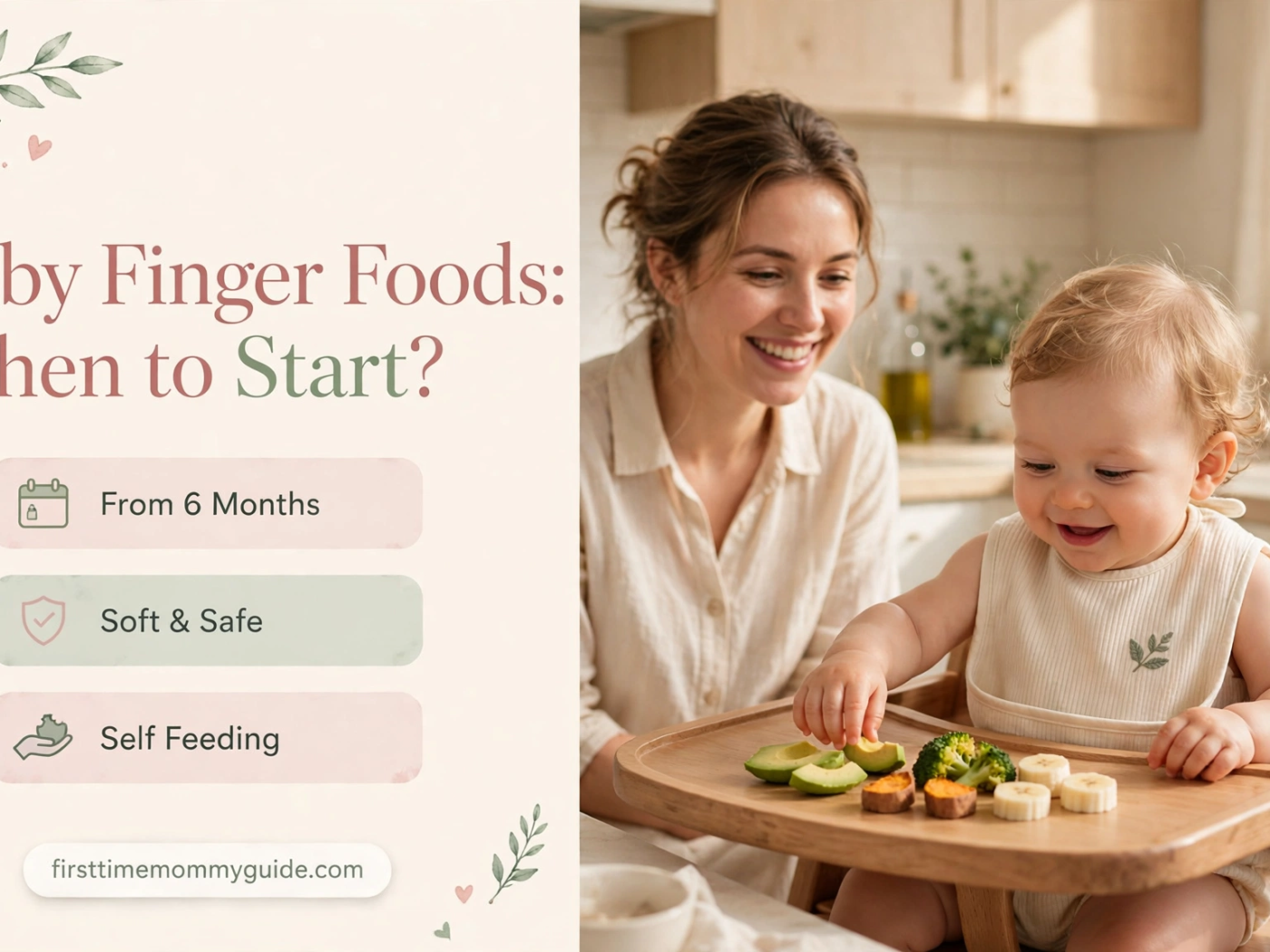
Quick Answer: When Can a Baby Start Finger Foods? Most babies can start finger foods around six months, once they can sit up with little support, hold their head steady, and show interest in food. Start with soft, graspable pieces about the size of two adult fingers, such as steamed sweet potato sticks, ripe avocado spears, or soft banana. Offer one or two pieces at a time and always supervise meals. The American Academy of Pediatrics (AAP) and the NHS both support introducing finger foods from around six months when a baby shows readiness signs. Avoid whole grapes, whole nuts, popcorn, hard raw vegetables, and chunks of meat, as these are choking hazards. Gagging is common and usually harmless; choking is rare but serious, so learn the difference before you begin.
Why Finger Foods Matter
Finger foods are about far more than nutrition. In the first year, breast milk or formula still provides most of your baby's calories. Finger foods are practice — practice for chewing, swallowing, grasping, and deciding what to eat.
Every time your baby picks up a piece of food, they are building fine motor skills. The early grasp, where the whole palm wraps around a piece, develops into the pincer grasp, where thumb and forefinger pick up tiny pieces. This progression takes months. Finger foods give your baby daily chances to practise.
Chewing matters too. Even before teeth arrive, babies can gum soft foods. Chewing builds jaw muscles and prepares the mouth for speech sounds later on. Babies who get regular finger food practice often handle a wider range of textures by their first birthday.
There is also an independence benefit. Babies who self-feed learn to listen to their own hunger and fullness. They decide when to pick up a piece, how much to eat, and when to stop. Research on self-feeding supports the idea that babies can regulate their intake well when offered healthy foods and allowed to lead. That said, you stay in charge of what is offered and when.
Finger foods also make family mealtimes possible. Instead of cooking a separate meal and spoon-feeding it, your baby can eat a soft version of what the family eats. That saves time and helps your baby feel part of the table.
Finally, finger foods expose your baby to flavours and textures early. A baby who tries avocado, lentils, salmon, and steamed broccoli in the first year is more likely to accept varied foods as a toddler. Early exposure is not a guarantee, but it helps.
When to Start Baby Finger Foods
Most babies are ready for finger foods around six months. That is the same age the AAP, the NHS, and the World Health Organization (WHO) recommend starting solid foods. The exact week matters less than the signs your baby shows.
Your baby does not need teeth to start finger foods. Gums are surprisingly strong, and soft foods can be mashed between them. Waiting for teeth often means waiting months longer than needed.
Signs Your Baby Is Ready for Finger Foods
Look for several of these signs together. One sign alone is not enough.
- Your baby can sit up with little or no support and hold their head steady.
- They can bring objects to their mouth on their own.
- They show interest in your food — reaching for it, watching you eat, opening their mouth.
- They have lost the tongue-thrust reflex, so they no longer automatically push food out with their tongue.
- They can swallow food rather than letting it dribble straight out.
- They seem hungry after milk feeds and want more than milk alone.
If your baby was born prematurely, use their corrected age as a rough guide and check with your paediatrician. Premature babies may need a little more time. Your doctor can advise on the best start date for your child.
If you are unsure whether your baby is ready for solids at all, read our guide to the signs your baby is ready for solid foods. It covers each readiness sign in detail so you can feel confident about timing.
What If My Baby Is Not Ready Yet?
Do not worry. Some babies are ready at five and a half months. Others are not interested until seven months. Both are normal. Keep offering small tastes without pressure and try again in a week.
Never force food into your baby's mouth or hold their hand to their mouth. Finger foods work best when your baby chooses to pick them up. Forcing creates stress and can make mealtimes a battle before they have even begun.
If your baby is eight months or older and still refuses all solid foods, talk to your paediatrician. There may be an underlying issue, such as oral sensitivity or reflux, that needs checking.
Finger Foods vs Purees: Do You Need Both?
You do not have to choose one approach forever. Many families use a mix of purees and finger foods, and that is perfectly fine. Purees help a baby learn to swallow. Finger foods help a baby learn to chew and self-feed. Together, they build a complete set of eating skills.
What Purees Do Well
Purees are smooth, spoon-fed foods. They let you introduce new flavours quickly and let your baby practise swallowing. They are useful when a baby is just starting solids and has not yet developed a good grasp.
Purees are also handy for foods that are hard to serve as finger foods, such as yoghurt, porridge, and lentil soup. You can keep offering these by spoon even after finger foods begin.
What Finger Foods Do Well
Finger foods build independence and motor skills. They let your baby control the pace of eating and explore textures. They also expose your baby to the real shape, colour, and smell of food, which purees hide.
Many parents who follow baby-led weaning skip purees almost entirely and start with finger foods from six months. Others start with purees for a few weeks and add finger foods gradually. Both paths lead to the same place: a baby who eats family foods by their first birthday.
Our baby-led weaning guide for beginners explains the baby-led approach in full, including how to prepare foods safely and how to handle the first weeks.
A Practical Mix
Here is a simple approach that works for most families. Start with a spoonful or two of puree alongside one or two finger foods at the same meal. Let your baby explore the finger foods while you offer the puree. Over a few weeks, increase the finger foods and reduce the purees.
By nine months, most babies are eating mostly finger foods and soft table foods, with purees only for foods like yoghurt or soup. By twelve months, purees are rarely needed at all.
Do not worry about which method is "better." The best method is the one that fits your baby and your family. Consistency and safety matter far more than the label.
Age-by-Age Finger Food Progression
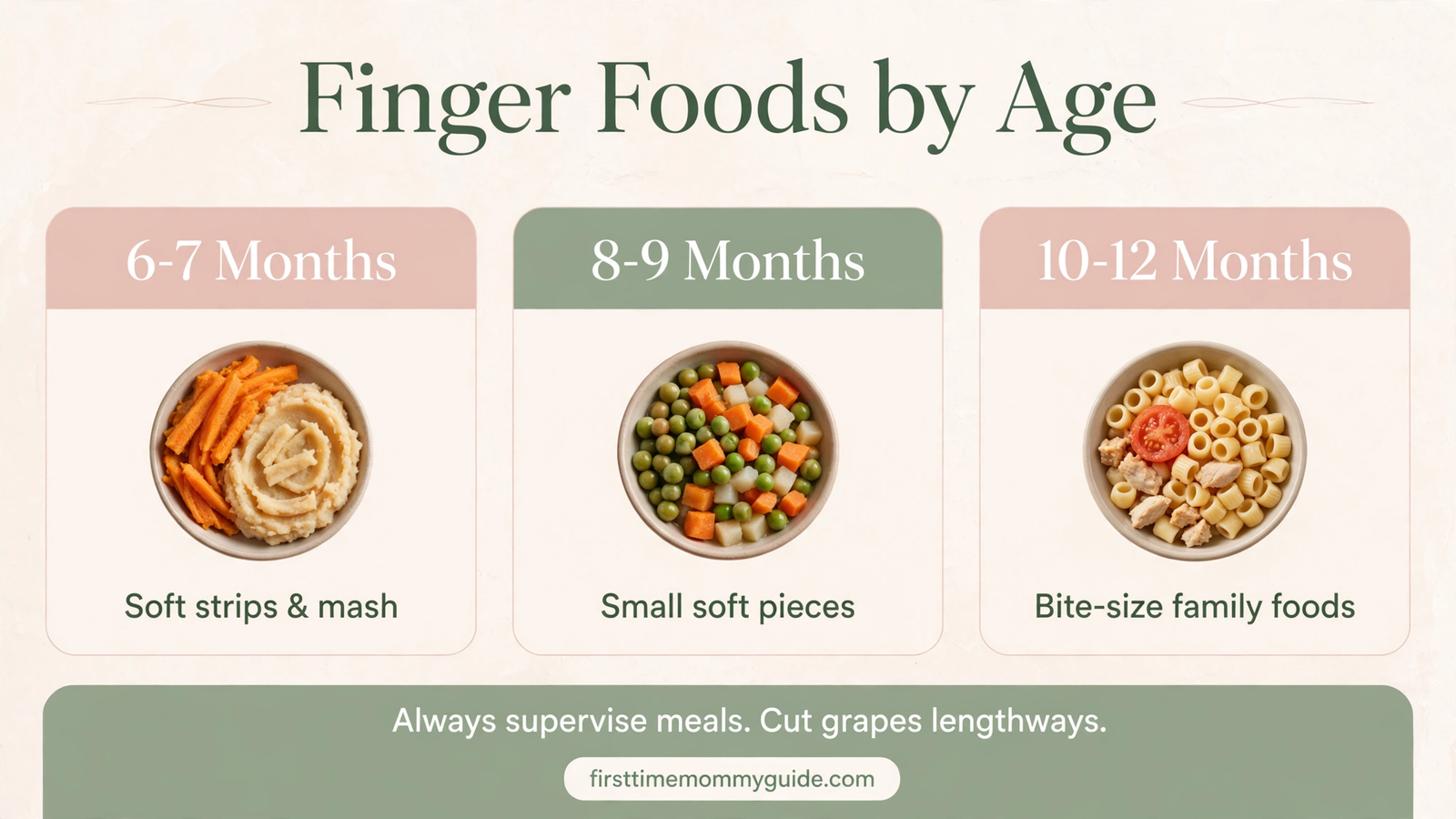
Your baby's finger foods should change as their skills grow. What works at six months will feel too easy at nine months. What works at nine months would have been unsafe at six months. Use this progression as a guide, not a strict timetable.
Finger Foods at 6 Months
At six months, babies use a palmar grasp. They wrap their whole hand around a piece of food, so pieces need to stick out beyond the fist. Think of two adult fingers pressed together — that is the ideal size and shape.
Foods should be soft enough to squash between your thumb and forefinger. If you cannot squash it, your baby cannot gum it. Test every food this way before serving.
Good first finger foods at six months include:
- Steamed sweet potato sticks, soft and warm
- Ripe avocado spears, with a little of the peel left on for grip
- Soft banana, cut in half lengthways
- Steamed carrot sticks, cooked until very soft
- Steamed broccoli florets with a chunky stalk to hold
- Soft-cooked pear spears or peach slices
- Omelette strips, well cooked and cut into fingers
- Toast fingers with a thin spread of avocado or hummus
Offer one or two pieces at a time. A full plate can overwhelm a new eater. Let your baby pick up a piece, explore it, and drop it if they want to. Dropping is part of learning.
Meals at this age are short, often five to ten minutes. Your baby may eat almost nothing. That is fine. Milk still provides most nutrition. The goal is exposure and practice.
Finger Foods at 7–8 Months
By seven or eight months, your baby's grasp is improving. They can pick up slightly smaller pieces and bring them to their mouth more accurately. They may start to use a raking motion to scoop food toward themselves.
You can now offer a wider range of textures and slightly firmer foods. Pieces can be a little smaller, but still soft. Keep the squash test as your guide.
Good finger foods at seven to eight months include:
- Soft-cooked pasta shapes, such as penne or fusilli, plain or with a mild sauce
- Shredded slow-cooked chicken or soft-cooked beef strips
- Soft cheese, such as mozzarella sticks or mild cheddar cut into fingers
- Steamed cauliflower florets
- Cooked green beans, soft and cut into short lengths
- Pancakes made with banana and egg, cut into strips
- Rice cakes, plain and unsalted, broken into manageable pieces
- Soft-cooked lentil patties or bean patties, cut into fingers
Your baby may start to bite pieces off rather than gumming whole sticks. That is a good sign. It means their chewing skills are developing. Stay close and watch, as biting can produce larger pieces.
At this age, two meals a day is typical, with milk feeds in between. Some babies are ready for three meals by eight months. Follow your baby's appetite.
Finger Foods at 9–12 Months
By nine months, many babies develop the pincer grasp. They can pick up small pieces — a pea, a blueberry, a cube of cheese — between thumb and forefinger. This opens up a whole new world of finger foods.
Foods can now be bite-sized rather than finger-sized. You can also offer more variety, including foods with mixed textures. Your baby may want to eat what you eat, and that is a good thing.
Good finger foods at nine to twelve months include:
- Small cubes of soft cheese, cut to pea size
- Halved blueberries, cut lengthways to reduce choking risk
- Cooked peas, chickpeas, and lentils
- Small pieces of soft fruit, such as melon, mango, or kiwi
- Mini sandwiches with soft fillings, cut into small squares
- Soft-cooked meatballs, cut into quarters
- Scrambled egg pieces
- Soft-cooked vegetable sticks with a dip, such as hummus or yoghurt
- Puffed rice cakes or baby crackers, broken into small pieces
By twelve months, your baby should be eating three meals a day plus one or two snacks. Milk is still important, but food now plays a bigger role. Most babies at this age eat a version of the family meal, with salt and sugar kept low.
Finger Food Progression at a Glance
| Age | Grasp | Food size | Food texture | Examples |
|---|---|---|---|---|
| 6 months | Palmar grasp (whole hand) | Finger-length sticks | Very soft, squashes easily | Sweet potato sticks, avocado spears, banana |
| 7–8 months | Raking grasp | Shorter fingers, small chunks | Soft, some texture | Pasta shapes, shredded chicken, soft cheese |
| 9–10 months | Early pincer grasp | Bite-sized pieces | Softer table foods | Peas, halved blueberries, meatball quarters |
| 11–12 months | Pincer grasp | Small pieces, family foods | Most textures | Mini sandwiches, fruit cubes, soft-cooked vegetables |
Remember that every baby develops at their own pace. Some babies master the pincer grasp at eight months. Others take until ten months. The table is a guide, not a test.
Best First Finger Foods: What to Serve and How to Prepare It
The best first finger foods share three qualities: they are soft, they are easy to hold, and they are nutritious. Here are the strongest choices, with exact preparation and serving sizes.
Avocado
Avocado is one of the best first finger foods. It is soft, rich in healthy fats, and packed with nutrients that support brain development. It is also easy to prepare — no cooking needed.
Cut a ripe avocado into spears about the size of two adult fingers. Leave a strip of peel on the bottom half to give your baby something to grip, since avocado is slippery. Serve at room temperature. One or two spears is a good serving for a first meal.
If your baby finds avocado too slippery, roll the spears in a little crushed baby cereal or ground oats. That adds grip without changing the flavour.
Banana
Banana is naturally soft, sweet, and easy to digest. It is a classic first finger food for good reason. Choose a ripe banana with brown spots for the softest texture.
Cut the banana in half lengthways, then cut each half into two or three fingers. You can also leave the peel on the bottom half as a handle, the way you would with avocado. Serve one or two pieces.
Avoid whole bananas for babies under twelve months. A whole banana can break off in a large chunk and block the airway. Cut it into fingers or halves first.
Sweet Potato
Sweet potato is rich in vitamin A, gentle on the stomach, and easy to make very soft. Peel it, cut it into finger-length sticks, and steam or roast it until it squashes easily between your fingers.
Roasting with a little olive oil brings out the sweetness. Do not add salt or sugar. Serve two or three sticks, warm but not hot. Sweet potato also freezes well, so you can batch-cook a tray and defrost sticks as needed.
Steamed Carrot
Carrots are a good source of beta-carotene and vitamin A. They need to be cooked until very soft — raw carrot is a serious choking hazard. Peel, cut into sticks, and steam for ten to fifteen minutes until soft all the way through.
Test a stick by squashing it between your fingers. If it resists, steam it longer. Serve two or three sticks. Carrots can also be served mashed, but the finger-food version gives your baby more practice.
Broccoli
Broccoli is rich in vitamin C, iron, and fibre. It also has a natural handle: the stalk. Steam a floret for five to seven minutes until the head is soft and the stalk is tender.
Serve one or two florets with the stalk pointing toward your baby. They can grip the stalk and gum the soft head. Broccoli can be messy, but that is part of the fun.
Egg
Egg is an excellent source of protein and iron. It is also one of the common allergens, so it is worth introducing early and carefully. Serve egg well cooked — never runny for babies.
Make a plain omelette, cut it into finger-length strips, and let it cool slightly. Or hard-boil an egg, remove the shell, and cut it into wedges. One egg strip or one or two wedges is a good serving. For more on early allergen introduction, see our guide to introducing allergens to your baby.
Soft-Cooked Meat and Fish
Meat and fish provide iron and zinc, which babies need from around six months as their iron stores from birth begin to run low. Iron-rich foods are especially important once solids start.
Slow-cook chicken, beef, or lamb until it is very tender, then shred or cut it into soft strips. Remove all bones and gristle. Fish should be cooked until it flakes easily, with all bones removed. Salmon is a great choice for its omega-3 fats. Serve one or two strips or a small handful of flakes.
Beans and Lentils
Beans and lentils are rich in iron, protein, and fibre. They are also cheap and easy to batch-cook. Cook lentils until very soft, then shape them into small patties or serve them as soft spoonfuls your baby can scoop.
For chickpeas, remove the skins and squash each one flat before serving. Whole round chickpeas are a choking risk. Serve a small handful of squashed chickpeas or a lentil patty cut into fingers.
Soft Fruit
Soft fruit offers natural sweetness and vitamins. Pears, peaches, plums, mango, melon, and kiwi all work well when ripe. Cut them into spears or cubes, depending on your baby's age and grasp.
Remove all pits, pips, and tough skins. Peel fruit with thick skins, such as mango and kiwi. Serve two or three pieces at a time. Hard fruits, such as raw apple, should be cooked or grated until your baby is older.
Bread, Toast, and Pasta
Toast fingers are a good first finger food because they are easy to hold and soften with saliva. Use wholemeal bread, lightly toasted, with a thin spread of avocado, hummus, or nut butter thinned with a little water or milk.
Pasta should be cooked until very soft. Penne, fusilli, and large shells are easy for small hands to grip. Serve plain or with a mild sauce, such as tomato or cheese sauce. One or two pieces is enough to start.
Foods to Introduce One at a Time
When you introduce a new food, offer it on its own for two or three days before adding another new food. That way, if your baby has a reaction, you will know which food caused it. This is especially important for common allergens such as egg, peanut, fish, and dairy.
You do not need to wait weeks between foods. A few days is enough for most families. Keep a simple note of what you introduced and when, especially in the first month.
Foods to Avoid as Finger Foods
Some foods are unsafe for babies, no matter how carefully you prepare them. Others are safe only when prepared in a specific way. Knowing the difference protects your baby from choking and from foodborne illness.
Choking Hazards
These foods are the most common causes of choking in babies and young children. The AAP and the NHS both list them as foods to avoid or to prepare very carefully.
- Whole grapes, cherry tomatoes, and whole cherry or berry fruits — always cut lengthways into quarters
- Whole nuts and seeds — never give whole nuts to a child under five; use smooth nut butter thinned with milk or water instead
- Popcorn — the hard kernels and hulls are a choking risk
- Hard raw vegetables, such as raw carrot, celery, or apple chunks — always cook or grate them
- Chunks of raw or undercooked meat
- Hard sweets, lollipops, and chewing gum
- Whole hot dogs or sausages cut into rounds — always slice lengthways first, then across
- Large chunks of cheese — cut into thin strips or small cubes instead
- Dried fruit, such as whole raisins — serve soaked and chopped, or in small amounts mixed into food
The rule is simple: anything round, hard, or slippery enough to block the airway needs to be cut, cooked, or avoided. When in doubt, cut it smaller or cook it longer.
Foods to Avoid for Other Reasons
Some foods are unsafe for babies for reasons other than choking.
Honey should never be given to a baby under twelve months. It can contain spores that cause infant botulism, a rare but serious illness. The CDC warns about this clearly. Honey is safe after the first birthday.
Salt should be kept very low. A baby's kidneys cannot handle much salt. Do not add salt to your baby's food, and avoid salty snacks such as crisps, processed meats, and ready meals made for adults. Check labels for sodium.
Sugar should also be kept low. Sugary foods and drinks train a preference for sweetness and increase the risk of tooth decay once teeth arrive. Offer water instead of juice. If you serve fruit, serve the whole fruit rather than juice.
Unpasteurised milk, soft cheeses made from unpasteurised milk, and undercooked eggs carry a risk of food poisoning. Use pasteurised dairy and cook eggs until both the white and yolk are firm. Whole cow's milk should not replace breast milk or formula as a main drink before twelve months, though it can be used in cooking.
Rice drinks, oat drinks, and other plant milks are not suitable as a main drink for babies under twelve months. They lack the nutrients a baby needs. After twelve months, your paediatrician can advise on suitable alternatives.
Caffeine, found in tea, coffee, and some soft drinks, is not suitable for babies. Herbal teas are also best avoided unless your paediatrician approves.
For a full list of foods to keep off your baby's plate, see our guide to baby first foods to avoid.
Choking vs Gagging: Know the Difference
This is the part that worries most parents, and it is the most important thing to understand before you start finger foods. Gagging and choking look similar, but they are very different.
What Gagging Looks Like
Gagging is a normal, protective reflex. It happens when food touches the back of the tongue or the throat before your baby is ready to swallow. Your baby's gag reflex sits much further forward than an adult's, so it triggers easily.
A gagging baby will cough, retch, make loud noises, and may go red in the face. They may push the food out with their tongue. They are still breathing and still making noise. This is uncomfortable to watch, but it is not dangerous.
Gagging usually lasts a few seconds. Your baby will cough the food forward and either spit it out or try again. Stay calm, watch closely, and let them work it out. Do not put your fingers in their mouth to fish the food out. That can push the food further back and cause real choking.
Gagging becomes less frequent as your baby's eating skills improve. Most babies gag a lot in the first few weeks and much less by nine or ten months.
What Choking Looks Like
Choking is different. It happens when food blocks the airway. A choking baby cannot breathe properly, cannot cough effectively, and cannot make much noise.
Signs of choking include:
- Silent or very quiet struggling, with little or no sound
- Inability to cough, cry, or breathe normally
- Skin turning blue or very pale, especially around the lips
- Panicked, wide-eyed expression
- Loss of consciousness in severe cases
Choking is an emergency. If your baby is choking, act immediately. Take a paediatric first aid course before you start solids if you can. Many local health services and charities offer short courses. Knowing what to do in advance is the best way to feel confident at mealtimes.
Baby Choking Prevention: Practical Steps
Most choking is preventable. These habits make finger food mealtimes much safer.
Always supervise. Never leave your baby alone with food, even for a moment. Always sit with them while they eat.
Sit your baby upright. Use a high chair or a secure seat with your baby sitting upright, not reclined. A baby who is leaning back cannot swallow safely.
Serve the right size and texture. Cut round foods lengthways. Cook hard foods until soft. Test every food with the squash test before serving.
Keep portions small. Offer one or two pieces at a time. A baby with a mouth full of food is more likely to gag or choke.
Avoid distractions. Turn off the television and keep mealtimes calm. A baby who is laughing or crying while eating is more likely to inhale food.
Do not let your baby eat while moving. Never let your baby eat while crawling, walking, or riding in a pushchair. Eating should happen sitting still.
Check the floor. Babies find dropped food and put it in their mouths. Keep small objects, coins, and older children's snacks out of reach during mealtimes.
What to Do If Your Baby Chokes
If your baby is coughing effectively, encourage them to keep coughing and do not intervene. If they cannot cough, cry, or breathe, call emergency services and start infant choking first aid — back blows and chest thrusts — if you have been trained. If you have not been trained, call for help and follow the dispatcher's instructions.
Learn the steps before you need them. The NHS and the American Red Cross publish clear guides to infant choking first aid. A short course is even better, because it gives you hands-on practice.
Introducing Allergens Through Finger Foods
Allergens are foods that commonly cause allergic reactions, such as egg, peanut, cow's milk, wheat, soy, fish, shellfish, and tree nuts. Current guidance from the AAP and the NHS has changed in recent years. Instead of avoiding allergens, parents are now encouraged to introduce them early and regularly.
Research shows that introducing peanut and egg from around six months, and continuing to offer them regularly, can reduce the risk of developing an allergy. Waiting too long may increase the risk. That is a big shift from older advice, so it is worth understanding.
How to Introduce Allergens Safely
Introduce one allergen at a time, in a small amount, at home, during the day. That way you can watch your baby for a reaction. Offer a small taste first, wait a few minutes, then offer a little more if there is no reaction.
For peanut, use smooth peanut butter thinned with warm water, breast milk, or formula. Never give whole peanuts or chunky peanut butter to a baby. Spread a thin layer on toast fingers or mix it into porridge. Offer peanut two or three times a week once introduced.
For egg, serve a well-cooked omelette strip or a small piece of hard-boiled egg. For fish, serve a small piece of well-cooked, boneless fish. For dairy, yoghurt and cheese are good first options.
Keep offering allergens regularly, two or three times a week, once they are introduced. A single taste is not enough. Regular exposure is what helps build tolerance.
Signs of an Allergic Reaction
Most reactions are mild, but watch for these signs in the first two hours after eating:
- A rash or hives, especially around the mouth or on the body
- Swelling of the lips, face, or tongue
- Vomiting or diarrhoea
- A runny nose, sneezing, or watery eyes
- Fussiness or unusual sleepiness
Severe reactions are rare but serious. Call emergency services immediately if your baby has trouble breathing, widespread swelling, or becomes limp or unresponsive. If your baby has a known severe allergy, follow your doctor's emergency plan.
If your baby has eczema or a family history of allergies, talk to your paediatrician before introducing allergens. They may recommend introducing them in a clinic or with a specific plan.
Setting Up Mealtimes for Self-Feeding
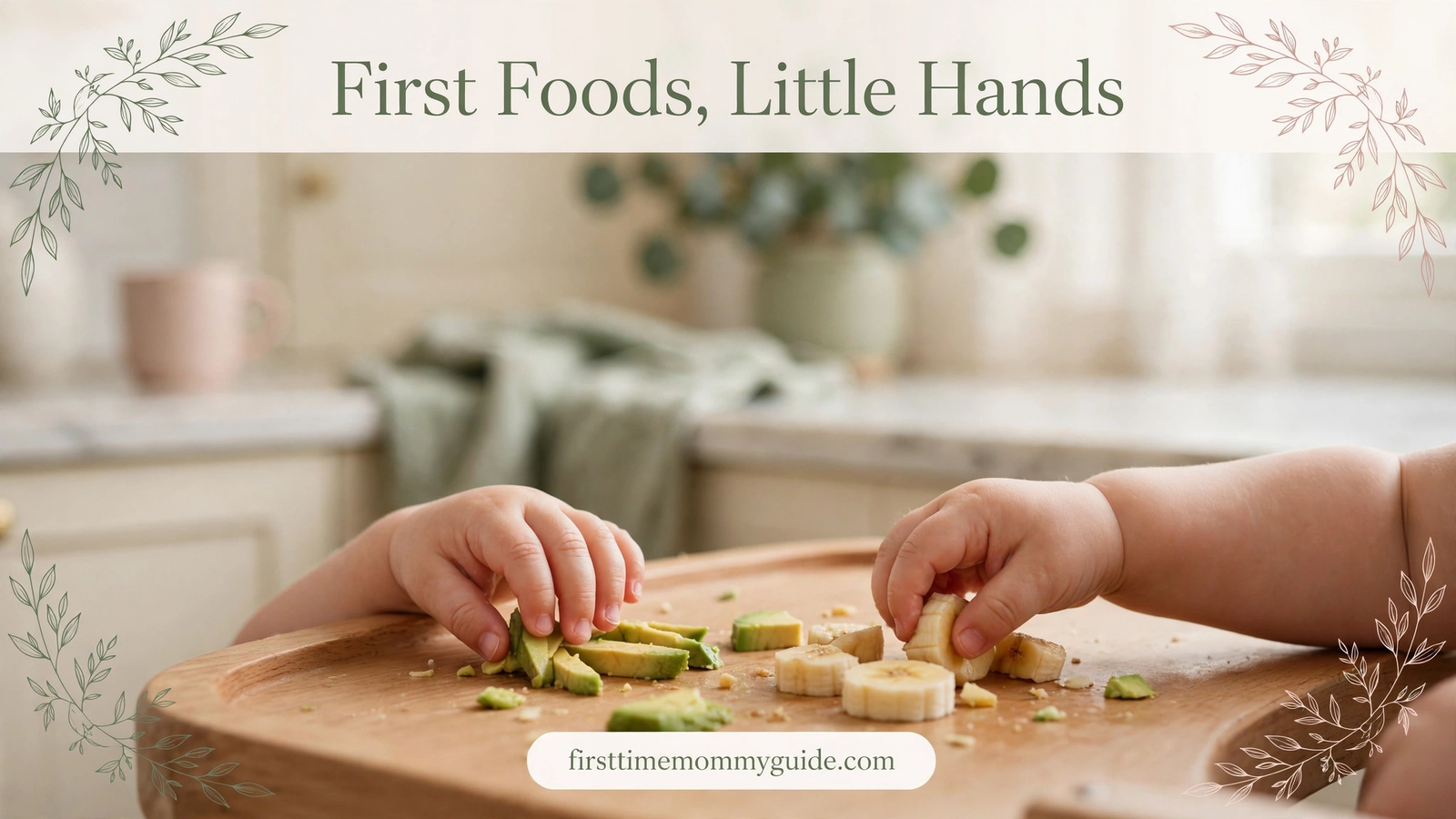
The environment matters almost as much as the food. A good setup helps your baby focus, stay safe, and enjoy the meal.
The High Chair
Use a high chair that supports your baby sitting upright with their feet supported. A footrest helps your baby feel stable and improves their ability to chew and swallow. If your baby's feet dangle, they may slump or lean, which makes eating harder.
Strap your baby in securely, but not so tightly that they cannot move their arms. The tray should be at chest height. Clean the tray and seat before each meal.
Timing Meals Well
Offer finger foods when your baby is alert and hungry but not starving. A baby who is overtired or very hungry will be too upset to explore food. A good window is about an hour after a milk feed.
Keep meals short at first — five to fifteen minutes. End the meal when your baby turns away, drops food repeatedly, or gets upset. Do not insist they keep eating. You can try again at the next meal.
Aim for one meal a day at six months, two meals by seven to eight months, and three meals plus snacks by nine to twelve months. Build up gradually. There is no rush.
The Right Atmosphere
Eat together when you can. Babies learn by watching. If they see you eating the same food, they are more likely to try it. Sit with them, talk about the food, and keep the mood relaxed.
Expect mess. Finger foods are messy by nature. Put a splash mat under the high chair, dress your baby in an easy-to-wash bib, and accept that food will end up on the floor, in their hair, and on your clothes. Mess is a sign that your baby is exploring.
Let your baby touch, squish, and drop food. That is how they learn about texture and cause and effect. Resist the urge to wipe their hands after every bite. A quick wipe at the end of the meal is enough.
Building Self-Feeding Skills
Self-feeding is a skill that develops over months. You can support it with simple habits and the right foods.
Encourage Exploration
Let your baby pick up food on their own. Do not place food in their mouth for them. Place a piece on the tray and let them reach for it. If they drop it, offer another piece. If they ignore it, try a different food.
Offer foods in different shapes, colours, and textures. A plate with a green broccoli floret, an orange sweet potato stick, and a yellow banana piece is more interesting than a plate of one colour. Variety keeps your baby engaged.
Introduce Cups and Utensils Gradually
From six months, offer water in an open cup or a free-flow sippy cup at mealtimes. Open cups help with oral motor development, though they are messy at first. Hold the cup for your baby at first, then let them hold it with both hands.
Spoons can be introduced from around seven or eight months. Load a spoon with soft food, such as yoghurt or porridge, and hand it to your baby. Let them bring it to their mouth, even if most of the food ends up on their face. Pre-loaded spoons are a good first step.
By ten to twelve months, many babies can hold a spoon and feed themselves with some success. Do not expect neatness. Expect effort, and praise it.
Let Your Baby Lead
Your baby will sometimes eat a lot and sometimes eat almost nothing. Both are normal. Appetite varies with growth spurts, teething, illness, and mood. Trust your baby to eat what they need.
Never use food as a reward or a punishment. Do not say "one more bite and you can have a toy." That teaches your baby to ignore their own fullness signals. Offer food, let them eat, and stop when they show they are done.
A Sample Day of Finger Foods (9–12 Months)
Here is what a typical day of finger foods might look like for a baby aged nine to twelve months. Milk feeds still happen alongside these meals. Adjust the amounts to your baby's appetite — this is a guide, not a prescription.
Breakfast
- Scrambled egg pieces with a toast finger spread thinly with avocado
- A few halved blueberries and a soft pear spear
- Water in a sippy cup
Mid-Morning Snack
- A rice cake broken into pieces
- A few cubes of soft cheese
Lunch
- Small pasta shapes with a mild tomato and lentil sauce
- Steamed broccoli florets and soft-cooked carrot sticks
- A few pieces of soft mango
Afternoon Snack
- A banana oat pancake, cut into strips
- A few pieces of soft melon
Dinner
- Shredded slow-cooked chicken with soft-cooked sweet potato sticks
- Cooked peas and a small piece of soft-cooked cauliflower
- A few spoonfuls of plain yoghurt
A Sample Day at 6–8 Months
At six to eight months, the day is simpler. One or two meals a day is enough.
- Breakfast or lunch: Two sweet potato sticks, one avocado spear, and a spoonful of porridge
- Second meal: One or two steamed broccoli florets, a banana finger, and a spoonful of yoghurt
Milk feeds make up the rest. Your baby's appetite will grow over the weeks. Follow their lead and add a third meal when they seem ready.
Our baby food chart for 6 to 12 months gives a fuller month-by-month plan with portion ideas and a printable chart.
What to Do If Your Baby Refuses Finger Foods
Refusal is common, especially in the first weeks. It does not mean your baby hates food or that you are doing something wrong. Here is how to handle the most common situations.
My Baby Won't Pick Up Food
Some babies need time to understand that the food on the tray is for eating. Try placing a piece of food in their hand and letting them bring it to their mouth. Or eat a piece yourself, with obvious enjoyment, and offer them one.
Sticky foods, such as banana or avocado, can be hard to grip. Roll them in crushed cereal or ground oats for extra grip. A slightly damp cloth on the tray can also help food stick less to the tray and more to the hand.
If your baby still will not pick up food after several weeks, offer finger foods alongside spoon-feeding. They may need more time. Talk to your paediatrician if you are worried.
My Baby Gags a Lot
Frequent gagging in the first weeks is normal. It usually fades as your baby learns to move food around the mouth. Make sure pieces are the right size — not too large — and that your baby is sitting upright.
If gagging is severe or your baby seems distressed at every meal, try softer foods for a week and build up slowly. If gagging continues for more than a month or your baby refuses all solids, ask your paediatrician for advice. They may refer you to a feeding specialist.
My Baby Throws Food on the Floor
Throwing food is a normal part of development. Babies learn cause and effect by dropping things and watching what happens. It is not bad behaviour.
Stay calm and do not react strongly. Gently say "food stays on the tray" and offer another piece. If your baby keeps throwing food, they may be full or bored. End the meal and try again later.
My Baby Only Eats One Food
Babies often fixate on one food for a week or two. That is normal. Keep offering other foods alongside the favourite. Do not stop offering the foods they refuse. It can take ten or more exposures before a baby accepts a new food.
If your baby refuses an entire food group for weeks, such as all vegetables, talk to your paediatrician. They can check that your baby is getting the nutrients they need.
My Baby Won't Eat at All
If your baby refuses all solid foods, first check the basics. Are they teething? Are they ill? Are they overtired? Are meals too soon after a milk feed? Small changes, such as offering food before a milk feed rather than after, can help.
Our guide on what to do when your baby won't eat covers refusal in more detail, including when to seek help and how to keep mealtimes positive.
Storage and Batch Prep for Finger Foods
Batch cooking saves time and makes finger foods easy on busy days. Cook a large batch once or twice a week, then store portions for the days ahead.
Freezing Finger Foods
Many finger foods freeze well. Sweet potato sticks, carrot sticks, lentil patties, banana oat pancakes, and meatballs all freeze and reheat well. Cook them, let them cool, and freeze them in a single layer on a tray before transferring them to a labelled freezer bag.
Label each bag with the food name and the date. Use frozen finger foods within one month for the best quality. Defrost in the fridge overnight or in the microwave, and always check the temperature before serving. Reheat until piping hot, then let it cool to a safe temperature.
Never refreeze food that has already been thawed. If your baby does not finish a portion, throw the leftovers away rather than saving them.
Fridge Storage
Cooked finger foods keep in the fridge for one to two days in a sealed container. Store them at the back of the fridge, where it is coldest. Do not store cooked food next to raw meat.
Cut fruit, such as avocado and banana, should be served fresh. Avocado browns quickly once cut, though a squeeze of lemon juice can slow this down. Do not store cut avocado for more than a few hours.
Batch Prep Ideas
- Sunday roast vegetables: Roast a tray of sweet potato, carrot, and butternut squash sticks. Freeze in portions.
- Lentil patties: Make a large batch, cook, cool, and freeze. Defrost one or two at a time.
- Banana oat pancakes: Cook a stack, freeze with baking paper between each one, and defrost as needed.
- Meatballs: Cook a batch of soft mini meatballs, freeze, and defrost for quick dinners.
- Steamed broccoli and cauliflower: Steam a large batch, cool, and refrigerate for up to two days.
Food Safety Basics
Always wash your hands before preparing food and before feeding your baby. Wash all fruit and vegetables thoroughly. Cook meat and eggs until they are fully cooked through. Clean the high chair tray before each meal.
Do not leave cooked food at room temperature for more than two hours. Bacteria grow quickly in warm food. If food has been sitting out, throw it away.
Mistakes to Avoid with Baby Finger Foods
Most mistakes are easy to fix once you know about them.
Starting too early. Finger foods before six months, or before readiness signs appear, can increase choking risk. Wait for the signs.
Serving foods that are too hard. Raw apple, raw carrot, and hard crackers are common mistakes. Always cook hard foods until soft and test them with the squash test.
Serving round foods whole. Whole grapes, cherry tomatoes, and whole blueberries are dangerous. Cut them lengthways into quarters or halves.
Leaving your baby alone with food. Even for a moment, to answer the door or check your phone. Always stay within arm's reach.
Offering too many pieces at once. A tray full of food overwhelms a new eater and increases the risk of them stuffing too much into their mouth. Offer one or two pieces at a time.
Adding salt or sugar. A baby's kidneys and taste buds do not need it. Keep food plain and let natural flavours shine.
Giving up after one refusal. Babies need repeated exposure to new foods. Keep offering, without pressure, and try again another day.
Comparing your baby to others. Some babies eat finger foods eagerly from day one. Others take weeks. Both are normal. Your baby's pace is the right pace.
Skipping allergen introduction. Waiting too long to introduce egg and peanut may increase allergy risk. Introduce them early, one at a time, and keep offering them regularly.
Forgetting iron-rich foods. From six months, babies need iron from food. Meat, lentils, beans, and fortified cereals are good sources. Pair them with vitamin C-rich foods, such as broccoli or citrus, to help absorption.
When to Call the Doctor
Most finger food mealtimes go smoothly. But contact your paediatrician if:
- Your baby chokes frequently, even with soft, well-prepared foods.
- Your baby gags and vomits at most meals after a month of trying.
- Your baby refuses all solid foods by eight or nine months.
- Your baby has a suspected allergic reaction, such as hives, swelling, or vomiting after eating.
- Your baby is losing weight, or not gaining weight as expected.
- Your baby has trouble swallowing, drools excessively, or seems to be in pain when eating.
- Your baby was born prematurely and you are unsure when to start solids.
- You notice signs of anaemia, such as unusual paleness or tiredness, which can be linked to low iron.
Call emergency services immediately if your baby cannot breathe, is turning blue, or becomes limp or unresponsive during a meal. If your baby has a known severe allergy, use their emergency plan and call for help.
Trust your instincts. If something feels wrong, it is always better to call and be reassured than to wait and worry.
Frequently Asked Questions
1. When can a baby start eating finger foods?
Most babies can start finger foods around six months, when they can sit up with little support, hold their head steady, and show interest in food. The AAP and the NHS both support starting from around six months when readiness signs are present. Your baby does not need teeth to begin.
2. What are the best first finger foods for a 6-month-old?
The best first finger foods are soft, easy to hold, and nutritious. Good choices include steamed sweet potato sticks, ripe avocado spears, soft banana fingers, steamed carrot sticks, steamed broccoli florets, and omelette strips. All should be soft enough to squash between your fingers.
3. How big should finger foods be for a 6-month-old?
Pieces should be about the size of two adult fingers pressed together — long enough to stick out of your baby's fist. This is because six-month-olds use a palmar grasp and wrap their whole hand around the food. Smaller pieces will disappear inside their fist.
4. How do I cut grapes for a baby?
Cut grapes lengthways into quarters, never across into rounds. Cutting lengthways removes the round shape that can block the airway. The same rule applies to cherry tomatoes, large blueberries, and other round fruits. For babies under twelve months, quartering is the safest option.
5. Is gagging normal when starting finger foods?
Yes, gagging is very common and usually harmless. It is a protective reflex that moves food away from the airway. A gagging baby makes noise, coughs, and may go red. They are still breathing. Gagging usually becomes less frequent over the first few weeks as your baby's skills improve.
6. What is the difference between gagging and choking?
Gagging is loud and involves coughing and retching, and the baby is still breathing. Choking is quiet or silent — the baby cannot cough, cry, or breathe effectively, and their skin may turn blue or pale. Choking is an emergency and needs immediate action. Learn infant choking first aid before you start solids.
7. Can babies eat finger foods without teeth?
Yes. Babies can gum soft foods very effectively, even without teeth. Gums are strong and can mash soft foods. You do not need to wait for teeth to start finger foods. Choose foods that pass the squash test — soft enough to squash between your thumb and forefinger.
8. What finger foods can I give a 9-month-old?
At nine months, babies can handle bite-sized pieces and a wider variety. Good options include halved blueberries, cooked peas, small cubes of soft cheese, mini sandwich squares, soft-cooked meatball quarters, scrambled egg pieces, and soft fruit cubes. Your baby may be developing a pincer grasp, so smaller pieces work well.
9. How many finger foods should I offer at once?
Offer one or two pieces at a time. A full plate can overwhelm a new eater and increases the risk of them stuffing too much food into their mouth. Add more pieces as your baby finishes the first ones. This also helps you see how much they are actually eating.
10. Should I stop purees when I start finger foods?
No, you do not need to stop purees. Many families use a mix of purees and finger foods. Purees help with swallowing and are useful for foods such as yoghurt and porridge. Finger foods build chewing and self-feeding skills. Over time, finger foods naturally become the main approach.
11. When should I introduce peanut to my baby?
Peanut can be introduced from around six months, once your baby has started solids. Use smooth peanut butter thinned with warm water, breast milk, or formula. Never give whole peanuts or chunky peanut butter to a baby. Offer peanut two or three times a week once introduced. If your baby has severe eczema or a known egg allergy, ask your paediatrician first.
12. Can my baby eat eggs?
Yes, eggs can be introduced from around six months. Serve them well cooked, with both the white and yolk firm. Omelette strips and hard-boiled egg wedges work well as finger foods. Egg is a common allergen, so introduce it on its own and watch for a reaction over the next two hours.
13. What foods should babies never eat?
Babies under twelve months should never have honey, because of the risk of infant botulism. They should also avoid whole nuts, popcorn, hard raw vegetables, whole grapes, and unpasteurised milk. Keep salt and sugar very low. Undercooked meat and eggs carry a risk of food poisoning and should be avoided.
14. How do I prevent choking with finger foods?
Always supervise meals, sit your baby upright in a high chair, and serve foods in the right size and texture. Cut round foods lengthways, cook hard foods until soft, and offer only one or two pieces at a time. Never let your baby eat while moving, and keep mealtimes calm and distraction-free. Take a paediatric first aid course so you know what to do if choking happens.
15. My baby throws all their food on the floor. What should I do?
Throwing food is normal. Babies learn cause and effect by dropping things. Stay calm, do not react strongly, and offer another piece. If your baby keeps throwing food, they may be full or bored. End the meal and try again later. Avoid making a big deal of it, as attention can reinforce the behaviour.
16. How long should a finger food meal last?
Meals at six months are often five to ten minutes. By nine to twelve months, meals may last fifteen to twenty minutes. End the meal when your baby turns away, drops food repeatedly, or becomes upset. Do not force your baby to keep eating once they show they are done.
17. Can I give my baby finger foods if they were born prematurely?
Yes, but use their corrected age as a guide and check with your paediatrician first. Premature babies may need a little more time before they are ready for finger foods. Your doctor can advise on the best timing and the best first foods for your baby.
18. How do I store leftover finger foods?
Cooked finger foods keep in the fridge for one to two days in a sealed container. Many finger foods freeze well for up to one month. Label freezer bags with the food name and date. Defrost in the fridge overnight, reheat until piping hot, and let it cool before serving. Never refreeze food that has already been thawed.
19. What if my baby only wants one food and refuses everything else?
This is common and usually temporary. Keep offering other foods alongside the favourite, without pressure. It can take ten or more exposures before a baby accepts a new food. Do not stop offering foods they refuse. If your baby refuses an entire food group for weeks, talk to your paediatrician.
20. Do finger foods help with picky eating later?
Early exposure to a variety of flavours and textures can help. Babies who try many foods in the first year often accept a wider range of foods as toddlers. There is no guarantee, as picky eating has many causes, but a varied early diet is a good start. Keep offering new foods, stay patient, and keep mealtimes positive.
21. Can I give my baby finger foods while travelling?
Yes, with a little planning. Pack foods that travel well, such as banana, avocado, rice cakes, and soft-cooked vegetable sticks in a sealed container. Bring a portable high chair or booster seat if you can. Avoid foods that need reheating unless you have access to a microwave. Always supervise your baby while they eat, even on the go.
22. When should my baby stop eating finger foods and eat regular food?
There is no sudden switch. Finger foods gradually become regular food. By twelve months, most babies are eating a version of the family meal, with salt and sugar kept low. They still need food cut into safe sizes, and whole nuts and popcorn should be avoided until age five. The transition is gradual and happens naturally as your baby's skills grow.
Conclusion
Starting finger foods is one of the most rewarding stages of your baby's first year. It is messy, funny, and sometimes stressful — and it is also the moment your baby begins to feed themselves. That independence is worth celebrating.
Remember the essentials. Start around six months, when your baby shows readiness signs. Offer soft, graspable pieces about the size of two fingers. Supervise every meal, sit your baby upright, and cut round foods lengthways. Learn the difference between gagging and choking, and take a first aid course if you can. Introduce allergens early, one at a time, and keep offering them regularly.
Do not aim for perfection. Some meals will go well and some will end up on the floor. Your baby may love avocado one day and refuse it the next. That is normal. Keep offering a variety of foods, keep mealtimes calm, and trust your baby to learn at their own pace.
If you are ever worried — about choking, allergies, refusal, or your baby's growth — talk to your paediatrician. They are there to help, and they answer these questions every day.
You are giving your baby more than food. You are giving them skills, confidence, and a love of eating that can last a lifetime. Trust yourself, trust your baby, and enjoy the mess. You have got this.

Dilawar Mughal
Founder and editor, First Time Mommy Guide
I research every guide against what the NHS, the AAP and the WHO publish, then write it in plain English — because most new parents are reading with one hand free, not comparing clinical guidelines. I'm not a doctor or a midwife. Every health claim on this site is sourced and linked so you can check it yourself, and anything urgent belongs with your health visitor or GP, not a blog.