General information, not medical advice. Every baby is different — if anything worries you, speak to your midwife, health visitor or GP rather than waiting.
There is something magical about a baby’s first splash. The wide eyes, the tiny kick, the delighted squeal when water ripples around their toes. It is one of those first-time-mom moments you will remember forever, and it is natural to wonder when the right time is to make it happen.
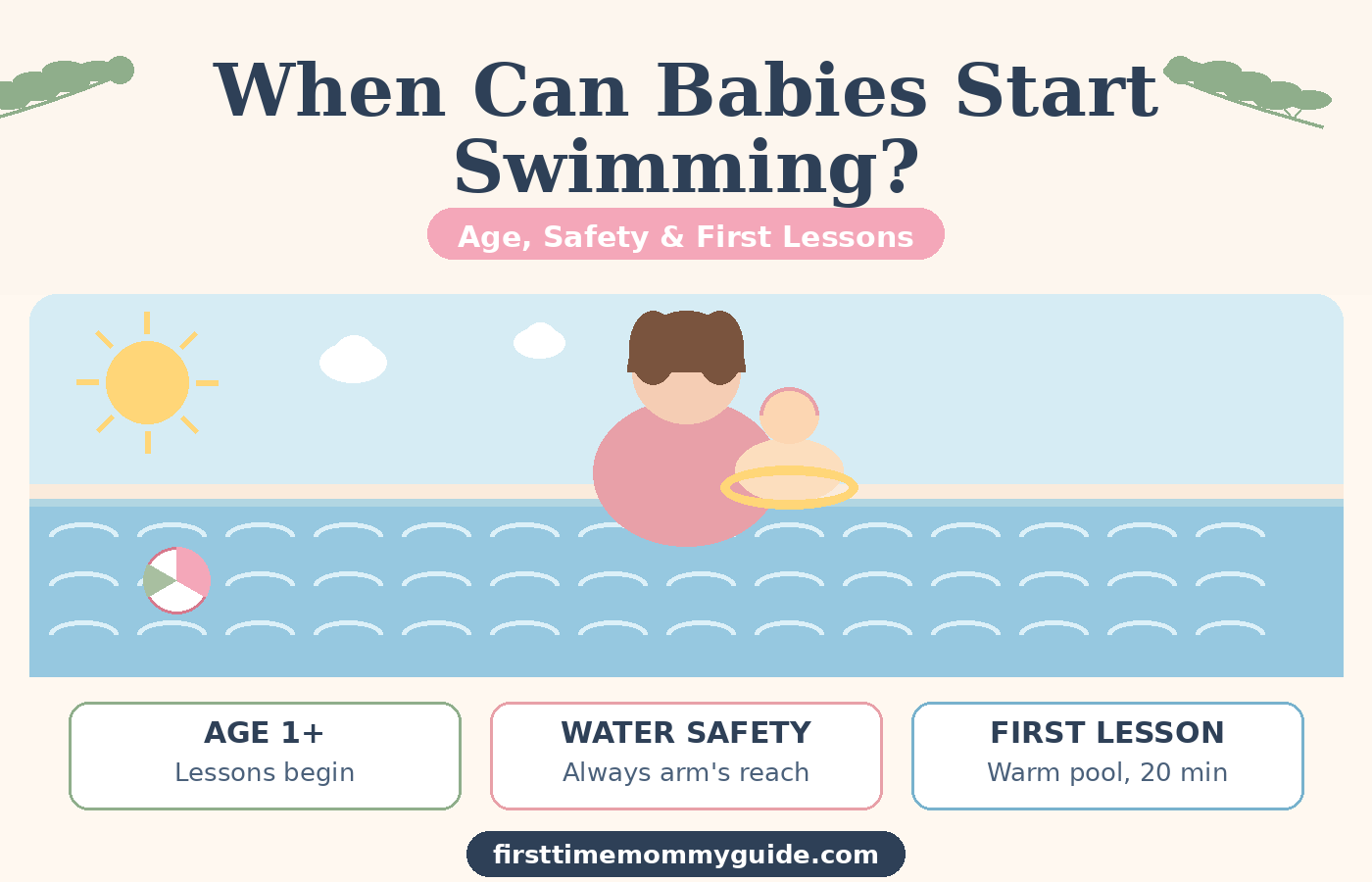
The short answer is that most babies can enjoy gentle water play from around six months old, while formal baby swim lessons are generally recommended from age one. That distinction matters, because splashing in a warm pool with you is very different from a structured lesson, and the rules for each are not the same.
This guide answers every question you are likely to have. We cover what the American Academy of Pediatrics (AAP), the CDC, and the NHS actually say, the right baby swimming age for different kinds of water, how to choose a class, what to pack, and the mistakes to avoid. By the end, you will know exactly when your baby can go in the pool, what is safe, and how to make that first swim a happy memory instead of a stressful one.
Quick Answer: When can babies start swimming?
- Gentle water play with a parent: from around 6 months, in a warm, clean pool, for short sessions of 10 to 20 minutes.
- Formal baby swim lessons: the AAP recommends starting at age 1, when most children are developmentally ready to learn water skills.
- Newborn swimming: newborns should not be submerged or taken swimming. Their immune systems are still developing, and they lose body heat very quickly.
- The golden rule: swim lessons reduce drowning risk, but they do not make any child drown-proof. An adult must stay within arm’s reach of your baby in or near water, every single time.
What Is the Recommended Baby Swimming Age?
Most parents ask about a single magic number, but the honest answer depends on what kind of swimming you mean. A six-month-old paddling in your arms is not doing the same thing as a two-year-old learning to float in a class, and the guidance reflects that.
Water play: from around 6 months
Around six months, most babies can handle a brief dip in a warm pool with a parent holding them the whole time. By this age, babies can usually hold their heads up steadily, their immune systems are stronger than in the newborn weeks, and they are starting to enjoy new sensory experiences.
Keep these early sessions short and sweet. Ten to twenty minutes is plenty for a first dip. Watch for signs your baby is getting cold, such as shivering, blue-tinged lips, or unusual fussiness, and get out of the water straight away if you see them.
Formal baby swim lessons: from age 1
The American Academy of Pediatrics recommends that most children begin formal swim lessons at age 1. Before that age, babies simply are not developmentally ready to learn swimming skills in a structured way. A class for a baby under one is really a parent-and-baby water familiarisation session, not a lesson in swimming.
That does not mean earlier classes are harmful. Parent-and-baby water sessions from around six months can help your little one feel comfortable in the water, which makes real lessons easier later. Just go in with the right expectations: your baby is getting used to water, not learning to swim.
When can baby go in the pool before 6 months?
It is best to wait. Newborns and very young babies lose heat fast, and their skin is delicate. Public pools also carry a higher germ load than a baby under six months can comfortably handle. If you are desperate for water time in the first months, a warm bath at home is the safest option. Our guide to how to give your newborn their first bath walks through safe water temperatures and handling step by step.
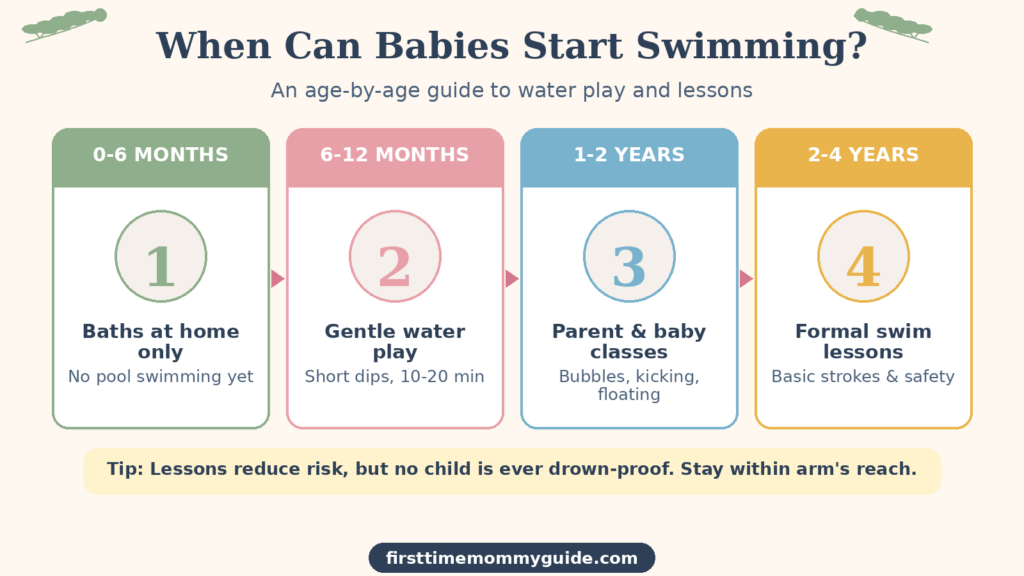
The age-by-age picture
| Age | What is appropriate | What to expect |
|---|---|---|
| 0–6 months | Warm baths at home only | No pool swimming; focus on bath-time water comfort |
| 6–12 months | Gentle water play with a parent | Splashing, kicking, floating with support; short sessions |
| 1–2 years | Parent-and-child swim classes | Blowing bubbles, kicking, assisted floating, water confidence |
| 2–4 years | Formal swim lessons | Basic strokes, floating independently, following instructions |
| 4 years and up | Structured swim lessons | Real swimming skills, water safety rules, stroke development |
Remember that every baby develops at their own pace. Some babies adore water from the first dip, while others need several gentle introductions before they relax. Neither reaction means anything is wrong, and pushing a reluctant baby rarely helps. If your little one cries through every session, take a break and try again in a few weeks.
What the AAP, CDC, and NHS Actually Say
It is easy to find confident claims about baby swimming online, so it helps to know what the major health authorities actually recommend. Here is the guidance in plain language.
American Academy of Pediatrics (AAP)
The AAP recommends that children start swim lessons at age 1, and that all children and young adults learn to swim. The AAP is clear that lessons are one layer of protection, not a guarantee: parents must still provide constant, close supervision, and children should never swim alone. The AAP’s parent site, HealthyChildren.org, has detailed pool and water safety guidance that is worth reading before your first visit.
The AAP also advises that parents of children under one should not expect swim programmes to reduce drowning risk, because babies that young cannot reliably learn the skills that keep them safe. Water play is fine for fun and comfort, but it is not a safety measure.
Centers for Disease Control and Prevention (CDC)
The CDC lists formal swimming lessons as one of the most effective ways to reduce drowning risk in young children, alongside close supervision and barriers such as pool fences. The CDC’s drowning prevention pages at cdc.gov/drowning explain that drowning is a leading cause of death for children aged 1 to 4, which is exactly why layers of protection matter so much.
The CDC’s message is consistent: teach children to swim, but never rely on lessons alone. An adult should always be within arm’s reach of a young child in the water, and pools should be fenced with self-closing, self-latching gates.
NHS and Start for Life (UK)
In the UK, the NHS advises that babies can go swimming from birth in some circumstances, but most health visitors and swim schools suggest waiting until around six months, when babies can better regulate their temperature and have had their first vaccinations. The NHS Start for Life resources include advice on keeping babies safe in water and sun, and your health visitor can advise on timing for your individual baby.
If your baby was born prematurely or has a health condition, check with your paediatrician before any swimming. The general guidance assumes a healthy, full-term baby, and your doctor knows your child’s situation best.
The bottom line from the experts
Three points come up in every major guideline, and they are worth memorising. First, start formal lessons at age one. Second, lessons lower risk but never remove it. Third, supervision is the single most important safety measure, and nothing replaces it — not a float, not a swim ring, and not a lesson.
Baby Swim Classes vs Survival Swim: What Is the Difference?
You may have seen two very different kinds of baby swimming advertised, and they are not interchangeable. Understanding the difference helps you choose what fits your family.
Traditional baby swim classes
Traditional baby swimming classes are gentle, parent-led sessions in a warm pool. You hold your baby throughout, sing songs, practise floating and kicking, and slowly build water confidence. The goal is comfort and familiarity, not independence.
These classes are widely available, relaxed, and enjoyable for most families. They are the right choice if you want a fun introduction to water and a foundation for later lessons.
Survival swim (ISR-style) lessons
Survival swim programmes, such as Infant Swimming Resource (ISR), teach babies as young as six months to roll onto their backs and float if they fall into water. Sessions are one-to-one, frequent, and far more intensive than a typical parent-and-baby class. Some programmes involve brief underwater submersions.
Supporters say these skills could save a life. Critics, including some paediatricians, worry about the stress involved, the risk of water inhalation, and the false sense of security it can give parents. The AAP has not endorsed survival swim programmes as a substitute for supervision, and the evidence base for their effectiveness is limited compared with traditional lessons.
Which should you choose?
| Feature | Traditional baby swim class | Survival swim (ISR-style) |
|---|---|---|
| Typical starting age | 6 months (with parent) | 6 months |
| Parent in the water? | Yes, throughout | No, instructor only |
| Session style | Group, songs, gentle play | One-to-one, intensive, daily |
| Main goal | Water confidence and fun | Self-rescue floating |
| Cost | Moderate | Usually higher |
| Best for | Most families, first introduction | Parents wanting self-rescue skills |
For most first-time moms, a traditional class is the calmer, happier starting point. If you are considering a survival swim programme, talk to your paediatrician first and visit a session before signing up. Whatever you choose, remember that no programme makes a baby safe unsupervised near water.
Pool vs Ocean vs Lake: Where Is It Safe to Swim?
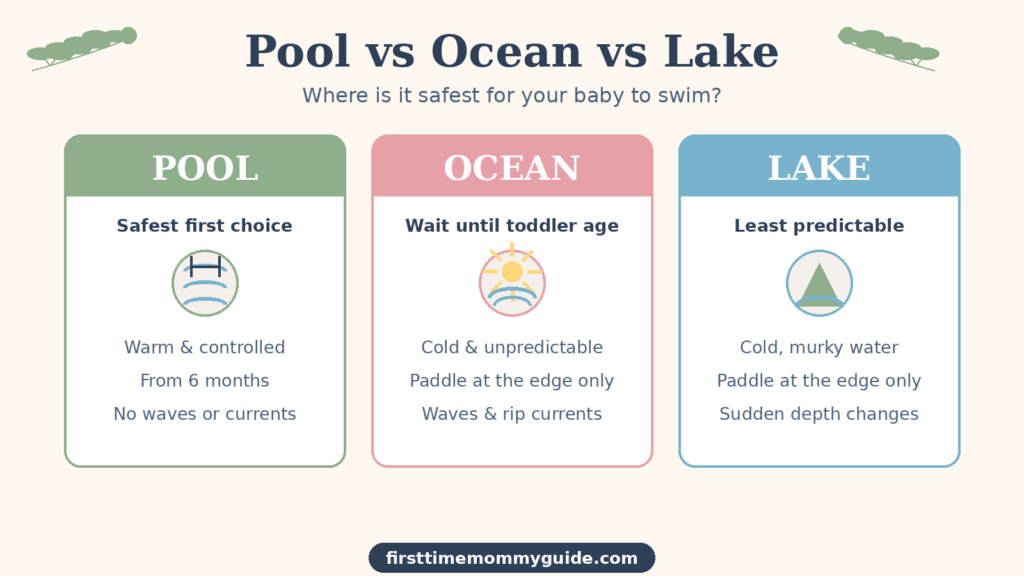
Not all water is equal, and the place you choose matters as much as the age you start. Here is how the three most common options compare.
| Factor | Swimming pool | Ocean / beach | Lake / river |
|---|---|---|---|
| Water quality | Treated, monitored | Natural, variable | Natural, variable |
| Temperature | Usually warm and controlled | Often cold, changes fast | Can be cold, changes fast |
| Waves and currents | None | Waves, tides, rip currents | Currents, sudden drop-offs |
| Best age to start | From around 6 months | Toddler age, with close supervision | Toddler age, with close supervision |
| Key risk | Germs, chlorine irritation | Waves, cold, sun exposure | Murky water, bacteria, depth changes |
| Supervision needed | Arm’s reach, always | Arm’s reach, always | Arm’s reach, always |
Swimming pools: the safest first choice
A clean, well-maintained pool is the best place for a baby’s first swim. The water is warm, the depth is predictable, there are no waves, and you can get out in seconds. Look for pools heated to around 30°C (86°F) or above for babies under one, and choose quieter times when the pool is less crowded.
Ocean and beach: wait until toddler age
The ocean is beautiful, but it is unpredictable. Waves can knock a small child over in seconds, the water is usually cold, and rip currents are a real danger even in shallow water. Most experts suggest waiting until your child is a confident toddler before proper ocean swimming, and even then, stay in very shallow water with your child in your arms.
If you do take a baby to the beach, keep them in the shade, use baby-safe sunscreen, and let them paddle at the water’s edge rather than going in properly. Our baby sunscreen guide explains which sunscreens are safe for babies and how to apply them.
Lakes and rivers: the least predictable option
Lakes and rivers can look calm and inviting, but the water is often cold, murky, and full of bacteria. Depths change suddenly, the bottom can be slippery or muddy, and there is no lifeguard. For babies and toddlers, lakes and rivers are best avoided for actual swimming. A gentle paddle at the edge on a warm day is one thing; going in properly is another.
Water Temperature: How Warm Is Warm Enough?
Babies lose body heat much faster than adults, so water temperature is not a minor detail. It is one of the most important safety factors in infant swimming safety.
For babies under one, the ideal pool temperature is around 30–32°C (86–90°F). Many dedicated baby swim pools are heated to this range. Standard public pools are often cooler, around 26–29°C (79–84°F), which is fine for older toddlers and adults but can chill a small baby quickly.
Before you get in, test the water yourself. If it feels cool to you, it will feel cold to your baby. Keep sessions short in cooler water, and consider a baby wetsuit or swim nappy with a thermal layer if you swim regularly in a standard pool.
Signs your baby is getting cold
- Shivering or trembling
- Lips turning blue or pale
- Skin looking mottled or blotchy
- Unusual fussiness or sudden quietness
- Hands and feet feeling very cold
If you notice any of these, get out of the water immediately, wrap your baby in a warm towel, and dress them in dry clothes. A warm cuddle and a feed usually settle a chilled baby quickly, but if your baby seems unusually lethargic or unwell, call your paediatrician.
Chlorine and Pool Chemicals: Are They Safe for Babies?
Chlorine keeps pool water clean, and in a well-maintained pool the levels are safe for babies. Problems usually arise in pools with poor ventilation or incorrect chemical balance, where the air above the water can irritate little lungs.
Choose indoor pools with good ventilation, and avoid pools with a very strong chemical smell, which can indicate poor air quality. After swimming, rinse your baby with clean fresh water and apply a gentle moisturiser, because chlorine can dry out delicate skin.
Babies with eczema or sensitive skin may react more to chlorine. If your baby’s skin flares up after swimming, try a shorter session, a thorough rinse, and a barrier moisturiser before your next visit. If the problem continues, ask your paediatrician whether swimming is right for your baby at this stage.
Saltwater pools are a gentler alternative for some families, but they still use chlorine, just generated differently. The key factor is always how well the pool is maintained, not whether it is labelled saltwater or chlorine.
Ear Infections and Swimming: What Parents Should Know
Swimmer’s ear, an infection of the outer ear canal, is one of the most common swimming-related problems in young children. It happens when water stays trapped in the ear after swimming, creating a warm, damp environment where bacteria thrive.
Babies who have had ear infections before may be more prone to them. Watch for signs after swimming, such as tugging at the ear, unusual crying, fever, or fluid coming from the ear. Our guide to baby ear infection signs and care explains what to look for and when to call your doctor.
How to protect your baby’s ears
- Tilt your baby’s head to each side after swimming to let water drain out.
- Gently dry the outer ear with a soft towel. Never insert cotton buds into the ear canal.
- Avoid submerging your baby’s head underwater in the early months.
- If your baby has tubes in their ears or a history of repeated ear infections, ask your paediatrician about ear plugs or drops before swimming.
A middle ear infection, the kind babies get with colds, is different from swimmer’s ear. Swimming does not usually cause middle ear infections, but a baby who is already unwell with a cold or ear infection should skip the pool until they recover. If your little one is sniffly, our baby first cold remedies can help you decide when they are well enough for normal activities again.
Sunscreen and Sun Protection for Baby Swimmers
Outdoor swimming and sun exposure go together, and babies need more sun protection than adults. Their skin is thinner, burns faster, and they cannot tell you they are getting hot.
For babies under six months, shade and clothing are the main protection, because most health authorities advise against sunscreen at that age. A wide-brimmed hat, a long-sleeved rash guard, and a shaded spot under an umbrella do the heavy lifting.
From six months onwards, you can use a baby-safe mineral sunscreen with SPF 30 or higher. Apply it 15 to 30 minutes before going outside, reapply after swimming and towelling off, and do not forget ears, the backs of hands, and the tops of feet. A swim nappy and rash guard add another layer of protection that sunscreen alone cannot match.
What to Bring to Baby Swim Lessons: The Checklist
Packing well makes the difference between a relaxed lesson and a frantic one. Keep a dedicated swim bag ready so you can grab it and go.
For your baby:
- [ ] Swim nappy (reusable or disposable — most pools require one, and many require two layers)
- [ ] Swimsuit or rash guard
- [ ] Warm towel, preferably hooded
- [ ] Dry clothes and a nappy for afterwards
- [ ] Baby wetsuit or thermal top for cooler pools
- [ ] Snack and drink for after the lesson
- [ ] Favourite bath toy for comfort
For you:
- [ ] Swimsuit and towel
- [ ] Water bottle
- [ ] Hair tie and shower cap if needed
- [ ] Change of clothes
- [ ] Plastic bag for wet items
Nice to have:
- [ ] Waterproof phone pouch for photos
- [ ] Baby-safe sunscreen for outdoor pools
- [ ] Small snack for yourself — holding a baby in water is surprisingly tiring
Feed your baby about an hour before the lesson, not right before it, so they are neither hungry nor full. A tired or hungry baby will not enjoy the water, and a recently fed baby may spit up. Timing the lesson around naps matters too: a well-rested baby learns and enjoys far more than an overtired one.
How to Choose a Baby Swim School
Not all swim schools are equal, and a little research before you book saves disappointment later. Here is what to look for.
Instructor qualifications
Ask whether instructors are certified in baby and toddler swimming and in first aid and CPR. Reputable schools display their qualifications and are happy to explain their training. The American Red Cross offers swim lesson programmes and instructor training, and its guidance on lesson structure is a useful benchmark.
Class size and structure
Small classes are better, especially for babies. Look for a maximum of six to eight babies per instructor, with a parent in the water for every child under three. Ask whether classes are grouped by age and ability, because a mixed class of six-month-olds and three-year-olds will not serve either group well.
Pool conditions
Visit the pool before you book. The water should be warm, the changing area clean, and the pool itself well maintained. Ask about the water temperature for baby classes specifically, and check that the pool has a shallow area or steps where you can sit with your baby.
Teaching philosophy
A good baby swim school is gentle and child-led. Instructors should never force a baby underwater, hold a baby under against their will, or push a distressed child to continue. If you see forced submersion or a baby crying through a session while the instructor carries on, walk away. That is not teaching; it is distress, and it can create a lasting fear of water.
Questions to ask before booking
- What qualifications do your instructors hold?
- What is the maximum class size?
- What is the water temperature for baby classes?
- What is your policy on underwater submersion?
- Can I watch a class before signing up?
- What is your refund or make-up policy if my baby is ill?
A school that answers these questions openly is a school worth trusting. One that dodges them is not.
First Lesson Tips: Making Baby’s First Swim a Happy One
Your baby’s first lesson sets the tone for every swim that follows, so it is worth getting it right. These tips come from swim instructors and experienced parents, and they work.
Arrive early and unhurried. Rushing into a pool with a stressed parent is a poor start. Arrive ten minutes early, change slowly, and let your baby look around and take in the new environment.
Start in your arms, on the steps. Sit on the pool steps with your baby on your lap and let the water lap gently around them. Splash a little water on their tummy and legs before going deeper. Let them adjust at their own pace.
Keep your face relaxed and smiling. Babies read your face constantly. If you look tense, they will be tense. If you smile and talk in a calm, happy voice, they take their cue from you.
Sing and play. Songs, gentle bouncing, and floating games keep the session fun and distract from any nervousness. Most baby swim classes build songs into the lesson for exactly this reason.
Never force submersion. Some programmes include gentle dips under the water, but only when the baby is ready and the parent is comfortable. If your baby is not ready, or you are not comfortable, say so. A good instructor will respect that.
Keep it short. Twenty to thirty minutes is enough for a first lesson. A tired, cold, or overstimulated baby will not learn anything, and a short happy session beats a long miserable one.
Celebrate afterwards. A warm towel, a cuddle, a feed, and a lot of praise help your baby associate swimming with good feelings. Take a photo if you like — you will want to remember this day.
If your baby cries through the first lesson, do not panic and do not give up. Many babies need two or three sessions before they relax. If crying continues beyond that, talk to the instructor about slowing down, or try a different time of day when your baby is more rested.
Common Mistakes Parents Make With Baby Swimming
Even careful parents make these mistakes. Knowing them in advance helps you avoid them.
1. Starting too early. Taking a newborn swimming is not a head start; it is a risk. Wait until around six months for water play and age one for formal lessons, unless your paediatrician advises otherwise.
2. Believing lessons make a child drown-proof. This is the most dangerous misconception in baby swimming. Lessons reduce risk, but drowning can happen in seconds, in inches of water, to a child who has had lessons. Supervision is always required.
3. Using floaties as a substitute for supervision. Arm bands, swim rings, and float suits can give a false sense of security. They can slip off, deflate, or tip a baby face-down. Use them as toys and aids if you like, but never as a babysitter.
4. Leaving a baby unattended near water, even briefly. Drowning is silent and fast. Never leave a baby alone in a bath, a paddling pool, or near any water to answer the phone or grab a towel. If you need to leave, take your baby with you. Our baby-proofing home checklist covers water hazards at home, including baths and buckets.
5. Swimming when the baby is ill. A baby with a fever, vomiting, diarrhoea, or an ear infection should not swim. It is uncomfortable for them, and it can spread illness to other babies in the pool.
6. Overdoing session length. An overtired, cold baby will not enjoy swimming and may start to associate the pool with discomfort. Short, happy sessions build a love of water; long, miserable ones build fear.
7. Skipping the swim nappy. Most pools require a swim nappy, and for good reason. A regular nappy swells up in water and does not contain accidents. Many pools require a double layer — a disposable swim nappy under a reusable one.
8. Comparing your baby to others. Some babies take to water instantly; others take months. Both are normal. Comparing your baby to the confident little swimmer in the next lane only adds pressure, and pressure is the enemy of learning.
FAQs: When Can Babies Start Swimming?
1. When can babies start swimming?
Most babies can start gentle water play from around 6 months old, in a warm pool with a parent holding them. Formal baby swim lessons are recommended from age 1, according to the AAP. Newborns should not swim.
2. Can a 3-month-old go swimming?
It is best to wait. Babies under 6 months lose body heat quickly, their immune systems are still developing, and they cannot regulate their temperature well. Warm baths at home are the safest water play for this age.
3. Can a newborn go in a pool?
No. Newborns should not go in a swimming pool. Their skin is delicate, they chill easily, and public pool water carries germs their young immune systems are not ready for. Wait until at least 6 months, and check with your paediatrician first.
4. When can baby go in a pool with chlorine?
From around 6 months, in a well-maintained pool with proper chlorine levels. Rinse your baby with fresh water afterwards and moisturise their skin. Avoid pools with a very strong chemical smell or poor ventilation.
5. What age is best for baby swim lessons?
Age 1 is the recommended starting age for formal lessons, according to the AAP. Parent-and-baby water familiarisation classes can start from around 6 months. Children aged 1 to 4 benefit most from lessons, because drowning risk is highest in this age group.
6. Do baby swim lessons prevent drowning?
Lessons reduce drowning risk, but they do not prevent it. No lesson makes a child drown-proof. Constant, close adult supervision is still essential, along with barriers such as pool fences and locked gates.
7. Are survival swim lessons safe?
Survival swim programmes are controversial. Some parents value the self-rescue skills they teach, while some paediatricians worry about stress and water inhalation. Talk to your paediatrician before enrolling, visit a session first, and never let any programme replace supervision.
8. How warm should the pool be for a baby?
Around 30–32°C (86–90°F) is ideal for babies under one. Standard public pools are often cooler, so keep sessions short and watch for signs of chilling, such as shivering or blue lips.
9. How long can a baby stay in the pool?
Ten to twenty minutes is plenty for a first session, and up to thirty minutes once your baby is used to it. Always get out sooner if your baby shivers, gets fussy, or seems tired.
10. Can babies swim in the ocean?
Babies should not swim properly in the ocean. The water is usually cold, waves are unpredictable, and currents are dangerous. Toddlers can paddle at the water’s edge with a parent holding them, but proper ocean swimming should wait until your child is older and more confident.
11. Can babies swim in a lake?
Lakes are not recommended for babies. The water can be cold, murky, and contain bacteria, and depths change suddenly. A gentle paddle at the edge on a warm day is fine, but avoid full swimming until your child is older.
12. Should my baby wear a swim nappy?
Yes. Always use a swim nappy in a pool, and check whether your pool requires a double layer. Regular nappies swell in water and do not contain accidents.
13. Can my baby swim if they have a cold?
A baby with a mild cold and no fever can sometimes swim, but it is usually better to rest. Skip swimming entirely if your baby has a fever, vomiting, diarrhoea, or an ear infection. When in doubt, wait a day.
14. Can my baby swim after vaccinations?
Yes, usually. Most babies can swim a day or two after routine vaccinations, once any soreness or mild fever has settled. If your baby seems unwell after their jabs, wait until they are back to normal. Our baby vaccination schedule for the first year explains what to expect after each round.
15. Will chlorine hurt my baby’s skin?
In a well-maintained pool, chlorine is safe, but it can dry out delicate skin. Rinse your baby with fresh water after swimming and apply a gentle moisturiser. Babies with eczema may need extra care, so check with your paediatrician.
16. Can my baby wear sunscreen in the pool?
From 6 months, yes. Use a baby-safe mineral sunscreen with SPF 30 or higher, apply it before swimming, and reapply after towelling off. For babies under 6 months, rely on shade and protective clothing instead.
17. What if my baby hates the water?
That is completely normal. Some babies need several gentle introductions before they relax. Keep sessions short and positive, never force it, and try again in a few weeks. If your baby continues to be distressed, talk to your paediatrician or try a different class or time of day. Our guide on how to soothe a crying baby has calming techniques that work well before and after swim sessions.
18. Do I need to be able to swim to take my baby to lessons?
No. In parent-and-baby classes, you will be in shallow water holding your baby, and the instructor guides you throughout. If you are not a confident swimmer yourself, tell the instructor in advance so they can give you extra support.
19. Can babies swim in a hot tub?
No. Hot tubs are not safe for babies or young children. The water is too hot, the jets are too strong, and the chemical levels are higher than in a pool. Babies should never go in a hot tub.
20. How do I know when my baby is ready for the next step?
Look for signs of comfort and confidence: relaxed body language in the water, happy kicking, blowing bubbles, and willingness to be held in a floating position. When your baby is comfortable with these, talk to the instructor about moving to a more advanced group. Every baby progresses at their own pace, and there is no rush.
Your Baby’s First Swim: A Gentle Start Matters More Than an Early Start
The question of when babies can start swimming has a simpler answer than most parents expect. Gentle water play from around six months, formal lessons from age one, and constant supervision at every age. That is the whole framework, and everything else is detail.
What matters most is not how early your baby starts, but how they feel about the water. A baby who splashes happily at seven months and takes lessons at eighteen months will be a stronger, safer swimmer than a baby who was pushed into lessons too early and learned to fear the pool. Patience now pays off for years.
So pick a warm pool, pack the swim bag, and go slowly. Sit on the steps, let the water lap around those tiny toes, and watch your baby’s face. That first splash, that first giggle, that first kick — those are the moments that make all the preparation worthwhile.
And when your baby is ready for the next milestone, whether it is crawling, reaching their six-month milestones, or settling into safe sleep in a sleep sack, you will find the same calm, practical guidance here. Enjoy the water, mama. You have got this.
This article is for general information only and is not medical advice. Always check with your paediatrician before starting swimming with your baby, especially if your baby was born prematurely or has a health condition.

Dilawar Mughal
Founder and editor, First Time Mommy Guide
I research every guide against what the NHS, the AAP and the WHO publish, then write it in plain English — because most new parents are reading with one hand free, not comparing clinical guidelines. I'm not a doctor or a midwife. Every health claim on this site is sourced and linked so you can check it yourself, and anything urgent belongs with your health visitor or GP, not a blog.


