Newborn Feeding Schedule (0–3 Months): How Often and How Much Your Baby Really Needs
Dilawar MughalOctober 23, 202610 min read
General information, not medical advice. Every baby is different — if anything worries you, speak to your midwife, health visitor or GP rather than waiting.
Quick answer: Most newborns eat every 2–3 hours — 8–12 times in 24 hours. Formula-fed babies usually eat every 3–4 hours. Follow your baby’s hunger cues, not just the clock. (Source: AAP)
Introduction
It’s 3am. Your baby is crying, and you’re doing the mental math: did she eat an hour ago, or was that three hours ago? Is she actually hungry, or just fussy?
Every first-time parent has been here. A newborn feeding schedule sounds like it should be simple, but the internet gives you twenty different answers, and your baby didn’t read any of them.
Here’s the truth: newborn feeding isn’t about a rigid timetable. It’s about learning your baby’s rhythm and knowing the general ranges that mean things are on track. This guide gives you both — clear schedules for breastfed and formula-fed babies from birth to 3 months, the hunger cues that matter more than the clock, and the warning signs worth calling your doctor about.
Everything here is checked against guidance from the American Academy of Pediatrics (AAP), the NHS, and the World Health Organization (WHO). I’m not a doctor or midwife — this is general information, not medical advice. Your pediatrician, GP, or health visitor always comes first.
Definition: Feeding on demand. Feeding your baby whenever they show hunger cues, rather than on a fixed schedule. Most experts, including the AAP, recommend feeding on demand for newborns — the “schedule” is really just the pattern that emerges.
How Often Should a Newborn Eat? The Short Version
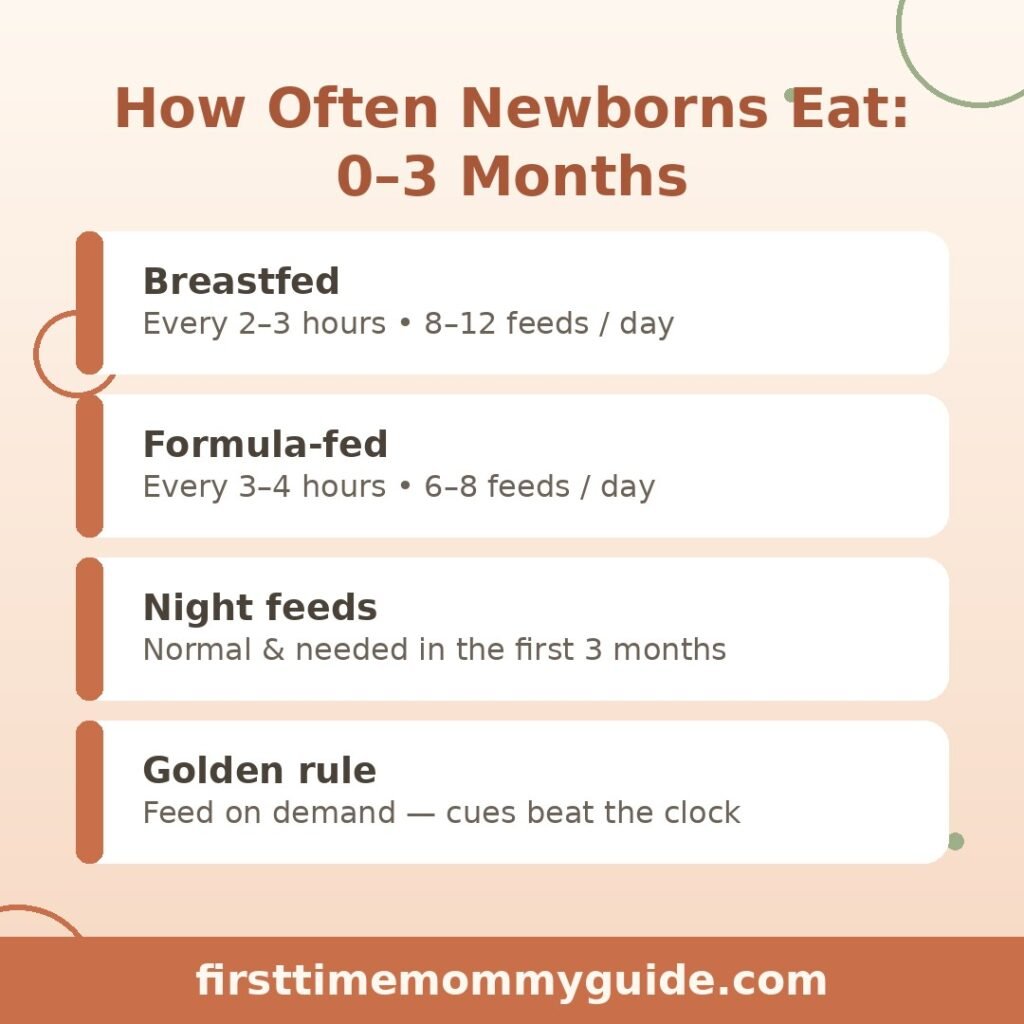
Breastfed newborns: every 2–3 hours, or 8–12 times per 24 hours (AAP).
Formula-fed newborns: every 3–4 hours, about 6–8 times per 24 hours.
Night feeds: yes, they’re normal. Newborns need to eat overnight.
The golden rule: watch the baby, not the clock. Hunger cues beat timetables.
Newborn stomachs are tiny — about the size of a cherry on day one, growing to roughly the size of an egg by one month. That’s why feeds are frequent and small.
Newborn Feeding Chart: 0–3 Months
Use these ranges as a starting point, then adjust to your baby.
Breastfed Babies
Baby’s age
How often
Feeds per 24 hours
0–2 weeks
Every 2–3 hours
8–12
2–4 weeks
Every 2–3 hours
8–10
1–2 months
Every 2–3 hours
7–9
2–3 months
Every 3–4 hours
6–8
The AAP advises not letting a newborn go longer than 4 hours without feeding in the first weeks — wake them if you have to, until your pediatrician says otherwise and weight gain is steady.
Formula-Fed Babies
Baby’s age
How often
Amount per feed
Feeds per 24 hours
0–2 weeks
Every 2–3 hours
1.5–3 oz (45–90 ml)
8–10
2–4 weeks
Every 3–4 hours
2–4 oz (60–120 ml)
7–8
1–2 months
Every 3–4 hours
4–5 oz (120–150 ml)
6–8
2–3 months
Every 3–4 hours
5–6 oz (150–180 ml)
5–6
Formula digests more slowly than breast milk, which is why formula-fed babies can usually stretch a little longer between feeds. Never force a baby to finish a bottle — stop when they show they’re full.
Hunger Cues: What to Watch For (More Important Than the Clock)
Babies tell you they’re hungry long before they cry. Crying is actually a late hunger cue — an already-upset baby is harder to feed. Learn the early signs:
Early hunger cues — “I’m getting hungry”
Stirring or becoming more alert while sleeping
Opening the mouth, turning the head (rooting)
Bringing hands to the mouth, sucking on fists
Mid-level hunger cues — “Feed me soon”
Stretching and moving more
Increased physical movement
Mouthing and lip-smacking
Late hunger cues — “I’m really hungry now”
Crying
Agitated body movements, turning red
Fullness cues — “I’m done”
Slowing down, stopping sucking
Turning away from the breast or bottle
Relaxed hands and body, often falling asleep
Pushing the bottle away or unlatching
Key takeaway: Feed at the early cues whenever you can. A calm baby latches better, takes a bottle more easily, and feeds more efficiently than a screaming one.
Breastfed vs. Formula-Fed: What’s Different About the Schedule?
The overall pattern is the same — frequent, small, on-demand feeds. The differences are practical:
Frequency: Breast milk digests faster, so breastfed babies typically eat more often (every 2–3 hours vs. every 3–4).
Measuring: With a bottle you can see ounces. With breastfeeding, you go by time at the breast, swallowing sounds, and output (wet diapers — more on that below).
Night feeds: Both need them. Breastfed babies may wake more often overnight.
What stays the same: hunger cues, fullness cues, and the “is my baby getting enough?” checks below apply to both.
The WHO recommends exclusive breastfeeding for the first 6 months where possible, with continued breastfeeding alongside solid foods up to 2 years or beyond. Fed is what matters most, though — a well-fed baby on formula is thriving. Do what works for your family.
Cluster Feeding: Why Your Baby Suddenly Wants to Eat Every Hour
Around 2–3 weeks, 6 weeks, and 3 months, many babies go through phases of cluster feeding — wanting to feed every 30–60 minutes, usually in the evenings. It feels relentless. It feels like something is wrong.
It’s normal. Cluster feeding usually lines up with growth spurts, and it serves a purpose: frequent feeding tells your body to make more milk. These phases typically last 2–3 days.
How to survive cluster feeding:
Set up a comfortable feeding station (see our newborn essentials checklist): water, snacks, phone charger, pillows.
Accept that the evening is a write-off for a few days.
Let someone else handle everything that isn’t feeding the baby.
If your baby seems in pain (arching, screaming, inconsolable), or cluster feeding lasts beyond a few days with poor weight gain, call your pediatrician.
Definition: Growth spurt. A short period of rapid growth when babies feed more frequently than usual. Common around 7–10 days, 3 weeks, 6 weeks, and 3 months. Each typically lasts 2–3 days.
Sample Newborn Feeding Schedules
Remember: these are examples, not prescriptions. Your baby’s pattern will be its own.
Sample schedule: 2-week-old, breastfed
Time
What happens
7:00 am
Feed, then nap
9:30 am
Feed, awake time
12:00 pm
Feed, then nap
2:30 pm
Feed, awake time
5:00 pm
Feed
6:30 pm
Cluster feed
8:00 pm
Cluster feed, bedtime routine
10:30 pm
Feed before your own sleep
1:30 am
Night feed
4:00 am
Night feed
Sample schedule: 2-month-old, formula-fed
Time
What happens
7:00 am
4–5 oz bottle
10:00 am
4–5 oz bottle, nap after
1:00 pm
4–5 oz bottle
4:00 pm
4–5 oz bottle, nap after
7:00 pm
4–5 oz bottle, bedtime routine
10:30 pm
Dream feed (4–5 oz)
2:30 am
Night feed as needed
5:00 am
Early feed, back to sleep
How to Know Your Baby Is Getting Enough
Forget the anxiety spiral. These are the concrete signs pediatricians actually look for:
Wet diapers: At least 6 wet diapers per 24 hours after the first week.
Dirty diapers: Several per day in the early weeks (breastfed babies may go less often after 6 weeks — ask your pediatrician).
Weight gain: Steady gain at checkups. Most babies regain birth weight by 2 weeks.
Behavior: Alert and content between feeds, not constantly lethargic.
Swallowing: You can hear rhythmic swallowing during feeds (breastfeeding).
Call your doctor promptly if: your baby has fewer than 6 wet diapers a day after week one, isn’t regaining birth weight by 2 weeks, is unusually sleepy and hard to wake for feeds, has a weak cry, or you’re worried for any reason. Trust your gut — that’s what they’re there for.
Common Feeding Mistakes First-Time Parents Make
Watching the clock instead of the baby. The schedule is a guide; hunger cues are the real signal.
Letting a sleepy newborn skip feeds in week one. Wake them until weight gain is established.
Forcing the bottle to be finished. Leftover milk is fine. An overfed baby is an uncomfortable baby.
Comparing with another baby. Ranges are wide. Your friend’s baby eating every 4 hours doesn’t mean yours should.
Night Feeds: When Can You Drop Them?
Honestly? Not yet. In the first 3 months, night feeds are biologically normal and necessary. Most babies start stretching one longer sleep stretch (4-5 hours) somewhere between 6-12 weeks, but there’s huge variation. If sleep falls apart again around the four-month mark, here’s how to handle the 4 month sleep regression.
Don’t try to night-wean a newborn. If your baby consistently sleeps a longer stretch on their own and weight gain is good, enjoy it — but don’t force it.
Conclusion
A newborn feeding schedule isn’t a timetable you impose — it’s a pattern you discover together. Aim for the ranges (every 2–3 hours breastfed, every 3–4 formula-fed), feed at early hunger cues, watch the diapers and the weight gain, and give yourself grace while you learn.
You’re not supposed to have this memorized. You’re learning a brand-new human. That takes a few weeks, and that’s completely normal.
Medical disclaimer: This article is general information, not medical advice. Feeding guidance here follows published AAP, NHS, and WHO recommendations, but every baby is different. Always check with your pediatrician, GP, or health visitor about your baby’s feeding.
FAQs
How often should a newborn eat in 24 hours?
Most newborns eat 8–12 times per 24 hours if breastfed, or 6–8 times if formula-fed. Feed on demand using hunger cues rather than a strict clock.
How many ounces should a newborn eat per feeding?
It depends on age: roughly 1.5–3 oz in the first two weeks, 3–4 oz at one month, and 4–6 oz by 2–3 months for formula-fed babies. Breastfed intake is measured by diapers and weight gain instead.
Should I wake my newborn to feed?
In the first couple of weeks, yes — don’t let a newborn go longer than 4 hours without feeding until your pediatrician confirms steady weight gain. After that, most babies will wake you.
What is cluster feeding and is it normal?
Cluster feeding is when a baby feeds very frequently (every 30–60 minutes) for a few hours, often in the evening. It’s normal, usually lasts 2–3 days, and often coincides with growth spurts.
How do I know if my breastfed baby is getting enough milk?
At least 6 wet diapers per day after the first week, steady weight gain, audible swallowing during feeds, and an alert, content baby between feeds.
Can you overfeed a newborn?
It’s difficult to overfeed a breastfed baby, who will stop when full. Bottle-fed babies can be overfed — watch fullness cues and don’t force them to finish the bottle.
Why does my newborn want to eat every hour?
Likely cluster feeding during a growth spurt (common at 2–3 weeks, 6 weeks, 3 months). If it persists beyond a few days or your baby seems in pain, check with your pediatrician.
How long should each breastfeeding session last?
Newborn sessions often last 20–45 minutes total in the early weeks, getting shorter as your baby becomes more efficient. Let your baby finish the first breast before offering the second.
When do babies start eating less frequently?
Feeds gradually space out: by 2–3 months many babies eat every 3–4 hours instead of every 2–3. Every baby’s timeline differs.
Is it normal for my newborn to fall asleep while feeding?
Yes, very normal in the early weeks. Try gentle stimulation — undressing to a vest, a cool cloth, or breast compressions — to keep them feeding actively.
Should newborns eat on a schedule or on demand?
On demand. The AAP recommends feeding newborns when they show hunger cues. A predictable pattern usually emerges on its own within a few weeks.
How many wet diapers should a newborn have?
After the first week, at least 6 wet diapers per 24 hours is a good sign of adequate intake. Fewer than that warrants a call to your doctor.
What are the signs of hunger in newborns?
Early signs: stirring, rooting, hands to mouth. Later signs: fussing, then crying. Crying is a late cue — try to feed before it gets there.
When should I call the doctor about feeding?
Call if your baby has fewer than 6 wet diapers daily after week one, isn’t back to birth weight by 2 weeks, is extremely sleepy and hard to wake, or feeding is consistently painful for you.
Do formula-fed babies sleep longer than breastfed babies?
Formula digests more slowly, so formula-fed babies may go slightly longer between feeds. But sleep stretches vary hugely by baby — feeding type is only one small factor.
What is a dream feed?
A dream feed is a late-evening feed (around 10–11pm) given while your baby is drowsy or lightly sleeping, to top them up before your own bedtime. Some families find it extends the first sleep stretch.
Can I give my newborn water?
No. The AAP and WHO advise against giving water to babies under 6 months — breast milk or formula provides all the hydration they need.
Why is my baby fussy after feeding?
Try burping first — trapped wind is the most common cause. If fussiness is persistent, with arching or screaming, talk to your pediatrician to rule out reflux or other issues.
Dilawar Mughal
Founder and editor, First Time Mommy Guide
I research every guide against what the NHS, the AAP and the WHO publish, then write it in plain English — because most new parents are reading with one hand free, not comparing clinical guidelines. I'm not a doctor or a midwife. Every health claim on this site is sourced and linked so you can check it yourself, and anything urgent belongs with your health visitor or GP, not a blog.