General information, not medical advice. Every baby is different — if anything worries you, speak to your midwife, health visitor or GP rather than waiting.
Your baby’s first birthday is approaching, and a new question keeps popping up at every well-child visit and playgroup chat: when can baby drink cow’s milk, and how do you actually make the switch? If you feel a mix of excitement and nervousness, you are in very good company. Introducing cow’s milk to baby is one of the biggest feeding milestones of the toddler years, and like most milestones, it goes much more smoothly with a little preparation and a lot of patience.
Here is the short answer first: most babies can start drinking whole cow’s milk at 12 months old. Before that birthday, breast milk or infant formula should remain their main milk drink, because cow’s milk does not provide the right balance of nutrients for a younger baby. After 12 months, whole cow’s milk becomes a healthy part of a varied diet, offered in a cup, in modest amounts, alongside solid foods.
This guide walks you through everything step by step: why 12 months is the magic number, which type of milk to buy, exactly how much to offer, how to handle a baby who refuses the new taste, and the warning signs that mean you should call your pediatrician. You will also find a sample daily menu, a week-by-week transition plan, and answers to the questions first-time moms ask most.
Quick Answer: When Can Baby Drink Cow’s Milk?
- Start at 12 months. The American Academy of Pediatrics (AAP) recommends waiting until your baby’s first birthday before offering cow’s milk as a main drink.
- Choose whole milk. Toddlers need the fat in whole milk for brain development. Low-fat and skim milk are not recommended before age 2 unless your pediatrician advises otherwise.
- Offer it in a cup. Moving to an open cup or straw cup at the same time helps protect teeth and supports oral development.
- Keep portions modest. Around 2 cups (16 ounces) per day is the sweet spot for most 12 to 24 month olds. More than that can crowd out iron-rich foods and even cause iron deficiency.
- Mix it in gradually. Many babies accept milk more easily when it is blended with breast milk or formula at first, with the ratio shifting over a week or two.
If your baby was born prematurely, has a known milk allergy, or follows a special diet, check the timing with your pediatrician first. Individual advice always beats a general guideline.
Why Wait Until 12 Months?
It is tempting to start earlier, especially if formula is expensive or breastfeeding is becoming harder. But there are solid medical reasons for the 12-month rule, and they are worth understanding before you decide.
First, cow’s milk is low in iron, and the iron it does contain is poorly absorbed. A baby under 12 months who drinks a lot of cow’s milk can develop iron-deficiency anemia, which can affect growth and development. Breast milk and formula, by contrast, are designed to deliver iron in a form young babies can use.
Second, cow’s milk contains more protein and minerals, such as sodium and potassium, than a young baby’s kidneys can comfortably handle. An immature kidney system has to work harder to process those loads, which is one reason pediatric guidance draws a firm line at 12 months.
Third, cow’s milk lacks several nutrients babies need in their first year, including adequate vitamin E, zinc, and essential fatty acids. It is not that cow’s milk is “bad” — it is simply the wrong main drink for a body that is still growing at a breathtaking pace. Once your baby eats a varied diet of solid foods, milk becomes a complement to meals rather than the main event, and that changes the equation entirely.
One important distinction: cow’s milk used as an ingredient is different from cow’s milk as a drink. Small amounts of milk cooked into foods, such as in mashed potatoes, pancakes, or porridge, are generally fine before 12 months, as long as your baby has no milk allergy. The restriction applies to cow’s milk as a primary drink. If you are unsure, your pediatrician can clarify what counts in your baby’s case.
For more on how feeding changes around this age, see our guide to signs your baby is ready for solid foods and the baby food chart for 6 to 12 months.
Which Type of Milk Should You Buy?
Walk down the milk aisle and you will face a wall of choices: whole, 2%, skim, organic, lactose-free, and a growing crowd of plant-based drinks. For most toddlers, the choice is refreshingly simple.
Whole cow’s milk is the default
Buy plain whole milk, also labelled full-fat milk. The fat it contains supports brain development and provides concentrated energy for a busy toddler. Avoid flavoured milks with added sugar, and skip low-fat versions until your pediatrician says otherwise, usually around age 2.
What about organic milk?
Organic milk is nutritionally similar to conventional milk. If it fits your budget and values, it is a fine choice, but it is not required for your baby’s health. The most important thing is that the milk is pasteurized. Never give a baby or toddler raw, unpasteurized milk, which can carry dangerous bacteria.
Plant-based drinks are not one-to-one swaps
Oat, almond, soy, and rice drinks are popular, but most are low in protein and fat compared with whole cow’s milk, and many contain added sugars. The exception is fortified soy milk, which some pediatricians approve as an alternative when a child cannot drink cow’s milk. If your family avoids dairy, talk to your pediatrician or a pediatric dietitian about which alternative, if any, fits your child’s needs, rather than swapping on your own.
Lactose-free milk
If your child is diagnosed with lactose intolerance, lactose-free cow’s milk keeps the protein and fat profile of regular milk without the lactose. True lactose intolerance is uncommon before age 2, so do not assume fussiness after milk means lactose intolerance. Gas, spit-up, or a change in stools can have many causes, and a pediatrician can help sort them out.
How Much Milk Does a 1 Year Old Need?
This is where many parents accidentally go wrong, because more milk feels like more nutrition. In fact, too much milk is one of the most common toddler feeding problems pediatricians see.
The AAP guidance for toddlers aged 12 to 24 months is about 2 cups, or 16 ounces, of whole milk per day. For children aged 2 to 3 years, the range stays similar, at up to 2 cups per day. Children aged 4 to 5 years can have up to 2.5 cups of dairy per day, which can include milk, yogurt, and cheese combined.
Why does the limit matter? Milk is filling. A toddler who drinks 30 ounces of milk a day often has little appetite left for iron-rich foods like meat, beans, eggs, and fortified cereals. Over time, that pattern can lead to iron-deficiency anemia, and it can also contribute to constipation. Milk also contains calcium, which in very large amounts can interfere with iron absorption. Two cups gives your child the calcium, vitamin D, and protein benefits of milk without crowding out the rest of the diet.
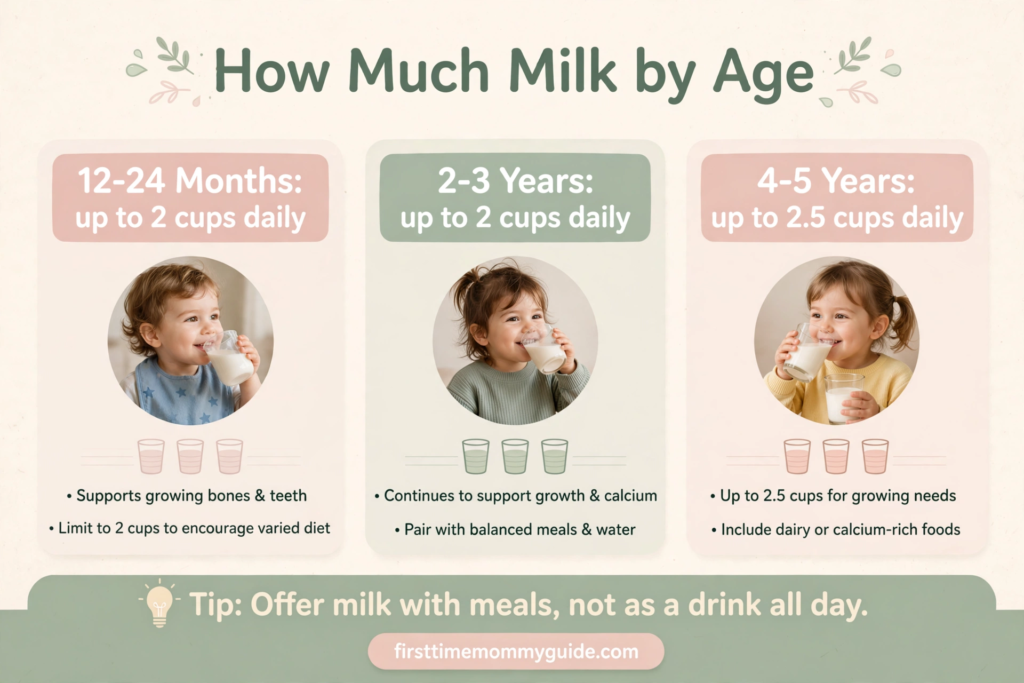
A practical way to manage the limit is to serve milk only at meals, in a measured cup, rather than letting your toddler carry a bottle or sippy cup of milk around all day. Constant sipping also increases the risk of tooth decay, since milk sugars sit on the teeth for hours. Mealtimes, a set amount, and water between meals is a routine that protects both nutrition and dental health.
If your baby is still breastfeeding after 12 months, that is wonderful, and you do not need to rush to replace breastfeeds with cow’s milk. Many families combine the two: breastfeeds in the morning and evening, and cow’s milk with meals during the day. Your pediatrician can help you find a balance that works for your child.
How to Introduce Cow’s Milk: A Gentle 2-Week Plan
Some babies take to cow’s milk immediately. Others wrinkle their noses at the unfamiliar taste and temperature. Both reactions are normal. A gradual transition gives your baby time to adjust and gives you a clear way to spot any reaction.
Week 1: Blend and familiarize
Start by mixing cow’s milk with the milk your baby already knows. For a formula-fed baby, try three parts formula to one part whole milk for a few days, then move to half and half. For a breastfed baby, you can mix expressed breast milk with cow’s milk in the same way, or simply offer a small amount of cow’s milk at a meal where your baby is already happy and hungry.
Serve the milk slightly warmed at first if that is what your baby is used to. Cold milk straight from the fridge can be a shock, and warming it to around body temperature makes the new taste less startling. Always test the temperature on your wrist first.
Week 2: Shift the ratio
Over the second week, increase the proportion of cow’s milk until the cup is all cow’s milk. Offer it at one meal first, usually lunch or dinner, then add a second serving once the first is accepted. Keep the total within the 2-cup daily limit, counting milk used in cereal or cooking only loosely, since those amounts are small.
Practical tips that help
- Use a cup your baby likes. A straw cup, an open cup with help, or a sippy cup can all work. Let your baby hold it and explore it without pressure.
- Offer milk when your baby is hungry but not starving. A very hungry baby may get frustrated by an unfamiliar taste. A calm, mildly hungry baby is more willing to try.
- Do not sweeten the milk. Adding sugar, honey (which is unsafe before 12 months anyway), or chocolate syrup creates a preference for sweet drinks and works against healthy habits.
- Model it. Drink a glass of milk yourself at the same meal. Toddlers are copycats, and seeing you enjoy it is surprisingly persuasive.
- Stay relaxed. If your baby refuses today, try again tomorrow. Pressure, coaxing, and forcing usually backfire and can turn milk into a battleground.
If your baby consistently refuses plain milk after several weeks, do not panic. Calcium and vitamin D can also come from yogurt, cheese, and fortified foods. Mention it at your next pediatric visit so your doctor can check overall nutrition.
From Bottle to Cup: Making Both Changes at Once
Many families use the milk transition as the moment to wean from the bottle entirely, and pediatric guidance supports that timing. Prolonged bottle use, especially at bedtime, raises the risk of tooth decay and ear infections, and the AAP recommends transitioning away from bottles around 12 to 15 months.
That said, changing the milk and the container at the same time can be a lot for one small person. If your baby is struggling, it is perfectly fine to change one thing at a time: introduce cow’s milk in the familiar bottle first, then move to a cup a week or two later, or vice versa. Progress beats perfection here.
For a step-by-step cup guide, see our article on introducing a sippy cup to your baby.
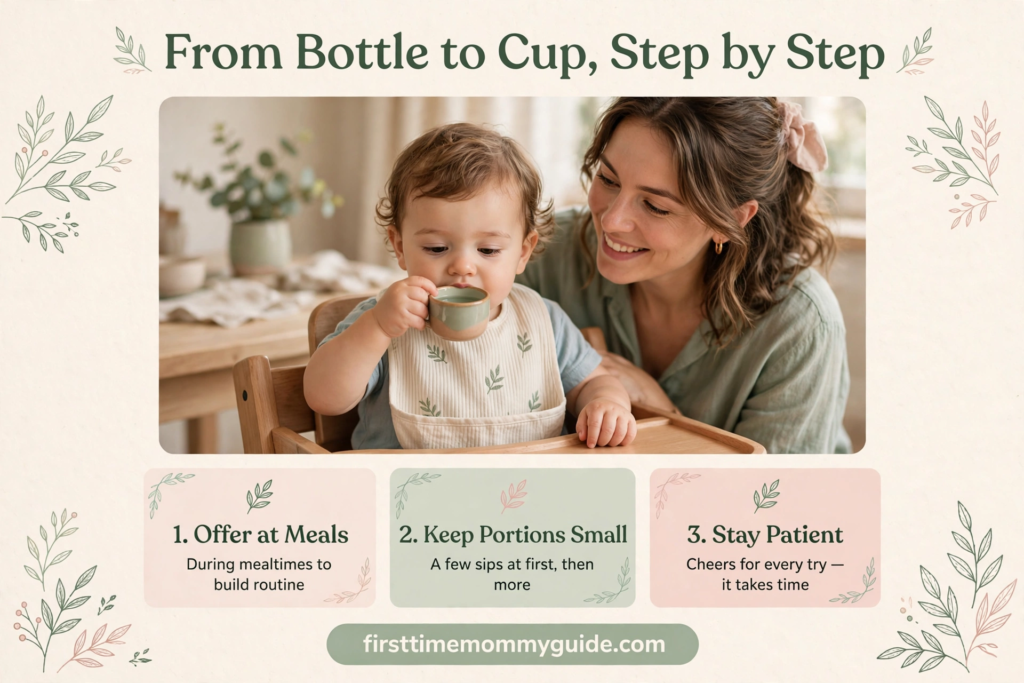
Useful cup tips include starting with small amounts so spills are minor, choosing a cup with handles your baby can grip, and keeping a cloth nearby without making a fuss about mess. Spills are part of learning, not misbehaviour.
Cow’s Milk Allergy vs. Intolerance: What to Watch For
Most babies tolerate cow’s milk well, but a small number react to it. Knowing the difference between an allergy and an intolerance helps you respond calmly and appropriately.
Cow’s milk protein allergy
A cow’s milk protein allergy is an immune reaction to the proteins in milk. Symptoms usually appear within minutes to a few hours of drinking milk, though some reactions are delayed by days. Signs can include hives, swelling of the lips or face, vomiting, wheezing, or, rarely, difficulty breathing. If your baby shows signs of a severe reaction, such as swelling, trouble breathing, or widespread hives, seek emergency care immediately.
If you already know your baby has a milk allergy, do not introduce cow’s milk without your pediatrician’s or allergist’s guidance. Many children outgrow milk allergy, but the timing and method of reintroduction should be medically supervised.
Our guide to introducing allergens to your baby explains how early allergen introduction works and when to seek specialist advice.
Lactose intolerance
Lactose intolerance means the body has trouble digesting lactose, the natural sugar in milk. It is rare in babies and toddlers, and its symptoms — gas, bloating, loose stools — are milder and slower to appear than an allergy. Temporary lactose intolerance can follow a stomach bug, but it usually resolves on its own.
What to do if you suspect a reaction
Stop the milk, note exactly what your baby drank, how much, and when symptoms started, and call your pediatrician. Do not start an elimination diet or switch to a specialty formula on your own, because unnecessary restriction can create nutritional gaps. A doctor can test, advise, and refer you to an allergist if needed.
Iron, Appetite, and the Rest of the Diet
Milk is only one part of your toddler’s nutrition, and the foods around it matter just as much. The biggest nutritional risk of the milk transition is not the milk itself, but what it pushes off the plate.
Build each day around iron-rich foods: finely chopped meat or poultry, beans and lentils, eggs, tofu, and iron-fortified cereals and breads. Pairing iron-rich foods with vitamin C, such as fruit with a meal, helps iron absorption. Keep milk servings at meals rather than between them, and offer water for thirst the rest of the day.
Constipation is another common complaint when milk intake jumps. If your toddler’s stools become hard, infrequent, or painful, first check the milk amount. Cutting back toward 2 cups a day, adding fibre from fruits, vegetables, and whole grains, and making sure your child drinks enough water usually helps. Persistent constipation deserves a pediatrician’s input, since it can have other causes.
For feeding foundations, our newborn feeding schedule guide and the baby-led weaning guide for beginners are useful background reads, even though your baby has now moved well beyond the first foods stage.
A Sample Day: Milk in a Toddler’s Diet
Here is what a balanced day might look like for a 13 month old who drinks cow’s milk. Portions are approximate, and appetites vary wildly from day to day, which is normal.
| Meal | Food | Milk |
|---|---|---|
| Breakfast | Oatmeal with mashed banana, scrambled egg | Small cup of whole milk (4 oz) |
| Morning snack | Soft fruit pieces, whole-grain toast fingers | Water |
| Lunch | Shredded chicken, cooked carrots, rice | Small cup of whole milk (4 oz) |
| Afternoon snack | Yogurt, berries | Water |
| Dinner | Lentil soup, soft pasta, steamed broccoli | Small cup of whole milk (4 oz) |
| Bedtime | Breastfeed or small snack if hungry | Water if thirsty |
That adds up to about 12 ounces of milk at meals, plus yogurt at snack time, comfortably within the daily dairy range. On days your baby eats more cheese or yogurt, you can offer a little less milk, and vice versa. Think of the 2-cup figure as a daily dairy budget, not a rigid prescription.
Mistakes to Avoid When Introducing Cow’s Milk
- Starting before 12 months. As a main drink, cow’s milk is not suitable for younger babies, even if they seem ready for it.
- Offering too much. More than 2 cups a day can reduce appetite for iron-rich foods and cause anemia or constipation.
- Letting milk become an all-day sipper. A bottle or cup carried everywhere harms teeth and appetite. Serve milk at meals, water between meals.
- Switching to low-fat milk too early. Toddlers need whole milk’s fat for brain development unless a doctor advises otherwise.
- Adding sweeteners. Sugar, honey, and syrups train a sweet tooth and add empty calories.
- Using raw milk. Unpasteurized milk carries a real risk of serious infection for young children.
- Panicking over refusal. A baby who rejects milk for a week is not failing. Keep offering calmly, and use yogurt and cheese in the meantime.
- Ignoring symptoms. Hives, swelling, vomiting, or breathing difficulty after milk need prompt medical attention, not a wait-and-see approach.
When to Call Your Pediatrician
Contact your pediatrician if your baby develops hives, swelling, vomiting, wheezing, or blood in the stool after drinking milk; if constipation or poor appetite persists after reducing milk intake; if your baby refuses all milk and dairy for several weeks; or if you are unsure whether an alternative milk is appropriate. You should also raise the milk transition at your 12-month well-child visit, which is a natural moment to review diet, growth, and iron status together.
Authoritative guidance worth reading includes the American Academy of Pediatrics’ recommendations on toddler milk intake via healthychildren.org, the NHS Start for Life guidance on drinks for babies, and the World Health Organization’s infant feeding recommendations. These sources agree on the core message: wait until 12 months, choose whole milk, and keep portions modest.
Frequently Asked Questions
Can I give my 11 month old a little cow’s milk?
Small amounts of cow’s milk cooked into foods are generally fine before 12 months. As a main drink, however, wait until 12 months, unless your pediatrician advises otherwise for a specific reason.
What if my baby hates the taste of cow’s milk?
Try mixing it with breast milk or formula and shifting the ratio gradually, serving it slightly warmed, and offering it in a fun cup. Keep offering without pressure. Yogurt and cheese can cover calcium in the meantime.
Is whole milk really necessary, or can I use 2%?
Whole milk is recommended for toddlers under 2 because its fat supports brain development. After age 2, your pediatrician may suggest moving to low-fat milk, depending on your child’s growth.
How do I know if my baby is allergic to cow’s milk?
Watch for hives, lip or face swelling, vomiting, wheezing, or eczema flare-ups shortly after drinking milk. Severe symptoms need emergency care. Milder, uncertain symptoms should be discussed with your pediatrician, who may refer you to an allergist.
Can I still breastfeed after introducing cow’s milk?
Yes, absolutely. Many families breastfeed alongside cow’s milk well into the second year. The two complement each other, and there is no deadline for weaning from breastfeeding.
Does cow’s milk cause constipation?
Too much milk can contribute to constipation, because it displaces fibre-rich foods and fluids. Keeping milk to about 2 cups a day, offering water between meals, and including fruits, vegetables, and whole grains usually resolves the problem.
What about goat’s milk?
Goat’s milk is closer to cow’s milk than plant drinks, but it is also low in folate and vitamin B12 and high in protein for infants. It is not recommended as a main drink before 12 months, and after 12 months it should only be used with pediatric guidance.
Can I put cow’s milk in cereal before 12 months?
Small amounts of milk mixed into cereal or purees are generally considered fine before 12 months, as long as your baby has no milk allergy. The concern is with cow’s milk replacing breast milk or formula as the main drink.
How long can milk sit out?
Offer fresh milk and discard what is left in the cup after a meal. Milk left at room temperature for more than an hour or two should not be saved, and a half-finished bottle should never be reheated later.
Should I warm cow’s milk?
Warming is a comfort preference, not a safety requirement. If your baby is used to warm formula or breast milk, slightly warmed milk may be accepted more easily. Always test the temperature before serving.
What if my toddler drinks more than 2 cups a day?
Gradually reduce the amount by serving smaller cups at meals and offering water for thirst. If your child is a big milk lover, check iron intake with your pediatrician, since heavy milk drinking is a known risk factor for anemia.
Is flavoured milk okay sometimes?
Flavoured milks add sugar without nutrition, and regular use can harm teeth and appetite. Save sweet drinks for rare occasions, if at all, and keep everyday milk plain.
Can cow’s milk replace formula immediately at 12 months?
You can switch fairly quickly once your baby turns 1, but a gradual blend over one to two weeks is gentler and helps you spot any reaction. There is no need to finish a formula stash first, but using it up in blends is fine.
Does my toddler need a vitamin D supplement with milk?
Whole milk is usually fortified with vitamin D, but some children still need a supplement, especially with limited sun exposure. Ask your pediatrician whether your child needs one.
What if my baby only drinks milk and refuses solids?
A milk-heavy, food-light pattern is common during transitions and teething, but if it persists for weeks, talk to your pediatrician. Reducing milk to mealtimes only usually restores appetite for solids.
Milk, Teeth, and Bedtime: Protecting That New Smile
The milk transition and dental health are closely connected, and a few small habits now prevent big problems later. Tooth decay in toddlers is often linked to milk or juice sitting on the teeth for long stretches, especially overnight. That is why pediatric dentists advise against sending a baby to bed with a bottle of milk, and why milk should be a mealtime drink rather than an all-day companion.
Start brushing as soon as the first tooth appears, using a smear of fluoride toothpaste about the size of a grain of rice. Brush twice a day, and wipe your baby’s gums and teeth after the last milk of the evening. If your toddler still wants a bedtime bottle, work on replacing it with a comforting routine that does not involve milk in bed: a bath, a story, a song, and a cuddle. The first few nights may be bumpy, but most babies adapt within a week when the new routine is consistent and warm.
Also watch the cup itself. A bottle or a spill-proof sippy cup that requires hard sucking keeps milk pooled around the teeth longer than an open cup or a straw cup, which lets milk clear more quickly. Neither is an emergency, but if you are choosing a new cup for the milk transition, an open cup or straw cup is the better long-term choice.
Troubleshooting the first week
| Problem | Likely cause | What to try |
|---|---|---|
| Refuses the cup | New taste or container | Blend with familiar milk, warm slightly, try a different cup |
| Drinks too much milk | Loves the taste, skips meals | Serve measured cups at meals only, water between meals |
| Loose stools for a day | New food adjustment | Keep portions small, watch for other symptoms, call doctor if it persists |
| Constipation | Milk displacing fibre and water | Reduce toward 2 cups daily, add fruit and vegetables, offer water |
| Spits milk out | Temperature or flow | Check temperature, try a slower-flow cup, offer again later |
| Wants milk at bedtime | Old habit | Replace with a story and cuddle routine, keep milk at dinner |
Conclusion
Introducing cow’s milk to baby is a milestone worth celebrating, not stressing over. Wait until 12 months, choose plain whole milk, serve about 2 cups a day in a cup at mealtimes, and let your baby adjust at their own pace. Keep iron-rich foods on the menu, water on hand for thirst, and your pediatrician in the loop about any reactions or worries.
Your baby will not remember the exact day milk changed, but the calm, unhurried way you handled it will shape how they feel about food for years. Offer, smile, try again tomorrow, and trust that this, like every other first, gets easier with practice. If this guide helped, save it for the week before your baby’s first birthday, and share it with another first-time mom who is wondering when the milk switch happens.

Dilawar Mughal
Founder and editor, First Time Mommy Guide
I research every guide against what the NHS, the AAP and the WHO publish, then write it in plain English — because most new parents are reading with one hand free, not comparing clinical guidelines. I'm not a doctor or a midwife. Every health claim on this site is sourced and linked so you can check it yourself, and anything urgent belongs with your health visitor or GP, not a blog.