4 Month Sleep Regression: Signs, How Long It Lasts, and How to Survive It
Dilawar MughalOctober 23, 202610 min read
General information, not medical advice. Every baby is different — if anything worries you, speak to your midwife, health visitor or GP rather than waiting.
Quick answer: The 4 month sleep regression is a normal, permanent change in how your baby sleeps — cycles mature from newborn to adult-like patterns. The rough patch usually lasts 2–6 weeks. It is developmental, not your fault.
Introduction
Your baby was finally sleeping longer stretches. You were starting to feel human again. And then — seemingly overnight — she’s waking every hour, naps collapsed to 30 minutes, and nothing you do works. For the full picture of how baby sleep develops, see our complete baby sleep guide.
Welcome to the 4 month sleep regression. It’s the most famous sleep regression for a reason: it blindsides almost every parent. But here’s what nobody tells you at 3am — this isn’t a step backward. It’s your baby’s brain leveling up. And it does pass.
This guide covers what the 4 month sleep regression actually is, the signs to look for, how long it lasts, and practical, gentle things you can do tonight. Everything is grounded in pediatric sleep science, and nothing here requires you to let your baby cry it out unless you choose to.
Definition: Sleep regression. A period when a baby who was sleeping relatively well suddenly starts waking more, napping worse, or fighting sleep — caused by developmental changes, not by anything you did wrong.
What Is the 4 Month Sleep Regression?
Newborns have simple sleep: they drop quickly into deep sleep and stay there. Around 3–4 months, that changes permanently. Your baby’s sleep cycles mature into lighter and deeper stages, much like adult sleep — cycling roughly every 45 minutes.
Here’s the catch: between each cycle there’s a brief, light-sleep transition. Adults roll over and drift back off without noticing. A 4-month-old fully wakes at each transition and needs help getting back to sleep — the same help they had when they first fell asleep.
That’s the whole regression in one paragraph: your baby didn’t forget how to sleep. The rules of sleep changed, and she’s still learning the new game.
Unlike later regressions (which are temporary disruptions), this one is a permanent upgrade to your baby’s sleep architecture. The rough patch passes, but the new sleep cycles are here to stay.
Signs of the 4 Month Sleep Regression
You might be in it if several of these appeared suddenly around 3–5 months:
Frequent night wakings — waking every 1–2 hours after previously sleeping longer stretches
Short naps — naps suddenly cut to exactly 30–45 minutes (one sleep cycle), then wide awake
Fighting bedtime — a bedtime routine that used to work now ends in protest
Only sleeping on you — refusing the crib but sleeping fine in arms or a carrier
Increased fussiness — especially late afternoon and evening (partly just exhaustion)
More night feeds — waking hungry-seeming even though daytime intake hasn’t changed
New skills appearing — rolling, babbling, grabbing often show up in the same weeks
Key takeaway: The hallmark sign is a baby who used to sleep in longer stretches and suddenly doesn’t. If sleep was always choppy, this may be a different issue — talk to your pediatrician or health visitor.
When Does It Start, and How Long Does It Last?
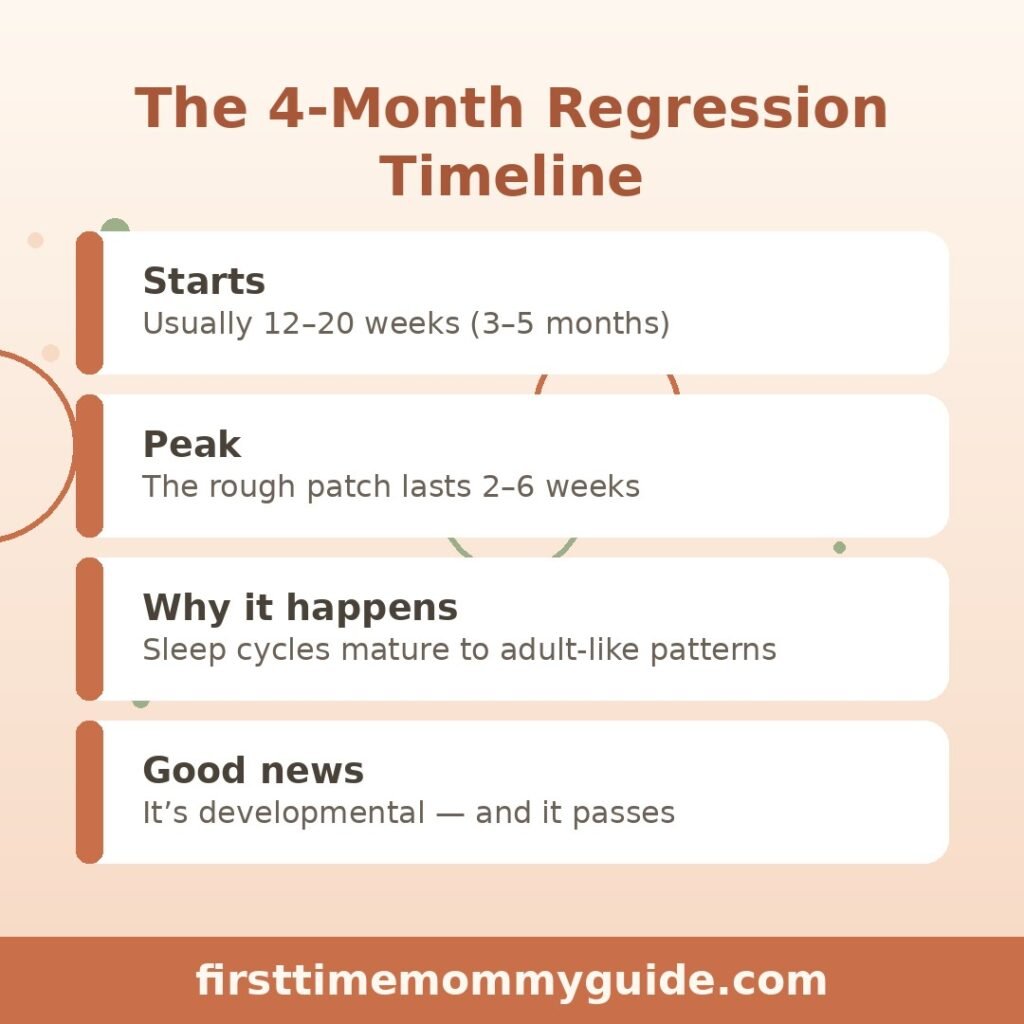
Starts: usually between 12 and 20 weeks (3–5 months). Some babies hit it at 3 months; others not until 5.
Peak: the worst of it typically runs 2–6 weeks.
Ends: the intense phase fades as your baby learns to link sleep cycles. But the underlying change is permanent — your baby now sleeps in cycles for life.
An honest nuance: families who adjust how the baby falls asleep often come through it faster. Families who wait it out sometimes find the frequent waking just continues — not because the regression never ended, but because the baby now genuinely needs help resettling at every cycle transition. That’s fixable, and it’s never too late.
Why Does the 4 Month Sleep Regression Happen?
Three developmental changes collide at once:
Sleep architecture matures. Cycles become adult-like, with light-sleep transitions every ~45 minutes.
Melatonin production ramps up. Your baby’s circadian rhythm is coming online, making them more sensitive to light and timing.
Brain development surges. New motor and cognitive skills (rolling, vocalizing) make sleep lighter and more easily disrupted.
None of this is caused by your parenting, your feeding choices, or anything you did or didn’t buy.
What Actually Helps: 7 Practical Strategies
1. Work on drowsy-but-awake at bedtime
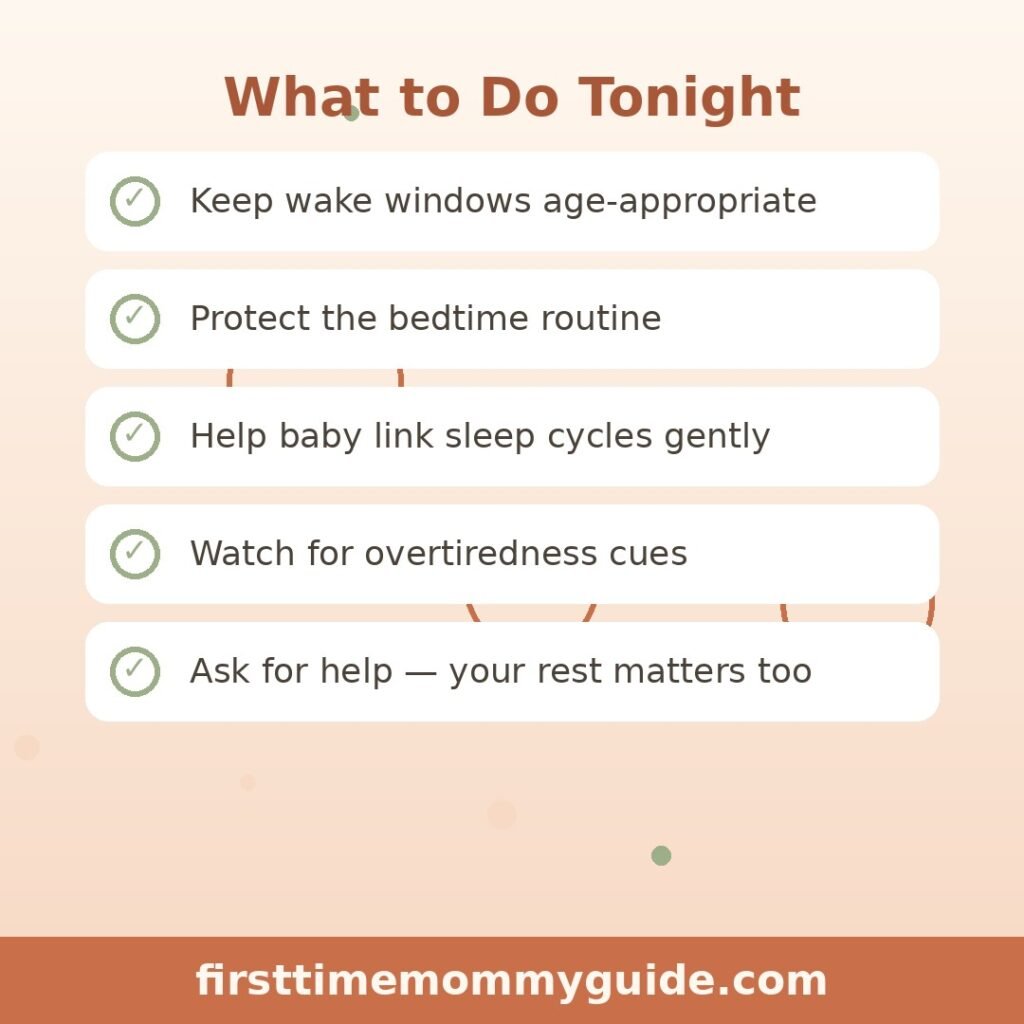
This is the highest-leverage change. If your baby falls asleep in your arms and wakes in the crib at the first cycle transition, the mismatch is jarring. Falling asleep where they’ll stay asleep removes the surprise.
Start with bedtime only — the highest sleep pressure of the day. You don’t have to do it for every nap on day one.
2. Check wake windows
At 4 months, wake windows stretch fast — roughly 90 minutes to 2 hours. An undertired baby fights sleep exactly like an overtired one. If bedtime suddenly became a battle, try stretching the last wake window by 15–20 minutes.
3. Make the room genuinely dark
Light suppresses melatonin, and 4-month-olds become far more sensitive to it. Dark enough that you can’t see your hand. Blackout blinds are one of the cheapest high-impact sleep tools.
4. Use continuous white noise
A consistent sound all night long masks the household noises that now wake a baby surfacing between cycles. Keep it at a safe volume (about as loud as a soft shower) and place it away from the crib.
5. Keep a boring, consistent bedtime routine
Same steps, same order, every night: bath, book, song, down. Predictability is soothing. Keep it short — 20–30 minutes is plenty.
6. Don’t rush in at the first sound
Babies are noisy sleepers, especially during light-sleep transitions. Give it a minute or two — many babies fuss briefly and resettle on their own. Rushing in can fully wake a baby who was about to drift back off.
7. Protect your own sleep ruthlessly
Split the night into shifts with your partner if you can. Sleep when the baby sleeps isn’t always possible — but one protected 4-hour stretch for each parent is a survival strategy, not a luxury. If exhaustion is affecting your mood or safety (driving, holding the baby), reach out to your doctor or health visitor. That matters more than any sleep schedule.
Naps During the 4 Month Sleep Regression
Naps often fall apart first: 30–45 minute naps, fighting the cot, only napping in the carrier. This is normal and temporary-ish — most babies don’t reliably link daytime sleep cycles until 5–6 months.
What helps with naps:
Keep offering naps at consistent times; don’t skip them hoping for better nights (overtiredness backfires).
One “rescue nap” in the carrier or pram per day is fine. Survival mode is allowed.
Cap any single nap around 2 hours so daytime sleep doesn’t eat into the night.
Aim for roughly 3–4 naps a day at this age.
Feeding During the Regression
Many babies suddenly want more night feeds. Some of this is genuine — growth spurts often overlap — and some is comfort-seeking at each waking. Both are fine.
Feed if your baby seems hungry. But if every single waking ends with a feed and wakings are multiplying, it may be worth checking with your pediatrician whether all those feeds are still needed, or whether some wakings are habit. No guilt either way — you’re responding to your baby. If you’re unsure what’s typical at this stage, revisit the newborn feeding schedule.
What NOT to Do
Don’t start solids to “fix” sleep. The AAP and NHS advise waiting until around 6 months for solids (see our starting solids guide), and there’s no good evidence that earlier solids improve sleep.
Don’t assume it’s always the regression. Ear infections, reflux flares, and genuine hunger can look similar. If something feels off, check with your doctor.
Don’t compare timelines. Your friend’s baby “sailed through it” — or says she did. Every baby is different.
Don’t try five new things at once. Change one thing, give it 3–4 nights, then assess.
When to Call Your Doctor
The regression is normal, but call your pediatrician or GP if:
Your baby seems to be in pain (arching, inconsolable screaming)
There’s fever, vomiting, diarrhea, or rash alongside the sleep changes
Your baby is feeding much less than usual
Your own exhaustion is affecting your mental health or safety — postpartum support exists, and you deserve it
Conclusion
The 4 month sleep regression feels like everything broke overnight. It didn’t. Your baby’s brain just upgraded its operating system, and the two of you are learning the new version together.
Keep the room dark, the routine boring, and your expectations gentle. The intense phase usually passes within 2–6 weeks. And on the other side, many families find sleep actually becomes more predictable than before — because now it runs on real cycles you can work with.
You’ve got this, mama. One cycle at a time.
Medical disclaimer: This article is general information, not medical advice. Sleep guidance follows widely published pediatric recommendations, but every baby is different. Always check with your pediatrician, GP, or health visitor about your baby’s sleep and health.
FAQs
What is the 4 month sleep regression?
A developmental phase around 3–5 months when a baby’s sleep cycles mature from newborn patterns to adult-like cycles, causing more frequent waking and shorter naps.
How long does the 4 month sleep regression last?
The intense phase usually lasts 2–6 weeks. The underlying change to sleep cycles is permanent, but babies learn to link cycles and sleep becomes more predictable again.
What are the signs of the 4 month sleep regression?
Frequent night wakings, 30–45 minute naps, fighting bedtime, only sleeping in arms, increased fussiness, and more night feeds — appearing suddenly around 3–5 months.
Does the 4 month sleep regression affect naps?
Yes — naps often become short (one sleep cycle, 30–45 minutes) or hard to initiate. Most babies don’t reliably link daytime cycles until 5–6 months.
Can the 4 month sleep regression start at 3 months?
Yes. It typically starts between 12 and 20 weeks, so some babies hit it at 3 months and others closer to 5 months.
Is the 4 month sleep regression permanent?
The change in sleep architecture is permanent — cycles don’t revert. But the difficult adjustment phase is temporary, usually resolving within weeks.
How can I help my baby through the 4 month sleep regression?
Put baby down drowsy but awake at bedtime, check wake windows, darken the room, use white noise, keep a consistent routine, and pause before rushing in at night sounds.
Should I sleep train during the 4 month sleep regression?
You don’t have to. Gentle adjustments (drowsy-but-awake, routine, environment) help many families. Formal sleep training is a personal choice — discuss timing with your pediatrician if you’re considering it.
Why is my 4 month old waking every hour?
They’re likely waking fully at each 45-minute sleep cycle transition and needing help to resettle — the core mechanism of the regression.
Do I need to feed at every night waking?
Not necessarily. Some wakings are genuine hunger (growth spurts overlap), others are comfort-seeking. Feed when baby seems hungry; check with your pediatrician if wakings keep multiplying.
Will starting solids help my baby sleep through the regression?
No good evidence supports this, and the AAP/NHS advise waiting until around 6 months for solids. Don’t start solids to fix sleep.
What are wake windows for a 4 month old?
Roughly 90 minutes to 2 hours. Watch your baby’s tired cues — yawning, eye rubbing, zoning out — rather than following the clock rigidly.
My baby only naps 30 minutes — is that normal at 4 months?
Yes, very common during the regression. One sleep cycle is 30–45 minutes, and babies wake fully between cycles until they learn to link them around 5–6 months.
Can teething cause the 4 month sleep regression?
Teething can disrupt sleep, but the 4 month regression is specifically about maturing sleep cycles. Some babies do start teething around this age, which can compound the problem.
When should I worry about my baby’s sleep?
Call your doctor if sleep changes come with fever, pain signs, much-reduced feeding, or if your own exhaustion is affecting your health and safety.
Does white noise really help?
Continuous white noise at a safe volume helps mask household sounds that wake babies during light-sleep transitions. It’s one of the simplest effective tools.
How dark should the nursery be?
Dark enough that you can’t see your hand. Light suppresses melatonin, and babies become more light-sensitive as their circadian rhythm develops around 4 months.
My baby sleeps fine in my arms but not the crib — help?
This is classic regression behavior. Work on drowsy-but-awake at bedtime first, keep the crib sheet warm, and try a consistent pre-sleep routine so the crib feels familiar.
Will the regression ruin sleep training we already did?
Not necessarily. Revisit the basics — consistent routine, drowsy-but-awake — and most babies get back on track within a couple of weeks.
Dilawar Mughal
Founder and editor, First Time Mommy Guide
I research every guide against what the NHS, the AAP and the WHO publish, then write it in plain English — because most new parents are reading with one hand free, not comparing clinical guidelines. I'm not a doctor or a midwife. Every health claim on this site is sourced and linked so you can check it yourself, and anything urgent belongs with your health visitor or GP, not a blog.