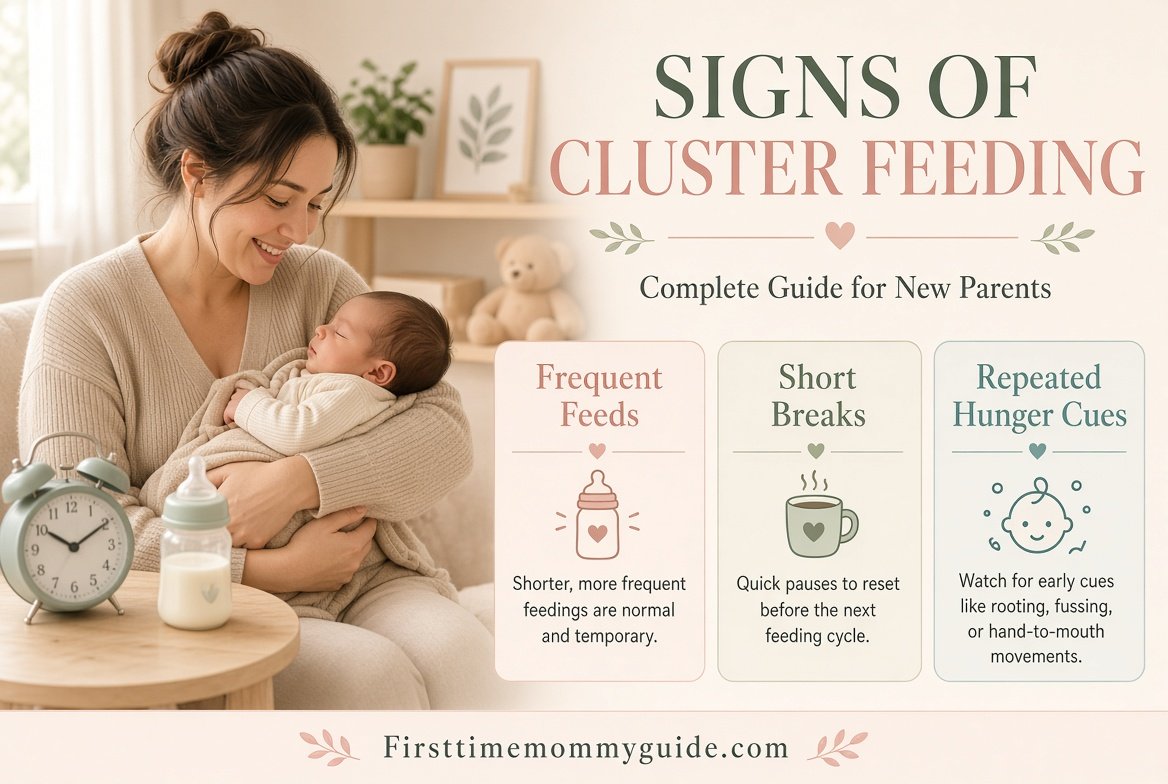
General information, not medical advice. Every baby is different — if anything worries you, speak to your midwife, health visitor or GP rather than waiting.
If your baby suddenly wants to nurse every 30 to 60 minutes for hours on end, you are probably watching the signs of cluster feeding unfold in real time. It feels alarming the first time it happens, especially late at night when you are exhausted and starting to wonder if something is wrong.
The truth is reassuring. Cluster feeding is one of the most common and well-documented breastfeeding and bottle-feeding patterns in early infancy, and it almost always means your baby is developing exactly as expected.
Table of Contents
What Are the Signs of Cluster Feeding?
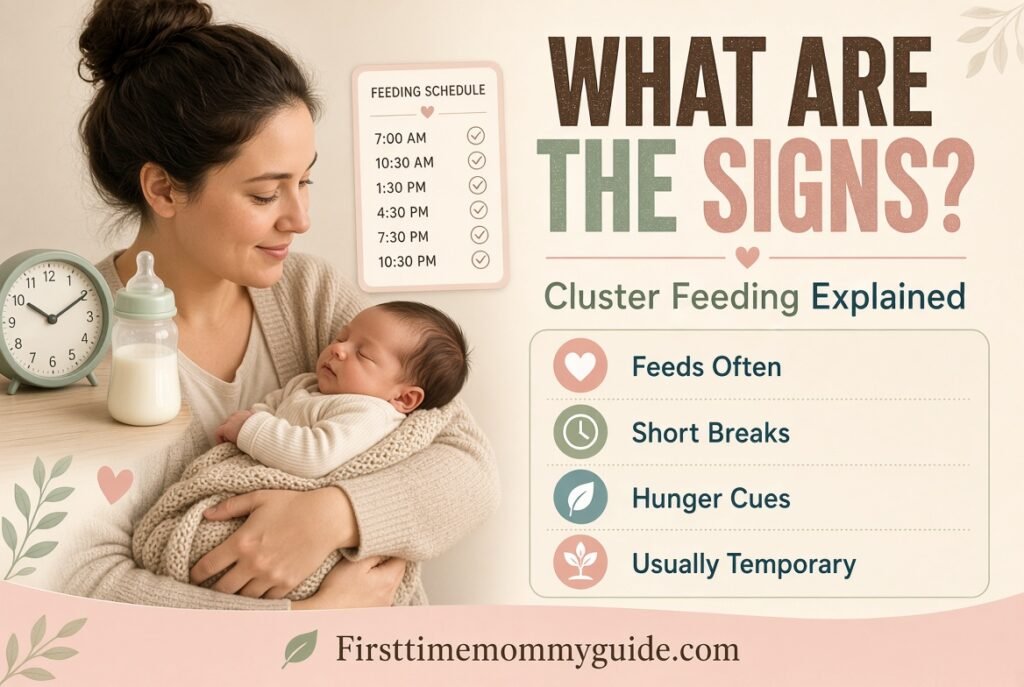
Cluster feeding shows up as frequent, closely spaced feeds, usually happening in the evening, combined with fussiness between feeds, rooting, and hand-sucking, even shortly after a full feed.
- Feeding every 30 to 60 minutes for a stretch of 2 to 5 hours
- Fussiness or crying unless actively nursing or being fed
- Rooting, lip-smacking, and sucking on fists between feeds
- Shorter, more frequent feeds instead of one long feed
- Happening mostly in the late afternoon or evening
- Baby still gains weight and produces normal wet and dirty diapers overall
If your baby is also gaining weight and producing enough wet diapers, cluster feeding on its own is not a sign of low milk supply or a feeding problem.
What Is Cluster Feeding?
Cluster feeding is a pattern where a baby feeds much more frequently than usual over a period of several hours, instead of following a spaced-out, predictable feeding schedule. Feeds bunch together in “clusters,” often with very short gaps in between.
According to Wikipedia’s summary of clinical sources, cluster feeding refers to a pattern where an infant feeds frequently in short intervals over a period of time, often during the evening or late afternoon.
It is not a medical diagnosis or a disorder. It is a normal infant feeding behavior that most breastfed babies show at some point, and that many formula-fed and bottle-fed babies show as well.
Cluster feeding is closely linked to two biological drivers: growth spurts, where a baby needs more calories to support rapid development, and the natural daily rhythm of prolactin, the hormone responsible for milk production, which tends to be higher in early morning and lower by evening.
Because prolactin dips later in the day, a baby who nurses more in the evening is effectively helping signal the body to make more milk overnight and into the next day. This is sometimes called “topping up the tank” before a longer stretch of sleep.
What Is Newborn Cluster Feeding?
Newborn cluster feeding refers specifically to this frequent-feeding pattern in the first few weeks of life, when it is most intense and most common. Almost every new parent encounters it in some form during this stage.
In the newborn period, a baby’s stomach is still tiny, roughly the size of a marble at birth and growing to about the size of a ping-pong ball by two weeks old. Frequent feeding is simply how a newborn takes in enough calories with such limited stomach capacity.
Newborn cluster feeding often overlaps with the first days after birth, when colostrum is transitioning into mature milk. Frequent nursing during this window helps stimulate that transition and establish a strong milk supply going forward.
- Newborns often cluster feed most intensely in the evening, sometimes called the “witching hour.”
- Sessions can last anywhere from a few minutes to 30 minutes each, repeating every 30 to 60 minutes.
- A newborn may seem to feed almost continuously for 2 to 4 hours before finally settling into a longer sleep stretch.
- This pattern typically peaks in the first 6 weeks and then gradually spreads out.
Why Does Cluster Feeding Happen? The Biology Explained
Understanding the biology behind cluster feeding makes the whole experience feel far less random. There are really three overlapping mechanisms at work, and most cluster feeding episodes involve at least one of them.
Growth spurts and caloric demand. Babies do not grow at a perfectly steady rate. Growth happens in bursts, and during those bursts, a baby’s calorie needs jump quickly. Feeding more often is the fastest way for a young baby to take in extra energy without being able to eat larger volumes at once.
Prolactin’s daily rhythm. Prolactin, the hormone most responsible for milk production, naturally peaks in the early morning hours and gradually declines through the day, reaching its lowest point in the evening. A baby nursing more in the evening is, in effect, compensating for that dip and simultaneously signaling the body to produce more milk overnight.
Supply-and-demand milk regulation. Breast milk production works on a demand-based feedback loop. The more frequently and effectively a baby removes milk, the more the body is signaled to produce. Cluster feeding is one of the most efficient ways a baby can rapidly increase milk supply in a short window, particularly during a growth spurt.
- Newborns cluster feed partly to establish this supply-demand relationship for the first time.
- Older infants cluster feed to recalibrate supply upward as their calorie needs increase with growth.
- Comfort and developmental overstimulation add a fourth, non-nutritive layer: babies also nurse or feed for soothing, especially after a mentally demanding day of new sights, sounds, and experiences.
Taken together, these mechanisms explain why cluster feeding clusters so predictably around growth-spurt ages and evening hours, rather than happening completely at random.
Signs of Cluster Feeding
The signs of cluster feeding are usually easy to recognize once you know what to look for, even though they can feel confusing or worrying in the moment. Most parents notice a distinct shift from the baby’s regular feeding rhythm.
Frequent, closely spaced feeds. Instead of feeding every 2 to 3 hours, your baby suddenly wants to feed every 30 to 60 minutes, sometimes even more often, for a stretch of several hours.
Shorter individual feeding sessions. Rather than one long feed, your baby latches, feeds for a few minutes, unlatches, fusses, and wants to latch again shortly after.
Increased fussiness between feeds. Your baby may cry, arch, or seem generally unsettled unless they are actively feeding or being held closely.
Rooting and hunger cues that reappear quickly. Lip-smacking, turning the head toward your chest or a bottle, and sucking on hands or fingers often show up again within minutes of finishing a feed.
A clear time-of-day pattern. Most cluster feeding concentrates in the late afternoon or evening, though it can occasionally happen at other times, especially during a growth spurt or illness.
Restlessness that eases only with feeding or holding. Rocking, pacifiers, and other soothing techniques may work only briefly, while nursing or bottle-feeding settles the baby more reliably.
A longer sleep stretch afterward. Many babies fall into a deeper, longer sleep once the cluster feeding session finally ends, which is one of the more reassuring signs that this was a normal, purposeful pattern.
Normal wet and dirty diapers overall. Even with frequent feeding, diaper output across the full day still falls in the expected range for the baby’s age.
Frequent switching between breasts or repeated small bottles. During a breastfeeding cluster session, a baby may want to switch sides more often than usual, going back and forth several times in a single sitting rather than finishing one side calmly.
A baby who seems more alert or wide-eyed between bursts of feeding. Some parents describe their baby as unusually watchful or wired during a cluster feeding evening, almost as if they are too stimulated to settle without the reassurance of feeding.
Increased need for physical closeness. Many babies want to be held, worn in a carrier, or kept skin-to-skin throughout a cluster feeding stretch, resisting being placed in a bassinet or swing even briefly.
It’s worth noting that no single sign on its own confirms cluster feeding. It is the combination of frequent feeding, evening timing, fussiness that resolves with feeding, and otherwise normal growth and diaper output that together paint the full picture.
Signs of Cluster Feeding in a Newborn
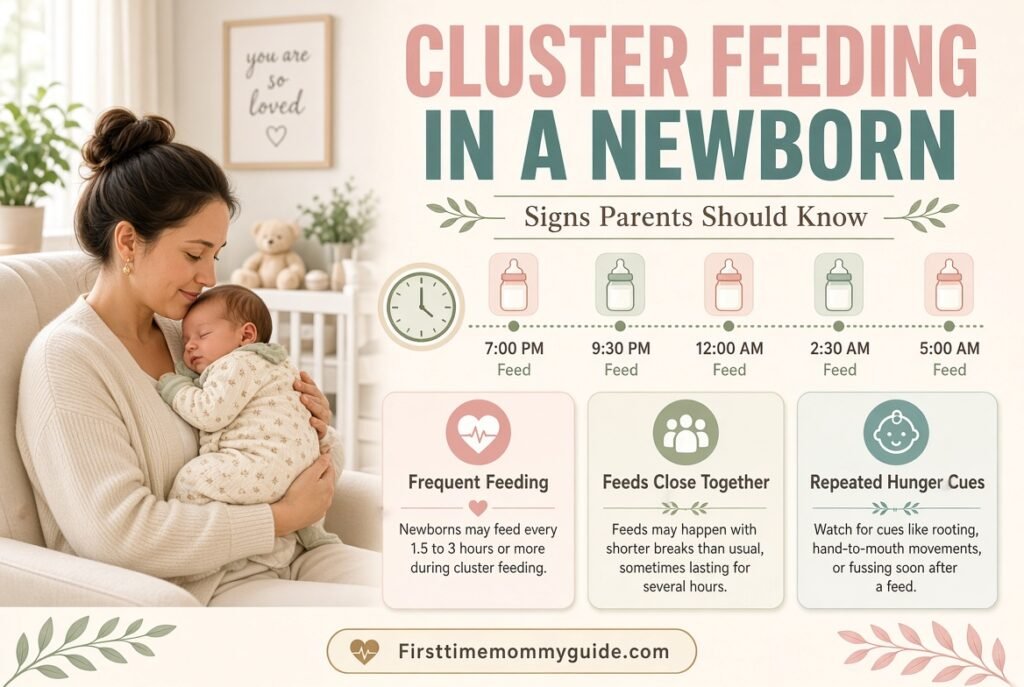
Signs of cluster feeding in a newborn look similar to the general pattern above, but they tend to be more intense and less predictable, simply because newborns feed so often to begin with.
A newborn who is cluster feeding may want to nurse every 30 to 45 minutes for several hours, particularly on day 2 or 3 of life, and again around 2 to 3 weeks and 6 weeks of age.
- Newborn may act like they are “never full,” pulling off and relatching repeatedly within the same feeding window.
- Newborn may fuss or cry the moment they are put down, wanting constant skin-to-skin contact.
- Newborn may show visible sucking motions and rooting reflexes even while sleeping lightly.
- Newborn may seem to feed almost nonstop from early evening until a later bedtime, then sleep a longer stretch.
- Parents may worry their milk “isn’t enough,” even though frequent newborn feeding of this kind is expected and healthy.
The most important reassurance for this age group is that newborn cluster feeding, paired with normal weight gain and diaper output, is not evidence of a supply problem. It is frequently the exact opposite: a sign the baby is actively working to build up the milk supply they will need going forward.
When Does Cluster Feeding Start?
Cluster feeding can start as early as the first 24 to 48 hours after birth, though it becomes more noticeable and more commonly discussed once a baby is a few days to a few weeks old.
Many babies show their first clear cluster feeding pattern in the first week of life, coinciding with the shift from colostrum to mature milk. Others do not show an obvious pattern until closer to the 2 to 3 week growth spurt.
- Day 2 to 3: Some babies cluster feed intensely as milk transitions from colostrum to mature milk.
- Week 1 to 2: Frequent evening feeding often becomes a noticeable, repeated pattern.
- Week 2 to 3: A recognized growth spurt tends to intensify cluster feeding further.
- Week 6: A second common growth spurt often brings cluster feeding back, sometimes more intensely than the first time.
There is no single universal starting point, since every baby’s feeding rhythm develops on its own timeline. If your baby has not shown obvious cluster feeding by two weeks old, that is also entirely normal.
When Does Cluster Feeding Happen?
Cluster feeding happens most commonly in the late afternoon and evening hours, a pattern so consistent across infants that many lactation professionals refer to it as part of the “witching hour.”
This timing lines up directly with the natural daily rhythm of prolactin, which tends to run higher in the early morning and gradually decline through the day, reaching its lowest point in the evening.
- Late afternoon to evening: the most common window, often between 4 p.m. and 10 p.m.
- During growth spurts: cluster feeding can happen at any time of day for a few days at a stretch.
- During illness or teething: frequent feeding can return temporarily, at any hour, purely for comfort and hydration.
- Occasionally at night: some babies cluster feed just before a longer nighttime sleep stretch, feeding several times in a row before settling.
Not every baby follows the evening pattern exactly, and some show cluster feeding behavior scattered more evenly throughout the day, particularly formula-fed babies on a more structured schedule.
Cluster Feeding Ages: Common Cluster Feeding Ages and Growth Spurt Timeline
Cluster feeding ages tend to cluster (no pun intended) around known developmental growth spurts, which is why so many parents report similar timing even though every baby is different.
| Common Age | What’s Typically Happening |
|---|---|
| 2 to 3 days old | Milk transitioning from colostrum to mature milk |
| 7 to 10 days old | Early supply-building phase |
| 2 to 3 weeks old | First major recognized growth spurt |
| 6 weeks old | Second major recognized growth spurt |
| 3 months old | Growth spurt paired with major developmental changes |
| 4 months old | Sometimes linked to the 4-month sleep regression |
| 6 months old | Often tied to increased activity and the start of solids |
These common cluster feeding ages are widely reported across pediatric and lactation resources, though the exact week can shift by several days in either direction for any individual baby.
Newborn cluster feeding ages cluster most heavily in the first six weeks, simply because growth is fastest and least predictable during this window, and because a young baby’s feeding-supply relationship is still being established.
Cluster Feeding at 7 Weeks
Cluster feeding at 7 weeks often shows up as a continuation or a slightly delayed version of the well-documented 6-week growth spurt, since these developmental windows are approximate rather than fixed to an exact day.
At this age, many babies are also becoming more alert, more socially responsive, and more distractible during the day, which can push more of their calorie intake into the evening, when distractions are fewer.
- Expect feeds to bunch together in the evening for several days in a row.
- Expect your baby to seem hungrier than usual across the whole day, not only in the evening window.
- Expect this phase to resolve within roughly 2 to 7 days, similar to earlier growth-spurt cluster feeding phases.
- Continue watching diaper output and general contentment as your best day-to-day reassurance.
If cluster feeding at 7 weeks feels more intense than earlier episodes, that is common, since babies are also becoming more efficient nursers and can transfer more milk in a shorter feed, sometimes prompting more frequent feeds to make up the difference in total volume.
Signs of Cluster Feeding at 3 Months
Signs of cluster feeding at 3 months often overlap with a well-known developmental leap, sometimes discussed alongside the “3-month growth spurt,” and can look slightly different from newborn cluster feeding.
By 3 months, babies are more alert, more aware of their surroundings, and easily distracted during daytime feeds, which naturally shifts more feeding into quieter, less stimulating evening hours.
- More frequent evening feeds, sometimes returning after weeks of a more predictable schedule.
- Increased fussiness in the early evening, often mistaken for colic if parents are unfamiliar with cluster feeding.
- A baby who was previously going longer between night feeds may temporarily wake more often.
- A noticeable jump in appetite that settles back down within about a week.
At 3 months, some parents also notice their milk supply feels different, softer, or less full between feeds. This is a normal supply regulation process, not a sign of declining milk production, and cluster feeding at this age often helps recalibrate supply to match the baby’s changing needs.
Cluster Feeding at 5 Months
Cluster feeding at 5 months is less universally documented than the earlier growth spurts, but many parents still report a noticeable uptick in feeding frequency around this age, often connected to an approaching developmental or motor milestone.
At 5 months, many babies are working on rolling, improved head control, or early signs of readiness for solid foods, all of which require extra energy and can temporarily increase hunger and feeding frequency.
- Watch for a short burst, typically a few days, of more frequent daytime and evening feeds.
- Watch for increased night waking that resolves once the growth or developmental phase passes.
- Continue offering the breast or bottle on demand rather than trying to stretch feeds during this window.
- Remember that at this age, breast milk or formula should still remain the primary source of nutrition, even if you are starting to introduce very early solid-food exploration.
If cluster feeding at 5 months seems to persist for more than one to two weeks without any easing, it is worth checking in with your pediatrician to rule out other causes, such as reflux, an illness, or an early tooth coming in.
Signs of Cluster Feeding at 6 Months

Signs of cluster feeding at 6 months frequently coincide with the introduction of solid foods, a major feeding transition that can temporarily confuse a baby’s hunger signals in either direction.
Some 6-month-old babies increase breast or bottle feeding frequency right around the start of solids, which can look exactly like classic cluster feeding, even though the underlying driver is different from the earlier growth-spurt pattern.
- A baby beginning solids may want more milk feeds for comfort as new tastes and textures are introduced.
- A baby experiencing a true growth spurt at 6 months may show the familiar evening cluster pattern.
- Teething often begins around this age too, and can independently trigger more frequent, comfort-driven feeding.
- Breast milk or formula should remain the primary source of nutrition at 6 months, with solids introduced gradually and without replacing milk feeds outright.
At 6 months, cluster feeding can sometimes be harder to distinguish from ordinary hunger linked to a genuine increase in appetite as the baby grows larger and more active. Tracking overall daily intake, rather than reacting to any single feed, gives the clearest picture.
How Long Does Cluster Feeding Last?
How long cluster feeding lasts depends on what is driving it. A growth-spurt related cluster feeding episode typically lasts anywhere from 2 to 7 days before your baby’s feeding pattern returns to its previous rhythm.
Within any single evening, a cluster feeding session itself often lasts 2 to 4 hours, made up of several shorter feeds strung closely together rather than one continuous feed.
- A single cluster feeding evening: usually 2 to 4 hours of frequent, closely spaced feeds.
- A growth-spurt cluster feeding phase: typically 2 to 7 days total before settling.
- Illness or teething-related cluster feeding: usually resolves once the underlying cause passes.
- Newborn-stage cluster feeding overall: most intense in the first 6 weeks, gradually easing over the following months.
It helps to think of cluster feeding less as one ongoing state and more as a recurring, temporary phase that shows up periodically, especially around known growth-spurt ages, and then fades until the next developmental leap.
When Does Cluster Feeding Stop?
Cluster feeding does not stop all at once on a specific date. Instead, it gradually becomes less frequent and less intense as a baby grows, their stomach capacity increases, and their feeding efficiency improves.
Most families notice a significant decrease in cluster feeding somewhere between 3 and 6 months, though brief return episodes tied to growth spurts, teething, or illness can still happen well beyond that point.
- By 3 to 4 months: many babies have longer, more predictable feeding intervals with only occasional cluster feeding evenings.
- By 6 months: the earlier, intense newborn-style cluster feeding pattern has usually eased substantially.
- Beyond 6 months: cluster feeding can still recur temporarily around teething, illness, developmental leaps, or travel and schedule disruptions.
- Throughout toddlerhood: occasional comfort nursing in clusters can still happen for breastfeeding pairs who continue past the first year.
Cluster feeding stopping earlier or later than these general ranges does not indicate a problem on its own. Every baby’s feeding maturity develops at its own pace.
Does Cluster Feeding Happen With Formula?
Yes, cluster feeding happens with formula, though it tends to look and behave a little differently than breastfeeding-based cluster feeding. Bottle-fed babies, whether taking formula or expressed breast milk, absolutely can and do cluster feed.
According to UK NHS guidance on bottle feeding, cluster feeding usually happens during the first 3 to 4 months, and while it is common in breastfed babies, formula-fed babies can cluster feed too, provided caregivers avoid overfeeding.
Because a bottle delivers milk faster and more consistently than the breast, a formula-fed baby cluster feeding may take smaller, more frequent bottles rather than one large feed, especially in the evening.
Cluster Feeding Formula: What Looks Different
Cluster feeding formula patterns differ from breastfeeding cluster feeding in a few key, practical ways that are worth understanding if you bottle-feed.
| Factor | Breastfed Cluster Feeding | Formula-Fed Cluster Feeding |
|---|---|---|
| Supply concern | Frequent feeding helps build supply | No supply-building function, so frequency is purely about hunger and comfort |
| Overfeeding risk | Very low, baby self-paces at the breast | Higher, since bottles flow faster and more consistently |
| Typical pattern | Longer feeds close together | Smaller, more frequent bottles |
| Best management tool | Continue nursing on demand | Use paced bottle feeding to reduce overfeeding risk |
Paced bottle feeding, holding the baby upright, using a slow-flow nipple, and pausing periodically, closely mimics the natural stop-start rhythm of breastfeeding and helps a formula-fed baby recognize fullness cues during a cluster feeding evening.
If your formula-fed baby is cluster feeding, resist the urge to always finish a full bottle out of habit. Following the baby’s cues, pausing, burping, and offering more only if they show continued hunger cues, is the safest way to manage frequent bottle feeds without overfeeding.
How to Stop Cluster Feeding (And Whether You Should)
Most lactation and pediatric resources are clear on this point: cluster feeding is not something you need to stop, since it usually serves a real biological purpose, whether that is building milk supply, supporting a growth spurt, or offering comfort.
That said, there are practical ways to manage cluster feeding so it feels less overwhelming, without trying to eliminate a normal, temporary behavior.
- Set up a comfortable feeding station. Keep water, snacks, your phone or a book, and a nursing pillow within arm’s reach before an evening cluster feeding session begins.
- Use skin-to-skin contact. This can soothe a fussy baby between feeds and support milk-ejection reflexes during breastfeeding.
- Ask for help with everything else. Let a partner or family member handle dinner, dishes, or older children so you can focus fully on feeding.
- Take shifts if you are bottle-feeding. A partner or support person can take some of the frequent bottle feeds during a cluster feeding evening.
- Avoid the urge to introduce formula “to fix it.” Frequent breastfeeding is what signals your body to increase milk supply; supplementing solely because of cluster feeding can unintentionally reduce that signal over time.
- Don’t try to stretch out feeds artificially. Delaying a hungry baby’s feed to “get them on schedule” during a cluster feeding phase usually backfires, leading to more distress rather than less.
- Offer comfort beyond feeding when appropriate. Sometimes a baby wants to suck for comfort rather than nutrition; a clean finger, pacifier, or simply being held can help once you’re confident they’ve fed enough.
- Track diapers and weight, not just feeding times. These remain the most reliable indicators that a cluster feeding phase is normal rather than a sign of a feeding problem.
If cluster feeding ever feels genuinely unmanageable, or if you have any doubt about your milk supply or your baby’s weight gain, a board-certified lactation consultant or your pediatrician can offer a proper, individualized assessment.
A simple step-by-step approach for a cluster feeding evening:
- Recognize the pattern early. Notice when your baby starts feeding more frequently than their usual rhythm, so you can mentally prepare rather than feeling blindsided.
- Set up your space. Move water, snacks, a phone or book, a nursing pillow, and burp cloths within reach before settling in for the evening.
- Follow the baby’s lead. Offer the breast or bottle when hunger cues appear, rather than trying to enforce a fixed interval.
- Watch for true fullness cues. Slower sucking, pulling away, relaxed hands, or falling asleep all suggest the baby has had enough for that particular mini-feed.
- Use brief comfort techniques between feeds if needed. Gentle rocking, white noise, or a pacifier (once breastfeeding is well established) can sometimes stretch the gap slightly without forcing it.
- Ask for a break if you need one. Handing the baby to a partner for ten minutes, once you’re confident they’ve fed enough, is a reasonable and healthy choice.
- Let the evening end on its own timeline. Most cluster feeding sessions naturally taper off into a longer sleep stretch; trying to rush that process rarely speeds it up.
Repeating this approach each evening during a cluster feeding phase tends to make the experience feel more predictable and less overwhelming, even though the underlying pattern hasn’t changed.
What Parents Commonly Describe About Signs of Cluster Feeding
Across parenting forums and community discussions, the description of cluster feeding tends to repeat the same few themes again and again, which is itself reassuring, since it shows just how universal this experience is.
Parents commonly describe feeling like their baby is “never satisfied,” worrying they have suddenly developed low milk supply, and being surprised by how much calmer things feel once they learn cluster feeding has a name and a known, temporary pattern.
- A common theme: relief after realizing frequent evening fussiness has an explanation, rather than being a personal feeding failure.
- A common theme: the exhaustion of an evening spent feeding almost constantly, followed by surprise at how well the baby then sleeps.
- A common theme: confusion about whether to “just keep feeding” or try to space things out, with most experienced parents and professionals agreeing that following the baby’s cues works best.
- A common theme: wondering whether formula-fed or combination-fed babies experience the same thing, which they do, just with the formula-specific considerations covered above.
If you’re reading parent community threads late at night while cluster feeding yourself, know that what you’re describing almost always matches this well-documented, normal pattern, and that you are far from alone in the experience.
A Real-Life Example: What a Cluster Feeding Evening Looks Like
Reading about the signs of cluster feeding in the abstract can still feel confusing, so it helps to walk through what a typical evening actually looks like in practice.
Around 5 p.m., your baby, who has been feeding roughly every 3 hours all day, suddenly wants to nurse again just 45 minutes after the last feed. You feed them, they seem satisfied, and you set them down, only for them to start rooting and fussing within 20 minutes.
You feed again. This time it’s a shorter session, maybe 8 to 10 minutes, before they pull off, fuss, and then latch again a few minutes later. This on-and-off pattern continues for the next 2 to 3 hours, with brief calm stretches where the baby seems content, followed by more rooting and fussing.
By around 8 or 9 p.m., after this extended stretch of frequent, closely spaced feeding, your baby finally falls into a deeper sleep, often for a longer stretch than they’ve managed during the rest of the day. Looking back, the entire episode fits the classic cluster feeding pattern: frequent short feeds, evening timing, fussiness that responds to feeding, and a longer sleep afterward.
This scenario plays out in some form for most breastfeeding and many bottle-feeding families at some point, especially in the first three months. Recognizing it in the moment, rather than an hour into a confusing evening, is exactly what this guide is designed to help with.
When to Call Your Pediatrician During a Cluster Feeding Phase
Ordinary cluster feeding does not require a call to your pediatrician, but there are specific warning signs that go beyond typical frequent feeding and warrant a conversation with your baby’s care provider.
- Poor or no weight gain at scheduled checkups, or noticeable weight loss beyond what is expected in the first few days of life.
- Very few wet diapers, generally fewer than 6 per day after the first week of life, or diapers that seem unusually dark or concentrated.
- Persistent lethargy, where your baby is unusually difficult to wake for feeds or seems limp and unresponsive rather than simply sleepy.
- Jaundice that seems to worsen, particularly a yellowing of the skin or the whites of the eyes that spreads or deepens.
- Feeding that appears to cause pain, such as arching, crying during feeds specifically, or persistent spit-up that looks forceful rather than typical.
- Fever, breathing difficulty, or repeated vomiting, which always warrant prompt medical attention regardless of feeding patterns.
- A gut feeling that something is different, beyond ordinary exhaustion. Parents often notice subtle changes before they can fully articulate them, and it is always reasonable to call and ask.
None of these signs are typical features of ordinary cluster feeding. If you notice any of them, reaching out to your pediatrician or a lactation consultant promptly is the right call, rather than waiting to see if things improve on their own.
Cluster Feeding vs Other Feeding Concerns
Cluster feeding is often mistaken for other feeding issues, largely because the surface-level symptoms, frequent feeding and fussiness, can look similar. A simple comparison helps clarify the difference.
| Concern | Key Feature | How It Differs From Cluster Feeding |
|---|---|---|
| Cluster feeding | Frequent, closely spaced feeds, usually evening-based | Baby still gains weight and has normal diaper output |
| Low milk supply | Poor weight gain, fewer wet/dirty diapers | Frequency alone does not confirm this; weight and diapers do |
| Colic | Crying more than 3 hours a day, 3+ days a week, for 3+ weeks | Crying is not resolved by feeding, unlike typical cluster feeding fussiness |
| Reflux | Frequent spit-up, arching, discomfort during or right after feeds | Feeding itself often seems to cause pain, not just frequent hunger |
| Growth spurt | Temporary spike in appetite and feeding frequency | Considered a specific, common cause of cluster feeding, not a separate concern |
If your baby shows warning signs beyond simple frequent feeding, such as poor weight gain, very few wet diapers, persistent lethargy, jaundice, or feeding that seems to cause pain, contact your pediatrician promptly rather than assuming it is ordinary cluster feeding.
Cluster Feeding in Premature Babies
Cluster feeding in premature babies can look different from full-term newborn cluster feeding, mostly because a premature baby’s feeding stamina, stomach capacity, and neurological maturity are still catching up to what a full-term baby has at birth.
Premature babies often need to feed more frequently in general, since they typically take in smaller volumes per feed and tire more easily during a feeding session. This can make it harder to distinguish “normal for a premature baby” frequent feeding from a true cluster feeding pattern.
- Premature babies may show cluster feeding closer to their adjusted age (counted from their due date) rather than their actual birth date.
- Growth spurts in premature babies often track more closely with adjusted age milestones than chronological age.
- Because premature babies are more vulnerable to inadequate weight gain, tracking feeds, wet diapers, and weight closely with a pediatrician or neonatal follow-up team is especially important.
- Cluster feeding that looks unusually intense or prolonged in a premature baby is worth discussing with your care team, simply because the margin for error around adequate intake is smaller at this stage.
None of this means cluster feeding itself is more dangerous in a premature baby. It simply means the surrounding context, feeding stamina, adjusted age, and weight trends, deserves closer attention.
Combination Feeding and Cluster Feeding
Combination feeding, offering both breast milk and formula, adds an extra layer to how cluster feeding shows up, since a baby’s hunger cues might be met with either the breast or a bottle depending on the situation.
Babies who are combination fed can still cluster feed at the breast, at the bottle, or both, often within the same evening. This does not usually cause confusion for the baby, since babies are generally good at adapting to whichever feeding method is offered in the moment.
- If you combination feed, consider offering the breast first during a cluster feeding window, since breastfeeding is naturally self-paced and lower risk for overfeeding.
- If a bottle is used to finish a cluster feeding session, use paced bottle feeding to reduce the chance of the baby taking in more than they need.
- Cluster feeding at the breast still provides the supply-building benefit that formula alone cannot replicate, so combination-feeding parents who want to protect milk supply may want to prioritize breastfeeding first during these windows when possible.
- There is no evidence that combination feeding causes more or less cluster feeding overall; it mostly changes which feeding method absorbs the extra demand.
Cluster Feeding While Pumping or Returning to Work
Cluster feeding can complicate pumping schedules and the return to work, mostly because pumping output does not always match how efficiently a baby feeds directly at the breast, and a cluster feeding evening can leave you feeling like your supply “isn’t keeping up.”
It helps to remember that pump output is not a reliable measure of total milk supply. A baby, especially one who is cluster feeding, is almost always more efficient at removing milk than a pump.
- If you are pumping at work, a cluster feeding evening at home does not mean your daytime pumping output will suddenly drop; the two are not directly linked.
- Power pumping, a short cycle of pumping, resting, and pumping again to mimic a cluster feeding pattern, can be a useful tool if you specifically want to boost supply while away from your baby.
- If your baby cluster feeds heavily with a caregiver during the day while you’re at work, that caregiver may need extra bottles on hand or guidance on paced feeding to accommodate the pattern safely.
- Returning to work does not typically cause cluster feeding, though schedule changes and reduced daytime contact can sometimes shift more of a baby’s feeding demand into the evening hours you are together.
Partner and Family Support During Cluster Feeding
Cluster feeding is exhausting largely because of its timing. Evening hours are already when most parents are running lowest on energy after a full day, which makes outside support especially valuable during this stretch.
A supportive partner or family member cannot take over the actual feeding if you are exclusively breastfeeding, but they can remove nearly everything else from your plate during a cluster feeding window.
- Bringing water, snacks, and a phone charger without being asked.
- Handling dinner, dishes, or other children during the cluster feeding stretch.
- Taking a turn holding, burping, or soothing the baby briefly between feeds if the baby will tolerate it.
- Simply sitting with you for company during a long, repetitive evening of feeding.
- For bottle-feeding or combination-feeding families, alternating who gives each bottle during a cluster feeding evening.
Talking about cluster feeding as a known, temporary, and biologically normal phase, rather than an unexpected crisis, can also help partners understand why the evening looks the way it does and respond with patience instead of concern.
Cluster Feeding and Your Mental and Emotional Wellbeing
It is completely normal to feel touched out, frustrated, or even resentful during a long cluster feeding stretch, especially in the newborn period when sleep is already in short supply. These feelings do not mean you are failing, and they do not mean anything is wrong with your baby or your feeding relationship.
Cluster feeding can be genuinely physically and emotionally demanding, particularly for parents recovering from birth, managing other children, or navigating postpartum mood changes.
- It’s okay to hand the baby to a partner for a few minutes, even mid-cluster-feeding-session, to reset if you’re feeling overwhelmed, as long as the baby is safe.
- It’s okay to feel two things at once: love for your baby and exhaustion with the current phase.
- If feelings of sadness, anxiety, irritability, or detachment persist beyond what feels like normal tiredness, or interfere with daily functioning, talk with your postpartum care provider. Cluster feeding fatigue is common, but persistent mood changes deserve their own dedicated support.
- Connecting with other parents, whether through in-person groups or online communities, can normalize the experience and reduce the isolation that late-night cluster feeding sessions often bring.
Taking care of your own wellbeing during this stage is not a distraction from caring for your baby. It is part of it.
Common Misconceptions About Cluster Feeding
A handful of myths about cluster feeding circulate widely, and clearing them up can meaningfully reduce new-parent anxiety during an already exhausting stage.
- “Cluster feeding means I don’t have enough milk.” In most cases, the opposite is closer to the truth. Frequent feeding is often exactly what builds and maintains a strong milk supply.
- “I need to introduce formula to help my baby settle.” Supplementing purely because of cluster feeding can reduce breastfeeding stimulation and isn’t usually necessary if weight gain and diapers are normal.
- “Formula-fed babies don’t cluster feed.” They do, just with a different practical management approach involving paced feeding and close attention to overfeeding risk.
- “Cluster feeding is the same thing as colic.” They are different, with colic defined by prolonged, feeding-independent crying, while cluster feeding fussiness generally eases once feeding resumes.
- “If cluster feeding happens, something is wrong with my routine.” Cluster feeding is a baby-led, biologically driven pattern, not a sign that a parent’s schedule or approach is flawed.
- “Only breastfed babies cluster feed.” Bottle-fed babies, whether taking formula or expressed milk, show the same frequent-feeding pattern, just with different management considerations around overfeeding.
- “Cluster feeding means my baby will always be a frequent feeder.” Cluster feeding is tied to specific, temporary phases like growth spurts, not a permanent feeding personality.
- “I should be able to predict exactly when it will happen.” While common ages exist, the exact timing and intensity vary from baby to baby, and some babies barely show a noticeable pattern at all.
- “Cluster feeding is a modern phenomenon caused by parenting trends.” Frequent evening feeding in infants has been documented across breastfeeding research for decades and reflects basic infant physiology, not a cultural trend.
Expert Tips and Best Practices for Managing Cluster Feeding
- Trust hunger cues over the clock during a known cluster feeding window, especially in the first few months.
- Track diaper counts and, if concerned, ask your pediatrician about a weight check rather than guessing based on feeding frequency alone.
- Keep a simple mental or written log of when cluster feeding tends to happen for your baby, since recognizing the pattern reduces anxiety the next time it starts.
- Rotate support between partners, family, or friends during predictable evening cluster feeding windows whenever possible.
- Remember that a cluster feeding phase is temporary, even when a single evening feels endless.
- If you exclusively pump, mimic a cluster feeding pattern with a short power-pumping session if you are actively trying to boost supply.
- Prepare older siblings for what a cluster feeding evening looks like, so they understand why you may be less available for a few hours at a stretch.
- If your baby is in daycare or with another caregiver during the day, share basic information about cluster feeding signs so the caregiver isn’t caught off guard either.
- Keep your pediatrician’s contact information handy during the newborn stage, not because cluster feeding itself is usually concerning, but because quick reassurance from a professional can ease anxiety in the moment.
Mistakes to Avoid During Cluster Feeding
- Do not assume frequent feeding alone means low supply without checking diapers and weight trends first.
- Do not try to force a strict feeding schedule onto a baby who is actively cluster feeding through a growth spurt.
- Do not overfeed a bottle-fed baby just to “get through” a cluster feeding evening faster; use paced feeding and hunger cues instead.
- Do not hesitate to reach out to a lactation consultant or pediatrician if something feels off beyond ordinary frequent feeding.
- Do not compare your baby’s exact cluster feeding timeline to another baby’s, since normal ages and durations vary meaningfully from child to child.
Key Takeaways
- The clearest signs of cluster feeding are frequent, closely spaced feeds, fussiness between feeds, and a strong evening pattern.
- Cluster feeding commonly starts within the first days of life and shows up again around known growth-spurt ages, especially 2 to 3 weeks, 6 weeks, and 3 months.
- A single cluster feeding episode usually lasts a few hours in an evening, while a growth-spurt phase overall typically resolves within 2 to 7 days.
- Cluster feeding happens with formula too, though paced bottle feeding matters more here to avoid overfeeding.
- Weight gain and normal wet and dirty diapers remain the best day-to-day reassurance that cluster feeding is a normal phase, not a feeding problem.
Frequently Asked Questions (FAQs)
What are the main signs of cluster feeding?
The main signs are frequent, closely spaced feeds over several hours, fussiness between those feeds, rooting or hand-sucking shortly after finishing, and a pattern that usually concentrates in the late afternoon or evening.
What is cluster feeding, in simple terms?
Cluster feeding is when a baby feeds much more often than usual, in short, closely spaced bursts over a few hours, rather than following their typical, more spaced-out feeding schedule.
When does cluster feeding start?
Cluster feeding can start as early as the first 24 to 48 hours after birth, though many parents first notice a clear pattern within the first one to two weeks of life.
When does cluster feeding usually happen during the day?
Cluster feeding most commonly happens in the late afternoon and evening, often linked to the natural daily dip in prolactin, the hormone responsible for milk production.
When does cluster feeding stop?
Cluster feeding gradually eases as feeding efficiency improves, with most families noticing a significant decrease between 3 and 6 months, though brief episodes can still recur around growth spurts, teething, or illness.
What is newborn cluster feeding?
Newborn cluster feeding refers to the especially frequent, closely spaced feeding pattern common in the first six weeks of life, driven by a newborn’s small stomach capacity and the need to establish milk supply.
What are common cluster feeding ages?
Common cluster feeding ages include 2 to 3 days old, 2 to 3 weeks old, 6 weeks old, and again around 3 months, each tied to a recognized growth spurt or developmental stage.
What are the signs of cluster feeding in a newborn specifically?
In a newborn, signs include feeding every 30 to 45 minutes for hours, fussing when put down, rooting even during light sleep, and finally settling into a longer sleep stretch once the cluster feeding session ends.
How long does cluster feeding last in a single evening?
A single cluster feeding evening typically lasts 2 to 4 hours, made up of several shorter feeds happening close together rather than one long, continuous feed.
How long does a cluster feeding phase last overall?
A growth-spurt related cluster feeding phase typically lasts 2 to 7 days before a baby’s feeding pattern returns to its previous rhythm.
Is cluster feeding at 7 weeks normal?
Yes, cluster feeding at 7 weeks is normal and often reflects a slightly delayed version of the well-known 6-week growth spurt, resolving within about a week.
What are the signs of cluster feeding at 3 months?
Signs at 3 months include a return of frequent evening feeding, increased fussiness that can resemble colic, and temporarily more frequent night waking, all typically easing within about a week.
Does cluster feeding happen at 5 months?
Cluster feeding can still happen around 5 months, often connected to a motor-development leap such as rolling or improved head control, and it usually resolves within a short window of days.
What are the signs of cluster feeding at 6 months?
At 6 months, signs often overlap with the start of solid foods or teething, showing up as more frequent milk feeds for comfort alongside, rather than instead of, new food exploration.
Does cluster feeding happen with formula-fed babies?
Yes, formula-fed and bottle-fed babies can and do cluster feed, though it usually looks like smaller, more frequent bottles rather than one large feed, especially in the evening.
What does cluster feeding with formula look like compared to breastfeeding?
Formula cluster feeding does not build milk supply the way breastfeeding does, and it carries a higher overfeeding risk, so paced bottle feeding and close attention to hunger cues matter more.
How do I stop cluster feeding?
Most experts recommend managing rather than stopping cluster feeding, since it usually serves a real purpose; practical steps include preparing a feeding station in advance, using skin-to-skin contact, and asking for extra help during predictable cluster feeding windows.
Does cluster feeding mean I have low milk supply?
Not usually. Frequent feeding alone does not confirm low milk supply; steady weight gain and normal wet and dirty diaper counts are far more reliable indicators.
Is cluster feeding the same as colic?
No. Cluster feeding fussiness typically eases once feeding resumes, while colic involves prolonged crying, often for more than 3 hours a day, that is not resolved simply by feeding.
Should I supplement with formula if my breastfed baby is cluster feeding?
Not automatically. Supplementing solely because of cluster feeding can reduce the breastfeeding stimulation your body needs to build supply, so it’s best to continue nursing on demand unless a professional advises otherwise.
Can cluster feeding happen after 6 months?
Yes, occasional cluster feeding episodes can still happen well beyond 6 months, often triggered by teething, illness, travel, or a developmental leap, even after the intense newborn-stage pattern has eased.
How can I tell cluster feeding apart from a real feeding problem?
Look beyond feeding frequency alone: steady weight gain, normal wet and dirty diaper counts, and a baby who eventually settles and sleeps well are the clearest signs that cluster feeding is normal rather than a feeding problem.
Why do many parents search for cluster feeding experiences online, including on Reddit?
Because cluster feeding can feel isolating and confusing in the moment, many parents look for real, first-hand accounts online for reassurance, and most of what they find echoes the same well-documented, normal pattern described by pediatric and lactation sources.
What should I do if I’m worried during a cluster feeding phase?
Track your baby’s wet and dirty diapers, note their overall alertness and comfort between feeds, and reach out to your pediatrician or a lactation consultant if anything feels genuinely off, rather than relying on feeding frequency alone.
Does cluster feeding happen in premature babies?
Yes, though it often lines up better with a premature baby’s adjusted age (based on their original due date) rather than their actual birth date, and feeding stamina should be tracked closely with a pediatric care team.
Can combination-fed babies cluster feed at both the breast and the bottle?
Yes, combination-fed babies can cluster feed using either or both feeding methods within the same evening, and offering the breast first, when possible, helps protect ongoing milk supply.
Will pumping output drop if my baby cluster feeds a lot?
Not necessarily. A baby is generally more efficient at removing milk than a pump, so a cluster feeding evening at home does not automatically mean lower pumping output during the day.
Is it normal to feel exhausted or frustrated during cluster feeding?
Yes, this is a very common and understandable reaction to a long, repetitive evening of feeding, and it does not mean anything is wrong with you or your feeding relationship.
Can teething cause cluster feeding?
Yes, teething can trigger a temporary return of frequent, comfort-driven feeding, even outside the usual growth-spurt ages, and it typically resolves once the tooth comes through.
Does cluster feeding affect nighttime sleep?
Often, yes, in a positive way. Many babies sleep a longer, deeper stretch immediately after a cluster feeding session, since they’ve taken in extra calories beforehand.
Should I wake my baby to cluster feed on a schedule?
No, cluster feeding is a baby-led pattern, and there is no need to intentionally schedule or wake a baby specifically to cluster feed; simply respond to hunger cues as they appear.
Is cluster feeding painful for a breastfeeding parent?
It shouldn’t be. If frequent feeding is causing ongoing nipple pain or damage, that points to a possible latch issue rather than cluster feeding itself, and is worth addressing with a lactation consultant.
Conclusion
Recognizing the real signs of cluster feeding, frequent evening feeds, fussiness between sessions, and a baby who finally settles into deeper sleep afterward, can turn one of the most exhausting parts of early parenting into something far less frightening.
Cluster feeding is a normal, temporary, and often purposeful pattern tied to growth spurts and milk supply, whether your baby breastfeeds, takes a bottle, or does both.
As long as weight gain and diaper output stay on track, riding out a cluster feeding evening with support, patience, and a well-stocked snack drawer is usually all that’s needed until this phase passes.

Dilawar Mughal
Founder and editor, First Time Mommy Guide
I research every guide against what the NHS, the AAP and the WHO publish, then write it in plain English — because most new parents are reading with one hand free, not comparing clinical guidelines. I'm not a doctor or a midwife. Every health claim on this site is sourced and linked so you can check it yourself, and anything urgent belongs with your health visitor or GP, not a blog.