General information, not medical advice. Every baby is different — if anything worries you, speak to your midwife, health visitor or GP rather than waiting.
Your toddler was happy one minute and screaming on the supermarket floor the next. Their face is red, their body is rigid, and every eye in the aisle is on you. You feel embarrassed, helpless, and maybe a little angry yourself. If this sounds familiar, take a breath. You are not alone, and you have not done anything wrong.
Toddler tantrums are one of the most normal parts of early childhood. Almost every child between the ages of one and four has them. They are not a sign of bad parenting or a "difficult" child. They are a sign of a developing brain that feels big emotions it cannot yet name, control, or explain.
This guide explains what causes toddler tantrums, how to handle them calmly in the moment, and how to prevent many of them before they start. You will find step-by-step strategies for home and public meltdowns, what not to do, and when a tantrum pattern is worth discussing with your paediatrician.
Quick Answer: How Do You Handle Toddler Tantrums? Stay calm, get down to your child's eye level, and wait out the storm without giving in to the demand that caused it. Acknowledge the feeling in simple words — "You are angry because you wanted the toy" — and offer comfort once the crying eases. Do not reason, lecture, or negotiate during the tantrum; a flooded brain cannot listen. Afterward, keep the routine normal and talk briefly about what happened. Most tantrums last one to five minutes. The American Academy of Pediatrics (AAP) advises parents to stay consistent, avoid rewarding tantrums, and seek advice if tantrums are frequent, very intense, or last past age four.
What Is a Toddler Tantrum?
A tantrum is an outburst of intense emotion that a young child cannot yet regulate. It can include crying, screaming, kicking, hitting, throwing things, falling to the floor, or holding their breath. Some children go rigid and silent. Others become loud and physical. Both are tantrums.
Tantrums happen because toddlers feel emotions as strongly as adults do, but they lack the tools to manage them. Their vocabulary is small. Their impulse control is still developing. Their sense of time is almost nonexistent — "later" means nothing to a two-year-old. When frustration meets all of that at once, the result is a meltdown.
Tantrums are not manipulation. A toddler is not scheming to embarrass you in the shop. They are overwhelmed. Understanding that difference changes everything about how you respond. You stop fighting your child and start helping them through something hard.
How Common Are Tantrums?
Tantrums are extremely common. Research and paediatric guidance consistently describe them as a normal developmental phase. Most children have their first tantrums around 12 to 18 months, when they begin to want independence but cannot yet communicate clearly.
Tantrums typically peak between ages two and three — the famous "terrible twos" — and then decline as language and self-control improve. By age four, most children have far fewer tantrums. Some children keep having occasional outbursts until age five, which can still be within the normal range.
If your toddler has several tantrums a week, that is normal. Even daily tantrums at age two are common. Frequency alone is not a reason to worry. What matters more is intensity, duration, and whether your child recovers and returns to play afterward.
Why Toddlers Have Tantrums: The Causes
Every tantrum has a trigger, even when the trigger looks tiny to an adult. A broken biscuit, the wrong colour cup, or a toy that will not fit can feel enormous to a toddler. Here are the main causes behind most tantrums.
Their Brain Is Still Under Construction
The part of the brain that controls impulses and manages emotions — the prefrontal cortex — is one of the last areas to mature. It will not be fully developed until early adulthood. In a toddler, it is barely online.
This means your child literally cannot "calm down" on command. Asking them to stop crying is like asking them to do maths they have not learned yet. They need your calm nervous system to borrow from until theirs catches up. That is why your own calm matters so much.
They Want Independence But Lack Skills
Toddlers are driven to do things themselves. "Me do it!" is their motto. But their bodies and skills cannot keep up with their ambitions. They want to pour the milk, climb the shelf, or dress themselves — and they fail, get frustrated, and explode.
This clash between wanting and being able to is the engine of most tantrums. Your child is not being stubborn. They are practising independence and hitting the limits of what they can do. That frustration is healthy, even when the expression of it is not pretty.
They Cannot Say What They Feel
A two-year-old may know only a handful of emotion words, if any. They cannot say "I am frustrated because I am tired and hungry and my sock feels wrong." They can only cry, scream, or throw themselves down. The tantrum is the communication.
This is one reason language development reduces tantrums. As children learn words for feelings, they can ask for help instead of melting down. Our guide to baby sign language basics explains how early communication tools can reduce frustration even before full speech arrives.
They Are Tired, Hungry, or Overstimulated
Physical states are the most common hidden triggers. A toddler who missed a nap, skipped a snack, or spent two hours in a noisy, bright shopping centre has very little patience left. Their body is already stressed, so the smallest disappointment tips them over.
The NHS and AAP both note that basic needs come first in behaviour. A rested, fed child with a predictable routine has far fewer tantrums than a tired, hungry child in a chaotic day. Prevention starts with sleep, food, and rhythm.
They Are Testing Boundaries
Toddlers test limits constantly. They need to know where the boundaries are, and the only way to find out is to push them. When you say no to a third biscuit or to running into the road, your child may protest loudly. That protest is not defiance. It is learning.
Consistent boundaries actually comfort toddlers. A child who knows the rule will not change — no matter how loud they cry — feels safe. A child who learns that screaming changes the rule learns to scream louder next time. Consistency is kindness, even when it feels harsh in the moment.
Tantrums by Age: What to Expect
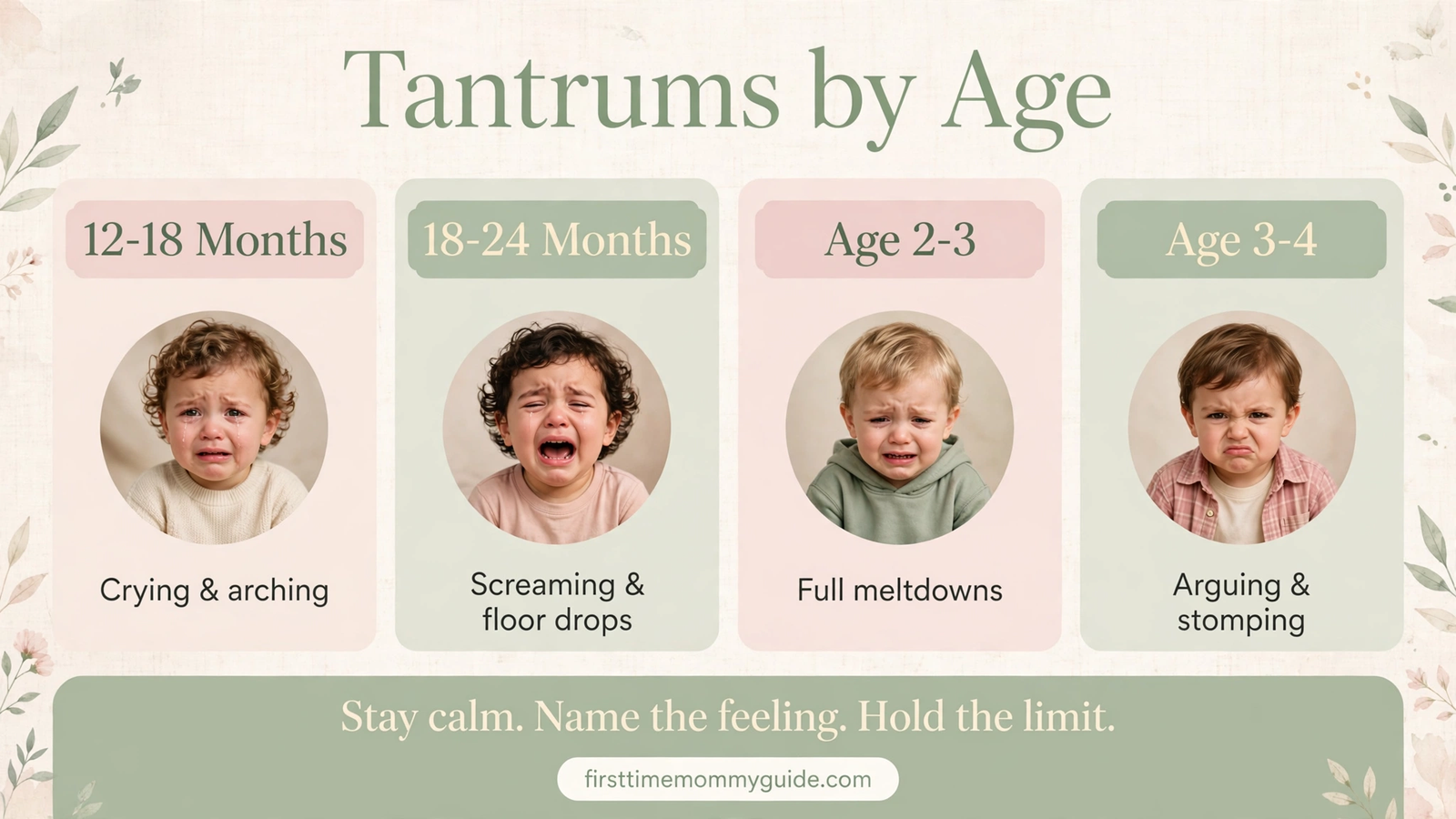
Tantrums change as your child grows. What is normal at 18 months looks different from what is normal at four years. This table shows the typical pattern.
| Age | What tantrums look like | What is driving them | What helps most |
|---|---|---|---|
| 12–18 months | Crying, arching back, throwing food or toys | Frustration with limited words and movement | Distraction, comfort, meeting physical needs |
| 18–24 months | Screaming, dropping to the floor, hitting, biting | Strong will meets limited language; "no" phase begins | Simple choices, naming feelings, calm presence |
| 2–3 years | Full meltdowns, kicking, running away, holding breath | Peak of independence vs. ability; testing limits | Consistent limits, emotion words, routines |
| 3–4 years | Crying, arguing, stomping off, slamming doors | More language but still weak impulse control | Reasoning after calm, problem-solving together |
| 4–5 years | Fewer tantrums; more verbal protests and sulking | Growing self-control and negotiation skills | Talking through feelings, teaching coping tools |
At 12 to 18 months, tantrums are mostly about physical discomfort and frustration. Your baby-turned-toddler wants something they cannot reach, say, or do. Distraction works well at this age because their attention shifts quickly.
The peak years, two to three, are the hardest for most parents. Your child has strong opinions, a growing sense of self, and very little ability to wait, share, or accept "no". Tantrums may happen daily. This is normal, even though it is exhausting.
By three to four, language improves and tantrums usually shorten. Your child can tell you they are angry, which is a huge step forward. They still lose control when tired or overwhelmed, but recovery is faster. By four to five, most children can use words, take a breath, or ask for help most of the time.
Common Toddler Tantrum Triggers
Triggers vary from child to child, but the same ones appear again and again. Learning your child's pattern is one of the most powerful prevention tools you have.
| Trigger | Why it causes a tantrum | What to do |
|---|---|---|
| Hunger | Low blood sugar reduces patience fast | Offer regular snacks; carry food when out |
| Tiredness | An overtired brain cannot regulate emotion | Protect naps; watch for sleepy cues |
| Transitions | Stopping a fun activity feels like a loss | Give warnings: "Two more minutes, then bath" |
| Saying no | The child wants something they cannot have | Stay firm and kind; offer an alternative |
| Overstimulation | Noise, crowds, bright lights overwhelm senses | Limit long outings; build in quiet breaks |
| Illness or teething | Pain and discomfort lower tolerance | Offer extra comfort; delay new demands |
| Change in routine | New sibling, move, nursery start disrupts security | Keep core routines steady; allow extra cuddles |
| Frustration with a task | Toy will not work, clothes will not go on | Offer help without taking over completely |
| Seeking attention | Child learns tantrums get a big reaction | Give attention for calm behaviour, not meltdowns |
| Too many choices | Open-ended choices overwhelm a toddler | Offer two options: "Red cup or blue cup?" |
Keep a simple note on your phone for a week. Write down when tantrums happen, what came before, and how long they lasted. Most parents spot a pattern within days — often hunger before lunch, or tiredness late in the afternoon. Once you see the pattern, you can prevent the next one.
How to Handle a Toddler Tantrum in the Moment
When a tantrum starts, your job is not to fix the feeling. It is to stay steady while the feeling passes. Follow these steps in order.
Step 1: Stay Calm
Your calm is the tool. Take a slow breath before you speak or move. Lower your voice rather than raising it. Unclench your jaw and relax your shoulders. Your child is watching your face and body for cues about whether this situation is safe.
If you feel yourself getting angry, it is okay to pause. You can say, "Mummy needs a moment," and take three slow breaths. A calm parent is not a perfect parent. It is a parent who recovers quickly.
Step 2: Get Down to Their Level
Kneel or crouch so your eyes are level with your child's. This makes you feel less towering and threatening. It also helps your child hear you and feel seen. Touch helps too — a hand on their back or shoulder, if they will accept it. Some children push touch away during a tantrum. Respect that and stay nearby instead.
Step 3: Name the Feeling
Use short, simple words. "You are angry." "You wanted the toy and you cannot have it." "You are sad because we have to leave the park." Naming feelings does two things. It shows your child you understand, and it teaches them the words they will eventually use themselves.
Do not add explanations or lectures. During a tantrum, your child's thinking brain is offline. Long sentences wash over them. Save the teaching for later.
Step 4: Hold the Boundary
If the tantrum started because you said no, keep the no. Giving in during a tantrum teaches your child that screaming works. This is hard, especially in public, but it is the single most important step for reducing future tantrums.
You can be kind and firm at the same time. "I know you really want it. The answer is still no. I am here with you." That sentence holds the limit and offers comfort in the same breath.
Step 5: Wait It Out Safely
Most tantrums peak within a minute or two and fade within five. Stay close, stay quiet, and let it run its course. If your child is in a safe place, you can sit nearby and wait. If they are in danger of hurting themselves or others — kicking, biting, throwing hard objects — move them gently to a safe space or hold them securely until they calm.
Do not try to reason, bribe, or distract mid-tantrum unless your child is very young. For a one-year-old, distraction often works. For a two- or three-year-old in full flood, distraction usually fails and can feel dismissive.
Step 6: Offer Comfort When the Storm Passes
As the crying slows, offer a cuddle, a drink of water, or a quiet moment together. Your child may cling to you or want to be held. This is not rewarding bad behaviour. It is repairing the connection after a hard moment. Comfort after a tantrum teaches your child that big feelings do not break your love.
For more on calming techniques that work beyond tantrums, see our guide on how to soothe a crying baby — many of the same soothing principles apply as your baby grows into a toddler.
What to Do After a Tantrum
The minutes after a tantrum matter as much as the tantrum itself. This is when learning happens.
Keep your response short and warm. For a two-year-old, one or two sentences is enough. "You were really angry. It is hard when we have to leave the park. Next time we can say goodbye to the swings." For a three- or four-year-old, you can ask a simple question: "What could we do next time when you feel angry?"
Return to the normal routine quickly. Do not punish your child after a tantrum, and do not keep bringing it up. A tantrum is not a crime to be punished. It is a skill gap. Your child needs practice, not consequences.
Do not apologise for the boundary either. You do not need to feel guilty for saying no to a third biscuit or to running into the road. A calm, consistent no is part of good parenting, not a failure.
If your child hurt someone during the tantrum, address it simply once they are calm. "You hit your brother. That hurt him. Let's say sorry and check he is okay." Keep it brief. Long lectures after a tantrum do not teach. They only restart the upset.
How to Handle Tantrums in Public
Public tantrums feel ten times worse than home tantrums, because of the audience. The embarrassment is real, but it is also survivable. Here is how to handle them.
First, ignore the audience. Most onlookers are parents who have been exactly where you are. They are not judging you. They are relieved it is not them today. The few who do judge do not matter. Your child matters.
Second, stay where you are if it is safe. You do not need to rush out of the shop or abandon your trolley. If your child is on the floor screaming, sit or kneel beside them and wait. If the situation is unsafe or your child is blocking others, carry them calmly to a quieter spot — the car, a bench outside, or an empty aisle.
Third, do not give in to end the scene. Buying the toy to stop the screaming teaches your child that public tantrums are more powerful than home ones. It will make the next shopping trip harder, not easier.
Fourth, prepare before you go out. A fed, rested toddler with a snack in your bag and a clear plan — "We are buying milk and bread, then we go home" — has fewer public tantrums than a tired, hungry toddler on an open-ended errand. Keep outings short when you can.
After a public tantrum, do not punish or shame your child for embarrassing you. They did not choose to melt down in front of strangers. They were overwhelmed. A quiet "That was hard. You did well calming down" is enough.
How to Prevent Toddler Tantrums
You cannot prevent every tantrum, and you should not try. But you can reduce how often they happen and how intense they are.
Keep Routines Predictable
Toddlers feel safe when they know what comes next. A regular rhythm for meals, naps, play, and bedtime reduces the uncertainty that fuels meltdowns. This does not mean a rigid schedule. It means the same broad pattern each day, with room for flexibility.
A visual routine chart can help older toddlers. Pictures showing breakfast, play, lunch, nap, bath, and bed give your child a sense of control. They can see what is happening now and what comes next.
Offer Limited Choices
Choice gives toddlers a sense of power without giving away your authority. Offer two options, both of which you are happy with. "Do you want the red shirt or the blue shirt?" "Would you like apple or banana?" This turns a potential power struggle into a decision your child owns.
Avoid open questions like "What do you want to wear?" That invites a negotiation you cannot win. Two choices are enough for a toddler brain.
Give Warnings Before Transitions
Transitions are a top trigger. A toddler who is happily playing does not want to stop for lunch, a bath, or bedtime. Warn them before the change comes. "Five more minutes of play, then we tidy up." "Two more pushes on the swing, then we go home."
Timers help. A simple kitchen timer or a phone timer makes the warning concrete. When the timer rings, the rule comes from the timer, not from you. Many toddlers accept that more easily.
Watch for Hunger and Tiredness
Keep snacks and water handy, especially on outings. Offer food before your child gets desperately hungry, not after. Watch for sleepy cues — rubbing eyes, going quiet, getting clumsy — and start the nap or bedtime routine before your child is overtired.
Sleep is the foundation of behaviour. A toddler who sleeps well has a much bigger window of tolerance than one who does not. If tantrums cluster in the late afternoon, look at nap timing first. Our guide to baby sleep training methods covers routines that help toddlers as well as babies.
Teach Feeling Words Every Day
The more words your child has for feelings, the fewer tantrums they need. Name emotions in everyday moments. "You look happy! You love the slide." "You seem frustrated. The block tower fell down." Use books, pictures, and mirror games to practise. When your child can say "I am angry," they are less likely to show it with their whole body.
Praise Calm Behaviour
Catch your child being good. When they share a toy, wait patiently, or use words instead of screaming, name it. "You waited so patiently. That was kind." Children repeat behaviour that gets attention. If calm behaviour gets more attention than tantrums, calm behaviour grows.
Keep Your Own Tank Full
This is not a luxury. A tired, stressed parent has less patience, and children sense it instantly. Sleep when you can. Ask for help. Take a short break when your partner or a family member can watch your child. You cannot pour calm from an empty cup, and looking after yourself is part of looking after your child.
What NOT to Do During a Tantrum
Good intentions can backfire in the middle of a meltdown. Avoid these responses.
Do not yell back. Shouting over a screaming child raises the emotional temperature for everyone. It models the very behaviour you want to reduce. If you have already raised your voice, it is okay. Repair it afterward with a calm apology. "Mummy shouted. I am sorry. I was frustrated too."
Do not ignore a young child completely. Planned ignoring can work for attention-seeking behaviour in older children, but a toddler in distress needs to know you are there. Stay nearby, even if you are not talking. Complete withdrawal can make a toddler feel abandoned, which makes the tantrum worse.
Do not give in to stop the crying. As noted above, giving in teaches your child that tantrums work. If you said no to sweets before dinner, keep the no. If you realise you were wrong and the rule was unfair, you can change it later, calmly — not in the middle of the tantrum.
Do not bribe with food or screens. Offering a biscuit or a phone to end a tantrum creates a pattern. Your child learns that screaming earns a reward. It also teaches them to soothe with food or screens instead of learning to manage feelings. Save treats for calm moments, not meltdowns.
Do not punish the feeling. Saying "Stop crying or you will go to your room" punishes your child for having an emotion. The feeling is not the problem. The behaviour — hitting, biting, throwing — is what needs a boundary. Address the behaviour, not the tears.
Do not use time-outs as a first response. A time-out can be useful for an older child who needs space to calm down, but for a toddler in full flood it often feels like rejection. Comfort first, teach later. If you do use a brief calm-down space, stay nearby and welcome your child back warmly when they are ready.
Do not laugh or film the tantrum. It may look funny from the outside, but your child is genuinely distressed. Laughing teaches them that their feelings are a joke. Filming, especially to share, breaks their trust. Keep the moment private and respectful.
Do not compare your child to others. "Your cousin never behaves like this" does not help. Every child is different. Some children are simply more intense, more sensitive, or slower to develop self-control. Comparison adds shame to an already hard moment.
Mistakes to Avoid
Beyond the clear don'ts, there are quieter mistakes that keep tantrums coming.
The first is inconsistent rules. If one parent says no and the other says yes, or the rule changes depending on your mood, your child cannot learn where the boundary is. They will keep testing, because testing is the only way to find out. Agree on the big rules together and hold them the same way.
The second is too many rules. A toddler cannot follow twenty rules. Pick the few that matter for safety and kindness — no hitting, no running into the road, no throwing food — and be flexible about the rest. A child who hears "no" all day has nothing left to lose.
The third is reasoning during the tantrum. Long explanations bounce off a flooded brain. Your child cannot process "We cannot buy the toy because we have a budget and you already have three like it at home" while screaming. Say the feeling, hold the limit, and explain later if needed.
The fourth is forgetting to teach after the calm. The tantrum itself is not a teaching moment. But the calm hour afterward is. A short, simple conversation about what happened and what to do next time builds the skills that prevent the next meltdown.
The fifth is taking it personally. A tantrum is not an attack on you. It is not proof you are failing. It is a developmental phase that every parent lives through. When you stop seeing tantrums as personal, you respond with far more patience.
Tantrums vs Meltdowns: Is There a Difference?
Parents often use the words tantrum and meltdown interchangeably, but they describe slightly different things.
A tantrum is usually goal-directed. Your child wants something — a toy, a biscuit, more time at the park — and protests when they cannot have it. The child often checks whether you are watching. The behaviour may stop quickly if the goal is achieved. Tantrums respond well to consistent limits and calm boundaries.
A meltdown is an overload response. It happens when a child's nervous system is overwhelmed by tiredness, noise, hunger, or sensory input. The child is not trying to get something. They have simply run out of coping capacity. Meltdowns often follow a long, overstimulating day and may not have an obvious trigger.
In practice, the line is blurry. Many outbursts have elements of both. The response is similar either way: stay calm, keep your child safe, reduce stimulation, and offer comfort. The main difference is in prevention. Meltdowns are prevented by managing the environment — shorter outings, quieter days, protected sleep. Tantrums are prevented by consistent limits and teaching coping skills.
Tantrums and Big Life Changes
Some periods bring more tantrums than usual. A new sibling, starting nursery, moving house, or a parent returning to work can all trigger a surge. Your child is not regressing. They are coping with a world that just changed.
During these periods, expect more clinginess, more tears, and more tantrums. This is normal. Keep routines as steady as you can. Offer extra comfort and one-on-one time. Talk about the change in simple words, even to a two-year-old. "A new baby is coming. Mummy will still love you. You will be a big brother."
If your toddler is struggling with a new sibling, our guide to baby separation anxiety signs and soothing has strategies that help with attachment worries during transitions too. And if the stress is spilling into your own behaviour, our honest piece on I yelled at my baby and feel horrible is a reminder that repair matters more than perfection.
When to Worry About Toddler Tantrums
Most tantrums are normal. But some patterns are worth discussing with your paediatrician or health visitor. Seek advice if:
- Tantrums happen very frequently — many times a day, most days — and do not improve with consistent limits.
- Tantrums regularly last longer than 15 minutes, or your child cannot calm down even with comfort.
- Your child hurts themselves during tantrums — banging their head hard, biting themselves, or holding their breath until they faint.
- Your child hurts others often, or the aggression is getting worse rather than better.
- Tantrums continue at the same intensity past age four or five.
- Your child has lost skills they used to have, such as speech or toilet training.
- Your child rarely makes eye contact, does not respond to their name, or shows other developmental concerns alongside tantrums.
- Tantrums are paired with extreme anxiety, withdrawal, or refusal to eat or sleep.
None of these signs alone means something is wrong. But together, or persisting over months, they justify a professional conversation. Your paediatrician can check development, hearing, and vision, and refer you to extra support if needed. Asking is not overreacting. It is good parenting.
For general guidance, the AAP's parent site HealthyChildren.org (healthychildren.org) covers tantrums and discipline, the NHS (nhs.uk) offers advice on toddler behaviour and temper tantrums, and the CDC (cdc.gov) publishes developmental milestones that help you track whether your child's behaviour is on track for their age.
Frequently Asked Questions
1. Are toddler tantrums normal?
Yes. Tantrums are a normal part of development between ages one and four. They happen because toddlers feel strong emotions but cannot yet control them or explain them in words. Most children grow out of frequent tantrums by age four as language and self-control improve.
2. How long does a toddler tantrum usually last?
Most tantrums last one to five minutes, with the worst part in the first minute or two. Some last up to ten minutes. A tantrum that regularly lasts longer than 15 minutes, or where your child cannot calm down at all, is worth mentioning to your paediatrician.
3. What causes toddler tantrums?
The main causes are frustration, tiredness, hunger, overstimulation, and the clash between wanting independence and lacking the skills to achieve it. Limited language is a major factor — toddlers cannot explain what they feel, so they show it. Transitions, saying no, and big life changes are common triggers too.
4. How do I stop a toddler tantrum fast?
There is no instant off switch. The fastest path is to stay calm, get to your child's level, name the feeling in short words, and wait quietly while the storm passes. Avoid reasoning, bribing, or giving in. For very young toddlers, distraction sometimes works. For older toddlers, calm waiting works better.
5. Should I ignore my toddler during a tantrum?
Stay nearby but do not engage in a power struggle. Ignoring completely can make a young toddler feel abandoned. Sit close, stay calm, and let your child know you are there. Once the crying eases, offer comfort and reconnect.
6. Is it okay to give in to a tantrum in public?
Try not to. Giving in teaches your child that public tantrums are more effective than home ones, which makes the next outing harder. Move to a quieter spot if needed, hold the boundary, and wait it out. Most onlookers understand — they have been there too.
7. What is the best age for tantrums to peak?
Tantrums usually peak between ages two and three. This is when independence and willpower are strong but language and impulse control are still weak. Frequency typically falls from age three onward and drops sharply by age four or five.
8. Do tantrums mean my child is spoiled?
No. Tantrums are not a sign of spoiling or bad parenting. They are a normal developmental phase. A child who has tantrums is not a badly behaved child. They are a child whose brain is still learning to manage big feelings.
9. How do I handle a tantrum when my toddler hits or bites?
Keep everyone safe first. Move your child away from the other person or hold them gently so they cannot hit. Say briefly, "No hitting. Hitting hurts." Wait for calm, then address it simply. Teach an alternative: "When you are angry, you can stomp your feet or ask for help." Stay consistent every time.
10. What should I do after a tantrum ends?
Offer comfort first — a cuddle, water, or a quiet moment. Then keep it brief: name the feeling and the rule in one or two sentences. Return to the normal routine quickly. Do not punish, lecture, or keep bringing the tantrum up afterward.
11. Can tantrums be prevented?
Many can. Protect sleep and regular meals, give warnings before transitions, offer limited choices, keep routines predictable, and watch for your child's triggers. You cannot prevent every tantrum, and you should not try — some frustration is part of healthy development.
12. Why does my toddler have tantrums every day?
Daily tantrums at age two or three are common, especially during the peak years. Check the basics first: Is your child sleeping enough? Eating regularly? Going through a big change? If tantrums are daily, intense, and not improving over several months, talk to your paediatrician.
13. Should I use time-outs for tantrums?
A brief calm-down space can help an older toddler who needs quiet to recover, but it is not a good first response for a child in full flood. Comfort first, teach later. If you use a time-out, keep it short — about one minute per year of age — and welcome your child back warmly.
14. What is the difference between a tantrum and a meltdown?
A tantrum is usually goal-directed — your child wants something and protests when they cannot have it. A meltdown is an overload response to tiredness, noise, or sensory input, with no clear goal. Both need a calm adult, safety, and comfort. Meltdowns are prevented by managing the environment; tantrums by consistent limits.
15. Do boys have more tantrums than girls?
Research does not show a clear, consistent difference in tantrum frequency between boys and girls in the toddler years. Individual temperament matters far more than sex. Some children are simply more intense or more sensitive, regardless of gender.
16. How do I handle tantrums when I have a new baby too?
This is genuinely hard. Keep your toddler's routines as steady as you can, and give them short bursts of one-on-one attention each day, even ten minutes of undivided play. Let them help with the baby in small ways. Expect a temporary increase in tantrums after a new sibling arrives — it is a normal adjustment.
17. Is holding my breath during a tantrum dangerous?
Some toddlers hold their breath during intense crying and may briefly go limp or faint. This is frightening but usually harmless, and breathing restarts on its own. Lay your child on their side in a safe place and stay calm. Mention breath-holding spells to your paediatrician, especially if they happen often.
18. Should I talk to my toddler about the tantrum later?
Yes, briefly, once they are calm. For a two-year-old, one sentence is enough: "You were angry because we left the park." For a three- or four-year-old, you can problem-solve together: "Next time you feel angry, what could you do?" Keep it short and kind.
19. What if my toddler's tantrums are worse at nursery or daycare?
Ask the nursery staff what they see. Tantrums at nursery often come from tiredness, overstimulation, or difficulty sharing. Share your home strategies so the nursery can use the same words and routines. Consistency between home and nursery helps tantrums fade faster.
20. When should I see a doctor about tantrums?
See your paediatrician if tantrums are very frequent, last longer than 15 minutes regularly, involve self-harm or aggression that is worsening, continue at the same intensity past age four, or come with developmental concerns such as lost skills or limited eye contact. Early advice is always better than waiting.
21. Can I prevent tantrums by giving my toddler everything they want?
No. Giving in to every demand does not prevent tantrums — it creates more of them. Toddlers need boundaries to feel safe. A child who learns that screaming gets results will scream more, not less. Kind, consistent limits are the real prevention.
Conclusion
Toddler tantrums are loud, messy, and exhausting. They are also normal, temporary, and survivable. Your child is not giving you a hard time. They are having a hard time, and they need your steady presence to get through it.
Stay calm when you can. Name the feeling in simple words. Hold the boundary with kindness. Wait out the storm, offer comfort when it passes, and keep the routine moving. Prevent what you can — sleep, food, warnings, choices — and accept the tantrums you cannot prevent.
Over time, the tantrums will fade. Language will grow. Self-control will catch up. And the child who once screamed on the supermarket floor will learn to say, "I am angry," and ask for help instead. That is the goal. You are building it, one calm response at a time.
If tantrums feel overwhelming, or you are worried about their frequency or intensity, talk to your paediatrician. There is no shame in asking for support. Every parent needs it sometimes. You are doing better than you think.

Dilawar Mughal
Founder and editor, First Time Mommy Guide
I research every guide against what the NHS, the AAP and the WHO publish, then write it in plain English — because most new parents are reading with one hand free, not comparing clinical guidelines. I'm not a doctor or a midwife. Every health claim on this site is sourced and linked so you can check it yourself, and anything urgent belongs with your health visitor or GP, not a blog.