General information, not medical advice. Every baby is different — if anything worries you, speak to your midwife, health visitor or GP rather than waiting.
There is a particular kind of milestone that sneaks up on you: one morning you realise the soft wisps that once barely covered your baby’s head are now falling into their eyes, getting stuck in food, and looking distinctly shaggy in photos. The first haircut is a small event with an outsized emotional charge. For many parents, it feels like the moment their baby officially becomes a little kid.
The good news is that a first haircut does not have to involve tears, screaming, or a lopsided result you regret in photos for years. With the right timing, the right place, and a little preparation, it can be a sweet, quick, and even fun memory. This guide covers when your baby is ready, whether to choose a salon or cut at home, exactly what to bring, how to keep your child calm in the chair, and what to do with that famous first curl.
Quick Answer: When Should a Baby Get a First Haircut?
- There is no set age. Most babies have their first haircut between 12 and 24 months, but some need one earlier and some much later. Readiness is about hair, not the calendar.
- Signs it is time: hair falls into the eyes, tangles constantly, looks uneven or straggly, or gets in the way of eating and play.
- Choose a kid-friendly salon. A salon experienced with toddlers has the right chairs, patience, and distractions — and that matters more than a fancy adult salon.
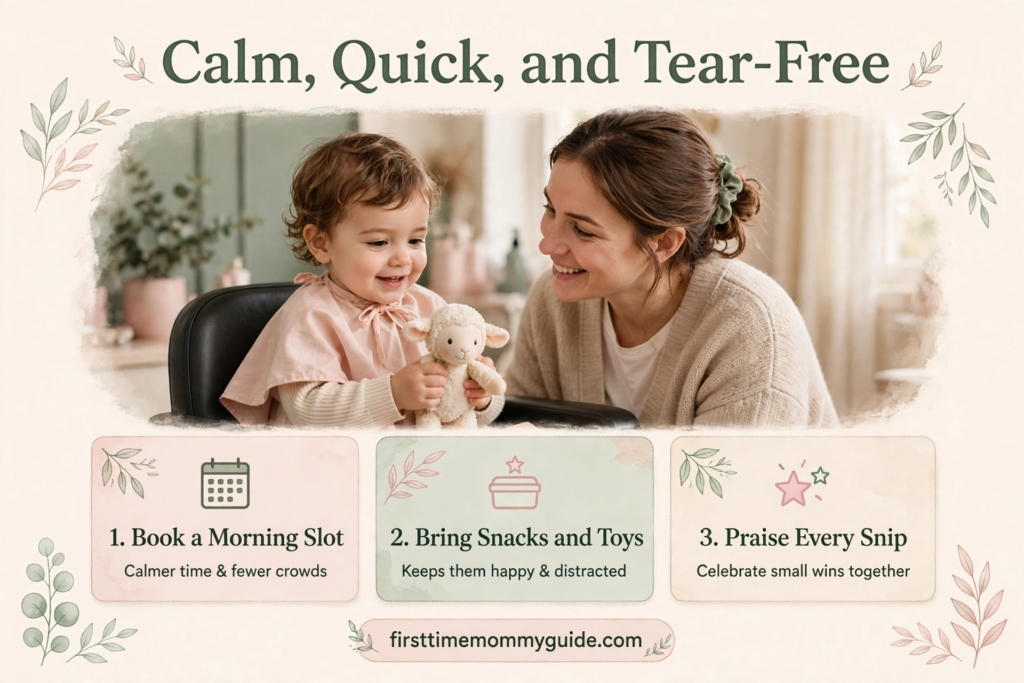
- Book a morning slot. A rested, fed baby after a nap is far more cooperative than a tired, hungry one at the end of the day.
- Keep the first cut simple. A gentle trim that tidies the shape is the goal. Save the fancy style for later visits.
- Bring comfort and distraction. A favourite toy, a snack, a phone with a cartoon, and a calm parent on hand cover most situations.
Does Your Baby Actually Need a Haircut Yet?
Before you book, it is worth asking whether the haircut is for your baby or for you. Many parents feel pressure from family comments or photos, but babies do not need haircuts on a schedule. Fine baby hair grows at very different rates: some babies are born with a full head of hair that needs trimming by 8 months, while others still have wispy fuzz at 18 months. Neither is a problem.
Practical signs that a cut would genuinely help include hair constantly in the eyes, which can irritate and distract; hair that tangles into knots at the nape of the neck; uneven growth that makes the head look lopsided in a way that bothers you; or hair that traps food and gets matted after every meal. Like other toddler milestones — see our guide to baby milestones at 6 months for how development unfolds in stages — timing varies widely from child to child. If none of those apply, there is no rush. Waiting a few more months is always an option, and a baby who is a little older is often a little more cooperative in the chair.
One myth worth clearing up: cutting a baby’s hair does not make it grow back thicker. Hair thickness is determined by genetics and the hair follicles, not by how often you cut it. The soft, fine texture of baby hair gradually changes to thicker childhood hair on its own timetable, whether you cut it or not. So cut because the hair needs tidying, not because you hope to change its texture.
Salon or Home: Which Is Better for a First Haircut?
Both options work, and the best choice depends on your baby’s temperament, your confidence, and your budget.
A kid-friendly salon
The biggest advantage of a salon is experience. A stylist who cuts toddlers every day knows how to work quickly, how to distract, and how not to panic when a small head suddenly turns. Many children’s salons have chairs shaped like cars or animals, cartoons playing, and a “first haircut” certificate with a keepsake envelope for the curl. The atmosphere is designed to make the experience feel like an adventure rather than an ordeal.
The downside is cost and the unfamiliar environment. A new room full of strangers, sounds, and smells can overwhelm a shy baby. If you choose a salon, visit beforehand if you can, so the room is not entirely new on the day. Book the first appointment of the day when the salon is quiet, and tell the stylist it is a first haircut so they allow extra time.
Cutting at home
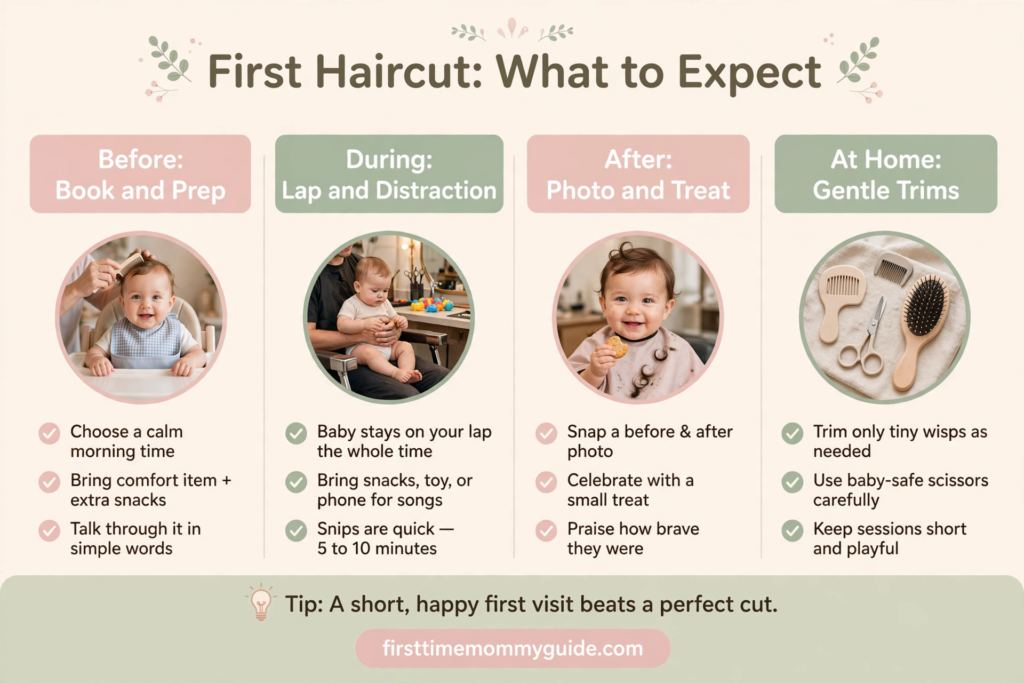
Home has the advantage of familiarity. Your baby is in their own space, on your lap, with their own toys. A simple trim at home costs nothing and can be done in short bursts over a couple of days if needed. The risk is your own skill: cutting a moving target is genuinely hard, and an uneven result is likely if you have never cut hair before. If you go this route, use blunt-tipped safety scissors designed for children, cut only a small amount at a time, and accept that “tidier” is a perfectly good outcome for a first attempt.
A hybrid approach works well for many families: a gentle tidy-up at home to practise sitting still, followed by a proper salon cut a few weeks later. There is no rule that the first cut must be perfect, or even that it must happen in one sitting.
How to Prepare Your Baby for the First Haircut
Preparation is mostly about familiarity. The less new the experience feels, the calmer your baby will be.
Talk about it beforehand. For a few days before, mention the haircut in a cheerful voice: “Soon we will visit the hair shop and get your hair all tidy.” Read a picture book about haircuts if you have one, or play hairdresser at home with a toy comb and a doll. Toddlers understand more than they can say, and a preview turns a surprise into an event they recognise.
Practise sitting and touching. Gently comb your baby’s hair each day, touching the ears and the nape of the neck, so those sensations are not new when a stylist does them. Practise sitting on your lap while you hold a toy and sing a song. Short, happy practise sessions build the exact skills the haircut needs.
Pick the right time of day. Book for the morning, after breakfast and a nap if possible. Avoid nap time, meal times, and the late afternoon, when toddlers are at their least cooperative. A well-rested baby with a full tummy is a different child from a tired, hungry one.
Dress for the occasion. Choose a top that is easy to brush hair off, or one you do not mind getting hairy. Avoid hoods and bulky collars that get in the stylist’s way. Some parents bring a change of shirt for after the cut, which also helps with the itchy-hair problem on the way home.
What to Bring to the First Haircut
Pack a small bag the night before so the morning is calm. Your kit should include:
- A favourite toy, comfort blanket, or stuffed animal
- A snack that is not too messy, such as crackers or soft fruit pieces
- A phone or tablet with a favourite cartoon, fully charged
- A change of shirt for your baby, and a small brush for loose hairs
- A zip-lock bag or envelope for the first curl keepsake, if you want one
- Tissues or wipes for stray hairs on the face and neck
- Your camera or phone, charged and ready for photos
Tell the salon in advance if your baby has any sensitivities, such as a dislike of water sprays or loud clippers. Most stylists will use scissors only for a first cut, which is quieter and less frightening than clippers. If clippers are needed, ask the stylist to let your baby see and hear them first, from a distance, before they come near the head.
During the Haircut: Keeping It Calm and Quick
The actual cut usually takes only 10 to 20 minutes, and the stylist will work fast. Your job is to be the calm, distracting presence your baby needs.
Sit with your baby. Most salons let a parent hold the baby on their lap during a first cut. Hold your baby securely but gently, with their head steady against your chest or shoulder. Talk, sing, or read a book in a relaxed voice. Your calm is contagious, and your tension is too, so take a slow breath before you sit down.
Distract, do not restrain. A toy, a snack, a cartoon, or a silly song works better than holding a struggling child still. Let the stylist work around your baby’s movements rather than forcing a frozen pose. A good toddler stylist expects wriggling and plans for it.
Expect some fuss. Some babies sail through their first cut smiling. Others cry from the first snip to the last. Both are normal, and crying does not mean you have traumatised your child. Most babies forget the experience within minutes of leaving, especially if you follow it with something pleasant, like a snack, a playground visit, or a favourite activity.
Keep expectations modest. The goal of a first haircut is a tidier shape, not a magazine style. If the stylist can only manage a partial trim before your baby’s patience runs out, that is a successful first visit. You can always return in a few weeks for a tidy-up, and the second visit is almost always easier than the first.
After the Cut: Photos, Keepsakes, and Cleanup
The first haircut deserves a little celebration, even a small one. Take a photo before, during, and after, even if the “during” photo includes tears. Those photos become family stories, and parents who skip them often wish they had not.
Many families keep a small curl from the first cut as a keepsake. If you want one, bring an envelope and ask the stylist to save a curl before they start tidying. Label it with the date and your baby’s age, and store it somewhere dry. Some parents press the curl into a baby book or a frame alongside a photo. There is no right way to do it, and no obligation to keep one at all.
Cleanup matters too. Loose hairs can itch and irritate, so brush your baby’s neck and shoulders after the cut, change their shirt, and give them a quick wipe or bath when you get home. Check for any small nicks, which are rare with scissors but worth a look, and dab any spot with a clean cloth.
Finally, praise your baby. “You did such a great job sitting still!” or “Look at your handsome new hair!” teaches your child that haircuts are achievements, not punishments. That framing pays off at every future appointment.
First Haircut at Home: A Step-by-Step Guide
If you decide to cut at home, here is a safe, simple method for a basic tidy-up.
- Wait for a calm moment. After a nap and a snack is ideal. Never start when your baby is tired, hungry, or unwell.
- Set up near a window. Good natural light helps you see what you are doing. Sit your baby on your lap or in a high chair with a favourite show playing.
- Use the right tools. Blunt-tipped children’s safety scissors, a fine comb, and a spray bottle of water. Never use sharp adult scissors near a moving child.
- Work in small sections. Comb a small section down, hold it between your fingers, and trim only a centimetre or two. Work around the head slowly, checking symmetry as you go.
- Cut less than you think. You can always take more off, but you cannot put it back. Stop while it looks a little long, and live with it for a day before deciding whether more is needed.
- Keep it short and sweet. If your baby becomes upset, stop. You can finish tomorrow. A half-finished cut is better than a distressing one.
Do not attempt a complex style at home for a first cut. A simple trim of the ends, the fringe away from the eyes, and the nape is plenty. If the result is uneven, a salon can fix it in minutes.
Common First Haircut Problems and Fixes
My baby screamed the whole time. This is common and not a disaster. Try a different time of day, a different stylist, or a home trim next time. Many babies who scream at the first cut are perfectly calm by the third.
The cut came out uneven. Toddler heads move, and perfect symmetry is unrealistic at this age. A quick tidy-up visit usually fixes it, and hair grows fast. Nobody will notice in a week.
My baby is now afraid of haircuts. Give it time, and rebuild the association gradually: play hairdresser at home, visit a salon just to watch, and praise bravery. Forcing another appointment immediately can deepen the fear.
The fringe is still in the eyes. Ask the stylist to show you how to trim the fringe safely between visits, or book shorter, more frequent trims until your baby tolerates a full cut.
Family disagrees about cutting. Grandparents and relatives often have strong feelings about a first haircut, especially in cultures where the first cut carries tradition or ceremony. Talk openly about what matters to each person, and remember that you, as the parent, make the final call. If a cultural or religious first-haircut tradition matters to your family, honour it in whatever way feels right, and let the salon know in advance so they can respect it.
Hair Care After the First Cut
A first haircut is a good moment to settle into a simple hair care routine. Wash your toddler’s hair two to three times a week with a gentle, tear-free shampoo, and rinse thoroughly. Brush daily with a soft brush, working gently through tangles from the ends upward rather than yanking from the roots. For curly or textured hair, a wide-tooth comb and a little leave-in conditioner, approved for toddlers, can prevent knots without weighing hair down.
Avoid tight hairstyles that pull on the scalp, heavy styling products, and heat tools, all of which are unnecessary for toddler hair. If your baby has cradle cap, the scaly patches common in infancy, gentle washing and soft brushing usually manage it, and your pediatrician can advise if it persists. Our guides to baby massage techniques and baby eczema care cover related skin and scalp care in more detail.
Sun protection matters too. A hat on sunny days protects a newly short haircut and a sensitive scalp, and it is a habit worth building early. In cold weather, a soft hat keeps a freshly cut head warm without irritating the skin.
First Haircut Traditions Around the World
The first haircut carries meaning in many cultures, and knowing the traditions can help you decide what feels right for your family. In some Hindu families, the mundan ceremony marks a baby’s first haircut as a sacred milestone, often performed in a temple with family present. In some Jewish families, a boy’s first haircut, the upsherin, happens at age three and is celebrated with family and community. In many Latin American families, the first haircut is a small party with photos and keepsakes. In other families, it is simply a practical trim with no ceremony at all.
Whatever your tradition, or lack of one, the principle is the same: mark the moment in a way that feels joyful rather than stressful. A ceremony should add meaning, not pressure. If a tradition involves shaving or a specific ritual, discuss it with your pediatrician or stylist beforehand so the practical details are safe and comfortable for your baby.
When to Ask a Professional for Help
Most first haircuts are straightforward, but a few situations deserve professional input. If your baby has a scalp condition, such as persistent cradle cap, eczema, or a birthmark you are unsure about, mention it to your pediatrician before the cut. If your baby’s hair is falling out in patches, growing very unevenly, or changing colour or texture suddenly, a pediatrician can check whether anything needs attention. Hair concerns are rarely urgent, but they are worth a mention at a routine visit.
Similarly, if your baby becomes extremely distressed by haircuts over several attempts, and the distress generalises to hair washing or brushing, talk to your pediatrician. Occasionally, sensory sensitivities underlie strong reactions to grooming, and early support makes later haircuts much easier.
Authoritative reading on toddler grooming and development includes the American Academy of Pediatrics’ guidance via healthychildren.org, the NHS guidance on caring for your baby, and the World Health Organization’s early childhood development resources.
Choosing the Right Salon: Green Flags and Red Flags
Not every salon that accepts children is genuinely good with them. A little scouting saves a difficult appointment.
Green flags include stylists who greet your baby first, before talking to you; chairs or boosters designed for small children; toys, books, or a screen available without you having to ask; a stylist who explains what they are doing in a friendly voice; and a willingness to stop, pause, or split the cut across two visits. A salon that offers a first-haircut package with a certificate and a keepsake envelope is usually signalling that they do this often and enjoy it.
Red flags include a stylist who seems rushed or annoyed by wriggling; a salon that insists on a rigid appointment length with no flexibility; loud adult music and strong chemical smells with no effort to soften the environment; and any pressure to use clippers on a frightened baby when scissors would do. If you spot red flags on arrival, it is perfectly acceptable to leave and rebook elsewhere. A first haircut should never feel like something your baby has to endure.
Ask friends for recommendations, and read recent reviews specifically mentioning toddlers rather than general haircut reviews. A salon can be excellent for adults and poor for toddlers, and the reviews will usually tell you which it is. If you find a stylist your baby likes, stick with them. Familiarity makes every future cut easier, and a stylist who knows your child’s temperament and hair growth pattern will do better work over time.
Making a Memory of the Day
Beyond the keepsake curl, there are small ways to mark a first haircut that cost nothing and mean a lot later. Take a photo of your baby in the chair, cape and all, even if they are mid-frown. Write the date and your baby’s age on the back of the photo or in your phone album. If you keep a baby book, add a short note about how the appointment went: what made them laugh, what they clutched, whether they cried or charmed the whole salon.
Some families celebrate with a small treat afterwards — an ice cream, a trip to the park, or a new book. The treat is not a bribe for future haircuts, but a way of marking the day as special. Years later, your child will enjoy hearing the story of their first haircut far more than they will care about how even the cut was.
If the appointment went badly, do not let that become the story. A rough first haircut is not a prediction of every future one. Give it a few weeks, play hairdresser at home, and try again with a different approach. Most children who hate the first cut are unbothered by the third.
Frequently Asked Questions
What age is best for a baby’s first haircut?
There is no best age. Most babies have their first cut between 12 and 24 months, when hair starts falling into their eyes or tangling. Let the hair, not the calendar, decide.
Will cutting my baby’s hair make it grow thicker?
No. Hair thickness is genetic. Cutting does not change the follicles, so a first cut will not make fine baby hair grow back thicker or darker.
Should I cut my baby’s hair at home or go to a salon?
A kid-friendly salon offers experience and distractions, while home offers familiarity and zero cost. Either works. Choose based on your baby’s temperament and your confidence with scissors.
What if my baby cries through the whole haircut?
That is normal and usually forgotten within minutes. Try a morning appointment, a different stylist, or a shorter session next time. Praise your baby afterwards regardless of tears.
How much should a first haircut cost?
Children’s salon first cuts vary widely by area, often from a modest fee to a premium package with a certificate and photo. Ask the price in advance, and remember that a simple trim is all a first visit needs.
Can I use regular scissors?
Use blunt-tipped children’s safety scissors, not sharp adult scissors. A moving toddler and sharp points are a risky combination, and safety scissors are designed for exactly this job.
Should the stylist use clippers or scissors?
Scissors are quieter and less frightening for a first cut, and most toddler stylists prefer them. Clippers are fine for older toddlers who are used to the sound, but ask first if you are unsure.
What is a first haircut certificate?
Many children’s salons give a certificate marking the date of the first cut, sometimes with a lock of hair attached. It is a sweet keepsake, but entirely optional. You can make your own at home with a photo and a curl in an envelope.
How often will my toddler need haircuts after the first?
Most toddlers need a trim every 2 to 3 months, depending on how fast their hair grows. Short styles need more frequent tidying, while longer styles can go longer between cuts.
What if the first cut is uneven?
Toddler cuts are rarely perfect, because toddlers move. A quick tidy-up fixes most unevenness, and hair grows quickly. Nobody will notice within a week or two.
Is it okay to cut a sleeping baby’s hair?
It is tempting, but not recommended. A baby who wakes mid-snip can jerk suddenly near scissors, and the surprise can create a negative association. A calm, awake cut is safer.
What about bangs or a fringe?
A fringe that falls into the eyes is the most common reason for a first cut. Ask for a soft, slightly long fringe that sits above the eyebrows, which gives room to grow out gracefully.
My baby has very little hair. Should I still cut it?
If there is nothing to tidy, there is no need to cut. Some babies keep wispy hair well past their first birthday, and that is completely normal. Wait until there is actually something to trim.
How do I remove loose hairs after the cut?
Brush the neck and shoulders, change your baby’s shirt, and wipe the face with a damp cloth. A quick bath when you get home removes the rest and stops itching.
Can I save the first curl?
Yes. Bring a small envelope and ask the stylist to save a curl before tidying. Label it with the date and your baby’s age, and keep it dry. It makes a lovely baby-book keepsake.
One last reassurance for nervous parents: your baby will not remember a wobbly first haircut, but they will benefit from the calm way you introduced it. The skills you practise now — previewing new experiences, bringing comfort items, and praising bravery — transfer to dentist visits, doctor appointments, and school mornings. A first haircut is small, but the way you handle it teaches your child that new experiences can be safe, even when they feel strange at first.
Conclusion
A baby’s first haircut is a small milestone with a big place in your heart, and it deserves to be handled gently. Wait until the hair actually needs it, choose a kind and experienced stylist or a calm moment at home, book a morning slot, and bring every distraction you own. Keep the cut simple, praise your baby loudly, and save a curl if you want one.
Years from now, you will look at the photo — the cape, the toy clutched tight, the brand-new haircut — and remember not the tears or the wriggling, but the moment your baby took one more small step toward being a little kid. That is what the first haircut really is: not a test of parenting, but a celebration of growing up. If this guide helped you feel ready, save it for the week before the appointment, and share it with another first-time mom staring at those overgrown curls and wondering where to start.

Dilawar Mughal
Founder and editor, First Time Mommy Guide
I research every guide against what the NHS, the AAP and the WHO publish, then write it in plain English — because most new parents are reading with one hand free, not comparing clinical guidelines. I'm not a doctor or a midwife. Every health claim on this site is sourced and linked so you can check it yourself, and anything urgent belongs with your health visitor or GP, not a blog.