General information, not medical advice. Every baby is different — if anything worries you, speak to your midwife, health visitor or GP rather than waiting.
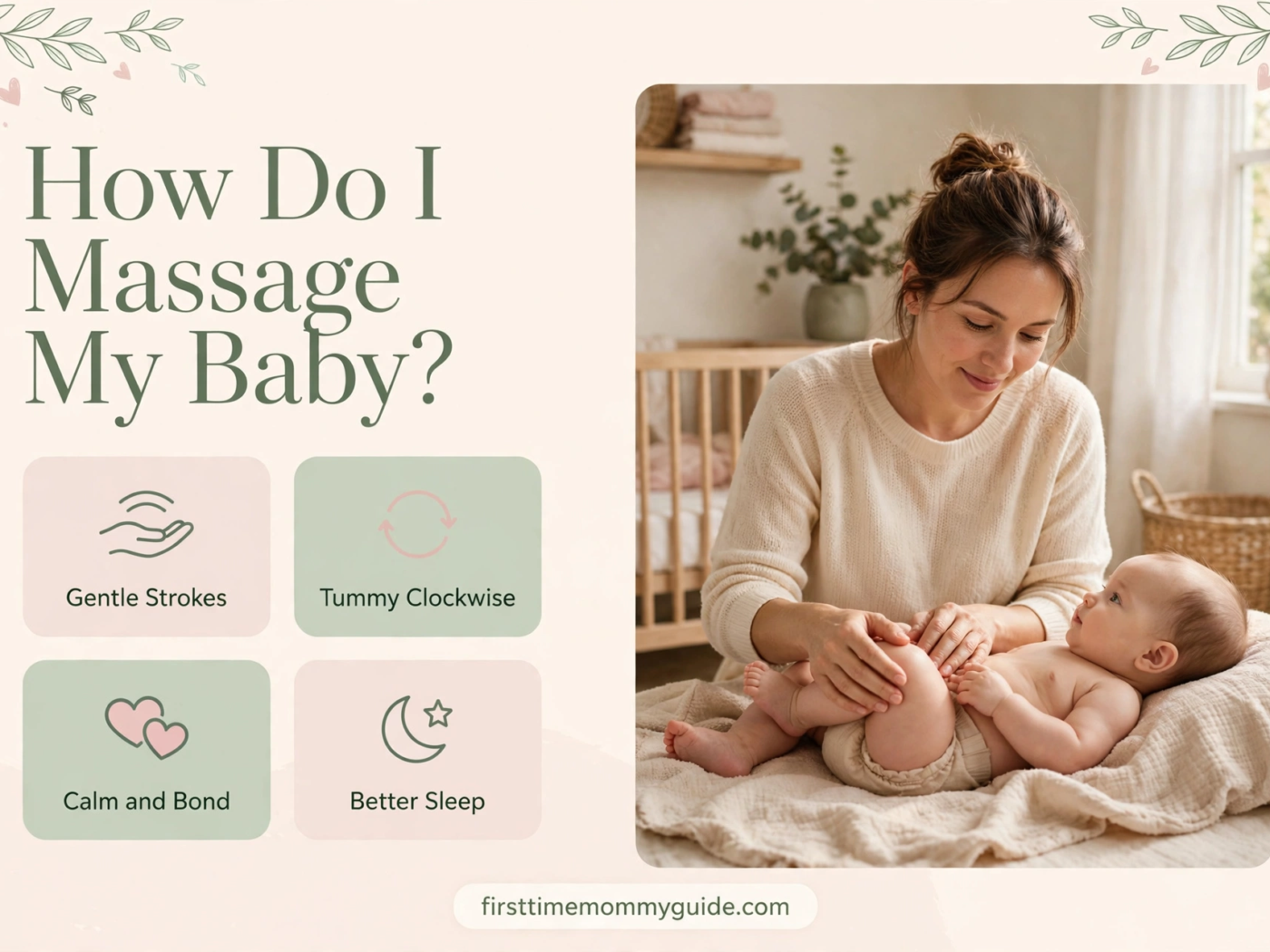
Touch is a baby’s first language. Long before they understand words, babies understand warmth, pressure, and rhythm through their skin. Baby massage is simply a structured way of using that language. Done gently and regularly, it can calm a fussy baby, ease gas and colic discomfort, support sleep, and deepen the bond between you and your child.
This guide teaches you baby massage techniques step by step, from preparation to a full routine covering legs, tummy, chest, arms, face, and back. You will learn which oils are safe, when to massage and when to skip it, how to read your baby’s cues, and which strokes help with common problems like gas, constipation, and teething discomfort. You will also learn what to avoid, so your massage sessions are always safe and enjoyable.
Quick answer: The best baby massage uses slow, gentle strokes with light to moderate pressure, always moving in a calm rhythm and watching your baby’s cues. Massage legs, tummy (clockwise), chest, arms, face, and back for 10 to 20 minutes, once or twice a day, when your baby is alert and content. Never massage a sick, distressed, or just-fed baby, and always use a safe, fragrance-free oil.
What Is Baby Massage, and Why Does It Help?
Baby massage, sometimes called infant massage, is the practice of gently stroking and kneading a baby’s body in a deliberate sequence. It has roots in many cultures, from India to Africa to Scandinavia, where massage has been part of infant care for generations. In recent decades, it has been studied more formally, and organisations including the NHS and the American Academy of Pediatrics recognise gentle touch as an important part of infant care.
Massage is not a medical treatment, and it does not cure illness. But it offers real, practical benefits for many families, and it is one of the most enjoyable parts of a daily routine once you get the hang of it.
Benefits for your baby
Regular, gentle massage may help your baby in several ways. It can promote relaxation and reduce crying, partly because rhythmic touch calms the nervous system. Many parents find that a massage before bed helps their baby settle more easily, and a consistent massage routine can become a sleep cue, signalling that bedtime is coming. Our guide to newborn sleep routines explains how routines like this support better sleep.
Massage may also help with digestion. Gentle tummy strokes, done in the right direction, can help move gas along and ease the discomfort of trapped wind. Some parents find that a regular tummy massage reduces the frequency or intensity of colic episodes, though massage is not a cure for colic. If your baby is struggling with persistent crying, our guide to colic symptoms and soothing covers the wider picture.
Massage also supports body awareness. As your baby feels their legs, arms, and back being touched in sequence, they learn where their body ends and the world begins. This is an early form of sensory development, and it complements other activities like tummy time.
Benefits for you
Massage benefits parents too. It gives you a calm, focused activity with your baby that is not about feeding, changing, or soothing tears. For parents who feel anxious or unsure about handling a tiny baby, massage builds confidence. You learn your baby’s body, their preferences, and their signals. For parents experiencing low mood after birth, the skin-to-skin contact and quiet time of massage can be genuinely therapeutic. If low mood is persistent, talk to your doctor or health visitor. Support is available, and it helps.
What massage cannot do
It is important to be realistic. Massage will not fix reflux, cure eczema, or replace medical care. It will not make a baby sleep through the night on its own, and it will not resolve feeding problems. Think of massage as a supportive daily practice, like reading or singing to your baby, not as a treatment. If your baby has a medical condition, check with your paediatrician before starting a massage routine.
When to Start Baby Massage
You can begin gentle massage in the first weeks of life, once your baby is settled at home and you feel comfortable handling them. There is no need to rush. Many parents start around 2 to 4 weeks, when feeding is more established and they have found a little rhythm. If your baby was born prematurely or spent time in a neonatal unit, ask your care team when massage is appropriate. Premature babies can benefit enormously from touch, but the timing and pressure need to be tailored to their needs.
Start slowly. Your first sessions might last only 5 minutes and cover just legs and tummy. That is fine. As your baby gets used to massage and you get more confident, sessions can grow to 10 or 20 minutes and cover the whole body. There is no prize for a long session. A short, happy massage is far better than a long one that ends in tears.
Before You Begin: Preparation Checklist
Good preparation makes massage enjoyable for both of you. Run through this checklist before each session.
Choose the right time
Massage when your baby is alert, calm, and content. The best window is usually between feeds, when your baby is neither hungry nor full. Avoid massaging straight after a feed, because pressure on a full tummy can cause spit-up or discomfort. Avoid massaging when your baby is tired, hungry, unwell, or already crying. A massage should be a pleasure, not a battle.
Create a warm, calm space
Choose a warm room, free from draughts. Lay your baby on a soft towel or blanket on a bed, a changing table, or the floor. Keep everything you need within reach: oil, a towel, a fresh nappy, and a change of clothes. Dim the lights slightly and keep the room quiet, or play soft music if you like. Turn your phone to silent. This is your time together.
Warm your hands and the oil
Cold hands will startle your baby. Rub your hands together to warm them, and warm a small amount of oil between your palms before you begin. Always test the oil temperature on the inside of your wrist first. It should feel comfortably warm, never hot.
Choose a safe oil
Use a plain, fragrance-free, edible-grade oil. Good choices include sunflower oil, coconut oil (if your baby tolerates it), or a plain baby massage oil with no added fragrance. Avoid mineral oil, olive oil, and nut oils unless you have discussed them with your doctor. Olive oil has been shown to potentially damage the skin barrier in some babies, and nut oils carry allergy risks. Avoid essential oils entirely for babies under 3 months, and only use them later if a qualified professional advises it. If your baby has eczema or sensitive skin, check with your doctor before introducing any oil, and patch-test a small area first. Our guide to baby eczema care covers skin sensitivity in more detail.
Undress your baby appropriately
You can massage your baby fully undressed, or leave a nappy on if you prefer. Many parents start with the nappy on and remove it for tummy strokes if needed. Keep a towel handy. Babies often relax so much during massage that they wee, and that is perfectly normal. Keep the room warm, because an undressed baby loses heat quickly.
Reading Your Baby’s Cues: The Most Important Skill
Technique matters, but reading your baby matters more. Your baby will tell you clearly whether they are enjoying massage or want you to stop. Learning to read those signals is the foundation of safe, happy massage.
Signs your baby is enjoying it
A baby who is enjoying massage looks relaxed. Their body is soft, not stiff. They may gaze at you, smile, coo, or make contented sounds. Their arms and legs move gently, and they may watch your hands with interest. Some babies become drowsy during massage, and their eyes grow heavy. That is a sign of deep relaxation, and it is a good time to wind down the session.
Signs to pause or stop
Stop or pause if your baby turns their head away, arches their back, stiffens their body, cries, fusses persistently, or becomes hiccupy. These are signals that they have had enough, are overstimulated, or are uncomfortable. Do not push through. Simply stop, hold your baby, and try again another time. Some babies love massage from the first session. Others need several short sessions to get used to it. Both are normal.
A note on crying
Babies cry during massage sometimes, and it is not necessarily your fault. They may be tired, hungry, or simply not in the mood. If crying starts, stop the massage, comfort your baby, and check the basics: hunger, nappy, temperature, tiredness. You can always try again tomorrow. Massage should never become a source of stress for either of you.
The Full Baby Massage Routine, Step by Step
The routine below covers the whole body in a logical order: legs, tummy, chest, arms, face, and back. You do not have to do every step every time. On a busy day, a legs-and-tummy session is plenty. On a relaxed day, work through the full sequence. Always use slow, rhythmic strokes, and keep one hand in contact with your baby as much as possible, so they always feel connected to you.

Step 1: Legs and feet
Babies often enjoy leg massage most, so it is a good place to start.
- Hold one leg gently at the ankle with one hand.
- With the other hand, stroke from the hip down to the ankle in a smooth, gliding motion, like milking. Repeat several times, then switch legs.
- Gently roll each leg between your palms, from thigh to ankle, with a light, rolling motion.
- For the feet, stroke the sole from heel to toe with your thumb, then gently squeeze and roll each tiny toe between your thumb and finger.
- Finish by holding both feet together and giving a gentle press.
Leg massage is also a good way to introduce your baby to touch, because legs are less sensitive than the tummy or face. If your baby is new to massage, start here and build up gradually.
Step 2: Tummy
Tummy massage is the most useful part of the routine for gas and digestion, and it needs the most care about direction.
- Place your hands flat on your baby’s tummy, and rest them there for a few seconds so your baby gets used to the contact.
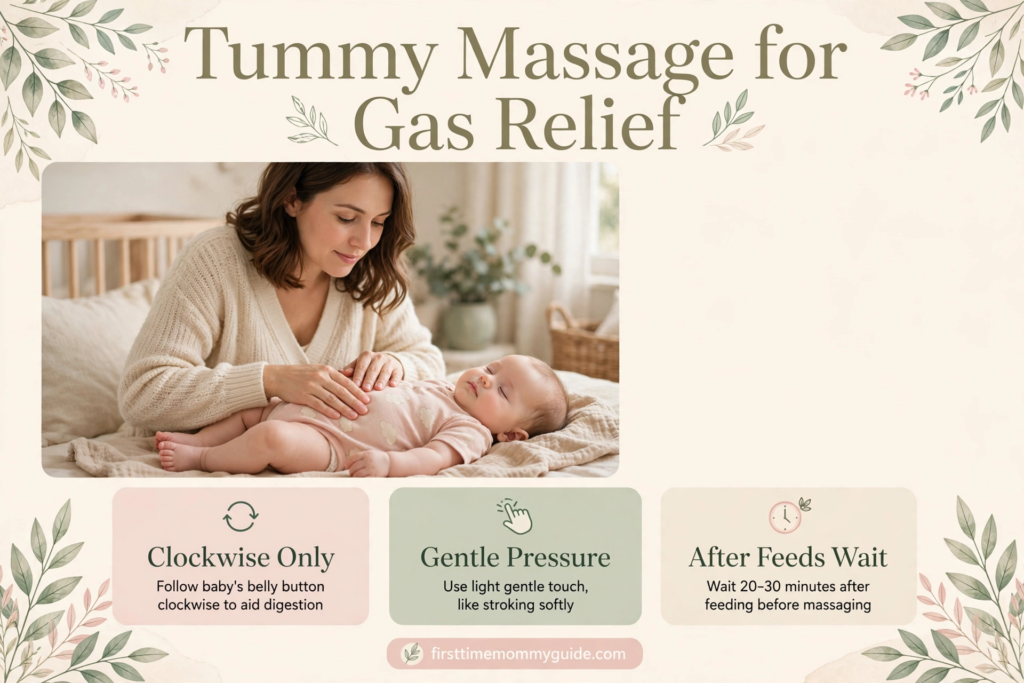
- Using the pads of your fingers, make gentle clockwise circles around the belly button. Clockwise is important, because it follows the direction of the large intestine and helps move gas along. Never massage the tummy in an anticlockwise direction.
- Try the “I Love U” stroke: trace the letter I down the left side of your baby’s tummy (your right as you face them), then an inverted L across the top and down, then an inverted U around the whole tummy. This sequence follows the path of the colon.
- Gently “walk” your fingertips across the tummy from one side to the other, like little footsteps.
- Finish by holding your hands still on the tummy for a few seconds.
Keep pressure light. Your baby’s tummy is soft, and deep pressure is not needed and not safe. If your baby has recently fed, skip tummy massage entirely. For more help with wind and digestive discomfort, see our guides to baby gas relief and burping techniques.
Step 3: Chest
Chest massage is gentle and soothing, and it can help your baby breathe more easily when they have a mild cold, though it does not replace medical care.
- Place both hands flat in the centre of your baby’s chest.
- Stroke outward toward the shoulders, then down and back to the centre, making a heart shape.
- Repeat slowly several times, keeping your touch light and rhythmic.
- You can also stroke from the centre of the chest outward to each side, like opening a book.
Keep your hands away from your baby’s neck and face during chest strokes, and stop if your baby seems uncomfortable.
Step 4: Arms and hands
Arms follow the same pattern as legs, and they are a good place to practise gentle, confident strokes.
- Hold one wrist gently, and stroke from the shoulder down to the wrist with the other hand, in a smooth gliding motion.
- Roll the arm gently between your palms from shoulder to wrist.
- Stroke the palm from wrist to fingers with your thumb, then gently roll each finger.
- Repeat on the other arm.
Some babies are ticklish on their hands and will pull away or giggle. That is fine. Keep the touch firm enough not to tickle. A light, feathery touch is more likely to tickle than a confident, smooth stroke.
Step 5: Face
Face massage is the most delicate part of the routine, and it should be done with clean hands and no oil, or only the smallest trace of oil.
- Place your fingertips gently on your baby’s forehead, and stroke outward toward the temples.
- Stroke gently over the eyebrows, from the centre outward.
- Using your fingertips, make tiny circles on the cheeks.
- Stroke from the nose outward across the cheeks, and gently around the mouth.
- Finish with a gentle stroke from the forehead down to the chin.
Keep face massage very light and very brief, especially at first. Some babies love it. Others prefer you to skip the face entirely, and that is fine. Never press on the soft spot (fontanelle) on the top of your baby’s head.
Step 6: Back
Back massage is wonderfully calming, and many babies relax deeply during it.
- Roll your baby gently onto their tummy, or hold them against your chest if they prefer. If your baby dislikes tummy time, skip back massage for now or do it while they lie across your lap.
- Place both hands flat on your baby’s back, and stroke from the neck down to the bottom, in long, smooth strokes.
- Make gentle circles with your fingertips on either side of the spine. Never press directly on the spine itself.
- Stroke from the spine outward to the sides, like smoothing out a sheet.
- Finish with long, slow strokes from neck to bottom, gradually slowing down.
If your baby is doing tummy time regularly, back massage pairs well with it, because both strengthen body awareness and comfort on the tummy.
Finishing the session
End every session the same way, so your baby learns the pattern. Slow your strokes down, hold your baby close, and talk softly to them. Dress them in a fresh nappy and sleepsuit, and give them a cuddle. Many parents find that massage flows naturally into a feed or a nap, and that is ideal. A calm baby after massage is a baby who is ready to rest.
Baby Massage for Gas, Colic, and Constipation
Tummy massage is the technique parents ask about most, because gas and colic cause so much distress. Here is how to use massage specifically for digestive comfort.
The gas-relief sequence
When your baby seems gassy, with a hard tummy, pulling legs up, or fussing after feeds, try this short sequence. It works best when your baby is calm, not in the middle of a crying episode.
- Bicycle legs: gently hold your baby’s legs and move them in a slow cycling motion. This is not strictly massage, but it pairs well with tummy strokes and helps move gas.
- Clockwise tummy circles: as described above, gentle circles around the belly button, always clockwise.
- The “I Love U” stroke: trace the colon path as described in the full routine.
- Gentle knee-to-tummy press: bring your baby’s knees gently toward their tummy, hold for a few seconds, and release. Repeat a few times if your baby tolerates it.
Do this for 5 to 10 minutes, once or twice a day, and watch for your baby’s response. If they pass wind or settle, the massage is helping. If they become more distressed, stop and try another soothing method.
What about constipation?
If your baby is constipated, the same tummy sequence may help, alongside the other measures in our guide to baby constipation signs and remedies. Massage does not replace feeding adjustments or medical advice. If your baby has not passed a stool for an unusual length of time, has hard stools, blood in the stool, or is feeding poorly, contact your doctor. Do not use laxatives or home remedies without medical advice.
A realistic word on colic
Colic is defined as crying for more than 3 hours a day, more than 3 days a week, for more than 3 weeks, in an otherwise healthy baby. It is exhausting and distressing for parents, and it is not caused by anything you did wrong. Massage may soothe a colicky baby for a time, and many parents find it helps, but it is not a cure. If crying is persistent, inconsolable, or accompanied by other symptoms such as fever, poor feeding, or vomiting, seek medical advice promptly. Our colic guide covers symptoms and soothing strategies in full.
Baby Massage for Sleep
Massage is a natural part of a bedtime routine, because it calms the nervous system and signals that rest is coming. Here is how to use it for sleep.
Keep the massage short and slow in the evening, about 10 minutes, with dim lights and a quiet room. Use the full routine if your baby enjoys it, or just legs, tummy, and back if time is short. Slow your strokes gradually toward the end, and keep talking to a minimum. After massage, dress your baby for bed and place them in their crib on their back, alone, with a firm flat mattress and nothing else in the sleep space.
Do not expect massage to produce instant sleep. Its value is in the routine. Over days and weeks, your baby learns that massage means bedtime is near, and that association helps them settle. Consistency matters more than any single technique.
Baby Massage for Teething Discomfort
Teething can make babies miserable, and while massage cannot cut a tooth, it can offer comfort. Gentle face and jaw strokes may help a baby who is drooling and chewing everything in sight. Stroke lightly along the jawline from the ears toward the chin, and make tiny circles on the cheeks. Keep it brief and gentle. If your baby pulls away, stop.
For the wider picture of teething, including safe pain relief options, see our guide to baby teething signs and remedies. Do not use teething gels or amber necklaces without checking with your doctor, as some products marketed for teething are not recommended.
How Often Should You Massage Your Baby?
Once or twice a day is plenty for most babies. A morning session can be energising and playful, while an evening session can be calming and sleep-focused. Some parents massage after bath time, when their baby is already warm and relaxed. Our guide to your newborn’s first bath pairs well with a post-bath massage routine.
There is no rule that says you must massage every day. If you miss a day, or a week, nothing is lost. Massage is a pleasure, not an obligation. The best frequency is the one that fits your life and that your baby enjoys. If massage becomes a chore, take a break. You can always return to it.
Safety Rules and When to Skip Massage
Massage is safe for most healthy babies, but there are times to skip it and situations where you should check with a doctor first.
Skip massage when your baby is:
- Unwell, feverish, or recovering from an illness or vaccination that has left them sore or distressed
- Crying inconsolably or clearly distressed
- Just fed, within about 30 to 45 minutes of a feed
- Very tired or overstimulated
- Has a rash, broken skin, or a skin infection in the area you would massage
- Has just had surgery or a medical procedure, until your doctor says it is safe
Check with your doctor first if your baby:
- Was born prematurely and is still under specialist care
- Has a medical condition affecting their bones, muscles, skin, or circulation
- Has eczema or another skin condition that might react to oil
- Has a heart condition or any condition affecting breathing
- Has any swelling, bruising, or unexplained marks
General safety rules
- Never press on the fontanelle (soft spot) on your baby’s head.
- Never massage directly over the spine with pressure. Stroke alongside it, not on it.
- Never pull or stretch your baby’s limbs forcefully. All movements should be gentle and within their natural range.
- Never use essential oils, scented products, or adult massage oils on a baby.
- Never leave your baby unattended on a raised surface during or after massage.
- Always wash your hands before massaging, and remove rings, watches, and bracelets that could scratch.
Common Mistakes to Avoid
New parents often make the same few mistakes when starting massage. They are easy to fix.
First, using too much pressure. Baby massage is gentle. Your strokes should be firm enough to feel, but light enough that your baby’s skin barely dents. If your baby stiffens or pulls away, you are probably pressing too hard or moving too fast.
Second, massaging at the wrong time. A hungry, tired, or just-fed baby will not enjoy massage, and a session that ends in tears can put you off trying again. Choose a calm, alert window between feeds.
Third, using the wrong oil or too much oil. A small amount is enough. Your hands should glide, not slide. Excess oil makes your baby slippery and hard to hold safely. If you have used too much, wipe the excess off with a towel.
Fourth, rushing. Massage works through rhythm and repetition. Slow down. Each stroke should take several seconds. If you find yourself speeding up, pause, take a breath, and reset.
Fifth, ignoring cues. The most common mistake is continuing when your baby has clearly had enough. A short session that ends happily is a success. A long session that ends in crying teaches your baby to dislike massage. Always follow your baby’s lead.
Building Massage Into Your Daily Routine
Massage works best when it becomes a habit, not a special occasion. Here are practical ways to fit it in.
Pair massage with something you already do. After bath time is the classic pairing, because your baby is warm, clean, and relaxed. After a nappy change is another good moment, when your baby is already undressed. Some parents massage in the morning, as a gentle way to start the day together.
Keep sessions short at first. Five minutes is a real session. As your baby grows and enjoys massage more, you can extend to 15 or 20 minutes. Let your baby’s response set the length, not the clock.
Involve your partner. Massage is a wonderful way for a partner to bond with the baby, especially if they are not the main feeding parent. Taking turns gives each parent their own special time with the baby, and it gives the other parent a break.
Keep a simple record if you like. Note which strokes your baby enjoys, which oils suit their skin, and what time of day works best. This is not required, but it helps you refine your routine over the first few months.
Key Takeaways
- Baby massage uses slow, gentle strokes to calm, comfort, and bond with your baby.
- Start in the first weeks, with short sessions, and build up as your baby gets used to it.
- Always massage clockwise on the tummy, following the direction of the colon.
- Use a plain, fragrance-free oil, warm your hands, and choose a calm moment between feeds.
- Read your baby’s cues: relaxed and gazing means continue; arching, stiffening, or crying means stop.
- Stop swaddling-style pressure rules do not apply here, but never press on the fontanelle or spine.
- Skip massage when your baby is unwell, just fed, distressed, or has broken skin.
- Massage supports sleep, digestion, and bonding, but it is not a medical treatment.
- Once or twice a day, for 10 to 20 minutes, is plenty. Short and happy beats long and tearful.
Frequently Asked Questions About Baby Massage Techniques
1. When can I start massaging my newborn?
You can start gentle massage in the first few weeks, once your baby is settled at home. Begin with short, 5-minute sessions and build up gradually. If your baby was premature, check with your care team first.
2. What is the best oil for baby massage?
A plain, fragrance-free, edible-grade oil such as sunflower oil is a good choice. Avoid mineral oil, olive oil, and nut oils unless your doctor advises otherwise, and avoid essential oils for babies under 3 months.
3. How long should a baby massage session last?
Start with 5 minutes and build to 10 to 20 minutes as your baby gets used to it. Let your baby’s cues set the length. A short, happy session is better than a long one that ends in tears.
4. Which direction should I massage my baby’s tummy?
Always clockwise, following the direction of the large intestine. Clockwise tummy strokes help move gas along. Never massage the tummy anticlockwise.
5. Can baby massage help with gas?
Yes, gentle clockwise tummy strokes, bicycle legs, and knee-to-tummy presses may help move gas and ease discomfort. Massage is not a cure for gas or colic, but many parents find it helps as part of a soothing routine.
6. Can baby massage help my baby sleep?
Massage can support sleep as part of a consistent bedtime routine, because it calms the nervous system and signals that rest is coming. It will not make a baby sleep through the night on its own.
7. Is it safe to massage my baby every day?
Yes, once or twice a day is fine for most healthy babies. There is no need to massage every day if it does not fit your routine. Massage is a pleasure, not an obligation.
8. What if my baby cries during massage?
Stop the massage and comfort your baby. Check hunger, nappy, temperature, and tiredness. Try again another time. Crying does not mean you did something wrong. It usually means your baby is not in the mood, or the timing was not right.
9. Should I massage my baby before or after a bath?
After a bath is ideal, because your baby is warm and relaxed. Bath time and massage pair naturally as part of a bedtime routine.
10. Can I massage my baby if they have eczema?
Check with your doctor first, and be cautious with oils. Some oils can irritate eczema-prone skin. Your doctor can advise on suitable products and whether massage is appropriate during a flare-up.
11. Is it safe to massage a premature baby?
Premature babies can benefit from gentle touch, but the timing, pressure, and technique should be tailored to their needs. Ask your neonatal team or paediatrician for guidance before starting.
12. What should I do if my baby has a rash?
Do not massage over a rash, broken skin, or infected area. Wait until the skin has healed, and check with your doctor if you are unsure about the cause of the rash.
13. Can my partner massage the baby too?
Absolutely. Massage is a wonderful bonding activity for any caregiver. Taking turns gives each parent special time with the baby and builds confidence in handling them.
14. Should I talk or sing during massage?
Yes, if it feels natural. Talking, singing, or simply narrating what you are doing adds to the bonding experience. Keep your voice calm and soft, especially during evening sessions.
15. What if my baby does not like massage?
Some babies take time to enjoy massage. Start with very short sessions, just legs or just back, and build up slowly. If your baby consistently dislikes it, do not force it. Try again in a few weeks, or focus on other forms of touch like cuddling and skin-to-skin contact.
16. Can massage help with teething pain?
Gentle face and jaw strokes may offer some comfort during teething, but massage cannot cut a tooth or replace appropriate pain relief. See our teething guide for safe options.
17. Is it okay to massage my baby’s head?
You can stroke your baby’s head very gently, but never press on the fontanelle, the soft spot on the top of the head. Keep head touch light and brief.
18. Should I use lotion instead of oil?
Oil is generally preferred for massage because it allows your hands to glide. Lotion absorbs quickly and can make strokes drag. If you use lotion, choose a plain, fragrance-free baby lotion, and check that your baby’s skin tolerates it.
19. When should I stop massaging my baby?
There is no set age to stop. Many parents massage their babies well into toddlerhood, adapting the routine as the child grows. Stop any individual session when your baby signals they have had enough.
20. Do I need to take a class to massage my baby?
No, a class is not required. This guide covers the basics safely. However, many parents enjoy a local infant massage class for hands-on practice and confidence. Your health visitor or local children’s centre may offer one.
Conclusion
Baby massage is one of the simplest, most rewarding things you can do with your baby. It needs no special equipment, no expensive products, and no training. Just warm hands, a little oil, a calm moment, and a willingness to follow your baby’s lead.
Start small. Learn the basic strokes: legs, tummy clockwise, chest, arms, face, and back. Watch your baby’s cues, and let them guide the session. Use massage to ease gas, to wind down before bed, and most of all, to spend quiet, focused time together.
Over weeks and months, those short sessions add up to something significant: a baby who trusts touch, a parent who feels confident, and a bond built one gentle stroke at a time. That is what baby massage is really about, and it is worth every minute.
This article is for general information only and is not a substitute for medical advice. If your baby has a medical condition, skin problem, or developmental concern, speak to your paediatrician or health visitor before starting a massage routine. For further reading, see the NHS guidance on baby care at nhs.uk and the American Academy of Pediatrics at healthychildren.org.

Dilawar Mughal
Founder and editor, First Time Mommy Guide
I research every guide against what the NHS, the AAP and the WHO publish, then write it in plain English — because most new parents are reading with one hand free, not comparing clinical guidelines. I'm not a doctor or a midwife. Every health claim on this site is sourced and linked so you can check it yourself, and anything urgent belongs with your health visitor or GP, not a blog.


