General information, not medical advice. Every baby is different — if anything worries you, speak to your midwife, health visitor or GP rather than waiting.
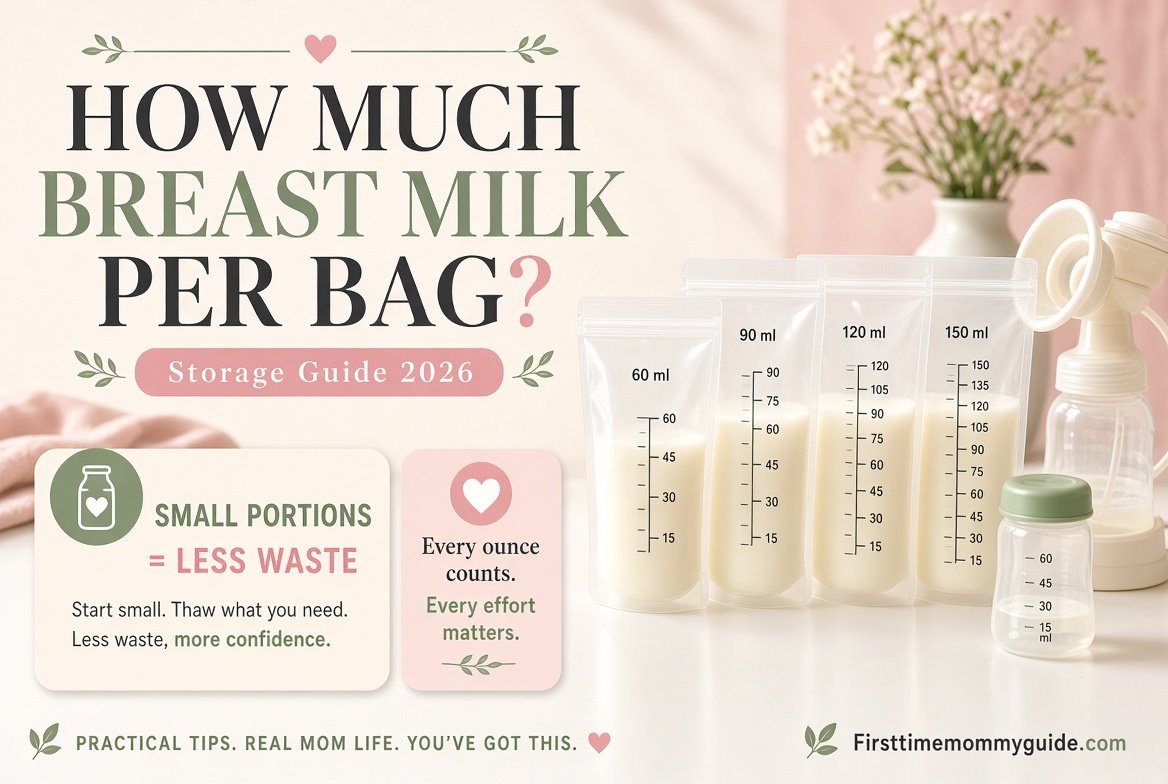
How much breast milk to put in each storage bag is one of the first questions pumping parents ask. The short answer is 2 to 4 ounces (60 to 120 mL) per bag, or the amount your baby usually drinks at one feeding.
Most bags can hold far more than that, often 5 to 8 ounces. But filling a bag to the top is rarely the smartest choice. Smaller portions thaw faster, waste less milk, and fit your baby’s real feeding needs.
Your best portion size depends on your baby’s age, appetite, and daily routine. It also depends on how you plan to use your freezer stash, whether for daycare, work, travel, or an occasional date night.
Table of Contents
How Much Breast Milk to Put in Each Storage Bag?
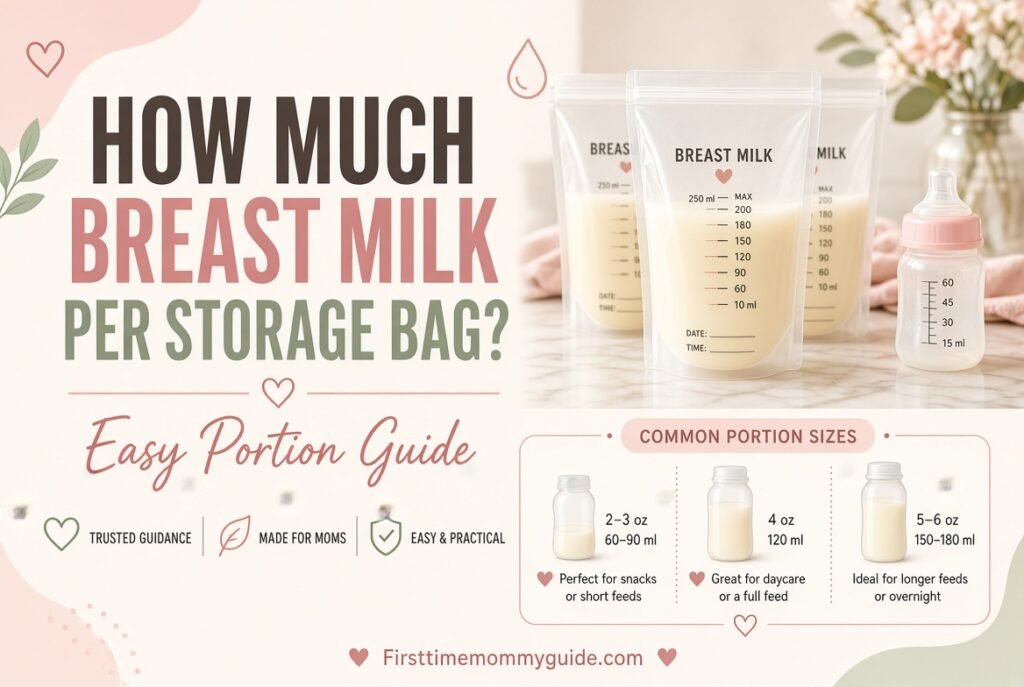
Store 2 to 4 ounces of breast milk per storage bag, or the amount your baby drinks in one feeding. Leave about one inch of empty space at the top for expansion. Never fill a bag to its maximum line.
This guidance matches CDC recommendations. The CDC advises storing small amounts to avoid wasting milk, using 2 to 4 ounces or whatever amount is offered at one feeding.
Lactation consultants often repeat the same advice. Northwestern Medicine and Nebraska Medicine both recommend freezing breast milk in small portions so little is wasted between thaws.
Key Takeaways
- Freeze 2 to 4 ounces per bag for most babies.
- Match the portion to what your baby drinks at one feeding.
- Leave one inch of headspace because breast milk expands as it freezes.
- Measure milk in a bottle first, since bag fill lines can be inaccurate.
- Label every bag with the date, amount, and baby’s name for daycare.
- Freeze bags flat, then stack them upright in a bin.
- Thaw the oldest milk first and never refreeze thawed milk.
- Keep a few 1 to 2 ounce “booster” bags for flexible feeds.
How Many Ounces of Breast Milk Per Storage Bag by Baby’s Age
Babies drink different amounts at different ages. A portion that works for a newborn will be too small for a six-month-old.
The table below shows common starting points. These are general ranges, not medical rules, so always follow your pediatrician’s advice on how much your baby needs.
| Baby’s Age | Typical Amount Per Feeding | Suggested Ounces Per Bag |
|---|---|---|
| Newborn to 2 weeks | About 1 to 2 oz (30 to 60 mL) | 1 to 2 oz |
| 2 weeks to 1 month | About 2 to 3 oz (60 to 90 mL) | 2 to 3 oz |
| 1 to 3 months | About 3 to 4 oz (90 to 120 mL) | 3 to 4 oz |
| 4 to 6 months | About 4 to 6 oz (120 to 180 mL) | 4 to 6 oz |
| 6 months and older | Varies with solid foods | 4 to 6 oz, plus 2 oz boosters |
Every baby is different. Some babies take smaller, more frequent feeds. Others take larger bottles less often.
Watch your own baby’s habits. The best portion is the one that gets finished without much leftover milk.
Why Newborns Need Smaller Portions
Newborn stomachs are tiny, so early feeds are small. A newborn may only take an ounce or two at a time.
If you freeze a large 5 ounce bag for a newborn, you will likely waste milk. Use 1 to 2 ounce bags during the first weeks instead.
Small bags are also useful if your baby is learning to take a bottle. You can warm a little milk, offer it, and save the rest.
Why Older Babies Need Larger Portions
As babies grow, they drink more per feeding. Many babies between 1 and 3 months settle into 3 to 4 ounce bottles.
Older babies who eat solid foods may drink less milk overall. Still, they often take 4 to 6 ounces per bottle.
Revisit your portion size every month or two. Your freezer stash should grow with your baby.
Why You Should Not Fill a Breast Milk Storage Bag to the Top
Most breast milk storage bags hold between 5 and 8 ounces. Some, like Milkies bags, hold up to 200 mL, which is a little more than 6.5 ounces.
It is tempting to use every inch of space. But a full bag causes real problems.
Breast Milk Expands When It Freezes
Liquid expands as it turns to ice. Breast milk is no exception.
The CDC recommends leaving about one inch of space at the top of the container. Without that room, a bag may split or burst at the seam.
A leaking bag means lost milk and a messy freezer. Extra headspace is a cheap way to prevent both.
Large Portions Create More Waste
Thawed breast milk cannot be refrozen. If you thaw a 6 ounce bag and your baby drinks 3 ounces, the leftovers are in trouble.
Leftover milk from a bottle your baby started must be used within 2 hours, according to the CDC. After that, it should be discarded.
Smaller bags let you thaw only what you need. You can always thaw a second bag if your baby is still hungry.
Full Bags Freeze Slowly and Take Longer to Thaw
A thick, overstuffed bag takes longer to freeze solid. It also takes longer to thaw.
Thin, flat bags with 2 to 4 ounces freeze quickly and thaw in minutes under warm water. That matters on a busy morning.
Faster thawing also means less time handling milk at risk of warming too much.
Fill Lines on Bags Can Be Inaccurate
Many brands print ounce markings on the bag. Some brands say these lines are only a guide.
For accurate measuring, pour milk into a bottle or the collection container from your pump kit first. Then pour it into the bag.
Nebraska Medicine lactation consultants recommend this same method for a more precise measurement.
How to Decide How Much Breast Milk to Store in a Bag
The right amount is not the same for every family. Use these steps to find your ideal portion size.
Step 1: Find Out How Much Your Baby Drinks Per Feeding
Watch a few bottle feeds over several days. Note how many ounces your baby takes each time.
If your baby is in daycare, ask the provider for the average amount per bottle. They usually track this.
Use that number as your base portion. If your baby drinks 3.5 ounces per feed, a 3 or 4 ounce bag is a good start.
Step 2: Choose a Main Portion Size
Pick one standard size for most of your bags. Many parents choose 4 ounces because it matches typical daycare bottles.
A consistent size keeps your freezer organized. It also makes counting your stash easy.
For example, if you have 40 bags at 4 ounces each, you know you have 160 ounces.
Step 3: Add Small Booster Bags
Keep some 1 to 2 ounce bags on hand. These let you adjust a feeding without thawing a whole new bag.
Say your baby wants 5 ounces. You can thaw one 4 ounce bag and one 1 ounce booster.
Parents in many pumping communities freeze in 2 and 3 ounce portions for this reason. They mix and match bags to build any bottle size.
Step 4: Adjust as Your Baby Grows
Your baby’s appetite changes quickly. A portion that fit at 8 weeks may be too small at 5 months.
Every few weeks, check how much your baby is finishing. If bottles come back empty, move up by half an ounce.
If milk keeps going to waste, move down. Small, steady changes keep your stash useful.
What Is the Best Amount of Breast Milk to Freeze in Each Bag?
There is no single perfect number. But a few amounts work well for most families.
| Portion | Best For | Pros | Cons |
|---|---|---|---|
| 1 to 2 oz | Newborns, small top-ups, bottle practice | Almost no waste, quick thaw | Uses more bags and freezer space |
| 2 to 3 oz | Young babies, mix-and-match feeds | Flexible, low waste | Needs two bags for some feeds |
| 3 to 4 oz | Most babies from 1 to 3 months | Matches many daycare bottles, easy to count | May be small for older babies |
| 4 to 6 oz | Babies 4 months and older | Fewer bags to thaw | More waste if baby drinks less |
| 6 oz and up | Donation or bulk stash building | Saves space | Higher waste, slower thaw, higher leak risk |
If you are unsure, start with 3 to 4 ounces. It is the most common middle ground and works for the widest range of babies.
Is 4 Ounces Too Much Breast Milk for One Bag?
Four ounces is not too much for a standard bag. It sits comfortably under the fill line on most brands.
It is a very popular size for babies over one month old. Many parents say it was the amount that “worked out perfectly.”
If your baby takes less than 4 ounces, switch to 2 or 3 ounce bags to cut waste.
Can You Put 6 or 8 Ounces of Breast Milk in One Bag?
Yes, many bags are designed to hold 6 ounces or more. But it is not always wise.
Larger portions make sense for older babies who drink bigger bottles. They also make sense if you are donating milk and a milk bank has specific rules.
For everyday feeding, smaller portions are safer for your wallet and your milk supply.
Can You Put Just 1 Ounce of Breast Milk in a Bag?
Absolutely. A 1 ounce bag is useful as a booster.
You can also use tiny portions for the very first milk you pump. Colostrum and early milk come in small amounts.
Just remember that small bags use more freezer space per ounce. Plan your storage accordingly.
How to Fill Breast Milk Storage Bags Step by Step
A good filling routine prevents leaks, spills, and wasted milk. It only takes a minute once you get used to it.
Follow these steps each time you store pumped milk.
Before You Start
- Wash your hands with soap and water for at least 20 seconds.
- If soap is unavailable, use an alcohol-based hand sanitizer with at least 60% alcohol, as the CDC advises.
- Check that your pump parts are clean and dry.
- Gather your bags, a permanent marker, and a measuring bottle.
Step-by-Step Filling Instructions
- Label the bag first. Write the date, the number of ounces, and your baby’s name. Labeling before filling is easier because a full bag is slippery.
- Measure the milk. Pour your pumped milk into a bottle and check the amount.
- Open the bag carefully. Pull the zipper apart without touching the inside of the bag.
- Pour slowly. Many bags stand up after 1 to 2 ounces. This frees both hands.
- Stop at your target amount. Do not go past the portion you chose, and never past the fill line.
- Press out the air. Squeeze from the bottom to the top, then seal the zipper fully.
- Check the seal. Run your finger along the zipper to make sure it is closed from end to end.
- Store it right away. Place the bag in the fridge, or lay it flat in the freezer.
Should You Cool Fresh Milk Before Filling the Bag?
Freshly pumped milk is warm. Putting warm milk straight into a freezer can raise the temperature around other stored bags.
A common approach is to chill freshly expressed milk in the refrigerator first. Then move it to the freezer in a labeled bag.
This keeps your frozen stash colder and more stable.
How to Freeze Breast Milk in Storage Bags
Freezing is the best way to build a stash for the future. A few simple habits protect both quality and safety.
Freeze Bags Flat
Lay each filled bag flat on a baking sheet or tray. Place the tray in the freezer.
Flat bags freeze quickly and evenly. They also stack neatly once frozen.
After the milk is solid, you can stand the bags upright like files in a bin.
Store Bags in the Back of the Freezer
Do not store breast milk in the door of the refrigerator or freezer. The CDC explains that storing milk further inside protects it from temperature changes when the door opens and closes.
A stable, cold spot at the back is best. A chest freezer or deep freezer is even better for long-term stash storage.
Use a Bin or Gallon Bag for Extra Protection
Many parents place frozen bags inside a larger labeled zip-top bag or plastic bin. This adds a second layer against leaks.
It also keeps your milk away from food smells. And it makes it easy to grab a day’s worth of milk at once.
A dedicated bin for breast milk keeps everything in one place.
Do Not Use Ordinary Plastic Bags
The CDC states that breast milk should never be stored in disposable bottle liners or plastic bags not intended for storing breast milk.
Regular sandwich bags are thin and may leak. They are not designed for milk.
Choose bags made for breast milk. Look for BPA-free, food-grade, pre-sterilized options with a double zipper.
Breast Milk Storage Guidelines: How Long Does Breast Milk Last?
Portion size is only half the story. You also need to know how long milk stays safe.
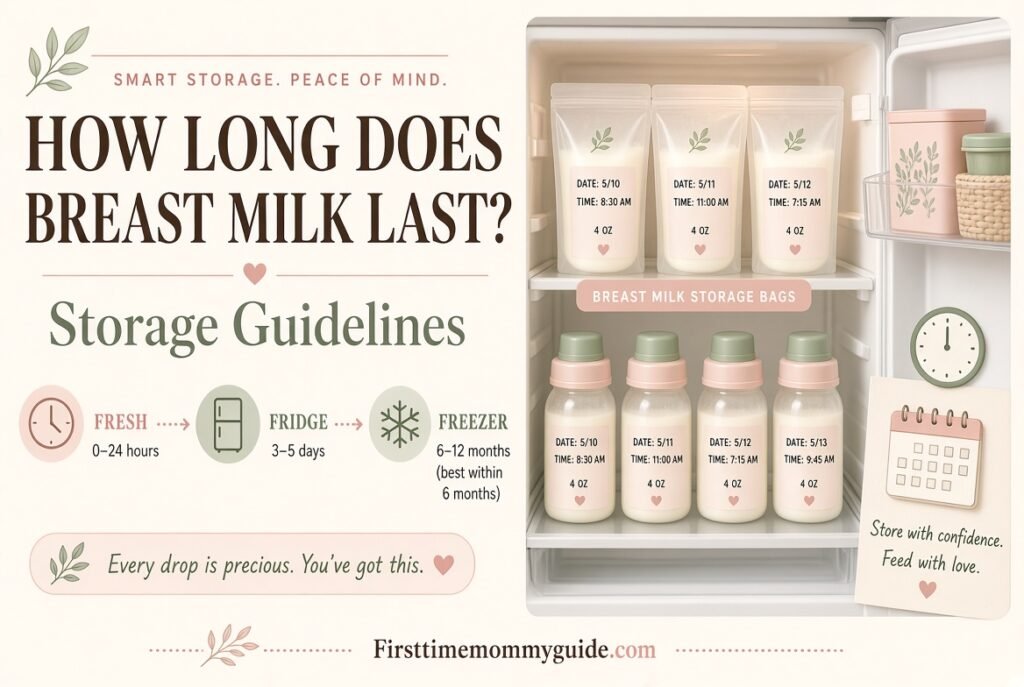
The CDC gives these guidelines for freshly expressed or pumped milk.
| Where Stored | Temperature | Best Time Limit |
|---|---|---|
| Countertop or room | 77°F (25°C) or colder | Up to 4 hours |
| Insulated cooler with frozen ice packs | Cold | Up to 24 hours |
| Refrigerator | 40°F (4°C) or colder | Up to 4 days |
| Freezer | 0°F (-18°C) | About 6 months is best, up to 12 months acceptable |
Freezing keeps food safe almost indefinitely. But the CDC notes that the recommended times matter for best quality.
Some hospitals and lactation programs use slightly different timelines. If your baby is premature or in the NICU, follow your hospital’s guidelines instead.
Freezer Type Can Change Storage Time
Nebraska Medicine lactation experts suggest a simple rule. If your freezer is attached to a refrigerator, use milk within about six months.
If you have a free-standing deep freezer, milk can last up to 12 months.
That is because fridge-top freezers warm slightly whenever the door opens.
First In, First Out
The CDC reminds parents to thaw the oldest milk first. Quality can decline over time.
Keep older bags at the front or on top of your bin. Place new bags behind or below them.
Labels with dates make this rotation simple.
How Much Breast Milk Can You Store in the Fridge?
Fridge storage is different from freezer storage. You do not need to worry about expansion.
Many parents store 4 to 6 ounces of fresh milk together in a bottle or bag in the fridge. That works well for daily bottle feeds.
If you will not use fresh milk within 4 days, freeze it right away. The CDC says this protects quality.
Can You Combine Milk From Different Pumping Sessions?
Yes. You can combine milk pumped on the same day.
Chill each batch first. Then mix the cooled milk together and portion it into bags.
Avoid pouring warm milk into already cold or frozen milk. The warm milk can partially thaw the cold milk.
Can You Add Fresh Milk to a Bag of Frozen Milk?
Many lactation consultants advise against adding fresh milk to a bag that is already frozen. The warmth can thaw part of the frozen milk.
Instead, store the new milk in its own bag. Or cool it fully first and add a smaller amount than what is already frozen.
The simplest rule is to keep each bag as a separate, clearly dated portion.
Should You Mix Milk From Different Days in One Bag?
It is best to keep dates clear. Mixing days makes it harder to track storage time.
If you must combine milk, label the bag with the date of the oldest milk. Use that bag first.
Most parents find it easier to keep one pumping day per bag group.
How to Thaw Breast Milk Stored in Bags
Safe thawing protects your baby and keeps the milk’s quality high. It is simple once you know the rules.
Safe Ways to Thaw Frozen Breast Milk
The CDC lists three safe options.
- In the refrigerator overnight. This is the gentlest method.
- In a bowl of warm or lukewarm water. Keep the bag sealed.
- Under lukewarm running water. This is the fastest method.
Small 2 to 4 ounce bags thaw quickly with these methods. A larger bag takes noticeably longer.
Never Microwave Breast Milk
The CDC says never to thaw or heat breast milk in a microwave. Microwaving can destroy nutrients and create hot spots that can burn a baby’s mouth.
Do not heat milk on the stove either. Warm water is the safest tool.
How Long Is Thawed Breast Milk Good For?
Use these time limits once milk has thawed.
| Situation | Time Limit |
|---|---|
| Thawed in the refrigerator | Use within 24 hours of being fully thawed |
| Brought to room temperature or warmed | Use within 2 hours |
| Leftover milk after a feeding | Use within 2 hours, then discard |
| Thawed milk | Never refreeze |
The CDC advises counting the 24 hours from the time the milk is completely thawed. Do not count from when you took it out of the freezer.
Why Thawed Milk Looks Different
Breast milk often separates into a creamy layer and a thinner layer. This is normal.
Gently swirl the bag or bottle to mix the fat back in. Do not shake it hard.
Thawed milk can also smell or taste a little different from fresh milk. That alone does not mean it is bad.
How to Warm Breast Milk Safely
Breast milk does not need to be warm. The CDC says it can be served at room temperature or cold.
If your baby prefers warm milk, follow these steps.
- Keep the bag or bottle sealed.
- Place it in a bowl of warm water, or hold it under warm, not hot, running water.
- Test a few drops on your wrist before feeding.
How Many Breast Milk Storage Bags Do You Need?
Knowing how many bags to buy saves money and stress. The answer depends on your pumping schedule and your goals.
Estimate How Many Bags You Need Per Day
Start with how many bottles your baby will need while you are away. Each bottle usually equals one bag.
If your baby takes three bottles during your workday, plan on three bags per day. Add a couple of boosters for flexibility.
Parents who return to work often pump at least as many times as their baby would feed.
A Simple Rule of Thumb for Work Days
A common lactation guideline is that babies drink about 1 to 1.5 ounces per hour of separation. This is a rule of thumb, not a medical standard.
Say you are away for 8 hours. Your baby may need around 8 to 12 ounces total.
Divide that by your bag size. With 4 ounce bags, that is about 2 to 3 bags.
How Many Bags Should You Buy for a Starter Stash?
Many parents start with a box of 25 to 50 bags. Then they restock as the freezer fills up.
A stash of 2 to 3 weeks of milk before returning to work gives most families peace of mind. It does not need to be huge.
Remember that you can also pump fresh milk each day at work. A big freezer stockpile is helpful but not required.
How to Build a Breast Milk Freezer Stash
A stash is a backup supply of frozen breast milk. It helps during work, travel, illness, or an unexpected night away.
You do not need to build one overnight.
Start Small and Stay Consistent
Add just one extra ounce or two each day. Small amounts add up quickly.
Pump after your first morning feed, when many parents have the most milk. Store that extra milk in labeled bags.
Over a few weeks, you will have a solid stash.
Pick a Good Time to Start
Many parents begin building a stash a few weeks before returning to work. Others wait until their supply is well established.
Talk to a lactation consultant if you are unsure. Pumping too much too early can cause oversupply for some people.
Listen to your body and your baby’s needs.
Track Your Stash
Keep a simple note on your phone or a sheet on the freezer. Record the number of bags and total ounces.
Update it when you add or remove milk. This helps you see when to pump more.
A tracked stash reduces surprises.
How to Label Breast Milk Storage Bags
Clear labels keep your stash organized and safe. They are especially important if someone else feeds your baby.
What to Write on Each Bag
- The date the milk was pumped
- The number of ounces in the bag
- Your baby’s full name (for daycare)
- The time, if you pump more than once a day
The CDC recommends clearly labeling milk with the date it was expressed. For childcare, it also advises adding the child’s name.
Best Pens and Labels
Use a permanent, waterproof marker. Regular ink can smear when the bag gets wet or frosty.
Many bags have a write-on panel. If yours does not, use freezer-safe labels or masking tape.
Write on the bag before you fill it. It is much easier on a flat, empty surface.
Use a Color Code System
Some parents use colored tape or markers to show the month. For example, blue for January and green for February.
At a glance, you can tell which bags are oldest. That makes “first in, first out” effortless.
It also helps partners and caregivers grab the right bag.
How Much Breast Milk to Put in Each Bag for Daycare
Daycare needs a slightly different approach. Providers want clear, ready-to-use portions.
Ask Your Provider About Their Rules
Every daycare has its own policies. Some accept only bottles. Others accept bags.
Ask about labeling, maximum bottle size, and how they handle leftovers. The CDC advises talking to your childcare provider about their requirements.
Follow these rules exactly to avoid rejected milk.
Pick a Portion That Matches Their Bottle Size
Look at how much your baby usually drinks at daycare. Freeze that amount, or slightly less.
For example, if your baby takes 3 ounces per bottle, send 3 ounce bags. Include one or two 1 ounce boosters.
This avoids waste and keeps feeds smooth.
Pack Milk Safely
Transport frozen or chilled milk in an insulated cooler bag with frozen ice packs. The CDC says milk can stay in an insulated cooler with frozen ice packs for up to 24 hours.
Label every bag clearly. Place them inside a leak-proof container or gallon bag.
Tell your provider to use the oldest milk first.
How Much Breast Milk to Store in a Bag When Pumping at Work
Pumping at work is easier with a simple system. Plan how you will collect, cool, and carry your milk.
Collect and Measure
Pump into the collection bottles that came with your pump. Check the ounces before you pour.
Many people pump 2 to 3 times during a workday. Each session may produce 3 to 6 ounces.
Your amounts will vary. That is normal.
Store Milk at Work
You can keep milk in an office fridge or in a small insulated cooler with ice packs. The CDC says freshly pumped milk is fine at room temperature up to 77°F for 4 hours.
When you can, move the milk to a refrigerator.
Keep it at the back, away from the door.
Bring Milk Home Safely
Use a cooler bag with ice packs for your commute. At home, put the milk in the fridge right away.
Use it for the next day’s bottles. Or freeze it in bags if you will not use it within 4 days.
This daily cycle is simple and efficient.
Can You Pump Directly Into Breast Milk Storage Bags?
Yes, but only with compatible equipment. Some pump brands offer adapters that attach bags directly to the flange.
This can save steps and reduce washing. It also lowers the chance of spills during transfer.
Pros and Cons of Pumping Into Bags
| Pros | Cons |
|---|---|
| Fewer bottles to wash | Harder to measure exact ounces |
| Less milk lost during pouring | Bags can tip or leak if not secure |
| Faster routine | Needs a compatible adapter |
| Good for travel | Fill lines may be less accurate |
If you pump into bags, check the amount carefully. The bag’s markings may be a rough guide.
Always label the bag before you start. Then seal it tightly and store it right away.
Breast Milk Storage Bags vs. Bottles vs. Containers
Bags are popular, but they are not your only option. Each choice has strengths.
| Container | Best For | Pros | Cons |
|---|---|---|---|
| Storage bags | Freezer stash, space saving | Flat storage, pre-sterilized, easy to label | Can leak, single use |
| Glass bottles | Fridge storage, repeat use | Reusable, easy to clean, no plastic | Heavy, can break, bulky in freezer |
| BPA-free plastic bottles | Pumping, daycare, fridge | Light, durable, ready to feed | Take more freezer room |
| Freezer trays or pods | Small portions, solids | Pre-portioned, stackable | Extra step to transfer to a bag |
The CDC says to use breast milk storage bags or clean, food-grade containers. They should be made of glass or plastic and have tight-fitting lids.
Many parents use bags for the freezer and bottles for the fridge. That combination balances space and convenience.
How to Choose the Best Breast Milk Storage Bags
Not all bags are equal. The right choice protects your milk and your time.
Features to Look For
- Double zipper seal. This lowers the chance of leaks.
- Thick, leak-resistant material. Look for strong seams and reinforced sides.
- BPA-free, food-grade plastic. This is a safety must.
- Pre-sterilized packaging. Bags should be sealed until opened.
- Clear measurement markings. Ounces and milliliters are both helpful.
- A write-on label area. This makes dates easy to record.
- Stand-up design. A bag that stands up is easier to fill.
Popular Breast Milk Storage Bag Brands
Several well-known brands sell storage bags in the United States. They include Lansinoh, Medela, Philips Avent, Kiinde, Milkies, Nanobébé, and Motif Medical.
Each brand differs in capacity, seal design, and price. Capacity usually falls between 5 and 8 ounces.
Check reviews and try a small box before buying in bulk.
Bag Size and Capacity
A standard bag usually holds about 6 ounces. Milkies bags hold up to 200 mL.
Since you only need 2 to 4 ounces per bag, any standard size works. You do not need to buy the largest option.
Choose based on seal quality, not just capacity.
Common Mistakes When Storing Breast Milk in Bags
Small errors can cause waste or safety problems. Avoid these common ones.
Overfilling the Bag
A full bag has no room to expand. It may burst in the freezer.
Always leave about one inch of space at the top. Stay below the fill line.
Skipping Labels
Unlabeled bags are a guessing game. You may toss good milk or use old milk by mistake.
Label every bag, every time. It takes seconds.
Leaving Air in the Bag
Trapped air takes up space and can lead to freezer odors. Press out as much air as you can before sealing.
Do not squeeze so hard that milk pushes out the top.
Storing Bags in the Freezer Door
The door warms every time you open it. That can partly thaw milk and shorten its life.
Store bags at the back where it stays coldest.
Refreezing Thawed Milk
The CDC says never to refreeze breast milk after it has thawed. Some lactation experts view this differently in specific cases.
For safety, follow the CDC rule. Thaw only what your baby needs.
Heating Milk in the Microwave
Microwaves create hot spots that can burn your baby. They can also reduce nutrients.
Use warm water instead.
Using Poor Quality Bags
Cheap, thin bags can tear or leak. A single leak can ruin hours of pumping.
Spend a little more on strong, reliable bags.
How to Prevent Leaks and Freezer Burn
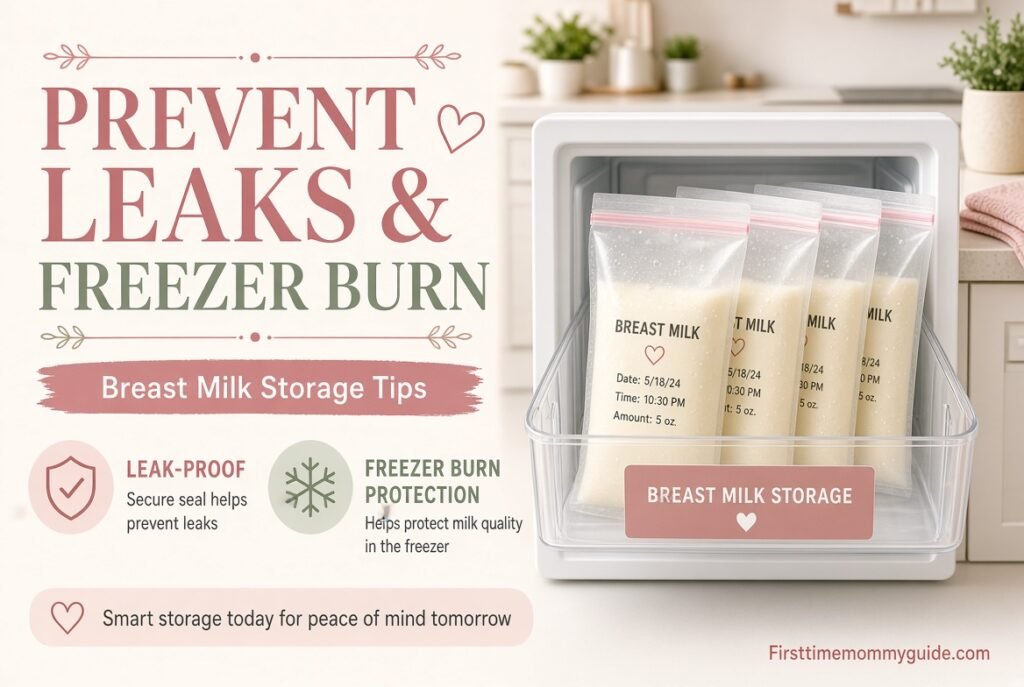
Leaks and freezer burn are two top frustrations. A few habits help.
Tips to Stop Leaks
- Press the zipper closed twice, from both directions.
- Check the seal before freezing.
- Do not overfill the bag.
- Freeze flat on a tray before stacking.
- Use a second outer bag or bin.
Tips to Reduce Freezer Odors and Freezer Burn
Remove excess air before sealing. Keep milk in a dedicated bin away from strong-smelling food.
Use milk within the recommended time. The longer milk sits, the more quality can change.
A stable freezer temperature also helps.
How to Tell if Breast Milk Has Gone Bad
Always trust your senses, but know that freshly thawed milk can look and smell different. Here is how to check.
Signs of Spoiled Milk
- A strong sour or rancid smell that does not fade
- Chunky or curdled texture that does not mix when swirled
- Milk that was stored past the recommended time
- Milk left out beyond the safe window
If you are unsure, discard it. A little lost milk is better than a sick baby.
What About a Soapy Smell?
Some milk smells soapy after freezing. This can happen when a natural enzyme called lipase breaks down fat.
The milk is usually safe, but some babies refuse it. If this happens, talk to a lactation consultant about options.
Test a small thawed sample before you build a large stash.
Special Situations: How Much Milk to Store in Each Bag
Not every family follows the standard path. These situations may call for different portions.
Premature or Sick Babies
Preterm babies and babies in the NICU often have different feeding and storage needs. Hospital teams usually provide specific guidelines.
The CDC notes that mothers of hospitalized infants should follow the hospital’s storage rules. Storage times may vary for preterm or sick babies.
Ask your care team before building a stash.
Twins and Multiples
With twins, you may need more milk per day. You can freeze in larger portions, like 4 to 5 ounces, if both babies drink similar amounts.
Or keep standard 3 to 4 ounce bags and thaw two at a time. Label each bag if the babies eat different amounts.
Exclusively Pumping Parents
Exclusive pumpers often store more milk, since every feed comes from a bottle. Many freeze in 4 to 6 ounce bags.
Rotating milk is easier when you cycle through it daily. Keep a clear date system.
Donating Breast Milk
Milk banks have strict rules about bags, labeling, and amounts. Some ask for specific ounces per bag.
Contact your milk bank before you freeze milk for donation. Follow their instructions exactly.
Low Milk Supply
If you pump small amounts, use 1 to 2 ounce bags. They help you track every drop.
Never feel discouraged by small numbers. Every ounce counts.
A lactation consultant can help with supply concerns.
Oversupply
If you make a lot of milk, your freezer can fill fast. Rotate milk often and set a goal for your stash.
Consider donating excess milk through an accredited milk bank. Ask your doctor or lactation consultant if oversupply is causing discomfort.
Traveling With Breast Milk Storage Bags
Travel adds planning, but it is manageable. Bring only what you need.
Packing Tips
- Use an insulated cooler with frozen ice packs.
- Pack small portions so you can thaw only what you need.
- Keep bags upright or flat, never crushed.
- Carry extra empty bags and a marker.
According to the CDC, milk can stay in an insulated cooler with frozen ice packs for up to 24 hours. At your destination, use it right away, refrigerate it, or freeze it.
Flying With Breast Milk
In the United States, the TSA allows breast milk in reasonable quantities for babies, even over 3.4 ounces. Tell the officer at the checkpoint that you have breast milk.
Rules can change, so check the TSA website before you fly.
Power Outages and Freezer Failures
A power cut can threaten your stash. Act quickly to protect it.
Keep the freezer closed as much as possible. A full freezer holds cold longer.
The CDC offers more details on what to do when the power goes out in its breastfeeding FAQ.
When in doubt, check the guidance from your doctor, lactation consultant, or the CDC before using milk.
Sample Breast Milk Portion Plans
Real examples make portion planning easier. Here are three common situations.
Example 1: A 2-Month-Old Going to Daycare
Your baby drinks about 3 to 4 ounces per bottle and takes three bottles during the day.
Freeze most bags at 3 ounces and a few at 4 ounces. Keep several 1 ounce boosters.
Each morning, send three bags plus one booster. Any bag left over stays frozen at home.
Example 2: A 5-Month-Old With Larger Feeds
Your baby now drinks 5 to 6 ounces per bottle. Stash bags of 4 ounces no longer fit well.
Switch to 5 or 6 ounce bags for new milk. Keep your older 4 ounce bags and combine them with 2 ounce boosters.
This avoids wasting your existing stash.
Example 3: A Newborn Practicing With a Bottle
Your newborn takes 1 to 2 ounces per feeding. You are only offering a bottle once a day.
Freeze 1 and 2 ounce bags. Thaw one at a time.
As your baby grows, you can gradually raise your bag size.
How to Mix and Match Bags for Any Feeding
Mixing bags is the secret to flexible feeding. It lets you hit any target amount.
| Feeding Amount Needed | Bag Combination |
|---|---|
| 2 oz | One 2 oz bag |
| 3 oz | One 3 oz bag |
| 4 oz | One 4 oz bag or two 2 oz bags |
| 5 oz | One 4 oz bag plus one 1 oz booster |
| 6 oz | One 4 oz bag plus one 2 oz bag |
| 7 oz | One 4 oz bag plus one 3 oz bag |
Thaw the oldest bags first when combining. Make sure all bags are completely thawed before mixing.
Do not mix milk of different temperatures. Bring both to the same cool or room temperature before combining.
How to Organize Your Freezer Stash
An organized freezer saves time when you are tired. A few small systems make a big difference.
Use Bins, Baskets, or Bag Organizers
Place a dedicated container in the freezer for breast milk. Stand flat-frozen bags upright like books.
Sort bins by portion size or by month. Label the front of the bin.
Try a Dispenser System
Some parents use a milk-storage organizer that holds bags in rows. It dispenses the oldest bag first.
It keeps rotation automatic. It is not required, but it is helpful.
Keep a Freezer Inventory
Tape a simple list to the freezer. Record each batch with the date and ounces.
Cross off bags as you use them. This avoids digging around.
Does Freezing Breast Milk Change Its Nutrition?
Parents often worry that freezing destroys the benefits of breast milk. Freezing does keep milk safe and useful.
The CDC says that storage time and temperature can affect quality, which is why recommended times matter. For the best quality, use milk within about six months.
What Happens to Frozen Milk
Fat may separate. Some immune components may decrease slightly over time. The milk still provides valuable nutrition.
Stored milk is far better than no milk. It also protects your baby when you cannot nurse.
Fresh vs. Frozen: Which Is Better?
Fresh milk is generally best when it is available. The sooner you feed expressed milk, the better, as lactation experts at Northwestern Medicine note.
But frozen milk is an excellent backup. Use fresh milk when you can and frozen milk when you must.
Pump and Bag Hygiene Basics
Clean habits protect your milk from germs. Contamination can happen at any step.
Before Pumping
Wash your hands well. Inspect your pump kit and tubing to make sure they are clean.
The CDC says to discard and replace moldy tubing immediately. If you use a shared pump, wipe the dials and countertop with a disinfectant wipe.
After Pumping
Wash pump parts that touch milk in hot, soapy water. Rinse and air-dry on a clean surface.
The CDC offers detailed instructions on cleaning, sanitizing, and storing infant feeding items and pump equipment. Follow them closely, especially for babies under three months old.
Handling Bags
Never reuse breast milk bags. They are designed for single use.
Do not touch the inside of a new bag. Open it just before filling.
Keep unused bags in their box in a clean, dry place.
Common Myths About Storing Breast Milk in Bags
A lot of advice online is misleading. Here are the facts.
Myth: You Must Fill the Bag Completely
Fact: Smaller portions are better for most families. They reduce waste and thaw faster.
Myth: Bigger Bags Save Space
Fact: A full bag can leak and is harder to stack. Flat, thin bags use space efficiently.
Myth: Frozen Breast Milk Is Unsafe After a Month
Fact: The CDC says freezer storage for about six months is best, and up to 12 months is acceptable.
Myth: You Can Reheat Leftover Milk Anytime
Fact: Milk left after a feeding must be used within 2 hours. After that, discard it.
Myth: Warm Milk Is Required
Fact: Breast milk can be served cold or at room temperature. Warming is a choice.
Expert Tips for Storing Breast Milk in Bags
These practical habits come from lactation professionals and experienced parents.
- Pump into a bottle first and pour into the bag for accuracy.
- Freeze 2 to 4 ounces so little is wasted between thaws, as Northwestern Medicine advises.
- Add 1 or 2 ounce booster bags to your stash for flexibility.
- Press all the air out, then double-check the zipper.
- Freeze bags flat, then stand them upright.
- Test a small amount of thawed milk before building a huge stash.
- Rotate milk by date, always using the oldest first.
- Keep an inventory list on or near your freezer.
- Ask a certified lactation consultant (IBCLC) if you have questions.
Breast Milk Storage Bag Checklist
Use this quick list each time you store milk.
- Wash your hands.
- Label the bag with the date, ounces, and your baby’s name.
- Measure the milk in a bottle.
- Pour 2 to 4 ounces, or your baby’s feeding amount.
- Leave one inch of headspace.
- Press out the air and seal fully.
- Freeze flat at the back of the freezer.
- Stack upright in a bin once frozen.
- Use the oldest milk first.
- Never microwave or refreeze.
Quick Reference: Breast Milk Storage Rules at a Glance
| Question | Answer |
|---|---|
| How much milk per bag? | 2 to 4 ounces, or one feeding |
| How much space to leave? | About one inch at the top |
| Room temperature time | Up to 4 hours at 77°F or colder |
| Fridge time | Up to 4 days |
| Freezer time | About 6 months best, up to 12 months acceptable |
| Thawed in fridge | Use within 24 hours |
| After warming | Use within 2 hours |
| Leftovers after feeding | Use within 2 hours, then discard |
| Refreeze thawed milk? | No |
| Microwave? | Never |
How to Portion Milk After a Pumping Session
Pumping output changes from session to session. Your morning session may give 6 ounces, while an afternoon session gives 3.
Portioning smartly keeps every ounce useful. Use these examples as a guide.
| Ounces Pumped | Suggested Bag Split |
|---|---|
| 2 oz | One 2 oz bag |
| 3 oz | One 3 oz bag |
| 4 oz | One 4 oz bag |
| 5 oz | One 3 oz bag plus one 2 oz bag |
| 6 oz | One 4 oz bag plus one 2 oz bag |
| 7 oz | One 4 oz bag plus one 3 oz bag |
| 8 oz | Two 4 oz bags |
| 9 oz | One 4 oz, one 3 oz, and one 2 oz bag |
If you have a small leftover amount, such as half an ounce, add it to the fridge bottle you will use tomorrow. Do not pour it into a frozen bag.
This approach keeps your stash tidy and wastes almost nothing.
What to Do if Your Baby Refuses Frozen Breast Milk
Some babies turn their heads at thawed milk. Taste, smell, or temperature may be the reason.
Do not panic. There are simple things to try.
Check the Smell and Taste
Thaw a small amount and smell it. A soapy or metallic smell may come from lipase activity.
If the milk is safe but tastes different, mix it with a small amount of fresh milk in the same bottle. Use it within the safe time window.
A lactation consultant can suggest methods that fit your situation.
Test Before You Build a Large Stash
Freeze a small bag early on. Thaw it after a few days and see how your baby reacts.
This simple test can save you from filling a freezer with milk your baby will not drink.
Try a Different Temperature
Some babies prefer milk at room temperature. Others like it slightly warm.
The CDC notes that milk does not need to be warmed. Offer it a different way and see what works.
How Much Money Do You Save by Portioning Correctly?
Pumped milk takes time and effort. Every wasted ounce is a lost feeding.
Imagine you thaw a 6 ounce bag, but your baby drinks only 3 ounces. After 2 hours, the remaining 3 ounces must be discarded.
If this happens often, you can lose a large amount of milk over weeks. Smaller bags protect your hard work.
The cost of extra bags is small compared to the value of the milk.
Using Frozen Breast Milk for Older Babies and Toddlers
As your baby grows, your use of stored milk will change. Many families keep using frozen milk well beyond the first six months.
Mixing Milk Into Solid Foods
After your pediatrician says your baby is ready for solids, you can mix thawed breast milk into purees or cereals. Small 1 to 2 ounce bags are ideal for this.
Always use thawed milk within the safe time limits. Do not refreeze it.
Keeping Your Stash Fresh
Older stored milk may lose some quality. Use the oldest bags first and plan to finish them before the 6 to 12 month window ends.
If you stop pumping, consider whether a milk bank could use any extra milk. Check their requirements first.
When to Ask a Professional About Breast Milk Storage
Most storage questions have simple answers. But some situations need expert guidance.
Contact your pediatrician or a certified lactation consultant (IBCLC) if any of these apply.
- Your baby was born early or has a medical condition.
- Your baby seems sick after feeding stored milk.
- You have trouble keeping up your milk supply.
- You are unsure whether milk is still safe to use.
- You plan to donate milk and need to meet bank rules.
Hospitals, WIC offices, and local breastfeeding support groups can also help. Do not hesitate to ask.
Trusted Sources for Breast Milk Storage Guidelines
For the most reliable information, use trusted health organizations.
- The CDC provides storage and preparation guidelines for breast milk, including a printable chart.
- The Academy of Breastfeeding Medicine publishes Clinical Protocol #8 on human milk storage for home use for full-term infants.
- Hospital lactation programs, such as those at Northwestern Medicine and Nebraska Medicine, share practical tips from IBCLC consultants.
- The American Academy of Pediatrics offers guidance on infant feeding.
- The USDA provides general information on freezing and food safety.
Guidelines can change. Check these sources from time to time to stay up to date.
Frequently Asked Questions (FAQs)
How much breast milk should I put in each storage bag?
Put 2 to 4 ounces (60 to 120 mL) in each bag, or the amount your baby drinks at one feeding. This is the CDC’s guidance for freezing milk.
Smaller portions reduce waste because thawed milk cannot be refrozen.
How many ounces of breast milk can a storage bag hold?
Most storage bags hold about 5 to 8 ounces. Some brands, like Milkies, hold up to 200 mL, which is a little more than 6.5 ounces.
Just because a bag can hold that much does not mean you should fill it. Leave room for expansion.
Is it okay to put 4 ounces of breast milk in a bag?
Yes. Four ounces is a very common portion, especially for babies over one month old.
It fits comfortably in standard bags and matches many daycare bottle sizes. If your baby drinks less, switch to 2 or 3 ounces.
Is it okay to put 6 ounces of breast milk in a bag?
Yes, if your baby drinks that much at one feeding. Older babies often take 5 to 6 ounces per bottle.
For younger babies, 6 ounces is likely too much and can lead to wasted milk.
How much space should I leave at the top of a breast milk storage bag?
Leave about one inch of empty space at the top. Breast milk expands as it freezes, and extra room helps prevent the bag from splitting.
Avoid filling past the maximum line on the bag.
Should I freeze breast milk in small or large portions?
Most experts recommend small portions of 2 to 4 ounces. They thaw quickly and let you use only what your baby needs.
Large portions make sense mainly for older babies or milk-bank donation. Always follow your milk bank’s rules.
Can I put different pumping sessions together in one bag?
You can combine milk from the same day once each batch is chilled. Do not pour warm milk into cold or frozen milk.
Label the bag with the date of the oldest milk so you can track storage time.
Can I add fresh breast milk to frozen milk in a bag?
It is best not to. Fresh milk can partly thaw the frozen milk below it.
Store the fresh milk in a separate bag, or cool it fully first and add a smaller amount than what is already frozen.
How long can breast milk stay in a storage bag in the freezer?
The CDC says about 6 months is best and up to 12 months is acceptable. Freezer type matters, too.
Milk in a freezer attached to a refrigerator should be used sooner, while a deep freezer holds quality longer.
How long can breast milk stay in a storage bag in the fridge?
Freshly expressed breast milk can stay in the refrigerator for up to 4 days. Keep it at the back of the fridge, not in the door.
If you will not use it within 4 days, freeze it right away.
How long can breast milk sit out in a bag at room temperature?
Freshly expressed milk can sit at room temperature, 77°F or colder, for up to 4 hours. After that, refrigerate or discard it.
In hot rooms, use the shorter end of the window or chill the milk sooner.
Do I need to measure milk before pouring it into the bag?
Measuring first gives you the most accurate amount. Bag fill lines are often only a guide.
Pour milk into a bottle, check the ounces, and then transfer it into a labeled bag.
Should I freeze breast milk bags flat or standing up?
Freeze them flat first. Flat bags freeze faster, take up less space, and stack neatly.
After they are frozen solid, you can stand them upright in a bin like files.
How do I thaw a bag of frozen breast milk?
Place the bag in the refrigerator overnight, in a bowl of warm water, or under lukewarm running water. Keep it sealed.
Never microwave it. The CDC warns that microwaving can destroy nutrients and create dangerous hot spots.
How long is thawed breast milk good for?
If thawed in the fridge, use it within 24 hours of being completely thawed. Once it reaches room temperature or is warmed, use it within 2 hours.
Never refreeze thawed milk.
Can I refreeze breast milk that has thawed?
The CDC says never to refreeze breast milk after it has thawed. Some lactation experts take a more flexible view, but the CDC rule is the safest standard.
This is another reason to freeze in small portions.
What should I do with leftover milk after a feeding?
If your baby does not finish a bottle, use the leftover milk within 2 hours. After 2 hours, discard it.
Saliva from the baby’s mouth can introduce bacteria, so leftovers are not stored again.
Why does my frozen breast milk look separated?
Separation is normal. Fat rises to the top and a thinner layer settles below.
Gently swirl the bag or bottle to mix it. Avoid shaking hard.
Why does my thawed breast milk smell soapy?
Some milk smells soapy because of an enzyme called lipase that breaks down fat. The milk is usually safe but some babies dislike the taste.
Talk to a lactation consultant if your baby refuses it.
How many bags of breast milk should I store per day?
It depends on how many bottles your baby needs while you are away. If your baby takes three bottles, plan on three bags plus one or two boosters.
Many parents estimate that babies drink about 1 to 1.5 ounces per hour of separation.
How much breast milk should I have stored before going back to work?
Many parents aim for about 2 to 3 weeks of milk, but it is not required. You can also pump fresh milk at work and use it the next day.
A stash is a safety net, not a strict rule.
Can I pump directly into a breast milk storage bag?
Yes, if your pump has a compatible adapter. It saves a step and reduces transfer spills.
Check the amount carefully since bag markings may be less precise than bottle markings.
Can I use regular freezer bags for breast milk?
No. The CDC says never to store breast milk in plastic bags not intended for storing breast milk.
Use bags designed for milk. They are sterile, BPA-free, and made to hold up in the freezer.
Can I reuse breast milk storage bags?
No. Breast milk bags are designed for single use. Reusing them risks contamination and leaks.
For reusable options, choose glass or BPA-free plastic bottles with tight lids.
Are glass bottles better than storage bags?
Glass bottles are reusable and easy to clean, but they are heavier and take more freezer space. Bags save room and come pre-sterilized.
The CDC accepts either option as long as the container is clean, food-grade, and sealed.
What should I write on breast milk storage bags?
Write the date pumped, the number of ounces, and your baby’s name if the milk goes to daycare. Adding the time is helpful if you pump multiple times a day.
Use a permanent marker or freezer-safe label.
Where is the best place to store breast milk in the freezer?
Store bags at the back of the freezer, never in the door. The CDC says this protects milk from temperature swings.
A deep or chest freezer is even better for long-term storage.
How should I store breast milk for daycare?
Use labeled bags with your baby’s name, the date, and the amount. Send portions that match your baby’s usual bottle size.
Keep milk cold in an insulated cooler with frozen ice packs, which the CDC says is safe for up to 24 hours.
Can I travel with breast milk in storage bags?
Yes. Use an insulated cooler with frozen ice packs and label each bag clearly. The CDC says milk can stay cold this way for up to 24 hours.
At your destination, use it right away, refrigerate it, or freeze it.
Can I take breast milk through airport security?
In the United States, the TSA allows breast milk in reasonable quantities for a baby, even if it exceeds 3.4 ounces. Tell the officer at the start of screening.
Check the TSA website before you fly since rules can change.
What is the best bag size for breast milk storage?
Standard bags that hold about 6 ounces work for most families. You will usually fill them with only 2 to 4 ounces.
Pick bags for seal strength and leak resistance, not just capacity.
How do I know if breast milk has gone bad?
Spoiled milk often has a strong sour or rancid smell and a curdled texture that does not mix when swirled. Milk stored too long or left out too long should be discarded.
When in doubt, throw it out.
When should I talk to a lactation consultant about storing breast milk?
Talk to an IBCLC if you have supply concerns, a premature baby, or trouble with milk that your baby refuses. They can also help with stash planning and pumping schedules.
Your pediatrician is the best source for how much milk your baby needs.
Conclusion
How much breast milk to put in each storage bag comes down to one simple rule: store 2 to 4 ounces, or the amount your baby drinks at a single feeding. That portion size reduces waste, thaws quickly, and keeps your freezer organized.
Always leave about one inch of headspace, measure milk in a bottle first, and label every bag with the date and amount. Freeze bags flat at the back of the freezer, and use the oldest milk first.
Follow the CDC timelines: up to 4 hours at room temperature, up to 4 days in the fridge, and about 6 months in the freezer for best quality. Thaw milk safely, never microwave it, and never refreeze it.
Add a few 1 to 2 ounce booster bags so you can build any bottle size. Adjust your portions as your baby grows.
With these habits, every bag you fill becomes a safe, ready-to-use feeding. And your stash will give you the confidence and flexibility to care for your baby on any schedule.

Dilawar Mughal
Founder and editor, First Time Mommy Guide
I research every guide against what the NHS, the AAP and the WHO publish, then write it in plain English — because most new parents are reading with one hand free, not comparing clinical guidelines. I'm not a doctor or a midwife. Every health claim on this site is sourced and linked so you can check it yourself, and anything urgent belongs with your health visitor or GP, not a blog.