General information, not medical advice. Every baby is different — if anything worries you, speak to your midwife, health visitor or GP rather than waiting.
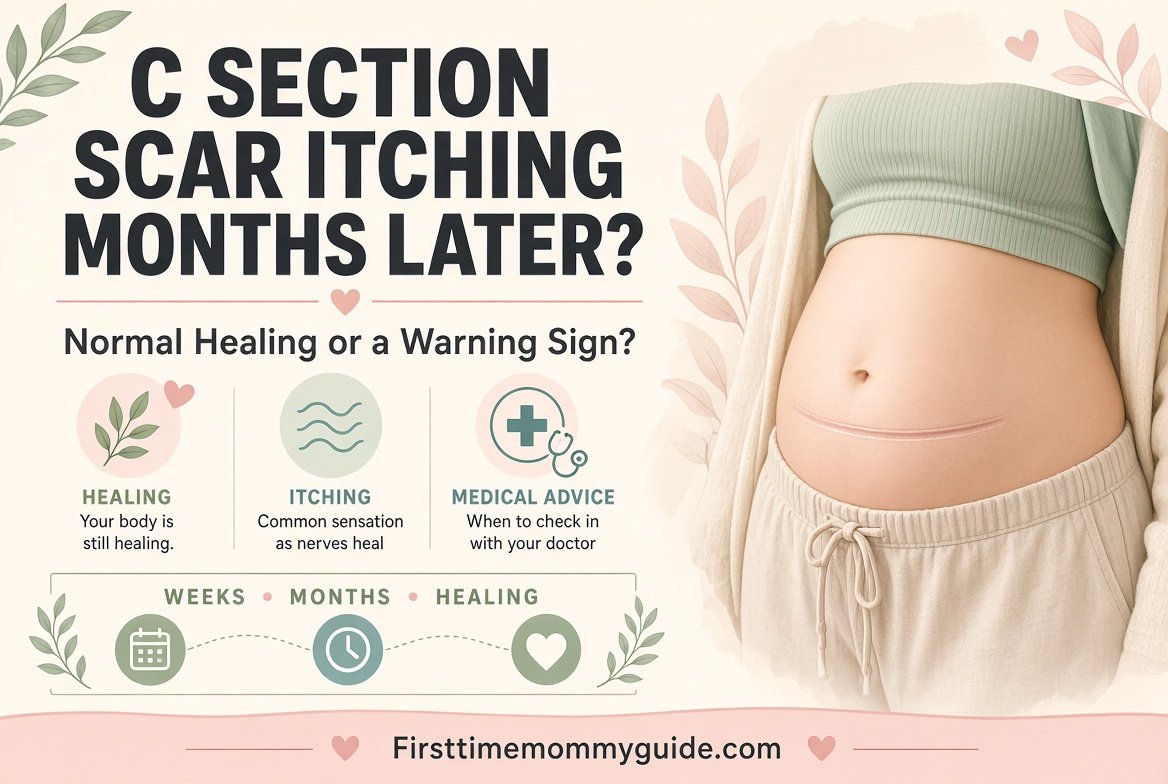
C Section Scar Itching Months Later Is It Normal? In many cases, yes. Itching around a cesarean incision can continue for months after delivery as the skin and underlying nerves heal. The sensation may result from nerve regeneration, scar tissue formation, dry skin, or changes in sensitivity around the incision.
The duration and intensity of itching vary from person to person, depending on the healing process and individual skin sensitivity.
However, persistent or worsening itching accompanied by redness, swelling, warmth, discharge, increasing pain, or a new lump may indicate a problem that needs medical evaluation.
Table of Contents
C Section Scar Itching Months Later Is It Normal?
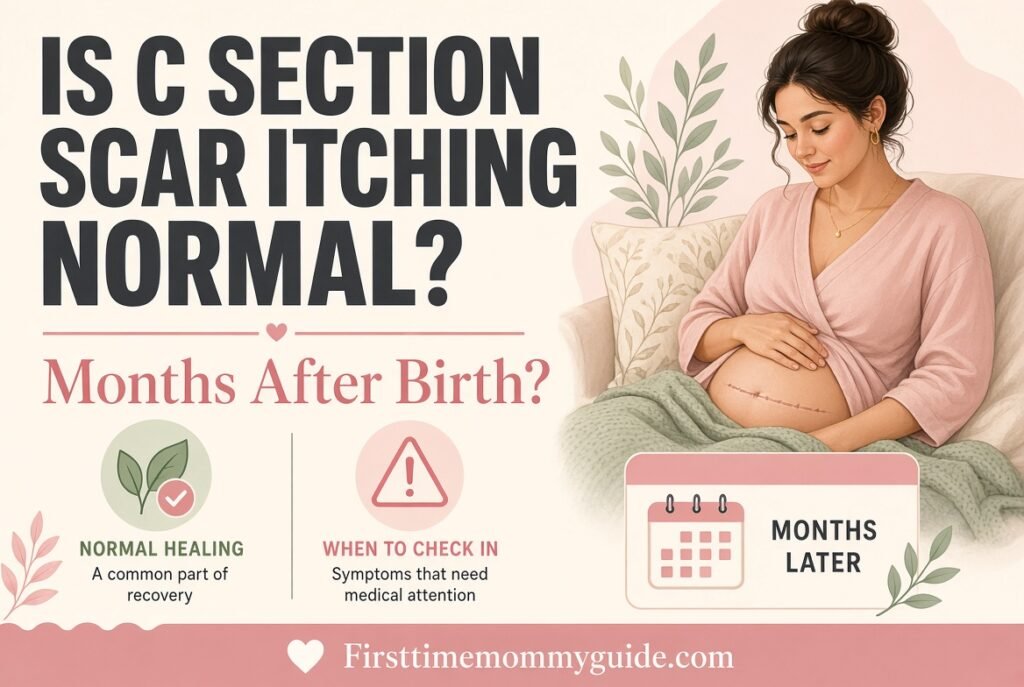
Yes, itching at the 3-month, 6-month, and even 12-month mark is common. Nerves that were cut during surgery regrow slowly, and the scar keeps remodeling for many months.
It is a concern when the itch is severe, keeps getting worse, or comes with other symptoms. Think of the itch as a signal to look closely at the scar, not as proof that something is wrong.
Usually normal:
- Mild to moderate itching that comes and goes
- Tingling, pins and needles, or small zaps near the scar
- Numb or oddly sensitive skin above or around the scar
- A pink, purple, brown, or slightly firm scar that is slowly softening
- Itching that is worse when skin is dry, hot, or rubbed by clothing
Needs a doctor’s visit:
- Redness that spreads, warmth, swelling, or pus
- Fever or chills
- A scar that opens, leaks, or bleeds
- A new bulge near the scar, especially when you cough or strain
- A raised scar that keeps growing or becomes painful
- Severe itching that disrupts sleep or daily life
How a C Section Scar Heals Month by Month
Understanding the healing timeline makes late itching far less alarming. Scars do not heal in a straight line. They move through overlapping stages, and each stage can feel different.
The visible incision closes in the first few weeks. Below the surface, the body keeps rebuilding collagen, forming new blood vessels, and reconnecting nerves for much longer.
The Four Overlapping Stages of Scar Healing
| Stage | Typical Timing | What Happens | How It May Feel |
|---|---|---|---|
| Inflammation | First days to about 1 week | Body cleans the wound and starts repair | Soreness, swelling, tenderness |
| Proliferation | About 1 to 6 weeks | New tissue and collagen fill the wound | Tightness, early itching, pulling |
| Early remodeling | About 6 weeks to 3 months | Scar is strong but still red or dark and firm | Itching, tingling, sensitivity |
| Late remodeling | About 3 to 12 months, sometimes up to 18 months | Collagen reorganizes, scar flattens and fades | Occasional itching, numbness, fading sensitivity |
Many sources describe the remodeling phase as lasting from about six weeks to as long as 18 months. That is why itching can still show up long after your six-week checkup.
Why the Itch Often Starts After the Wound Looks Healed
The skin surface closes first, but the deeper tissue is still maturing. Nerves are among the slowest parts to recover.
So a scar can look calm and still feel itchy, tingly, or tight. This mismatch surprises many new moms, but it is a well-known pattern.
Why Does My C Section Scar Itch Months After Delivery?
There is rarely a single cause. Most late itching comes from a mix of nerve healing, skin changes, and everyday irritation.
Knowing the likely cause helps you pick the right fix. A dry-skin itch needs moisture, while a nerve itch needs patience and gentle desensitizing.
Nerve Regeneration
A cesarean cuts small skin nerves along with the tissue. As those nerves regrow, they can fire unevenly.
Your brain may read those mixed signals as itching, tingling, or burning. This is one of the most common reasons for itching months later.
Nerve regrowth is slow. It can take many months, and some people notice odd sensations for a year or more.
Inflammation and Histamine Release
Healing tissue releases chemicals, including histamine, that irritate nearby nerve endings. This triggers the urge to scratch.
The effect is strongest early on, but low-level inflammation can linger in a maturing scar. That is why the itch often fades slowly rather than stopping suddenly.
Dry Skin Around the Scar
Scar skin has fewer working oil glands than normal skin. It loses moisture more easily and can feel tight and itchy.
Cold weather, hot showers, harsh soap, and fragrance can make dryness worse. Breastfeeding and postpartum hormone shifts can also leave skin drier than usual.
Scar Tissue Tension and Remodeling
As collagen reorganizes, the scar contracts and pulls on the skin around it. This tension can stimulate nerve endings and cause itching or a pulling feeling.
Stretching, bending, and lifting can make the sensation more noticeable. Gentle massage and movement often help.
Friction From Clothing
Waistbands, tight leggings, and rough seams rub directly on a low-lying scar. Constant friction irritates the skin and can keep the itch going.
Synthetic fabrics trap heat and sweat. That makes the area itchier, especially in warm weather.
Heat, Sweat, and Skin Folds
A scar that sits in a skin fold stays warm and damp. Moisture and friction together can cause irritation or yeast overgrowth, which itches strongly.
This is more common when there is a fold of skin over the scar, often called a C-section shelf.
Abnormal Scar Formation
Some scars grow thicker than normal. Hypertrophic and keloid scars contain extra collagen and nerve fibers, and they are more likely to itch.
If your scar is raised, thick, or expanding, this section applies to you. We cover it in detail below.
C Section Scar Itching at 3 Months, 4 Months, 6 Months, and 1 Year
The same symptom means slightly different things at different points in recovery. Here is how to read it.
C Section Scar Itching 3 Months After Delivery
At three months, the scar is usually still pink, red, purple, or darker than your skin. It may feel firm or ridged.
Itching, tingling, and tightness are very common now. This is the middle of the remodeling phase, so some itch is expected.
C Section Scar Itching 4 Months After Delivery
By four months, many scars begin to soften. Itching often becomes more occasional, but nerve-related zings can still appear.
If the itch is getting stronger instead of weaker, take a closer look at the scar. Check for thickening, new redness, or a rash.
C Section Scar Itching 6 Months After Delivery
Six months is a common point for people to worry. The incision looks healed, so persistent itching feels strange.
It is still within the normal range. Many scars continue to flatten and fade through the second half of the first year.
C Section Scar Itching 9 to 12 Months After Delivery
Itching at nine months to a year is less common, but it still happens. Dryness, clothing friction, and nerve changes are the usual causes.
A scar that is still very itchy, raised, or painful at this stage deserves a check. It may need silicone therapy, physical therapy, or another treatment.
C Section Scar Itching After a Year or Longer
Occasional itching after a year can still be part of normal nerve and scar behavior. Some people notice it when the weather changes or when the scar is stretched.
Constant or worsening itching years later is different. A clinician should look at it to rule out nerve entrapment, adhesions, abnormal scarring, or a skin condition.
How Long Does C Section Scar Itching Last?
For many women, the itch fades within a few weeks to several months. For others, it comes and goes for a year or more.
There is no single deadline. The better question is whether the itch is trending down over time.
Factors That Change How Long the Itch Lasts
- Skin type and genetics: Some people scar thicker than others
- Incision type: Deeper or longer incisions affect more nerves
- Wound healing: Infection or delayed healing can prolong remodeling
- Skin dryness and care routine: Moisturizing shortens irritation
- Tension on the scar: Weight changes, coughing, and heavy lifting add strain
- Previous scars: Repeat cesareans can change how the scar behaves
A Realistic Expectation
Think in phases. Itching is often strongest in the first few months, then becomes occasional, then fades into a rare twinge.
If you notice a clear downward trend, you are likely on track. If the pattern is flat or rising, it is worth asking your provider about it.
C Section Scar Itching and Tingling
Tingling is one of the most common companions of scar itching. Many moms describe it as pins and needles, buzzing, or tiny electric zaps.
This feeling usually points to nerve regrowth. The nerves are waking up, but their signals are still noisy.
What Tingling Usually Means
Mild tingling that comes and goes is typically part of normal nerve recovery. It may show up when you stretch, change position, or touch the area.
It often appears alongside numb patches. As feeling returns, the in-between stage can feel strange.
What Can Make Tingling Stronger
- Tight waistbands pressing on the scar
- Long periods of sitting or slouching
- Cold air or sudden temperature changes
- Stress and poor sleep, which turn up sensitivity
When Tingling Needs Attention
See your provider if tingling spreads down the thigh, becomes sharp or burning, or limits movement. Those patterns can point to nerve irritation or entrapment, which may respond well to targeted treatment.
C Section Scar Itching and Numbness
Numbness above or around the scar is very common after a cesarean. Many women notice a numb strip of skin just above the incision.
Itching in or near a numb area sounds contradictory, but it makes sense. Damaged nerves can send mixed or distorted signals while they regrow.
Why the Skin Can Feel Numb and Itchy at the Same Time
Surgery can cut or stretch small sensory nerves in the skin. The nerve fibers regrow slowly, and sensation returns in patches.
During that process, one spot may feel nothing while the next spot feels itchy or oversensitive. The pattern often shifts over time.
How Long Does Numbness Last?
Some people regain normal feeling within months. Others have a small numb area for a year or longer, and a few keep it permanently.
Mild leftover numbness is usually harmless. Let your provider know if it is spreading or paired with pain.
Protecting Numb Skin
Because you cannot feel it well, numb skin is easier to injure. Avoid heating pads directly on the scar and be gentle with hot water.
Check the area now and then in the mirror for rashes or irritation you might not feel.
C Section Scar Itching and Burning
A burning or “sunburn” feeling near the scar is another known pattern. Some mothers describe a hot, raw sensation above the incision that lasts for months.
This is often nerve-related, though skin irritation can also feel like burning.
Likely Causes of Burning Sensations
- Healing or irritated skin nerves
- Friction from clothing
- Reaction to adhesives, dressings, or products
- Scar tissue pulling on nearby tissue
- Less commonly, a nerve caught in scar tissue
What Helps
Loose, soft, breathable clothing is the first step. A gentle fragrance-free moisturizer and a cool compress can calm the surface.
If burning is constant, worsening, or spreading beyond the scar area, ask your doctor to examine you. Nerve-focused treatment options exist.
C Section Scar Itching at Night
Itching often feels worse at night. There are fewer distractions, and skin temperature and moisture shift while you lie in bed.
Many people also scratch in their sleep without realizing it. That can irritate the scar and keep the cycle going.
Why the Itch Feels Stronger After Dark
- Skin loses more water at night, so dryness increases
- Body temperature changes can trigger itch signals
- With no distractions, you notice sensations more
- Bedding or pajamas may rub on the scar
Simple Night Routine for an Itchy Scar
- Apply a thick, fragrance-free moisturizer before bed
- Wear soft, loose cotton pajamas or high-waisted underwear that does not rub
- Keep the room cool and use breathable sheets
- Trim your nails short so accidental scratching does less damage
- Tap or press gently over clothing instead of scratching
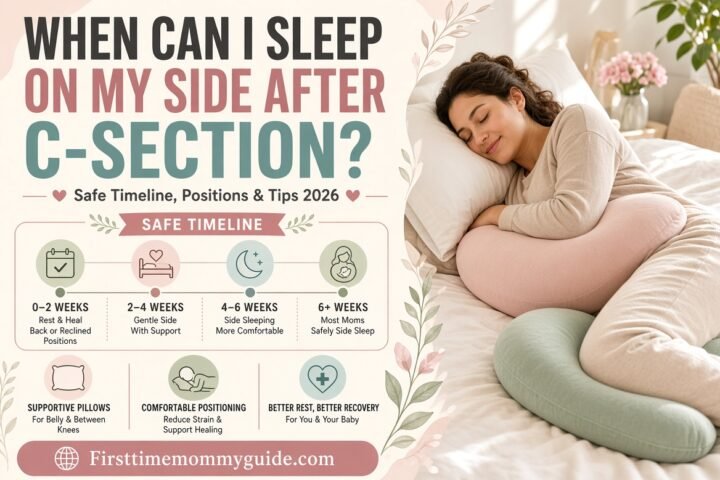
If you have been struggling to find a comfortable sleeping position, our guide on when you can sleep on your side after a C-section walks through positions that reduce pulling on the scar.
Itchy, Raised, or Red C Section Scar: Hypertrophic and Keloid Scars
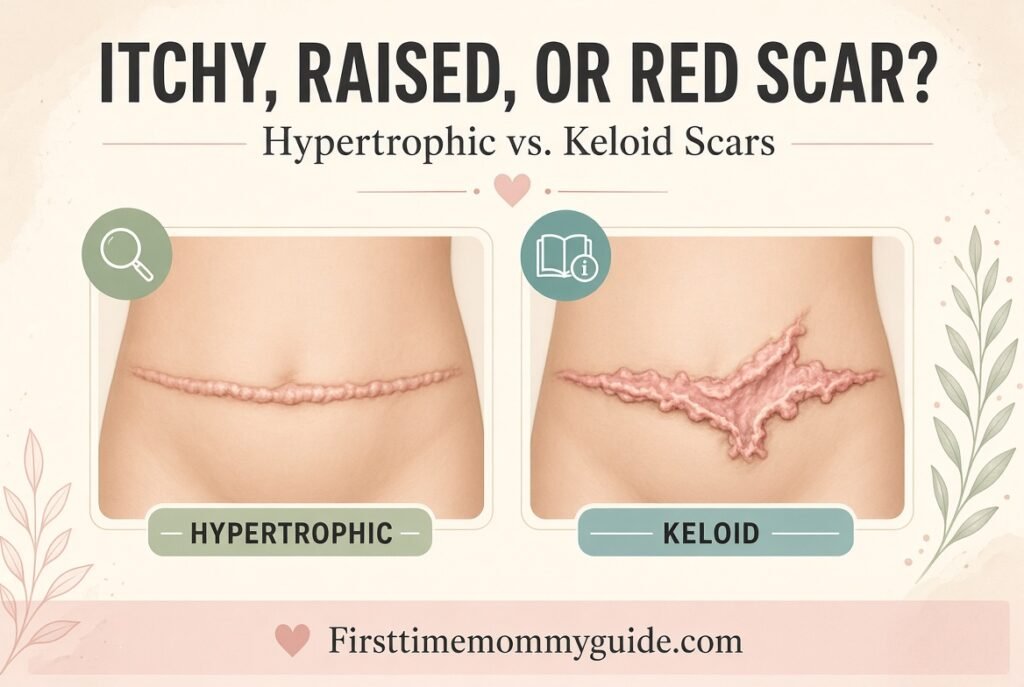
Not every itchy scar is a normal scar. When the body makes too much collagen, the scar can become thick, raised, and very itchy.
These are called hypertrophic scars and keloids. They are different conditions, though they can look similar at first.
Hypertrophic Scar vs Keloid Scar
| Feature | Hypertrophic Scar | Keloid Scar |
|---|---|---|
| Borders | Stays within the original incision line | Grows beyond the incision edges |
| Timing | Appears within weeks of surgery | Can appear months later |
| Course | May flatten on its own over time | Rarely improves without treatment |
| Symptoms | Raised, red, itchy, sometimes tender | Raised, firm, often itchy or painful |
| Common Treatments | Silicone, pressure, steroid injections, laser | Steroid injections, silicone, laser, other medical care |
Keloids are more common in people with darker skin tones and in those with a family history of keloids. Anyone can develop a raised scar, though.
Signs Your Scar May Be Hypertrophic or Keloid
- It is thick, raised, and firm
- It is darker red, purple, or deeper in color than the surrounding skin
- It is getting bigger, not smaller
- It itches, burns, or hurts more over time
- It extends past the original incision line
What to Do
Do not try to cut, pick, or aggressively treat a raised scar at home. See a doctor or dermatologist for an exam.
Early treatment works better. Silicone therapy, steroid injections, and other options can soften and flatten these scars.
C Section Scar Itching vs Infection: How to Tell the Difference
Itching alone rarely means infection months later. Most infections show up in the first weeks after surgery, though late problems can occur.
The key is looking at the whole picture, not just the itch.
Itching Alone vs Itching Plus Warning Signs
| Sign | More Likely Normal Healing | More Likely a Problem |
|---|---|---|
| Itch | Mild, comes and goes | Severe, constant, or worsening |
| Redness | Faint pink or darker tone that is fading | Spreading, hot, or increasing |
| Swelling | Slight firmness | New puffiness, warmth, or a lump |
| Drainage | None | Pus, fluid, or blood |
| Fever | None | Fever or chills |
| Scar edges | Closed and stable | Opening or separating |
| Pain | Mild tenderness | Severe or increasing pain |
What to Do If You See Warning Signs
Call your doctor the same day if you notice drainage, a fever, a spreading red area, or a wound that is opening. Do not wait for your next scheduled visit.
Avoid squeezing, scrubbing, or putting random ointments on the area. Let a clinician examine it first.
Allergic Reactions and Skin Conditions That Mimic Scar Itching
Sometimes the itch is not from the scar itself. The skin around it can react to what touches it.
Because the scar sits in a high-friction area, these causes are easy to miss.
Contact Dermatitis From Products or Adhesives
Adhesive bandages, tape, scar strips, lotions, and ointments can trigger allergic or irritant contact dermatitis. The result is an itchy, red, sometimes blistered rash with a clear pattern, like the shape of a bandage.
Fragrance, preservatives, and certain antibiotic ointments are common triggers. Some people also react to silicone products or the adhesive on them.
Eczema and Dry Skin Conditions
If you have a history of eczema, the scar area may flare. Postpartum hormonal changes and frequent handwashing can also push skin toward dryness.
Eczema usually causes a wider patch of rough, itchy skin, not only a line along the scar.
Yeast or Fungal Irritation in the Skin Fold
Warm, damp skin folds can grow yeast. This causes a red, itchy rash that may have small satellite spots and sits where skin touches skin.
A doctor can diagnose it quickly. Antifungal treatment usually clears it, but moisturizer alone will not.
Fabric and Detergent Reactions
Laundry products and rough fabrics can irritate a sensitive scar. Switching to a fragrance-free detergent and soft cotton underwear is a simple, low-cost test.
If a rash appears after you start a new product, stop it and let the skin settle. If the rash does not improve, see your provider.
C Section Scar Itching With Pain, Pulling, or Deep Pressure
Itching on the surface is one thing. Itching that comes with deeper pain, a pulling feeling, or pressure is another.
These symptoms can hint at scar tissue that has attached to deeper structures, or at a nerve under strain.
Scar Tissue Adhesions
Internal scar tissue, called adhesions, can bind layers that should slide freely. This may cause a tugging or catching feeling, especially with stretching or twisting.
Gentle scar mobilization from a trained physical therapist can help. It improves how the layers glide over one another.
Nerve Irritation or Entrapment
A nerve can get caught in scar tissue or tight fascia. This can cause sharp, burning, or electric pain along the scar or into the groin or thigh.
Persistent nerve pain should be evaluated. Options range from physical therapy to medication to targeted injections.
Incisional Hernia
An incisional hernia is a bulge that forms when tissue pushes through a weak spot in the abdominal wall near the scar. It may be more obvious when you cough, strain, or stand.
This is not an itch problem, but it can cause pulling or aching near the scar. Any new bulge needs a prompt medical exam.
Cesarean Scar Endometriosis
Rarely, endometrial tissue can grow in or near the scar. The typical clue is pain, swelling, or tenderness that changes with your menstrual cycle.
If your scar symptoms flare around your period, mention that pattern to your doctor.
Cesarean Scar Defect (Niche)
A niche is a small pocket or indentation in the uterine wall at the site of the cesarean scar. It is inside the uterus, not on the skin.
It is more often linked to spotting or pelvic pain than to skin itching. Still, it is worth asking about if you have unusual bleeding along with scar discomfort.
C Section Shelf, Overhang, and Itching
Some moms have a fold or overhang of skin above the scar, often called a C-section shelf. It is common and does not mean something went wrong.
The shelf can trap heat and moisture, which makes itching and irritation more likely.
Why the Fold Causes Itching
Skin rubbing on skin creates friction. Warmth and sweat then create a damp environment where irritation and yeast can thrive.
Tight waistbands pressing on the fold make the problem worse.
Care Tips for Scar Folds
- Gently wash and fully dry the area every day
- Place a soft, breathable cloth or moisture-wicking liner in the fold if it stays damp
- Choose high-waisted, soft cotton underwear that sits above or below the scar, not on it
- Ask your doctor about antifungal treatment if a red, itchy rash appears
Exercise and the Shelf
Core-friendly movement and pelvic floor rehab can help your abdominal wall recover. A pelvic health physical therapist can guide you safely.
Aim for gradual progress and avoid aggressive crunches until you are cleared.
C Section Scar Itching During Your Period, Weight Changes, or Another Pregnancy
Your scar does not live in isolation. Hormones, body changes, and a new pregnancy can all change how it feels.
Itching Around Your Period
Hormonal shifts across your cycle can make skin more sensitive. Some women notice a little more itching or tenderness near the scar before or during their period.
A mild, predictable pattern is usually fine. Pain or swelling that changes with your cycle should be mentioned to your doctor.
Itching While Breastfeeding
Breastfeeding changes hormone levels and can leave skin drier. A scar that was calm may start itching again as skin dries out.
Extra moisturizing and lukewarm showers help. If you are nursing and considering any medicated product or tablet for itch, ask your provider first.
Weight Gain, Weight Loss, and Stretching
Weight changes pull on the scar. Gaining weight can stretch it, and losing weight can change how skin folds over it.
Both can bring on new itching or tightness. Gradual changes are easier on scar tissue than rapid ones.
Itching During a Second Pregnancy
As the belly grows, the skin over an older scar stretches. This often causes itching, tightness, burning, or a pulling feeling.
Many women report this in a later pregnancy, even if the scar was quiet for years. Moisturizing daily and wearing a soft, supportive band can help, but mention new or intense symptoms at prenatal visits.
If you are planning ahead, our pregnancy guide month by month explains what changes to expect and when.
C Section Scar Itching After Multiple Cesareans
Repeat cesareans often use the same incision line, though doctors sometimes make a new one. Each surgery adds another round of healing and more scar tissue.
That can change how the scar behaves.
What May Be Different
- More internal scar tissue and adhesions
- A thicker or wider scar in some people
- More patchy numbness
- Itching that returns during stretching in a later pregnancy
How to Respond
The same care rules apply. Moisturize, protect from friction, use silicone if your skin allows it, and track changes over time.
Let your doctor know how your previous scar healed. It can help them plan the next surgery and aftercare.
How to Stop C Section Scar Itching: Home Remedies That Work
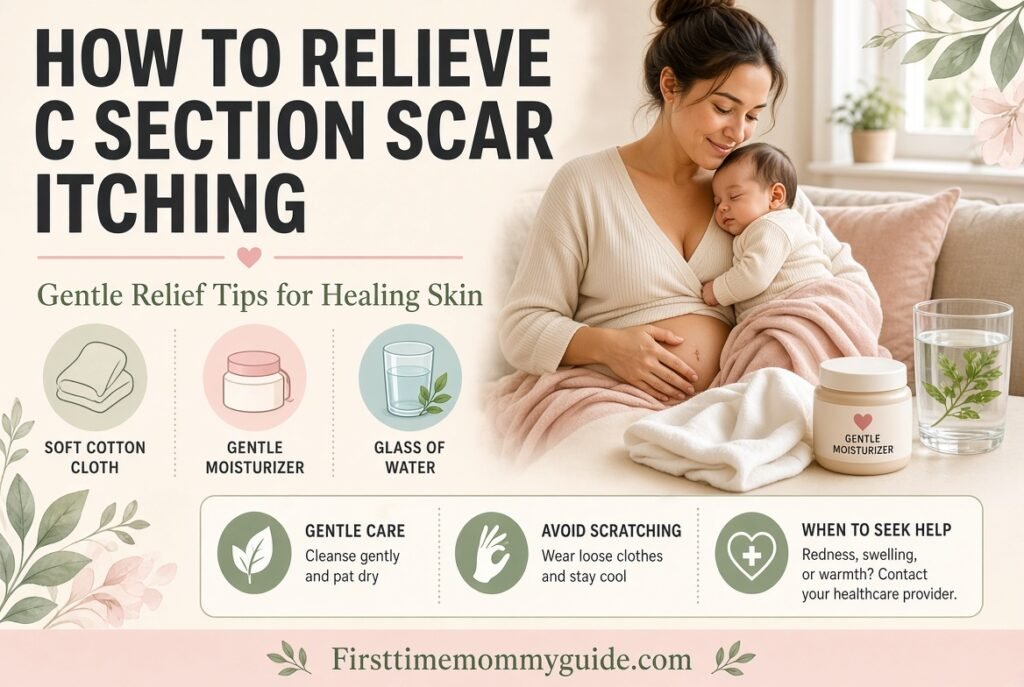
Most scar itching improves with simple, consistent skin care. You do not need a long list of products.
Start with the basics and add one change at a time so you can tell what helps.
Moisturize Daily With a Fragrance-Free Product
Moisturizer is the foundation. It reduces dryness, improves flexibility, and calms the surface itch.
Choose a thick, fragrance-free cream or ointment. Apply it after showering while skin is still slightly damp.
Use a Cool Compress
A cool, clean, damp cloth held on the scar for several minutes can calm an itch. The cold helps quiet irritated nerve endings.
Do not apply ice directly on the skin, especially over numb areas. Wrap anything cold in a cloth.
Try Lukewarm Showers, Not Hot Ones
Hot water strips natural oils and increases itch. Lukewarm water and a mild, fragrance-free cleanser are gentler.
Pat the scar dry with a soft towel. Avoid rubbing.
Take an Oatmeal Bath or Use Colloidal Oatmeal Products
Colloidal oatmeal is often used to soothe itchy skin. It can be a good option for a wider area of dryness or irritation.
Make sure the incision is fully healed before soaking, and follow your provider’s guidance on baths.
Tap, Press, or Pat Instead of Scratching
Scratching can irritate the scar and raise infection risk. It also trains the itch to come back harder.
When the urge hits, press firmly with your palm or tap lightly over clothing. This satisfies the urge without damaging skin.
Avoid Known Irritants
Skip scented lotions, perfumed soaps, and harsh scrubs on or near the scar. Rubbing alcohol and strong “scar removal” products can also irritate.
If a product stings or makes the itch worse, stop using it.
Over-the-Counter Itch Options
Some over-the-counter itch products exist, such as short-term hydrocortisone cream or oral antihistamines. Whether they are right for you depends on your skin, your scar, and whether you are breastfeeding.
Check with your doctor or pharmacist first. Steroid creams should generally be used on intact, fully healed skin and for short periods only.
Scar Massage for an Itchy C Section Scar
Scar massage is one of the most commonly recommended self-care steps for late itching. It softens tight tissue, improves blood flow, and helps the scar move more freely over deeper layers.
It also retrains the nerves. Gentle, regular touch can make oversensitive skin feel more normal over time.
When Is It Safe to Start?
Wait until the incision is fully closed, scabs are gone, and your doctor says it is okay. Many sources point to around four to six weeks, but your provider’s guidance comes first.
If your scar is open, red, draining, or very painful, do not massage it.
Step-by-Step Scar Massage
- Wash your hands and sit or lie comfortably
- Apply a small amount of fragrance-free lotion or oil
- Place two fingers flat on the scar and make small circles with gentle pressure
- Move slowly along the whole length of the scar
- Then gently press the scar sideways, up and down, and diagonally
- Lightly pinch and roll the skin over the scar if it feels comfortable
- Spend about five minutes a day, once or twice daily
Pressure Guide
Start with very light pressure and increase slowly. You should feel mild tension, not sharp pain.
If a spot is tender, stay with light pressure there and build up over days. Stop and ask your provider if massage makes symptoms worse.
Desensitizing Touch for Oversensitive Skin
If light touch feels unpleasant, begin with soft fabric stroked over the area. Move to a cotton ball, then to your fingertips.
This gradual exposure helps the nervous system accept normal touch again.
Silicone Gel and Silicone Sheets for Itchy C Section Scars
Silicone is the most widely recommended topical treatment for scars. It reduces itching, redness, and thickness, and it helps lower the risk of raised scars.
NHS scar management guidance also describes silicone gel sheets as helpful for preventing and treating hypertrophic and keloid scarring.
How Silicone Works
Researchers do not fully understand the exact mechanism. It appears to hydrate the scar and create a protective, breathable barrier that supports healthy collagen remodeling.
The result is a softer, flatter, less itchy scar over time.
Gel vs Sheets
| Option | Best For | Pros | Cons |
|---|---|---|---|
| Silicone gel | Everyday use, skin folds, hard-to-cover spots | Easy to apply, dries clear, can be worn under clothes | Needs reapplication, less constant pressure |
| Silicone sheets | Raised or thick scars | Steady contact and light pressure, reusable | Can slip, may irritate skin, needs washing |
How to Use Silicone Safely
- Only use on fully closed, healed skin with no scabs
- Apply a thin layer of gel once or twice daily as directed
- For sheets, follow the product schedule and build up wearing time slowly
- Wash reusable sheets with mild soap and lukewarm water and let them dry flat
- Stop and speak to your provider if redness, rash, or blistering appears
How Long to Use It
Sources vary. Some guidance describes consistent use for at least about 12 weeks, while NHS guidance mentions that treatment may continue for up to 18 months in some cases.
Results build slowly. Consistency matters more than any single product.
Best Cream for an Itchy C Section Scar: What to Look For
There is no magic cream. The best choice is usually simple, gentle, and used every day.
Focus on ingredients and avoid long lists of extras.
What to Look For
| Ingredient or Feature | Why It Helps |
|---|---|
| Silicone (gel or sheet) | Strongest evidence for scar softening and itch relief |
| Fragrance-free | Lower risk of allergic reactions |
| Petrolatum or thick ointments | Seal in moisture and protect dry skin |
| Ceramides | Support the skin barrier |
| Colloidal oatmeal | Soothes itchy, irritated skin |
| Shea or cocoa butter | Rich moisture, but patch test first |
What to Avoid
- Heavily perfumed lotions and “natural” fragrance blends
- Products with alcohol that sting or dry the skin
- Essential oils applied undiluted
- Harsh scrubs, exfoliating acids, or “scar removal” gimmicks
- Any product on an open or healing wound
Do a Patch Test First
Apply a small amount to a patch of normal skin, like the inner forearm. Wait a day to see if redness, itching, or a rash appears.
This simple step prevents many product-related flare-ups.
What About Vitamin E and Onion Extract Products?
Marketing around these products is strong, but evidence for them is weaker than for silicone. Some people also develop skin reactions to vitamin E.
If you want to try something besides silicone, patch test it and talk with your provider.
Clothing, Sun Protection, and Daily Habits That Calm an Itchy Scar
Small daily choices can reduce itching more than people expect. They also protect the scar while it matures.
Choose the Right Clothing
- Soft, breathable cotton or bamboo fabrics
- High-waisted underwear that sits well above the scar, or low-rise styles that sit well below it
- Seamless or smooth-seam styles that do not dig in
- Loose waistbands on pants and leggings
Avoid anything that rubs, pinches, or traps sweat on the scar.
Protect the Scar From the Sun
A new scar can darken permanently if it is exposed to strong sun. Cover the area with clothing, or use broad-spectrum sunscreen with SPF 30 or higher when it will be exposed.
Sun can also add to itching and irritation. This matters most during the first year of scar maturation.
Stay Hydrated and Eat Well
Healing tissue needs protein, vitamins, and fluids. A balanced diet supports skin repair, though no single food will erase a scar.
If you are breastfeeding, balanced nutrition also supports you and your baby. Our guide to low milk supply signs and fixes covers how hydration and feeding habits connect.
Manage Stress and Sleep
Stress and exhaustion make everything feel itchier. Even small improvements in sleep can lower the volume on irritation.
Newborn nights are hard, so lean on what works. Our baby sleep guide for new moms offers realistic sleep strategies.
Move Gently
Walking, stretching, and gentle core work keep tissues flexible. Avoid heavy lifting and intense core exercises until you are cleared.
Pain, pulling, or bulging during exercise is a sign to stop and ask your provider.
Physical Therapy for C Section Scar Itching and Pain
If itching or pain lingers months later, a pelvic health or women’s health physical therapist can be a big help. They specialize in postpartum recovery, including scar work.
Physical therapy does not involve more surgery, and it can address several causes at once.
What a Physical Therapist May Do
- Assess scar mobility and how it moves over deeper tissue
- Teach safe scar massage and mobilization techniques
- Improve core and pelvic floor function
- Address posture and movement habits that increase tension
- Suggest desensitization exercises for oversensitive skin
Who Should Consider It
- Anyone with itching or pain that lasts past several months
- Those who feel pulling, tightness, or limited movement
- Moms who want a safe plan to return to exercise
- People with a visible shelf or abdominal weakness
How to Find One
Ask your OB-GYN or midwife for a referral to a pelvic health physical therapist. Many clinics list “postpartum” or “scar” work in their service descriptions.
C Section Scar Itching by Incision Type and Closure Method
Not every cesarean scar is the same. The type of incision and how it was closed can shape how the scar feels months later.
Knowing your own surgery details helps you and your doctor judge what is normal for you.
Low Transverse (Bikini Line) Incision
This is the most common cesarean incision. It runs side to side low on the abdomen, usually below the bikini line.
Itching here is often made worse by waistbands, underwear, and skin folds, because the scar sits exactly where clothing rubs.
Vertical Incision
A vertical incision runs up and down between the navel and the pubic area. It is used less often, usually in urgent situations or for specific medical reasons.
Vertical scars can feel tighter during stretching and movement. They may also be more noticeable, which can add to concern about how the scar looks.
Stitches, Staples, Glue, and Adhesive Strips
Surgeons close the skin in different ways. Some use dissolvable stitches under the skin, others use staples, and others use surgical glue or adhesive strips.
Sensitivity to adhesives or stitch materials can show up as local itching, bumps, or small pimple-like spots along the scar. Tell your doctor if you see these, since a stitch fragment working its way out can sometimes cause irritation.
Why Your Surgery Details Matter
If you remember which incision you had, or have it in your discharge paperwork, keep that information handy. It helps your provider understand your symptoms and plan any treatment.
If you are unsure, ask your OB-GYN at your next visit.
Itching, Pain, Numbness, or Burning: Quick Symptom Guide
Many people feel several scar sensations at once and cannot tell what they mean. This guide gives a simple starting point.
It is not a diagnosis. It simply helps you decide what to do next.
| Symptom | Common Meaning | Helpful First Step | When to Get Checked |
|---|---|---|---|
| Mild itch that comes and goes | Normal healing, dry skin | Moisturize, avoid friction | If it worsens or stays flat for months |
| Itch with tingling | Nerve regrowth | Gentle massage, patience | If it spreads or turns sharp |
| Itch with numb patches | Cut skin nerves recovering | Protect the numb skin | If numbness grows or causes pain |
| Itch with burning | Nerve irritation or skin irritation | Loose clothing, cool compress | If constant or spreading |
| Itch with raised, thick scar | Hypertrophic scar or keloid | Silicone, see a doctor | Soon, since early treatment works best |
| Itch with red, scaly rash | Dermatitis, eczema, or yeast | Stop new products, keep dry | If the rash persists beyond a few days |
| Itch with deep pulling or pain | Adhesions or nerve entrapment | See a physical therapist | If pain is persistent or severe |
| Itch with a bulge | Possible hernia | Do not delay | Promptly, any new bulge |
| Itch that changes with your cycle | Hormone sensitivity or rare scar endometriosis | Track your pattern | If pain or swelling follows your cycle |
Skin Tone, Scar Color, and What Healing Looks Like
Scars heal differently across skin tones. Knowing what to expect can ease worry about color and texture.
Color is one of the most visible parts of healing, and also one of the slowest to change.
Early Scar Color
New scars are often pink, red, or purple on lighter skin. On deeper skin tones, they may look dark brown, purple, or darker than the surrounding skin.
This color comes from extra blood vessels and pigment in the healing area. It usually fades gradually over months.
Lighter or Darker Scars Later On
Over time, many scars become paler than the skin around them. Others stay darker, particularly if they were exposed to sun early on.
Sun protection and gentle care help keep pigment changes from becoming more noticeable.
Raised Scars and Skin Tone
Keloids occur more often in people with darker skin tones and in those with a family history of them. This does not mean you will develop one, but it is worth watching for a thick, expanding scar.
If your scar is thickening or growing beyond the incision, see a clinician early.
What a Healthy Scar Usually Looks Like Over Time
- Flatter than it was in the first months
- Softer when you touch it
- Slowly closer in color to the skin around it
- Less itchy and less sensitive as the year goes on
Keeping a Scar Symptom Diary
When scar symptoms last for months, memory gets blurry. A simple diary shows patterns and makes doctor visits more productive.
It also helps you notice what actually works.
What to Track
- Date and time the itching occurs
- Severity from 1 to 10
- Where on the scar it appears
- Triggers such as clothing, heat, sweat, or stress
- Products or remedies you tried and whether they helped
- Any rash, redness, bumps, or changes in color
- Link to your menstrual cycle, if relevant
Take Regular Photos
Photograph the scar every two weeks in the same lighting and from the same angle. Small changes are hard to notice in person but obvious in side-by-side photos.
Share the photos with your provider if you notice thickening, spreading, or color changes.
What Patterns Can Tell You
If the itch is worse after using a new product, it may be a reaction. If it is worse in hot weather, heat and sweat may be the trigger.
If it is gradually fading week by week, you are likely on the right track.
Exercise, Lifting, and Daily Activity With an Itchy C Section Scar
Moving again helps recovery, but too much too soon can strain the scar and irritate nerves. Balance is the goal.
Your own clearance from your OB-GYN or midwife matters more than any general timeline.
Gentle Movement That Usually Helps
- Short, regular walks
- Gentle stretching
- Breathing and pelvic floor work guided by a professional
- Light posture work during feeding and carrying
Movements to Approach Slowly
- Heavy lifting
- High-intensity core work such as crunches or planks
- High-impact exercise
- Sudden twisting or straining
Build up slowly and stop if you feel pulling, bulging, or sharp pain near the scar.
Managing Sweat and Friction During Exercise
Sweat and rubbing can make scar itching worse. Choose soft, moisture-wicking clothing, and keep waistbands away from the scar.
Shower and dry the area after exercise, then moisturize.
Carrying a Baby Without Straining Your Scar
Holding a newborn against your belly can press on a sensitive scar. Try carrying baby higher on your chest or shifting to your hip when comfortable.
Our baby essentials checklist for the first three months includes carrier and positioning ideas that can be easier on your body.
Itching Compared With Other Common Postpartum Skin Changes
The scar is not the only place skin changes after birth. Hormones and recovery affect the whole body.
Separating scar itching from other postpartum skin changes helps you choose the right care.
Dry, Itchy Skin Across the Body
Many postpartum moms notice dryness and itching on the belly, arms, and legs. Hormone shifts, frequent handwashing, and breastfeeding can all play a part.
A daily, fragrance-free moisturizer helps most of these cases.
Stretch Mark Itching
Stretch marks can itch as they fade, especially in the first months after delivery. They sit on the belly and sides, and look different from a scar.
The same gentle moisturizing helps. Scratching can worsen the irritation.
Rashes Unrelated to the Scar
A rash that spreads beyond the scar, comes with hives, or appears after a new medicine should be checked. It may not be related to the incision.
If you have trouble breathing, swelling of the lips or face, or rapid spread, seek emergency care.
Hair Loss and Skin Sensitivity
Postpartum hair shedding and increased skin sensitivity are common as hormone levels settle. They are not scar problems, but they can make you feel generally itchy and uncomfortable.
If you are worried about how your body is changing, bring it up at your postpartum visit.
Medical Treatments for Persistent C Section Scar Itching
If home care is not enough, there are several medical options. The right one depends on what is causing the itch.
A clinician needs to examine the scar first. Treating a raised scar, a nerve problem, and a fungal rash are all very different things.
Prescription and Medical Skin Treatments
- Topical steroids: Reduce inflammation and itch for a limited time
- Antifungal treatment: For yeast or fungal rashes in skin folds
- Prescription-strength moisturizers or barrier creams: For stubborn dryness or eczema
- Allergy testing and product changes: When contact dermatitis is suspected
Treatments for Raised Scars
- Corticosteroid injections: Can shrink hypertrophic scars and keloids and ease itching
- Pressure therapy and silicone: Used alone or alongside other treatments
- Laser therapy: Can improve color, texture, and sometimes itch
- Other procedures: Some dermatology or plastic surgery clinics offer additional options
Treatments for Nerve-Related Itch or Pain
When the cause is nerve irritation, treatment may include physical therapy, desensitization, certain prescription medicines, or targeted nerve injections. A pain specialist or neurologist can guide this.
If you are breastfeeding, always mention it when any medication is discussed.
Scar Revision Surgery
Scar revision is usually considered only when a scar causes persistent symptoms or significant concern despite other treatment. It is not a first step.
A plastic surgeon or your OB-GYN can discuss whether it makes sense for you, and what recovery would involve.
When to Call Your Doctor About C Section Scar Itching
Most itching is harmless. Still, some signs mean you should not wait.
Trust your instincts. If something feels off, it is always okay to call.
Call Your Doctor Promptly If You Notice
- Redness that is spreading, hot, or swollen
- Pus, foul-smelling drainage, or bleeding
- Fever, chills, or feeling generally unwell
- A wound that is opening or separating
- A new bulge or lump near the scar
- Severe or worsening pain
- A scar that is growing, thickening, or becoming raised
- Itching that is intense, constant, or interfering with sleep and daily life
- Itching or pain that changes with your period
Seek Emergency Care If
- You have a high fever with severe abdominal pain
- A bulge becomes hard, very painful, or discolored
- You have heavy bleeding or feel faint
Emergency symptoms are rare this long after surgery, but they should never be ignored.
What to Expect at the Doctor’s Appointment
Going in prepared makes the visit more useful. Doctors can usually learn a lot from a simple exam and a few questions.
What Your Provider Will Likely Do
- Look at the scar and surrounding skin
- Press gently to check for tenderness, lumps, or a hernia
- Ask about when the itching started and what makes it better or worse
- Review any products you use
- Ask about your cycle, breastfeeding, and any other symptoms
Questions Worth Asking
- Is my scar healing normally for this stage?
- Could this be an allergy, a rash, or an abnormal scar?
- Is scar massage or silicone right for me?
- Would physical therapy help?
- Do I need any tests or a specialist referral?
Helpful Things to Bring or Note
Write down when the itching began, how severe it is on a scale of 1 to 10, and what triggers it. Take clear photos of the scar every couple of weeks so you can show changes over time.
Common Myths About C Section Scar Itching
Misinformation spreads quickly in parent groups and forums. Here are common myths and what to do with them instead.
| Myth | What Is Closer to the Truth |
|---|---|
| “Itching means the scar is infected” | Itching alone is usually part of healing. Infection comes with other signs such as redness, drainage, or fever |
| “If it still itches at 6 months, something is wrong” | Itching at 6 months is common and often normal |
| “Scratching helps it heal faster” | Scratching irritates the scar and can raise infection risk |
| “Any scar cream will fade my scar” | Silicone has the strongest evidence. Many other products have little proof |
| “You should massage right away” | Wait until the wound is fully closed and your provider approves |
| “If it is common, it is normal” | Common does not always mean healthy. Persistent symptoms deserve a check |
Your C Section Scar Itching Action Plan by Stage
Use this simple plan to decide what to do at each point. It keeps care calm and consistent.
Weeks 6 to 12
- Keep the scar clean and moisturized
- Start gentle massage and silicone only after your provider approves
- Wear soft, loose clothing
- Do not scratch
Months 3 to 6
- Continue daily moisturizing and silicone if advised
- Add regular scar massage for about five minutes a day
- Protect the scar from sun
- Track whether the itch is trending down
Months 6 to 12
- Keep up with scar care, even if it feels better
- Consider physical therapy if pulling or tenderness continues
- Ask about treatment if the scar is raised, thick, or still very itchy
After 12 Months
- Occasional itching can still be normal
- Persistent or worsening symptoms deserve a medical evaluation
- Ask about advanced options if the scar still affects daily life
Preventing Future Scar Itching and Irritation
You cannot fully control how your body scars. You can improve your odds with a few supportive habits.
Do and Do Not
| Do | Do Not |
|---|---|
| Keep the scar clean and moisturized | Pick scabs or peel skin |
| Use fragrance-free products | Use strong perfumes or harsh scrubs |
| Protect from sun and friction | Expose a new scar to strong sun |
| Follow your provider’s wound care advice | Massage an open or draining wound |
| Move gently and build core strength gradually | Lift heavy loads or do hard core work too soon |
| Report new symptoms early | Ignore a growing, painful, or draining scar |
Healing From the Inside
Rest, nutrition, and hydration help your body repair itself. These are simple and not glamorous, but they matter.
Recovery is easier when you accept help. Share baby care, meals, and chores when you can.
Be Patient With Your Body
A cesarean is major abdominal surgery. Your body is also recovering from pregnancy, hormones, and interrupted sleep.
Itching, numbness, and odd sensations can feel annoying, but they often reflect real, slow, healthy repair.
The Emotional Side of Living With a C Section Scar
For many moms, an itchy or sensitive scar is more than a physical annoyance. It can bring up feelings about the birth, body image, or recovery.
Those feelings are valid. You do not have to pretend the scar does not bother you.
Common Feelings
- Frustration that healing is taking so long
- Worry that something is wrong
- Discomfort with how the scar looks
- Sadness or anger about the birth experience
- Pride in what your body has done
Small Steps That Help
Talk with your partner, a friend, or a support group. Share your concerns with your provider as well.
If sadness, anxiety, or intrusive thoughts feel heavy or last for weeks, tell your doctor. Postpartum mood changes are common and treatable, and you deserve support.
Reconnecting With Your Body
Gentle massage, mindful touch, and appreciation for what your body did can make the scar feel less foreign. Over time, many women come to see their scar as part of their story.
Your recovery after a cesarean also affects daily tasks. Our practical guide on how to poop after a C-section without pain covers one of the most common recovery worries.
Trusted Medical Sources to Check
Reliable information makes it easier to separate fact from forum advice. These organizations publish evidence-based guidance on cesarean recovery, wound care, and scars.
- American College of Obstetricians and Gynecologists (ACOG)
- Mayo Clinic
- Cleveland Clinic
- American Academy of Dermatology (AAD)
- National Health Service (NHS)
- Centers for Disease Control and Prevention (CDC)
- Association of Women’s Health, Obstetric and Neonatal Nurses (AWHONN)
- Pelvic health physical therapy organizations
Also Read:
- When Can I Sleep on My Side After C Section? Safe Timeline, Positions & Tips
- How to Poop After C Section Without Pain: Complete Recovery Guide for New Moms
- Pregnancy Guide: Month by Month
- Hospital Bag Checklist for Baby: The Complete Packing List
- Baby Essentials Checklist: 0 to 3 Months
- Newborn Coming Home Outfit: What to Pick, What to Skip, and How to Keep Baby Safe
- Baby Sleep Guide for New Moms: Safe Sleep & Schedules
- Low Milk Supply Signs and Fixes: What Every Breastfeeding Mom Should Know
- Breastfeeding Latch Problems: Causes, Fixes & When to Get Help
- Signs of Cluster Feeding: Complete Guide for New Parents
- How Long Does Newborn Cluster Feeding Last Each Night?
- Bottle Feeding Schedule Newborn: Complete Age-by-Age Guide
- How Much Breast Milk to Put in Each Storage Bag (Complete Guide)
- How to Do the Pitcher Method for Breast Milk Step by Step
- How to Scald Breast Milk for High Lipase Before Freezing
- Thawed Breast Milk Smells Like Soap Is It Still Good? Causes, Safety, and Fixes
- Newborn Grunting in Sleep Normal or Should I Call the Doctor?
- Is It Normal for Umbilical Cord Stump to Bleed After Falling Off?
- When Do Babies Start Rolling Over? (Guide)
- Baby Won’t Eat? Common Reasons, Fixes & When to Worry
- When Can My Baby Start Eating Real Food? Age, Signs & First Foods
- Baby Food Chart 6 to 12 Months: Free Month-by-Month Feeding
- Fruit Purees for 6 Month Old Babies: Safe Recipes & Guide
- Best Vegetable Purees for Baby: A Complete Age-by-Age Guide
Frequently Asked Questions (FAQs)
Is it normal for a C-section scar to itch months later?
Yes, it is common. Nerves regrow slowly and the scar keeps remodeling for up to a year or more, so itching at 3, 6, or even 12 months can be part of normal healing. See a doctor if it is severe, worsening, or comes with redness, drainage, fever, or a new bulge.
Why is my C-section scar itchy after 6 months?
The most common reasons are nerve regeneration, dry skin, friction from clothing, and ongoing scar remodeling. Less often, a raised scar, allergic reaction, or skin fold rash is the cause. If the itch is strong or getting worse, have it examined.
How long does a C-section scar itch?
For many women it fades within a few weeks to several months. For others it comes and goes for a year or longer. A downward trend over time is a good sign.
Is an itchy C-section scar a sign of infection?
Itching alone is rarely a sign of infection months after surgery. Infection usually brings spreading redness, warmth, swelling, pus, pain, or fever. If you see those signs, call your doctor right away.
Why does my C-section scar itch and tingle?
Tingling and itching usually come from regrowing nerves sending uneven signals. It is common during the first year. Tingling that spreads, becomes sharp or burning, or limits movement should be checked.
Why is the skin above my C-section scar numb and itchy?
Surgery can cut or stretch small skin nerves, so sensation returns in patches. A numb spot next to an itchy one is a known pattern. Most people improve over time, though some keep a small numb area.
Is it normal for my C-section scar to burn?
A mild burning or sunburn-like feeling can occur as nerves heal and skin adjusts. Constant, severe, or spreading burning should be evaluated. A doctor can check for nerve irritation or skin problems.
Can a C-section scar itch years later?
Yes, occasional itching years later happens, often from dryness, friction, or nerve changes. Constant or worsening itch years later should be examined. A clinician can rule out adhesions, nerve entrapment, abnormal scarring, or a skin condition.
What is the best way to stop C-section scar itching?
Moisturize daily with a fragrance-free product, protect the scar from friction and sun, and avoid scratching. Silicone gel or sheets and gentle scar massage are commonly recommended once the wound is fully healed and your doctor approves.
Does silicone help itchy C-section scars?
Yes, silicone is the topical treatment with the strongest support for reducing scar itching, redness, and thickness. Use it only on fully closed skin and stop if a rash appears. Results build over weeks to months.
When can I start massaging my C-section scar?
Usually after the incision is fully closed and scabs are gone, often around four to six weeks. Always follow your provider’s guidance. Do not massage a scar that is open, draining, or very painful.
What is the best cream for an itchy C-section scar?
Silicone-based gels and sheets are widely recommended. Otherwise, choose a thick, fragrance-free moisturizer. Avoid perfumes, harsh ingredients, and anything that stings.
Can I use hydrocortisone on my C-section scar?
Some doctors approve short-term use on fully healed, intact skin. Steroid creams are not suitable for every scar or situation. Ask your doctor or pharmacist first.
Can I take an antihistamine for scar itching?
Sometimes, but it depends on your health and whether you are breastfeeding. Antihistamines may not help nerve-related itch very much. Ask your provider which option, if any, is suitable.
Why does my C-section scar itch at night?
Skin loses more moisture at night, body temperature changes, and fewer distractions make itching more noticeable. Moisturize before bed, wear loose cotton, keep your nails short, and keep the room cool.
Why is my C-section scar raised and itchy?
It may be a hypertrophic scar or a keloid, both of which have extra collagen and more nerve fibers. See a doctor or dermatologist. Silicone, steroid injections, and laser treatments can help.
What is the difference between a hypertrophic scar and a keloid?
A hypertrophic scar stays within the original incision and may flatten over time. A keloid grows beyond the incision edges and rarely improves without treatment. Both can itch.
Can a C-section shelf cause itching?
Yes. The skin fold can trap heat and moisture, causing irritation or a yeast rash. Keep the area clean and dry, wear soft breathable fabrics, and ask your doctor about antifungal treatment if a red itchy rash appears.
Can I be allergic to my C-section scar products?
Yes. Adhesives, fragrances, preservatives, ointments, and even silicone products can cause contact dermatitis. Stop the product, let the skin calm down, and see your provider if the rash continues.
Does itching mean my scar is healing?
Itching often accompanies normal healing, but it does not prove that the scar is healing well. It is best judged along with how the scar looks and how symptoms change over time.
Can scar itching come back during another pregnancy?
Yes. A growing belly stretches the skin over the old scar and can bring back itching, tightness, or burning. Moisturize daily, wear soft supportive clothing, and mention new or strong symptoms at prenatal visits.
Should I see a doctor for itching and pain together?
Yes, especially if pain is deep, sharp, worsening, or paired with pulling or a bulge. These can point to adhesions, nerve irritation, or a hernia. A clinician can examine you and recommend treatment.
Does a physical therapist help with C-section scar itching?
Often yes, particularly for tightness, adhesions, sensitivity, or pain. A pelvic health therapist can teach safe scar massage and mobilization and help you rebuild core strength.
Can scar itching be linked to my period?
Mild hormonal sensitivity is possible. Pain, swelling, or changes in the scar that follow your menstrual cycle should be reported, since rare conditions such as scar endometriosis can show this pattern.
How can I tell if my scar is healing normally?
Over time, a normal scar becomes flatter, softer, and lighter, and symptoms like itching fade gradually. Worrying signs include spreading redness, drainage, a growing raised scar, severe pain, or a new bulge.
Will my C-section scar ever stop itching?
For most women, yes. Itching usually fades as nerves and tissues mature, and ongoing scar care speeds comfort. If it never settles, medical and physical therapy options can help.
Conclusion
C section scar itching months later is common, and for most moms it reflects slow nerve regrowth and long-term scar remodeling rather than a hidden problem. Itching at three, six, or even twelve months can still be part of normal healing, especially when it is mild and gradually improving.
The best approach is simple and steady. Keep the scar moisturized, protect it from friction and sun, avoid scratching, and add silicone and gentle massage once your doctor says the skin is ready.
Pay attention to the whole picture. Spreading redness, drainage, fever, a growing raised scar, severe pain, or a new bulge mean it is time to call your provider.
If the itch is intense or does not improve, effective help exists, from physical therapy to dermatology treatments. You do not have to just put up with it. Your recovery matters, and asking for help is part of healing well.

Dilawar Mughal
Founder and editor, First Time Mommy Guide
I research every guide against what the NHS, the AAP and the WHO publish, then write it in plain English — because most new parents are reading with one hand free, not comparing clinical guidelines. I'm not a doctor or a midwife. Every health claim on this site is sourced and linked so you can check it yourself, and anything urgent belongs with your health visitor or GP, not a blog.