General information, not medical advice. Every baby is different — if anything worries you, speak to your midwife, health visitor or GP rather than waiting.
Somewhere between the 6-month checkup and your baby’s first birthday, you’ll go from spooning in a single teaspoon of rice cereal to watching them grab handfuls of pasta off their own tray.
That’s a huge nutritional leap in a short window, and it’s normal to want something more concrete than “just follow your baby’s cues.”
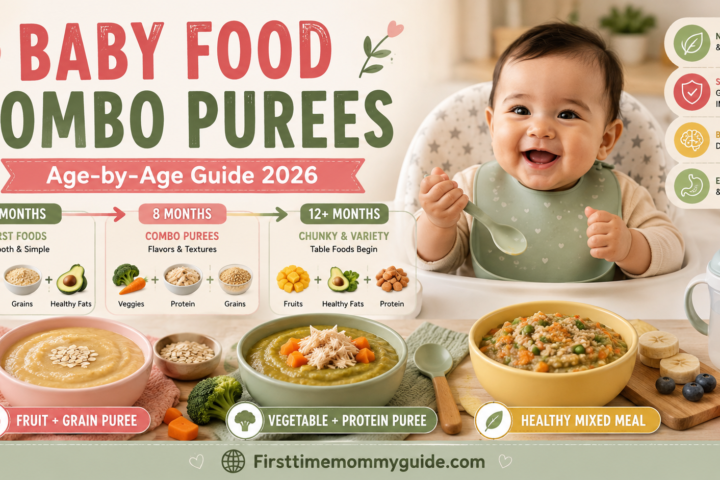
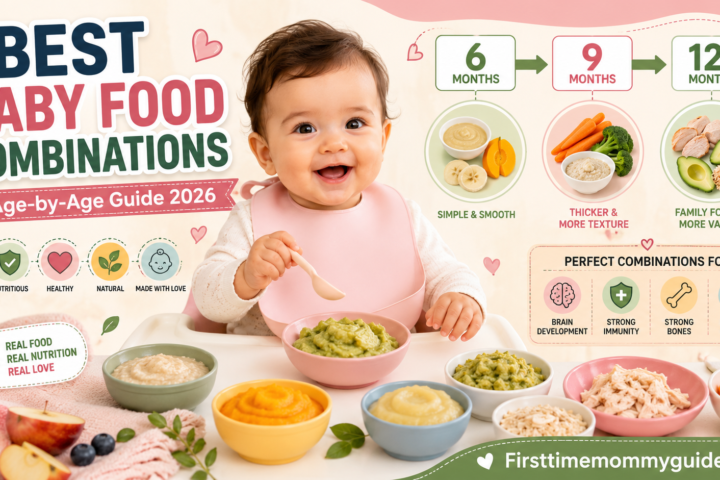
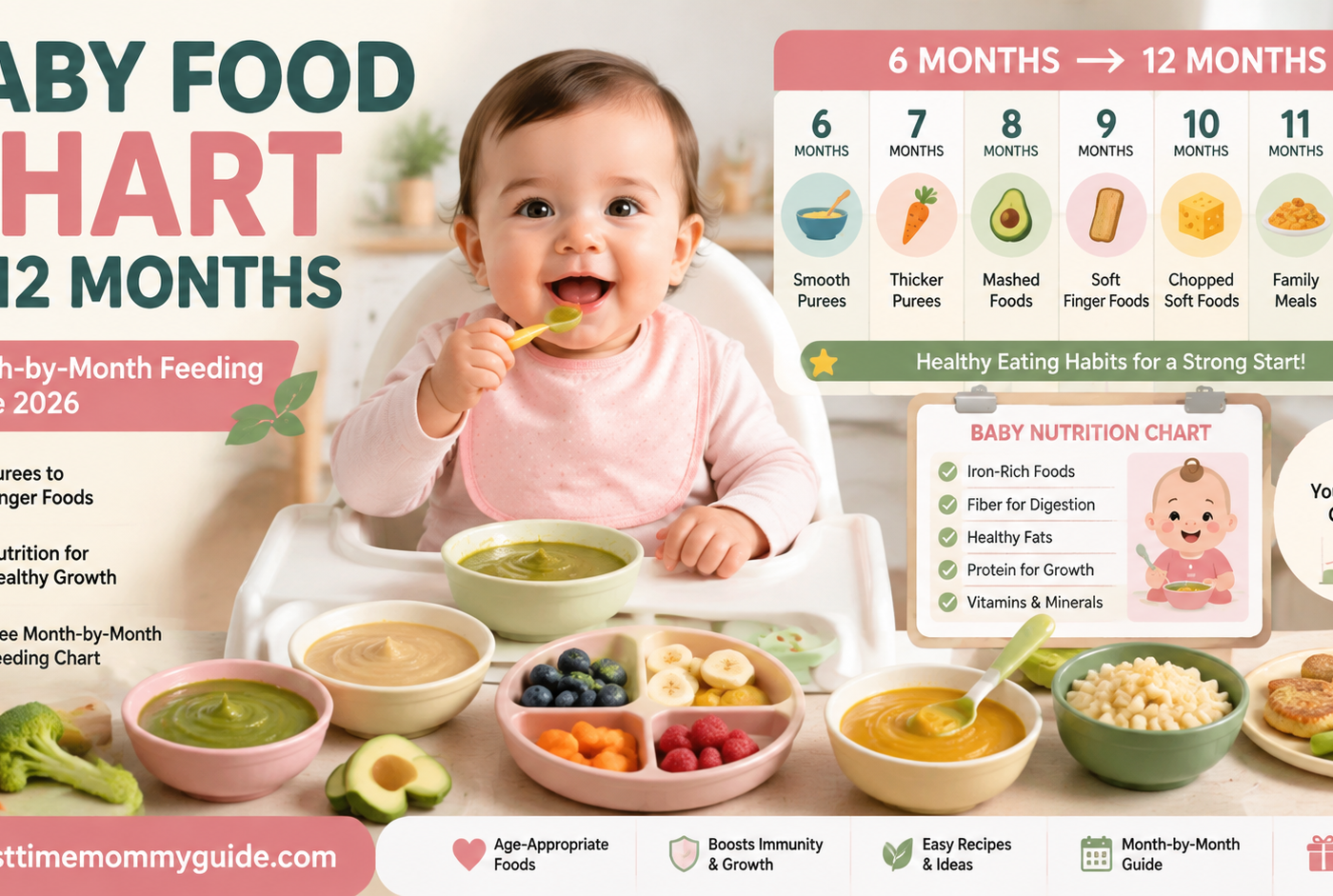
Baby Food Chart 6 to 12 Months: From 6 to 12 months, babies move from one meal a day of smooth purees (1–2 tablespoons) to three meals plus snacks of finely chopped table food (up to ½–¾ cup per meal) by 12 months, while breast milk or formula remains their main source of nutrition throughout.
Table of Contents
Key Takeaways
- Start around 6 months, not by a fixed date — readiness signs (sitting with support, good head control, interest in food, losing the tongue-thrust reflex) matter more than the calendar.
- Breast milk or formula stays the primary nutrition source for the whole first year; solids are “complementary,” not a replacement.
- Iron- and zinc-rich foods first — fortified infant cereal, pureed meat, beans, and lentils — because a baby’s natural iron stores start to drop around 6 months.
- Introduce common allergens early and often (egg, peanut, dairy, wheat, soy, fish, shellfish, tree nuts, sesame), starting around 6 months, one at a time, per current AAP guidance.
- Texture should progress, not stall — smooth purees at 6 months, mashed/lumpy by 8–9 months, soft chopped finger foods by 10–12 months. Waiting too long to add texture is linked to feeding difficulties later.
- Portions grow gradually: roughly 1–2 tablespoons per meal at 6 months, up to ½–¾ cup per meal by 12 months, always following the baby’s hunger and fullness cues rather than a forced amount.
- Never give honey before 12 months (infant botulism risk), and avoid choking hazards like whole grapes, whole nuts, popcorn, and chunks of hard raw vegetables throughout this whole stage.
Baby Food Chart: 6 to 12 Months at a Glance
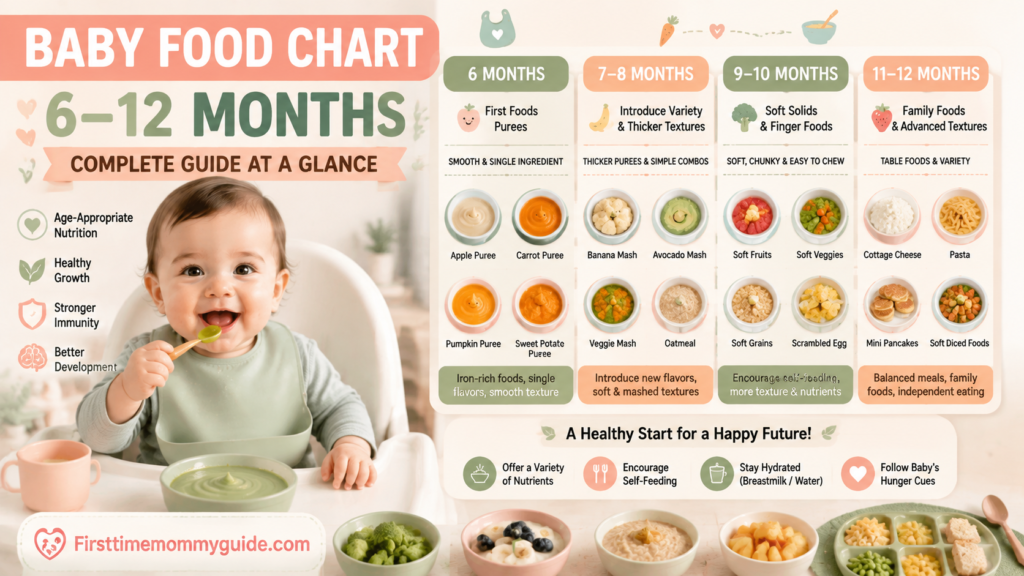
| Age | Meals/Day | Texture | Typical Portion per Meal | Milk Feeds/Day |
|---|---|---|---|---|
| 6 months | 1 (building to 2) | Thin, smooth purees | 1–2 tablespoons | 4–6 breast/bottle feeds |
| 7–8 months | 2–3 | Thicker purees, soft mashed | 2–4 tablespoons | 3–5 breast/bottle feeds |
| 9–10 months | 3 + 1–2 snacks | Mashed with soft lumps, soft finger foods | ¼–½ cup | 3–4 breast/bottle feeds |
| 11–12 months | 3 + 1–2 snacks | Chopped soft table food | ½–¾ cup | 3 breast/bottle feeds |
Portions are averages from pediatric feeding guidance, not targets to hit exactly. A baby who eats less on a given day and makes it up in milk feeds is not doing anything wrong.
Signs Your Baby Is Ready for Solids
Before using any chart, confirm readiness. The American Academy of Pediatrics recommends starting solids around 6 months, once a baby:
- Sits upright with minimal support and has good head and neck control
- Has lost the tongue-thrust reflex (no longer automatically pushes food back out)
- Shows real interest in food — leaning forward, opening their mouth, reaching for what’s on your plate
- Can move food to the back of the mouth and swallow instead of choking
A baby who hits these milestones at 5.5 months is ready; a baby who isn’t quite there at 6.5 months isn’t behind. Readiness, not the calendar, decides the start date.
Month 6: First Foods and First Tastes
What to feed
Start with single-ingredient, iron-rich purees: fortified infant cereal (oatmeal or multigrain, not just rice), pureed meat or poultry, mashed beans or lentils, and simple pureed vegetables and fruits like sweet potato, avocado, banana, and pea.
Texture and consistency
Thin, completely smooth purees — closer to a runny yogurt than mashed potato. Thin with breast milk, formula, or water if needed.
Portion and frequency
Offer 1–2 teaspoons to start, working up to 1–2 tablespoons, once a day, typically after a milk feed so hunger doesn’t derail the first tries. Some babies naturally move to two small meals a day by the end of month 6.
What’s happening developmentally
This is exploration, not nutrition replacement — breast milk or formula still supplies the vast majority of calories and nutrients. The goal is exposure to flavors and texture, and practice with the swallow reflex.
Expert tip: Introduce one new single-ingredient food at a time and wait 2–3 days before adding the next. This makes it far easier to identify the cause if a reaction occurs.
Months 7–8: Building Variety and Thicker Textures
What to feed
Expand across all food groups: iron-fortified cereals, soft-cooked and mashed vegetables (carrot, squash, broccoli), soft fruits (pear, peach, melon), plain full-fat yogurt, mashed egg, and well-cooked, shredded or minced meat, poultry, and fish.
Texture and consistency
Move from smooth to thicker, slightly lumpy purees and soft mashes. This is also the window to start offering soft, dissolvable finger foods — a strip of ripe banana, a well-cooked carrot stick, or a puff — even before teeth arrive, since babies gum food effectively with their gums.
Portion and frequency
2–4 tablespoons per meal, working toward 2–3 meals a day, alongside continued breast milk or formula feeds (roughly 24–32 oz/day of formula, or nursing on demand).
Allergen introduction continues
By 7–8 months, most of the common allergens (peanut, egg, dairy, wheat, soy, tree nuts, fish, shellfish, sesame) should already be in rotation if introduction started at 6 months — keep offering them 2–3 times a week to maintain tolerance.
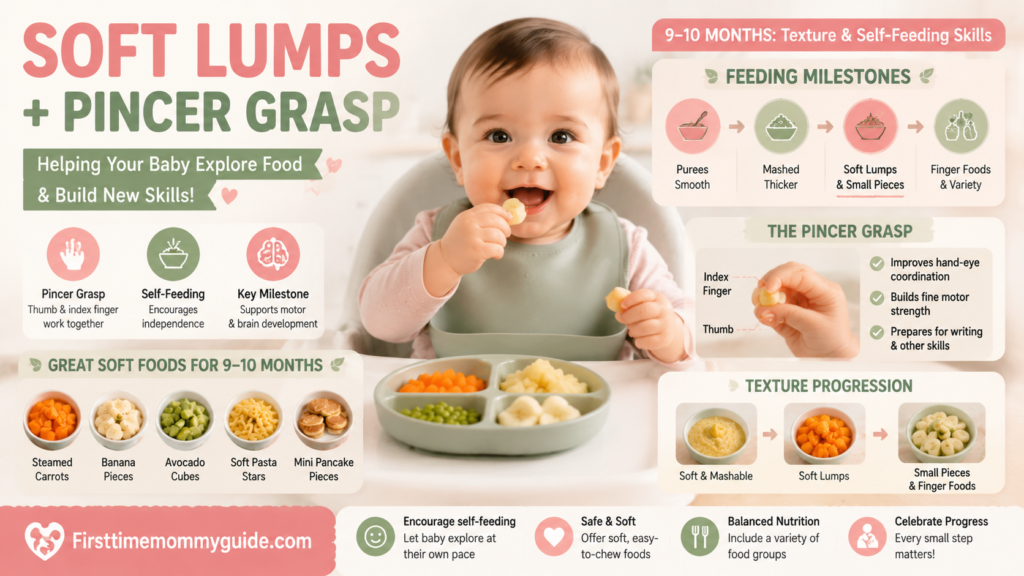
Months 9–10: Soft Lumps and the Pincer Grasp
What to feed
Continue expanding variety: soft-cooked pasta, rice, oatmeal, cottage cheese, well-cooked beans, small pieces of soft fruit, and shredded meats. This is the stage many parents introduce more citrus and acidic foods.
Texture and consistency
Mashed with soft lumps, moving into small, soft, pea-sized pieces. Around 9–10 months, most babies develop the pincer grasp — the ability to pick up small objects between thumb and forefinger — which opens the door to real finger foods.
Portion and frequency
¼–½ cup per meal, three meals a day plus 1–2 small snacks, alongside 3–4 milk feeds.
Safety note
Cut foods to about the size of a pea and make sure they’re soft enough to squish easily between your fingers. Bread-like textures (pancakes, muffins) can be sticky; moistening them with yogurt, applesauce, or milk makes them easier to manage.
Months 11–12: Toward Table Food
What to feed
By now, your baby can eat a version of most family meals — soft-cooked vegetables, diced soft fruit, shredded meat, scrambled eggs, whole-milk yogurt, and small pasta shapes — just chopped smaller and cooked softer than what the rest of the family eats, and kept low in added salt and sugar.
Texture and consistency
Soft, chopped table food, moving away from purees almost entirely unless your baby prefers them. Chewing skills are much stronger, though molars are often still missing.
Portion and frequency
½–¾ cup per meal across three meals plus 1–2 snacks, alongside about three milk feeds a day — though breast milk or formula still matters and shouldn’t be dropped just because solids intake looks good.
The 12-month milestone
At 12 months, cow’s milk can typically replace formula as a drink (with pediatrician confirmation), and honey becomes safe to serve for the first time.
Allergen Introduction Chart (6–12 Months)
Delaying allergenic foods does not prevent allergies — current AAP guidance, based on the LEAP and EAT trials, supports early and regular introduction for all babies, including those without eczema or a family history of allergy.
| Allergen | When to Start | How to Serve |
|---|---|---|
| Peanut | ~6 months (as early as 4 months for high-risk babies, with pediatrician guidance) | Thinned peanut butter mixed into puree, cereal, or breast milk/formula — never whole nuts or a spoonful of peanut butter alone |
| Egg | ~6 months | Well-cooked, mashed scrambled or hard-boiled egg |
| Dairy (yogurt, cheese) | ~6 months | Plain whole-milk yogurt, small amounts of soft cheese |
| Wheat | ~6 months | Infant cereal, soft pasta, bread softened with liquid |
| Soy | ~6 months | Tofu, soy-based infant foods |
| Tree nuts | ~6 months | Smooth nut butter thinned and mixed into food |
| Fish and shellfish | ~6 months | Well-cooked, flaked, and checked carefully for bones |
| Sesame | ~6 months | Tahini thinned into puree or yogurt |
High-risk babies — those with severe eczema or an existing egg allergy — may benefit from introducing peanut as early as 4 months, but this should be discussed with a pediatrician first, and sometimes done under medical supervision.
After introducing any allergen, keep serving it 2–3 times a week; a one-time taste does not build tolerance. If a reaction (hives, vomiting, rash, swelling) occurs, stop the food and contact your pediatrician.
Choking Hazards to Avoid Through 12 Months (and Beyond)
Some foods carry a real choking risk regardless of how they’re prepared and should be avoided until a child is older, generally age 3–4:
- Whole grapes, cherry tomatoes, or berries (unless quartered)
- Whole nuts and seeds
- Popcorn
- Hot dogs and sausages (unless finely diced or cut lengthwise into thin strips)
- Hard raw vegetables and fruit (raw carrot rounds, apple chunks)
- Peanut butter served in a spoonful or thick blob — thin it instead
- Hard candy, marshmallows, chewing gum
- Honey — not a choking hazard, but unsafe before 12 months due to infant botulism risk
Always supervise every meal, keep your baby seated upright, and avoid feeding in a moving car or stroller where you can’t watch closely.
Portion Sizes by Age: A Closer Look
Portion sizes are guidelines, not a target to hit at every meal — appetite varies day to day, and babies are generally very good at self-regulating intake if allowed to.
| Age | Grains/Cereal | Fruits & Vegetables | Protein (meat, egg, beans) | Dairy |
|---|---|---|---|---|
| 6 months | 1–2 Tbsp, 1–2x/day | 1–2 Tbsp each, 1–2x/day | Optional, 1–2 Tbsp | Not yet a main food |
| 7–8 months | 2–4 Tbsp, 2x/day | 2–4 Tbsp each, 2x/day | 1–2 Tbsp, 2x/day | 2–4 Tbsp yogurt/day |
| 9–10 months | ¼ cup, 2–3x/day | ¼ cup each, 2–3x/day | 2–3 Tbsp, 2–3x/day | ¼ cup yogurt or cheese |
| 11–12 months | ¼–½ cup, 3x/day | ¼–½ cup each, 3x/day | ¼ cup, 3x/day | ½ cup dairy/day |
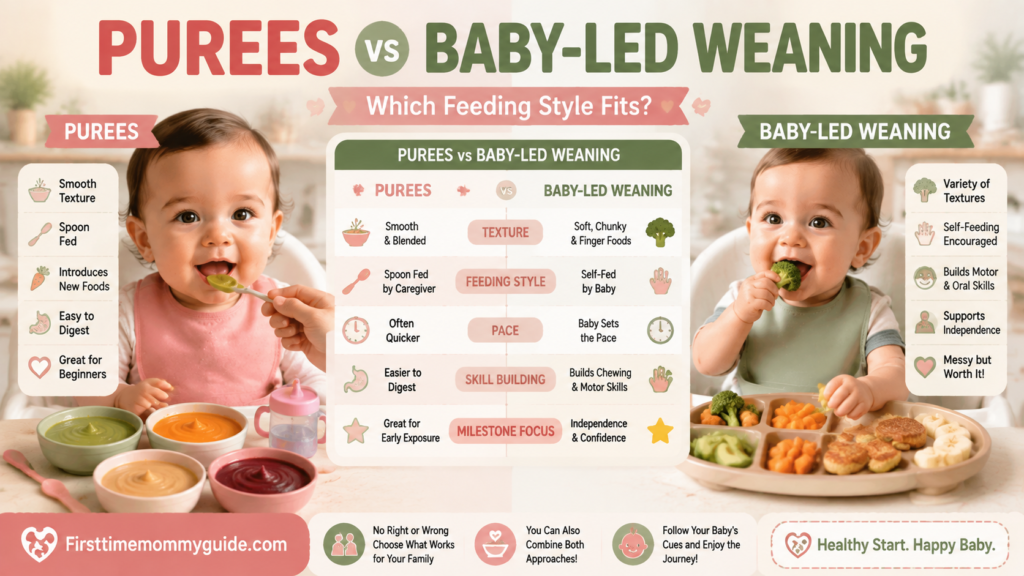
Purees vs. Baby-Led Weaning: Which Approach Fits This Chart?
| Factor | Purees First | Baby-Led Weaning (BLW) |
|---|---|---|
| Texture progression | Smooth → thicker → lumpy → chopped | Soft, graspable pieces from the start |
| Parent control over intake | Higher — you control the spoon | Lower — baby self-feeds and self-paces |
| Mess level | Lower | Higher |
| Choking vs. gagging | Requires separate finger-food introduction later | Gagging is common early on and is a normal, protective reflex — distinct from choking |
| Best for | Parents who want a gradual, controlled introduction | Parents comfortable with more mess and baby-led pacing |
Many families land on a combination approach — offering purees by spoon for iron-rich foods while also giving soft finger foods for self-feeding practice. This chart works for either method; the texture and portion guidance simply shifts from “on a spoon” to “in a graspable piece.”
Common Mistakes to Avoid
- Starting solids before 4 months. Babies aren’t developmentally ready, and it’s linked to a higher choking risk and disrupted milk intake.
- Relying on rice cereal as the only first food. It’s low in nutrients beyond fortified iron; rotate in oatmeal, meat, and legumes.
- Delaying allergens “to be safe.” Current guidance shows the opposite — early, regular exposure reduces allergy risk.
- Adding salt, sugar, or honey. A baby’s kidneys can’t process high sodium loads yet, and honey before 12 months carries a botulism risk.
- Staying on purees too long. Waiting past 9–10 months to introduce lumps and finger foods is associated with picky eating and feeding difficulties later.
- Forcing a “clean plate.” Following hunger and fullness cues supports healthy self-regulation; pressure to finish a portion can work against it.
- Cutting round foods into circles instead of strips. A grape sliced in half is still round and can lodge in the airway — quarter it instead.
Expert Tips for Smoother Feeding
- Offer new foods earlier in the day, when a baby is more alert and less tired.
- Serve one new allergenic food at a time, ideally at home, so you can watch for a reaction.
- Batch-cook and freeze purees in ice cube trays for portion-controlled, low-waste meals.
- Eat together as a family when possible — babies are more likely to accept a food when they see a caregiver eating it too.
- Expect it to take 8–10 exposures to a new food before a baby accepts it. Repeated offering (without pressure) works better than giving up after one refusal.
Related Articles
Baby Essentials Checklist: What New Parents Actually Need
Starting Solids, 6–12 Months: The Complete Feeding Guide
First Foods for Baby at 6 Months: A Complete Guide to Starting Solids
Sweet Potato Puree for Baby: Easy Recipe, Age Guide & Storage Tips
Apple Puree for Baby: Easy Recipe & Safety Guide
Blueberry Puree for Baby: Easy Recipe & Choking Safety Guide
Spinach Puree for Baby: Safe Recipe, Nitrate Facts & Age Guide
Frequently Asked Questions (FAQs)
1. What is the best baby food chart for 6 to 12 months?
The best chart follows a gradual progression: single smooth purees at 6 months, thicker mashed textures with variety at 7–8 months, soft lumps and finger foods at 9–10 months, and chopped table food by 11–12 months — always alongside continued breast milk or formula.
2. How much solid food should a 6-month-old eat?
Around 1–2 tablespoons per meal, once a day to start, gradually increasing as appetite grows. Breast milk or formula still provides the majority of nutrition at this stage.
3. How many meals a day should a 9-month-old have?
Most 9-month-olds eat three meals a day plus one or two small snacks, alongside three to four milk feeds.
4. What foods should be avoided before 12 months?
Honey (botulism risk), added salt and sugar, whole nuts, whole grapes, popcorn, hard raw vegetables, and any food that isn’t cut small and soft enough to squish easily.
5. When should I introduce allergens like peanut and egg?
Around 6 months, alongside other solid foods, and continued regularly afterward. High-risk babies (severe eczema or egg allergy) may start peanut as early as 4 months under a pediatrician’s guidance.
6. Can I give my baby cow’s milk before 12 months?
No — cow’s milk as a main drink isn’t recommended before 12 months, though small amounts in cooking or mixed into food (like yogurt or cheese) are fine earlier.
7. What’s the difference between gagging and choking?
Gagging is loud, active, and often looks dramatic but is a normal reflex that pushes food forward, away from the airway. Choking is silent or accompanied by weak coughing, with the baby unable to breathe, cry, or make noise — it requires immediate action.
8. Is baby-led weaning safer or riskier than purees?
Research hasn’t found a meaningful difference in choking rates between the two approaches when foods are prepared safely (soft, appropriately sized). The bigger safety factor is food preparation and supervision, not the method itself.
9. How do I know if my baby is ready for finger foods?
Once a baby can sit independently, bring food to their mouth, and show early signs of a pincer grasp (usually 8–10 months), they’re ready for soft, pea-sized finger foods.
10. What should a 12-month-old’s meal look like?
Roughly ½–¾ cup of soft, chopped table food per meal — a mix of grains, protein, fruit or vegetable, and dairy — three times a day plus snacks, alongside about three milk feeds.
11. Do I need to introduce foods in a specific order?
No strict order is required, but many pediatric guidelines suggest starting with iron-rich foods (fortified cereal, pureed meat, legumes) first, since a baby’s iron stores begin declining around 6 months.
12. What if my baby refuses a new food?
Keep offering it — without pressure — across multiple sittings. It commonly takes 8–10 exposures before a baby accepts an unfamiliar taste or texture.
13. Can I season my baby’s food?
Mild herbs and spices (cinnamon, garlic, cumin) are fine and can help build a broader palate. Avoid added salt and sugar specifically.
14. How much water should my baby drink?
Small sips of water (2–4 oz/day) can be offered with meals starting around 6 months, but it shouldn’t replace breast milk or formula as the main fluid source.
15. What’s a good first food for a 6-month-old?
Iron-fortified infant cereal, pureed meat, mashed avocado, sweet potato, or banana are all commonly recommended first foods.
16. Should I sterilize baby food equipment?
Standard clean washing (hot, soapy water) is sufficient for feeding equipment once baby starts solids; sterilizing is more relevant for bottle and formula prep in the first months.
17. Is store-bought baby food as good as homemade?
Both can be nutritionally sound. Store-bought pouches offer convenience and consistency; homemade purees let you control texture progression and ingredients more directly. Many families use a mix of both.
18. How do I transition from purees to table food?
Gradually thicken purees, add soft lumps, then progress to small soft pieces of the same foods the family eats — moving at the pace your baby’s chewing and swallowing skills allow.
19. What’s the right texture for a 7-month-old?
Thicker, slightly lumpy purees and soft mashes — no longer completely smooth, but not yet chunky.
20. Can babies have citrus fruit?
Yes, typically from around 7 months onward; citrus is not considered a top allergen, though mild skin irritation around the mouth (not a true reaction) is common and harmless.
21. What’s the safest way to serve peanut butter?
Thin it with water, breast milk, formula, or puree, and mix it into another food — never serve a spoonful or thick blob on its own, which is a choking hazard.
22. How long can homemade baby puree be stored?
Generally 48–72 hours refrigerated, or up to 1–3 months frozen in an airtight container or ice cube tray, though this varies by ingredient.
23. What if my baby has a family history of food allergies?
Talk to a pediatrician before starting allergen introduction; some high-risk babies benefit from starting peanut as early as 4 months, sometimes with allergy testing first.
24. Should I follow a strict feeding schedule?
A loose structure (offering meals at similar times as family meals) helps babies learn routine, but rigid adherence to portion size isn’t necessary — following hunger cues matters more.
25. What are signs my baby is full?
Turning their head away, closing their mouth, pushing the spoon away, or playing with food instead of eating it are all normal fullness cues.
26. Can teething affect feeding?
Yes — many babies temporarily eat less or prefer cold, soothing foods during teething flare-ups. This is normal and usually passes within a few days.
27. When can babies start using a spoon themselves?
Most babies start experimenting with self-feeding by spoon around 9–12 months, though it’s messy and takes practice well past the first birthday.
28. Is it normal for babies to eat less some days?
Yes — appetite naturally fluctuates with growth spurts, teething, illness, and general mood, just as it does in adults.
29. What vegetables are best to start with?
Sweet potato, carrot, peas, squash, and avocado are common first vegetables due to their mild flavor and soft, easy-to-puree texture.
30. Can babies eat spicy food?
Mild spice exposure is generally fine and can support flavor acceptance later, but very hot or heavily spiced dishes should wait until the child is older and can tolerate it.
31. How much protein does a baby need daily?
Roughly 2–3 tablespoons of a protein source (meat, egg, beans, dairy) per meal by 9–12 months is a reasonable guideline, alongside continued milk feeds.
32. What’s the difference between baby cereal and regular oatmeal?
Infant cereal is typically fortified with iron and processed to a finer, easier-to-mix texture; plain oatmeal can be used too but should be well-cooked and blended smooth for younger babies.
33. Should I avoid gluten?
No — current guidance supports introducing gluten-containing foods (wheat, oats with cross-contact) around 6 months along with other solids, rather than delaying it.
34. How do I introduce fish safely?
Serve well-cooked, boneless, flaked fish in small amounts, starting around 6–7 months, and continue offering it regularly once tolerated.
35. What should I do if my baby gags a lot?
Gagging is a normal, protective reflex, especially with new textures. Stay calm, let your baby work through it, and avoid pulling food out of their mouth unless they’re truly choking.
36. Can I mix breast milk into solid foods?
Yes — thinning purees with breast milk or formula is a common and safe way to adjust texture and add familiar flavor.
37. Is baby yogurt necessary, or can I use regular yogurt?
Plain, whole-milk regular yogurt (unsweetened) works well and is often more cost-effective than baby-branded yogurt, which can contain added sugar.
38. What’s a realistic weekly meal rotation look like at 10 months?
A rotation across iron-rich proteins, 2–3 vegetables, 2 fruits, a grain, and dairy, repeated with variation, ensures both nutrient coverage and ongoing allergen exposure.
39. When should I contact a doctor about feeding concerns?
If your baby consistently refuses all solids past 7–8 months, shows signs of a true allergic reaction, isn’t gaining weight as expected, or struggles significantly with textures, check in with your pediatrician.
40. Does this chart apply to premature babies?
Not directly — premature babies often start solids based on adjusted (corrected) age rather than chronological age, and a pediatrician should guide the timeline.

Dilawar Mughal
Founder and editor, First Time Mommy Guide
I research every guide against what the NHS, the AAP and the WHO publish, then write it in plain English — because most new parents are reading with one hand free, not comparing clinical guidelines. I'm not a doctor or a midwife. Every health claim on this site is sourced and linked so you can check it yourself, and anything urgent belongs with your health visitor or GP, not a blog.