General information, not medical advice. Every baby is different — if anything worries you, speak to your midwife, health visitor or GP rather than waiting.
Choosing a baby stroller feels like it should be simple — until you walk into a shop or open a comparison site and find dozens of models, each claiming to be the one. Full-size, lightweight, travel system, jogging, double, all-terrain: the categories blur, the prices range from under $100 to over $1,000, and every parent you ask swears by something different.
The truth is that there is no single best stroller. There is a best stroller for your life: your home, your car, your streets, your budget, and how you actually spend your days. This guide helps you work that out before you spend a cent, so you buy once and buy right.
Quick answer: To choose a baby stroller, start with your lifestyle: city parents need a light, compact, easy-fold model; suburban and rural parents need bigger wheels and storage; frequent drivers need a travel system that clicks with a car seat. Newborns need a fully flat recline or a bassinet. Always check the harness, brakes, stability, and fold before buying.
Key Takeaways
- Match the stroller to your daily life, not to a review ranking — your streets, car boot, and home storage matter most.
- Newborns must lie flat (or in a bassinet) until they can sit up unaided, usually around 6 months.
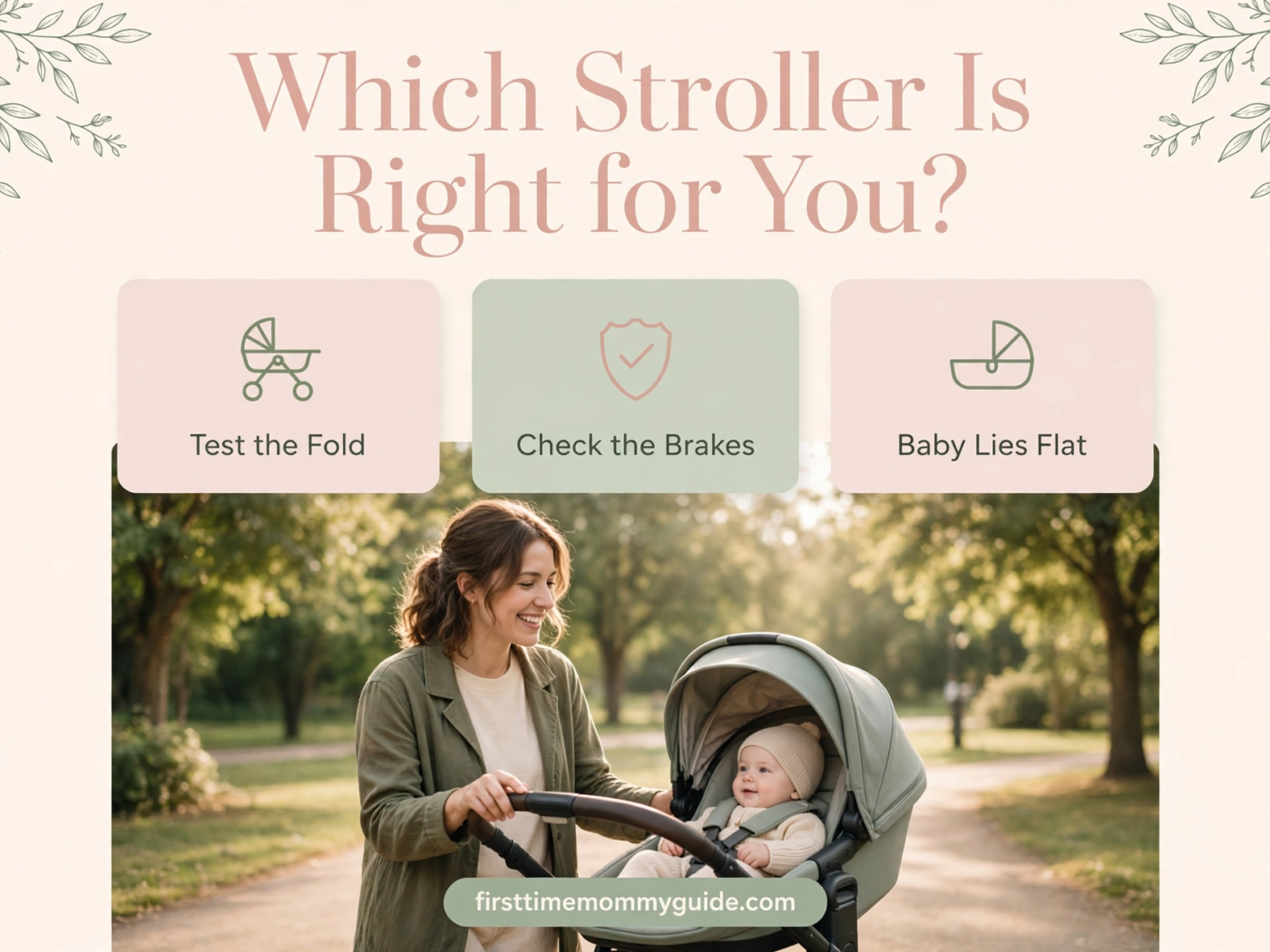
- Test the fold, the weight, and the push with one hand before buying — you will do all three while holding a baby.
- A 5-point harness, reliable brakes, and a stable frame that does not tip easily are non-negotiable safety features.
- Budget for accessories separately: rain cover, cup holder, and footmuff often cost extra.
Start With Your Life, Not the Stroller
Before comparing models, answer these questions honestly. Your answers narrow the field faster than any review.
- Where will you walk most? Smooth pavements, city streets, parks, gravel paths, or countryside trails?
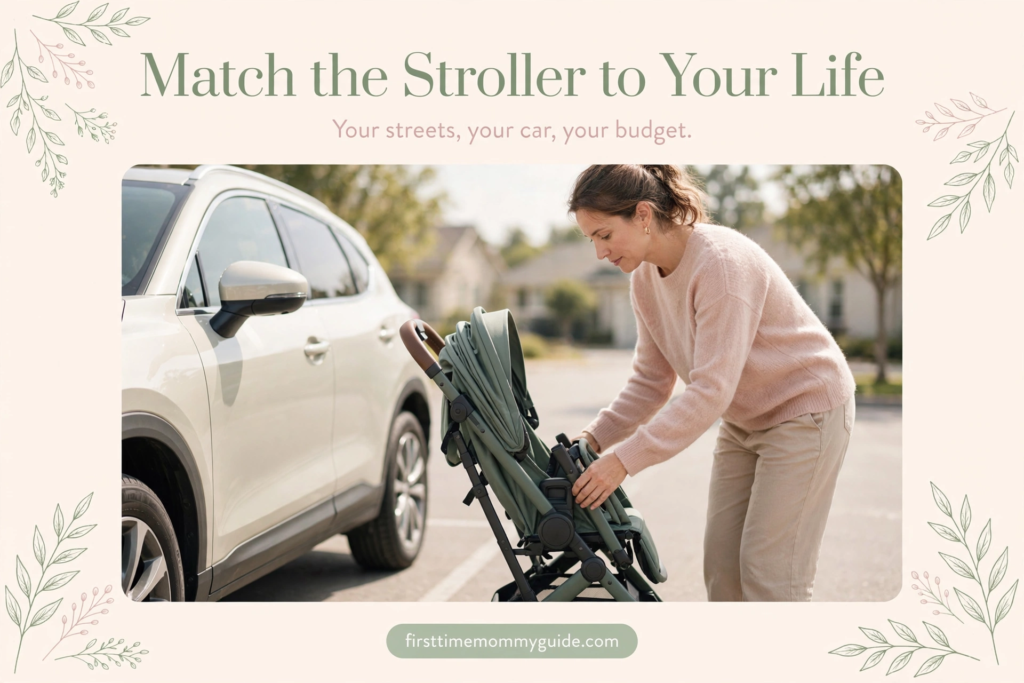
- Do you drive? How big is your car boot, and will you fold the stroller daily?
- Do you use public transport? Buses and trains demand light weight and a fast one-hand fold.
- Where will you store it? A hallway, a flat with no lift, a garage — weight and folded size matter differently in each.
- How many children? One baby now, twins, or a toddler plus a newborn on the way?
- What is your budget? Include accessories, which can add $50–$150.
A parent who walks city pavements and takes the bus needs a very different stroller from a parent who drives to forest trails. Keep your answers in mind through every section below.
Stroller Types Compared
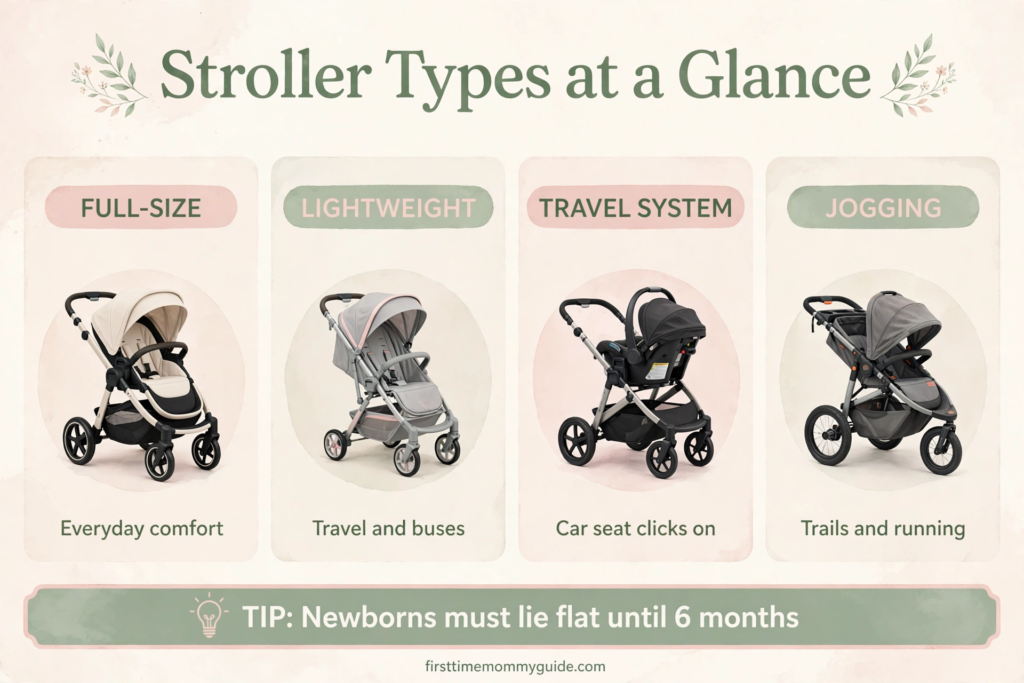
Full-size strollers
Full-size strollers are the all-rounders: sturdy, comfortable, with good storage, a large seat, and usually a bassinet option for newborns. They handle daily walks well and last from birth to toddlerhood. The trade-off is weight (often 22–30 lbs / 10–14 kg) and folded size — check your car boot before buying.
Best for: Everyday use, parents with car boot space, first stroller for most families.
Lightweight / umbrella strollers
Lightweight strollers fold small, weigh as little as 11–15 lbs (5–7 kg), and are easy to carry up stairs or onto buses. Most are not suitable from birth, because their seats do not recline fully flat — they suit babies who can sit up, around 6 months and older. They are brilliant as a second stroller or for travel.
Best for: Travel, public transport, small homes, second stroller for older babies.
Travel systems
A travel system pairs a stroller frame with an infant car seat that clicks on and off. You can move a sleeping baby from car to stroller without waking them — a genuinely life-changing feature in the early months. Most systems also include a bassinet or a seat that reclines flat. Check that the car seat fits your car and meets current safety standards before committing.
Best for: Parents who drive daily, newborns, anyone who values undisturbed transfers.
Jogging strollers
Jogging strollers have three large wheels, a fixed or lockable front wheel, suspension, and a hand brake. They are built for running and rough terrain. They are not suitable for newborns unless they accept a bassinet or car seat, and most manufacturers advise waiting until the baby is 6–8 months old before jogging. They are also wider and heavier than everyday strollers.
Best for: Active parents, runners, rough terrain, long outdoor walks.
All-terrain strollers
All-terrain strollers bridge full-size and jogging models: four wheels, good suspension, and larger, often puncture-resistant tyres. They handle parks, gravel, and countryside paths better than city strollers, without the bulk of a true jogger.
Best for: Rural and suburban families, mixed surfaces, outdoor lifestyles.
Double strollers
Double strollers come in two layouts: side-by-side (wider, easier to push, harder through doors) and tandem (one seat behind the other, narrower, longer, heavier to steer). Side-by-side suits twins of similar age; tandem suits a newborn and a toddler. Test door widths in your home and car boot space carefully — doubles are big.
Best for: Twins, two children under three, siblings close in age.
| Type | Weight (typical) | From birth? | Best terrain | Fold size |
|---|---|---|---|---|
| Full-size | 22–30 lbs | Yes, with bassinet/flat recline | Pavements, parks | Medium–large |
| Lightweight | 11–15 lbs | Usually no (6 months+) | Smooth pavements | Small |
| Travel system | 20–30 lbs | Yes | Pavements, parks | Medium–large |
| Jogging | 25–35 lbs | With bassinet/car seat only | Rough terrain, trails | Large |
| All-terrain | 22–30 lbs | Yes, with bassinet/flat recline | Mixed surfaces | Medium–large |
| Double | 28–40 lbs | Depends on model | Pavements, parks | Large |
The Newborn Rule: Lying Flat Matters
Newborns cannot support their own heads, and their airways are vulnerable when they sit semi-upright for long periods. That is why paediatric guidance recommends that babies under about 6 months lie flat when in a stroller, either in a bassinet (carrycot) or in a seat that reclines to a fully flat position.
If you buy a stroller before birth, make sure it offers one of these options. A bassinet is ideal for the first months — it is also a handy supervised nap spot at home. If your chosen stroller’s seat reclines fully flat, that works too. What does not work for a newborn is a standard upright bucket seat, however padded it looks.
The same flat-and-firm principle applies to sleep. Our safe sleep for newborns guide explains why firm, flat surfaces matter, and our newborn sleep routine guide covers how sleep patterns evolve.
Safety Features You Must Check
5-point harness
Every stroller should have a 5-point harness: straps over both shoulders, around both hips, and between the legs, all meeting at a central buckle. It should adjust easily as your baby grows, and the buckle should be secure enough that a toddler cannot open it but simple enough for an adult to release one-handed in an emergency.
Brakes
Test the brakes in the shop. A single-action brake bar that locks both rear wheels is easier and safer than two separate pedal brakes. Push the stroller with the brakes on — it should not move. Always apply the brakes whenever you stop, even on flat ground, and never hang heavy bags on the handlebar, which can tip the stroller backwards.
Stability
A stable stroller resists tipping when your baby leans or when bags hang on the handles. In the shop, press down on the handlebar and lean the stroller slightly — it should feel planted. Be wary of very light strollers with high seats, which tip more easily. The shopping basket should sit low and central for balance.
Wheel locks and suspension
A lockable front swivel wheel gives you manoeuvrability in shops and stability on rough ground. Suspension matters if you walk on uneven surfaces regularly; on smooth pavements it is less critical. Check that wheels are securely attached and that tyres are in good condition.
Sun and weather protection
A large, extendable canopy with UV protection (UPF 50+) shields your baby from sun and wind. Check how far the canopy extends — a small hood leaves legs and face exposed. Never drape a blanket or cloth over the canopy to add shade: it restricts airflow and can dangerously overheat the stroller. Our baby sunscreen guide explains sun protection for babies under six months, when sunscreen use is limited.
Recalls and standards
Buy from reputable retailers, check that the stroller meets your country’s current safety standards, and register the product so the manufacturer can contact you about recalls. For second-hand strollers, check the model for recalls, inspect the frame, harness, brakes, and wheels carefully, and replace any worn straps.
Comfort for Your Baby
- Seat padding and recline. A padded seat with multiple recline positions — including fully flat for newborns and upright for curious toddlers — covers every stage.
- Leg rest. An adjustable leg rest supports growing legs and lets toddlers nap comfortably.
- Canopy size. A big canopy with a peek-a-boo window lets you check on your baby without disturbing them.
- Suspension and wheels. Larger wheels and suspension smooth out bumps; air-filled tyres ride softest but can puncture, while foam-filled tyres are maintenance-free.
- Ventilation. Mesh panels and breathable fabrics keep your baby cool in summer.
Comfort for You
You will push this stroller thousands of times. Your comfort matters as much as your baby’s.
- Handlebar height. An adjustable handlebar suits parents of different heights and prevents back strain. Telescoping bars are better than pivoting ones for tall parents.
- One-hand push and fold. You will often hold your baby, a bag, and a coffee while folding the stroller. Practise the fold in the shop until it feels natural.
- Weight. Lift the folded stroller into a car boot yourself, in the shop, before buying. A stroller you cannot lift comfortably is the wrong stroller.
- Storage basket. A large, accessible basket holds the nappy bag, shopping, and jackets. Check access when the seat is reclined — some baskets become unusable in recline mode.
- Cup holder and parent console. Small additions that make daily outings much easier; often sold separately.
Budget: What to Expect
Stroller prices vary enormously, and price does not always track quality. A sensible budget framework:
| Budget | What you get | Watch out for |
|---|---|---|
| Under $150 | Basic lightweight or umbrella models | Often not suitable from birth; smaller baskets; limited suspension |
| $150–$400 | Good full-size and travel system options | Check newborn suitability and fold size |
| $400–$800 | Premium full-size, all-terrain, and travel systems | Accessories often sold separately |
| $800+ | Luxury brands, doubles, high-end joggers | Diminishing returns; check weight and boot fit |
Buying second-hand can save hundreds. Inspect the frame for cracks, test brakes and harness, check for recalls, and wash fabrics before use. Avoid second-hand strollers with missing parts, damaged harnesses, or unknown histories.
Budget for accessories: rain cover, footmuff or cosy toes, cup holder, parasol or sunshade, and a stroller organiser. Some brands bundle these; many do not, and accessory costs add up fast.
Step-by-Step: How to Choose in the Shop
- Bring your car. Fold each shortlisted stroller and try it in your boot. If it does not fit easily, cross it off.
- Push it one-handed. Steer around the shop with one hand, as you will in real life.
- Fold and unfold it repeatedly. If the fold needs two hands, a foot, and a manual, it will frustrate you daily.
- Lift it. Carry the folded stroller up a few steps, as you would at home or on transport.
- Check the recline. Lie the seat fully flat and sit it fully upright. Test the harness adjustments.
- Test the brakes. Lock them and push hard. Check they release easily.
- Sit your baby’s weight in it. Use a shop demo doll or a bag of similar weight to test stability and push feel.
- Check the basket. Load it with your nappy bag and see if access stays easy.
- Measure your doors. Note the stroller’s width against your narrowest doorway and lift.
- Sleep on it. A stroller is a big purchase. Shortlist two models, compare prices and accessories at home, then decide.
Travel Systems: Worth It?
Travel systems solve a real problem: transferring a sleeping baby between car and stroller without waking them. In the first six months, when car trips and naps dominate, this convenience is hard to overstate. The downsides are weight, bulk, and the fact that infant car seats are outgrown around 12 months, after which you use the stroller seat alone.
A travel system is worth it if you drive most days. If you rarely drive or mostly walk and use public transport, a lightweight stroller with a bassinet may serve you better and cost less. Check car seat compatibility carefully: not every infant seat fits every stroller frame, and adapters are sometimes sold separately.
Stroller Mistakes First-Time Parents Make
- Buying for the fantasy, not the reality. The rugged all-terrain jogger is wasted if you walk city pavements; the ultra-light umbrella stroller frustrates on country lanes.
- Ignoring folded size. A stroller that does not fit your boot or hallway becomes a daily battle.
- Skipping the in-shop test. Online reviews cannot tell you how a stroller feels in your hands.
- Forgetting the newborn flat rule. Buying a seat-only stroller before birth and discovering it does not recline flat.
- Hanging heavy bags on the handlebar. This is the most common cause of stroller tip-overs. Use the basket instead.
- Leaving the baby in the stroller too long. Strollers are for transport, not all-day sleep or play. Give your baby floor time, tummy time, and free movement every day.
- Buying every accessory upfront. Start with the essentials and add accessories once you know what you actually need.
- Not checking recalls on second-hand buys. A quick model search takes minutes and can prevent serious harm.
Stroller Care and Maintenance
- Clean regularly. Wipe the frame, wash fabric covers per the label, and clean wheels after muddy walks.
- Check brakes and harness monthly. Straps fray and brakes wear; a monthly check catches problems early.
- Lubricate moving parts. A drop of silicone lubricant on folding joints keeps the mechanism smooth.
- Store dry. Damp storage breeds mould on fabrics and rust on frames.
- Follow weight limits. Overloading the basket or seat affects stability and voids warranties.
When Your Baby Outgrows the Stroller
Most children use a stroller until age 3–4, though usage drops sharply once walking confidently. Signs your child is ready to walk more: they resist the stroller, climb out, or exceed the weight limit. Keep a lightweight stroller for longer outings, travel, and tired days even after daily use ends. Our guide to baby milestones at 6 months helps you track the sitting, crawling, and mobility stages that shape stroller needs.
Expert Tips
- Test with your real nappy bag. Bring it to the shop and load the basket — advertised basket sizes mislead.
- Check the canopy in sunlight. Step outside with the display model if the shop allows it.
- Ask about spare parts. Wheels, tyres, and fabric replacements extend a stroller’s life enormously.
- Consider resale value. Premium brands hold value well; a popular model resells easily if your needs change.
- Register your stroller. Warranty claims and recall notices depend on it.
- Practise the fold at home before the first outing. A calm living-room rehearsal beats a stressful car park struggle with a crying baby.
Strollers for Special Situations
Twins and two under two
Double strollers are a world of their own. Side-by-side models are easier to push and steer, and both children get an equal view, but they can be too wide for narrow shop aisles, older lifts, and some doorways — measure your narrowest regular doorway before buying. Tandem models fit through standard doors but are long, heavy, and harder to turn in tight spaces. If your children are different ages, a tandem with a bassinet for the baby and a seat for the toddler often works best. Some families skip a double entirely and pair a single stroller with a buggy board for the older child — cheaper, lighter, and often more practical once the toddler prefers walking.
City living without a car
If you live in a flat, use buses and trains, and carry your stroller up stairs, weight and fold speed matter more than anything else. Look for a stroller under 16 lbs (7 kg) with a true one-hand fold and a carry strap or handle. Test it folded on a bus: can you hold it, hold your baby, and hold a rail at the same time? Check your building’s lift size too — a stroller that does not fit in the lift is a daily problem.
Air travel with a stroller
For flying, a compact, lightweight stroller that folds small enough for cabin storage is ideal, though airline rules vary and many parents gate-check a sturdier model instead. A travel bag protects your stroller in the hold. If you gate-check, remove accessories, cup holders, and anything detachable first. Some airlines allow a stroller plus a car seat free of charge — check your airline’s policy before you fly.
Tall or short parents
Handlebar height matters enormously over thousands of pushes. Parents over 6 feet tall often kick the rear axle of short-handled strollers; parents under 5 feet 3 inches may struggle to see over a high canopy or reach a high handlebar. An adjustable telescoping handlebar solves both problems and is worth prioritising if two parents of different heights share the stroller.
Winter and wet climates
If you walk in rain, snow, and cold, look for large wheels, good suspension, a full rain cover included in the box, and a footmuff that fits your model. Foam-filled tyres beat air-filled ones in winter, because punctures in freezing weather are miserable to fix. Mudguards or a longer canopy help in driving rain, and a stroller with washable fabrics survives muddy winters far better.
Accessories Worth Buying — and Ones to Skip
Worth it:
- Rain cover. Essential for wet climates; buy the model-specific one for a proper fit.
- Footmuff. Keeps toddlers warm without loose blankets, which are a safety risk in a moving stroller.
- Cup holder or parent console. For your water bottle, phone, and keys — a small luxury that pays off daily.
- Stroller organiser. Hangs on the handlebar for essentials; keep it light to avoid tipping.
- Sunshade or parasol. Extends shade beyond the canopy on bright days.
- Travel bag. Protects your stroller in car boots, aeroplane holds, and storage.
Often skippable:
- Fancy liners. Nice to look at, but they add laundry and rarely improve comfort.
- Toy bars and entertainment attachments. Babies lose interest quickly, and dangling toys become projectiles on bumpy paths.
- Designer changing bags that only fit one brand. A good backpack works with any stroller and leaves your hands free.
- Stroller fans and gadgets. Battery-powered extras add weight and rarely survive daily use.
Start with the essentials and add accessories after a few weeks of real use, when you know what your outings actually demand.
Stroller vs Baby Carrier: When Each Wins
A stroller is not always the right tool. Baby carriers and slings win in some situations, and many parents use both.
| Situation | Better choice | Why |
|---|---|---|
| Newborn errands and housework | Carrier | Keeps baby close, hands free, no wheels to manage |
| Long walks and shopping | Stroller | Less strain on your back, storage for bags |
| Public transport at rush hour | Carrier | No folding, no aisle blocking |
| Rough trails and beaches | Carrier or all-terrain stroller | Wheels struggle in sand; carriers handle steps |
| Hot weather | Stroller | Carriers add body heat; strollers allow airflow |
| Baby naps on the go | Stroller with bassinet | Flat, safe, and easy to transfer |
A carrier also supports bonding and can soothe a fussy baby when the stroller does not. Many parents find a soft structured carrier for the early months and a stroller for longer outings is the combination that covers everything.
Second Strollers: When One Is Not Enough
Many parents end up owning two strollers, and that is not wasteful — it is practical. A full-size stroller handles daily walks and shopping, while a lightweight umbrella stroller lives in the car boot or by the front door for quick trips, travel, and public transport. The lightweight model also serves as a backup when the main stroller is being cleaned or repaired.
If you go this route, buy the full-size stroller first and use it for a few months before choosing the lightweight one. By then you will know exactly what frustrates you about the big model — weight, fold, or size — and you can pick a second stroller that fixes that specific problem rather than guessing. Second-hand lightweight strollers are excellent value, since they get less daily wear, and they resell easily when your child outgrows them.
Some parents add a third option: a jogging stroller for exercise, or a wagon for toddlers who want to climb in and out. Each addition should solve a real, recurring problem in your week. If it does not, it becomes garage clutter.
Questions to Ask Before You Buy
Before you hand over any money, run through this quick list — it catches the details that cause regret later.
- Does the seat recline fully flat, or does it need a bassinet for a newborn?
- What is the stroller’s weight, and can I lift it into my car boot alone?
- Does it fold with one hand, and does it stand upright when folded?
- Are the rain cover, footmuff, and adapters included, or sold separately?
- What is the maximum weight limit, and how long will it realistically last my child?
- Does the car seat I already own (or plan to buy) click onto this frame?
- What does the warranty cover, and are spare wheels and fabrics available?
- Has this model ever been recalled, and is it still in production?
If a retailer cannot answer these, or the answers do not match your daily life, keep looking. The right stroller answers every one of these questions cleanly.
Frequently Asked Questions
What is the best stroller for a newborn?
A stroller with a bassinet or a seat that reclines fully flat. Travel systems with an infant car seat and bassinet are popular for newborns, as are full-size strollers with a bassinet attachment. Avoid upright bucket seats until your baby can sit unaided, around 6 months.
When can my baby sit in a regular stroller seat?
When they can sit up unaided and hold their head steady, usually around 6 months. Before that, use a bassinet or fully flat recline. Always follow your stroller manufacturer’s age and weight guidance.
Are travel systems worth the money?
If you drive daily, yes — moving a sleeping baby from car to stroller without waking them is a major daily convenience. If you rarely drive, a stroller with a bassinet may be better value.
How much should I spend on a stroller?
Good strollers exist at every price. Expect $150–$400 for a solid full-size or travel system, and more for premium or double models. Prioritise safety, fold, weight, and fit over brand prestige.
What is the difference between a stroller and a pram?
Traditionally, a pram is a bassinet on wheels for newborns who lie flat, while a stroller (or pushchair) has a seat for older babies. Modern combination models convert from pram to stroller as your baby grows.
Can I jog with a regular stroller?
No. Regular strollers are not designed for jogging speeds or rough terrain and can tip or lose control. Use a dedicated jogging stroller with a fixed front wheel and hand brake, and wait until your baby is at least 6–8 months old.
Are lightweight strollers safe for newborns?
Most lightweight strollers are not suitable from birth because they do not recline fully flat. A few do — check the manufacturer’s age guidance and confirm a fully flat recline before using one with a newborn.
What size stroller fits in a car boot?
Measure your boot before shopping, and test the fold in the shop. Compact folds suit small cars; full-size and double strollers need medium to large boots. Bring your car to the shop if possible.
Should I buy a stroller before the baby arrives?
Yes, if you can — you will need it from the first outings, and shopping with a newborn is harder. Buy a model with a bassinet or flat recline, and practise the fold before birth.
Is a second-hand stroller safe?
It can be, if you check for recalls, inspect the frame, harness, brakes, and wheels, and confirm all parts are present. Avoid strollers with damaged harnesses, cracked frames, or unknown histories.
How do I stop my stroller tipping over?
Use the low storage basket for bags, never hang heavy bags on the handlebar, always apply brakes when stopped, and keep your baby harnessed. Choose a stable model with a wide wheelbase.
Do I need a rain cover and footmuff?
A rain cover is essential if you walk in wet weather; a footmuff keeps toddlers warm in winter. Both are often sold separately, so budget for them. Check compatibility with your exact model.
What is a 5-point harness and why does it matter?
A 5-point harness secures your baby at both shoulders, both hips, and between the legs. It prevents climbing out, sliding down, and injury in a tip or sudden stop. Always use it, even for short trips.
Can my baby sleep overnight in a stroller bassinet?
No. Stroller bassinets are for supervised naps and outings, not overnight sleep. Overnight, use a cot, crib, or bassinet that meets overnight sleep safety standards, on a firm flat mattress.
How long will my child use a stroller?
Most children use a stroller until age 3–4, with heavy use in the first two years. Usage tapers as walking confidence grows, but a lightweight stroller remains useful for travel and long days out.
Side-by-side or tandem double stroller — which is better?
Side-by-side doubles push more easily and give both children equal views, but are wider and may not fit through narrow doors. Tandem doubles fit through doors but are longer and harder to steer. Choose based on your door widths and children’s ages.
What should I look for in stroller wheels?
Larger wheels handle rough ground better; smaller wheels suit smooth pavements. Air-filled tyres ride softest but can puncture; foam-filled tyres are puncture-proof but firmer. Lockable swivel front wheels offer the best of both worlds.
Do strollers expire?
Strollers do not have a formal expiry date, but materials wear, safety standards change, and recalled models should be retired. Replace a stroller with a damaged frame, worn harness, or faulty brakes rather than repairing critical safety parts yourself.
Further Reading From Authoritative Sources
- American Academy of Pediatrics: Back to Sleep, Tummy to Play — why a flat, firm surface matters for babies, the same principle behind the newborn lie-flat rule for strollers.
- U.S. Consumer Product Safety Commission: Home Safe with Young Children — official guidance on safe sleep, product recalls, and checking children’s gear for safety.
Conclusion
Choosing a baby stroller comes down to one principle: fit the stroller to your life, not your life to the stroller. Start with where you walk, how you travel, and where you store it. Insist on a fully flat option for a newborn, a 5-point harness, reliable brakes, and a fold you can manage one-handed. Test your shortlist in person, in your car, with your bag — and then stop second-guessing.
The right stroller will not make parenting easy, but it will make getting out of the house easier — and in the first year, that counts for a lot. Once you have chosen, our safe sleep for newborns checklist helps you make sure every outing and nap is as safe as your new wheels.
Safety note: This article is for general information only. Always follow your stroller manufacturer’s instructions, use the harness on every outing, apply brakes whenever you stop, and never leave your baby unattended in a stroller. Check for product recalls regularly and register your stroller after purchase.
Sources and further reading: The American Academy of Pediatrics’ guide How to Keep Your Sleeping Baby Safe explains why a baby who falls asleep in a stroller should be moved to a firm, flat sleep surface, and NHS Baby basics covers everyday baby care.

Dilawar Mughal
Founder and editor, First Time Mommy Guide
I research every guide against what the NHS, the AAP and the WHO publish, then write it in plain English — because most new parents are reading with one hand free, not comparing clinical guidelines. I'm not a doctor or a midwife. Every health claim on this site is sourced and linked so you can check it yourself, and anything urgent belongs with your health visitor or GP, not a blog.