General information, not medical advice. Every baby is different — if anything worries you, speak to your midwife, health visitor or GP rather than waiting.
Baby clothes sizes look simple until you try to buy them. One brand labels a sleepsuit 0–3 months, another labels the same garment 3–6 months, and your baby outgrows both in different ways. Add weight, height, cloth nappies, and seasonal layering, and choosing baby clothes by size can feel like guesswork.
This guide removes the guesswork. You will learn how baby clothes sizes actually work, how to measure your baby at home, and how to use weight and height rather than age alone. You will find size charts, a step-by-step measuring guide, quantity advice, fabric and safety guidance, and the mistakes that waste the most money.
Quick Answer: Choosing Baby Clothes by Size
Baby clothes sizes are usually based on age ranges, but weight and height predict fit far better than age. Always check the brand’s own size chart, because sizes vary widely between brands and countries.
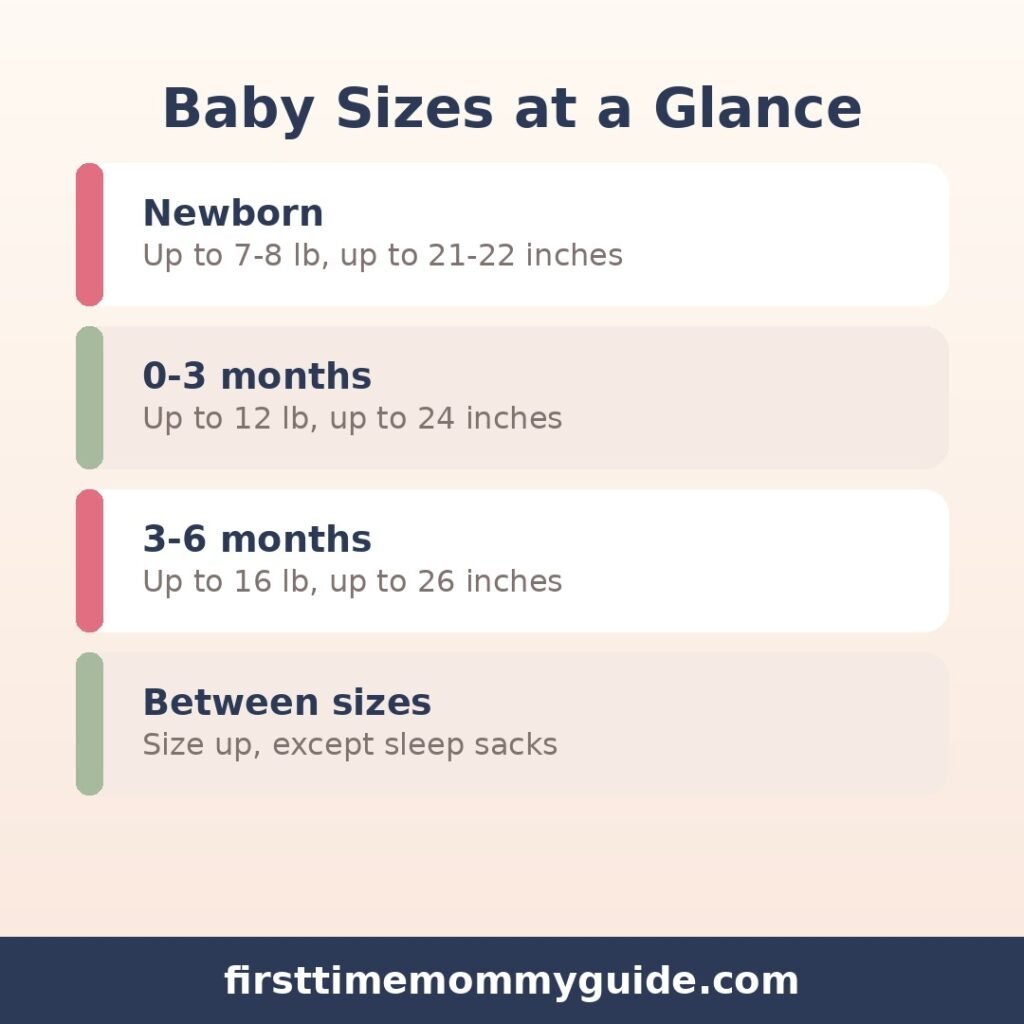
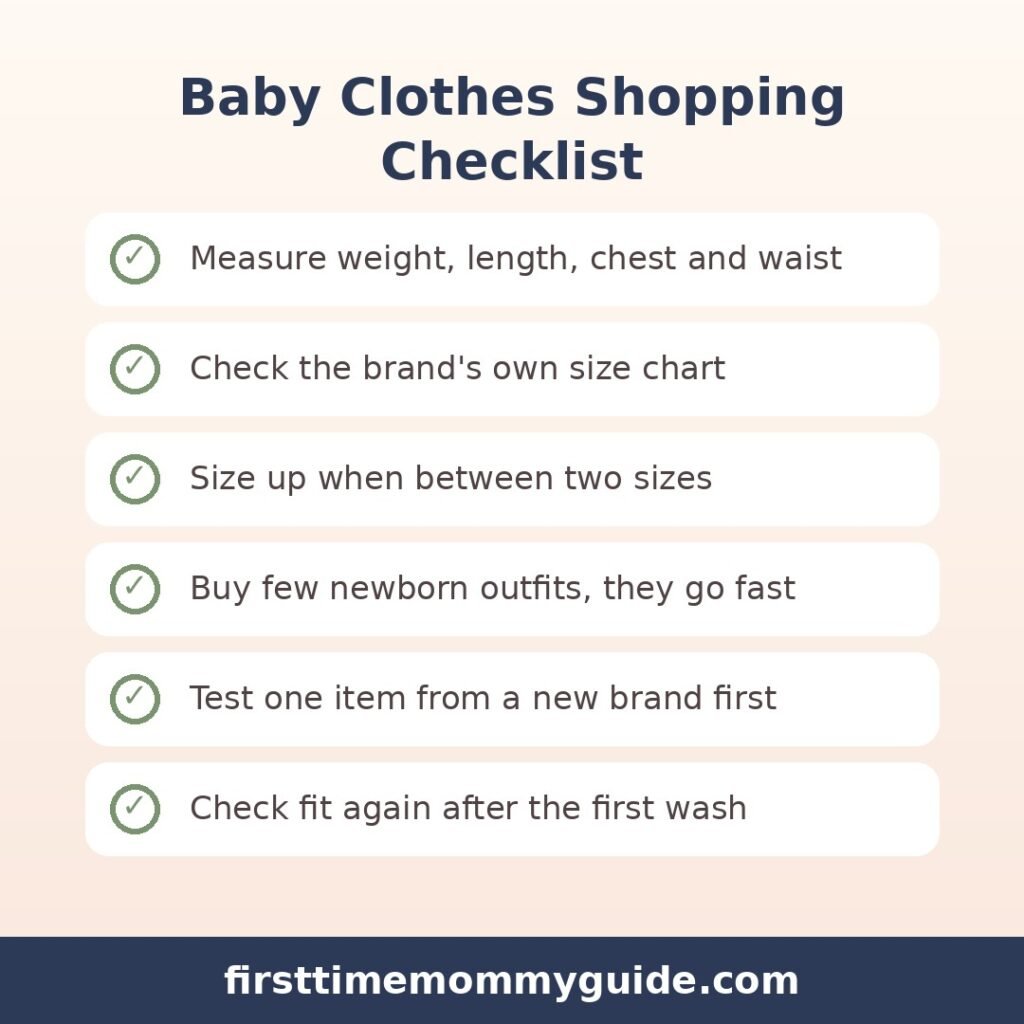
Measure your baby’s weight, length, chest, and waist, then match those numbers to the chart. If your baby sits between two sizes, size up, especially for sleepsuits, coats, and anything worn over other layers.
Newborn size typically fits babies up to about 7–8 lb (3.2–3.6 kg). Size 0–3 months usually fits babies up to about 12–13 lb (5.4–5.9 kg) and 23–24 inches (58–61 cm), but every brand differs. Check the label, not just the age.
Buy fewer newborn-size outfits than you expect. Many babies outgrow newborn size within two to four weeks, and gifts often arrive in newborn size. Start with a small base, then buy the next size as your baby grows.
How Baby Clothes Sizes Work
Most baby clothing uses age ranges as the main label: newborn, 0–3 months, 3–6 months, 6–9 months, 9–12 months, 12 months, 18 months, and 24 months. Those labels describe the average baby of that age, not your baby. A long, slim baby and a shorter, heavier baby of the same age will often wear different sizes.
Weight is usually the most useful single measure for bodysuits and sleepsuits. Height, or length, matters most for one-piece outfits, trousers, and dresses, where leg and torso length decide comfort. Chest and waist measurements matter for fitted tops, coats, and trousers with no stretch. When a chart gives weight and height, use both, and size up if either measure crosses into the next size.
Brands also cut clothes differently. Some brands run small and slim, others run generous and long. Some size for disposable nappies, others leave extra room for cloth nappies. Some use US sizing, some UK sizing, and some European sizing measured in centimetres. The same number can mean different things, which is why a size chart from the brand you are buying from matters more than a general chart.
Age, Weight, and Height: Which Matters Most?
Age is the least reliable guide. Babies grow at very different rates, and growth spurts arrive without warning. A baby born at 6 lb and a baby born at 9 lb will not wear the same size at six weeks, even though both are the same age. Premature babies, twins, and babies with different feeding patterns add further variation.
Weight is the best starting point for most everyday clothes. It reflects how much body the garment must cover. Height is the best check for length: a sleepsuit that is too short will pull at the shoulders and toes, even if the weight fits. Use weight first, height second, and age only as a rough starting point when you have no measurements.
If weight and height point to different sizes, size up. A tight garment restricts movement, presses on the tummy, and is outgrown within days. The only exception is items that must fit snugly for safety, such as sleep sacks rated by weight, where you should follow the manufacturer’s weight range exactly.
US, UK, and European Baby Sizes
Sizing labels differ by country, and imported clothes add confusion. US sizes often use months: 0–3M, 3–6M, 6–9M, 12M, 18M, 24M. UK sizes use similar month labels but can differ in cut and in the weight ranges behind them. European sizes often use height in centimetres: 50, 56, 62, 68, 74, 80, 86, and 92. A European size 62, for example, is designed for a baby about 62 cm long.
When buying from an international brand, always use that brand’s chart and check whether it lists weight, height, or both. Do not assume a US 3–6 months equals a UK 3–6 months in the same garment type. If a listing gives only an age, look for reviews or measurements from other parents, and favour retailers with easy returns for baby clothes.
| Label type | Example | What it is based on | How to use it |
|---|---|---|---|
| Age in months | 0–3 months | Average baby of that age | Rough guide only; check weight and height |
| Weight | Up to 12 lb / 5.4 kg | Baby’s current weight | Best guide for bodysuits and sleepsuits |
| Height / length | Up to 24 in / 61 cm | Baby’s length | Best guide for one-piece and leg length |
| European cm | Size 62 | Height in centimetres | Match to measured length; size up if between |
| Weight-banded sleep | 0–6 months, 8–18 lb | Weight range for safe fit | Follow exactly; do not size up for safety items |
Baby Clothes Size Charts
The charts below are general guides based on typical brand ranges. They help you estimate, but they do not replace the chart of the brand you are buying. Always check the retailer’s own measurements before ordering, especially online.
General Baby Size Chart by Age, Weight, and Height
| Size label | Typical weight | Typical height / length | Notes |
|---|---|---|---|
| Premature / Preemie | Up to 5 lb (2.3 kg) | Up to 17 in (43 cm) | For small or early babies; check hospital guidance |
| Newborn | Up to 7–8 lb (3.2–3.6 kg) | Up to 21–22 in (53–56 cm) | Often outgrown in 2–4 weeks |
| 0–3 months | 8–12 lb (3.6–5.4 kg) | 21–24 in (53–61 cm) | Most common first size after newborn |
| 3–6 months | 12–16 lb (5.4–7.3 kg) | 24–26 in (61–66 cm) | Good size for the first growth spurt |
| 6–9 months | 16–19 lb (7.3–8.6 kg) | 26–28 in (66–71 cm) | Sitting and crawling stage |
| 9–12 months | 19–22 lb (8.6–10 kg) | 28–30 in (71–76 cm) | Standing and cruising stage |
| 12 months | 22–24 lb (10–10.9 kg) | 30–31 in (76–79 cm) | Often the first “toddler” cut |
| 18 months | 24–28 lb (10.9–12.7 kg) | 31–33 in (79–84 cm) | Roomier toddler fit |
| 24 months / 2T | 28–30 lb (12.7–13.6 kg) | 33–35 in (84–89 cm) | Toddler sizing; cuts vary widely |
These ranges overlap because brands set their own boundaries. One brand’s 0–3 months may end at 12 lb, another’s at 13 lb. When your baby is near the top of a range, move up. A garment at the top of its range will fit tightly and briefly.
European Size Chart in Centimetres
| European size | Height (cm) | Approximate age | Approximate weight |
|---|---|---|---|
| 50 | 50 cm | Newborn | Up to 3.5 kg |
| 56 | 56 cm | 0–2 months | 3.5–5 kg |
| 62 | 62 cm | 2–4 months | 5–6.5 kg |
| 68 | 68 cm | 4–6 months | 6.5–8 kg |
| 74 | 74 cm | 6–9 months | 8–9.5 kg |
| 80 | 80 cm | 9–12 months | 9.5–11 kg |
| 86 | 86 cm | 12–18 months | 11–12.5 kg |
| 92 | 92 cm | 18–24 months | 12.5–14 kg |
European sizing is often the clearest system because it is tied directly to height. Measure your baby’s length, match it to the size, and size up if your baby is between sizes. If a European garment lists only a centimetre size, that number is the height it is designed for, not the age.
How Sizes Differ Between Brands
Brand variation is the biggest cause of sizing frustration. A sleepsuit from one high-street brand may be a full size smaller than the same labelled size from another. Stretch, cut, and intended fit all play a part. Slim-fit brands suit long, lean babies. Generous brands suit babies with cloth nappies or rounder tummies.
Before a big order, buy one item in the size you think fits and test it. Check the fit after washing, because some fabrics shrink, especially cotton. Parent reviews often mention whether a brand runs small, true to size, or large. Those notes are worth reading.
How to Measure Your Baby for Clothes
Measuring a wriggling baby is easier with two people and a calm moment, ideally after a feed when your baby is content. You do not need perfect precision. A measurement within a centimetre or half an inch is enough to choose a size.
Step-by-Step Measuring Guide
Step 1: Weigh your baby. Use your most recent clinic or health-visitor weight, or weigh yourself holding your baby and subtract your own weight. Record weight in pounds and kilograms if possible. Weight changes fastest, so use a recent figure.
Step 2: Measure length. Lay your baby on a flat surface, such as a changing mat on the floor. Gently straighten one leg, mark the top of the head and the heel on a piece of paper or with soft tape, then measure between the marks. Ask a helper to hold your baby’s head steady while you mark the heel.
Step 3: Measure chest. Wrap a soft tape measure around the fullest part of the chest, under the arms, keeping it level and snug but not tight. Your baby should be breathing normally. Note the number in inches and centimetres.
Step 4: Measure waist and hips. Measure the waist at the level of the belly button, and the hips at the fullest part of the nappy area. These numbers matter for trousers, skirts, and fitted dresses. Keep the tape flat and do not pull it tight over a nappy.
Step 5: Measure head for hats. Wrap the tape around the widest part of the head, just above the eyebrows and ears. Hat sizes are often given in centimetres. Measure twice, because hats that are too tight leave marks and hats that are too loose slip over the eyes.
Step 6: Compare with the brand chart. Match weight first, length second, and chest or waist third. If any measure falls in the next size, size up for everyday clothes. For sleep sacks and swaddles, follow the weight range printed on the product, not this general rule.
Record measurements monthly in the first year, or whenever clothes start to feel tight. Babies grow in spurts, and a size that fit last week may be tight this week. A quick note on your phone, with date, weight, and length, makes online shopping much easier.
Choosing the Right Size for Each Garment Type
Different garments fit differently, and the same size label does not guarantee the same fit across types. A bodysuit, a sleepsuit, a coat, and a hat each need a different check.
Bodysuits and Vests
Bodysuits, also called onesies or vests, are the base layer for most babies. Fit should be snug but not tight, with no gaping at the neck and poppers that close easily over the nappy. The shoulder should sit at the shoulder line, and the leg openings should not dig into the thighs. Envelope necks and popper shoulders help with dressing and with pulling the bodysuit down over the shoulders after a nappy accident.
Size bodysuits by weight and chest. If poppers strain or leave marks, size up. If the neck gapes and the bodysuit rides up, the size may be too large, or the cut may not suit your baby. Cotton bodysuits can shrink slightly, so wash before judging fit. Keep at least a few in the next size ready, because bodysuits are outgrown quickly.
Sleepsuits and Rompers
Sleepsuits, also called onesies with legs or footed sleepers, need length above all. Check toe room: your baby’s toes should not press against the end of the foot. Check shoulder and torso length: the poppers should close without pulling, and the suit should not ride up when your baby stretches. A sleepsuit that is too short will wake a baby who kicks and stretches in sleep.
Size sleepsuits by length first, weight second. If your baby is long, you may need the next size even when weight still fits the current one. Look for two-way zips for easier night changes, and fold-over cuffs that protect tiny hands from scratching. For babies in cloth nappies, allow extra room in the seat.
Tops, Trousers, and Dresses
Separates give you more flexibility, because you can size the top and bottom differently. Tops should allow arm movement without riding up. Trousers should fit at the waist without a belt or tight elastic, and should allow crawling and kicking. Dresses and tunics should not catch under knees when crawling.
Check the waistband. Elastic should be soft, wide, and stretchy, not narrow and digging. Trousers with adjustable waists, buttons, or drawstrings last longer through growth spurts. Avoid trousers that need to be pulled up constantly, because they restrict movement and frustrate a crawling baby. For dresses, check that the length allows sitting and crawling without tripping.
Coats, Jackets, and Outerwear
Outerwear must fit over other layers, so size up if your baby is between sizes. A coat that fits perfectly over a vest will be too tight over a jumper and sleepsuit. Check arm length with arms bent, and check that the coat closes without pulling. Hoods should not cover the face or restrict head turning.
For car seats, remember that bulky coats and snowsuits must not be worn under harness straps. Dress your baby in thin, warm layers for the car seat, and place a blanket over the harness afterwards. This safety rule matters more than the coat size. Choose outerwear that is easy to remove when moving between outdoors and a warm car or shop.
When to Size Up: Signs Your Baby Has Outgrown Clothes
Babies rarely announce a growth spurt. Clothes do it for them. Watch for these signs, and size up promptly rather than squeezing a few more wears from a tight garment. Comfort and movement matter more than getting full use from every item.
Poppers that strain, gap, or leave marks are the clearest sign. If you must pull fabric to close a bodysuit, the size is too small. Red marks on thighs, shoulders, or waist after wearing an item mean the elastic or seam is too tight. Toes pressing the end of a sleepsuit, or a sleepsuit riding up to expose the tummy, mean the length is too short.
Behaviour also signals poor fit. A baby who suddenly resists dressing, cries during changes, or seems unsettled in clothes that used to be fine may be uncomfortable. Check for tight cuffs, scratchy seams, or a waistband that digs in when sitting. A baby who kicks a sleepsuit off repeatedly may be too warm, but may also be fighting a suit that is too short.
| Sign | What it means | Action |
|---|---|---|
| Poppers strain or will not close | Torso or weight outgrown | Size up in bodysuits and sleepsuits |
| Red marks on thighs or waist | Elastic or opening too tight | Size up; check for soft, wide elastic |
| Toes press sleepsuit feet | Length outgrown | Size up; check toe room before buying |
| Tummy exposed when stretching | Torso too short | Size up; try a longer cut or brand |
| Baby resists dressing suddenly | Discomfort or restriction | Check seams, cuffs, and waistband fit |
| Sleeves ride past wrists constantly | Size too large, or cut too long | Size down, or fold cuffs and re-check |
As a rule, keep the next size ready in the wardrobe. When two or three items in the current size become tight in the same week, move the whole drawer up. Wash and store the smaller size, in case you need it for a smaller baby later, and bring the next size forward. This simple routine avoids frantic shopping and dressing struggles.
How Many Clothes Does a Baby Need?
New parents often overbuy, especially in newborn size. Babies need fewer outfits than catalogues suggest, because laundry is frequent and growth is fast. A practical wardrobe covers a week of changes, plus spares for accidents, without filling drawers with clothes that are outgrown unworn.
For a newborn, a useful starting point is seven to ten bodysuits, seven sleepsuits, two to three daytime outfits, two hats, and seven pairs of socks. Add a cardigan or two, a coat or pramsuit for cold weather, and a few bibs and muslins. That base covers daily changes and laundry every two to three days. Adjust for your climate, laundry access, and whether you use cloth nappies, which need more changes.
Buy in stages. Start with newborn and 0–3 months in small numbers, then buy 3–6 months once you see your baby’s growth pattern. Many parents receive newborn clothes as gifts, so check what you already have before buying more. Keep tags on larger sizes until you need them, so you can exchange them if your baby skips a size entirely. Babies sometimes jump from 0–3 months to 6–9 months in one spurt.
Quantity Checklist by Stage
| Stage | Bodysuits | Sleepsuits | Day outfits | Notes |
|---|---|---|---|---|
| Newborn (first weeks) | 7–10 | 7 | 2–3 | Buy few; outgrown fast |
| 0–3 months | 7–10 | 5–7 | 3–4 | Add cardigans and hats |
| 3–6 months | 7 | 5 | 4–5 | Crawling: durable knees help |
| 6–12 months | 7 | 4–5 | 5–6 | Weaning: more bibs and spares |
| 12–24 months | 5–7 | 3–4 | 5–7 | Toddler play: easy, washable clothes |
These numbers assume laundry every two to three days. If you wash daily, you need fewer. If laundry is weekly, you need more. Spit-up, nappy leaks, and weaning mess all increase changes. It is better to have a few extra bodysuits than a drawer of special outfits that are rarely worn.
Fabrics, Comfort, and Seasons
Fabric affects comfort, temperature, washing, and how long a garment lasts. In the first year, softness and breathability matter more than fashion. Babies have sensitive skin, sweat easily, and spend long periods lying, sitting, and crawling. The wrong fabric can irritate skin, overheat a baby, or wear out quickly.
Best Fabrics for Newborn Skin
Cotton is the standard choice for everyday baby clothes. It is soft, breathable, and easy to wash. Organic cotton is grown without certain pesticides and is often softer, but standard cotton is also suitable for most babies. Cotton jersey, used for bodysuits and sleepsuits, stretches gently and feels smooth against skin.
Bamboo fabric is soft, breathable, and good at wicking moisture. It suits babies who sweat or have sensitive skin, but it can be less durable and needs gentle washing. Wool, especially fine merino wool, regulates temperature well and suits cooler climates, but check for itchiness and wash according to the label. Avoid rough, scratchy fabrics, stiff denim for very young babies, and fabrics with heavy chemical finishes.
Dressing for Warm and Cold Weather
Dress your baby in layers you can add or remove. A useful rule is one more light layer than you are wearing, adjusted for activity and room temperature. Check your baby’s chest or tummy for warmth, not hands or feet, which are often cooler. A sweaty neck or damp back means your baby is too warm.
In warm weather, choose light, breathable cotton, a sun hat with a brim, and shade rather than heavy clothing. Keep babies under six months out of direct sunlight, and use clothing and shade as the first protection. See our baby sunscreen guide for sun protection from six months onwards. In cold weather, use a warm coat or pramsuit, hat, mittens, and socks, and check that your baby is not overheating indoors.
Safety Checklist for Baby Clothes
Safety comes before style. Small details on baby clothes can create choking, strangulation, or overheating risks. Check every garment before you buy it and before each wear.
Avoid cords, drawstrings, and ribbons around the neck, hood, or waist. They can catch on furniture or wrap around a baby’s neck. Choose hoods without drawstrings, and remove decorative cords from any garment. Check buttons, bows, and appliqués: tug them firmly. If anything feels loose, remove it or do not use the garment until it is fixed.
Check seams and labels. Rough seams can rub delicate skin, especially around the neck and underarms. Flat seams or seamless designs suit newborns best. Cut off scratchy labels, or choose tagless garments, and check that no sharp label edge remains. Check zips: they should have a fabric guard at the top so they do not catch skin, and a two-way zip helps with nappy changes without fully undressing a sleepy baby.
Follow flame-resistance guidance for sleepwear. In many countries, sleepwear must meet flammability standards or carry a warning. Do not use loose, flowing sleepwear near heaters or open flames, and follow the manufacturer’s care instructions, because fabric softener and incorrect washing can reduce flame resistance. Keep sleep surfaces bare, with no loose clothing, blankets, or toys that could cover a baby’s face.
| Safety check | What to look for | Action if it fails |
|---|---|---|
| Cords and drawstrings | None around neck, hood, or waist | Do not buy, or remove cord completely |
| Buttons and decorations | Firmly attached, no loose parts | Remove loose decoration; do not use |
| Seams and labels | Flat, soft, no scratchy edges | Choose tagless or cut label carefully |
| Zips | Fabric guard, smooth action | Do not use if zip catches skin |
| Sleepwear fit | Snug fit or flame-resistant label | Follow manufacturer and safety guidance |
| Small parts | No detachable beads or toggles | Remove or discard the garment |
Mistakes to Avoid When Choosing Baby Clothes Sizes
The most expensive mistake is buying too much in the wrong size. The most frustrating mistake is trusting the age label alone. Avoid the errors below and you will save money, time, and dressing battles.
Buying too many newborn outfits. Newborn size is outgrown quickly, and gifts often fill this size. Start small, keep receipts, and buy the next size as soon as growth shows. A baby who weighs 8 lb at birth may skip newborn size almost entirely.
Ignoring the brand’s chart. General charts help you estimate, but each brand cuts differently. Always check the brand’s weight and height ranges before ordering, especially online. A five-minute chart check prevents a return and a disappointed wait.
Sizing down to make clothes last longer. Tight clothes restrict movement, press on the tummy, and leave marks. They do not last longer; they become unwearable sooner because your baby cannot move comfortably in them. Size up when between sizes, except for safety items such as sleep sacks.
Forgetting cloth nappies. Cloth nappies are bulkier than disposables and need extra room in bodysuits, sleepsuits, and trousers. If you use cloth nappies, size up in bottoms, or choose brands cut for cloth. Check the fit with the nappy on, not off.
Buying seasonal clothes too far ahead. A winter coat bought in summer for a size your baby may reach in winter is a gamble. Growth spurts are unpredictable, and weather varies. Buy seasonal items close to the season, in the size your baby wears then, with room for one layer underneath.
Choosing style over comfort. Stiff fabrics, tight collars, fiddly buttons, and outfits that need ironing will sit unworn. In the first year, easy dressing, soft fabric, and washability win every time. Save special outfits for short occasions, and keep everyday clothes simple.
Not checking after washing. Cotton shrinks, colours run, and poppers weaken. Wash new clothes, check the fit, and keep tags on duplicates until you know how a brand washes. A garment that fits in the shop may be a size smaller after its first wash.
Expert Tips for Smart Baby Clothes Shopping
Shop with measurements, not memories. Keep a note on your phone with your baby’s current weight, length, and the sizes that fit in each favourite brand. Update it monthly. When you see a sale, you can buy confidently without guessing or bringing your baby to the shop.
Build a capsule wardrobe. Choose a small palette of colours that mix and match, so any top works with any bottom. Neutral bodysuits, a few patterned tops, and two or three bottoms create many outfits from few items. A capsule approach reduces decision fatigue and makes laundry simpler.
Prioritise easy dressing. Envelope necks, popper shoulders, two-way zips, and wide leg openings make changes faster, especially at night and after nappy accidents. Avoid outfits with many buttons down the back, tight necklines, or complicated fastenings for everyday wear. Your future tired self will thank you.
Plan for growth spurts, not against them. Keep one step ahead: when your baby fits comfortably in 3–6 months, have a few 6–9 month bodysuits and sleepsuits washed and ready. Growth spurts often arrive overnight, and a prepared drawer avoids an emergency shop. Rotate clothes weekly, moving tight items out and the next size in.
Frequently Asked Questions About Baby Clothes Sizes
1. What size clothes should a newborn wear?
Most newborns start in newborn size or 0–3 months, depending on birth weight. Newborn size typically fits babies up to 7–8 lb, while 0–3 months fits up to about 12 lb. Check weight and length against the brand chart, and start with few newborn items because they are outgrown quickly.
2. How do I know if baby clothes are too small?
Poppers strain, red marks appear on thighs or waist, toes press the end of a sleepsuit, or the tummy shows when your baby stretches. Behaviour can also signal poor fit, such as resisting dressing or seeming unsettled. If two or more signs appear, size up.
3. Should I size up in baby clothes?
Yes, size up if your baby is between sizes, near the top of a weight or height range, or wearing cloth nappies. Slightly loose everyday clothes are comfortable and last longer. The exception is safety items such as sleep sacks, where you must follow the manufacturer’s weight range exactly.
4. Do baby clothes sizes vary by brand?
Yes, widely. One brand’s 3–6 months can be a full size different from another’s. Cut, stretch, and intended fit all vary. Always check the brand’s own size chart, buy one item to test a new brand, and read parent reviews about whether it runs small or large.
5. What is the difference between newborn and 0–3 months?
Newborn size is for the smallest babies, usually up to 7–8 lb and 21–22 inches. Size 0–3 months is the next step, usually up to 12 lb and 24 inches. Some brands treat them as overlapping, and some babies skip newborn size entirely. Use weight and length, not the label alone.
6. How many newborn outfits do I need?
Seven to ten bodysuits and about seven sleepsuits are a practical start, plus a few daytime outfits. Buy few newborn items, because many babies outgrow them in two to four weeks and gifts often add more. Keep tags on larger sizes until you need them.
7. How do European baby sizes work?
European sizes are based on height in centimetres: 50, 56, 62, 68, 74, 80, 86, and 92. The number is the height the garment is designed for. Measure your baby’s length, match it to the size, and size up if your baby falls between sizes. This system is often clearer than age labels.
8. How do I measure my baby for clothes at home?
Weigh your baby using a recent clinic weight, measure length lying flat from head to heel, and measure chest, waist, and head with a soft tape. Compare weight first and length second with the brand chart. Take each measurement twice, and measure over a nappy for bottoms and sleepsuits.
9. When should I move from 0–3 months to 3–6 months?
Move up when poppers strain, toes press sleepsuit feet, or your baby reaches the top of the brand’s weight or height range for 0–3 months. Do not wait until clothes are painfully tight. Keep the next size washed and ready, and move the whole drawer up when several items become tight in the same week.
10. Do cloth nappies affect clothes sizing?
Yes. Cloth nappies add bulk around the hips and seat, so bodysuits, sleepsuits, and trousers may need the next size up, or a brand cut for cloth nappies. Always check the fit with the nappy on. Look for extra room in the seat and poppers that close easily over the nappy.
11. What clothes size will my baby wear at 6 months?
It depends on growth, not age. Many six-month-old babies wear 6–9 months, but some wear 3–6 months and others wear 9–12 months. Check current weight and length against the brand chart. A long baby may need a larger size for length even when weight still fits a smaller size.
12. How do I choose a hat size for my baby?
Measure head circumference around the widest part, just above the eyebrows and ears, and match it to the brand’s hat chart, which is often in centimetres. The hat should fit snugly without red marks or slipping over the eyes. Measure twice, because a hat that is too tight or too loose will not stay comfortable.
13. Should baby clothes be snug or loose?
Everyday clothes should be comfortable and allow free movement, with a little growing room. They should not be so loose that they catch, ride up, or cover the face. Sleep sacks and swaddles are different: they must fit the manufacturer’s weight range snugly for safety. Follow product guidance for those items.
14. Why do my baby’s clothes shrink after washing?
Cotton and some natural fabrics shrink, especially in hot water and high-heat tumble drying. Wash at the label temperature, line dry when possible, and check fit after the first wash before removing tags from duplicates. If a brand shrinks a lot, size up next time in that brand and fabric.
15. How often should I re-measure my baby?
Measure monthly in the first year, or whenever clothes start to feel tight. Babies grow in spurts, and a size that fit last week can be tight this week. Keep a dated note of weight and length on your phone, so online shopping uses current numbers rather than last month’s guess.
16. What is the safest way to dress a newborn for sleep?
Use a well-fitting sleep sack with a tog rating matched to room temperature, and light layers underneath. Place your baby on their back on a firm, flat mattress with no loose bedding, pillows, or toys. Do not use hats indoors for sleep, and do not prop your baby up. Stop swaddling at the first sign of rolling.
17. Can I buy baby clothes second-hand safely?
Yes, if you check them carefully. Look for loose buttons, worn elastic, stains, and damage, and wash everything before use. Avoid items with cords, drawstrings, or outdated safety features. Second-hand clothes are often softer from washing, but decline anything damaged or unsafe, however cute it looks.
Conclusion: Measure, Check the Chart, Size Up
Choosing baby clothes by size becomes simple once you stop trusting the age label alone. Weigh and measure your baby, check the brand’s own chart, and size up when you are between sizes. Keep the wardrobe small, practical, and ready for the next growth spurt, and prioritise soft fabric, easy dressing, and safety over style.
Start with a small base in newborn and 0–3 months, test each new brand with one item, and wash before judging fit. Keep notes on what fits, pass on what does not, and remember that every baby grows at their own pace. The right size is the one that lets your baby move, sleep, and play comfortably today, not the label that matches their age.
For more newborn care guidance, read our guides on how to swaddle a newborn, how to give a newborn their first bath, and newborn sleep routine guide. For skin and comfort, see baby eczema care signs and treatment and baby diaper rash causes treatment prevention. Authoritative safety guidance is available from the NHS, HealthyChildren.org from the American Academy of Pediatrics, and the Centers for Disease Control and Prevention.

Dilawar Mughal
Founder and editor, First Time Mommy Guide
I research every guide against what the NHS, the AAP and the WHO publish, then write it in plain English — because most new parents are reading with one hand free, not comparing clinical guidelines. I'm not a doctor or a midwife. Every health claim on this site is sourced and linked so you can check it yourself, and anything urgent belongs with your health visitor or GP, not a blog.