
General information, not medical advice. Every baby is different — if anything worries you, speak to your midwife, health visitor or GP rather than waiting.
If you are reading this at 3 a.m. with a wide-awake baby in your arms, welcome. You are not doing anything wrong, and your baby is not broken. Newborn sleep is famously chaotic, and no routine will make a two-week-old sleep through the night.
But a gentle, consistent routine can make nights calmer, days more predictable, and life with a newborn much more manageable.
This guide explains how to establish a newborn sleep routine step by step. You will learn what realistic newborn sleep looks like, how wake windows work, how to build a calming bedtime routine, how to handle night wakings, and what safe sleep really means. Everything here follows guidance from the American Academy of Pediatrics (AAP) and the NHS, with practical tips from real parents who have survived the newborn stage.
Quick Answer: What Does a Newborn Sleep Routine Look Like?
A newborn sleep routine is a short, repeatable sequence of calming steps you do before every sleep, day and night. It usually includes a feed, a diaper change, dim lights, a bath or wipe-down, pajamas, a swaddle or sleep sack, a lullaby or white noise, and placing your baby down drowsy but awake. The routine stays the same each time so your baby learns to recognize sleep cues.
Newborns sleep 14 to 17 hours a day in short stretches, waking every two to three hours to feed. A routine will not stretch those stretches dramatically in the early weeks. What it does is help your baby fall asleep more easily, settle faster after night wakings, and gradually link sleep cycles into longer blocks as they mature.
What Is Realistic for Newborn Sleep?
How Much Sleep Newborns Need
Newborns need roughly 14 to 17 hours of sleep in 24 hours, though some healthy babies sleep a little more or less. This sleep comes in many short bursts rather than one long night block. A typical newborn sleeps two to four hours at a stretch, wakes to feed, and drifts off again.
These short cycles are biological, not behavioral. Newborn stomachs are tiny, so they need frequent feeds, and their circadian rhythms are not yet developed. Day-night confusion is extremely common in the first weeks, with babies sleeping soundly all day and partying all night.
Why Newborns Do Not Sleep Through the Night
Sleeping through the night is a developmental milestone, not a training outcome. Most babies do not sleep six to eight hour stretches until three to six months, and some take longer. Night wakings protect against low blood sugar and support healthy growth in the early months.
It is tempting to compare your baby to a friend's baby who "slept through at six weeks." Those stories usually involve a different definition of sleeping through, or a baby who was simply ready earlier. Your baby's timeline is normal even if it feels endless at 3 a.m.
The Fourth Trimester
The first three months are sometimes called the fourth trimester, because babies are still adjusting to life outside the womb. They crave closeness, warmth, movement, and the sounds of the womb. This is why swaddling, shushing, and rocking work so well: they recreate womb conditions.
A routine that respects this need for closeness works better than one that demands independence too early. Holding, rocking, and feeding to sleep are not bad habits in the newborn stage. They are responsive parenting, and they lay the foundation for independent sleep later.
The Building Blocks of a Newborn Sleep Routine
Wake Windows: The Secret Ingredient
A wake window is the amount of time your baby can comfortably stay awake between sleeps. For newborns, wake windows are very short: 45 to 90 minutes in the first weeks, stretching to 60 to 120 minutes by three months. Keeping within these windows prevents overtiredness, which is the number one cause of difficult bedtimes.
An overtired baby is harder to settle, cries more, and sleeps worse, which creates a vicious cycle. Watch for early tired signs rather than the clock alone: staring into space, reduced activity, jerky movements, and losing interest in surroundings. Crying and eye-rubbing are late signs, meaning your baby is already overtired.
Sleep Cues: Reading Your Baby
Every baby has their own tired language. Common early cues include going quiet, staring blankly, turning away from stimulation, and making jerky arm movements. Some babies yawn, others fuss, and some get a glazed, faraway look.
Learn your baby's cues over the first weeks and respond promptly. When you see them, start the wind-down routine immediately. Waiting for a "better" time or finishing one more task often means missing the sleep window entirely.
Day and Night Differentiation
Help your baby learn the difference between day and night from the first week. During daytime feeds and play, keep lights on, talk normally, and allow household noise. During night feeds, keep lights dim, voices low, and interaction minimal.
Do not keep the house silent during the day. Normal daytime noise actually helps babies learn that daytime is for activity and nighttime is for sleep. At night, use only a dim nightlight for changes and feeds, and avoid play or eye contact that might wake your baby fully.
The Eat, Play, Sleep Rhythm
A loose rhythm of eat, play, sleep helps structure the day without rigid scheduling. Your baby wakes, feeds, has a short period of awake time, then sleeps again. This rhythm prevents the common trap of feeding to sleep at every single sleep, which can become the only way your baby knows how to fall asleep.
The rhythm does not need to be strict. Some days the order will be eat, sleep, eat, play, and that is fine. Think of it as a gentle pattern, not a timetable.
The goal is variety in sleep associations, not perfection.
Building Your Bedtime Routine: Step by Step
Step 1: Start With a Calm Environment
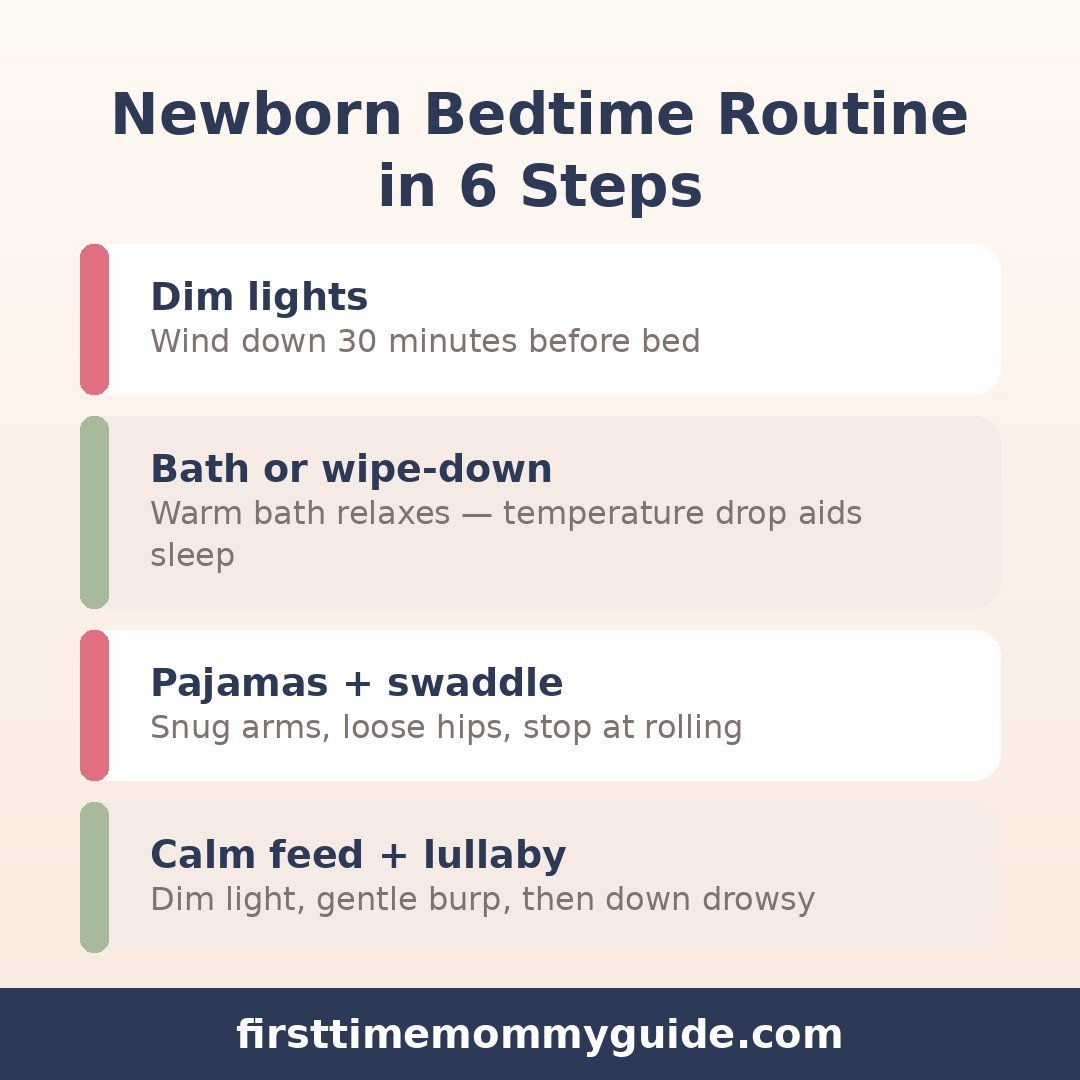
About 30 minutes before bedtime, dim the lights and reduce noise and activity. A calm environment signals to your baby's developing brain that sleep is coming. This wind-down period is as important as the routine itself.
Avoid screens, bright lights, and rough play in the wind-down window. Older siblings can be part of the calm routine with a quiet story, but save energetic play for earlier in the day.
Step 2: Bath or Warm Wipe-Down
A warm bath is a classic sleep cue, and the drop in body temperature after a bath promotes drowsiness. If a bath excites rather than calms your baby, try it earlier in the day instead. A warm wipe-down with a soft cloth achieves a similar effect without the full bath routine.
Bath time also has a practical benefit: it is a natural transition point in the evening. Pairing it consistently with bedtime teaches your baby that bath means sleep is near. For guidance on bathing safely, see our guide to how to give your newborn their first bath.
Step 3: Diaper, Pajamas, and Swaddle
Change your baby into a fresh diaper and comfortable pajamas. Dress for room temperature, not for the weather outside, and avoid overdressing. A good rule is one more layer than you would wear, and check your baby's chest, not hands or feet, to judge warmth.
Swaddling helps many newborns sleep longer by preventing the startle reflex from waking them. Use a light, breathable swaddle with hips loose enough to move, and stop swaddling once your baby shows signs of rolling. Our guide to how to swaddle a newborn covers safe technique in detail.
Step 4: Feed in a Calm, Dim Setting
Offer a full feed in dim light with minimal talking. A well-fed baby sleeps better, and a calm feed avoids waking your baby fully. Burp gently afterward, since trapped gas causes discomfort that disrupts sleep.
Our guide to how to burp a newborn has positions that work when your baby is drowsy.
Keep the feed unhurried. Rushing a feed leads to swallowed air and spit-up, both of which wake babies. If your baby falls asleep during the feed, that is fine in the early weeks; you can gradually work toward drowsy-but-awake placement later.
Step 5: Lullaby, Book, or White Noise
Choose one or two calming activities to repeat every night. A short lullaby, a brief board book, or a few minutes of gentle rocking all work. The specific activity matters less than the consistency: repetition is what builds the sleep association.
White noise is particularly effective for newborns, because it mimics womb sounds and masks household noise. Keep the volume moderate, about as loud as a shower, and place the machine across the room rather than right beside your baby's head. Continuous white noise through the night is fine.
Step 6: Place Down Drowsy but Awake
When your baby is calm and drowsy, place them in their crib or bassinet on their back. This is the ideal, and it is also the step many parents find hardest. A baby who falls asleep in your arms and wakes in a crib often cries, because the environment changed.
Start with one placement attempt per day, usually at bedtime, and do not stress about perfection. If your baby cries, pick them up, soothe, and try again. Gradual practice over weeks builds the skill, and even partial success helps.
Sample Newborn Schedules by Age
0 to 6 Weeks: Survival Mode
At this age, there is no real schedule, only a rhythm. Expect feeds every two to three hours around the clock, naps of 30 minutes to two hours, and wake windows of 45 to 60 minutes. The routine is simply: feed, brief awake time, sleep, repeat.
Focus on day-night differentiation and a short bedtime sequence, even if bedtime is 10 p.m. because your baby's longest stretch starts then. Do not try to force an early bedtime yet. Your baby's circadian rhythm is still developing, and bedtime will naturally move earlier over the coming months.
6 to 12 Weeks: Patterns Emerge
By six to twelve weeks, many babies develop a slightly longer first night stretch, often three to five hours. Wake windows stretch to 60 to 90 minutes, and naps become a little more predictable. A loose daily pattern often emerges, with a morning nap, a midday nap, and an afternoon nap.
This is a good time to firm up the bedtime routine and move bedtime a little earlier, toward 8 or 9 p.m. Watch for the first signs of a more regular pattern, such as a consistent wake time or a predictable fussy period in the evening.
3 to 4 Months: The First Real Routine
By three to four months, wake windows reach 90 to 120 minutes, and many babies settle into three naps a day. Bedtime often moves to 7 or 8 p.m., and night sleep stretches to five or six hours for some babies. This is also when the 4-month sleep regression arrives, as sleep cycles mature and babies wake more between cycles.
Do not panic when the regression hits. It is a sign of healthy brain development, not a failure of your routine. Keep the routine consistent, respond to wakings calmly, and know that it usually passes within two to six weeks.
Handling Night Wakings
The Pause Before You Respond
When your baby stirs at night, pause for a minute before picking them up. Babies make many noises between sleep cycles, including grunts, squirms, and brief cries, and they often settle themselves. Rushing in at the first sound can wake a baby who would have drifted back off.
This pause does not mean ignoring genuine cries. If crying escalates or continues beyond a minute or two, respond promptly. The pause is simply a chance for your baby to practice self-settling, which is a skill that develops gradually.
Keep Night Wakings Boring
Change the diaper only if wet or soiled, feed in dim light, burp, and place your baby back down. Avoid eye contact, conversation, and play. Boring nights teach your baby that nighttime is for sleeping, not socializing.
If your baby is wide awake and alert at 3 a.m., stay calm and boring anyway. Do not turn on lights or start play, even if your baby seems ready to party. Consistency, night after night, is what eventually shifts the pattern.
When Night Wakings Increase
A sudden increase in night wakings often has a cause: a growth spurt, teething, illness, a developmental leap, or a sleep regression. Growth spurts typically last two to three days and involve extra hunger. Teething brings drooling, gum discomfort, and sometimes low-grade fussiness.
Check the basics first: hunger, wet diaper, gas, temperature, and discomfort. Our guides to baby gas relief remedies and colic symptoms and soothing can help you rule out tummy troubles. If wakings come with fever, poor feeding, or unusual lethargy, contact your pediatrician.
Safe Sleep: The Non-Negotiable Rules
Safe sleep rules from the AAP are simple and life-saving. Always place your baby on their back to sleep, on a firm, flat mattress with a fitted sheet. Keep the sleep space bare: no pillows, blankets, bumpers, or stuffed animals.
Room-sharing is recommended for at least the first six months, ideally twelve, with your baby in a bassinet or crib beside your bed. Bed-sharing is not recommended, as it increases the risk of suffocation and sudden infant death syndrome (SIDS). Keep the room at a comfortable temperature, around 18 to 20 degrees Celsius, and avoid overdressing.
Pacifiers at sleep time are associated with reduced SIDS risk, once breastfeeding is established. If your baby rejects the pacifier, do not force it, and do not reinsert it repeatedly through the night once it falls out. These rules apply to every sleep, day and night, without exception.
Naps: Making Daytime Sleep Work
How Many Naps and How Long
Newborns nap frequently, often four to six times a day in the early weeks, dropping to three or four by three months. Nap lengths vary wildly, from 30 minutes to two hours, and short naps are normal. A baby who takes several short naps and one longer nap is doing fine.
Do not expect a fixed nap schedule before three or four months. Instead, follow wake windows and sleep cues, and offer naps in a consistent place when possible. One nap a day in the crib, even if others are in arms or a carrier, helps build the crib association gradually.
The Dreaded Short Nap
Short naps of 20 to 30 minutes frustrate many parents, but they are developmentally normal. Babies wake between sleep cycles and have not yet learned to link cycles. As sleep matures around four to six months, naps typically lengthen.
You can try to extend a short nap by responding quickly at the first stir, offering a pacifier, or gently patting. Sometimes it works, sometimes it does not, and neither outcome reflects on your parenting. Focus on total daily sleep rather than any single nap length.
Common Newborn Sleep Problems and Fixes
| Problem | Likely Cause | What to Try |
|---|---|---|
| Fighting sleep, crying at bedtime | Overtiredness | Shorter wake window, earlier bedtime |
| Waking every hour at night | Hunger, gas, or sleep cycle linking | Full feeds, burping, consistent routine |
| Day-night confusion | Immature circadian rhythm | Bright days, dim nights, morning light |
| Only sleeping in arms | Need for closeness, startle reflex | Swaddle, gradual crib practice, carrier naps |
| Short 30-minute naps | Normal cycle length | Respond at first stir, accept short naps |
| Evening fussiness (witching hour) | Overstimulation, tiredness | Calm evening, cluster feeds, early bedtime |
The Witching Hour
Many newborns have a fussy period in the late afternoon or evening, often called the witching hour. It typically peaks around six weeks and fades by three months. Cluster feeding, where your baby feeds frequently in the evening, is normal during this period and helps tank up for the night.
During the witching hour, keep stimulation low, try motion such as walking or rocking, and offer frequent feeds. It is exhausting, but it is temporary, and it is not a sign that your routine has failed.
Taking Care of Yourself
Sleep When the Baby Sleeps (Sort Of)
The advice to sleep when the baby sleeps is well-meaning but often impractical. Instead, aim for one protected sleep block per day, even if it is just a nap while someone else watches the baby. Accept help with household tasks, and lower your standards for everything except baby care.
If you have a partner, consider shifts: one person takes the first half of the night, the other takes the second. Even a four-hour uninterrupted block makes a significant difference to mood and functioning. Sleep deprivation is serious, and asking for help is not weakness.
When to Seek Help
If you feel persistently overwhelmed, anxious, or low, or if you have thoughts of harming yourself or your baby, reach out immediately to your doctor or a trusted person. Postpartum mood disorders are common and treatable, and they are not your fault. Your health matters as much as your baby's sleep.
Also seek help if your baby's sleep seems severely abnormal: sleeping far less than 10 hours a day, extreme difficulty waking for feeds, or breathing pauses during sleep. Your pediatrician can assess whether something medical is going on.
Partner Shifts: Sharing the Nights Fairly
Night duty does not have to fall on one person. A simple shift system protects both parents' sleep and keeps resentment low. One common split is that one parent takes all wakings until 2 a.m., and the other takes everything after.
Each parent gets one longer unbroken block, which is far more restorative than two people waking at every sound.
If one parent is breastfeeding, the other can still help by handling diaper changes, burping, and settling after feeds. Pumping one bottle a day also lets the non-breastfeeding parent take a full night feed. Talk about the plan before exhaustion sets in, and revisit it weekly as your baby's pattern changes.
Single parents need a different plan, and that plan starts with accepting help. A friend, family member, or postpartum doula watching the baby for one afternoon nap can be transformative. You do not need to do every night alone to be a good parent.
Keep a simple night log for the first weeks if it helps. Note feed times, diaper changes, and anything unusual, such as a fever or an extra-fussy stretch. The log helps you spot patterns, and it gives your pediatrician useful information at checkups.

Frequently Asked Questions
How do I start a sleep routine with a newborn?
Start with a short, consistent sequence before sleep: dim lights, bath or wipe-down, pajamas, swaddle, feed, lullaby, and place down drowsy. Repeat the same steps every time. Keep it simple enough to do even when exhausted, and build it gradually over weeks.
What time should a newborn go to bed?
In the first weeks, bedtime is whenever your baby's longest sleep stretch begins, often 9 or 10 p.m. As your baby matures, bedtime moves earlier, typically to 7 or 8 p.m. by three to four months. Follow your baby's cues rather than forcing an arbitrary bedtime.
How long should a newborn be awake between naps?
Newborn wake windows are 45 to 90 minutes in the first weeks, stretching to 60 to 120 minutes by three months. Watch for tired signs rather than watching the clock alone. An overtired baby is much harder to settle.
Should I wake my newborn to feed at night?
In the first weeks, yes, wake your baby every two to three hours to feed until your pediatrician says weight gain is established. Once your baby is gaining well, usually after the first few weeks, you can let them sleep and feed on demand at night.
Is it okay if my baby only sleeps in my arms?
In the newborn stage, yes, this is normal and common. Babies crave closeness, and contact naps are not a bad habit. Gradually introduce crib naps, one per day at first, and increase over time.
There is no deadline for this transition.
When will my baby sleep through the night?
Most babies sleep longer stretches between three and six months, but the timeline varies widely. Sleeping through the night usually means a five to six hour stretch, not twelve hours. Some babies take longer, and that is normal.
Should I use white noise for my newborn?
White noise can help newborns sleep by masking household sounds and mimicking womb noise. Keep the volume moderate and the machine across the room. Continuous white noise through the night is considered safe at moderate volume.
How do I fix day-night confusion?
Expose your baby to daylight and normal activity during the day, and keep nights dim, quiet, and boring. Morning light exposure helps set the circadian rhythm. Day-night confusion usually resolves within a few weeks with consistent cues.
Is swaddling safe for newborns?
Swaddling is safe when done correctly: snug around the arms, loose around the hips, and on the back. Stop swaddling as soon as your baby shows signs of rolling, usually around three to four months. Never place a swaddled baby on their stomach or side.
What if my baby fights every nap?
Fighting naps usually means overtiredness or overstimulation. Shorten the wake window, start the wind-down earlier, and reduce stimulation before sleep. If fighting persists for weeks, discuss it with your pediatrician to rule out reflux or other issues.
Can I sleep train a newborn?
Formal sleep training is not recommended for newborns. The AAP and most pediatric guidance suggest waiting until at least four to six months for structured sleep training. In the newborn stage, focus on routines, responsive settling, and safe sleep.
How many naps should a newborn take?
Newborns take four to six naps a day in the early weeks, dropping to three or four by three months. Nap lengths vary from 30 minutes to two hours. Follow wake windows and tired cues rather than a fixed nap count.
Does a bath before bed really help?
A warm bath helps many babies relax, partly because the temperature drop afterward promotes drowsiness. If your baby finds baths exciting rather than calming, move bath time earlier in the day. The routine matters more than the specific activity.
What is the witching hour and how do I survive it?
The witching hour is a fussy period in the late afternoon or evening, peaking around six weeks. Cluster feeding, motion, and low stimulation help. It usually fades by three months.
Remember that it is developmental, not a sign of poor parenting.
Should my baby sleep in my room?
Yes, room-sharing is recommended for at least the first six months, ideally twelve. Your baby sleeps in a bassinet or crib beside your bed, not in your bed. Room-sharing reduces SIDS risk and makes night feeds easier.
What if my baby wakes every hour all night?
Hourly waking often comes from hunger, gas, discomfort, or difficulty linking sleep cycles. Check feeds, burping, diaper, and temperature first. If it persists for weeks despite good routines, discuss it with your pediatrician.
How do I handle sleep when traveling with a newborn?
Keep the bedtime sequence the same, even in a new place, and bring familiar items such as the swaddle and white noise machine. Expect some disruption and be patient. Babies usually settle back into routine within a few days of returning home.
Is it normal for my newborn to grunt and squirm while sleeping?
Yes, newborns are noisy sleepers. Grunting, squirming, and brief cries between sleep cycles are normal. Pause before responding, since many babies settle themselves.
Persistent loud grunting with breathing difficulty deserves a doctor's check.
Conclusion: Gentle, Consistent, and Patient
Establishing a newborn sleep routine is not about achieving perfect nights. It is about building a predictable rhythm that helps your baby feel safe and helps you feel less lost. Short wake windows, a calming bedtime sequence, day-night cues, and safe sleep practices are the foundation.
Everything else is refinement over time.
Be patient with your baby and with yourself. Sleep improves as your baby's brain matures, usually in noticeable steps around six weeks, three months, and six months. Keep the routine steady through regressions and growth spurts, and trust that the consistency is working even when a single night feels chaotic.
If you need help with the earliest weeks, our guides to newborn feeding schedule and how to swaddle a newborn pair well with this one. For the months ahead, 4-month sleep regression will prepare you for the next big sleep shift. And if your baby's nights are disrupted by tummy troubles, how to burp a newborn and baby gas relief remedies can help.
A gentle note: this article is for general information only and is not medical advice. If you are concerned about your baby's sleep or health, talk to your pediatrician.

Dilawar Mughal
Founder and editor, First Time Mommy Guide
I research every guide against what the NHS, the AAP and the WHO publish, then write it in plain English — because most new parents are reading with one hand free, not comparing clinical guidelines. I'm not a doctor or a midwife. Every health claim on this site is sourced and linked so you can check it yourself, and anything urgent belongs with your health visitor or GP, not a blog.


