General information, not medical advice. Every baby is different — if anything worries you, speak to your midwife, health visitor or GP rather than waiting.
Your newborn wants to be held. All day. Every day. Your arms get tired, dinner needs cooking, and the dog needs walking — and that is exactly why a baby carrier earns its place on every new parent’s shortlist.
But walk into a baby shop or scroll an online store and the choice feels overwhelming. Wraps, slings, buckle carriers, Mei Tais, backpacks. Prices from twenty dollars to two hundred. Every brand claims to be the best baby carrier for newborns, and every review contradicts the last one.
This guide cuts through the noise. You will learn the five main baby carrier types, which ones genuinely suit a newborn, how to check for a hip-healthy fit, and the safety rules every parent should know before the first walk around the block.
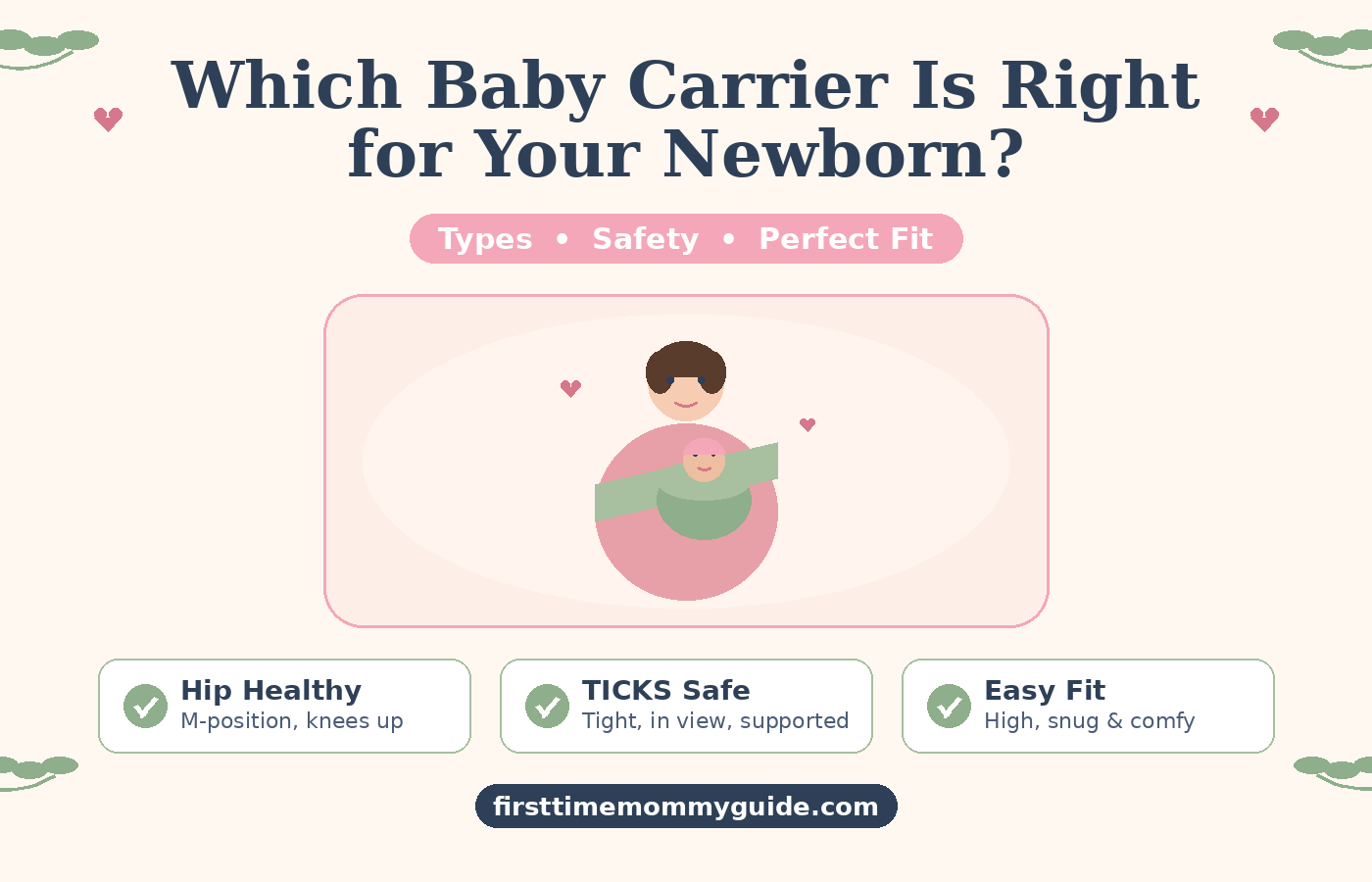
Quick answer: For most newborns, the safest starting points are a stretchy wrap or a soft-structured carrier with a newborn insert or an adjustable seat that supports the baby from knee to knee. Look for a carrier certified as hip-healthy by the International Hip Dysplasia Institute, check that your baby sits in the M-position with knees higher than their bottom, and follow the TICKS safety rules every single time you carry. Try before you buy if you can, and choose the carrier you can put on and adjust by yourself.
Why a Carrier Matters in the First Months
Newborns arrive expecting closeness. For nine months they lived pressed against you, hearing your heartbeat and feeling your movement. A carrier recreates that world, and the benefits reach both of you.
Carried babies tend to cry less. When your baby is snug against your chest, you feel their early hunger cues sooner, which can make breastfeeding smoother in the early weeks.
Carrying also protects your hands and your back. A well-fitted carrier spreads your baby’s weight across your shoulders and hips instead of loading one arm. That matters when you are recovering from birth and rebuilding strength — see our guide to postpartum recovery in the first weeks for gentle ways to rebuild stamina.
A carrier also lets you move through narrow shop aisles and up stairs where a pushchair cannot go. If you are still deciding on wheels as well, read our guide on how to choose a baby stroller so the two choices work together.
Before you buy anything, though, it helps to understand what you are actually choosing between. The carrier world splits into five main types, and each one suits a different baby, body, and budget.
The 5 Baby Carrier Types Compared
Every carrier on the market is a variation on one of five designs. Understanding the five first makes every product page easier to read, because you can ignore the marketing and focus on the shape.
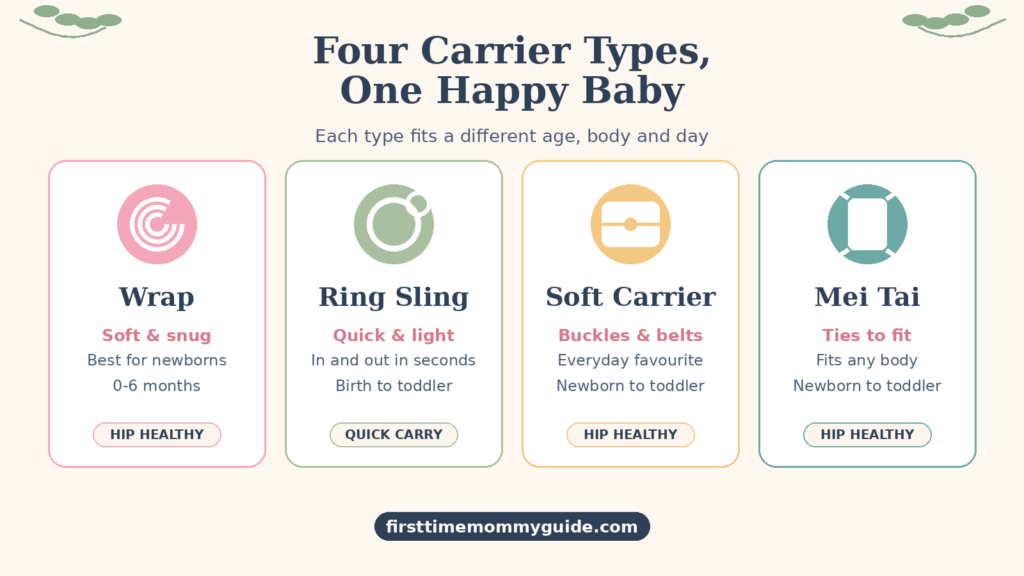
| Carrier type | Best age range | Typical weight limit | Learning curve | Best for |
|---|---|---|---|---|
| Stretchy wrap | Birth to ~6 months | Up to 15–18 lb | Moderate | Newborn snuggles, around the house |
| Ring sling | Birth to toddler | Up to 35 lb | Moderate | Quick ups and downs, hip carries |
| Soft-structured carrier (SSC) | Newborn to toddler | Up to 45 lb | Easy | Everyday use, outings, two parents sharing |
| Mei Tai | Newborn to toddler | Up to 45 lb | Moderate | Long-term value, adjustable fit |
| Backpack carrier | ~6 months to toddler | Up to 40–48 lb | Easy | Hiking, older babies, long walks |
Now let us look at each type in detail.
1. Stretchy Wrap
A stretchy wrap is a long piece of soft, stretchy fabric — usually a cotton-spandex blend — that you tie around your body to make a snug pocket for your baby. It is the closest thing to being held in arms, and many parents say it is the only thing that settled their baby in the first eight weeks.
Pros: Extremely comfortable for newborns. The fabric moulds to your baby’s body and spreads weight evenly across your back and shoulders. It is inexpensive, machine washable, and packs down to almost nothing in a nappy bag. Pre-tying it before you leave the house makes outings quick.
Cons: There is a learning curve. The first few attempts feel like wrestling a very long scarf, and most parents need a video tutorial and a few practice runs. Stretchy wraps suit small babies best; once your baby passes about 15 pounds, the fabric starts to sag. They are also warm, which can be too much in summer.
Best for: The newborn weeks at home, soothing a fussy baby, and parents who want the closest, softest carry. If your baby is under three months and you mostly carry indoors or on short walks, a stretchy wrap is hard to beat.
2. Ring Sling
A ring sling is a long piece of woven fabric threaded through two metal rings, worn over one shoulder. You slide your baby into the pouch, then pull the fabric through the rings to tighten. It is one of the oldest carrier designs in the world.
Pros: Fast once you learn it. You can pop your baby in and out in seconds, which makes it brilliant for quick errands and for a baby who wants up and down constantly. It adjusts to fit different body sizes easily, and it doubles as a nursing cover or a blanket. It is also lovely for hip carries once your baby is older.
Cons: All the weight sits on one shoulder, so long carries can ache. The fit depends on spreading the fabric well across your shoulder and back, which takes practice. Newborns need careful positioning in a sling, with the fabric supporting them from knee to knee and their airway kept clear at all times.
Best for: Short carries, quick trips, and parents who want one carrier that works from newborn to toddler. It also suits hot weather, since there is less fabric than a wrap.
3. Soft-Structured Carrier (SSC)
The soft-structured carrier is the buckle carrier most people picture when they hear “baby carrier.” It has padded shoulder straps, a waist belt, and a structured body panel, and it closes with buckles. Think of it as a small, comfortable backpack worn on your front.
Pros: The easiest carrier to learn. Buckles click, straps adjust, and you are ready in under a minute. The waist belt carries most of the weight on your hips, which protects your back on longer walks. Most good SSCs adjust from newborn to toddler, and many are certified hip-healthy. Partners can share one carrier by adjusting the straps.
Cons: Newborns need the right set-up. Some SSCs need a separate newborn insert, while others have an adjustable seat that narrows for small babies. Check this before you buy: a carrier that fits a six-month-old may swallow a newborn. SSCs are also bulkier than wraps and cost more.
Best for: Everyday carrying, longer walks, and families who want one carrier that lasts from the early weeks into toddlerhood. If you only buy one carrier, this is the most common recommendation — and the one most parents end up using most.
4. Mei Tai
A Mei Tai (also spelled Meh Dai) is a panel of fabric with four long straps — two that tie around your waist and two that go over your shoulders. It sits between a wrap and a buckle carrier: soft and mouldable like a wrap, structured enough to feel secure.
Pros: Beautifully adjustable. Because it ties rather than buckles, it fits almost any body shape, including plus-size and petite parents, and it fits newborns through toddlers with the same panel. It is comfortable for long carries, packs flat, and is usually cheaper than a premium buckle carrier.
Cons: Tying takes practice, and long straps can drag on the ground in a car park or a public toilet. It is slower to put on than a buckle carrier, so it suits parents who do not mind a minute of tying in exchange for a custom fit.
Best for: Parents who want a wrap-like fit with more structure, and families where two adults of very different sizes will share one carrier.
5. Backpack Carrier
A framed backpack carrier holds your baby high on your back in a metal-framed seat. It is built for hiking and long outdoor walks, with storage pockets, sun shades, and a kickstand so it stands on the ground.
Pros: Superb for active families. Your baby rides high with a great view, your hands stay free, and the frame carries the weight comfortably for hours. Most models have excellent storage for nappies, water, and snacks.
Cons: Not for newborns. Backpack carriers are for babies who can sit unaided, usually from around six months, and who have strong head and neck control. They are heavy, bulky, and expensive, and they are overkill for the supermarket.
Best for: Hiking and outdoor adventures with a baby over six months old. Skip this one entirely until your baby can sit up on their own.
Baby Wrap vs Carrier: Which Is Better for a Newborn?
This is the question almost every new parent asks first, and the honest answer is that both can be excellent — they just solve different problems.
A wrap wins on softness and closeness. In the first weeks, when your baby weighs under ten pounds and wants to be curled against you, a stretchy wrap feels like an extension of your arms. It is gentle on a newborn’s body, easy on a recovering parent, and cheap enough to try without commitment.
A buckle carrier wins on speed and staying power. It takes seconds to put on, supports a heavier baby without sagging, and lasts into toddlerhood. If you want to buy once and carry for two years, a soft-structured carrier with a proper newborn setting is the more practical choice.
Many experienced parents end up owning both: a wrap for the sleepy newborn weeks at home, and a buckle carrier for outings once the baby is a few months old. That is not a sales pitch — it is simply how the two designs complement each other. If your budget only stretches to one, choose the buckle carrier, because it covers the longest stretch of your baby’s life. Then add a wrap later if you find you want that extra closeness at home.
Whichever you choose, the deciding factor is not the brand or the price. It is the fit, and that is where hip health comes in.
Hip-Healthy Positioning: The M-Shape Explained
Your newborn’s hips are still developing. At birth, the ball of the thigh bone sits loosely in a shallow hip socket, and the joint deepens over the first months as your baby moves and grows. How you carry your baby can support that development — or work against it.
The goal is the M-position, sometimes called the spread-squat position. In it, your baby’s knees are higher than their bottom, their thighs are supported from knee to knee, and their legs form a wide “M” shape. This is the position your baby naturally takes when you pick them up, and a good carrier holds them there.
The International Hip Dysplasia Institute certifies carriers as hip-healthy when they hold babies in this position. Look for their acknowledgment on the product page or packaging before you buy. A carrier that lets your baby’s legs dangle straight down — the way some narrow-seat carriers do — puts pressure on the developing hip joint and should be avoided, especially in the first months.
Three quick checks confirm the M-position:
- Knees higher than bottom. Look at your baby from the side. Their knees should sit clearly above the level of their bottom, not level with it and not below it.
- Supported knee to knee. The carrier fabric or seat should reach from one knee crease to the other. If the seat is too narrow, your baby’s legs hang. If it is too wide, the fabric bunches behind their knees.
- A natural curve. Your baby’s spine should keep its gentle newborn curve, not be forced straight or arched backwards. In a wrap, the fabric supports the curve; in a buckle carrier, the panel should be soft enough to let it happen.
For a newborn, the seat needs to be narrow — most soft-structured carriers achieve this with an adjustable base or a newborn insert. If you have to stuff a rolled muslin into the carrier to make your baby sit high enough, the carrier probably is not adjusted correctly.
Baby Carrier Safety: The TICKS Rules
Safety comes before comfort, style, and price. The best-known version is TICKS, published by the UK Lullaby Trust and echoed by health visitors, the NHS, and safe-sleep organisations around the world.
T — Tight. The carrier should be tight enough to hug your baby close to you, with no slack fabric that lets them slump. If you can fit your hand between your baby and your chest easily, tighten the carrier.
I — In view at all times. You should always be able to see your baby’s face by glancing down. Never let fabric cover their face, and never carry with their face pressed into your chest or into the carrier where you cannot see them.
C — Close enough to kiss. Your baby should sit high enough that you can tip your head forward and kiss the top of their head. If you have to strain or bend deeply, your baby is sitting too low.
K — Keep chin off chest. A baby’s chin should never rest on their chest. There should always be at least a two-finger gap between their chin and chest, because a tucked chin can restrict their airway. This is the rule that matters most for newborns, who have weak neck muscles and cannot reposition themselves.
S — Supported back. Your baby’s back should be supported in its natural position, with their tummy and chest against you. In a cradle or lying-down carry, their back should be supported and their face kept clear. Never carry a baby lying flat in a sling unless the product is specifically designed for it and you can see their face.
The NHS advises parents to follow these same checks with slings and carriers, and its guidance on baby sling safety sits alongside its safe-sleep advice — worth reading before your first carry. The American Academy of Pediatrics, through HealthyChildren.org, also stresses keeping your baby visible, their airway open, and their chin off their chest. The US Consumer Product Safety Commission has published guidance on sling and carrier safety too, and it is worth a look on the CPSC website if you want the official word.
Two more safety points deserve a mention. First, never use a carrier as a car seat, and never carry your baby in a carrier while cooking over a hot stove or cycling. Second, check your carrier before every use: look for worn fabric, frayed straps, cracked buckles, and loose stitching.
Your Baby Carrier Safety Checklist
Print this list or save it on your phone. Run through it every time you put your baby in the carrier, especially in the first month while the routine is still new.
- Airway clear. Your baby’s face is visible, their nose and mouth are uncovered, and their chin is off their chest.
- High and tight. You can kiss the top of their head without straining, and the carrier hugs them close with no sagging.
- Knees up. Knees are higher than their bottom in the M-position, supported from knee to knee.
- Back supported. Their back is held in its natural curve, with their tummy and chest against you.
- Buckles and knots secure. Every buckle is clicked and every knot is tied. Give each strap a tug before you walk.
- Fabric in good condition. No tears, frayed seams, cracked buckles, or worn rings.
- You can move safely. You can see your feet, bend your knees, and sit down without your baby’s position changing.
- Weather appropriate. Your baby is dressed for the temperature, not overheated under layers of carrier fabric.
That last point catches many parents out. A carrier counts as a layer of clothing. In warm weather, dress your baby in one layer less than you would without the carrier, and check the back of their neck for sweat. In cold weather, their legs and feet need extra cover, because carrier fabric rarely covers little legs fully.
How to Check the Fit Step by Step
A carrier that fits well feels almost weightless. A carrier that fits badly pulls on your neck, digs into your shoulders, and leaves your lower back aching after ten minutes. The difference is usually adjustment, not the carrier itself, so work through these steps before you decide a carrier does not suit you.
Step 1: Start with the Waist Belt
Put the waist belt on first and fasten it snugly around your natural waist or hips — high on your waist for a newborn, settling onto your hips as your baby grows. It should sit level all the way around, not riding up at the back. The waist belt carries most of your baby’s weight, so a loose belt means your shoulders do all the work.
Step 2: Settle Your Baby High and Centred
Hold your baby against your chest, high enough to kiss, with their bottom roughly at your belly button or above. Their tummy should press against you, not hang away from you. If your baby slides down when you let go, the carrier is too loose or the seat is too wide.
Step 3: Tighten the Shoulder Straps
Pull the shoulder straps snug, one side at a time. They should sit flat on your shoulders, not twisted, and they should not dig in. If the straps slide off your shoulders, the chest clip (on a buckle carrier) is probably too low — slide it up to shoulder-blade height.
Step 4: Check the Seat Width
Look at your baby’s legs. The fabric should support them from one knee crease to the other. On an adjustable carrier, narrow the seat for a newborn and widen it as they grow. If the seat is too wide, your baby’s legs will stick out stiffly; too narrow, and their legs dangle.
Step 5: Do the Mirror Check
Stand in front of a mirror and run the TICKS check: tight, in view, close enough to kiss, chin off chest, supported back. Check from the side too — your baby’s knees should be higher than their bottom, and their spine should curve gently. Ask your partner to check your back view: straps should be even, not twisted, and the waist belt level.
Step 6: Walk and Re-check
Walk around the house for five minutes, then check again. Carriers settle as you move, and a strap that felt tight may loosen. Re-tighten once, then you are ready. If you feel pain in your neck or shoulders after ten minutes, something is still off — usually the waist belt is too loose or the chest clip is in the wrong place. Adjust and try again before giving up on the carrier.
| Fit check | What good looks like | What to fix |
|---|---|---|
| Height | You can kiss baby’s head easily | Raise baby higher, tighten straps |
| Tightness | Baby hugs your chest, no gaps | Tighten panel and straps evenly |
| Knees | Knees above bottom, M-shape | Narrow or widen the seat |
| Chin | Two-finger gap from chest | Lift baby higher, reposition head |
| Straps | Flat, even, no digging | Untwist, adjust chest clip height |
| Waist belt | Level, snug, carries the weight | Tighten belt, lower or raise it |
| Back | Gentle curve, fully supported | Tighten fabric, check panel height |
If you are struggling, a local sling library or babywearing consultant can be worth their weight in gold. Many offer a one-hour session where you try several carriers with your own baby.
Front, Hip and Back Carry: What Suits Each Age
Where your baby rides changes as they grow. Each position has a right time, and moving to the next one too early is one of the most common mistakes new parents make.
Front Carry Facing In (Birth to ~6 Months)
This is the newborn position. Your baby faces your chest, tucked close in the M-position, with their head supported. It keeps their airway visible, their hips in the right shape, and their world small and calm — exactly what a newborn needs.
Keep your baby facing in until they have strong, steady head control and can hold their head up without wobbling, usually around four to six months. A newborn should never face outwards: their hips cannot hold the position, their spine gets no support, and they cannot turn away when the world gets too much.
Front Carry Facing Out (~6 Months and Older)
Once your baby has full head and neck control, good trunk strength, and can sit with support, a short facing-out carry becomes an option. Keep these carries brief — twenty minutes is a good limit — because facing out gives your baby no way to rest their head or retreat from stimulation, and it loads their hips and spine differently. Watch for signs of overstimulation: fussing, arching, or turning their head away. If you see them, turn your baby back in.
Some parents skip facing-out entirely and go straight to hip or back carries, and that is perfectly fine. Facing out is optional, not a milestone.
Hip Carry (~6 Months and Older)
A hip carry places your baby on your side, usually in a ring sling or a carrier designed for it. It suits babies who can sit unaided and want to look around while staying close. Hip carries free one arm completely, which makes them handy for older babies at home.
Wait until your baby sits well on their own before trying a hip carry. Before that, their trunk is not strong enough to hold the position safely.
Back Carry (~6 Months to 1 Year, Depending on the Carrier)
Back carrying is a game-changer for toddlers: your baby rides high on your back, you get both arms free, and long walks become comfortable again. Most manufacturers allow back carrying from around six months, once the baby can sit unaided — but check your carrier’s manual, because the minimum age varies.
Learning to move a baby to your back takes practice. Practise over a bed or a sofa first, or have your partner help until the move feels automatic. Never try a back carry with a newborn or a baby who cannot yet sit up.
| Carry position | Minimum age | Needs | Best carrier types |
|---|---|---|---|
| Front facing in | Birth | Head support, M-position | Wrap, ring sling, SSC, Mei Tai |
| Front facing out | ~6 months | Full head control, trunk strength | SSC, Mei Tai |
| Hip carry | ~6 months | Sits unaided | Ring sling, SSC, Mei Tai |
| Back carry | ~6 months | Sits unaided | SSC, Mei Tai, backpack carrier |
If your baby is going through big milestones — learning to sit, or starting to move more — you may find our guide on when do babies start sitting up useful for timing the switch to hip and back carries.

Summer vs Winter Carrying
The same carrier behaves very differently in July and in January. A little planning keeps your baby comfortable in both.
Carrying in Summer
Heat is the main risk. A carrier adds warmth, and a newborn cannot tell you they are too hot — so you have to check. Dress your baby in a single light layer, such as a vest, and leave their legs bare or lightly covered. Choose breathable fabrics: linen, cotton, or mesh panels beat heavy canvas on a hot day. A ring sling or a lightweight wrap is often cooler than a padded buckle carrier.
Check the back of your baby’s neck every twenty minutes or so. If it feels sweaty or hot, find shade, loosen the carrier slightly for airflow, and offer a feed. Never cover your baby’s face with a muslin or blanket for shade — it traps heat and hides their airway. A wide-brimmed hat and a parasol do the job safely.
Stay out of the midday sun, keep carries shorter on very hot days, and remember that your own body heat adds to your baby’s.
Carrying in Winter
Cold is easier to manage than heat, because you can add layers — but the layers need to go in the right places. Your baby’s legs and feet stick out of most carriers, so warm socks, leg warmers, and a babywearing coat matter more than a thicker top.
Dress your baby in their normal indoor clothes, then add a warm layer over the carrier rather than under it. Bulky snowsuits are a problem: they make it hard to get a tight, safe fit and can hide the TICKS checks. Keep their head warm with a soft hat, and check their cheeks and hands for cold.
Common Mistakes New Parents Make
Most carrying problems come from a small handful of errors, and all of them are easy to fix once you know what to look for.
Buying before trying. A carrier that fits your best friend perfectly may not fit your body at all. If you can, try carriers at a sling library, a baby shop, or a friend’s house before you spend money. If you buy online, check the return policy first.
Carrying too low. A baby riding at your belly button or below is hard on your back and impossible to kiss. Raise your baby up, tighten the waist belt, and tighten the straps until they sit high on your chest.
Leaving the carrier too loose. A loose carrier lets your baby slump, which risks their airway and strains your back. The carrier should feel like a firm hug, not a hammock. If your baby bounces as you walk, tighten up.
Facing a newborn outwards. It looks fun, but a newborn’s neck and hips are not ready. Keep them facing in for the first months, and only try facing out when they have full head control.
Skipping the safety checks. The TICKS check takes ten seconds. Do it every time, even when you are in a rush — especially when you are in a rush.
Budget vs Premium: What Are You Actually Paying For?
Baby carriers range from around twenty dollars for a simple stretchy wrap to well over two hundred for a premium buckle carrier. Here is what the price difference usually buys.
At the budget end, you get safe, functional carrying. A twenty-dollar stretchy wrap carries a newborn beautifully. A mid-range buckle carrier from a reputable brand, usually between sixty and one hundred dollars, covers most families well, with decent padding, adjustability, and a hip-healthy design.
Premium carriers add comfort and longevity: softer fabrics, better padding, more precise adjustment, mesh panels for hot weather, and a fit that stays comfortable with a twenty-pound toddler on your back. They also tend to hold their resale value, so the cost per use can end up similar to a cheaper carrier that you replace after six months.
What price does not buy is safety on its own. An expensive carrier used loosely is less safe than a cheap wrap used correctly. Spend your money on fit and adjustability first, and treat luxury fabrics as a bonus.
A sensible approach: start with a stretchy wrap or a mid-range buckle carrier, learn what you like, and only upgrade if you find yourself carrying for hours a day and wanting more comfort.
Expert Tips for Happy Babywearing
- Practise at home first. Put the carrier on over a bed or sofa a few times before your first outing. Your baby will forgive a wobble; a busy car park will not.
- Use a mirror. A full-length mirror is the fastest way to learn what good positioning looks like from the outside.
- Keep a muslin handy. A small muslin tucked in the carrier pocket handles dribble, sick, and sun-shade duties.
- Build up gradually. Start with ten-minute carries and build up. Your back and shoulders need time to adapt, just like any new exercise.
- Carry for soothing. A fussy baby often settles in a carrier when nothing else works. The motion, warmth, and heartbeat are a powerful combination — which is why carriers pair so well with the techniques in our guide on how to soothe a crying baby.
- Share the load. Partners, grandparents, and caregivers can all carry. A carrier that adjusts quickly between adults gets used far more than one set up for a single person.
- Check in with your body. If something hurts, stop and adjust. Pain is information, not a badge of honour.
When to Stop Using a Carrier
There is no single age to stop carrying. Most families use a carrier well into toddlerhood, and some carry a three-year-old on a long walk without a second thought. The limits are practical, not medical.
Stop using a particular carrier when your baby exceeds its weight limit — check the label, because limits vary from about 35 to 48 pounds. Stop using it if the fabric, buckles, or stitching show wear you cannot trust. And stop a carry if your baby is distressed, overheated, or unwell, or if you feel dizzy, exhausted, or in pain.
As your baby grows, you may find they want to walk more and be carried less. That is normal. A carrier becomes a backup for tired legs rather than the main transport, and that is a success, not a failure. If you are heading out with a toddler, a quick check of your baby-proofing home checklist before you leave is still a good habit.
Frequently Asked Questions
What is the best baby carrier for a newborn?
A stretchy wrap or a soft-structured carrier with a newborn setting is the best starting point for most families. The wrap is softest for the first weeks; the buckle carrier lasts longer. Choose the one you can put on confidently and that holds your baby in the M-position.
When can I start using a baby carrier?
You can carry a healthy, full-term newborn from birth, as long as the carrier is designed for newborns and your baby weighs above the carrier’s minimum — usually around 7 pounds. Check your carrier’s manual for its exact minimum weight.
Is a baby carrier safe for a newborn?
Yes, when used correctly. Follow the TICKS rules, keep your baby’s chin off their chest, keep their face visible, and carry them high and tight. Always check the manufacturer’s weight limits and read the manual before the first use.
What does hip-healthy mean for a baby carrier?
Hip-healthy means the carrier holds your baby with knees higher than their bottom and thighs supported from knee to knee — the M-position. The International Hip Dysplasia Institute certifies carriers that meet this standard.
How long can a newborn stay in a carrier?
Newborns can nap in a carrier for a sleep cycle or so, but check them regularly and take them out for feeds, nappy changes, and stretches.
Can I breastfeed in a baby carrier?
Many parents do, especially in a ring sling or a wrap that loosens easily. Always bring your baby to the breast, keep their airway clear, and return them to the upright, visible position after the feed.
Is a wrap or a buckle carrier better for a newborn?
A wrap is softer and more mouldable for tiny babies; a buckle carrier is faster and lasts into toddlerhood. If you can only buy one, choose a buckle carrier with a good newborn setting. If you want the closest, cosiest carry for the first weeks, start with a wrap.
How do I know if the carrier fits my baby?
Your baby sits high enough to kiss, their knees are above their bottom, the fabric supports them from knee to knee, and their chin is off their chest. If any of these fail, adjust the seat width, raise the waist belt, or tighten the straps.
Can my partner use the same carrier?
Yes, if it adjusts easily. Buckle carriers and Mei Tais usually adjust between adults in under a minute. Stretchy wraps fit almost anyone because they tie to size. Ring slings adjust through the rings.
What should my baby wear in a carrier?
Indoors, their normal clothes are enough — the carrier counts as a layer. Outdoors in summer, dress them lightly and check for sweat. In winter, add warm socks and a layer over the carrier, not a bulky snowsuit underneath it.
Can I use a baby carrier after a C-section?
Many parents can, once they feel comfortable, but check with your doctor or midwife first. A waist belt sitting on your scar can be uncomfortable, so you may prefer a wrap that spreads pressure or a carrier worn higher until you heal.
How do I wash a baby carrier?
Most wraps, slings, and soft-structured carriers are machine washable on a gentle cycle. Check the label, use mild detergent, and air-dry. Avoid fabric softener, which can weaken fibres over time.
Can a baby sleep in a carrier?
Yes, babies often fall asleep in carriers, and it is safe as long as you keep the TICKS checks — face visible, chin off chest, back supported. Transfer them to a flat sleep surface when you get home.
What is the weight limit for baby carriers?
It depends on the carrier: stretchy wraps usually top out around 15–18 pounds, ring slings around 35 pounds, and soft-structured carriers around 40–45 pounds. Always check the label on your specific carrier.
Do I need a newborn insert?
It depends on the carrier. Some soft-structured carriers need an insert to lift a newborn high enough and narrow the seat. Others have a built-in adjustable seat and need no insert. Check the manual for your model before buying an extra insert.
What should I pack for a day out with a carrier?
Keep it light: nappies, wipes, a muslin, a spare outfit, and a bottle or your nursing cover. A small cross-body bag beats a heavy backpack when you are already carrying a baby. Our baby essentials checklist for 0–3 months covers the full packing list.
Conclusion
Choosing a baby carrier for your newborn does not need to be stressful. Start with the basics: a carrier that holds your baby high, tight, and in the M-position; a design you can put on by yourself; and the TICKS safety check every single time.
For most families, a stretchy wrap covers the sleepy newborn weeks, and a soft-structured carrier takes over for everything after that. Try before you buy if you can, re-check the fit as your baby grows, and remember that the best carrier is the one you actually enjoy using.

Dilawar Mughal
Founder and editor, First Time Mommy Guide
I research every guide against what the NHS, the AAP and the WHO publish, then write it in plain English — because most new parents are reading with one hand free, not comparing clinical guidelines. I'm not a doctor or a midwife. Every health claim on this site is sourced and linked so you can check it yourself, and anything urgent belongs with your health visitor or GP, not a blog.