How to Introduce Allergens to Baby: A Calm, Step-by-Step Guide
Dilawar MughalOctober 23, 202611 min read
General information, not medical advice. Every baby is different — if anything worries you, speak to your midwife, health visitor or GP rather than waiting.
Quick answer: Current guidance (AAP, NHS) says introduce common allergens like peanut and egg early — from around 6 months, once your baby is ready for solids — one at a time, in small amounts, at home where you can watch. Early introduction reduces allergy risk.
Introduction
The first time you hold a spoonful of peanut butter near your baby’s mouth, your hand might shake a little. That’s completely normal. Somewhere along the way, most of us absorbed the idea that allergenic foods are dangerous for babies — and that waiting is safer.
The science says the opposite. And that’s actually good news, because it means the scary thing you’re about to do is one of the most protective things you can do for your baby’s immune system.
This guide walks you through introducing allergens to your baby calmly and safely: which foods matter most, when to start, exactly how to serve each one, what a reaction looks like, and when to call for help. It’s all checked against current guidance from the AAP, the NHS, and allergy societies. As always, I’m not a doctor – this is general information, and your pediatrician or GP knows your baby best. If your baby is just starting solids, begin with our starting solids guide for 6–12 months.
Definition: Allergen. A usually-harmless substance (like peanut protein) that some people’s immune systems overreact to. The top 9 food allergens account for the vast majority of food allergies in children.
The Big Idea: Early Introduction Prevents Allergies
For years, parents were told to delay allergenic foods — wait until 1, 2, even 3 years old. That advice has flipped completely.
The landmark LEAP study (a large randomized trial published in 2015) found that introducing peanut early to high-risk infants dramatically reduced peanut allergy by age 5, compared with avoiding it. Following this and similar research, the AAP, NHS, and allergy organizations worldwide now recommend introducing common allergens early — from around 6 months — rather than delaying.
The principle is simple: the infant immune system learns what’s “safe” through early, regular exposure via the gut. Delaying doesn’t protect — it may actually increase risk.
When to Start Introducing Allergens
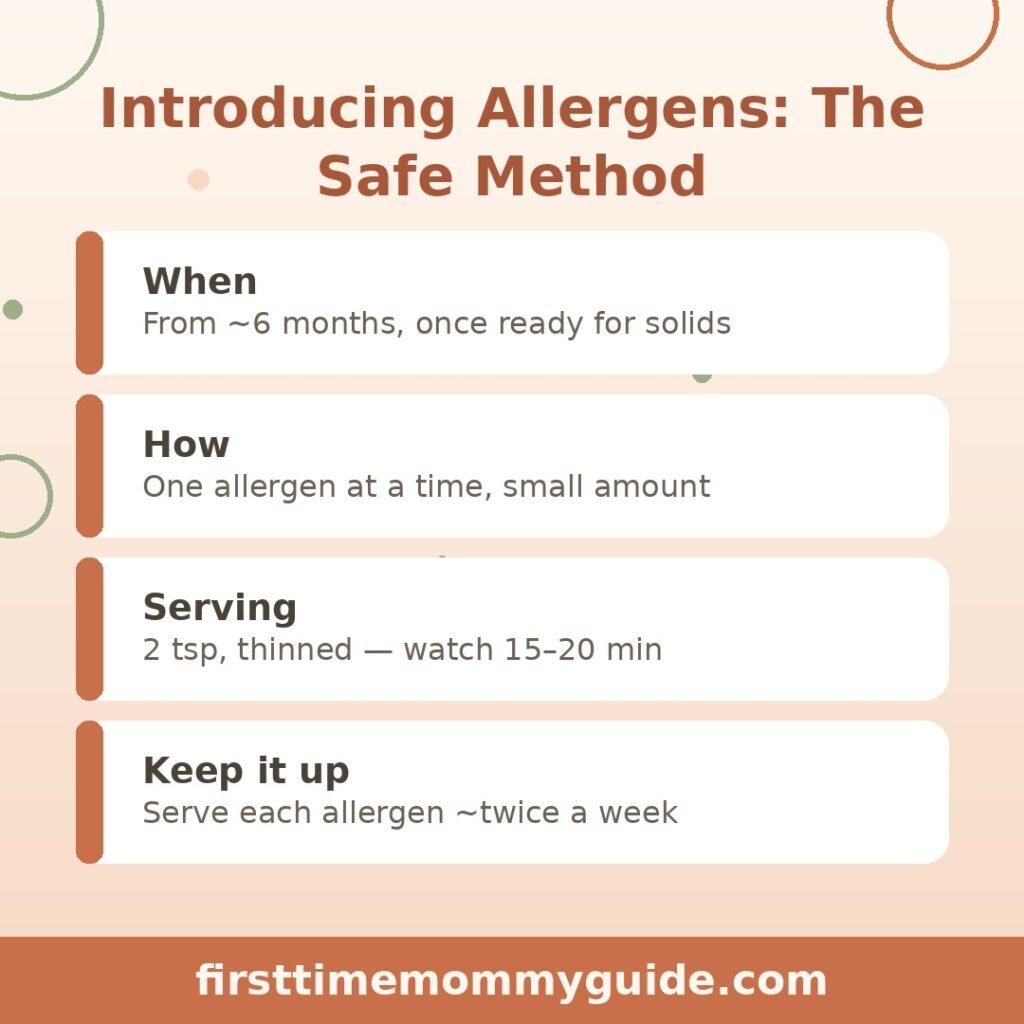
When: from around 6 months, once your baby shows signs of readiness for solids.
Not before 4 months: allergens shouldn’t come before your baby is developmentally ready for any solids.
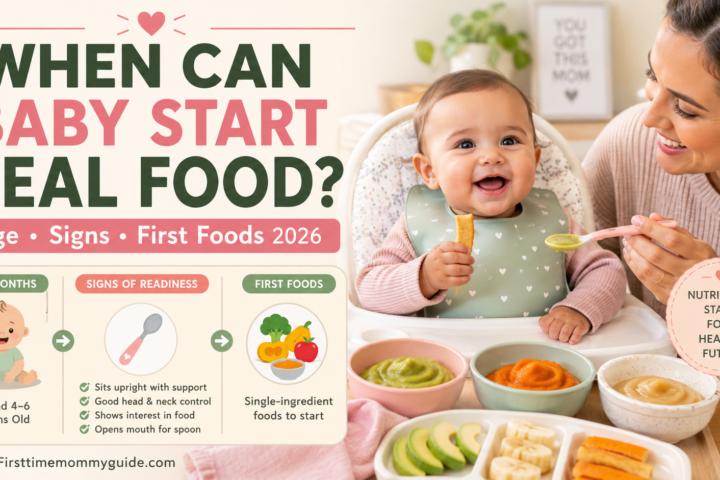
Signs of readiness: sits with support, holds head steady, reaches for food, opens mouth for the spoon, has lost the tongue-thrust reflex.
You don’t need to introduce allergens on day one of solids. Many families start with a few simple first foods for baby (like iron-fortified cereal or vegetable purées), then add allergens within the first weeks. The key is: don’t put it off for months.
If your baby has moderate to severe eczema, or there’s already a diagnosed food allergy in the family, talk to your pediatrician before introducing peanut — some babies benefit from testing first. This is specifically recommended in AAP guidance.
The Top 9 Allergens (and Which Matter Most)
These nine foods cause the vast majority of food allergies:
Allergen
Priority for early introduction
First-try serving idea
Peanut
Highest — strongest evidence
Thinned smooth peanut butter
Egg
Highest — strong evidence
Well-cooked, mashed egg
Cow’s milk (in foods)
High
Plain yogurt
Tree nuts
High
Thinned almond/cashew butter
Fish
Moderate
Flaked low-mercury fish (salmon, cod)
Shellfish
Moderate
Mashed shrimp
Wheat
Moderate
Soft wheat cereal, bread
Soya
Moderate
Soft tofu, edamame purée
Sesame
Moderate
Thinned tahini
Focus your energy on peanut and egg first — they have the strongest evidence for early introduction and are the most common childhood allergies. The rest can follow in the coming weeks.
Important: Cow’s milk as a drink should wait until 12 months (per AAP/NHS), but cow’s milk in foods like yogurt and cheese is fine from 6 months.
How to Introduce Allergens: The Step-by-Step Method
Before you start
Pick a calm day when your baby is healthy — not when they’re ill or just vaccinated, so you can spot any reaction clearly.
Do it early in the day, at home — never right before a nap, at daycare, or at a restaurant. You want a 2-hour window to observe.
Have one adult present the whole time (that’s you, phone in pocket).
The method, each time
One allergen at a time. Introduce a single new allergen, then wait 2–3 days before the next one — so any reaction has a clear culprit.
Start small. About a quarter teaspoon of the prepared food, mixed into something familiar like vegetable purée or oatmeal.
Watch for 15–20 minutes. If all is well, offer a little more.
Build gradually. Over the next few servings, increase to a normal portion.
Keep it regular. Once tolerated, serve that allergen roughly twice a week. Regular exposure maintains tolerance – a one-time taste isn’t enough, so building a feeding rhythm helps you stay consistent.
How to Serve Each Allergen Safely
Texture matters as much as timing — whole nuts and thick globs of nut butter are serious choking hazards.
Peanut: Mix 2 teaspoons of smooth peanut butter with warm water, breast milk, or formula until thin and runny. Never whole peanuts or thick spoonfuls.
Egg: Hard-boiled or scrambled, mashed smooth with a little breast milk, formula, or water. Serve well-cooked, not runny.
Tree nuts: Thin almond or cashew butter exactly like peanut butter. Never whole nuts.
Dairy: Plain whole-milk yogurt is the easiest start. Small pieces of soft cheese later.
Fish: Flaked, boneless, well-cooked low-mercury fish (salmon, cod, tilapia). Check carefully for bones.
Shellfish: Well-cooked, finely mashed shrimp or crab.
Wheat: Iron-fortified wheat cereal or soft pieces of bread/toast.
Soya: Soft tofu or edamame purée.
Sesame: Tahini thinned with water or stirred into purée.
Never smear food on your baby’s skin to “test” for allergy — especially with eczema. Skin exposure without oral exposure may actually increase allergy risk. The mouth is the route that teaches tolerance.
What Does an Allergic Reaction Look Like?
Most reactions in babies are mild — but you should know the full spectrum.
Mild — monitor closely, call your pediatrician
Hives (raised red welts)
Redness or mild rash around the mouth
Runny nose, watery eyes
One episode of vomiting shortly after eating
Note: a mild red rash just around the mouth where food touched is common and often not an allergy (it’s contact irritation). Photograph anything you’re unsure about.
Moderate — call your pediatrician promptly
Widespread hives
Repeated vomiting or diarrhea
Swelling beyond the lips
Persistent coughing
Severe (anaphylaxis) — call emergency services immediately
Difficulty breathing or swallowing
Swelling of lips, tongue, or throat
Pale, floppy, or bluish skin
Sudden extreme drowsiness or collapse
Severe reactions in young babies trying a food for the first time are uncommon, but knowing the signs is exactly what makes you prepared rather than scared.
If your baby was prescribed an epinephrine auto-injector, use it for signs of a severe reaction and call emergency services. Most families won’t need one — this is just for completeness.
Special Situations
Baby has eczema
Babies with moderate-to-severe eczema have a higher risk of food allergy, particularly peanut. The AAP specifically recommends early peanut introduction (around 4–6 months) for these babies — and suggests talking to your pediatrician about testing before the first taste. Well-controlled mild eczema doesn’t change the plan much, but mention it at your next visit.
Family history of food allergy
A parent or sibling with a food allergy raises your baby’s risk somewhat, but doesn’t guarantee anything. You don’t need to avoid allergens — still introduce early, but it’s worth discussing the plan with your pediatrician.
Baby already reacted to a food
Stop that food, note exactly what happened (photos help), and call your pediatrician before trying it again. Don’t re-challenge at home after anything beyond the mildest reaction.
Premature babies
Use corrected age as a rough guide and check with your pediatrician about timing — the principles are the same, but the calendar shifts.
Common Worries, Answered Honestly
“What if I’m too nervous to do this?”
Start with the least scary one — yogurt is just… yogurt. Build your confidence there, then work up to peanut. Nervous is normal; avoidance isn’t protective.
“Should I buy those allergen powder products?”
They’re not necessary. Regular foods from your kitchen, served as described above, do the job — and they’re cheaper. Some families like the convenience; there’s nothing wrong with them, just nothing essential.
“Do I need to keep a food diary?”
A simple note on your phone (food + date) is enough. It helps if you ever need to describe a reaction to your doctor.
“What if my baby hates peanut butter?”
Try again another day, mixed into something they like. Persistence matters more than perfection — and egg, dairy, and the others all count too.
Sample 3-Week Allergen Introduction Plan
Week
New allergen
How
Week 1
Peanut
Thinned smooth peanut butter, ¼ tsp building up, twice that week
Week 1 (later)
Egg
Mashed hard-boiled egg, small amounts, twice that week
Week 2
Dairy
Plain yogurt, a few spoonfuls, several times that week
Week 2 (later)
Wheat
Iron-fortified wheat cereal or soft toast
Week 3
Tree nut
Thinned almond butter, like peanut
Week 3 (later)
Fish
Flaked salmon, boneless, mashed
Keep serving the earlier ones regularly while you add new ones. By the end of the month, your baby is eating a varied diet — exactly what the immune system needs.
Conclusion
Introducing allergens feels like the scariest part of starting solids, but it’s genuinely one of the most evidence-backed, protective things you’ll do in your baby’s first year. Early and regular beats late and cautious — every time.
Go one food at a time, keep it small, do it at home in the morning, and keep serving what works. You’ve got the plan. Your baby’s got this. And so do you.
Medical disclaimer: This article is general information, not medical advice. Allergen guidance follows current AAP, NHS, and allergy-society recommendations, but every baby is different — especially babies with eczema or a family history of allergy. Always check with your pediatrician, GP, or health visitor about your baby’s specific situation.
FAQs
When should I introduce allergens to my baby?
From around 6 months, once your baby is ready for solids. Don’t delay — current AAP and NHS guidance recommends early introduction rather than waiting.
Which allergen should I introduce first?
Peanut and egg have the strongest evidence. Start with one of them — thinned smooth peanut butter or well-cooked mashed egg — then add others over the coming weeks.
How do I introduce peanut butter to my baby safely?
Mix 2 teaspoons of smooth peanut butter with warm water, breast milk, or formula until thin and runny. Start with about a quarter teaspoon, watch for 15–20 minutes, then offer more. Never give whole peanuts or thick globs.
How long should I wait between introducing new allergens?
Wait 2–3 days between new allergens so any reaction has a clear cause. Once a food is tolerated, serve it regularly (about twice a week) while you add the next.
What does a mild allergic reaction look like in babies?
Hives, redness around the mouth, or vomiting shortly after eating. A faint rash just where food touched the skin is often simple irritation, not allergy — photograph it and ask your doctor if unsure.
When should I call emergency services?
Call immediately for difficulty breathing or swallowing, swelling of lips/tongue/throat, pale or bluish skin, floppiness, or sudden extreme drowsiness — signs of a severe reaction (anaphylaxis).
Should I introduce allergens if my baby has eczema?
Yes — but talk to your pediatrician first. Babies with moderate-to-severe eczema have higher allergy risk, and the AAP recommends discussing testing before peanut introduction specifically.
Can I give my baby whole nuts?
No. Whole nuts are a choking hazard for babies and young children. Always use thinned nut butters or finely ground nuts until your child is older (generally age 4+ for whole nuts, per pediatric guidance).
Does my baby need allergen powder products?
No. Regular foods prepared safely work just as well and cost less. Commercial allergen products are convenient but not necessary.
How often should my baby eat allergens after introduction?
Roughly twice a week per allergen to maintain tolerance. Regular exposure is what teaches the immune system — a single taste isn’t enough.
Can I introduce allergens before 6 months?
Not before 4 months, and only from around 6 months when your baby shows readiness for solids (sitting with support, good head control, interest in food). For high-risk babies, your pediatrician may advise 4–6 months.
What is the LEAP study?
A landmark 2015 randomized trial showing that early peanut introduction dramatically reduced peanut allergy by age 5 in high-risk infants, compared with avoidance. It changed global feeding guidance.
Should I rub food on my baby’s skin to test for allergy?
No. Skin exposure without eating the food may increase allergy risk rather than test for it. The safe route is small amounts by mouth, as described above.
What if my baby refuses an allergenic food?
Try again another day, mixed into a food they already like. It can take many exposures for a baby to accept a new taste. Keep the routine going with the allergens they do accept.
Can breastfeeding prevent food allergies?
Breastfeeding has many benefits, but there’s no strong evidence it prevents food allergies on its own. Early introduction of allergens matters regardless of feeding type.
Is yogurt okay as a first dairy food?
Yes — plain whole-milk yogurt is one of the easiest first dairy foods. Hold off on cow’s milk as a drink until 12 months, per AAP/NHS guidance.
What should I do if my baby vomits after trying a new food?
A single spit-up may just be texture or volume. Repeated vomiting shortly after eating, especially with hives or swelling, suggests a reaction — stop the food and call your pediatrician.
Do I need to see an allergist before starting?
Most families don’t. See your pediatrician first if your baby has moderate-to-severe eczema, already had a reaction to a food, or has a strong family history of food allergy.
Can I introduce allergens when my baby is sick?
Better to wait until they’re well, so you can tell the difference between illness symptoms and a possible reaction.
Dilawar Mughal
Founder and editor, First Time Mommy Guide
I research every guide against what the NHS, the AAP and the WHO publish, then write it in plain English — because most new parents are reading with one hand free, not comparing clinical guidelines. I'm not a doctor or a midwife. Every health claim on this site is sourced and linked so you can check it yourself, and anything urgent belongs with your health visitor or GP, not a blog.