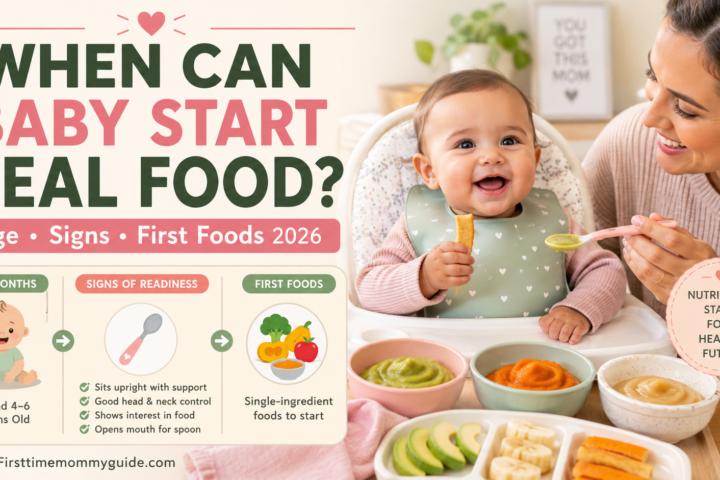
General information, not medical advice. Every baby is different — if anything worries you, speak to your midwife, health visitor or GP rather than waiting.
One of the most common questions new parents ask at the six-month mark is deceptively simple: can my baby have water now?
For the first six months, the answer is almost always no extra water needed. Breast milk or formula provides all the hydration a young baby requires, even in warm weather. But once solids begin, water earns a small, useful place at the table.
Introducing water to baby sounds straightforward, yet the details matter. How much is right? What kind of cup should you use? Does water need to be boiled? Can too much water be harmful? And what about juice, flavoured water, or water in hot weather?
This guide answers all of that, step by step. You will learn exactly when to start, how much to offer at each age, how to choose a cup, how to make water appealing without sugar, and the warning signs of both dehydration and over-hydration.
By the end, you will feel confident offering those first sips — and confident about when water is not needed at all.
The Short Answer: When Can Babies Drink Water?
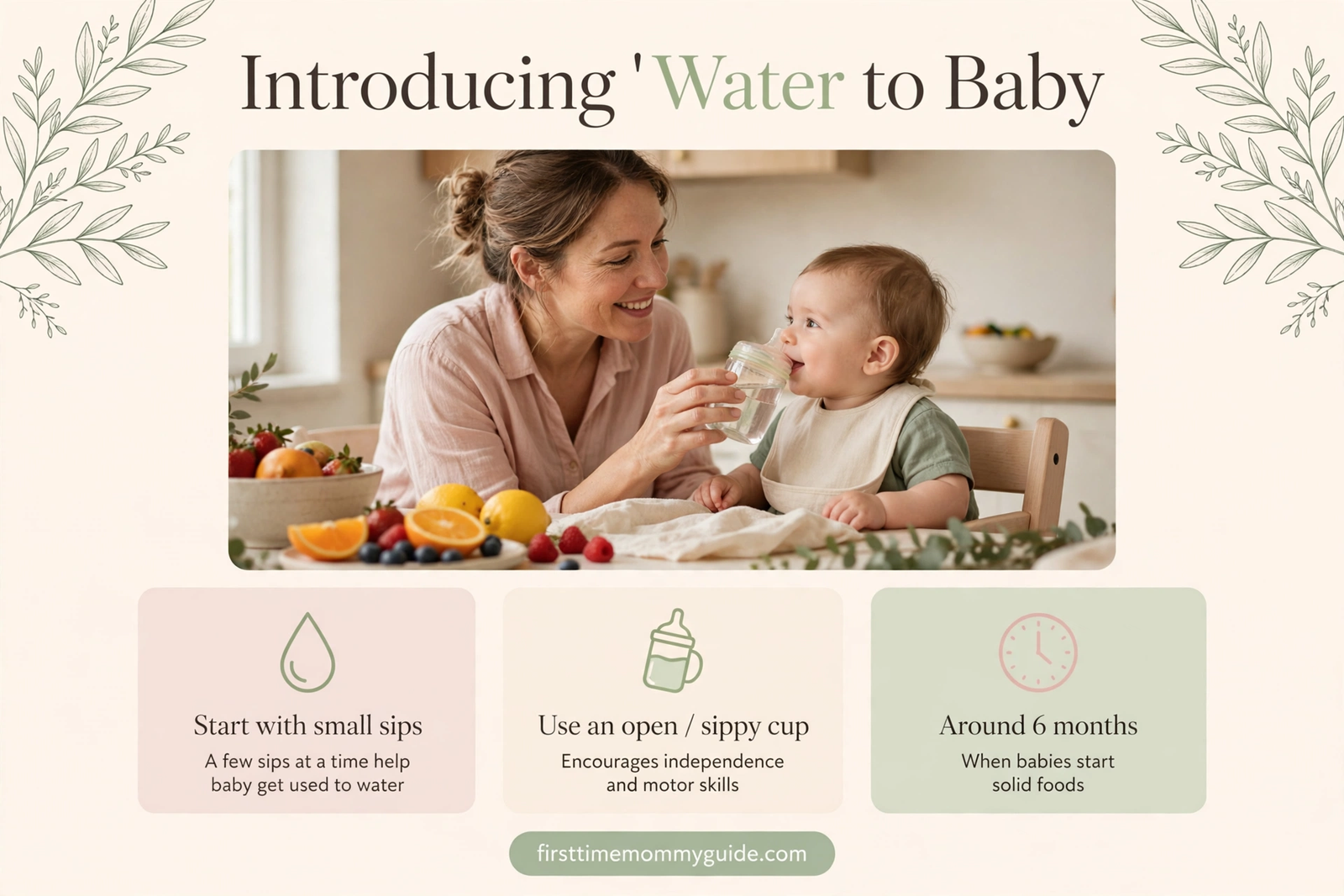
Babies can start having small sips of water at around 6 months, at the same time as they start solid foods. This is the guidance given by the American Academy of Pediatrics and reflected in NHS Start for Life weaning advice.
Before 6 months, babies should not be given extra water as a routine drink. Breast milk is about 88 percent water, and formula is mixed with water, so a young baby is already well hydrated from milk alone. Extra water in the early months can fill a tiny stomach, reduce milk intake, and in rare cases disturb the balance of salts in the blood.
After 6 months, the picture changes. Solids are drier than milk, and small sips of water with meals help babies learn to drink from a cup, practise swallowing, and wash down food. The amounts are small at first: a few sips, not a full bottle.
By 12 months, water becomes a more regular drink alongside milk and meals, and it remains the healthiest everyday drink throughout toddlerhood.
The key principle is simple: before six months, milk is enough. From six months, add small sips with meals. After one year, water becomes a main drink.
Why Babies Under 6 Months Do Not Need Extra Water
It feels counterintuitive, especially on a hot day. If you are thirsty, surely your baby must be thirsty too? But young babies are different from adults in a few important ways.
First, their stomachs are tiny. A newborn’s stomach holds only a small amount, and every millilitre of water is a millilitre that is not milk. Milk provides calories, nutrients, and hydration together. Water provides hydration only, so too much of it can displace the nutrition a growing baby needs.
Second, young babies’ kidneys are still maturing. They are less able to handle large amounts of plain water, and in rare cases excess water can dilute sodium in the blood, a condition called water intoxication. It is uncommon, but it is the reason health guidance is firm about not offering water routinely before six months.
Third, breast milk and formula adjust to some extent to conditions. In hot weather, a breastfed baby may simply feed more often, taking in more of the thinner, thirst-quenching milk at the start of a feed. A formula-fed baby can also be offered an extra feed if they seem thirsty, following your doctor’s advice on amounts.
There are exceptions, and they are always medical. If your doctor advises a small amount of water for a specific reason, such as constipation, follow their guidance exactly. That is different from offering water as an everyday drink.
If you are worried about hydration in a young baby, the signs to watch are fewer wet nappies, a sunken soft spot on the head, unusual sleepiness, or a dry mouth. Those signs warrant a prompt call to your doctor, not a bottle of water.
For more on early feeding patterns, our guide to the newborn feeding schedule explains how milk intake changes in the early months, and our article on baby constipation signs and remedies covers the one situation where doctors sometimes discuss extra fluids.
How Much Water Does a Baby Need?
Once you start, the amounts are reassuringly small. Babies do not need to drink a set number of glasses. They need sips with meals, plus milk, and that is usually enough.
Here is a practical guide by age. Treat these as typical ranges, not strict rules, and let your baby’s appetite and your doctor’s advice lead.
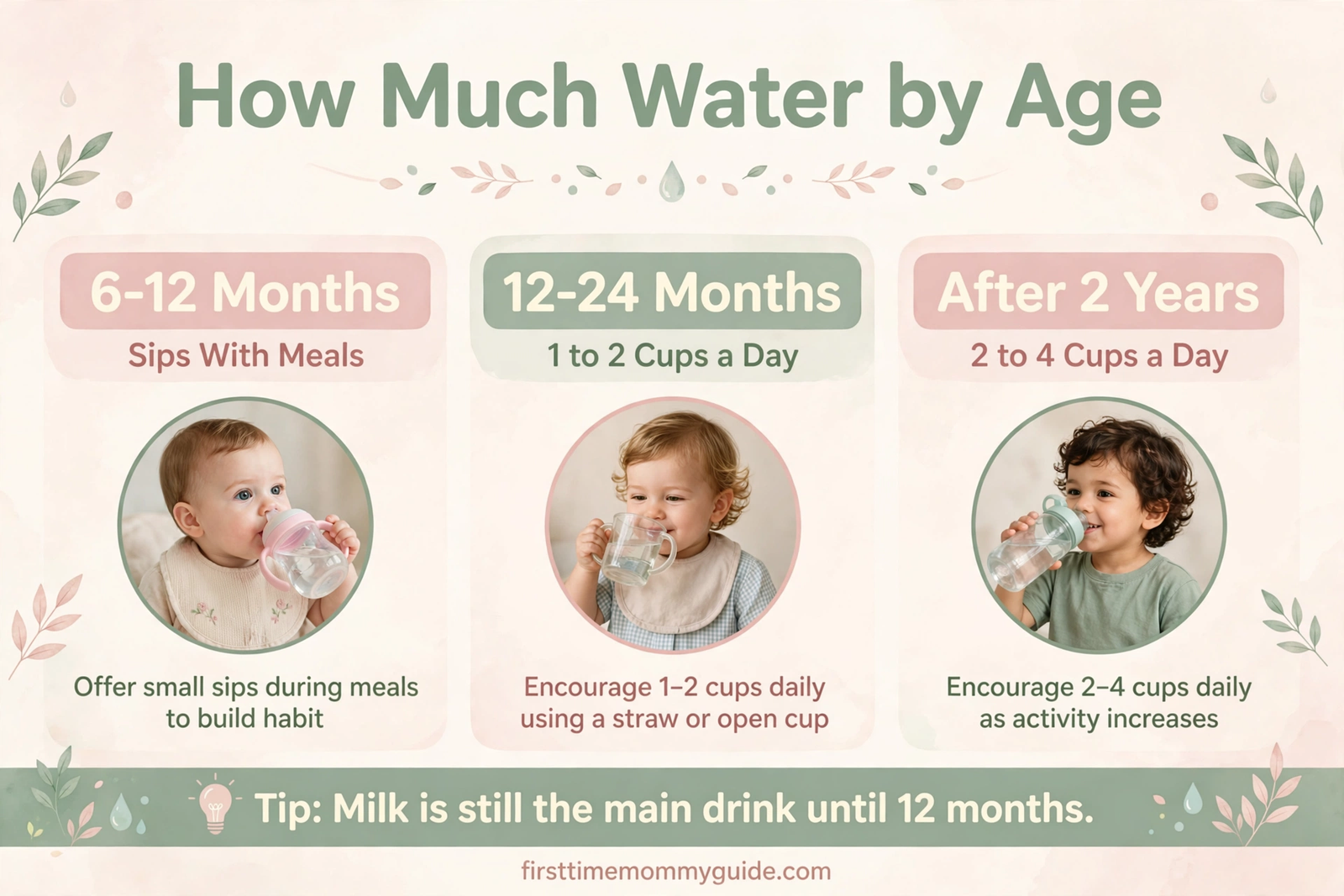
6 to 12 months: sips with meals
At 6 to 12 months, offer about 60 to 120 millilitres (2 to 4 ounces) of water per day, spread across meals. In practice, that means a few sips from a cup at each meal, not a measured quota to finish.
Some babies drink barely any water at this stage, and that is fine. Milk remains their main drink and main source of hydration until their first birthday. Water at this age is mainly about learning to drink, not about meeting a fluid target.
Offer water in an open cup or a free-flow sippy cup, not a bottle. The goal is to practise a new skill, not to replace milk feeds.
12 to 24 months: water becomes a regular drink
From 12 months, toddlers typically need around 240 to 480 millilitres (1 to 2 cups) of water per day, alongside milk and food. Some guidance puts total fluid needs higher once food fluids are included, but as a drink, one to two cups of water a day is a sensible ballpark.
At this age, offer water with meals and snacks, and keep a cup available during play, especially in warm weather or after active play. Toddlers are notoriously unreliable about asking for a drink before they are thirsty, so regular offers help.
Milk intake usually drops after one year to around 350 to 500 millilitres a day. Water fills the gap, and it does so without sugar, which is why dentists and paediatricians prefer it over juice.
After 2 years: building a water habit
From age two, most children need roughly 480 to 960 millilitres (2 to 4 cups) of water a day as a drink, with more in hot weather or during illness with fever, vomiting, or diarrhoea. Food also contributes fluid, so the total intake is higher than the drinking figure alone.
The habit you build now matters. A toddler who grows up reaching for water will usually keep doing so as a child, while a toddler raised on sweet drinks often expects sweetness from every drink. Water first, from the start, is one of the simplest healthy habits you can give.
Remember that these figures are guides. A baby who eats watery foods like soup, fruit, and yoghurt gets fluid from food too. A baby in a heatwave or with a fever needs more. Watch your baby, not just the numbers.
What Kind of Water, and Does It Need to Be Boiled?
For babies over six months, ordinary tap water is fine in most places where tap water is safe to drink. In the United Kingdom, tap water is safe for babies from six months without boiling, according to NHS guidance. In the United States, the Centers for Disease Control and Prevention notes that tap water is generally safe, with fluoridated tap water offering dental benefits.
If you are unsure about your local tap water, or if you use well water, check with your local health authority or your doctor. Well water should be tested, because it can contain nitrates or bacteria that are risky for infants.
Bottled water is not automatically safer. Some bottled waters are high in sodium or sulphate, which are not ideal for babies. If you use bottled water, choose one labelled as low in sodium (under 200 milligrams per litre) and low in sulphate (under 250 milligrams per litre), and boil it until your baby is at least six months old if advised locally.
For babies under six months, any water used to mix formula must be boiled and cooled, following the formula manufacturer’s instructions. That rule is about formula preparation, not about offering water as a drink.
Once your baby passes six months, you do not need to boil tap water for drinking in areas with safe supplies. If you are travelling, or if your water supply has been disrupted, boiling is a sensible precaution until you are sure the supply is safe again.
A note on fluoride: in areas where tap water is fluoridated, drinking tap water helps protect emerging teeth. If your water is not fluoridated, your dentist can advise whether a supplement is needed once teeth appear. Do not give fluoride supplements without professional advice.
Choosing the Right Cup
The cup you choose matters more than many parents expect. It shapes how your baby learns to drink, and it affects dental health too.
Open cups first
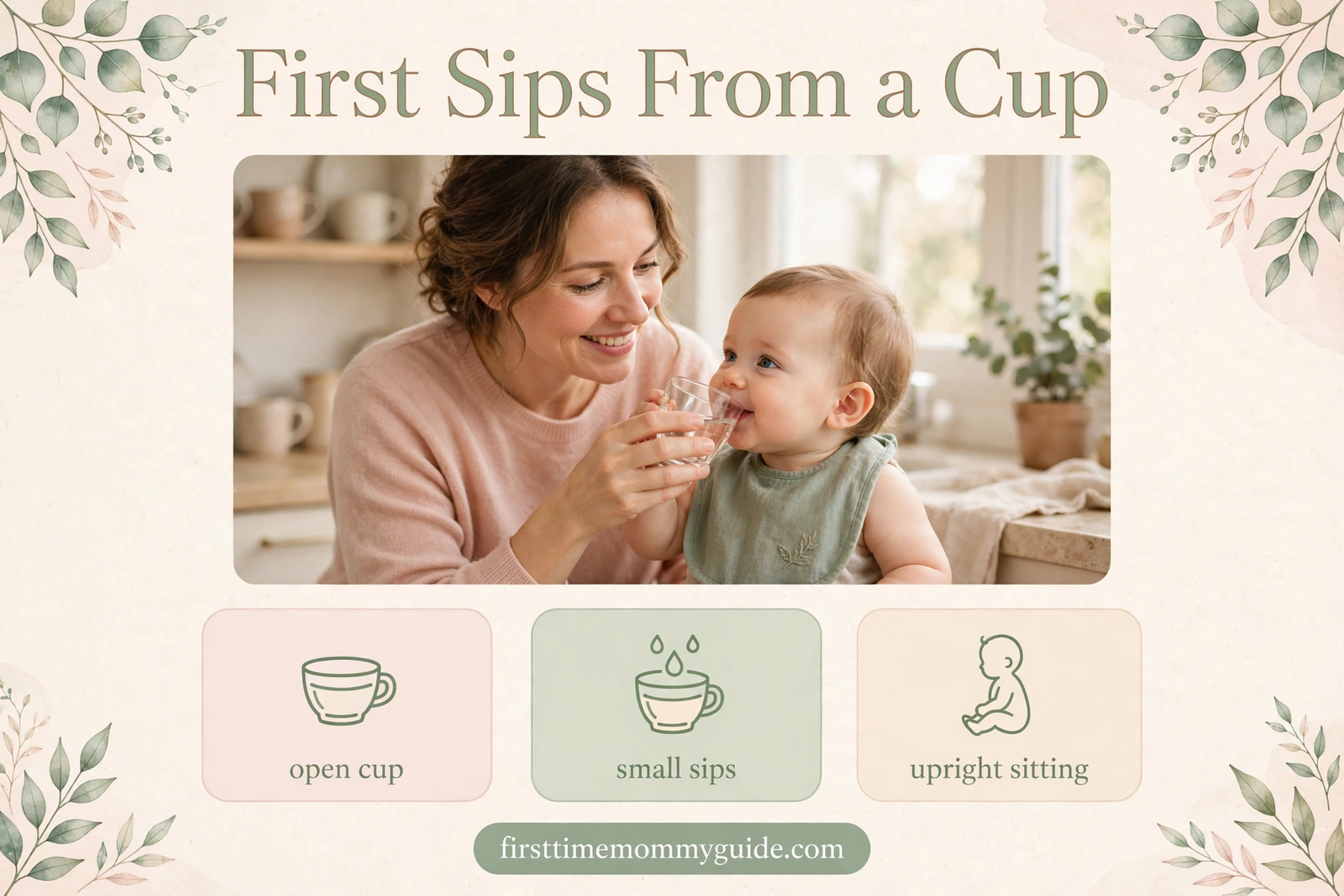
The best first cup is a small open cup, sometimes called a free-flow cup. Your baby will spill, and that is fine. Spilling is part of learning. Hold the cup for them at first, tilt it gently, and let them take small sips.
Open cups encourage proper lip, tongue, and swallowing movements, and they do not keep liquid pooled around the teeth the way a bottle or a valved sippy cup can. Dentists prefer open cups for exactly this reason.
Start with a tiny amount of water in the cup, just a centimetre or so, so spills are small and your baby is not overwhelmed. A weighted or handled training cup can help, but a small plastic tumbler works too.
Sippy cups: free-flow, not valved
If you use a sippy cup, choose a free-flow spout without a non-spill valve. Valved cups require hard sucking, which is closer to bottle feeding and does not teach the same drinking skill. Free-flow cups let water flow when tipped, which teaches your baby to control the flow with their mouth.
Many families use both: an open cup at home for meals, and a free-flow sippy cup for outings or the car, where spills matter more. That combination works well.
Avoid cups with a teat-style spout for everyday drinking once your baby is past the early weaning stage. Prolonged teat use can affect teeth and speech development if it continues well into toddlerhood.
What about straw cups?
Straw cups are a good next step, usually from around 9 to 12 months. Drinking through a straw builds lip strength and oral coordination, and many toddlers enjoy them. A short, soft straw in a small cup is ideal.
Whatever cup you choose, clean it thoroughly every day. Cups with valves, straws, or hidden parts can harbour mould if not dismantled and washed properly. Check the manufacturer’s cleaning instructions and replace cups that develop mould or cracks.
Our guide to introducing sippy cup to baby goes into more detail on cup types and timing, and it pairs naturally with this article if your baby is just starting to drink independently.
How to Introduce Water, Step by Step
Introducing water does not need a grand occasion. It works best as a small, calm part of an ordinary meal.
Start at a meal when your baby is settled and hungry for solids, not overtired or upset. Sit them upright in a highchair, with their feet supported if possible. Good posture makes swallowing easier and safer.
Pour a small amount of water into an open cup or free-flow sippy cup. Hold it to your baby’s lips and tilt it just enough for a sip. Some babies take to it immediately. Others cough, splutter, or push the cup away. All of that is normal while they learn to coordinate sipping and swallowing.
Let your baby hold the cup with you, even if most of the water ends up on the tray. Mess is learning. Wipe, refill with a small amount, and try again. Two or three attempts per meal are plenty.
Offer water at each solid meal, but do not force it. If your baby turns away, closes their mouth, or cries, stop and try again at the next meal. Pressuring a baby to drink usually backfires and creates a battle you do not need.
Model drinking yourself. Babies copy relentlessly. Drink from your own glass at the table, say “Mummy’s drinking water, yum,” and let them see you enjoy it. Many babies become far more interested in water once they see it is what the grown-ups drink.
Keep milk feeds separate from water practice at first. Offer water with solids, and keep milk feeds at their usual times. That way water supplements rather than replaces milk, which is exactly what you want before twelve months.
Over weeks, your baby will get steadier. Sips become bigger, spills become smaller, and they will start reaching for the cup themselves. That independence is the real milestone, more than any particular volume drunk.
First-week checklist
- Small open cup or free-flow sippy cup, clean and ready.
- Only a centimetre of water in the cup at a time.
- Offer at one or two meals a day to start, building to every meal.
- Sit baby upright, hold the cup together, tilt gently.
- Expect spills, coughs, and refusals; all are normal.
- Praise attempts, never force a finish.
- Keep milk feeds unchanged.
Water With Solids: Why It Helps
Water is not just a drink for babies starting solids. It serves a few practical purposes that make weaning smoother.
First, it helps with swallowing. Purees and soft finger foods are drier than milk, and a sip of water helps wash food down and clear the mouth between bites. Babies who are learning to manage lumps often find a sip reassuring.
Second, it helps prevent constipation. As babies move from an all-milk diet to solids, their stools change and can become firmer. Small amounts of water, alongside fibre-rich foods like fruit, vegetables, and whole grains, help keep stools soft.
Third, it builds a skill. Learning to drink from a cup takes practice, and starting at six months gives your baby six months of practice before milk feeds reduce after the first birthday. By twelve months, a baby who has practised daily is usually a confident cup drinker.
Fourth, it sets a taste preference. Babies who are offered water early learn that water is a normal, pleasant drink. Babies who are offered sweet drinks early often develop a preference for sweetness that is hard to undo later.
If your baby is starting solids and you want a fuller picture of readiness, our guide to signs baby ready for solid foods explains the physical signs that matter, and our baby led weaning guide for beginners covers finger foods and self-feeding in detail.
Water, Juice, and Other Drinks: What to Avoid
Water is the best drink for babies and toddlers. Most other drinks are either unnecessary or actively unhelpful at this age.
Juice
Juice is not recommended for babies under 12 months. The American Academy of Pediatrics advises no juice at all in the first year, and only small amounts of 100 percent juice after that, ideally served in a cup with meals rather than sipped all day.
Even 100 percent juice is high in natural sugars and low in fibre compared with whole fruit. It contributes to tooth decay, especially when sipped from a bottle or sippy cup over a long period, and it can fill a small stomach and reduce appetite for milk and food.
If you do offer juice after twelve months, keep it to no more than 120 millilitres (4 ounces) a day, serve it with a meal, use an open cup, and never put it in a bottle. Whole fruit is almost always a better choice than juice.
Squash, cordial, and flavoured water
Sweetened squash, cordial, flavoured waters, and fizzy drinks are not suitable for babies or toddlers. They contain sugar or sweeteners, they encourage a preference for sweet tastes, and they can damage emerging teeth.
Even “no added sugar” squash can be acidic and bad for teeth if drunk frequently. Water needs no flavouring. If your toddler refuses plain water, try offering it very cold, in a fun cup, or with a slice of fruit in your own glass as a model, rather than sweetening theirs.
Plant milks and cow’s milk as drinks
Cow’s milk as a main drink is not recommended before 12 months, because it is low in iron and can irritate a young baby’s gut. That is a separate issue from water, but it is worth knowing: before one year, milk means breast milk or formula, plus small sips of water with meals.
After twelve months, whole cow’s milk can become a main drink, alongside water. Plant milks vary widely in nutrition, so discuss them with your doctor or dietitian before using one as a main drink for a toddler.
Our guide to introducing cows milk to baby explains the timing, amounts, and transition in full, including how water and milk fit together after the first birthday.
Hot Weather, Illness, and Hydration
Hot weather worries parents most, and understandably. Babies cannot tell you they are thirsty, and they overheat more easily than adults.
For babies under six months in hot weather, offer more frequent milk feeds rather than water. Breastfed babies may want shorter, more frequent feeds. Formula-fed babies can be offered their usual formula more often, within the guidance your doctor has given for total daily intake.
For babies over six months, offer water more often in hot weather, in addition to milk feeds. Keep a cup handy during play, offer sips regularly rather than waiting for signs of thirst, and dress your baby in light clothing with shade and a hat outdoors.
During illness, hydration needs change. A baby with fever, vomiting, or diarrhoea loses fluid faster and may need extra fluids. For babies under six months, that usually means more frequent milk feeds and medical advice. For older babies, small, frequent sips of water, plus milk, are often advised, and your doctor may recommend an oral rehydration solution in some cases.
Never give an oral rehydration solution, or any special fluid, without medical advice for a baby, unless you have been given clear instructions for that situation. The right fluid and amount depend on the baby’s age, weight, and illness.
Signs of dehydration in a baby include fewer wet nappies than usual, a dry mouth and lips, no tears when crying, unusual sleepiness or irritability, and a sunken soft spot on the head in young babies. If you see these signs, contact your doctor promptly, or seek urgent care if your baby is very sleepy, difficult to wake, or has not had a wet nappy for many hours.
Can a Baby Drink Too Much Water?
Yes, though it is uncommon after six months when water is offered sensibly. The risk is highest before six months, and it drops sharply once babies are eating solids and their kidneys are more mature.
Water intoxication happens when a baby takes in so much plain water that sodium in the blood becomes diluted. Symptoms can include irritability, drowsiness, vomiting, swelling, and in severe cases seizures. It is a medical emergency, and it is the reason guidance is strict about water before six months.
After six months, the risk from normal sips with meals is very low. Problems arise mainly when water is given in large volumes, for example a baby drinking bottle after bottle of water instead of milk, or water being used to stretch formula. Neither is part of normal weaning.
The safeguard is simple: offer water in a cup, in small amounts, with meals, and keep milk as the main drink until twelve months. Do not dilute formula with extra water, do not replace milk feeds with water, and do not force a baby to finish a set amount of water.
If your baby ever drinks a very large amount of water in one go and then seems unwell, vomits repeatedly, or becomes unusually sleepy, seek medical advice promptly and mention the water intake.
When to Call the Doctor
Most questions about water are routine, and your health visitor or doctor can answer them at a check-up. But some situations deserve a prompt call.
Contact your doctor if your baby:
- Is under six months and you are considering giving water for any reason other than medical advice.
- Has signs of dehydration: fewer wet nappies, dry mouth, no tears, unusual sleepiness, or a sunken soft spot.
- Has persistent vomiting or diarrhoea, especially with reduced fluid intake.
- Refuses all fluids, including milk, for several hours.
- Has blood in their stool, or stools that are very hard and painful to pass despite water and dietary measures.
- Drinks unusually large amounts of water and seems unwell afterwards.
- Has a fever and is not drinking, or is difficult to wake.
Trust your instincts. Parents are often the first to notice that something is off, and doctors would rather hear from you early than late. A quick call for reassurance is never wasted.
For general weaning and hydration guidance, NHS Start for Life and the World Health Organization both publish infant feeding recommendations that support the six-month starting point for water alongside complementary foods.
Making Water Fun Without Sugar
Some toddlers resist water, especially if they have tasted sweet drinks elsewhere. A few playful strategies usually help, without resorting to sugar.
Let your toddler choose a cup. A cup with a favourite colour, animal, or character can make water far more appealing. Let them carry their own water bottle on outings, just like the grown-ups.
Serve water cold in warm weather. Many toddlers prefer cold water, and a chilled cup on a hot day is genuinely refreshing. In winter, room-temperature water is fine.
Eat watery foods together. Cucumber, watermelon, oranges, soup, and yoghurt all contribute fluid and teach your toddler that hydration comes from food as well as drinks. These are complements to water, not replacements for it.
Make drinking a ritual. A cup of water with every meal and snack, a sip before story time, a drink after play in the park. Rituals remove negotiation, because water is simply what happens at those moments.
Praise drinking without making it a performance. A simple “Well done, you drank your water” is enough. Avoid bargaining with sweet drinks as a reward for drinking water, because that teaches your child that water is the chore and the sweet drink is the prize.
If refusal persists for weeks, or your toddler will only drink sweet drinks and is refusing milk and food as well, mention it to your doctor or health visitor. They can check for mouth pain, teething discomfort, or other reasons a child might avoid drinking.
Frequently Asked Questions
Can I give my 3-month-old water in hot weather?
No, not as a routine drink. Offer more frequent milk feeds instead. Breast milk and formula already contain water, and extra water before six months can displace milk and, in rare cases, disturb blood salt levels. If you are worried about hydration, contact your doctor.
How much water should a 6-month-old drink?
Only small sips with meals, around 60 to 120 millilitres (2 to 4 ounces) a day in total, and often less. Milk remains the main drink until twelve months. Do not worry if your baby drinks very little water at first.
Do I need to boil water for a 7-month-old?
In areas with safe tap water, no. Tap water is fine for babies over six months in the UK and in most US supplies. If you use well water, or you are unsure about your supply, check with your local authority or doctor.
Can babies drink bottled water?
Yes, if it is low in sodium and sulphate, but tap water is usually better and cheaper where it is safe. Avoid bottled waters high in minerals for everyday baby drinking, and check labels for sodium content.
When can babies drink juice?
Juice is not recommended before 12 months. After twelve months, only small amounts of 100 percent juice, served in a cup with meals, and never in a bottle. Water and milk remain the best everyday drinks.
What cup is best for introducing water?
A small open cup or a free-flow sippy cup without a valve. Open cups build the best drinking skills and are kindest to teeth. Start with a tiny amount of water and expect spills.
My baby refuses water. What should I do?
Keep offering small sips at meals without pressure, model drinking yourself, and try a different cup or colder water. Most babies accept water gradually over weeks. If refusal is persistent and your baby is also refusing milk or food, seek advice.
Conclusion
Introducing water to baby is a small step with a big payoff. Start at around six months, alongside solids. Offer small sips from an open or free-flow cup at meals. Keep milk as the main drink until twelve months, then let water grow into a regular everyday drink.
Before six months, milk is enough, even in hot weather. After six months, water helps with swallowing, digestion, cup skills, and healthy taste preferences. Avoid juice and sweet drinks in the first year, choose tap water where it is safe, and keep an eye out for signs of dehydration during illness or heat.
Offer water calmly, model it yourself, and do not force it. Your baby will learn at their own pace, one spill, one sip, and one proud, independent drink at a time.
This article is general information only and is not a substitute for medical advice. If you have concerns about your baby’s hydration, feeding, or health, speak to your doctor or health visitor.

Dilawar Mughal
Founder and editor, First Time Mommy Guide
I research every guide against what the NHS, the AAP and the WHO publish, then write it in plain English — because most new parents are reading with one hand free, not comparing clinical guidelines. I'm not a doctor or a midwife. Every health claim on this site is sourced and linked so you can check it yourself, and anything urgent belongs with your health visitor or GP, not a blog.