General information, not medical advice. Every baby is different — if anything worries you, speak to your midwife, health visitor or GP rather than waiting.
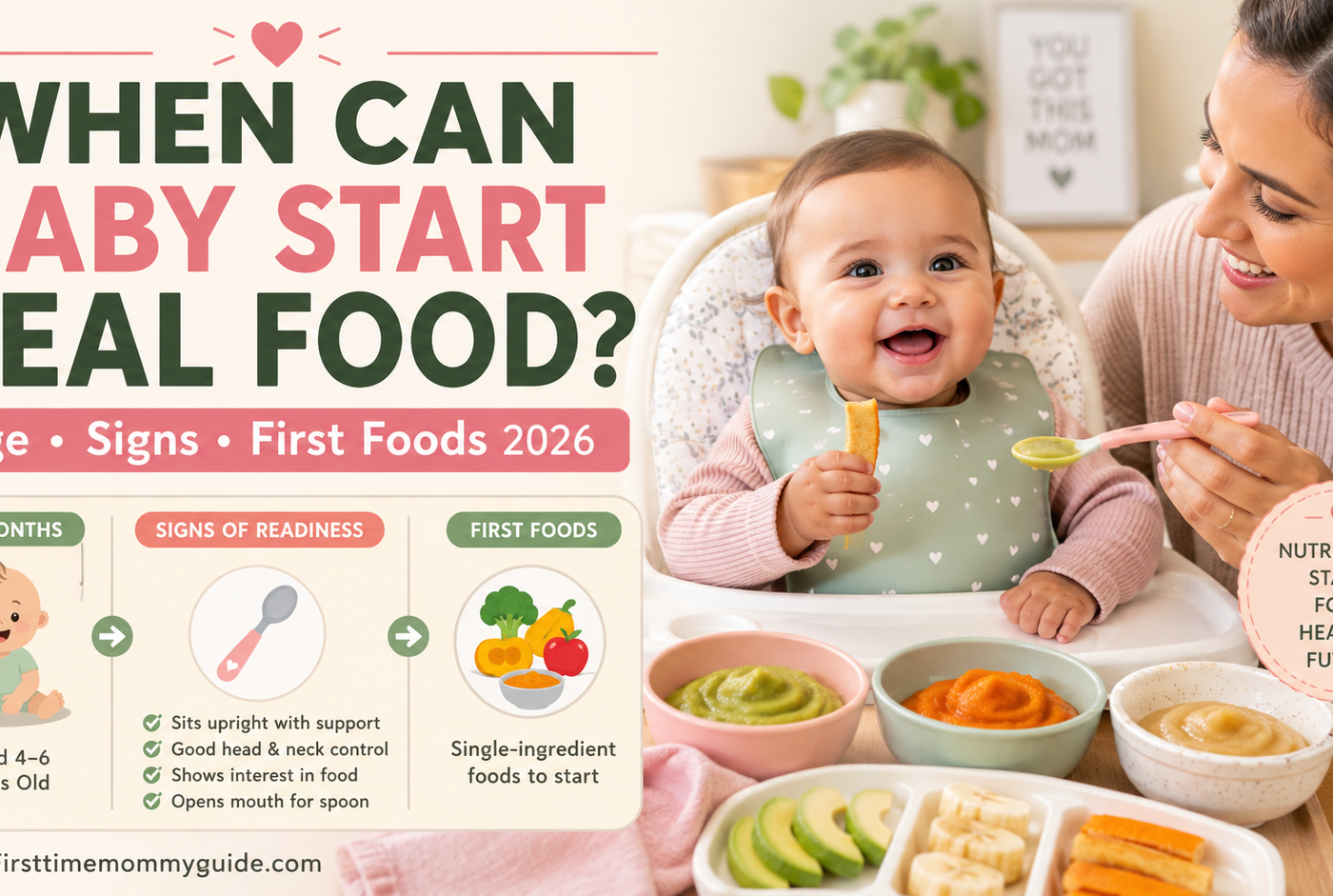
Somewhere between the newborn blur and the toddler chaos, there’s a moment every parent waits for: When Can My Baby Start Eating Real Food? It’s exciting, a little nerve-wracking, and full of questions you didn’t know you’d have.
Most babies are developmentally ready to start eating real food at around 6 months old — not by the calendar date alone, but by a specific set of physical signs their body needs to show first.
Table of Contents
When Can My Baby Start Eating Real Food?
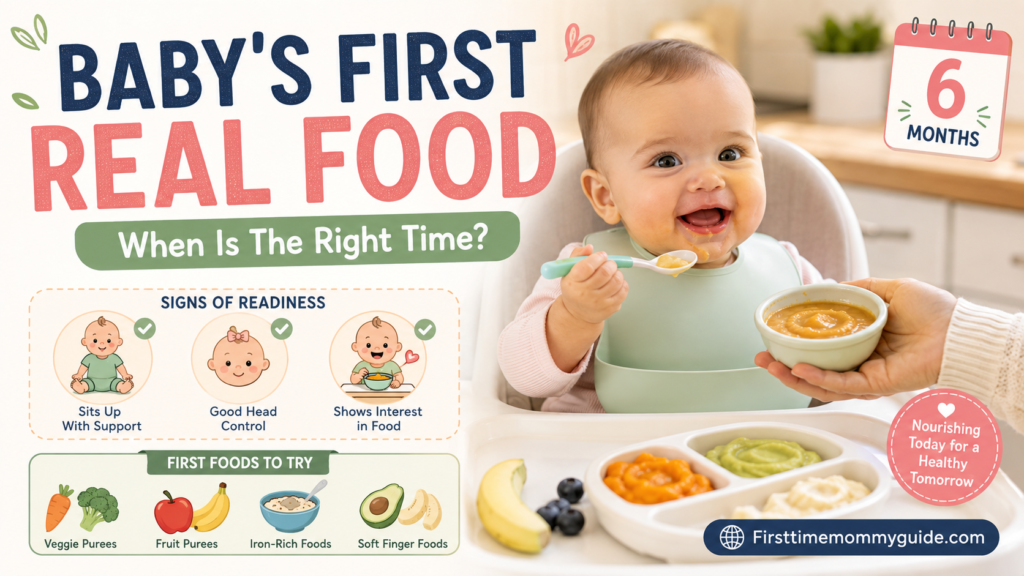
Babies can typically start solid, “real” food at around 6 months of age, once they can sit with minimal support, have good head and neck control, and show interest in food. Starting before 4 months is not recommended, and most babies aren’t ready between 4–6 months either — readiness signs matter more than the date on the calendar.
What “Real Food” Actually Means for a Baby
“Real food” is the everyday term parents use for what pediatricians call complementary foods — anything beyond breast milk or formula. It doesn’t have to mean chunks of steak on day one. Real food covers a wide range:
- Single-ingredient purees (mashed sweet potato, banana, avocado)
- Iron-fortified infant cereal mixed with breast milk or formula
- Soft, cooked finger foods (steamed carrot sticks, ripe pear slices)
- Mashed or shredded family meals with no added salt or sugar
The texture and format change a lot between 6 months and 12 months, but the underlying idea is the same: food that isn’t breast milk or formula, offered by spoon or by hand.
The Short Answer: 6 Months, With Conditions
The AAP, WHO, and CDC all point to about 6 months as the target window for introducing solids. Starting before 4 months is not recommended, and at about 6 months, babies need the added nutrition — such as iron and zinc — that solid foods provide.
That said, age alone isn’t the deciding factor. Experts recommend starting solid foods when a baby is about 6 months old, depending on the baby’s readiness and nutritional needs — which is why pediatricians talk about readiness signs rather than a single fixed date.
Why Not Earlier Than 4 Months?
A younger baby’s body isn’t built for solids yet, and starting too soon carries real risk. According to the USDA Food and Nutrition Service, feeding solid foods too early can increase the risks of choking on food, developing food allergies or intolerances, or receiving improper nutritional requirements. It’s also a myth worth retiring: it is a myth that feeding solid foods to babies before they are developmentally ready will help them sleep through the night or make them eat fewer times.
Why Not Wait Much Past 6 Months?
Delaying too long has its own downside. By around 6 months, breast milk and formula alone no longer supply enough iron and zinc for healthy growth and brain development, which is exactly why the 6-month window matters — not because of a magic switch that flips on that day, but because nutritional needs start to outpace what liquid feeds alone can provide.
The Real Signs Your Baby Is Ready (Not Just the Age)
Pediatricians look for a cluster of developmental signs, sometimes nicknamed the “solid food readiness checklist.” Your baby doesn’t need every single sign perfectly, but most of these should be showing up together.
| Readiness Sign | What It Looks Like | Why It Matters |
|---|---|---|
| Head and neck control | Holds head steady and upright without support | Needed to swallow safely and avoid choking |
| Sits with minimal support | Sits in a high chair or feeding seat without slumping | Proper posture for safe swallowing |
| Loss of tongue-thrust reflex | Doesn’t automatically push the spoon or food back out | Reflex disappearing means the body can move food to the back of the mouth |
| Interest in food | Watches you eat, reaches for your plate, opens mouth for the spoon | Behavioral cue of developmental readiness |
| Weight milestone | Around double birth weight, roughly 13+ pounds | Generally, when infants double their birth weight (typically at about 4 months of age) and weigh about 13 pounds or more, they may be ready for solid foods |
| Can move food to the throat | Swallows rather than letting food dribble out | Confirms the oral motor skills needed for chewing and swallowing |
Babies have a natural tongue-thrust reflex that pushes food back out, and this typically disappears when babies are 4–6 months old. If your baby still pushes every spoonful straight back out, it often just means the reflex hasn’t faded yet — that’s normal, and it may take some getting used to before they can move food to the back of the mouth to swallow it.
If Your Baby Isn’t Showing Signs Yet
Not every baby hits these markers on the same week. If your baby isn’t sitting with minimal support by around 7 months, it’s worth a check-in with your pediatrician just to rule out anything that needs extra support — most of the time it’s simply normal variation in development.
How to Start: Your Baby’s First Weeks of Real Food
Step 1 — Pick the Right Moment in the Day
Start when your baby is calm, a little hungry (not starving or overtired), and well-rested. A hungry, exhausted baby has no patience for learning a brand-new skill.
Step 2 — Offer a Small Amount First
Start with half a spoonful or less, talking your baby through the process. One helpful trick many pediatricians recommend: offer a little breast milk or formula first, then a few half-spoonfuls of food, then finish with more milk — this keeps a hungry baby from getting frustrated mid-meal.
Step 3 — Expect Mess and Rejection at First
Your baby may not know what to do at first — they may look confused, wrinkle their nose, roll the food around in their mouth, or reject it altogether, and most of the first few feedings wind up on your baby’s face, hands and bib. This is completely normal and not a sign you’re doing anything wrong.
Step 4 — Introduce One New Food at a Time
Offer foods with only one ingredient and no added sugar or salt, and wait 3 to 5 days between each new food to watch for a reaction such as diarrhea, a rash, or vomiting. Once a food has passed that window with no issues, you can start combining it with others.
Step 5 — Prioritize Iron- and Zinc-Rich Foods
Iron helps carry oxygen throughout your baby’s body and brain, and zinc aids digestion and helps build a healthy immune system — both are in short supply from milk alone by 6 months. Good first choices include iron-fortified infant cereal, pureed meat, lentils, and beans.
Spoon-Feeding, Baby-Led Weaning, or Both?
There isn’t one “correct” method — plenty of families mix the two approaches.
| Approach | How It Works | Pros | Cons |
|---|---|---|---|
| Traditional spoon-feeding | Purees and mashed foods offered by spoon, moving to thicker textures over time | Easier to track how much baby eats; familiar for most caregivers | Can delay some fine-motor and self-feeding skills |
| Baby-led weaning (BLW) | Baby is offered soft, appropriately-sized finger foods from the start and feeds themselves | Builds chewing and hand-eye coordination early; baby controls pace | Messier; requires closer supervision for choking risk |
| Combination feeding | Purees for some meals, soft finger foods for others | Flexible; lets baby build both skill sets | Requires planning both formats |
Whichever method you choose, always supervise your child while eating, and make sure whatever you offer is soft enough to squash between two fingers.
Best First Foods for Babies
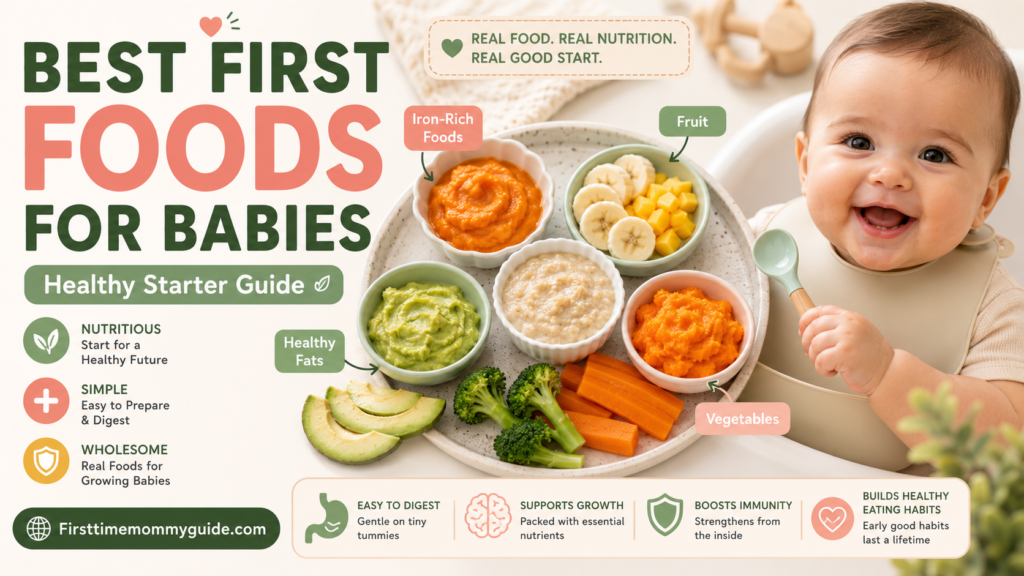
There’s no strict order requirement — there is no specific order in which foods need to be introduced — but most pediatric guidance points toward starting with nutrient-dense, easy-to-digest options.
- Iron-fortified infant cereal (oat or single-grain), mixed with breast milk or formula
- Pureed meats and poultry — a strong iron source
- Vegetables: sweet potato, squash, carrots, peas, avocado
- Fruits: banana, pear, apple, blueberries
- Legumes: lentils, beans
- Dairy (non-drinking forms): plain yogurt, cottage cheese
A common approach is starting with vegetables before fruits, since it can help babies get used to less-sweet flavors first — though this isn’t a strict rule, just a helpful habit some pediatricians suggest.
Foods and Habits to Avoid
| Avoid | Why |
|---|---|
| Honey (any form, before age 1) | Risk of infant botulism |
| Cow’s milk as a drink (before age 1) | Baby’s digestive system isn’t ready for large amounts; yogurt and cheese are fine sooner |
| Added sugar or salt | Unnecessary and shapes taste preferences early |
| Whole grapes, nuts, popcorn, chunks of hard raw vegetable | Choking hazards |
| Food added to a bottle | Adding cereal or food to a bottle can lead to too much weight gain, and doesn’t help a baby sleep better |
| Unpasteurized foods | Food-safety risk for a developing immune system |
Introducing Allergens: What Changed in Recent Guidance
Older advice told parents to delay allergenic foods. That guidance has reversed. Pediatricians used to advise staying clear of common allergen foods, but based on recent research, the AAP now says there’s no need to wait. Research indicates that introducing foods that are common allergens before the first year of life can actually help prevent allergic reactions to these foods as children get older.
Common allergen foods to introduce early (in age-appropriate, well-cooked forms) include peanut products, egg, dairy, wheat, soy, tree nuts, fish, and shellfish. Introduce them one at a time, at home, when your baby is well, and watch for signs like hives, rash, vomiting, or breathing trouble — if your baby has trouble breathing, that requires immediate medical attention.
Month-by-Month Feeding Guide (6–12 Months)
| Age | Texture | What to Offer | Approx. Frequency |
|---|---|---|---|
| 6 months | Smooth purees, thin cereal | Iron cereal, single-ingredient purees | 1–2 times/day, milk still primary |
| 7–8 months | Thicker purees, mashed foods | Combination purees, soft mashed meats, yogurt | 2–3 times/day |
| 9–10 months | Soft finger foods, lumpy textures | Small amounts of finely chopped, soft finger foods — soft fruits, vegetables, pasta, cheese, well-cooked meat | 3 times/day plus snacks |
| 11–12 months | Chopped table food | Modified family meals, self-feeding encouraged | 3 meals + 1–2 snacks |
Throughout this window, keep offering breast milk or formula — up to about 32 ounces a day — alongside the new foods, since milk remains the primary source of nutrition well into the first year.
How Much Should Baby Eat?
Don’t measure success by the ounce. Start with about 2 ounces of a new food, but don’t worry if your baby doesn’t eat much — or any at all — since your baby will guide you on how much they need, and it can take 10–12 tries before a baby gets used to a new taste. At 4 to 6 months, most of a baby’s nutrition still comes from breast milk or formula, so don’t stress if eating solids gets off to a slow start.
Common Mistakes Parents Make When Starting Solids
- Starting too early because of sleep myths. Solids do not reliably improve sleep, and starting before readiness raises choking and allergy risk.
- Giving up after one rejection. If your baby won’t eat, don’t force it — try again in a week and keep trying.
- Skipping iron-rich foods. Cereal alone isn’t enough; pureed meat, beans, and lentils matter just as much.
- Introducing several new foods at once. This makes it hard to identify the cause if a reaction occurs.
- Avoiding allergens out of caution. Current guidance favors early, supervised introduction over delay.
- Leaving baby unsupervised while eating, even for “just a second.”
Expert Tips for a Smoother Start
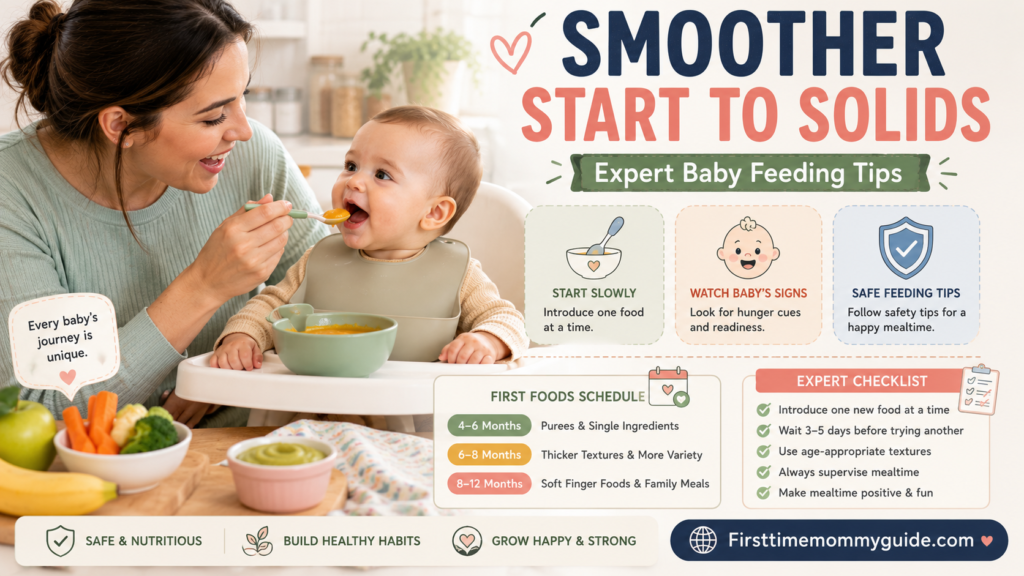
- Let your baby get messy — dropped food and hands-in-the-bowl moments are part of learning to eat, even if it’s hard to watch as a parent.
- Offer water in a sippy cup with meals once solids start — this builds a healthy habit early, in place of juice or sweet drinks.
- Set a loose meal rhythm — breakfast, lunch, and dinner with small snacks in between helps babies learn to anticipate eating times.
- Keep a same-food streak for a few days when testing something new, rather than switching daily.
- Trust your baby’s fullness cues — leaning back or turning away means they’re done, even mid-bite.
Related Articles
- First Foods for Baby at 6 Months: A Complete Guide to Starting Solids 2026
- Sweet Potato Puree for Baby: Easy Recipe, Age Guide & Storage Tips
- Blueberry Puree for Baby: Easy Recipe & Choking Safety Guide
- Spinach Puree for Baby: Safe Recipe, Nitrate Facts & Age Guide
- Homemade Pumpkin Puree for Baby: Easy, Safe Recipe (6+ Months)
- Zucchini Puree for Baby: Easy Recipe & Age Guide
- Baby Food Guide, 6 to 12 Months
Frequently Asked Questions (FAQs)
When can my baby start eating real food?
Most babies are ready around 6 months, once they show readiness signs like sitting with support, good head control, and interest in food.
Can a 4-month-old eat solid food?
It’s possible for some babies to show early readiness around 4 months, but starting before 4 months is not recommended, and most babies aren’t fully ready until closer to 6 months.
What are the first signs my baby is ready for solids?
Good head and neck control, sitting with minimal support, loss of the tongue-thrust reflex, and visible interest in food are the main signs pediatricians look for.
What should baby’s first food be?
There’s no required order, but iron-fortified infant cereal or pureed meat are common first choices because of their iron content.
Do I start with fruits or vegetables?
Either is fine. Some parents start with vegetables first so babies get used to less-sweet flavors before fruit.
How much solid food should a 6-month-old eat?
Start with a spoonful or two once a day. Amounts vary widely — breast milk or formula is still the main source of nutrition at this stage.
Is it normal for my baby to refuse the first few tries?
Yes. It can take 8–12 exposures before a baby accepts a new food. Don’t stop offering it after one rejection.
Can I put cereal in my baby’s bottle to help them sleep?
No. This doesn’t improve sleep and can lead to excessive weight gain. Offer cereal by spoon only.
When should I introduce common allergens like peanut or egg?
Current AAP guidance supports introducing allergens early, around the same time as other first foods, rather than delaying them.
How do I know if my baby is having an allergic reaction?
Watch for rash, hives, vomiting, or diarrhea. Trouble breathing needs immediate medical attention.
Is baby-led weaning safer or better than purees?
Neither is inherently better — both are supported approaches. BLW builds self-feeding skills earlier; purees make portions easier to track. Many families combine both.
What foods should I avoid giving my baby before age 1?
Honey, cow’s milk as a drink, added sugar or salt, and choking hazards like whole grapes, nuts, and popcorn.
Why can’t babies have honey before 12 months?
Honey can carry spores that cause infant botulism, which an infant’s digestive system can’t yet handle safely.
When can babies start finger foods?
Most babies can manage soft, finely chopped finger foods by around 9–10 months, once they’re comfortable with purees.
How many times a day should a 6-month-old eat solids?
Typically once or twice a day at 6 months, increasing to 2–3 times a day by 7–8 months.
Should I give my baby water once they start solids?
Yes, small amounts of water in a sippy cup with meals is appropriate once solid foods begin.
What if my baby was born premature — does the 6-month rule still apply?
Look at your baby’s adjusted (corrected) age rather than their birth date, and follow readiness signs, which is why premature babies are typically assessed around 6 months of adjusted age.
Can starting solids too early cause problems?
Yes — it’s linked to higher choking risk, higher allergy and intolerance risk, and can interfere with getting proper nutrition from milk.
What happens if I start solids too late?
Waiting significantly past 6 months can lead to iron and zinc shortfalls, since milk alone no longer meets those needs.
Does my baby need teeth before starting solids?
No. Babies gum and mash soft foods well before teeth appear — teeth aren’t a requirement for starting solids.
How long should I wait between introducing new foods?
A common guideline is 3–5 days between each new single-ingredient food, to watch for any reaction.
Is yogurt okay before age 1 even though cow’s milk isn’t?
Yes. Yogurt and cheese in appropriate amounts are fine before 12 months — it’s cow’s milk as a main drink that should wait.
My baby keeps pushing food out with their tongue — are they not ready?
This is often just the tongue-thrust reflex, which usually fades between 4 and 6 months. It doesn’t necessarily mean readiness is far off — try smaller amounts and revisit in a week or two.

Dilawar Mughal
Founder and editor, First Time Mommy Guide
I research every guide against what the NHS, the AAP and the WHO publish, then write it in plain English — because most new parents are reading with one hand free, not comparing clinical guidelines. I'm not a doctor or a midwife. Every health claim on this site is sourced and linked so you can check it yourself, and anything urgent belongs with your health visitor or GP, not a blog.