General information, not medical advice. Every baby is different — if anything worries you, speak to your midwife, health visitor or GP rather than waiting.

Introduction
Your baby's first cold can feel frightening, even when you know colds are common. A tiny nose gets blocked, feeding becomes a struggle, and sleep breaks into short, restless stretches. You want to help right away, yet most medicines made for older children are not safe for babies.
This guide covers baby's first cold remedies that are safe, gentle, and backed by guidance from the NHS, the American Academy of Pediatrics (AAP) through HealthyChildren.org, and the Centers for Disease Control and Prevention (CDC). You will learn how to spot baby cold symptoms, how to treat a baby cold at home, and when a cold needs a doctor rather than home care.
You will also find age-by-age advice for newborns, clear steps for saline drops and suction, feeding and sleep tips, and a list of things to avoid. Every remedy here is drug-free or doctor-approved for babies, because comfort care is the safest path through a first cold.
Important safety note: This article shares general information only. It is not medical advice for your baby. Always check with your paediatrician if you are unsure, and seek urgent care for a baby under 3 months old with a fever.
What Is a Baby's First Cold?
Definition box: A cold is a viral infection of the nose and throat. In babies, it is usually caused by a rhinovirus. It brings a stuffy or runny nose, sneezing, a mild cough, and sometimes a low fever. Colds are not caused by cold weather, although they spread more easily when people spend time indoors together.
Babies catch colds easily because their immune systems are still learning. They touch everything, put their hands in their mouths, and meet new germs at every outing, playgroup, and family gathering. Most babies have several colds in their first year, and each one helps their immune system grow stronger.
A first cold often starts slowly. You may notice a clear, watery runny nose before anything else. Sneezing follows, then congestion, then a cough that sounds worse at night. Feeding may become fussy because a blocked nose makes sucking hard work.
The good news is that most baby colds are mild. They usually improve on their own within a week to ten days. Your job is not to cure the virus, because no medicine can do that, but to keep your baby comfortable, hydrated, and breathing as easily as possible while the cold runs its course.
Why Babies Get Colds So Often
Babies are born with some protection from their mothers, but that protection fades over the first months. Their immune systems have not met most common viruses yet, so each new virus can cause a cold. Older siblings, nursery, and crowded indoor spaces all raise the chance of catching one.
Breast milk offers antibodies that can soften illness, but it does not prevent every cold. Formula-fed babies also build immunity with each mild infection. Neither feeding choice makes a baby immune, and catching colds does not mean you did anything wrong.
Touch is the main route of spread. Cold viruses travel on hands, toys, and surfaces, and they enter through the nose, mouth, or eyes. That is why handwashing matters so much, especially before handling your baby after being out or after changing a nappy.
How Long Does a Baby's First Cold Last?
Most baby colds follow a familiar pattern. The first two or three days are usually the worst, with the most congestion and fussiness. Symptoms then ease slowly over the next four to seven days. A mild cough can linger for up to two weeks, even after the nose clears.
A cold that lasts longer than ten days, or one that seems to improve and then suddenly worsens, deserves a call to your paediatrician. A new fever after the first few days can signal a secondary infection, such as an ear infection. Trust your instincts if the pattern feels wrong.
| Day | What to expect | What helps most |
|---|---|---|
| Days 1–2 | Clear runny nose, sneezing, mild fussiness | Saline drops, gentle suction, extra feeds |
| Days 3–4 | Thicker mucus, blocked nose, cough starts | Steam, suction before feeds, humidifier |
| Days 5–7 | Symptoms start to ease, appetite returns | Keep fluids up, gentle routine, rest |
| Days 8–10 | Nose mostly clear, cough may linger | Watch for new fever or worsening cough |
| After day 10 | Should be mostly better | Call the doctor if symptoms persist |
Baby Cold Symptoms: What to Look For
Recognising baby cold symptoms early helps you start comfort care before feeding and sleep fall apart. Symptoms vary by age, but the core signs stay the same. A newborn may show only a stuffy nose and extra sleepiness, while an older baby may cough, refuse feeds, and wake often at night.
Watch for a runny nose that starts clear and turns thicker and yellow or green after a few days. That colour change alone does not mean a bacterial infection. It is a normal part of how mucus changes as the body fights the virus.
Sneezing is common in the first days. It helps clear the nose, so it is not a problem by itself. A mild cough often appears as mucus drips down the back of the throat, especially when your baby lies flat. This post-nasal drip cough sounds worse at night but usually settles as the nose clears.
Common Symptoms Checklist
- Stuffy or blocked nose, making breathing noisy
- Clear runny nose that may thicken over days
- Sneezing, often in bursts
- Mild cough, worse at night or after lying down
- Low-grade fever, usually below 38°C (100.4°F)
- Fussiness, clinginess, or extra crying
- Reduced appetite or shorter feeds
- More night waking and broken sleep
- Slightly watery or red eyes
- Less interest in play than usual
A baby with a cold may also feed less at each sitting but want to feed more often. Short, frequent feeds are normal when the nose is blocked. Offer the breast or bottle often, and do not worry if each feed is smaller than usual for a day or two.
Symptoms That Need a Doctor Promptly
Some signs go beyond an ordinary cold. Fast or laboured breathing, wheezing, or a chest that pulls in with each breath needs medical attention the same day. Blue lips, very pale skin, or unusual sleepiness are emergency signs that need urgent care.
A baby who refuses all feeds, has very few wet nappies, or has a dry mouth may be dehydrated. Dehydration can develop quickly in small babies, so count wet nappies and offer fluids often. If your baby has fewer than four wet nappies in 24 hours, call your paediatrician.
Fever rules matter most in the youngest babies. A baby under 3 months old with a temperature of 38°C (100.4°F) or higher needs urgent medical care, even if they seem otherwise well. Do not wait to see if it passes. Call your paediatrician or seek urgent care straight away.
Baby Cold vs Flu: How to Tell the Difference
Parents often ask whether it is a cold or the flu, because the two illnesses can look similar at first. Both are viral, both cause a runny nose and cough, and both make babies miserable. The flu, however, usually arrives faster and hits harder.
A cold builds slowly over a day or two. The flu often starts suddenly, with a high fever, body aches, chills, and deep tiredness. A baby with flu may seem much sicker, feed very little, and sleep far more than usual. According to HealthyChildren.org, the flu tends to cause higher fever and more severe symptoms than a common cold, and it carries a higher risk of complications in young children.
| Feature | Common cold | Flu (influenza) |
|---|---|---|
| Onset | Gradual, over 1–2 days | Sudden, within hours |
| Fever | Low-grade or none | Often high, 38.5°C+ (101°F+) |
| Runny/stuffy nose | Very common, main symptom | Common, but not always worst |
| Cough | Mild, worse at night | Often dry, hacking, severe |
| Body aches | Rare or mild | Common, baby seems in pain |
| Tiredness | Mild, extra naps | Marked, very sleepy or limp |
| Appetite | Reduced but still feeding | Often refuses feeds |
| Duration | 7–10 days | 1–2 weeks, slower recovery |
| Main risk | Discomfort, feeding trouble | Dehydration, pneumonia, hospital care |
If you suspect flu, especially during flu season, contact your paediatrician promptly. Babies under 6 months cannot receive a flu vaccine, so protecting them depends on vaccinating everyone around them. Older babies can be vaccinated from 6 months, following your doctor's advice.
You can read more about the difference between a cold and the flu on HealthyChildren.org. The NHS also explains common cold symptoms and care on its common cold page, and the CDC covers cold basics at CDC common cold.
When a Cold Might Be Something Else
Not every sniffle is a cold. Allergies are rare in babies under one year, but they can cause a runny nose without fever. Teething does not cause a true cold, although it can cause drooling and mild fussiness that parents sometimes mistake for illness. If your baby has a fever with teething, do not assume teething is the cause. For more on that question, see our guide on whether teething can cause a low-grade fever.
Ear infections often follow colds. Watch for new ear pulling, crying when lying down, or a fever that returns after improving. Bronchiolitis, caused by RSV and other viruses, brings wheezing and fast breathing and needs medical review. Croup causes a barking cough and a harsh sound when breathing in. Any of these patterns should prompt a call to your doctor.
What Causes a Baby's First Cold?
Colds are caused by viruses, most often rhinoviruses. More than 200 viruses can cause cold symptoms, which is why babies can catch cold after cold. Immunity to one virus does not protect against the next one.
The virus spreads through droplets when someone coughs or sneezes, and through hands and surfaces. A caregiver with a mild cold can pass it on before they even feel ill. Toys, dummies, and shared cups are common routes in homes with older children.
Cold weather itself does not cause colds, despite the name. People simply spend more time indoors in winter, breathing shared air and touching shared surfaces. Dry indoor air can also dry out the lining of the nose, making it easier for viruses to take hold.
Can You Prevent a Baby's First Cold?
You cannot prevent every cold, and you should not try to keep your baby sealed away from the world. Gentle exposure helps immunity develop. You can, however, lower the odds with a few simple habits.
Wash hands often, especially after being outside, after nappy changes, and before feeding. Ask visitors to wash their hands before holding the baby. Keep your baby away from people who are actively coughing or sneezing when you can.
Clean toys, dummies, and high-chair trays regularly. Avoid sharing cups, spoons, and towels during cold season. Keep your baby's sleep space ventilated and not overheated, and avoid smoke exposure, which irritates tiny airways and worsens colds.
How to Treat a Baby Cold at Home: The Safe Approach
Learning how to treat a baby cold at home starts with one idea: comfort care, not cure. No medicine kills the cold virus. The safest home care keeps the nose clear, keeps fluids going in, and helps your baby rest. Everything below is drug-free unless your paediatrician advises otherwise.
Start with the nose, because a clear nose fixes most other problems. A baby who can breathe through their nose can feed better, sleep better, and cry less. Saline drops and gentle suction are the most useful tools you have, and they are safe from birth when used correctly.
Keep the air moist, keep feeds frequent, and keep the routine calm. Dress your baby in light layers, avoid overheating, and resist the urge to try every remedy you see online. Simple care, done well and repeated often, beats a long list of unproven products.
Key Takeaways
- Colds are viral and usually last 7–10 days; comfort care is the treatment.
- Saline drops plus gentle suction are the safest, most effective remedy for congestion.
- Offer frequent small feeds and watch wet nappies for hydration.
- Never give cough or cold medicine to a baby unless a doctor prescribes it.
- Honey is unsafe under 12 months; avoid it completely.
- A fever in a baby under 3 months needs urgent medical care.
Baby's First Cold Remedies That Actually Help
The remedies below are the ones paediatricians and health bodies recommend most often. They are gentle, low-risk, and easy to repeat through the day. Use them together as a routine, rather than picking one and hoping it is enough.
1. Saline Drops: The First Step for a Congested Nose
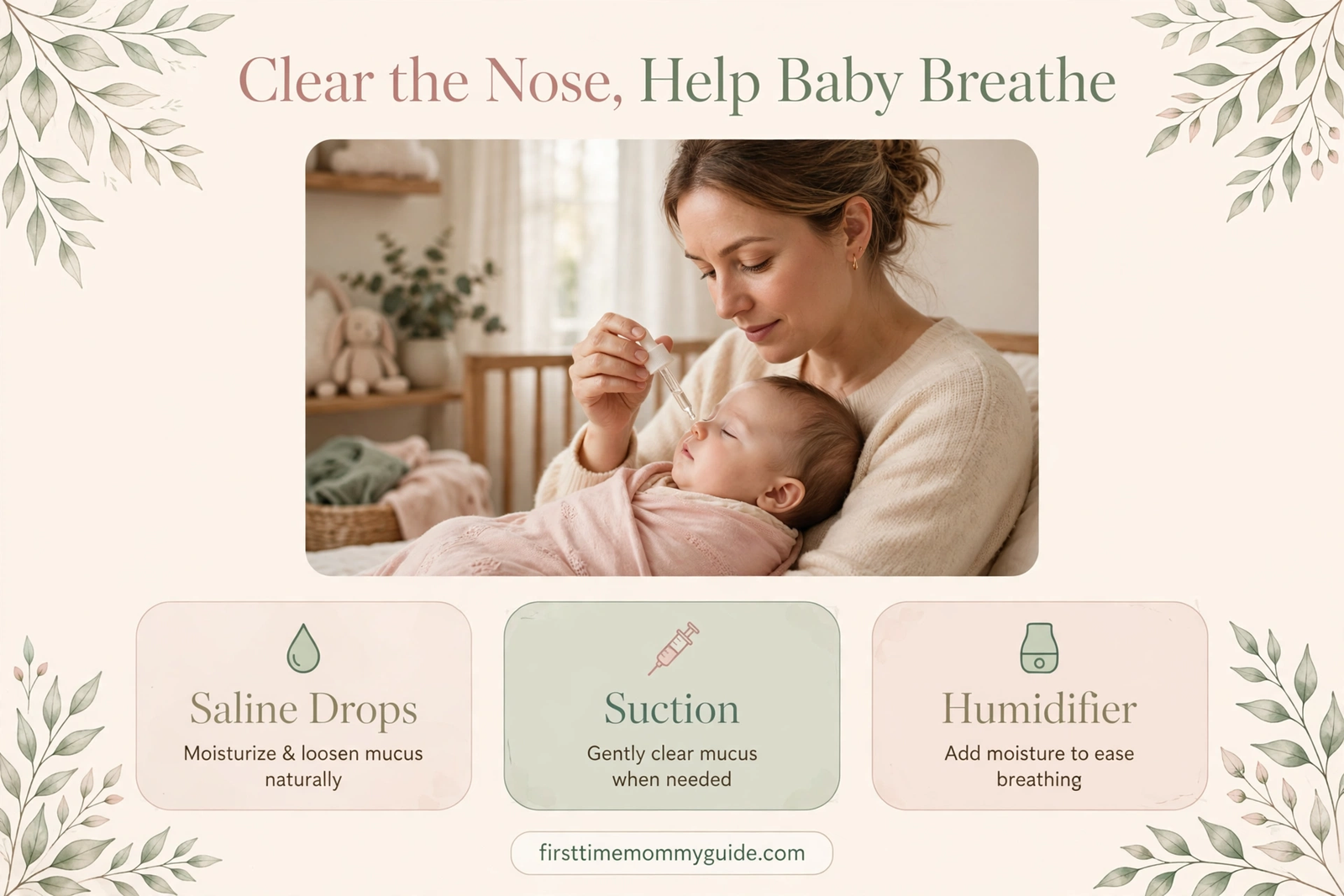
Saline drops for babies are sterile salt water, and they are the single most useful remedy for baby congested nose relief. They thin thick mucus, moisten dry nasal passages, and make suction far more effective. They are safe from birth and can be used several times a day.
Use a baby saline spray or drops made for infants, not a homemade mix unless your doctor advises it. Lay your baby on their back with their head slightly tilted. Place one or two drops in each nostril, then wait 30 to 60 seconds for the saline to loosen the mucus.
Do not use saline more than about four to six times a day unless your paediatrician says otherwise. Overuse can irritate the delicate lining of the nose. If the nose bleeds or looks sore, pause and ask your doctor.
Definition box: Saline is a sterile solution of salt in water, matched to the body's natural salt level. In the nose it draws moisture into dried mucus, softens crusts, and helps tiny hairs called cilia move mucus out. It does not contain medicine, so it cannot cause drowsiness or side effects like decongestants can.
2. Nasal Suction: Clearing the Nose Gently
After saline, gentle suction removes the loosened mucus. A bulb syringe or a manual nasal aspirator both work well. Choose the tool you find easiest to clean, because a dirty aspirator can reintroduce germs.
Squeeze the bulb before placing it at the nostril entrance, then release slowly to draw mucus out. For a manual aspirator, place the tip just inside the nostril and suck gently through the mouthpiece, which has a filter to stop mucus reaching you. Never push the tip deep into the nose.
Suction works best before feeds and before sleep, when a clear nose matters most. Limit suction to a few times a day, because too much suction can inflame the nasal lining and make congestion worse. Clean the aspirator with warm soapy water after every use and let it dry fully.
Step-by-Step: Saline and Suction Routine
- Wash your hands well before you start.
- Lay your baby on their back on a safe, flat surface.
- Put one to two saline drops in each nostril.
- Wait 30–60 seconds while the saline works.
- Suction gently, one nostril at a time.
- Wipe the nose with a soft cloth or tissue.
- Wash the aspirator and wash your hands again.
Repeat this routine before feeds and at bedtime, and whenever breathing sounds very noisy. Most parents find two to four sessions a day is enough. If mucus is thick and green, saline and suction still help, and the colour alone does not mean antibiotics are needed.
3. Steam and Humidified Air
Moist air soothes irritated airways and loosens mucus. A cool-mist humidifier in the baby's room can help, especially in dry winter air or air-conditioned rooms. Keep it clean, because a dirty humidifier can spread mould and bacteria.
Run the humidifier at night and clean it daily according to the maker's instructions. Use plain water, not essential oils or medicated vapours, unless your doctor approves them. Keep the humidifier away from the cot so mist does not fall directly on your baby.
A steamy bathroom is a simple alternative. Run a hot shower with the door closed, sit with your baby in the steamy room for 10 to 15 minutes, and let the warm moist air work. Never hold your baby under hot water or near the shower stream. This trick often helps before bedtime, when congestion feels worst.
Keep room humidity around 40–50% if you can measure it. Too much humidity encourages mould, while too little dries the nose. A small hygrometer costs little and takes the guesswork out.
4. Fluids and Feeding: Keep Them Coming
Fluids are the most important remedy of all. A baby with a cold loses water through a runny nose, faster breathing, and sometimes a mild fever. Breast milk or formula is the best fluid for babies under six months. Water is not needed for young babies unless your doctor advises it.
Offer feeds more often, in smaller amounts. A blocked nose makes long feeds tiring, so your baby may take less at each feed and want to eat again sooner. That pattern is normal during a cold. Follow your baby's cues rather than the clock.
For babies over six months who have started solids, keep offering milk first and add small sips of water between feeds if your doctor agrees. Warm, thin soups are not needed, and fruit juice is not a good choice during illness. Milk, rest, and patience cover most needs.
Count wet nappies as your hydration check. A well-hydrated baby should have at least four to six wet nappies a day, with pale yellow urine. Dark urine, very few wet nappies, a sunken soft spot on the head, or no tears when crying are signs to call your doctor promptly.
If feeding becomes very hard, saline and suction just before a feed can help. Hold your baby slightly upright while feeding, and take breaks so they can breathe. Burp gently and often, because a cold baby swallows more air.
5. Sleep and Rest: Helping Your Baby Breathe at Night
Night is when colds feel hardest. Lying flat lets mucus pool in the nose, so your baby wakes coughing and snuffling. You cannot safely prop a baby up with pillows, and you should never place pillows, wedges, or rolled blankets in the cot. Safe sleep guidance is clear on this point.
Instead, keep the room cool, around 18–20°C (65–68°F), and use a humidifier if the air is dry. Dress your baby in a light sleep sack rather than heavy blankets. A saline and suction session before bed often buys a longer stretch of sleep.
Expect broken nights for a few days. You can sit with your baby upright on your chest for a short cuddle if they are very congested, but always return them to their back in a clear cot for sleep. Contact naps during the day are fine and often help a sick baby rest better.
Avoid vapour rubs on babies under two years unless your paediatrician specifically recommends a baby-safe product. Adult vapour rubs contain camphor and menthol in strengths that can irritate a baby's airways. Never apply vapour rub inside the nostrils or on broken skin.
6. Comfort Measures: Warmth, Cuddles, and Calm
A cold baby needs comfort as much as care. Extra cuddles, skin-to-skin contact, and a calm voice all help. Hold your baby upright against your chest, where your warmth and heartbeat soothe them. Gentle rocking and soft singing can settle a fussy baby when nothing else works.
Keep the house calm and the routine simple. Skip outings, visitors, and stimulating play for a day or two. A quiet, dim room helps a tired baby drift off. Change nappies promptly, because a wet nappy adds discomfort to an already unhappy baby.
A warm bath can help some babies, loosening mucus and relaxing tense muscles. Keep the water warm, not hot, and keep the bath short. Dry your baby quickly and dress them in warm, dry clothes. If your baby dislikes baths when ill, skip it and stick with cuddles.
7. Fever Care Without Medicine
A low fever is the body's way of fighting the virus, and it does not always need treatment. The NHS advises that a mild fever in an older baby can often be managed with fluids and rest, with medicine only if your baby seems uncomfortable. Always follow your paediatrician's advice on fever medicine and dosing.
Dress your baby in light clothing and keep the room cool. Offer extra feeds. You can sponge your baby with lukewarm water if they feel very hot, but avoid cold water or ice, which can cause shivering and raise the temperature further.
Paracetamol (acetaminophen) may be used for babies over two to three months, depending on local guidance and your doctor's advice. Never give ibuprofen to a baby under six months unless a doctor tells you to. Never give aspirin to a child, because it is linked to a rare but serious condition called Reye's syndrome.
Always dose by weight, not by age alone, and use the syringe or dropper that comes with the medicine. Write down the time of each dose so you do not double-dose in the night. If you are unsure about any medicine, call your paediatrician or pharmacist before giving it.
| Fever situation | What to do |
|---|---|
| Baby under 3 months, 38°C+ (100.4°F+) | Urgent medical care, do not wait |
| Baby 3–6 months, fever over 38.5°C | Call paediatrician same day |
| Baby over 6 months, mild fever, feeding well | Fluids, rest, monitor closely |
| Fever over 39°C (102.2°F) at any age | Call paediatrician promptly |
| Fever lasting more than 3 days | Call paediatrician |
| Fever with rash, stiff neck, or unusual sleepiness | Urgent medical care |
Baby Cold Remedies by Age
Baby cold remedies for newborns are more limited than for older babies, because newborns cannot have medicines and their airways are very small. The table below shows what is safe at each stage. When in doubt, ask your paediatrician before trying anything new.
Newborns: 0–3 Months
Newborns need the gentlest care and the closest watch. Their noses are tiny, so even a little mucus blocks breathing and feeding. Saline drops and gentle suction are safe and should be your main tools.
Feed on demand, little and often. Watch wet nappies closely, because newborns dehydrate quickly. Keep visitors to a minimum and ask anyone with a cold to stay away.
Call a doctor urgently for any newborn with a fever of 38°C (100.4°F) or higher, poor feeding, unusual sleepiness, or laboured breathing. Newborns can become ill quickly, so early review is always the right choice. See our newborn doctor visits checklist for what to expect at those early appointments.
Babies: 3–6 Months
By three to six months, your baby can handle a little more comfort care, but medicines are still very limited. Saline, suction, steam, and humidified air remain the core remedies. Paracetamol may be used only on your doctor's advice, with weight-based dosing.
This is a good age to start a simple sick-day routine: saline and suction before feeds, a steamy bathroom before bed, and a cool, humidified room at night. Keep feeds frequent and watch for any change in breathing or alertness.
Babies: 6–12 Months
Older babies have slightly more options. You can offer small sips of water alongside milk, and your doctor may approve paracetamol or ibuprofen for fever or discomfort. Honey is still unsafe at this age, and cough medicines remain off the table.
A warm bath, gentle chest rubs with a baby-safe balm if your doctor approves, and extra cuddles all help. Keep solids simple and familiar, and do not worry if your baby eats less for a few days. Milk remains the main source of nutrition and hydration.
| Remedy | 0–3 months | 3–6 months | 6–12 months |
|---|---|---|---|
| Saline drops | Yes | Yes | Yes |
| Nasal suction | Yes, gentle | Yes | Yes |
| Cool-mist humidifier | Yes | Yes | Yes |
| Steamy bathroom | Yes, 10–15 min | Yes | Yes |
| Extra breast milk / formula | Yes | Yes | Yes |
| Small sips of water | No, unless doctor advises | No, unless doctor advises | Yes, small amounts |
| Paracetamol | No, unless doctor advises | Only on doctor's advice | On doctor's advice |
| Ibuprofen | No | No, unless doctor advises | On doctor's advice |
| Honey | No | No | No, unsafe under 12 months |
| Cough / cold medicine | No | No | No |
Baby Cough Cold Remedies: Soothing the Cough
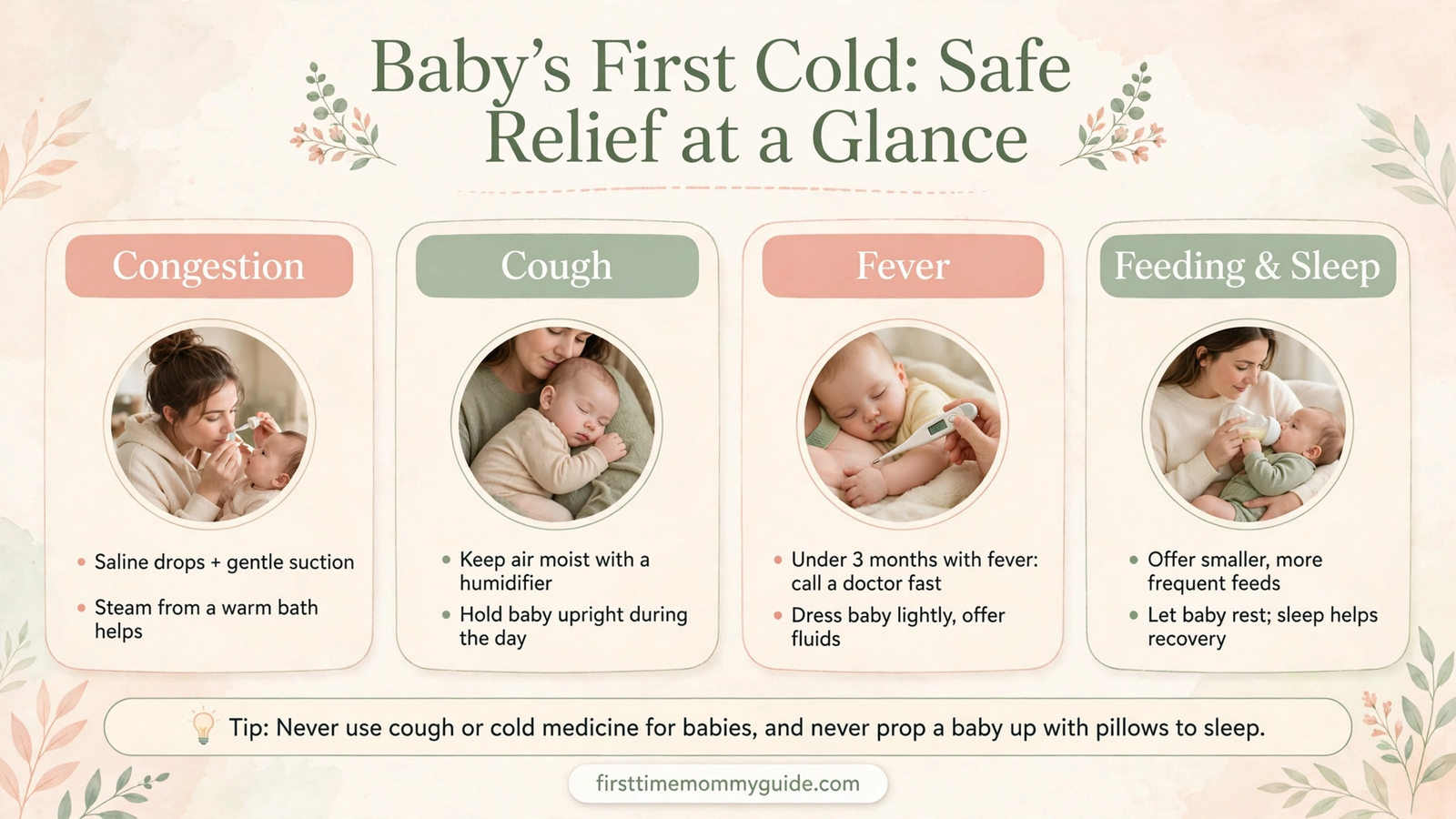
Baby cough cold remedies focus on the cause, which is usually mucus dripping down the throat. Clearing the nose often eases the cough more than any cough syrup could. Saline and suction before sleep are the best first step.
Steam helps a cough, too. A steamy bathroom or a cool-mist humidifier moistens the airways and loosens mucus. Keep the air in the bedroom moist but not damp, and avoid smoke, strong scents, and cleaning sprays near your baby.
For babies over 12 months, a small spoonful of honey can soothe a cough, but honey is not safe for babies under 12 months because it can carry bacteria that cause infant botulism. Never give honey to a baby under one year, even in warm water or tea. This rule is absolute and worth repeating to every caregiver.
Hold your baby upright after coughing fits, and pat their back gently. Offer a feed or a small drink if they are old enough, because swallowing can calm the throat. If the cough sounds barking, wheezy, or very harsh, or if your baby struggles to breathe between coughs, call your doctor.
What About Cough Syrup?
Cough and cold medicines are not recommended for babies and young children. Health authorities, including the AAP and the NHS, advise against them because they do not shorten colds and they can cause serious side effects. Decongestants, antihistamines, and cough suppressants are not safe for babies.
Some products are marketed for babies, but marketing is not proof of safety. Read labels carefully and ask your paediatrician before giving any over-the-counter product. In most cases, the answer will be to skip the medicine and use saline, suction, steam, and fluids instead.
If a doctor does prescribe a medicine for a specific reason, follow the prescription exactly. Do not borrow medicine from an older child, do not use adult products, and do not combine products without advice. Keep all medicines out of reach, and store them as the label directs.
What NOT to Do When Your Baby Has a Cold
Knowing what to avoid is as important as knowing what helps. Many common remedies for adults are unsafe for babies, and some well-meaning tricks can make things worse. Keep this list handy and share it with anyone who cares for your baby.
Medicines and Products to Avoid
- Cough and cold medicines: Not recommended for babies. They do not cure colds and can cause harm.
- Decongestant drops or sprays: Adult nasal sprays can damage a baby's delicate nasal lining and cause rebound congestion.
- Honey under 12 months: Risk of infant botulism, a rare but serious illness. No honey in any form.
- Aspirin: Never give to a child, due to the risk of Reye's syndrome.
- Adult vapour rubs: Camphor and menthol can irritate baby airways. Use only baby-safe products if your doctor approves.
- Essential oils: Many are unsafe for babies, even diffused. Do not use them without medical advice.
- Antibiotics: Colds are viral, so antibiotics do not help. They are only used if a doctor finds a bacterial infection.
- Herbal teas and home remedies: Many are untested in babies. Ask your paediatrician first.
- Over-the-counter antihistamines: Not recommended for babies with colds, and they can cause drowsiness and dry mucus.
Habits That Make Colds Worse
Do not overdress your baby. Extra layers can cause overheating, which makes fever and fussiness worse. Dress your baby as you would dress yourself, plus one light layer at most.
Do not smoke near your baby, and keep your baby away from smoky rooms. Smoke irritates the airways, prolongs coughs, and raises the risk of ear infections and chest infections. Ask visitors who smoke to change clothes and wash hands before holding the baby.
Do not use a hot-water vaporiser that boils water, because it can scald a curious baby. Cool-mist humidifiers are safer. Do not place a humidifier right next to the cot, and clean it daily to prevent mould and bacterial growth.
Do not suction too often or too forcefully. Aggressive suction can cause swelling inside the nose and make breathing harder. Gentle, brief suction a few times a day is enough. If the nose looks red or sore, give it a break and rely on saline alone for a while.
Feeding a Baby With a Cold
Feeding is often the hardest part of a first cold. A blocked nose makes sucking and swallowing a juggling act. Your baby may latch, pull off, cry, and latch again. This is frustrating for both of you, but it is normal and it passes.
Breastfeeding Through a Cold
Breast milk is the best food and fluid for a sick baby. It provides antibodies, hydration, and comfort in one feed. Offer the breast often, even if feeds are short. Your baby may prefer shorter, more frequent feeds while congested.
Clear the nose with saline and suction just before a feed. Hold your baby in a more upright position, and pause often so they can breathe. If one nostril is clearer, try feeding on the side that lets your baby breathe more easily.
Your milk supply may dip slightly if feeds are shorter, but frequent offering usually keeps it steady. Drink plenty of water yourself, rest when you can, and ask for help with household tasks so you can focus on your baby. If your baby refuses the breast entirely for several feeds, call your paediatrician.
Bottle Feeding Through a Cold
Bottle-fed babies face the same challenge. Use a slow-flow teat so milk does not come too fast while your baby struggles to breathe. Offer smaller amounts more often, and burp after every few minutes.
Keep the bottle upright enough that milk flows steadily but not too fast. Pause the feed if your baby coughs or splutters. Wipe the nose gently between pauses. Sterilise bottles and teats as usual, and wash your hands before preparing each feed.
Solids and Weaning Babies
If your baby has started solids, keep meals simple and familiar. Offer soft, easy foods such as porridge, mashed banana, or well-cooked vegetables. Do not introduce new foods during a cold, because you will not know whether a reaction is from the food or the illness.
Milk remains more important than solids during a cold. If your baby eats very little solid food for a few days, that is fine as long as milk intake and wet nappies stay reasonable. Offer solids after milk, not instead of it, until appetite returns.
Night Care: Getting Through the Worst Nights
The first two or three nights are usually the hardest. Your baby may wake every hour, cough, and need holding. This is exhausting, especially when you are also catching the cold. Plan for broken sleep and share night duties if you can.
Set up a simple night station before bed: saline drops, aspirator, tissues, a spare sleep sack, and a drink of water for yourself. Keep the room dim and calm. When your baby wakes, do saline and suction only if the nose is very blocked, then offer a feed and settle them back to sleep.
Avoid bright lights and play at night. Keep your voice low and your movements slow. If your baby only settles on your chest, hold them upright for a while, then transfer them to the cot on their back once they are drowsy but not fully asleep.
A Simple Sick-Day Routine
| Time | What to do |
|---|---|
| Morning | Saline + suction, feed, fresh air by a window, rest |
| Mid-morning | Feed, nappy change, quiet play, humidifier on |
| Lunchtime | Saline + suction before feed, light solids if 6+ months |
| Afternoon | Nap, steamy bathroom if very congested, feed |
| Evening | Warm bath (if liked), saline + suction, feed, calm routine |
| Bedtime | Cool room, humidifier on, sleep sack, cot clear |
| Night waking | Feed, suction only if needed, settle back to sleep |
This routine is a guide, not a rule. Follow your baby's cues. Some babies need suction before every feed, while others need it only twice a day. The goal is a baby who can breathe, feed, and rest, not a perfect schedule.
When to Call the Doctor for a Baby Cold
Most colds can be managed at home, but some need medical review. The list below is your safety net. If you are ever unsure, call your paediatrician. Doctors expect calls about sick babies, and a quick call is always better than waiting and worrying.
Call Your Paediatrician the Same Day If:
- Your baby is under 3 months old and has any fever, cough, or breathing difficulty.
- Fever lasts more than three days, or returns after improving.
- Your baby feeds much less than usual or refuses feeds.
- Wet nappies drop below four in 24 hours.
- Cough lasts more than two weeks, or worsens after a week.
- Your baby has an earache, ear pulling, or discharge from the ear.
- Breathing is fast, noisy, or laboured, or the chest pulls in.
- Your baby is unusually sleepy, hard to wake, or unusually irritable.
- A rash appears with the fever.
- Your baby has a health condition such as prematurity, heart disease, or immune problems.
Seek Urgent Care Immediately If:
- Your baby struggles to breathe, grunts, or wheezes.
- Lips or face turn blue or very pale.
- Your baby is limp, unresponsive, or cannot be woken.
- There is a stiff neck, a bulging soft spot, or a seizure.
- Your baby vomits repeatedly and cannot keep fluids down.
- There are signs of dehydration: no tears, dry mouth, sunken soft spot, very few wet nappies.
Keep your paediatrician's number and your local urgent-care number saved in your phone. Write down symptoms, temperatures, and feed times before you call, so you can give clear information. A calm, factual summary helps the doctor advise you quickly.
Definition box: A fever is a body temperature of 38°C (100.4°F) or higher, measured with a reliable thermometer. Rectal thermometers are most accurate in babies under three months. Forehead and ear thermometers are less reliable in very young babies. Always follow your thermometer's instructions and your doctor's advice on measurement.
For more on newborn health checks, see our newborn doctor visits checklist. If your baby also has skin irritation from frequent nose wiping, our guide to baby eczema care, signs and treatment may help with gentle skin care.
Other Common First-Year Worries That Overlap With Colds
A first cold rarely arrives alone. Parents often notice hiccups, constipation, teething, or skin rashes at the same time, and it helps to know which symptom belongs to which cause. A cold does not cause hiccups, but a baby who swallows air while feeding with a blocked nose may hiccup more often. Our guide to newborn hiccups remedies explains how to ease them.
Constipation can appear when a baby drinks less during a cold. Fewer feeds mean less fluid, which can firm up stools. Offer feeds often, and do not change formula or start new foods to fix it. If constipation persists, see our guide to baby constipation signs and remedies.
Teething often coincides with the age when first colds appear, which causes confusion. Teething can cause drooling, chewing, and mild irritability, but it does not cause a high fever or a true cold. If your baby has both teething signs and cold symptoms, treat the cold and monitor the fever. Our baby teething signs and remedies guide covers teething care separately.
Newborn jaundice is a different condition, but parents of very young babies sometimes confuse yellowish skin with cold-related paleness. Jaundice needs its own review, so ask your paediatrician if you notice yellowing of the skin or eyes.
Prevention: Reducing the Next Cold
You cannot stop every cold, but you can make the next one less likely and less severe. Hand hygiene is the single most effective step. Wash hands before holding your baby, after nappy changes, and after coming home. Teach older children to wash hands before touching the baby.
Keep your baby's environment clean but not sterile. Wash toys that go in the mouth, change bedding often, and wipe high-chair trays and changing mats. Avoid crowded indoor places during peak cold season when you can, especially with a newborn.
Make sure everyone around your baby is up to date with vaccines, including flu and whooping cough vaccines. Babies under six months rely on the people around them for protection. Ask your paediatrician about the vaccine schedule for your baby, and keep appointments even during cold season unless your baby is unwell.
Breastfeeding, where possible, offers immune support. A balanced diet, fresh air, and good sleep also help your baby's immune system. None of these guarantees a cold-free winter, but together they lower the odds and soften the illness when it comes.
Mistakes to Avoid
- Trying every remedy at once instead of sticking to saline, suction, steam, and fluids.
- Giving cough or cold medicine because it worked for an older child or adult.
- Using adult nasal sprays, vapour rubs, or essential oils on a baby.
- Offering honey to a baby under 12 months, even a tiny taste.
- Propping the cot with pillows or wedges, which is unsafe for sleep.
- Waiting too long to call the doctor for a fever in a baby under 3 months.
- Stopping feeds because your baby eats less, instead of offering smaller, more frequent feeds.
- Comparing your baby's cold to another baby's and assuming the same course.
Expert Tips for First-Time Parents
First-time parents often feel unsure during a first cold. That is normal. You are learning your baby's normal patterns while also learning what illness looks like. Keep notes for a few days: temperature, feeds, wet nappies, and sleep. Patterns become clearer on paper than in a tired memory.
Trust your instincts. You know your baby's usual cry, feeding rhythm, and alertness better than anyone. If something feels different in a worrying way, call your paediatrician. Doctors would rather hear from a worried parent early than late.
Ask for help. A cold can leave you exhausted, especially if you catch it too. Let a partner, family member, or friend take a shift, cook a meal, or hold the baby while you rest. You cannot care well for a sick baby if you are running on empty.
Keep the house stocked before cold season. Saline drops, a nasal aspirator, a reliable thermometer, soft tissues, and a cool-mist humidifier are the basics. Check expiry dates on any medicine you keep, and store medicines safely out of reach.
Sources and Further Reading
- NHS, Common cold: symptoms, treatment and prevention — https://www.nhs.uk/conditions/common-cold/
- HealthyChildren.org (AAP), The Difference Between a Cold and the Flu — https://www.healthychildren.org/English/health-issues/conditions/ear-nose-throat/Pages/The-Difference-Between-a-Cold-and-the-Flu.aspx
- CDC, About Common Cold — https://www.cdc.gov/common-cold/about/index.html
- Always check with your paediatrician for advice specific to your baby.
Frequently Asked Questions
1. What are the best baby's first cold remedies?
The best remedies are saline drops, gentle nasal suction, steam or a cool-mist humidifier, and frequent feeds. These ease congestion, keep your baby hydrated, and help them rest. They are safe from birth and recommended by paediatricians.
2. How can I treat my baby's cold at home?
Treat a baby cold at home with comfort care: clear the nose with saline and suction before feeds, run a humidifier, offer extra breast milk or formula, and keep the room cool. No medicine cures a cold, so focus on breathing, fluids, and rest.
3. What are safe baby cold remedies for a newborn?
For a newborn, saline drops and gentle suction are the safest remedies. Offer frequent small feeds and keep the air moist. Do not give any medicine unless your paediatrician advises it, and seek urgent care for any fever in a baby under 3 months.
4. How do I give my baby saline drops?
Lay your baby on their back, tilt the head slightly, and place one or two drops in each nostril. Wait 30–60 seconds, then suction gently if needed. Use saline up to four to six times a day, or as your paediatrician advises.
5. How often can I suction my baby's nose?
Suction two to four times a day, usually before feeds and bedtime. More often is fine if the nose is very blocked, but avoid aggressive or constant suction. If the nose looks sore or red, pause and use saline alone for a while.
6. What helps baby congested nose relief at night?
Saline and suction before bed, a cool-mist humidifier, and a cool room around 18–20°C help most. Keep the cot clear of pillows and wedges. A steamy bathroom session before bed can also loosen mucus.
7. How long does a baby's first cold last?
Most baby colds last 7–10 days. The worst days are usually days two to four. A mild cough can linger for up to two weeks. Call your doctor if symptoms last longer than ten days or worsen after improving.
8. What are the main baby cold symptoms?
The main symptoms are a stuffy or runny nose, sneezing, a mild cough, low-grade fever, fussiness, reduced appetite, and broken sleep. Symptoms build slowly over a day or two, unlike flu, which often starts suddenly.
9. How can I tell a baby cold from flu?
A cold builds slowly with a low fever and a runny nose as the main symptom. Flu starts suddenly with a high fever, body aches, and marked tiredness. If you suspect flu, contact your paediatrician promptly, especially in flu season.
10. When should I call the doctor for a baby cold?
Call the doctor if your baby is under 3 months with a fever, if fever lasts more than three days, if feeds drop sharply, if wet nappies fall below four a day, or if breathing becomes fast or laboured. Seek urgent care for blue lips, limpness, or trouble breathing.
11. Can I give my baby cough medicine?
No, cough and cold medicines are not recommended for babies. They do not shorten colds and can cause serious side effects. Use saline, suction, steam, and fluids instead, and ask your paediatrician if you are unsure.
12. Is honey safe for a baby with a cold?
No, honey is not safe for babies under 12 months. It can carry bacteria that cause infant botulism, a rare but serious illness. Do not give honey in any form, including in warm water or tea, until after your baby's first birthday.
13. Can I use a humidifier for my baby?
Yes, a cool-mist humidifier can help, especially in dry air. Clean it daily, use plain water, and keep it away from the cot. Do not add essential oils or medicated vapours unless your doctor approves them.
14. Should I use vapour rub on my baby?
Do not use adult vapour rubs on babies under two years. They contain camphor and menthol in strengths that can irritate a baby's airways. Only use a baby-safe product if your paediatrician specifically recommends it.
15. How do I feed a baby with a blocked nose?
Offer smaller, more frequent feeds, and clear the nose with saline and suction just before feeding. Hold your baby more upright, pause often, and burp gently. Short feeds are normal during a cold.
16. Can a baby with a cold still breastfeed?
Yes, breastfeeding is one of the best things you can do during a cold. Breast milk provides fluids, antibodies, and comfort. Offer the breast often, even if feeds are shorter than usual.
17. Does teething cause a cold?
No, teething does not cause a cold or a high fever. Teething can cause drooling and fussiness, but a runny nose, cough, and fever point to a viral illness. Do not blame teething for a fever; monitor it and call your doctor if needed.
18. Can my baby go outside with a cold?
A short, gentle outing in fresh air is usually fine if your baby feels well enough and the weather is mild. Avoid crowded indoor places, cold wind, and smoke. Keep outings short and dress your baby warmly but not heavily.
19. How can I prevent my baby catching another cold?
Wash hands often, ask visitors to wash theirs, clean toys and dummies regularly, and keep your baby away from people who are actively ill. Make sure family members are up to date with vaccines, including flu vaccine where eligible.
20. What if my baby's cold keeps coming back?
Babies can catch several colds in their first year, and each one is usually mild. Frequent colds are normal as immunity develops. If colds are very frequent, very severe, or always lead to breathing trouble, talk to your paediatrician about further review.
21. Is a green runny nose a sign of infection?
Not necessarily. Mucus often turns yellow or green after a few days as the body fights the virus. Colour alone does not mean a bacterial infection or a need for antibiotics. Watch for fever, worsening symptoms, or breathing difficulty instead.
22. Can I give my baby paracetamol for a cold?
Paracetamol may be used for babies over two to three months, depending on local guidance and your doctor's advice. Always dose by weight, use the correct measuring device, and record each dose. Never give ibuprofen under six months unless a doctor advises it, and never give aspirin to a child.
Conclusion
Your baby's first cold is hard, but it is also normal, common, and usually mild. The safest path is simple: saline drops and gentle suction for the nose, steam and humidified air for comfort, frequent feeds for hydration, and plenty of rest for both of you.
Remember the safety rules that matter most. A baby under 3 months with a fever needs urgent medical care. Cough and cold medicines are not recommended for babies. Honey is unsafe under 12 months. When you are unsure, call your paediatrician — that call is always the right choice.
With gentle care and close watching, most first colds pass within a week to ten days. Your baby will feed better, sleep better, and smile again, and you will feel more confident the next time a sniffle appears. You are doing the most important thing already: paying attention, staying calm, and keeping your baby comfortable.
This article is for general information only and does not replace medical advice. Always consult your paediatrician about your baby's health, especially for babies under 3 months old, babies with ongoing health conditions, or any symptom that worries you.

Dilawar Mughal
Founder and editor, First Time Mommy Guide
I research every guide against what the NHS, the AAP and the WHO publish, then write it in plain English — because most new parents are reading with one hand free, not comparing clinical guidelines. I'm not a doctor or a midwife. Every health claim on this site is sourced and linked so you can check it yourself, and anything urgent belongs with your health visitor or GP, not a blog.