General information, not medical advice. Every baby is different — if anything worries you, speak to your midwife, health visitor or GP rather than waiting.
Can teething cause a low grade fever in babies? Yes, it can, but only a slight one. A small rise in body temperature that stays below 100.4°F (38°C) can happen around the time a tooth pushes through the gum.
A true fever is different. A reading of 100.4°F or higher is not explained by teething and usually points to an infection or another illness.
Parents get confused because the first teeth often arrive between 4 and 7 months. That is also the age when babies start catching their first colds and putting everything in their mouths.
So the tooth and the fever show up together, and it feels like one caused the other. Most of the time, they are two separate things happening at once.
Table of Contents
Can Teething Cause a Low Grade Fever in Babies?
Short answer: Teething may cause a mild temperature rise, usually under 100.4°F (38°C), but it does not cause a true fever.
If your baby’s temperature reaches 100.4°F or higher, look for another cause. Ear infections, colds, viral illness, and urinary tract infections are far more likely.
Key takeaways
- A low grade temperature during teething is possible but mild and short-lived.
- A rectal temperature of 100.4°F (38°C) or higher counts as a fever, even if your baby is teething.
- Teething does not cause high fevers like 102°F or 103°F.
- Babies under 3 months with a fever of 100.4°F or higher need urgent medical care.
- Never dismiss a fever, vomiting, diarrhea, rash, or unusual sleepiness as “just teething.”
What Is a Low Grade Fever in Babies?
A low grade fever is a temperature that is higher than normal but below the medical fever line. In babies, it usually means a reading somewhere between about 99°F and 100.3°F.
Normal baby temperature is not one fixed number. It changes during the day and depends on activity, clothing, and room temperature.
Normal Temperature vs Low Grade Fever vs True Fever
| Temperature (rectal) | What it usually means | What to do |
|---|---|---|
| 97.5°F to 99°F (36.4°C to 37.2°C) | Normal range for most babies | Nothing needed |
| 99.1°F to 100.3°F (37.3°C to 37.9°C) | Slightly raised, sometimes called low grade | Recheck in 15 to 30 minutes, watch behavior |
| 100.4°F (38°C) or higher | True fever | Call your pediatrician, urgent if under 3 months |
| 102°F (38.9°C) or higher | Higher fever | Call your pediatrician the same day |
| 104°F (40°C) or higher | High fever | Seek urgent medical care |
These ranges are general guides. Your pediatrician may give you slightly different call thresholds based on your baby’s age and health.
Why 100.4°F (38°C) Is the Magic Number
The American Academy of Pediatrics (AAP) and other major health groups use 100.4°F as the line for fever in infants. This number is measured rectally in babies under 3 years.
Below that line, a baby who is feeding well and acting like themselves is usually fine. At or above it, doctors want to know why.
Fever Is a Symptom, Not a Disease
Fever is the body’s response to something, usually an infection. It helps the immune system fight germs.
The number matters, but your baby’s behavior matters just as much. A baby with a mild temperature who is limp and not feeding needs more attention than a playful baby with a slightly higher one.
Why Teething Seems to Cause a Low Grade Fever
Teething involves a tooth moving through gum tissue. That can cause local inflammation, swelling, and soreness in the mouth.
Some parents and doctors believe this mild inflammation may nudge body temperature up a little. The effect is small, though, and research has not shown it creates a true fever.
Gum Inflammation and Mild Temperature Changes
When a tooth presses through the gum, the tissue becomes red, swollen, and tender. This is a local reaction, not a whole-body infection.
A slight temperature bump may follow for a day or so around the time the tooth breaks through. It tends to settle on its own.
The Timing Coincidence Between Teething and Illness
Babies start teething at roughly the same time that antibodies passed on from the mother begin to fade. This is usually between 4 and 7 months.
That means babies become more open to common viruses right when teeth are arriving. It is easy to blame the tooth when a cold is the real cause.
More Hands and Toys in the Mouth
Teething babies chew on fingers, toys, blankets, and anything within reach. This brings germs straight into the mouth.
Extra mouthing can lead to more colds, stomach bugs, and other infections. The fever then comes from the germ, not from the tooth.
Drool, Rash, and Fussiness Make Everything Look Like Teething
Drooling, chewing, fussiness, and poor sleep are all real teething signs. They are also common signs of many baby illnesses.
Because teething symptoms are so common, parents may overlook early signs of sickness. This is why a measured temperature matters more than a guess.
Overheating and Warm Environments
A baby who is bundled too warmly, held for a long time, or sitting in a hot room can show a slightly raised temperature. This has nothing to do with teething.
If you see a mild reading, remove extra layers, cool the room a little, and recheck after 15 to 30 minutes.
What Pediatric Experts and Research Say About Teething and Fever
Major health sources agree on the main point. Teething can cause mild symptoms, but it does not cause a true fever.
This matters because treating a real fever as teething can delay care for an infection.
What the AAP Says
The AAP’s parent site, HealthyChildren.org, lists drooling, irritability, and a desire to chew among common teething signs. It treats a rectal temperature of 100.4°F or higher as a fever that needs attention, regardless of teething.
The AAP also stresses that fever in babies under 3 months is a medical concern at any time.
What Mayo Clinic and Cleveland Clinic Say
Mayo Clinic describes a slightly raised temperature as possible with teething but says a true fever is not a teething symptom. It advises checking with a doctor if a baby has a fever.
Cleveland Clinic gives similar guidance. It explains that teething can cause mild discomfort, but a temperature of 100.4°F or higher suggests something else.
The 2016 Pediatrics Systematic Review
A 2016 systematic review in the journal Pediatrics looked at the signs and symptoms linked to teething. It found that irritability, drooling, and gum rubbing were commonly reported.
The review found that some babies had a small rise in temperature, but not a true fever. It also found that symptoms such as vomiting, diarrhea, and rash were not reliably linked to teething.
An Earlier Prospective Study
An earlier prospective study of infants, also published in Pediatrics, followed babies as teeth came in. Researchers found a slight temperature rise around the time of eruption, but not a pattern of true fevers.
This fits with what most pediatricians see in practice. A mild bump is possible; a fever points elsewhere.
Why Doctors Stay Cautious
Pediatricians would rather you check a fever than assume it is teething. Serious infections in babies can look mild at first.
If you are unsure, a quick call to your pediatrician’s office is always a reasonable choice.
What Temperature Is Normal When a Baby Is Teething?
A teething baby’s temperature usually stays within or just above the normal range. Most sources describe a rise to roughly 99°F to 100°F, still below the 100.4°F fever line.
If the number climbs above that, teething is not the likely explanation.
Teething Temperature Range at a Glance
| Reading | Likely explanation |
|---|---|
| 98°F to 99°F | Normal |
| 99°F to 100°F | Can fit with teething or overheating |
| 100.1°F to 100.3°F | Borderline, recheck and watch closely |
| 100.4°F and above | Fever, look for another cause |
Does Teething Cause a 100.4°F Fever?
Teething does not reliably cause a reading of 100.4°F. If your baby reaches this number, treat it as a real fever.
For babies under 3 months, this needs urgent care. For older babies, call your pediatrician for advice.
Does Teething Cause a 101°F Fever?
A 101°F reading is above the fever line. Teething is not considered the cause.
Check for cold symptoms, ear pulling, cough, diarrhea, or fewer wet diapers, and call your pediatrician.
Does Teething Cause a 102°F or 103°F Fever?
No. Teething does not cause temperatures this high.
A fever of 102°F or 103°F means the body is fighting something, such as a viral or bacterial infection. Call your pediatrician the same day, or seek urgent care if your baby looks unwell.
How Long Does a Teething Low Grade Fever Last?
A mild temperature rise linked to teething is usually brief. It often appears around the time the tooth breaks through and fades within a day or two.
Since teething itself does not cause a true fever, there is no standard length for a “teething fever.”
Typical Timing of Teething Symptoms
Teething discomfort can start a few days before a tooth appears and ease once it breaks through. Some babies seem fussy for days, while others barely notice.
Gum swelling and drooling can come and go for weeks as several teeth move at once.
When a Low Grade Temperature Lasts Too Long
If a mild temperature lasts more than 24 to 48 hours, it is time to look beyond teething. A temperature that keeps returning also deserves a call to the doctor.
Longer-lasting temperature changes usually mean a viral illness, an ear infection, or another condition that needs evaluation.
Why Temperature Often Goes Up and Down
Baby temperatures shift with sleep, feeding, clothing, and room warmth. A reading in the afternoon may be higher than one in the early morning.
Take your baby’s temperature at similar times and in the same way to see a true pattern.
Teething Symptoms in Babies: What Is Normal
Knowing the real teething signs helps you spot what does not belong. These symptoms are the ones most commonly linked to teething.
Common Teething Signs
- Extra drooling
- Swollen, tender, or red gums
- Chewing on hands, toys, or clothing
- Mild fussiness or irritability
- Trouble settling at night
- Rubbing the face or cheeks
- Wanting to nurse or suck more for comfort
- A slightly raised temperature below 100.4°F
Signs Parents Often Blame on Teething but Should Not
Fever of 100.4°F or higher, heavy diarrhea, repeated vomiting, and a widespread rash are not typical teething signs. Neither is a high-pitched cry or a baby who is hard to wake.
These need a different explanation and often a call to the doctor.
How Fussy Is Too Fussy?
Teething fussiness comes and goes. Your baby should still smile, play, and settle with comfort.
If your baby is inconsolable for hours, refuses all feeds, or seems weak, do not assume it is teething.
Teething Fever vs Illness: How to Tell the Difference
This is the question that matters most. A mild bump with drooling and chewing points to teething, while a fever with other symptoms points to illness.
Use the comparison below as a quick guide, not a diagnosis.
Teething vs Illness Comparison Table
| Sign | More likely teething | More likely illness |
|---|---|---|
| Temperature | Under 100.4°F | 100.4°F or higher |
| Gums | Swollen, tender, maybe a white bump | Normal gums |
| Drooling | Heavy | Normal or not noticeable |
| Appetite | Slightly reduced during sore moments | Strongly reduced, refusing feeds |
| Stools | Normal | Watery, frequent, or bloody |
| Cough or runny nose | Usually absent | Often present |
| Ear pulling | Possible with cheek rubbing | Possible ear infection if with fever |
| Energy | Playful between fussy spells | Tired, limp, or very sleepy |
| Rash | Chin or neck drool rash | Body rash with fever |
| Duration | Comes and goes | Persists or worsens |
Check the Whole Picture
Look at your baby from head to toe. Check the mouth, ears, breathing, wet diapers, and skin.
Write down what you see. This helps you decide when to call and gives your pediatrician useful details.
The “Fever Plus” Rule
If a fever comes with anything else, such as cough, vomiting, diarrhea, rash, or poor feeding, treat it as illness first. Teething can stay on the list, but it should not be the main explanation.
Can Teething Cause a Fever at Night?
Teething discomfort can feel worse at night because there are fewer distractions. Your baby may be more aware of sore gums when lying down.
Still, a true fever at night is not caused by teething.
Why Teething Seems Worse After Dark
During the day, your baby is busy with play and feeding. At night, the quiet lets soreness stand out.
Lying flat can also increase blood flow to the head and gums. This may make the gums feel a bit more uncomfortable.
What to Do for Night-Time Temperature Rise
Take the temperature before you give anything for comfort. Keep the room comfortably cool and dress your baby in light sleepwear.
Do not add extra blankets to the crib. The AAP safe sleep guidance says to keep cribs free of loose bedding and soft objects.
Teething and Other Symptoms: What Is Linked and What Is Not
Parents often hear that teething causes everything from diarrhea to ear infections. Research does not support most of these links.
Here is what to know about each common symptom.
Teething and Diarrhea
Teething does not cause true diarrhea. Babies swallow more drool, which may make stools slightly looser for some, but watery or frequent stools point to a stomach bug.
Call your pediatrician if diarrhea lasts more than a day or if there are fewer wet diapers.
Teething and Runny Nose
A clear runny nose is not caused by teething. It is more often a cold, which is common at the same age.
If the nose runs with a cough or fever, think viral infection.
Teething and Cough
Drool can cause a mild throat tickle and an occasional cough. A frequent or wet cough is more likely a respiratory infection.
Fast breathing or trouble breathing needs medical attention right away.
Teething and Ear Pulling
Gum pain can radiate toward the ear, so some babies tug at their ears or rub their cheeks. This is often harmless.
But ear pulling with fever, crying, and poor sleep can mean an ear infection. Have your pediatrician check the ears.
Teething and Vomiting
Vomiting is not a teething symptom. Babies may gag on extra saliva, but repeated vomiting suggests illness.
Watch for dehydration signs such as dry lips, no tears, and fewer wet diapers.
Teething and Loss of Appetite
Sore gums can make babies more fussy at the breast or bottle. Some feed less for a day or two.
If your baby refuses most feeds for more than a day, speak with your pediatrician.
Teething and Rash
Drool can irritate skin and cause a red rash on the chin, cheeks, neck, and chest. This is common and harmless.
A rash across the body, especially with fever, is not a teething rash and should be checked.
Teething and Sleep Problems
Fussy sleep can happen with teething, but sleep changes are also normal at 4, 6, and 9 months for other reasons. These include sleep regressions, new skills, and changes in feeding.
Do not assume every rough night is teething.
Teething Timeline: When Do Babies Start Teething?
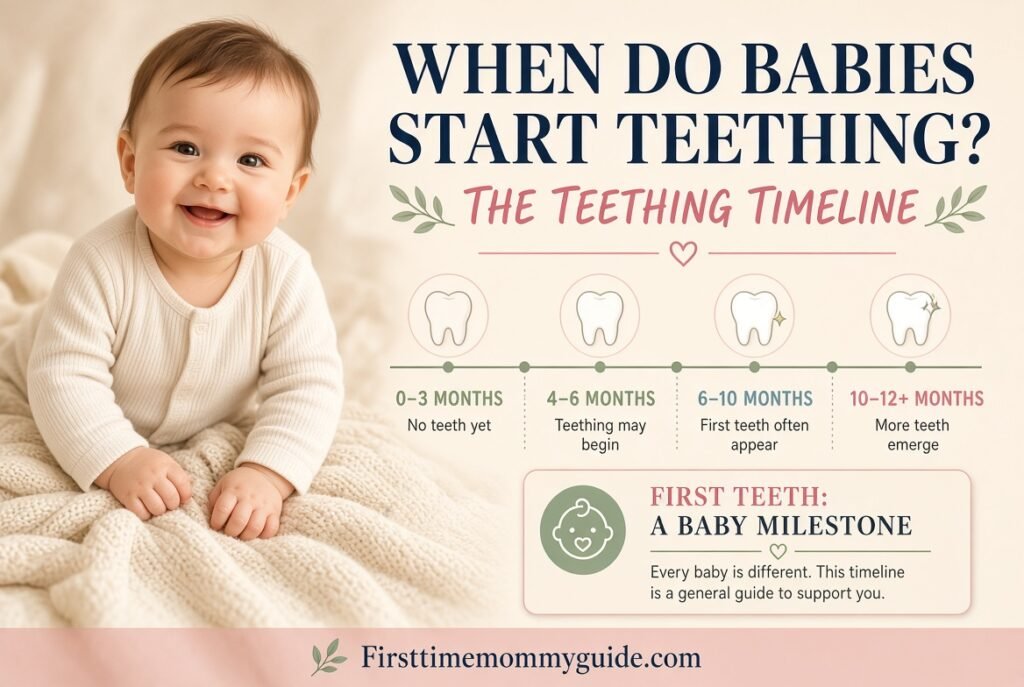
Most babies get their first tooth around 6 months. Some start as early as 3 or 4 months, and others do not see a tooth until after their first birthday.
All of these timelines can be normal.
Teething Chart by Age (Approximate)
| Tooth | Typical eruption age |
|---|---|
| Lower central incisors | 6 to 10 months |
| Upper central incisors | 8 to 12 months |
| Upper lateral incisors | 9 to 13 months |
| Lower lateral incisors | 10 to 16 months |
| First molars | 13 to 19 months |
| Canines (eyeteeth) | 16 to 23 months |
| Second molars | 23 to 33 months |
Most children have all 20 baby teeth by around age 3.
Teething at 3 to 4 Months
Many babies at this age drool and chew without any teeth coming. This is often normal development, not teething.
Drooling begins as salivary glands mature, and hand-to-mouth play grows.
Teething at 4 to 7 Months
This is the most common window for the first tooth. The bottom front teeth usually come first.
Fussiness, drooling, and chewing are common here. A temperature of 100.4°F or higher is still not explained by teething.
Teething at 8 to 12 Months
The top front teeth and side teeth begin to arrive. Several teeth may be moving at the same time.
Many babies are crawling and exploring by now, which means more germs and more colds.
Teething at 12 to 18 Months
First molars come in around this time. They are bigger and may cause more discomfort.
Some toddlers chew harder and seem fussier. A true fever still needs another explanation.
Teething at 18 Months to 3 Years
Canines and second molars finish the set. Discomfort tends to be milder for many children.
Offer cold foods and chewing options as your toddler wants them.
Late Teething
If there are no teeth by 12 months, talk to your pediatrician or dentist. Often it is simply a family pattern, but it is worth a check.
How to Take a Baby’s Temperature Accurately
A correct reading is the key to knowing whether you are dealing with a low grade temperature or a true fever. Always use a digital thermometer.
Avoid glass mercury thermometers.
Rectal Thermometer: The Most Accurate Method for Babies
For babies under 3 years, rectal temperature is the most accurate. Healthcare providers also use this method.
The steps are simple.
- Clean the thermometer tip with soap and water or rubbing alcohol.
- Apply a small amount of petroleum jelly to the tip.
- Lay your baby on their back with knees bent, or on your lap tummy down.
- Gently insert the tip about half an inch to one inch, and stop if you feel resistance.
- Hold it still until the thermometer beeps.
- Clean it again after use.
Forehead (Temporal) Thermometers
These are quick and easy, which helps with a sleeping baby. They can be less accurate if the forehead is sweaty or the technique is off.
If the reading seems high or low, confirm with a rectal temperature, especially in babies under 3 months.
Ear Thermometers
Ear thermometers are generally not recommended for babies under 6 months. Small ear canals make readings unreliable.
For older babies, wax or a wrong angle can still throw off the number.
Armpit Thermometers
Armpit readings are the least accurate. They can miss a true fever.
If an armpit reading is high, confirm with a rectal reading. If it is normal but your baby seems sick, trust your instincts and call the doctor.
Tips for Better Readings
- Wait about 15 to 20 minutes after a bath, feeding, or heavy bundling.
- Take the temperature the same way each time.
- Write down the time, number, and method.
- Tell your pediatrician which method you used.
When to Call the Doctor for a Teething Baby With a Temperature
Trust your instincts. If something feels off, call.
Use the guide below for the most common situations.
Go to the ER or Call Immediately If
- Your baby is under 3 months and has a rectal temperature of 100.4°F (38°C) or higher.
- Your baby has trouble breathing or breathes very fast.
- Your baby is hard to wake, limp, or very floppy.
- Your baby has a seizure.
- Your baby has a stiff neck, a bulging soft spot, or a purple or blood-colored rash.
- Your baby shows signs of dehydration, such as no wet diaper in 6 to 8 hours or a very dry mouth.
- The fever is 104°F (40°C) or higher.
Call Your Pediatrician the Same Day If
- Your baby is 3 to 6 months old with a rectal fever above about 102°F, or any fever with unusual behavior.
- Your baby has a fever with vomiting, diarrhea, cough, ear pulling, or a rash.
- Your baby has a fever and is refusing feeds.
- A fever lasts more than 24 hours in a baby under 2 years.
- The fever lasts more than 3 days at any age.
- A fever goes away and then returns.
Call During Office Hours If
- A mild temperature keeps coming back.
- Your baby has been fussy for many days with no tooth in sight.
- You see white spots, sores, or blisters in the mouth.
- You have questions about teething remedies or medicines.
Your pediatrician may set slightly different thresholds based on your baby’s age and history, so follow their advice first.
Teething Fever in Newborns and Babies Under 3 Months
Newborns do not get teeth, so teething is not the cause of a fever in babies this young. Any rectal temperature of 100.4°F or higher in a baby under 3 months is an emergency.
Do not give fever medicine before speaking with a doctor.
Why This Age Is Different
Young infants have immature immune systems. Serious infections can spread fast and look mild at first.
That is why doctors want to examine every fever in this age group.
Natal and Neonatal Teeth
Very rarely, a baby is born with a tooth or gets one in the first month. These are called natal or neonatal teeth.
They are uncommon and need a dentist’s or pediatrician’s evaluation, but they do not explain a fever.
Other Causes of a Low Grade Fever in Babies
If your baby has a mild or true fever while teething, another cause is almost always responsible. Knowing the common ones helps you act sooner.
Viral Infections and the Common Cold
Colds are the most common cause of fever in babies. Babies can catch several each year, especially with older siblings or daycare.
Other signs include a runny or stuffy nose, sneezing, cough, and mild fussiness.
Ear Infections
Ear infections often follow colds. A baby may pull at an ear, cry more when lying down, sleep poorly, or have a fever.
Only a doctor can confirm an ear infection, so call if you suspect one.
Roseola
Roseola is a common viral illness in babies and toddlers. It often causes a few days of high fever, followed by a pink rash after the fever breaks.
The fever can be high even though the baby may otherwise act fairly well.
Hand, Foot, and Mouth Disease
This virus causes fever, mouth sores, and sometimes a rash on the hands and feet. Mouth sores can make feeding painful and are often mistaken for teething pain.
If you see sores or blisters in the mouth, call your pediatrician.
Urinary Tract Infections (UTIs)
UTIs can cause fever with few other signs, especially in babies and toddlers. Signs may include fussiness, poor feeding, foul-smelling urine, or vomiting.
Pediatricians often check urine when a baby has an unexplained fever.
Stomach Bugs and Gastroenteritis
A stomach virus may bring fever, vomiting, and watery diarrhea. Dehydration is the main risk in babies.
Offer frequent feeds and watch wet diapers closely.
Bacterial Infections
Pneumonia, bacterial ear infections, and rare serious infections can cause fever. These need prompt treatment.
This is why a persistent or high fever should never be blamed on teething.
Overheating and Too Many Layers
Babies cannot regulate temperature as well as older children. Too many layers, a hot car, or a warm room can raise the reading.
If the temperature falls after removing layers and cooling the room, overheating was likely the cause.
Dehydration
Dehydrated babies may have a slightly raised temperature along with dry lips, fewer wet diapers, and a sunken soft spot. This needs medical care.
Vaccines, Teething, and Low Grade Fever
Many routine vaccines are given at 2, 4, and 6 months. This overlaps with early teething.
A mild fever after vaccines is common and can be mistaken for a teething fever.
How to Tell the Difference
If your baby had shots in the last day or two, the vaccine is a likely explanation for a mild fever, fussiness, and sleepiness. These reactions usually settle in a day or two.
Tell your pediatrician about recent vaccines when you call about a fever.
When Post-Vaccine Fever Needs a Call
Call if the fever is high, lasts more than two days, or comes with severe crying, vomiting, or unusual sleepiness. Seek emergency help for trouble breathing or a seizure.
Safe Ways to Soothe a Teething Baby
You cannot make teething disappear, but you can make it more comfortable. The safest remedies are simple and cost little.
Start with these options.
Gentle Gum Massage
Wash your hands well, then rub your baby’s gums with a clean finger. Light pressure can soothe soreness.
Many babies relax right away, and it takes only a minute.
Chilled Teething Rings
Use a solid, one-piece teething ring made of firm rubber or silicone. Chill it in the refrigerator, not the freezer.
Frozen items can become too hard and may hurt the gums.
Cold, Clean Washcloth
Wet a clean washcloth, wring it out, and chill it in the fridge. Let your baby chew on a corner while you hold it.
Wash it after each use, and never leave a baby alone with it.
Cool Foods for Babies Eating Solids
If your baby has started solids, chilled foods may help. Cold plain yogurt, chilled fruit puree, or cool water in an open cup can feel soothing.
Be careful with hard raw foods. Whole pieces of raw apple or carrot can be a choking risk.
Extra Comfort and Cuddles
Babies often just need closeness. Hold, rock, sing, or carry your baby for extra comfort.
A change of scene or a walk outside can also help.
Wipe Away Drool
Keep a soft cloth nearby and pat the chin dry. This prevents drool rash.
A thin layer of petroleum jelly or a gentle barrier cream can protect the skin.
Pacifiers
If your baby uses a pacifier, a clean one may offer comfort. Chilled pacifiers are fine as long as they are not frozen solid.
Pacifier use can continue as before. Do not start one just for teething unless you want to.
Offer a Bottle or Nursing for Comfort
Sucking can be soothing. Some babies nurse more often, while others pull away because of sore gums.
Both are normal and usually pass.
Safe Fever Care at Home When a Teething Baby Has a Temperature
If your baby is over 3 months old, comfortable, feeding well, and has a mild temperature, home care is usually reasonable. Always check with your pediatrician first if you are unsure.
The goal is comfort, not lowering the number.
Dress Lightly and Keep the Room Comfortable
Use light clothing and a light sheet if needed. Do not bundle a baby with a temperature.
For sleep, follow safe sleep rules: a firm flat sleep surface, back to sleep, and no loose bedding.
Offer Fluids Often
Breast milk or formula is the best fluid for babies under 6 months. Older babies may also take small sips of water with solids.
Watch for at least one wet diaper every 6 to 8 hours.
Do Not Use Cold Baths or Alcohol Rubs
Cold baths can cause shivering and raise body temperature again. Alcohol rubs can be absorbed through the skin and are dangerous.
A lukewarm sponge bath is fine if your baby finds it soothing, but it is not required.
Rest
A sick or sore baby needs more rest. Keep activities calm and stay close.
Pain and Fever Medicine for Babies: What Parents Should Know
Medicine is not needed for every baby with sore gums. If your baby is very uncomfortable, ask your pediatrician what is appropriate.
Never guess a dose. Doses depend on weight, age, and the exact product.
Acetaminophen (Tylenol)
Acetaminophen can ease pain and lower fever in babies. For babies under 12 weeks, call your pediatrician before giving any.
Use the product made for infants, follow the label or your pediatrician’s instructions, and use the dosing syringe that comes with it.
Ibuprofen (Motrin, Advil)
Ibuprofen is generally used only for babies 6 months and older. It should not be given to younger infants.
Avoid ibuprofen if your baby is dehydrated or vomiting repeatedly, and check with your pediatrician first.
Never Give Aspirin
Aspirin is not safe for babies and children because it is linked to Reye syndrome, a rare but serious illness.
Do not use products that contain aspirin or salicylates.
Do Not Alternate or Combine Without Medical Advice
Some families alternate acetaminophen and ibuprofen. This can lead to dosing mistakes, so only do it if your pediatrician tells you to.
Keep a written log of what you gave and when.
Medicine Can Hide How Sick a Baby Looks
Giving medicine can make a baby look better, which can hide how sick they are. If your baby has a fever, treat it as an illness and follow the call guidance above.
Teething Products to Avoid
Some popular teething remedies are not safe. The FDA and AAP have issued warnings about several of them.
Skip these entirely.
Benzocaine Gels and Lidocaine Products
Numbing gels with benzocaine have been linked to a rare but serious condition called methemoglobinemia, which lowers the oxygen carried in the blood. The FDA advises against using benzocaine products for teething in children under 2.
Viscous lidocaine has also been linked to serious harm in young children when swallowed.
Homeopathic Teething Tablets and Gels
The FDA has warned about homeopathic teething products that may contain inconsistent amounts of belladonna. These products have been linked to serious adverse events.
Natural or homeopathic does not mean safe for babies.
Teething Necklaces and Bracelets
Amber, wood, marble, and silicone teething jewelry worn by babies can cause strangulation, choking, and injury. The FDA and AAP advise against them.
Silicone jewelry made for the caregiver to wear while baby chews is sold, but supervise closely and choose carefully.
Frozen Teething Rings and Ice
Rings frozen solid can hurt gums. Ice cubes can also be a choking hazard.
Chill in the fridge instead.
Honey on Gums
Never give honey to a baby under 12 months. It can cause infant botulism.
Alcohol on Gums
Alcohol is never safe for babies, even a small amount on the gums.
Hard Teething Biscuits
Some teething biscuits dissolve into pieces that can be a choking risk and may add sugar. If you offer one, supervise closely and choose a low-sugar option.
Caring for Your Baby’s First Teeth
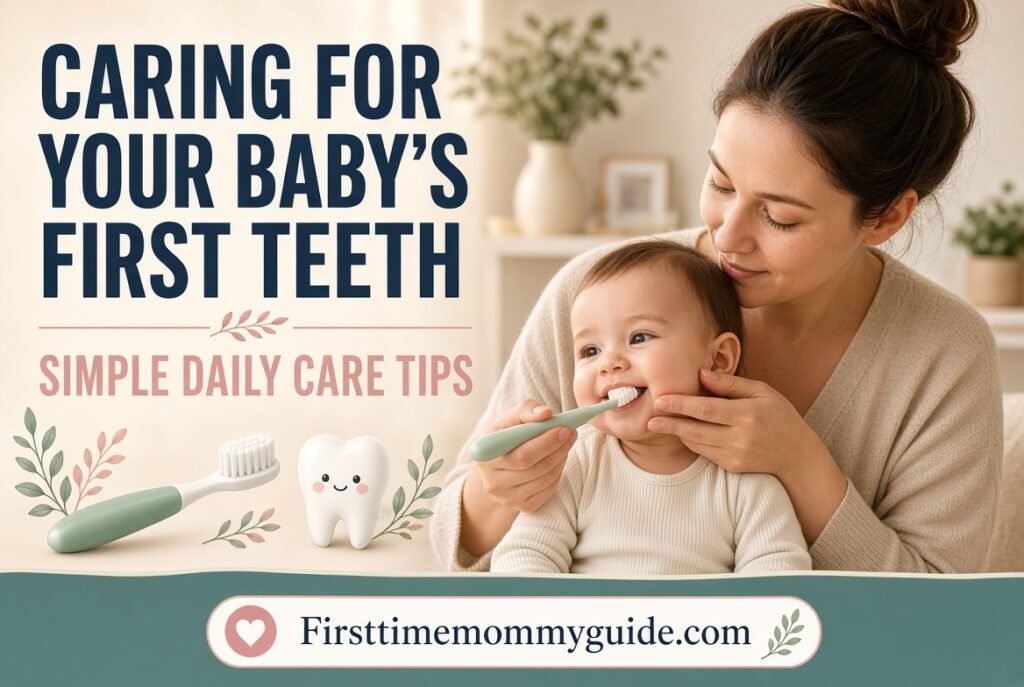
Once a tooth appears, oral care begins. Good habits early protect the teeth for years.
Clean the Gums Before Teeth Appear
Wipe your baby’s gums gently with a clean, damp cloth after feeds. This removes milk residue and helps get your baby used to mouth care.
Brush From the First Tooth
Brush twice a day with a soft, infant-size toothbrush as soon as the first tooth comes in. The AAP and American Dental Association recommend a tiny smear of fluoride toothpaste, about the size of a grain of rice, for children under 3.
Use a pea-sized amount from age 3 to 6.
Schedule the First Dental Visit
The AAP and ADA recommend a first dental visit by age 1 or within six months after the first tooth appears. Early visits help prevent cavities and answer teething questions.
Avoid Putting Baby to Bed With a Bottle
Milk or juice sitting on teeth overnight can cause decay. If your baby needs a bottle at bedtime, finish it before the teeth are brushed or wiped.
Common Myths About Teething and Fever
Many old beliefs about teething still circulate. Here are the most common myths.
Myth: Teething Causes High Fevers
Teething does not cause high fevers. A fever of 100.4°F or higher needs another explanation.
Myth: Teething Causes Diarrhea and Colds
Research has not shown teething causes diarrhea, colds, or ear infections. These are separate illnesses.
Myth: All Babies Suffer Terribly When Teething
Some babies hardly notice. Others are cranky for a few days. Both are normal.
Myth: You Can Tell Which Tooth Is Coming by the Symptoms
Symptoms are not specific to a certain tooth. Gum swelling and a white or bluish bump may show where a tooth is about to appear.
Myth: A Baby With No Teeth at 6 Months Is Behind
The range is wide. Many babies are first to get a tooth at 8 to 12 months and are perfectly healthy.
Myth: Teething Is the Reason for Every Bad Night
Sleep changes are common at many ages. Teething is only one of many possible reasons.
Mistakes Parents Make When a Teething Baby Has a Fever
Even careful parents can slip. Avoiding these mistakes protects your baby.
Assuming It Is Teething Without Taking a Temperature
Always measure. A feeling of warmth on the forehead is not accurate.
Waiting Too Long to Call
If your baby has a true fever and you are unsure why, call early. Waiting can delay treatment for infections.
Using Teething Gels or Tablets
These products carry safety risks and have little proof of working. Stick with chilled rings and cuddles.
Giving Medicine Without Checking the Dose
Always use the right product for your baby’s age and weight. Confirm with your pediatrician or pharmacist.
Overbundling
Layers and heavy blankets raise temperature and increase safe sleep risks.
Ignoring Other Symptoms
Cough, rash, vomiting, diarrhea, fewer wet diapers, and unusual sleepiness all matter.
Teething, Sleep, and Feeding Tips
Teething can disturb routines. A few small adjustments often help everyone rest better.
Keep the Bedtime Routine Consistent
A bath, feed, song, and bed in the same order each night can calm a fussy baby. Predictability is soothing.
Offer Comfort Before Bed
Rub the gums or offer a chilled ring about 20 to 30 minutes before bedtime, if your baby enjoys it. Remove the ring before sleep.
Do Not Start New Sleep Habits You Do Not Want
Rocking for hours or feeding to sleep may feel necessary on a hard night. These habits can stick, so only start what you can keep up.
Feeding a Teething Baby
Offer smaller, more frequent feeds if your baby is sore. Cold spoons or chilled purees can ease eating.
If your baby refuses solids for a day or two, return to milk feeds and try again later.
Breastfeeding and Biting
Teething babies may bite while nursing. If your baby bites, calmly break the latch, say “no,” and offer a chilled ring.
Most babies learn quickly that biting ends the feed.
What to Track When Your Baby Is Teething and Has a Temperature
A short log helps you and your pediatrician see the whole picture. Use a notes app or paper.
Helpful Details to Write Down
- Temperature, time, and method used
- Medicines given, with time and amount
- Number of wet diapers and stools
- Feeding amounts or length of feeds
- Sleep patterns
- Other symptoms such as cough, vomiting, or rash
- Recent vaccines or sick contacts
What to Tell the Pediatrician
Share your baby’s age, weight, temperature, how long it has lasted, and what you have given. Mention any changes in feeding, wet diapers, or behavior.
Clear information gets you faster, safer advice.
Parent Checklist: Teething With a Mild Temperature
Use this quick checklist when you are tired and need to decide fast.
Teething Is a Possible Cause If
- Temperature is under 100.4°F
- Your baby is drooling, chewing, and has swollen gums
- Your baby plays, feeds, and sleeps fairly normally
- There is no cough, vomiting, diarrhea, or rash
Call the Pediatrician If
- Temperature is 100.4°F or higher
- Your baby is under 3 months with any fever
- Fever lasts more than 24 hours in a baby under 2
- You notice other symptoms or your gut says something is wrong
Emergency Signs
- Trouble breathing
- Blue or gray lips
- Seizure
- Very limp or hard to wake
- Purple or blood-colored rash
- Signs of dehydration
Low Grade Fever and Teething by Age
The question looks a little different depending on how old your baby is. Here is what to expect at each stage.
Low Grade Fever While Teething at 4 Months
Four months is early for a first tooth, though it happens. Drooling and chewing are far more likely than an actual tooth.
A temperature of 100.4°F or higher at this age should be checked by your pediatrician.
Low Grade Fever While Teething at 5 Months
Many babies show strong teething signs at 5 months even if no tooth appears for weeks. Gums may look puffy.
Mild warmth is possible, but fever suggests illness, especially as maternal antibodies begin to fade.
Low Grade Fever While Teething at 6 Months
Six months is the average age for the first tooth. It is also the time of many new foods, new germs, and more social contact.
Fever at this age is a common sign of a cold, ear infection, or other illness. Teething should not be the first explanation.
Low Grade Fever While Teething at 7 and 8 Months
The bottom teeth may be through, and the top front teeth start getting ready. Babies are mobile, mouthing everything, and picking up viruses.
Watch for ear pulling, cough, and feeding changes along with any temperature rise.
Low Grade Fever While Teething at 9 to 11 Months
More teeth arrive, and babies are often at daycare or around other children. Illness is common.
If a fever lasts more than a day or two, call your pediatrician instead of waiting for a tooth.
Low Grade Fever While Teething at 12 Months
First birthday teething may involve the first molars soon after. Many toddlers are cranky with sore gums.
Fever at this age usually points to an infection, so check the temperature and look for other signs.
Low Grade Fever While Teething in Toddlers
Toddlers get canines and second molars over the second and third years. Discomfort may be milder, but chewing and irritability can return.
The same rule applies: a true fever is not a teething symptom.
Teething Questions Parents Often Ask
These topics come up often and deserve a clear answer.
What Is the White Bump on a Teething Baby’s Gum?
A white, bluish, or bruised-looking bump can appear where a tooth is about to come through. It is often a harmless eruption cyst that usually resolves on its own.
Call your dentist or pediatrician if it looks infected, painful, or very large.
Why Is My Teething Baby Drooling So Much?
Drooling increases as salivary glands develop, usually around 3 to 4 months. It often looks heavier during teething.
Drool is normal and helps protect new teeth, but it can irritate skin, so dry the chin often.
Do Teeth Come in Pairs?
Often, yes. The bottom front teeth usually come in together or one right after the other, but patterns vary.
Some babies get a top tooth first. Both are normal.
Do Premature Babies Teethe Later?
Babies born early may get teeth a little later by actual age. Many pediatric sources suggest using corrected age to judge milestones, including teething.
Ask your pediatrician if you are unsure what is expected for your baby.
Can Teething Cause a Baby to Wake at Night?
It can make a baby fussier at night, but many babies wake for other reasons. If waking is new, look at hunger, illness, developmental leaps, and routine changes too.
Can Teething Make a Baby Pull Their Ears?
Gum pain can feel like it is near the ear, so some babies tug at ears. If there is fever, crying, or poor sleep, ask a doctor to check for an ear infection.
Should I Worry If My Baby Has Teething Symptoms but No Tooth?
No. Teething symptoms can show up weeks or even months before a tooth appears. Keep an eye on your baby and talk to your dentist if no teeth appear by 12 months.
How Teething Works: What Happens Inside Your Baby’s Mouth
Baby teeth begin forming before birth. They sit under the gums and move slowly upward until they break through.
Understanding this process explains why symptoms are local to the mouth and why a whole-body fever does not fit.
The Stages of Tooth Eruption
First, the tooth presses against the gum from below. The tissue may swell and look red or pale.
Next, the tooth cuts through the surface. Soreness often eases once the edge is visible.
Why Symptoms Stay in the Mouth
Teething is a mechanical process in one small area. The body does not treat it like an infection, so it does not need to raise temperature to fight germs.
This is why pediatricians say a true fever should send you looking for another cause.
Why Babies Chew
Counter-pressure on the gums feels good. Chewing, gnawing, and biting give temporary relief, which is why firm, safe objects help.
Safe vs Unsafe Teething Options at a Glance
Use this table when you are deciding what to offer your baby.
| Option | Safe? | Notes |
|---|---|---|
| Clean finger gum massage | Yes | Wash hands first |
| Chilled solid rubber or silicone ring | Yes | Chill in the fridge, not the freezer |
| Cold wet washcloth | Yes | Supervise and wash after use |
| Chilled purees or yogurt (solids stage) | Yes | Only for babies who have started solids |
| Benzocaine or lidocaine gels | No | FDA warns about serious risks |
| Homeopathic teething tablets or gels | No | FDA warnings about inconsistent ingredients |
| Amber, wood, or silicone necklaces worn by baby | No | Strangulation and choking risk |
| Frozen rings or ice cubes | No | Can hurt gums and cause choking |
| Honey on gums | No | Infant botulism risk under 12 months |
| Alcohol on gums | No | Never safe for babies |
Teething in Daycare and Group Settings
Babies at daycare share toys, hands, and germs. This is a major reason fevers show up around teething age.
If your baby has a temperature, most daycares will ask you to keep them home until the fever has passed.
Keeping Teething Toys Clean
Wash teething rings and toys with warm soapy water. Do not share them between children.
Label each baby’s items and replace any that crack, tear, or become sticky.
What to Tell Caregivers
Let caregivers know which teething items are safe for your baby. Ask them not to give gels, tablets, or medicines unless you or your pediatrician have approved them.
Share the temperature numbers that would make you want a call.
Coping as a Parent: Staying Calm When Your Baby Is Teething and Warm
A fussy baby with a warm forehead can make any parent anxious. It helps to have a simple plan.
Take the temperature, check the checklist above, and decide whether it is a home-care or call-the-doctor situation.
Trust Your Instincts
You know your baby best. If your baby looks different, acts different, or seems very unwell, call even if the number looks mild.
Doctors would always prefer a call about a healthy baby than a delayed call about a sick one.
Share the Load
Teething nights can be exhausting. Take turns with your partner or a family member so each person can rest.
Short breaks help you respond calmly when your baby needs comfort.
Keep Notes Simple
You do not need a perfect record. A quick phone note with times, temperatures, and what you gave is enough.
Real-Life Teething Fever Scenarios
These real-life examples show how to apply the guidance.
Scenario: 6-Month-Old With Drool, Sore Gums, and 99.5°F
This fits with teething. Offer a chilled ring, keep your baby comfortable, and recheck in 30 minutes. Call if the temperature rises or new symptoms appear.
Scenario: 7-Month-Old With Swollen Gums and 100.6°F
This is a fever. Teething may be present, but another cause is likely. Call your pediatrician and look for cold or ear symptoms.
Scenario: 5-Month-Old With Drool and 100.4°F After Vaccines
The vaccine may explain the fever. Still call your pediatrician for advice, especially if your baby seems unusually sleepy or fussy.
Scenario: 2-Month-Old With a Warm Forehead
Take a rectal temperature right away. If it is 100.4°F or higher, go to the ER or call your pediatrician immediately.
Scenario: 10-Month-Old With Fever for Two Days and a Rash
Teething does not explain this. Call your pediatrician today, since roseola and other illnesses can cause fever followed by a rash.
Trusted Sources for Teething and Fever Information
For accurate guidance, rely on medical and public health organizations. These sources inform the guidance in this article.
- American Academy of Pediatrics (HealthyChildren.org): teething, fever, and safe sleep guidance
- Mayo Clinic: teething and infant fever overviews
- Cleveland Clinic: teething signs and symptoms
- U.S. Food and Drug Administration (FDA): warnings on teething gels, homeopathic teething products, and teething jewelry
- American Dental Association (MouthHealthy.org): first teeth, brushing, and dental visits
- Centers for Disease Control and Prevention (CDC): childhood illness and vaccine information
- Pediatrics journal: research on signs and symptoms attributed to teething
Also Read:
- Baby Sleep Guide for New Moms: Safe Sleep & Schedules (2026)
- Baby Won’t Eat? Common Reasons, Fixes & When to Worry 2026
- Baby Essentials Checklist: 0 to 3 Months
- Baby Shopping List for First-Time Moms: The Complete 2026 Checklist
- Hospital Bag Checklist for Baby: The Complete Packing List 2026
- Newborn Grunting in Sleep Normal or Should I Call the Doctor? A Complete Parent Guide 2026
- How Long Does Newborn Cluster Feeding Last Each Night? A Complete Guide for New Parents 2026
- Signs of Cluster Feeding: Complete Guide for New Parents 2026
- Is It Normal for Umbilical Cord Stump to Bleed After Falling Off? What Parents Should Know 2026
- Bottle Feeding Schedule Newborn: Complete Age-by-Age Guide 2026
- Low Milk Supply Signs and Fixes: What Every Breastfeeding Mom Should Know 2026
- Breastfed Baby Hasn’t Pooped in 5 Days but Passing Gas: Is It Normal? Causes and Safe Relief 2026
- Thawed Breast Milk Smells Like Soap Is It Still Good? Causes, Safety, and Fixes 2026
- How Much Breast Milk to Put in Each Storage Bag (Complete Guide) 2026
- How to Scald Breast Milk for High Lipase Before Freezing: Step-by-Step Guide for Pumping Moms
- How to Do the Pitcher Method for Breast Milk Step by Step: A Safe, Simple Guide for Pumping Moms 2026
- When Can My Baby Start Eating Real Food? Age, Signs & First Foods 2026
- First Food for Baby 6 Months: Best Options, Safety Tips & Feeding Guide
- Fruit Purees for 6 Month Old Babies: Safe Recipes & Guide (2026)
- Best Vegetable Purees for Baby: A Complete Age-by-Age Guide 2026
- Baby Food Chart 6 to 12 Months: Free Month-by-Month Feeding 2026
- Baby Food Combo Purees: The Complete Age-by-Age Guide 2026
- Best Baby Food Combinations: A Complete Age-by-Age Guide for Parents 2026
- Baby Food Guide: 6 to 12 Months
Frequently Asked Questions (FAQs)
Can teething cause a low grade fever in babies?
Yes, teething may cause a slight temperature rise, usually under 100.4°F (38°C). It does not cause a true fever. A reading of 100.4°F or higher points to illness.
What temperature is considered a fever in a teething baby?
A rectal temperature of 100.4°F (38°C) or higher is a fever, whether or not your baby is teething. Readings below that may be mild elevation. Call your pediatrician for any fever, and seek urgent care if your baby is under 3 months.
Can teething cause a 100.4°F fever?
Teething is not considered a reliable cause of a 100.4°F reading. Treat it as a real fever. Check for other symptoms and call your pediatrician for guidance.
Can teething cause a 101°F fever?
No, 101°F is above the fever line and is not explained by teething. Look for signs of a cold, ear infection, or other illness. Call your pediatrician.
Can teething cause a 102°F fever?
No. A 102°F fever means your baby is fighting something, such as a viral or bacterial infection. Call your pediatrician the same day.
Can teething cause a 103°F fever?
No. Teething does not cause fevers this high. A 103°F fever needs prompt medical advice, and urgent care if your baby seems very unwell.
How long does a teething low grade fever last?
A mild temperature rise tied to teething is usually brief, often lasting a day or two around the time the tooth breaks through. If it lasts longer than 24 to 48 hours, look for another cause.
How long does teething last for each tooth?
Teething discomfort for one tooth can last a few days, though gums may feel sore on and off for longer. Several teeth can move at once, so symptoms may seem to continue for weeks.
What are the first signs of teething?
Common first signs include extra drooling, chewing on objects, swollen gums, and mild fussiness. Some babies also rub their cheeks or ears. Symptoms can appear weeks before a tooth shows.
At what age do babies start teething?
Most babies get their first tooth around 6 months, with a normal range of about 4 to 12 months. Drooling and chewing may begin earlier, around 3 to 4 months.
Can teething cause a fever at night?
Teething pain may feel worse at night, but it does not cause a true fever. Take the temperature before giving anything. If it is 100.4°F or higher, call your pediatrician.
Is a low grade fever normal for a teething baby?
A temperature slightly above normal, below 100.4°F, can happen with teething. If your baby is feeding, playing, and sleeping reasonably well, it is usually not a concern. Recheck and watch for new symptoms.
Can teething cause diarrhea in babies?
Teething does not reliably cause diarrhea. Watery or frequent stools usually point to a stomach virus. Call your pediatrician if diarrhea lasts more than a day or your baby has fewer wet diapers.
Can teething cause a runny nose and cough?
No. A runny nose and cough are usually signs of a cold or other infection, which are common at the same age. Teething drool can cause an occasional mild cough, but a wet or frequent cough needs attention.
Can teething cause vomiting?
Vomiting is not a teething symptom. Babies may gag on saliva, but repeated vomiting suggests illness or another condition. Watch for dehydration and call your pediatrician.
Can teething make a baby sick?
Teething itself does not make babies sick. Babies may get more infections at this age because they mouth objects and lose maternal antibodies. The illness is separate from the tooth.
Why does my baby have a fever and swollen gums?
The swollen gums may be from teething, but the fever is likely from another cause. Check the temperature, look for other symptoms, and call your pediatrician.
Why does my baby feel warm when teething?
Gum inflammation may cause a slight temperature rise, and babies can also feel warm from clothing, room temperature, or crying. Take a rectal temperature to know for sure.
How can I tell if it is teething or a cold?
Teething usually brings drooling, chewing, and swollen gums without much else. A cold brings a runny or stuffy nose, cough, and sneezing. Fever points more toward a cold.
How can I tell if it is teething or an ear infection?
Both can cause ear pulling and fussiness. An ear infection often comes with fever, poor sleep, and cold symptoms. Only a doctor can confirm an ear infection by examining the ear.
What is the best way to take a teething baby’s temperature?
A digital rectal thermometer is the most accurate method for babies under 3 years. Forehead and ear thermometers are quicker but less reliable, and armpit readings are the least accurate.
Can I give Tylenol for teething pain?
Acetaminophen can be used for pain in babies when your pediatrician approves. For babies under 12 weeks, call a doctor first. Use the infant product and follow the label or your pediatrician’s dosing advice.
Can I give ibuprofen to a teething baby?
Ibuprofen is generally for babies 6 months and older. Check with your pediatrician first, avoid it if your baby is dehydrated or vomiting, and follow the label or doctor’s directions.
Is it safe to use teething gels?
Experts advise against them. The FDA warns that benzocaine gels can cause a serious blood condition in young children and recommends against use for teething in children under 2. Viscous lidocaine and homeopathic teething products also carry risks.
Are teething necklaces safe?
No. The FDA and AAP advise against teething necklaces and bracelets worn by babies because of strangulation, choking, and injury risks.
Are frozen teething rings safe?
Frozen rings can be too hard and may hurt gums. Chill rings in the refrigerator instead. Choose solid, one-piece rings and check them for damage.
What are the best natural ways to soothe teething?
Gentle gum massage, a chilled solid teething ring, a cold wet washcloth, and extra cuddles are safe options. Cool foods can help babies who have started solids. Avoid honey, alcohol, and anything small enough to choke on.
Does teething cause a rash?
Drool can cause a red rash on the chin, cheeks, and neck. This is common and harmless. A rash across the body, especially with fever, is not from teething and should be checked.
Can vaccines be mistaken for a teething fever?
Yes. Vaccines at 2, 4, and 6 months can cause a mild fever and fussiness that overlap with early teething. Mention recent shots when you call your pediatrician.
When should I call the doctor about a teething baby with a temperature?
Call right away if your baby is under 3 months with a fever of 100.4°F or higher. Call the same day for fever with other symptoms, a fever above 102°F in a 3- to 6-month-old, or a fever lasting more than 24 hours in a baby under 2.
When is a baby’s fever an emergency?
Seek emergency care for trouble breathing, blue lips, seizures, a very limp or hard-to-wake baby, a purple rash, stiff neck, signs of dehydration, or a fever of 104°F or higher.
Can a baby be teething with no symptoms?
Yes. Some babies show few or no symptoms, and the first sign is simply a tooth. Others are fussy for days. Both are normal.
Does teething get worse with molars?
Molars are larger and may cause more discomfort for some children. Others barely notice. The same safe soothing methods apply, and a true fever still needs another explanation.
Should I wake my baby to check the temperature?
If your baby seems comfortable and is sleeping normally, you generally do not need to wake them. Check if they feel hot, are breathing fast, or you have concerns. For babies under 3 months, follow your pediatrician’s advice.
When should I take my baby to the dentist?
The AAP and ADA recommend a first dental visit by age 1 or within six months after the first tooth appears. Your dentist can also answer questions about teething, brushing, and fluoride.
Conclusion
So, can teething cause a low grade fever in babies? It can cause a slight rise in temperature, usually below 100.4°F, but it does not cause a true fever.
Any reading of 100.4°F or higher deserves attention and another explanation, such as a cold, ear infection, or other illness.
Check your baby’s temperature with a digital thermometer, look at the whole picture, and treat sore gums with safe options like a chilled teething ring or a cold washcloth. Avoid numbing gels, homeopathic tablets, and teething necklaces.
If your baby is under 3 months, has a high fever, or shows red flags like trouble breathing or unusual sleepiness, get medical help right away. When in doubt, call your pediatrician. A quick call is always better than guessing.

Dilawar Mughal
Founder and editor, First Time Mommy Guide
I research every guide against what the NHS, the AAP and the WHO publish, then write it in plain English — because most new parents are reading with one hand free, not comparing clinical guidelines. I'm not a doctor or a midwife. Every health claim on this site is sourced and linked so you can check it yourself, and anything urgent belongs with your health visitor or GP, not a blog.