General information, not medical advice. Every baby is different — if anything worries you, speak to your midwife, health visitor or GP rather than waiting.
Your baby’s first doctor visits arrive quickly, often within days of coming home. Between feeding, sleeping, and recovering from birth, it is easy to feel unsure about when to go, what will happen, and what to ask. A clear checklist makes those early visits calmer and far more useful.
This guide explains the newborn doctor visit schedule in the first year, what happens at each check, what to bring, and which questions matter most. You will find a printable-style checklist, guidance on feeding, sleep, and development checks, immunisation information, and the warning signs that mean you should call sooner than your next appointment.
Quick Answer: Newborn Doctor Visits at a Glance
Most newborns see a doctor within 3–5 days of birth, then again at about 2 weeks, 1 month, 2 months, 4 months, 6 months, 9 months, and 12 months. Your doctor may adjust this schedule if your baby was born early, lost more weight than expected, had jaundice, or has any health concern.
At each well-child visit, the doctor checks weight, length, and head size, examines your baby from head to toe, reviews feeding and sleep, checks development, and gives immunisations when due. Bring your baby’s health record, a list of questions, nappies, a spare outfit, and milk for a feed.
Write questions down before you go. Ask about feeding, weight gain, sleep, crying, cord and skin care, and anything that worries you. No question is too small at a newborn visit. If something changes between visits, such as fever, poor feeding, or breathing difficulty, call your doctor promptly rather than waiting.
Why Newborn Doctor Visits Matter
Well-child visits, sometimes called check-ups or health checks, are preventive care. They are not only for sick babies. Their purpose is to track growth, catch problems early, support feeding, check development, and give immunisations on time. Early checks matter most in the first weeks, when weight, feeding, and jaundice can change quickly.
A newborn visit also supports you. Birth recovery, breastfeeding challenges, sleep deprivation, and worry are normal, and your doctor and health visitor expect to hear about them. These appointments are a safe place to ask about your own recovery, mood, and support, as well as your baby’s health. If you feel low, anxious, or overwhelmed, say so. Help is available, and early support makes a real difference.
Regular visits build a record. Weight, length, and head circumference plotted over time show growth patterns far better than a single measurement. That record helps your doctor spot a slowing pattern early, reassure you when growth is steady, and make feeding decisions based on evidence rather than guesswork. Keep your baby’s health record safe and bring it to every appointment.
Choosing a Doctor Before Birth
If you can, choose your baby’s doctor, paediatrician, or family doctor before birth. Ask about newborn visit timing, after-hours advice, hospital affiliations, and how urgent questions are handled. Check that the practice accepts new patients and your insurance or health coverage, and confirm where to call outside office hours.
Ask friends, your midwife, or your obstetrician for recommendations, and trust your own judgement after a first meeting. You need a doctor who listens, explains clearly, and respects your questions. If language, location, or appointment times make visits difficult, raise that early. A practice that is hard to reach will be hard to use when your baby is ill.
Tell the practice your due date and expected hospital, so they can plan the first visit. Many practices book the first newborn appointment before birth, or ask you to call from the hospital or on the day you go home. Confirm the process in advance, so the first visit is not left to chance in a busy first week.
Newborn Doctor Visit Schedule: First Year
Schedules vary slightly by country and by your baby’s needs, but the pattern below reflects the widely used schedule recommended by the American Academy of Pediatrics and similar guidance in the UK through the NHS Healthy Child Programme. Always follow your own doctor’s schedule, which takes priority over any general guide.
| Visit | Typical timing | Main focus |
|---|---|---|
| First newborn check | 3–5 days after birth | Weight, feeding, jaundice, cord, general health |
| 2-week check | About 2 weeks | Weight gain, feeding, sleep, parent wellbeing |
| 1-month check | About 1 month | Growth, development, feeding, immunisation planning |
| 2-month check | About 2 months | Growth, development, first immunisations |
| 4-month check | About 4 months | Growth, rolling, feeding, immunisations |
| 6-month check | About 6 months | Growth, sitting, solids readiness, immunisations |
| 9-month check | About 9 months | Growth, crawling, babbling, feeding and sleep |
| 12-month check | About 12 months | Growth, walking, first words, immunisations |
Babies born early, babies with low birth weight, and babies with medical conditions often need extra visits. Your doctor may ask to see your baby weekly at first, or sooner after hospital discharge. Follow that tailored schedule closely. Extra visits in the early weeks are common and do not mean something is seriously wrong.

The First Visit: 3–5 Days After Birth
The first visit is often the most important. Your doctor will check your baby’s weight against birth weight, because most newborns lose some weight in the first days and should regain it by about two weeks. They will ask about feeding frequency, wet and dirty nappies, sleep, and alertness. They will examine skin colour for jaundice, check the umbilical cord stump, look at eyes, mouth, heart, lungs, tummy, hips, and genitals, and check reflexes.
Bring your hospital discharge notes and any screening results. Tell the doctor about any concerns since discharge, however small they seem: feeding difficulty, vomiting, fewer wet nappies, yellow skin or eyes, cord redness or discharge, fever, or unusual sleepiness. Early information helps your doctor decide whether your baby needs closer follow-up or any test.
This visit is also for you. Expect questions about your recovery, bleeding, pain, mood, and support at home. If you had a caesarean, a difficult birth, or complications, mention them. If breastfeeding is painful or you are worried about milk supply, ask for help now. Early feeding support prevents many later problems.
The 2-Week and 1-Month Visits
By two weeks, most babies have regained birth weight. The doctor will confirm that, review feeding and nappy output, and check for jaundice, cord healing, and general wellbeing. They will ask about crying patterns, sleep, and how you are coping. This is a good time to discuss newborn feeding schedule concerns, burping, wind, and how to burp a newborn if feeding feels unsettled.
At one month, the visit widens to early development. Your doctor will check head control, visual tracking, hearing responses, and social smiling. They will review immunisation plans and discuss vitamin D, safe sleep, and car seat safety if not already covered. Bring questions about newborn sleep routine patterns, day-night confusion, and what is normal for crying at this age.
Visits at 2, 4, and 6 Months
The two-month visit usually includes the first routine immunisations. Your doctor will measure growth, check development, examine your baby fully, and discuss feeding, sleep, and safety. They will explain which immunisations are due, what side effects to expect, and how to comfort your baby afterwards. Bring your immunisation record and ask about any missed doses.
At four months, your doctor checks rolling, head control, reaching, babbling, and social responses. Feeding is reviewed, including readiness cues for later solids, though solids are not usually started yet. Sleep, crying, and 4-month sleep regression patterns often come up at this visit, so ask if nights have become harder.
At six months, the visit covers sitting, babbling, reaching, and early solids. Your doctor will discuss introducing solid foods, allergen introduction, iron-rich foods, and continued milk feeding. If your baby shows signs of being ready for solid foods, this visit is the right time to confirm timing. Immunisations due at six months will also be given or planned.
Visits at 9 and 12 Months
At nine months, your doctor checks crawling or other movement, pulling to stand, babbling, gestures such as waving and pointing, and response to their name. Feeding, sleep, and safety at home become central, because a mobile baby explores everything. Discuss baby-proofing, choking hazards, and safe sleep as your baby becomes more active.
At twelve months, the visit reviews walking or cruising, first words, gestures, play, and social behaviour. Growth is checked, and immunisations due at twelve months are given. Your doctor will discuss weaning from bottles if relevant, dental care, screen time, and toddler nutrition. Bring questions about tantrums, sleep transitions, and nursery or childcare plans if they apply.
What Happens at Every Well-Child Visit?
Although each visit has its own focus, most follow a similar structure. Knowing it in advance helps you prepare, use the time well, and remember what was said.
Growth Measurements and Head Circumference
At every visit, your baby is weighed, measured for length, and has head circumference measured. Measurements are plotted on growth charts to track patterns over time. A single measurement matters less than the trend. Your doctor will explain whether growth follows a steady curve, and whether any change needs closer watching or a feeding review.
Undress your baby down to a nappy for weighing, as directed by the practice, so measurements are consistent. Note that different scales and measuring methods vary slightly, so small differences between clinics are normal. If you weigh your baby at home, do not compare home and clinic numbers directly. Use clinic measurements for the official record.
Ask to see the growth chart if you are curious. Understanding percentiles helps: a baby on the 25th percentile is smaller than 75 out of 100 babies of the same age and sex, but that is normal for that baby if they follow their own curve steadily. Crossing percentiles sharply, up or down, is what prompts a closer look, not the percentile number alone.
Head-to-Toe Examination
The doctor examines eyes, ears, mouth, neck, heart, lungs, tummy, hips, genitals, skin, and reflexes. They listen to the heart and lungs, feel the tummy and fontanelle, the soft spot on the head, check hip movement, and look for rashes, birthmarks, or cord issues. They check hearing and vision responses appropriate to age, and watch how your baby moves and interacts.
Some findings are normal and temporary. Mild jaundice, dry or peeling skin, baby acne, and a soft clicking hip check can all be normal in early weeks. Your doctor will explain what is normal, what needs watching, and what needs follow-up. Ask them to explain any term you do not understand. Clear explanations are part of good care, not a favour.
Development and Behaviour Checks
Development checks look at movement, communication, play, and social responses. At newborn visits, this means reflexes, alertness, and responses to sound and light. Later, it means rolling, sitting, babbling, gestures, and play. Your doctor may use a standard questionnaire or observe your baby during the visit.
You know your baby best. Tell the doctor what your baby does at home: sounds they make, movements they enjoy, how they respond to you, and anything you have not seen yet. If you have concerns about development, raise them early. Early support, when needed, works best, and most concerns turn out to be normal variation that reassurance resolves.
Feeding, Sleep, and Daily Care Review
Feeding is reviewed at every early visit: type of milk, frequency, amount or duration, nappy output, weight gain, and any difficulty. Sleep is reviewed too: total sleep, night waking, sleep position, and sleep surface safety. Daily care topics include cord care, nappy rash, skin care, bathing, and crying patterns.
Be honest about feeding and sleep. If you are supplementing, struggling with breastfeeding, co-sleeping, or feeling exhausted, say so. Doctors and health visitors hear these concerns daily and can offer practical help without judgement. Hiding a struggle delays support that could make the first months easier.
For related guidance, see our articles on colic in babies symptoms and soothing, baby gas relief remedies, and baby reflux symptoms and remedies if feeding discomfort is part of your questions.
Immunisations: What to Expect
Immunisations protect babies from serious diseases at the age when they are most vulnerable. Schedules differ by country, so follow the schedule in your country and the advice of your doctor. In the United States, the Centers for Disease Control and Prevention (CDC) publishes the recommended child immunisation schedule. In the UK, the NHS vaccination schedule sets out routine vaccines from eight weeks onwards. Your doctor will follow the schedule that applies where you live.
Routine Immunisations in the First Year
Most schedules begin immunisations at about two months, with further doses at three and four months in the UK, or at two, four, and six months in the US, plus additional vaccines at twelve months. Exact vaccines and timing vary, so do not rely on another country’s schedule. Ask your doctor for a printed or digital copy of your local schedule at the first visit, and keep it with your baby’s health record.
Common first-year vaccines protect against diphtheria, tetanus, whooping cough, polio, Hib, pneumococcal disease, rotavirus, meningococcal disease, measles, mumps, and rubella, among others, depending on country. Some are given by injection, some by mouth drops. Your doctor will explain which are due, why they matter, and what to expect afterwards.
If a dose is missed because your baby was ill or you could not attend, contact the practice promptly to reschedule. Most missed doses can be caught up without restarting the course. Do not wait until the next routine visit if a dose is overdue. Keeping immunisations on time gives the best protection.
Side Effects and Aftercare
Mild side effects are common and usually settle within two to three days. They include soreness, redness, or swelling where the injection was given, mild fever, fussiness, sleepiness, reduced appetite, and, for rotavirus vaccine, mild diarrhoea or vomiting. These signs show the immune system is responding. They are not the illness itself.
Comfort your baby with cuddles, extra feeds, and light clothing if they feel warm. Your doctor may advise infant paracetamol for fever or discomfort after certain vaccines, following local guidance and correct dosing for your baby’s age and weight. Never give medicine without checking dose and suitability with your doctor or pharmacist. Do not give aspirin to a baby or child.
Call your doctor if fever is high, lasts more than two to three days, or your baby seems very unwell, unusually sleepy, or inconsolable. Seek urgent care for difficulty breathing, swelling of the face or lips, a seizure, or any symptom that alarms you. Serious allergic reactions to vaccines are rare, but they need immediate care. Your doctor will explain what to watch for at each immunisation visit.
If You Have Questions About Vaccines
Questions about vaccines are normal and welcome. Ask your doctor about benefits, risks, timing, and what happens if a dose is delayed. Reliable information comes from your doctor, the CDC, the NHS, and the World Health Organization. Avoid advice from social media posts, forums, or videos that do not cite official sources.
Do not delay immunisations because of a mild cold, teething, or a family history of allergy without medical advice. Most mild illnesses do not prevent vaccination. Your doctor will advise if your baby is too unwell for a vaccine on the day, or if a specific medical history changes the plan. A clear, calm conversation at the visit resolves most worries.
Before the Visit: Preparation Checklist
Good preparation turns a rushed appointment into a useful one. Use this checklist the night before or the morning of the visit, and keep a copy on your phone for future appointments.
What to Bring
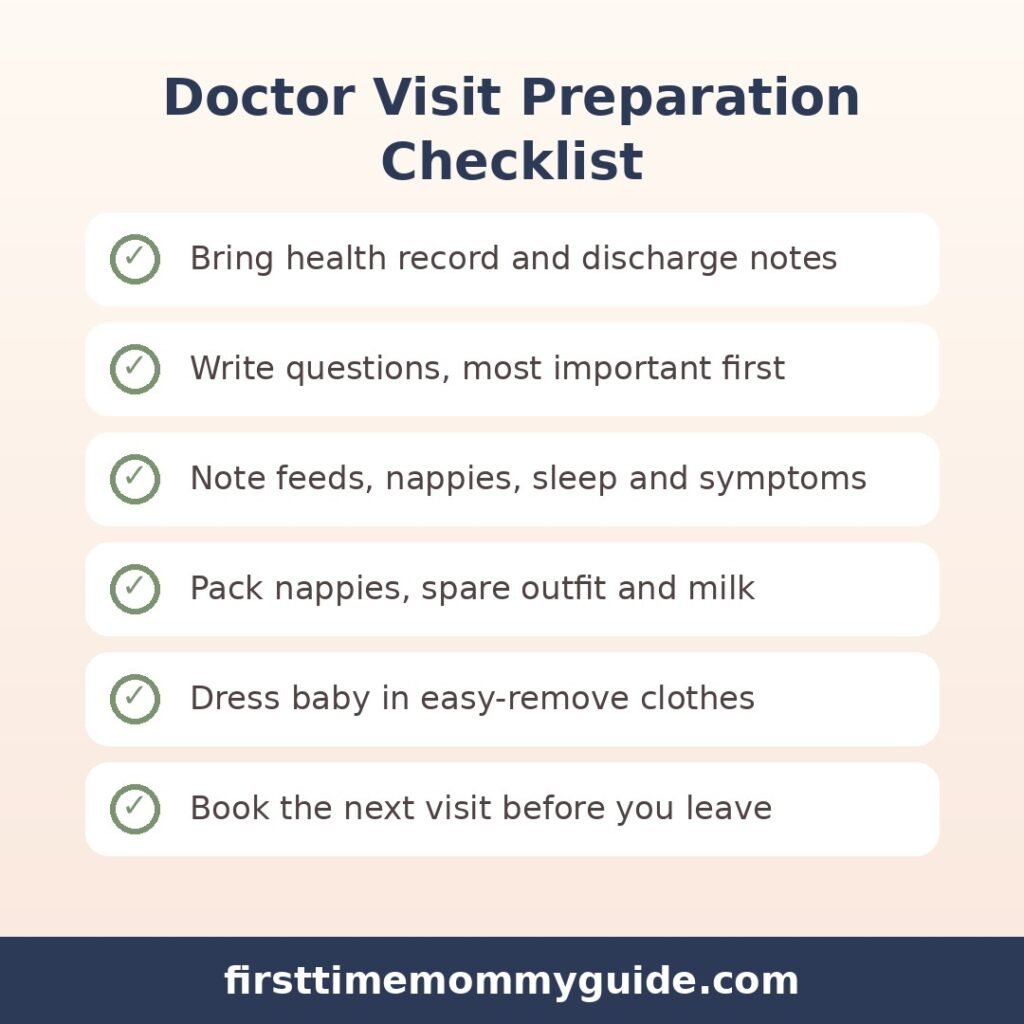
- Baby’s health record, immunisation record, and hospital discharge notes.
- Your list of questions, written down, with the most important first.
- A nappy bag with nappies, wipes, a spare outfit, and a muslin or blanket.
- Milk for a feed: breastfeed as usual, or bring a prepared bottle and spare formula if bottle feeding.
- A dummy, if your baby uses one, and a favourite toy or comforter.
- Any medicines, vitamins, or supplements your baby takes, with doses.
- A note of feeding times, nappy output, sleep, and any symptoms since the last visit.
- Your own notes about recovery, mood, and support, if you want to discuss them.
- Insurance card, identification, and payment details if required by your practice.
- A phone or notebook to record advice, weights, and next appointment details.
Arrive a few minutes early to complete forms, weigh your baby if the practice does that first, and settle before the doctor comes in. Dress your baby in clothes that are easy to remove, such as a bodysuit and sleepsuit with poppers, so examination is quick and calm. Bring an extra layer in case the clinic is cool.
What to Record Before You Go
A short record helps your doctor more than a long story told from tired memory. Note feeding frequency and type, number of wet and dirty nappies per day, sleep pattern, crying pattern, any vomiting or spitting, skin or cord concerns, and any illness or fever since the last visit. Note your baby’s behaviour at home: alertness, smiling, sounds, and movements.
Record your own concerns too. Note pain, bleeding, mood, sleep, and support at home. If you take medicine, note the name and dose. Doctors expect these questions and will not judge you for asking them. A written list also means you will not forget the question that worried you at 3 a.m. once you are in the room.
Questions to Ask at Each Visit
Ask the questions that matter to your baby’s age and your current worries. The list below covers the most useful questions for newborn visits. Choose the ones that apply, and add your own.
Feeding and growth:
- Is my baby’s weight gain on track, and what should I expect before the next visit?
- How often should my baby feed, and how will I know they are getting enough?
- Should I wake my baby for feeds, or let them sleep?
- Does my baby need vitamin D or any other supplement?
- When should we discuss introducing solid foods?
Sleep and crying:
- How much sleep is normal at this age, and how can we improve nights?
- Is my baby’s crying pattern normal, and when should I call about crying?
- Is our sleep setup safe, and should we change anything?
Health and care:
- How is the umbilical cord healing, and when should I worry about it?
- What skin changes are normal, and what needs a check?
- How do I care for my baby’s eyes, ears, nails, and nappy area?
- What should I do if my baby has a fever, vomits, or has diarrhoea?
Development and safety:
- What development should I expect before the next visit?
- Are there any concerns about hearing, vision, or movement?
- Is our car seat fitted correctly, and what safety changes do we need as our baby grows?
- What immunisations are due today, and what side effects should I expect?
For you:
- How is my recovery, and when should I seek help for pain, bleeding, or mood?
- Where can I get breastfeeding or feeding support locally?
- Who do I call after hours, and when should I seek urgent care?
Ask the doctor to repeat or write down anything you did not understand. Take notes during the visit, or ask if you can record the key advice on your phone. A second adult at the visit, if possible, can help listen, hold the baby, and remember advice.
Between Visits: Red Flags to Call About Sooner
Routine visits assume your baby is well between appointments. Some symptoms need advice sooner than the next scheduled visit. Call your doctor, health visitor, or local urgent-care service promptly if you notice any of the following, and seek urgent or emergency care for severe symptoms.
Call Your Doctor Promptly If Your Baby:
- Has a fever, especially under three months old, or a temperature you are worried about.
- Feeds poorly, refuses feeds, or has far fewer wet nappies than usual.
- Vomits repeatedly, vomits green fluid, or has blood in vomit or stools.
- Has diarrhoea, especially with fever, poor feeding, or signs of dehydration such as a dry mouth, sunken soft spot, or fewer wet nappies.
- Is unusually sleepy, hard to wake, floppy, or unusually irritable and inconsolable.
- Has yellowing skin or eyes that is spreading or worsening after the first week.
- Has cord redness, swelling, discharge with a bad smell, or bleeding that does not stop.
- Has a rash that does not fade when pressed, breathing difficulty, or a persistent cough.
- Has not regained birth weight by two weeks, or is losing weight after that point.
- Shows a sudden change in behaviour, alertness, or feeding that worries you.
Trust your instincts. Parents often sense a change before it is obvious on examination. A call to ask is never wasted. Health professionals would rather advise early than see a baby later than needed. If you are told to wait and your baby worsens, call again or seek urgent care.
Seek Urgent or Emergency Care Immediately If Your Baby:
- Has difficulty breathing, pauses in breathing, wheezing, or turns blue or very pale.
- Is unresponsive, has a seizure, or has repeated stiffening or jerking.
- Has a bulging soft spot on the head, or a head injury.
- Has severe vomiting, dehydration, or cannot keep any fluids down.
- Has a temperature with a rash that does not fade, or looks very unwell.
In an emergency, call your local emergency number. Do not drive yourself if you are distressed. Ask someone to help, or call for an ambulance. Bring your baby’s health record and a list of medicines if you can do so safely.
Mistakes to Avoid With Doctor Visits
Small planning mistakes can waste a visit or delay help. Avoid these common errors, and your appointments will work harder for you.
Waiting until the visit to raise a worrying symptom. If your baby is unwell between visits, call sooner. Routine visits are not a substitute for urgent advice. A symptom that worries you today deserves a call today.
Arriving without questions written down. Tired parents forget questions in the clinic room. Write them down, put the most important first, and tick them off as you ask. Bring the list to every visit.
Forgetting the health record. Without growth and immunisation records, your doctor cannot track patterns or confirm which vaccines are due. Keep the record in the nappy bag, so it is always with you.
Skipping visits because your baby seems well. Well-child visits are preventive. Growth, development, and immunisation checks matter most when your baby looks well. Skipping them delays detection and protection.
Comparing your baby to other babies. Growth and development vary widely. Comparing weights, milestones, or sleep with friends or online groups creates worry without information. Compare your baby with their own previous measurements, and discuss concerns with your doctor.
Relying on online advice over your doctor. Online guides, including this one, support but do not replace medical advice. If online advice conflicts with your doctor’s advice, ask your doctor to explain the difference. Follow the advice tailored to your baby.
Not asking about your own health. Postnatal recovery and mood affect your baby’s care. If you feel unwell, low, or overwhelmed, raise it at the visit. Support for parents is part of newborn care, not an extra.
Expert Tips for Getting the Most From Every Visit
Book the next appointment before you leave the clinic. Ask for the date, time, and any preparation needed, such as bringing a urine sample or fasting, if relevant. Put the appointment in your calendar immediately, with a reminder the day before. Early booking avoids gaps in the schedule.
Build a relationship with one doctor or practice team when possible. Continuity helps, because a doctor who knows your baby’s history spots changes faster. If you see different doctors, bring the health record every time and summarise recent concerns briefly at the start of the visit.
Use the health visitor service as well as the doctor, where available. Health visitors support feeding, sleep, development, and parental wellbeing, and they often visit at home in the early weeks. Their advice complements medical checks. Ask how to contact your health visitor between visits, and what concerns they can help with directly.
Keep a simple baby log between visits. A phone note with feeds, nappies, sleep, weight, and symptoms takes a minute a day and transforms the next visit. Patterns that feel vague from memory become clear in a log. Bring the log, or a summary of it, to each appointment.
Prepare your baby for the visit. Feed shortly before you leave if possible, so your baby is content during travel. Bring a spare outfit for after examination or immunisations, and allow extra time for traffic, parking, and settling. A calm arrival helps your baby settle faster in the clinic.
Follow up on advice. If your doctor suggests a feeding change, a repeat weight check, or a referral, note the timing and complete it. If you do not understand advice, call the practice to clarify rather than guessing. If a referral is made, check that the appointment arrives, and chase it if it does not.
Frequently Asked Questions About Newborn Doctor Visits
1. When should a newborn first see a doctor?
Most newborns should see a doctor within 3–5 days of birth, or within 1–2 days if discharged very early, jaundiced, or with feeding concerns. Your hospital or midwife will advise the exact timing. If no appointment is booked by the time you go home, call your doctor’s practice promptly.
2. How often do newborns need doctor visits?
In the first year, visits are usually at 3–5 days, 2 weeks, 1 month, 2 months, 4 months, 6 months, 9 months, and 12 months. Babies born early or with health concerns may need extra visits. Follow your doctor’s schedule, which is tailored to your baby.
3. What does the doctor check at a newborn visit?
The doctor checks weight, length, and head circumference, examines your baby head to toe, reviews feeding, nappies, sleep, and development, and checks screening results. They also ask about your recovery and wellbeing, and plan immunisations. Each visit has a focus suited to your baby’s age.
4. What should I bring to my baby’s first doctor visit?
Bring the health record, hospital discharge notes, immunisation record, a written list of questions, nappies and a spare outfit, milk for a feed, and any medicines your baby takes. A note of feeding, nappy output, and sleep since discharge helps the doctor assess progress quickly.
5. How do I choose a paediatrician or family doctor?
Choose before birth if possible. Ask about newborn visit timing, after-hours advice, hospital links, and new-patient availability. Seek recommendations from your midwife, obstetrician, or friends, and choose a doctor who listens and explains clearly. Location and appointment access matter for regular visits.
6. What if I miss a doctor visit or immunisation?
Call the practice promptly to reschedule. Most missed immunisations can be caught up without restarting the course. Do not wait until the next routine visit if a dose is overdue. If your baby was ill, tell the practice, so they can advise on the best timing for the catch-up visit.
7. Are immunisation side effects normal?
Mild side effects such as soreness, mild fever, fussiness, and sleepiness are common and usually settle in two to three days. Comfort your baby with cuddles and extra feeds. Call your doctor if fever is high, lasts longer, or your baby seems very unwell. Serious reactions are rare but need urgent care.
8. Should I give pain relief before immunisations?
Do not give medicine routinely before immunisations unless your doctor advises it for a specific vaccine or reason. After vaccination, your doctor may advise infant paracetamol for fever or discomfort, with correct dosing for age and weight. Always check dose and suitability with your doctor or pharmacist first.
9. When should I call the doctor between visits?
Call promptly for fever, especially under three months, poor feeding, fewer wet nappies, repeated vomiting, diarrhoea, unusual sleepiness, worsening jaundice, cord infection signs, or any sudden change that worries you. Trust your instincts. A call to ask is never wasted, and early advice often prevents a bigger problem.
10. How can I tell if my baby is gaining enough weight?
Your doctor tracks weight on growth charts over time. Most babies regain birth weight by about two weeks and then gain steadily. Feeding frequency, wet and dirty nappies, and alertness also signal adequate intake. If weight gain slows or your baby loses weight after two weeks, your doctor will review feeding closely.
11. What development should I expect by each visit?
Development varies, but doctors look for head control and smiling by one to two months, rolling and babbling by four months, sitting and early solids readiness by six months, crawling and gestures by nine months, and walking and first words around twelve months. Raise any concern early, even if it turns out to be normal variation.
12. Can I ask about my own health at my baby’s visit?
Yes. Doctors and health visitors expect questions about recovery, pain, bleeding, mood, sleep, and support. Postnatal mood concerns are common and treatable. Raising them early helps you and your baby. If you need urgent support for your own health, seek care promptly and tell someone close to you.
13. What is the difference between a doctor visit and a health visitor check?
A doctor visit focuses on medical examination, growth, development, and immunisations. A health visitor supports feeding, sleep, development, safety, and parental wellbeing, often at home. The two services complement each other. Use both, and share information between them by bringing records to every contact.
14. Do premature babies follow the same visit schedule?
No, not exactly. Premature babies often need more frequent visits, closer weight checks, and development assessed using corrected age, based on due date rather than birth date, for the first two years. Your neonatal team and doctor will set a tailored schedule. Follow it closely and ask what corrected age means for milestones.
15. What if my baby cries through the whole visit?
Crying during a visit is normal, especially during examination and immunisations. Doctors are used to it and can still examine your baby. Feed, cuddle, and soothe your baby as you normally would. Bring a dummy or comforter if your baby uses one, and do not worry that crying reflects badly on you. It does not.
16. How do I prepare for immunisation visits?
Bring the immunisation record, dress your baby in easy-access clothes, and feed shortly before the visit if possible. Ask which vaccines are due and what side effects to expect. Plan a calm rest of the day afterwards, with cuddles and extra feeds. Note any reaction and report concerns to your doctor.
17. When should I seek emergency care instead of waiting?
Seek emergency care for difficulty breathing, pauses in breathing, turning blue or very pale, unresponsiveness, seizures, severe vomiting or dehydration, a bulging soft spot, or a head injury. In an emergency, call your local emergency number. Do not wait for the next routine visit if any of these signs appear.
Conclusion: Prepared, Calm, and Connected
Newborn doctor visits are a rhythm of reassurance, measurement, and support through the first year. A clear schedule, a written list of questions, a complete health record, and honest notes about feeding and sleep turn each visit into a useful check rather than a rushed worry. Your doctor tracks growth and development, protects your baby with immunisations, and supports you as well as your baby.
Keep the checklist in this guide for every visit. Book the next appointment before you leave, follow up on advice, and call sooner if anything changes between visits. Trust your instincts, ask every question, and remember that no concern is too small when it comes to a newborn.
For more early care guidance, read our articles on newborn feeding schedule, how to swaddle a newborn, and newborn sleep routine guide. If feeding discomfort is a concern, see baby reflux symptoms and remedies and baby gas relief remedies. Authoritative guidance is available from the NHS, HealthyChildren.org from the American Academy of Pediatrics, the Centers for Disease Control and Prevention immunisation schedules, and the World Health Organization.
This article is for general information only and does not replace medical advice. If you are worried about your baby, check with your baby’s doctor, health visitor, or local health service promptly.

Dilawar Mughal
Founder and editor, First Time Mommy Guide
I research every guide against what the NHS, the AAP and the WHO publish, then write it in plain English — because most new parents are reading with one hand free, not comparing clinical guidelines. I'm not a doctor or a midwife. Every health claim on this site is sourced and linked so you can check it yourself, and anything urgent belongs with your health visitor or GP, not a blog.