
General information, not medical advice. Every baby is different — if anything worries you, speak to your midwife, health visitor or GP rather than waiting.
Your baby will not stay still for long. One day they are lying happily on a play mat, and seemingly the next they are rolling, crawling, pulling up, and reaching for everything within arm’s length — and a few things beyond it. Baby-proofing is not about wrapping your home in bubble wrap. It is about removing the real dangers, managing the risks you cannot remove, and giving your child freedom to explore safely.
The best time to baby-proof is before your baby starts moving, ideally during pregnancy or in the first months. Once crawling begins, you will be glad the work is already done. This guide walks you room by room, explains what matters most, and flags the hazards parents most often miss.
Quick answer: Start baby-proofing before your baby crawls (around 6–9 months), and work room by room: cover outlets, secure heavy furniture to walls, gate the stairs, lock away medicines and cleaning products, and get down on your baby’s level to spot hazards you cannot see standing up.
Key Takeaways
- Start before crawling begins — once your baby moves, hazards appear faster than you can fix them.
- The highest-risk dangers are falls (stairs, furniture tip-overs), poisoning (medicines, cleaners), choking (small objects), water (baths, buckets, toilets), and burns.
- Get on your hands and knees in every room to see hazards from your baby’s eye level.
- Anchor every tall, heavy piece of furniture to the wall — tip-overs are a leading cause of serious injury.
- Baby-proofing does not replace supervision. It buys you the seconds that matter when you look away.
When to Start Baby-Proofing
Most babies begin rolling around 4–6 months, crawling around 6–10 months, and pulling to stand around 8–12 months. That timeline sounds generous, but babies develop at their own pace, and some surprise their parents early. Starting during pregnancy or in the first three months gives you a comfortable margin.
A staged approach works well. Do the big jobs first — stair gates, furniture anchors, outlet covers, and poison storage — then refine room by room as your baby’s mobility grows. Revisit your baby-proofing every few months, because a climbing toddler defeats solutions that worked for a crawler.
The Baby’s-Eye-Level Test
Before you buy anything, do this in every room: get down on your hands and knees and look around. You will immediately notice dangling cords, low outlets, sharp table corners at head height, loose rug edges, and small objects on the floor that are invisible from standing height. This single habit catches more hazards than any checklist alone.
While you are down there, check for:
- Cords, cables, and curtain or blind cords within reach
- Small objects: coins, buttons, batteries, pet food, older siblings’ toys
- Unstable furniture and anything climbable near windows
- Open bins, pet bowls, and low cupboards with interesting contents
Baby-Proofing Essentials: What to Buy First
You do not need every gadget on the market. These items cover the highest risks and are worth buying first:
| Item | Where it goes | Why it matters |
|---|---|---|
| Hardware-mounted stair gates | Top and bottom of stairs | Prevents falls, the most common serious home injury |
| Furniture anchor straps | Dressers, bookshelves, TVs | Stops deadly tip-overs |
| Outlet covers or sliding plates | Every accessible outlet | Prevents electric shock |
| Cabinet and drawer locks | Kitchen, bathroom, laundry | Keeps medicines, cleaners, and sharp objects away |
| Cord shorteners or cleats | Blinds, curtains, electronics | Strangulation and tripping hazard |
| Corner guards | Low tables, fireplace hearths | Softens head-height bumps |
| Toilet lock | Every bathroom | Prevents drowning risk in even shallow water |
| Door knob covers or finger-pinch guards | Interior doors | Prevents trapped fingers and wandering |
| Smoke and carbon monoxide alarms | Every level, near bedrooms | Early warning saves lives |
| Baby monitor or room thermometer | Nursery | Sleep safety and peace of mind |
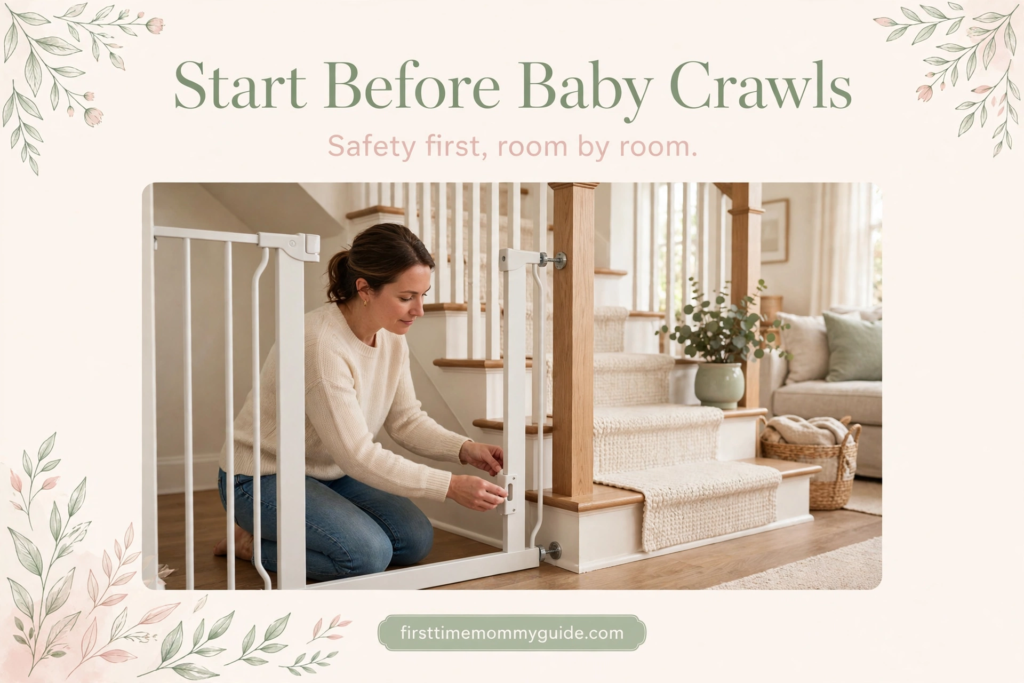
Buy quality gates and anchors rather than the cheapest options. A pressure-mounted gate at the top of stairs can be pushed over by a determined toddler; hardware-mounted gates screwed into the wall or banister are the safe choice for stair tops.
Room-by-Room Baby-Proofing Checklist
Living room
The living room is where babies spend most of their awake time, so it deserves the most attention.
- [ ] Anchor bookshelves, TV stands, and dressers to the wall; mount the TV or strap it down.
- [ ] Cover all outlets, including those hidden behind furniture.
- [ ] Secure cords: TV cables, lamp cords, phone chargers, and gaming equipment out of reach or in cord covers.
- [ ] Fit corner guards on coffee tables and low shelves at head height.
- [ ] Remove or secure heavy ornaments, candles, and anything breakable from low surfaces.
- [ ] Shorten or remove blind and curtain cords; use cordless blinds where possible.
- [ ] Keep remote controls, coins, and small batteries out of reach — button batteries are extremely dangerous if swallowed.
- [ ] Check houseplants: many common plants are toxic if eaten. Move them up high or out of the room.
- [ ] Secure rugs with non-slip pads to prevent slips.
- [ ] Block access to fireplaces with a fixed hearth guard; never leave a fire unattended.
Hidden hazard: Older siblings’ toys with small parts are a major choking risk for babies. Keep a separate play zone for small-part toys, and tidy them away after play.
Kitchen
The kitchen combines sharp objects, hot surfaces, chemicals, and heavy items — it needs the strictest controls.
- [ ] Lock cupboards containing cleaning products, dishwasher tablets, medicines, alcohol, and sharp objects.
- [ ] Move knives, scissors, and heavy pots to high cupboards or locked drawers.
- [ ] Use stove knob covers and a stove guard; cook on back burners with pot handles turned inward.
- [ ] Never carry hot food or drinks while holding your baby, and never leave a hot drink at table edge height.
- [ ] Lock the dishwasher (detergent residue is toxic) and keep the oven door locked or guarded.
- [ ] Secure the fridge with a latch if your toddler can open it; move magnets and small items off low fridge surfaces.
- [ ] Keep plastic bags, cling film, and aluminium foil out of reach — suffocation risk.
- [ ] Use a high chair with a secure harness, and never leave your baby unattended in it.
- [ ] Store pet food and water bowls out of the baby’s area or behind a gate.
- [ ] Fit a bin with a locking lid or keep it inside a latched cupboard.
Hidden hazard: Dishwasher tablets and laundry pods look like sweets to toddlers and are highly toxic. Store them in a high, locked cupboard, never under the sink.
Bathroom
Water is the key danger in bathrooms: babies can drown in just a few centimetres of water, and they can slip on wet floors in seconds.
- [ ] Never leave your baby unattended near water — not even for a moment to answer the door.
- [ ] Fit a toilet lock on every toilet.
- [ ] Set your water heater to no more than 120°F (49°C) to prevent scalds, and always test bath water with your elbow or inner wrist.
- [ ] Lock away medicines, vitamins, razors, hair tools, and cleaning products — ideally in a high, latched cabinet.
- [ ] Use a non-slip bath mat and a non-slip mat on the bathroom floor.
- [ ] Empty buckets, mop water, and baths immediately after use.
- [ ] Keep hair dryers, straighteners, and other electrical items unplugged and stored away from water.
- [ ] Cover bath taps with a soft spout cover to prevent bumps.
- [ ] Store cotton buds, small toiletries, and jewellery out of reach.
Bath time is precious bonding time, and our guide on how to give your newborn their first bath covers safe water temperature, holding positions, and what you need.
Nursery and bedrooms
The nursery should be the safest room in the house, because babies sleep there unsupervised.
- [ ] Use a cot that meets current safety standards: firm flat mattress, no pillows, blankets, bumpers, or toys in the sleep space.
- [ ] Keep the cot away from windows, curtains, cords, and radiators.
- [ ] Anchor the dresser and changing table to the wall; never leave your baby unattended on a changing table.
- [ ] Cover outlets and secure monitor cords well away from the cot — cords near a cot are a strangulation risk.
- [ ] Keep nappy supplies, creams, and small items out of the baby’s reach from the changing table.
- [ ] Check the room temperature: 68–72°F (20–22°C) is the recommended range for safe sleep.
- [ ] Secure wardrobes and any freestanding furniture.
- [ ] Use a baby gate on the nursery door if you want airflow without wandering.
Safe sleep basics — baby on their back, firm flat mattress, room-sharing for the first six months — are covered in full in our safe sleep for newborns guide. When your baby outgrows the bassinet, our bassinet-to-crib transition guide explains timing and safety checks.
Stairs and hallways
Falls on stairs cause more serious injuries than almost any other home hazard for toddlers.
- [ ] Fit hardware-mounted gates at the top of every staircase.
- [ ] Fit a gate at the bottom of the stairs too, so a crawler cannot start climbing unsupervised.
- [ ] Keep stairs clear of toys, shoes, and clutter.
- [ ] Fit handrails securely and check banister gaps — gaps wider than 4 inches (10 cm) can trap a small head; mesh banister guards solve this.
- [ ] Use non-slip strips on smooth stair treads.
- [ ] Keep hallway lighting good for night-time checks.
- [ ] Store shoes and bags out of walkways to prevent trips when carrying the baby.
Laundry room and garage
These rooms are often forgotten, and they hold some of the most dangerous substances in the home.
- [ ] Lock away detergents, fabric softeners, bleach, and laundry pods in high, latched cupboards.
- [ ] Keep the washing machine and dryer doors closed and latched; front-loaders are climbable.
- [ ] Store tools, paints, pesticides, and garden chemicals in locked cabinets in the garage.
- [ ] Keep the garage door opener and car keys out of reach.
- [ ] Never let a baby play unsupervised in a garage or utility room.
Garden and outdoors
- [ ] Fence off ponds, pools, and water features, or drain them; empty paddling pools after every use.
- [ ] Lock garden sheds and store tools, fertilisers, and pesticides out of reach.
- [ ] Check for poisonous plants and berries in beds and borders.
- [ ] Supervise around barbecues, fire pits, and outdoor heaters.
- [ ] Keep garden gates latched so a toddler cannot wander into the street.
The Most Dangerous Hazards Parents Miss
Furniture tip-overs
A child climbing a dresser to reach a toy can pull the whole unit down in seconds. Tip-overs kill children every year, and they are almost entirely preventable with anchor straps. Anchor every dresser, bookshelf, TV stand, and tall unit — including in rooms you think your baby rarely enters.
Button batteries
Button batteries, found in remote controls, greeting cards, toys, and watches, can burn through a child’s oesophagus within hours if swallowed. Tape battery compartments shut where possible, store spare batteries in a high locked container, and seek emergency care immediately if you suspect your child swallowed one.
Water in unexpected places
Toilets, buckets, mop water, pet bowls, and even a mop bucket left in the utility room are drowning risks for babies and toddlers, who are top-heavy and cannot easily lift themselves out. Empty containers, lock toilets, and supervise constantly around water.
Blind cords
Looped blind and curtain cords are a strangulation risk. Replace them with cordless blinds, or fit cleats and tension devices so cords cannot form loops. Cut looped cords and fit tassels that break apart under pressure.
Medicines and vitamins
Iron supplements, painkillers, and even gummy vitamins can poison a small child in small doses. Store all medicines in a high, locked cabinet — not in a handbag, nappy bag, or bedside drawer where a toddler can explore.
Baby-Proofing by Age and Stage
| Stage | Typical age | New risks to address |
|---|---|---|
| Rolling | 4–6 months | Floor-level small objects, pet bowls, unsecured rugs |
| Crawling | 6–10 months | Outlets, low cupboards, stairs, cords, plants |
| Pulling to stand | 8–12 months | Furniture tip-overs, table edges, TV stands |
| Walking | 12–18 months | Doors, gates, climbing, kitchen access, outdoor gates |
| Climbing | 18 months+ | Countertops, tall furniture, windows, locks and latches defeated |
Revisit your checklist at every stage. A lock that defeats a crawler may be no match for a determined two-year-old.
Choosing and Installing Safety Gear
Stair gates
Use hardware-mounted gates at stair tops and pressure-mounted gates only for doorways between rooms. Measure your opening before buying, and check whether your banister needs an adapter kit. Test the gate by pushing firmly — it should not budge. Teach visitors and older children to close gates behind them every time.
Cabinet locks
Magnetic locks are the most toddler-resistant and the least visible, but they need a magnetic key kept out of reach. Spring-loaded latches are cheaper and easier to install. Whichever type you choose, install them on every cupboard that holds hazards, not just the obvious ones.
Outlet covers
Sliding outlet plates are the most convenient — they close automatically when a plug is removed. Plug-in caps work but are themselves a choking hazard if a toddler pries them out, so choose plates for outlets your baby can reach.
Furniture anchors
Anchor kits typically include a strap and wall fixings. Screw into a wall stud where possible; plasterboard fixings are a weaker alternative. Test by pulling the furniture firmly toward you — it should not tip.
Baby-Proofing Without Ruining Your Home
Safety gear does not have to make your home look like a fortress. Many parents choose a few strategies that keep things liveable:
- Create one fully safe room where your baby can play freely, and supervise more closely elsewhere.
- Use baskets and high shelves to move hazards up rather than locking everything down.
- Choose furniture with rounded edges when buying new pieces.
- Keep a “yes space” — an area with safe toys, soft flooring, and nothing off-limits — so your baby can explore without constant “no.”
- Rotate toys to keep the yes space interesting without adding clutter.
A yes space is not just convenient; it supports development. Babies learn by exploring, and a safe space to do it builds confidence and independence.
Teaching Safety as Your Baby Grows
Baby-proofing buys safety for babies, but toddlers need to learn boundaries too. Short, consistent messages work best: “Hot — no touch,” said calmly every time, paired with moving the child away, teaches faster than long explanations. Praise safe behaviour, redirect rather than scold, and stay consistent — mixed messages confuse toddlers.
As your child grows, involve them: let them help lock the cleaning cupboard, practise “gentle hands” around pets, and learn to come to you when they find something small on the floor. These habits build a foundation for safety that outlasts any gadget.

Mistakes to Avoid When Baby-Proofing
- Starting too late. Begin before crawling, not after your baby’s first escape.
- Forgetting the rooms you rarely use. Spare bedrooms, utility rooms, and garages hold hazards too.
- Using pressure gates at stair tops. They can fail under a toddler’s weight. Hardware-mounted only.
- Anchoring only some furniture. Anchor everything tall and heavy, in every room.
- Storing hazards “up high” but within climbing reach. Toddlers climb chairs, drawers, and shelves — high is not safe if it is climbable.
- Assuming one check is enough. Revisit safety every few months as mobility and strength grow.
- Relying on gear instead of supervision. Baby-proofing reduces risk; it never replaces watching your child.
- Ignoring older children’s toys. Small parts, magnets, and batteries from older siblings’ toys are a top choking hazard for babies.
Baby-Proofing on a Budget
Safety does not require a big spend. Prioritise in this order if money is tight:
- Stair gates and furniture anchors — the highest-impact items.
- Outlet covers and cabinet locks — cheap and effective.
- Toilet locks and cord shorteners — a few pounds each.
- Poison storage — often free: move hazards to a high cupboard and fit a simple latch.
Second-hand gates are fine if they meet current safety standards and include all fixings. Check for recalls on second-hand gear, and never use accordion-style gates with V-shaped openings, which can trap a child’s head.
Expert Tips
- Do the crawl test monthly. Babies grow fast; a monthly hands-and-knees check catches new hazards.
- Check your car too. Car seat safety, loose objects that become projectiles, and never leaving a child alone in a car are part of home safety’s bigger picture.
- Keep emergency numbers visible. Poison control, your doctor, and emergency services on the fridge save precious minutes.
- Prepare a first-aid kit. Plasters, thermometer, saline, and your clinician’s number, stored out of children’s reach but easy for adults to find.
- Tell every caregiver. Grandparents, babysitters, and visitors should know your house rules: gates closed, medicines locked, water emptied.
- Photograph your setup. Photos of anchored furniture and locked cupboards help babysitters and family members keep the same standards.
Choking Hazards: The Small-Object Test
Choking is one of the most frightening risks for babies, and it is also one of the most preventable. Babies explore the world with their mouths, and anything small enough to fit through a toilet paper roll is small enough to choke on. Use that roll as your test: if an object fits through it, it does not belong anywhere your baby can reach.
Common culprits include coins, buttons, beads, marbles, small batteries, pen caps, screws, deflated balloons, and pieces of older children’s toys. Balloons deserve special mention: uninflated balloons and popped balloon fragments are a leading choking hazard, and they should never be given to babies or toddlers as toys.
Magnets are another serious danger. Small, powerful magnets from toys or fridge magnets can cause severe intestinal injury if a child swallows more than one, because the magnets attract each other through intestinal walls. Keep magnetic toys designed for older children completely out of a baby’s reach, and check that toys with magnetic parts have screwed-shut compartments.
Food is a choking hazard too, and it changes as your baby grows. When solids begin, cut food into safe shapes — soft, mashable pieces for beginners, and avoid whole grapes, whole nuts, raw carrot sticks, popcorn, and hot dog rounds for toddlers. Always supervise meals, keep your baby seated upright while eating, and learn infant choking first aid before you need it. A short first-aid course is one of the most valuable things any new parent can do.
Windows, Doors, and Balconies
Windows and doors deserve their own check, because falls from windows and balcony accidents cause devastating injuries every year.
- Window locks and restrictors. Fit restrictors so windows open no more than 4 inches (10 cm), and keep furniture — especially climbable furniture like dressers and toy boxes — away from windows.
- Window guards. In upper-storey rooms, window guards that an adult can release in an emergency add a vital layer of protection.
- Balcony doors. Keep balcony doors locked and latched, and never place chairs, planters, or storage boxes near balcony railings where a toddler could climb them.
- Door safety. Fit finger-pinch guards on doors that swing into play areas, and use door knob covers on doors to rooms you want off-limits, such as the garage or basement.
- Glass doors. Apply safety film or decals at a child’s eye level so a toddler can see glass doors and panels and does not run into them.
A good rule: if a toddler can climb it, push it, or stand on it to reach something higher, move it away from windows and railings.
Poison-Proofing: What Counts as Poison in Your Home
Most parents lock away bleach and move on, but the poison list is much longer than cleaning products. Walk through your home with fresh eyes and check for:
| Location | Hidden poisons |
|---|---|
| Kitchen | Dishwasher tablets, oven cleaner, alcohol, essential oils, vitamins |
| Bathroom | Medicines, iron tablets, mouthwash, nail polish remover, hair dye |
| Laundry | Detergent pods, fabric softener, stain removers, bleach |
| Garage | Pesticides, fertiliser, paint, solvents, antifreeze, rat poison |
| Living areas | Houseplant leaves, cigarettes and vaping liquids, button batteries |
| Handbags and nappy bags | Painkillers, inhalers, loose tablets, coins |
Store all of these in high, locked cupboards — not just high, because toddlers climb. Keep medicines in their original child-resistant containers, and never describe medicine as “sweets” to persuade a child to take it. If your child swallows something potentially harmful, call poison control or emergency services immediately and bring the container with you.
Baby-Proofing Grandparents’ and Visitors’ Homes
Babies spend time in other people’s homes, and those homes are rarely baby-proofed. Before a visit, ask grandparents and hosts to cover a few basics: lock away medicines, move cleaning products out of low cupboards, cover accessible outlets, and gate the stairs if possible. Bring a small kit of your own — a few outlet covers, a portable stair gate, and a toilet lock — for longer stays. Remind hosts about the small things that are easy to forget: handbags with tablets inside, bowls of nuts or sweets at toddler height, and hot drinks left on low tables. A short conversation before the visit prevents an emergency during it.
Frequently Asked Questions
When should I start baby-proofing my home?
Start during pregnancy or in your baby’s first three months, before rolling and crawling begin. The big jobs — stair gates, furniture anchors, outlet covers, and poison storage — should be done by the time your baby is around six months old.
What is the most important baby-proofing item?
A hardware-mounted stair gate at the top of the stairs and furniture anchors on every tall unit. Falls and tip-overs cause the most serious injuries, and both are highly preventable.
Do I need to baby-proof every room?
Yes, every room your baby can access — including spare rooms, utility rooms, and the garage. Babies wander further than you expect, especially once they walk. A fully safe playroom helps, but it does not replace whole-home basics.
Are pressure-mounted gates safe for stairs?
Pressure-mounted gates are fine for doorways between rooms, but not for the top of stairs. A toddler pushing against one can dislodge it. Use hardware-mounted gates, screwed into the wall or banister, at every stair top.
How do I baby-proof blinds and curtains?
Replace looped cords with cordless blinds where possible. Otherwise, fit cord cleats high on the wall, cut loops, and use breakaway tassels. Keep cots, beds, and furniture away from windows so children cannot reach cords.
What plants are dangerous for babies?
Common toxic houseplants include philodendron, peace lily, dieffenbachia, pothos, and poinsettia. Move all houseplants out of reach or out of the room, and check garden plants too — many berries and bulbs are toxic if eaten.
How can I keep my baby safe in the kitchen?
Lock cupboards with cleaners, medicines, and sharp objects; use stove knob covers; cook on back burners; never carry hot drinks while holding your baby; and keep small items like plastic bags and magnets out of reach. A locked dishwasher and a harnessed high chair complete the basics.
What should I do if my baby swallows a button battery?
Seek emergency medical care immediately — button batteries can cause severe burns within hours. Do not wait for symptoms. Call emergency services or go to the emergency department and tell them exactly what happened.
Is it safe to use a baby walker?
Most paediatric organisations advise against baby walkers. They give babies speed and reach before they have balance or judgement, and they are linked to falls down stairs and access to hazards. A stationary activity centre is a safer alternative.
How do I childproof a home with older siblings?
Create separate play zones: small-part toys stay in an older child’s room or a gated area, and are tidied away after play. Teach older children why small toys are dangerous for the baby, and give them a special “big kid” box for their small treasures.
Do I need outlet covers if my outlets are behind furniture?
Yes — babies move furniture, pull it, and squeeze behind it. Cover every outlet your baby could reach, including those behind light furniture. Sliding outlet plates are the most reliable option.
How often should I re-check baby-proofing?
Re-check every few months and at each new developmental stage: rolling, crawling, pulling up, walking, and climbing. Toddlers defeat locks and reach new heights regularly, so baby-proofing is ongoing, not one-and-done.
What is the safest room temperature for a baby?
For sleep, 68–72°F (20–22°C) is recommended. Use a room thermometer, dress your baby in light sleep layers, and avoid heavy blankets, pillows, and hats indoors.
Should I lock my medicine cabinet?
Absolutely. All medicines, vitamins, and supplements — including iron tablets and gummy vitamins — should be in a high, locked cabinet. A handbag, nappy bag, or bedside drawer is not safe storage once a toddler is mobile.
Can I baby-proof a rental home?
Yes. Use pressure-mounted gates for doorways, adhesive cabinet locks, outlet plates, and furniture anchors with minimal-damage fixings. Most landlords accept small screw holes for safety gates and anchors, and many will agree in writing if you ask first.
What do I do about stairs in a home with open banisters?
Fit mesh banister guards to close gaps wider than 4 inches (10 cm), and use hardware-mounted gates at top and bottom. Teach toddlers to hold the rail and sit to go down stairs when they are old enough, always supervised.
How do I keep my baby safe around pets?
Supervise all baby-pet interactions, keep pet food and water bowls behind a gate, store pet medicines and litter trays out of reach, and give pets a baby-free retreat space. Never leave a baby alone with a pet, however gentle the animal seems.
What is a “yes space” and do I need one?
A yes space is a fully baby-proofed area where everything within reach is safe to touch, mouth, and explore. It gives your baby freedom to play independently and gives you a safe place to put them while you cook or answer the door. It is one of the most useful baby-proofing strategies.
Further Reading From Authoritative Sources
- U.S. Consumer Product Safety Commission: Home Safe with Young Children — official safety checklist covering safe sleep, furniture anchoring, window cords, magnets, and drowning prevention.
- American Academy of Pediatrics: Back to Sleep, Tummy to Play — safe sleep and tummy time guidance for babies.
Conclusion
Baby-proofing your home is not a weekend project you finish once — it is a habit of looking at your home through your child’s eyes as they grow. Start early, cover the big risks first, and revisit your checklist at every new stage. Stair gates, furniture anchors, locked poisons, covered outlets, and water safety cover most serious injuries, and a yes space gives your baby the freedom to explore that helps them learn.
Do the crawl test this week, fix the top hazards first, and give yourself credit: a home that is safe enough for a curious baby is a home where everyone can relax a little more. For more first-time mom guidance, see our safe sleep for newborns checklist and our guide to baby milestones at 6 months so you know which mobility stage is coming next.
Safety note: This article is for general information only and is not a substitute for professional safety advice. If your child swallows a battery, medicine, or cleaning product, or has a serious fall, seek emergency medical care immediately. Always supervise babies and toddlers around water, stairs, and hazards, even in a baby-proofed home.
Sources and further reading: The American Academy of Pediatrics’ Childproofing Your Home for Poisons guide lists room-by-room hazards to lock away before your baby crawls.

Dilawar Mughal
Founder and editor, First Time Mommy Guide
I research every guide against what the NHS, the AAP and the WHO publish, then write it in plain English — because most new parents are reading with one hand free, not comparing clinical guidelines. I'm not a doctor or a midwife. Every health claim on this site is sourced and linked so you can check it yourself, and anything urgent belongs with your health visitor or GP, not a blog.


