
General information, not medical advice. Every baby is different — if anything worries you, speak to your midwife, health visitor or GP rather than waiting.
Your baby has outgrown the bassinet, or is about to. The bassinet that once felt cosy now looks small, your baby is pushing up, rolling, or bumping the sides, and you are wondering whether the crib will undo weeks of hard-won sleep progress.
This guide explains how to transition your baby from bassinet to crib safely and gently. You will learn when to move, how to set up a safe crib, a step-by-step transition plan that works whether the crib is beside your bed or in the nursery, and what to do when your baby cries, wakes more, or refuses the new sleep space.
The safety advice here follows American Academy of Pediatrics (AAP) safe sleep guidance, the U.S. Consumer Product Safety Commission (CPSC), and the Lullaby Trust. It is general information only. It does not replace advice from your own paediatrician. If your baby has reflux, breathing concerns, or a medical condition that affects sleep, talk to your paediatrician before changing the sleep setup.
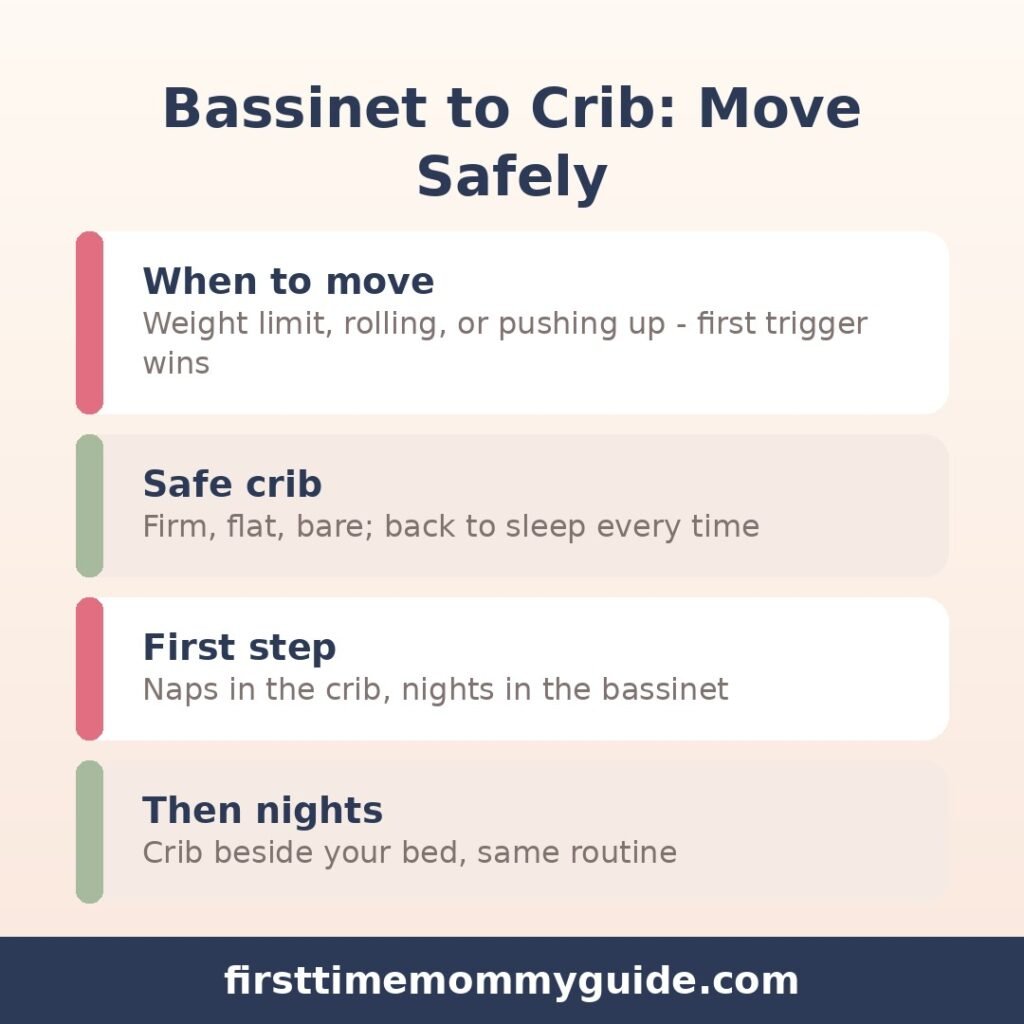
Quick answer: Move your baby from bassinet to crib when your baby reaches the bassinet weight or height limit, starts rolling over, or can push up on hands and knees — whichever comes first, often around 3–5 months. Keep the crib firm, flat, and bare, place your baby on their back, and room-share for at least 6 months if you can.

Key takeaways
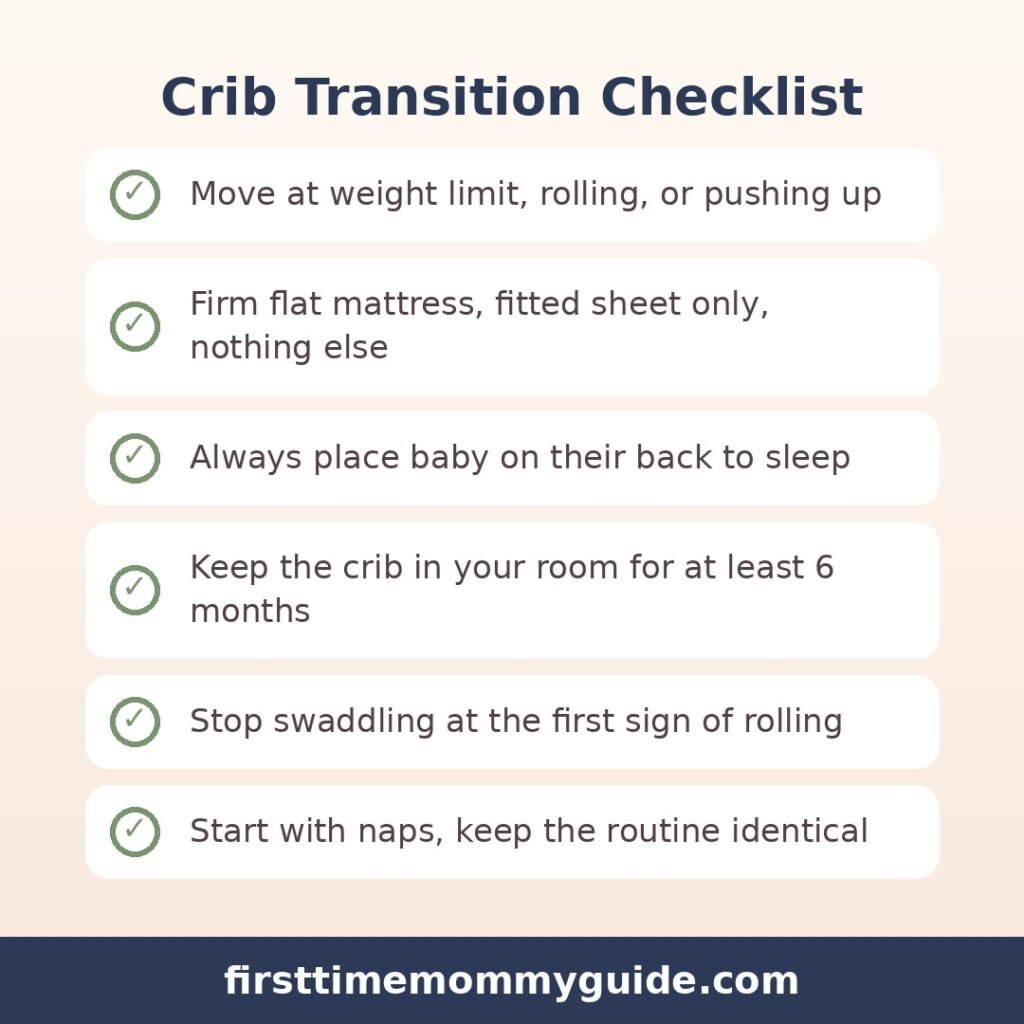
- Transition at the earliest trigger: weight limit, height limit, rolling, or pushing up.
- Never wait until your baby can climb or sit up in the bassinet.
- The crib must be firm, flat, and bare: fitted sheet only, no pillows, blankets, bumpers, or toys.
- Always place your baby on their back for every sleep, in the bassinet and in the crib.
- Keep the crib in your room for at least the first 6 months, ideally 12 months.
- Move gradually: naps first, same routine, same sleep sack, familiar smells.
- Expect a few unsettled nights. Consistency matters more than speed.
- Stop swaddling when your baby shows signs of rolling over.
When to move from bassinet to crib
There is no single age that fits every baby. The right time is set by your baby’s size, development, and your bassinet’s own limits. Check all three, and move when the first one applies.
1. Weight and height limits
Every bassinet has a manufacturer weight limit, commonly 15 to 20 pounds (about 7 to 9 kg), and sometimes a height or length limit as well. The limit is printed on the product label, in the manual, and often on the bassinet itself. Do not guess it, and do not exceed it because your baby “still fits.”
Weigh your baby at routine health visits, and check the limit in advance. If your baby is close to the limit, start the transition before you hit it. A bassinet used beyond its limit can tip, collapse, or become unstable, especially if your baby moves vigorously.
2. Rolling over
Once your baby can roll over, or is trying hard to roll, the bassinet’s low sides become a hazard rather than a comfort. A baby who rolls in a bassinet can press against the side, get stuck in an awkward position, or roll over the edge in a shallow bassinet.
The AAP safe sleep guidance is clear on the related point: stop swaddling when your baby shows signs of attempting to roll. A swaddled baby who rolls onto their tummy cannot use their arms to lift or turn. Rolling is therefore both a transition trigger and a swaddling trigger. Treat them together.
3. Pushing up, sitting, or pulling up
If your baby can push up on hands and knees, sit unaided, or pull up on the bassinet sides, move to the crib at once. Bassinets are designed for babies who lie flat. A baby who can push up can tip a bassinet or climb over a low side.
4. Your baby looks cramped or wakes bumping the sides
A baby who constantly bumps hands and feet against the bassinet sides, wakes when they touch the edge, or cannot stretch out may sleep better in the larger crib. Cramped sleep is not unsafe on its own, but combined with rolling or pushing up, it is a clear sign to move.
Typical ages: a realistic range
| Trigger | Typical age | Action |
|---|---|---|
| Weight limit reached | 3–5 months for many babies | Start transition now |
| Rolling over | Around 4 months, sometimes 3–6 months | Move to crib, stop swaddling |
| Pushing up / sitting | 4–7 months | Move to crib at once |
| No trigger yet | By 6 months | Most families have moved by now; check limits again |
Some babies transition at 3 months because they roll early. Others stay in the bassinet until 5 or 6 months because they are small and not yet rolling. Both are normal. The trigger, not the calendar, decides.
If your baby is already sleeping in a crib from birth, this guide still helps. The setup, routine, and troubleshooting sections apply to any crib move, including moving the crib from your room to the nursery later.
For context on early sleep patterns, see our newborn sleep routine guide. Many of the routine cues in that guide — dark room, white noise, consistent wind-down — transfer directly to the crib.
Bassinet vs crib: what changes for your baby
A bassinet is small, close, and often beside your bed. It rocks or sits at bed height, and your baby can hear and smell you all night. A crib is larger, firmer-feeling, and often in a different spot. That change in space, sound, and smell is why some babies protest, even when the crib itself is perfectly safe and comfortable.
The crib is not a downgrade. It gives your baby room to move, roll safely, and stretch without bumping sides. It is built for the next year or more, with a mattress that supports a growing baby and sides high enough to keep a rolling, sitting baby safe. The bassinet was a short-term sleep space. The crib is the long-term one.
Your baby does not need to “like” the crib on night one. They need a safe, familiar routine that teaches them the crib is the new sleep place. Familiarity comes from repetition: same bedtime, same sleep sack, same white noise, same order of events, in the same crib, night after night.
Safe crib setup: the non-negotiables
Safe sleep rules do not change when you move from bassinet to crib. They become more important, because your baby is more mobile. Set up the crib once, correctly, and do not add extras “just for comfort.”
The ABCs of safe sleep
- A — Alone: your baby sleeps alone in the crib, without pillows, blankets, bumpers, positioners, or stuffed toys.
- B — Back: place your baby on their back for every sleep, nap and night, until they can roll both ways on their own.
- C — Crib: use a crib, bassinet, or play yard that meets current CPSC safety standards, with a firm, flat mattress and a fitted sheet.
The AAP recommends room sharing, without bed sharing, for at least the first 6 months, ideally the first year. If you can, keep the crib in your room for the transition. Moving to a new sleep surface and a new room at the same time is a double change. Do one change at a time.
Crib safety checklist
Use this checklist before the first night:
- Crib meets current CPSC standards. Avoid drop-side cribs, which were banned in the United States in 2011, and check secondhand cribs for recalls.
- Slats are no more than 2 3/8 inches (about 6 cm) apart. A standard soda can should not fit between slats.
- Mattress is firm and flat, fits snugly, and leaves no gaps at the sides. Press it with your palm: it should not indent easily.
- Only a fitted sheet made for that mattress. No loose sheets, blankets, or mattress toppers.
- Mattress is at the highest setting only while your baby cannot sit or pull up. Lower it as soon as your baby can sit, and lower it again before pulling up.
- No pillows, blankets, quilts, bumpers (padded or mesh), wedges, positioners, or toys in the crib.
- No weighted sleep sacks, weighted swaddles, or weighted blankets.
- Crib is away from windows, curtains, blind cords, lamps, and wall decorations.
- All hardware is tight, with no broken, cracked, or missing parts. Check screws monthly.
- No inclined sleep surface. The crib mattress must be flat, not raised at one end, unless your paediatrician advises otherwise for a specific medical reason.
For a detailed CPSC overview, see Safe Sleep for Babies. For CDC guidance on creating a safe sleep area, see Providing Care for Babies to Sleep Safely. For answers to common safe-sleep product questions, see the Safe Infant Sleep FAQs. For AAP guidance in parent-friendly form, see HealthyChildren’s A Parent’s Guide to Safe Sleep. UK parents can also read the Lullaby Trust’s safer sleep advice.
Mattress, sheets, and sleep sacks
Choose a firm crib mattress that fits the crib frame exactly. If you can fit more than two fingers between the mattress and the crib side, the mattress is too small. Use two or three fitted sheets so a night-time change is quick and you are never tempted to add a loose blanket.
Sleep sacks replace blankets. Choose a sleep sack by room temperature (TOG rating in the UK, weight guidance in the US), and dress your baby in one light layer underneath. A sleep sack keeps legs free for rolling and kicking, unlike a swaddle, and cannot ride up over the face.
Stop swaddling as soon as your baby shows signs of rolling. Move to a sleep sack with arms free. Some babies protest the loss of the swaddle for a few nights. Keep the rest of the routine identical, and the protest usually fades. If your baby is already rolling in the bassinet, stop swaddling now, before the crib move, so you are not changing two things at once.
Room setup for the crib
- Dark: blackout curtains or blinds help naps and early mornings. A dim red or amber night light is enough for feeds and checks.
- Cool: aim for a comfortable room temperature, roughly 16–20°C (61–68°F) in UK guidance. Dress your baby in no more than one layer more than you would wear.
- Quiet or white noise: a continuous white noise machine at low volume, placed away from the crib, masks household sounds. Keep the same sound you used with the bassinet.
- Familiar: use the same fitted sheet material, sleep sack, and comfort cue you used before. A worn (unwashed) fitted sheet from the bassinet, placed on the crib mattress for the first nights, can carry a familiar smell. Make sure it fits the crib mattress safely and is not loose.
- Close, if possible: keep the crib beside your bed for the first stage of the transition. Proximity lets you soothe with a hand or voice without picking up, and lets your baby hear your breathing.
Step-by-step transition plan
There are three common approaches: gradual (naps first), cold turkey (all sleeps in the crib from night one), and room-first (crib beside your bed, then move the crib). All three work. Gradual suits most families because it builds familiarity without a sudden overnight change.
Stage 1: Prepare the crib (2–3 days before)
Set up the crib in its first position, usually beside your bed. Let your baby spend awake, happy time in and near the crib during the day. Place them in the crib for a few minutes of play, with you beside them, talking and smiling. Do not force it. The goal is a neutral or positive association, not a lesson.
Do daytime care in the new room if the crib will later move there. Change nappies, read stories, and do tummy time in that room so it becomes familiar. Our tummy time guide has floor-play ideas that work well in a nursery during this familiarisation stage.
Wash the new fitted sheets with your usual detergent. Keep the same sleep sack, white noise, and bedtime order you already use. Familiarity is the whole strategy.
Stage 2: Naps in the crib first (days 1–4)
Start with the first nap of the day, when your baby is most rested and easiest to settle. Follow the exact bedtime routine in miniature: nappy change, sleep sack, story or song, white noise, lights low, place on back, say the same sleep phrase.
If your baby cries, use the same soothing approach you used in the bassinet. Pat, shush, or hold a hand on their chest until they settle, then step back. Keep your response calm and brief. If a nap fails completely after 20–30 minutes of calm attempts, rescue the nap in the bassinet or pram for that one nap, and try again next time. One rescued nap does not undo progress.
Add a second nap in the crib after 2–3 successful first naps. Keep the last nap of the day in the bassinet for now if late-day fussiness makes crib naps hard. Progress, not perfection, is the goal.
Stage 3: First nights in the crib (days 4–7)
When naps are going reasonably well, move bedtime to the crib. Keep the bedtime routine identical in order and timing. Put your baby down drowsy but awake if you can, so they learn to fall asleep in the crib rather than being transferred asleep.
Expect more waking in the first few nights. Your baby may wake when they notice the larger space, or when they roll and bump a side. Respond as you did before: feed if hungry, otherwise soothe in the crib with voice, touch, and patting before picking up. Keep lights low and interaction boring at night.
If you room-share, keep the crib beside your bed for this stage. Your presence helps, and you can soothe without fully waking yourself or your baby. Do not move your baby back to the bassinet for the second half of the night “just for sleep.” That teaches your baby that crying after midnight brings the old sleep space back.
Stage 4: Move the crib to the nursery (when ready)
If the long-term plan is a separate nursery, move the crib only after your baby is sleeping reasonably well in it beside your bed. Move it during the day, keep the same sheets, sleep sack, white noise, and routine, and spend awake time in the room first.
For the first few nights in the nursery, stay for the wind-down, then leave as usual. Use a video monitor if it helps you feel confident, but do not rush in at every stir. Babies make noises in light sleep. Pause, listen, and watch before responding. Many “wakes” resolve on their own in a minute or two.
Room sharing for at least 6 months is the AAP recommendation, so do not feel pressured to move to the nursery early. A crib beside your bed for 6–12 months is safe, normal, and often easier for night feeds. Move when your family is ready, not when a calendar says you should.
A sample 7-day plan
| Day | Naps | Night | Notes |
|---|---|---|---|
| 1–2 | First nap in crib | Bassinet | Crib play in daytime, same routine |
| 3–4 | First two naps in crib | Bassinet | Add crib nap after success, not after failure |
| 5 | All naps in crib | First night in crib | Crib beside your bed, same sleep sack |
| 6–7 | All naps in crib | Crib all night | Soothe in crib, keep nights boring |
| 8+ | Crib | Crib | Move crib to nursery only when nights settle |
Adjust the pace to your baby. A baby who takes to the crib at once can move faster. A baby who struggles can stay at Stage 2 for a week. There is no prize for finishing in 7 days. There is a prize for a safe, settled baby and a rested parent.
Keeping the bedtime routine identical
The routine is the bridge between bassinet and crib. Babies learn by sequence. When the sequence stays the same, the sleep space can change without the whole night falling apart.
A simple routine that transfers
- Bath or wipe-down, nappy change, pyjamas or sleep sack.
- Feed in a dim, quiet spot, away from the crib if possible.
- Story, song, or quiet cuddle for 5–10 minutes.
- White noise on, lights low, sleep phrase (“Night night, sleep tight”).
- Place on back in the crib, hand on chest for a moment, then step back.
- Leave the room, or settle into bed if room-sharing.
Keep the routine to 20–30 minutes. A routine that is too long becomes hard to repeat when you are tired, and a routine that changes every night teaches nothing. Write it down and share it with every caregiver, so grandparents, partners, and babysitters do the same steps in the same order.
If your baby has been falling asleep only while feeding or rocking, the crib move is a good moment to gently shift towards drowsy-but-awake. Do it gradually: feed and rock until calm, not fully asleep, then place in the crib and soothe with a hand and voice. Over several nights, reduce the rocking a little each time. Do not attempt a full sleep-training method and a crib move on the same night unless you have planned both and feel ready.
For babies who only sleep when held, our guide to why your newborn wakes every time you put them down and the companion piece on newborns who only sleep when held and getting baby into the bassinet cover transfer technique, drowsy-but-awake practice, and when to seek support. The same transfer tips — warm the mattress with a hot water bottle removed before placing baby, lower bottom first, keep a hand on chest — help with the crib too, provided the mattress is firm, flat, and at room temperature when your baby lies on it.
Troubleshooting: baby hates the crib
“My baby cries as soon as I put them in the crib”
Crying at the moment of being put down is common in the first week. Check the basics first: hunger, nappy, temperature, wind, and overtiredness. If those are fine, the cry is usually protest at change, not pain or danger.
Try these steps in order:
- Place your baby down, hand on chest, shush or hum for 1–2 minutes.
- If crying escalates, pick up, calm fully, then try again once.
- If the second try fails, rescue that sleep in the old way (bassinet, pram, or holding) and try again next sleep. Do not force repeated put-downs until everyone is distressed.
- Check the mattress: is it cold, is the sheet scratchy, is the room too bright or too noisy?
A baby who cries for 5 minutes and then settles is learning. A baby who cries hard for 30 minutes, vomits, or becomes hysterical needs a different pace. Slow the transition, add more daytime crib play, and try naps only for a few more days.
“My baby wakes every hour in the crib but slept in the bassinet”
More waking in the first week is normal. The larger space means more movement, more rolling, and more chances to wake fully between sleep cycles. Most babies settle back to their previous pattern within 1–2 weeks if the routine stays consistent.
Check for new factors before blaming the crib: a growth spurt, teething, illness, a sleep regression, or a change in feeds. The 4-month sleep regression often coincides with the bassinet-to-crib move, because both happen around the same age. If waking started suddenly with new skills (rolling, babbling, sitting), development is likely part of the picture, not the crib alone.
Keep night responses boring and consistent. Feed if hungry, change if needed, otherwise soothe in the crib. Avoid introducing new habits you do not want to keep, such as feeding to sleep every wake if you had stopped that habit, unless your baby genuinely needs the feed.
“My baby rolls and gets stuck against the crib side”
Rolling babies often end up pressed against a crib side, or with a leg through slats. This looks uncomfortable but is usually safe in a bare crib with correct slat spacing. Do not add bumpers, positioners, or rolled blankets to stop it. Bumpers are banned for sale in the US under the Safe Sleep for Babies Act and are not recommended by the AAP or CPSC.
If your baby rolls onto their tummy and can roll back, leave them in the position they choose, provided you placed them on their back to start. If they cannot yet roll back, gently roll them onto their back when you check, without fully waking them if you can. Practise rolling both ways during daytime tummy time and floor play, so the skill develops faster. Our tummy time guide covers rolling practice and safe floor play.
Legs through slats are common and rarely dangerous in a modern crib. If your baby gets a leg stuck and cries, free it gently and soothe. Sleep sacks can reduce leg-through-slat episodes because legs stay together. Do not use a crib tent or netting unless it is part of the crib manufacturer’s approved system.
“My baby only sleeps in the bassinet / pram / car seat”
A baby who has learned to sleep only in motion or only in a small space needs gradual practice, not a sudden ban on all other sleep. Use the naps-first plan, and make the crib the “practice” sleep space for one nap a day. Keep other naps in the old way until crib naps improve. Over 1–2 weeks, shift more naps to the crib.
Never use a car seat, swing, bouncer, or lounger as a routine sleep space. If your baby falls asleep in one, move them to the crib or bassinet as soon as you safely can. Inclined sleepers and loungers are not safe sleep surfaces, and the CPSC and AAP advise against them for unsupervised sleep.
“The crib is in the nursery and I am exhausted from walking there”
Exhaustion is a real safety issue. If night feeds in a separate room are leaving you dangerously tired, move the crib back beside your bed for a while. Room sharing is recommended for at least 6 months for safety reasons, and it is also easier. There is no rule that says a baby must be in the nursery by a certain age. Move the crib when nights are more settled and you feel ready, not before.
Sleep training and the crib transition: should you combine them?
Sleep training means teaching your baby to fall asleep without a parent doing all the work, using a consistent method. The crib transition is a change of sleep space. You can do them together or separately. Separately is gentler and easier to troubleshoot.
If you decide to sleep train, choose one method, agree it with every caregiver, and apply it consistently for at least a week before judging it. Common approaches include gradual retreat (sitting beside the crib, moving further away over nights), check-and-console (brief checks at increasing intervals), and pick-up-put-down for younger babies. All of them require a safe crib, a consistent routine, and a baby who is fed, well, and developmentally ready.
Do not start sleep training during illness, teething pain that needs treatment, a move, a new sibling’s arrival, or the first week in a new childcare setting. Do not sleep train a baby who is still swaddled or who cannot roll. Discuss any sleep training plan with your paediatrician if your baby was born prematurely, has reflux, or has any medical condition.
If sleep training feels wrong for your family, that is valid. A consistent routine, drowsy-but-awake practice, and responsive night soothing also teach sleep skills over time. The goal is a baby who sleeps safely and a parent who can function, not a particular method.
Special situations
Twins or multiples
Transition twins at the same time if you can, using separate cribs. Twins should sleep in separate sleep spaces from birth, and the crib move is no exception. Keep routines synchronised where possible, and use white noise to mask one twin’s noises for the other. If one twin settles in the crib faster, keep the other twin’s pace separate. Do not hold one back or rush one forward to match the other.
Premature babies
Use corrected age for developmental milestones like rolling and sitting when judging readiness, and discuss timing with your paediatrician or neonatal team. Premature babies may need a smaller sleep space for longer, or a different mattress setup. Follow the medical advice you were given at discharge, and check weight limits against your baby’s actual weight, not age alone.
Reflux babies
Babies with reflux often sleep worse flat, and parents are tempted to incline the crib. Do not incline the crib mattress unless your paediatrician advises it for a specific reason. Inclined sleep surfaces increase suffocation risk. Our baby reflux guide covers upright feeding, burping, and when to seek medical review. If reflux is affecting sleep, ask your paediatrician about feeding and positioning advice before the crib move, so you are not changing sleep space and reflux management at the same time.
Moving house or travelling during the transition
If you are moving house, travelling, or have visitors staying, delay the crib transition if you can. Too many changes at once make it hard to know what is causing waking, and hard for your baby to learn the new routine. Use the bassinet or a travel cot that meets safety standards for the trip, and start the crib plan when you are home and settled.
For travel cots, follow the same bare, firm, flat rules. Use only the mattress supplied with the travel cot, check for recalls, and do not add extra padding. A familiar sleep sack and white noise help a baby settle in an unfamiliar room.
Baby-led weaning and sleep changes
Around 6 months, many babies start solids. New foods, allergen introductions, and longer awake times can all affect sleep. Keep the crib routine steady through weaning, and introduce new foods earlier in the day so any reaction is noticed while you are awake. Our signs baby is ready for solids and baby-led weaning guide cover readiness signs and first foods. Do not start solids early to “help sleep.” Solids do not reliably improve night sleep, and early introduction carries its own risks.
Mistakes to avoid
- Waiting too long. A baby who can roll, push up, or exceed the weight limit must move now, even if nights are going well in the bassinet.
- Adding blankets, pillows, or bumpers “for comfort.” A bare crib is a safe crib. Comfort comes from routine, sleep sack, and room temperature, not loose bedding.
- Inclining the mattress. Flat is safe. Inclines increase risk and do not treat reflux on their own.
- Moving room and bed on the same night. Change one thing at a time: crib beside your bed first, nursery later.
- Changing the whole routine. Keep feed, bath, story, and sleep phrase identical. Change only the sleep surface.
- Rescuing every wake with the bassinet. One rescued nap is fine. Every rescued night teaches your baby that crying brings the old bed back.
- Starting sleep training and crib move together without a plan. Do the crib move first, settle it, then decide about sleep training.
- Using a secondhand crib without checks. Check recalls, slat spacing, hardware, and the manual. If any part is missing or broken, do not use it.
- Forgetting to lower the mattress. Lower the mattress as soon as your baby can sit or pull up. A high mattress plus a pulling-up baby is a fall risk.
- Leaving the swaddle on after rolling signs. Stop swaddling at the first sign of rolling. Use a sleep sack with arms free.
What success looks like
Success is not a baby who sleeps through the night in the crib on night one. Success is a baby who falls asleep in the crib with the same routine, wakes and is soothed in the crib, and gradually returns to their previous waking pattern over 1–2 weeks.
Measure progress over a week, not a night. Look for: shorter time to settle, fewer full wakes, easier resettling with voice and touch, and naps that last longer in the crib. A bad night after three good nights is normal. Development, teeth, illness, and growth spurts all cause wobbles. Keep the routine steady through the wobble.
If after 2–3 weeks of consistent effort your baby is still distressed at every crib sleep, waking far more than before, or you are worried about breathing, reflux, or development, talk to your paediatrician or health visitor. Bring notes: bedtime, wake times, feeds, and what soothing you tried. A professional can check for medical causes and help you adjust the plan.
Frequently asked questions
1. When should I move my baby from bassinet to crib?
When your baby reaches the bassinet weight or height limit, starts rolling over, or can push up on hands and knees, whichever comes first. For many babies this is 3–5 months. Check your bassinet label for the exact limit.
2. Can I move my baby to the crib at 2 months?
You can use a crib from birth if you wish, provided it meets safety standards and is set up bare, firm, and flat. A move at 2 months is usually for space or preference, not because the bassinet limit has been reached. Keep the crib in your room.
3. How long can a baby stay in a bassinet?
Until the weight, height, or developmental limit is reached. Most bassinets are outgrown by 4–6 months. Never use a bassinet after your baby can sit, push up, or roll over it, even if they are under the weight limit.
4. Should the crib be in my room or the nursery?
Keep the crib in your room for at least 6 months, ideally 12 months, following AAP guidance. Move to the nursery when your baby sleeps well in the crib and your family is ready. Do not move room and bed on the same night if you can avoid it.
5. How do I get my baby to sleep in a crib after a bassinet?
Start with naps, keep the routine identical, use the same sleep sack and white noise, and put your baby down drowsy but awake. Soothe in the crib with voice and touch. Expect a few unsettled nights, and keep the routine consistent.
6. What if my baby cries in the crib but not the bassinet?
Crying at change is normal for the first week. Check hunger, nappy, and temperature first. Soothe in the crib, try again once after calming, and rescue that sleep if needed. Slow the pace and add daytime crib play if crying is intense or prolonged.
7. Do I need to stop swaddling before the crib transition?
Stop swaddling when your baby shows signs of rolling over, whether or not you move to the crib that week. Use a sleep sack with arms free. Stopping swaddling and moving to the crib on the same night is a double change, so stagger them if you can.
8. Can I put blankets in the crib to make it cosier?
No. The crib should contain only a firm mattress and a fitted sheet, plus your baby in a sleep sack. Blankets, pillows, bumpers, and toys increase suffocation and entrapment risk. Warmth comes from room temperature and sleep sack tog, not loose bedding.
9. My baby rolls onto their tummy in the crib. What should I do?
Always place your baby on their back to start. If they can roll both ways, you can leave them in the position they choose. If they cannot yet roll back, gently roll them onto their back when you check. Practise rolling during daytime play.
10. How do I transition twins from bassinet to crib?
Use separate cribs, transition at the same time if possible, and keep routines synchronised. Let each twin move at their own pace if one settles faster. Use white noise to mask noises between cribs.
11. Can I incline the crib mattress for reflux?
Do not incline the mattress unless your paediatrician advises it for a specific medical reason. Flat, firm, and bare is the safe sleep standard. Discuss reflux feeding and positioning with your paediatrician instead.
12. What mattress height should I use in the crib?
Use the highest setting only until your baby can sit unaided. Lower it when your baby sits, and lower it again before pulling up or standing. Check your crib manual for the settings and weight guidance.
13. Will moving to the crib cause sleep regression?
It can coincide with the 4-month sleep regression, because both happen at a similar age. More waking for 1–2 weeks is common. A consistent routine and responsive soothing help most babies return to their previous pattern.
14. Should I sleep train at the same time as the crib move?
It is gentler to do the crib move first, settle it for a week or two, then decide about sleep training. Combining both at once makes it hard to know which change is causing waking, and can overwhelm both baby and parents.
15. Can my baby sleep in a travel cot instead of a crib?
A travel cot that meets safety standards can be a safe sleep space for travel and short-term use. Use only the supplied mattress, keep it bare, firm, and flat, and follow the manufacturer’s weight and age limits. Use a full-size crib at home for long-term sleep.
16. What if my baby’s legs get stuck between crib slats?
This is common and usually harmless in a modern crib with correct slat spacing. Free the leg gently and soothe your baby. Do not add bumpers to prevent it. A sleep sack can help keep legs together.
17. How long does the bassinet to crib transition take?
Most families see real progress in 1–2 weeks. Naps often settle first, then nights. Some babies settle in a few days, others need 3 weeks. Judge progress over a week, not a single night, and slow down if distress is intense.
18. When should I call the paediatrician about crib sleep?
Call if your baby has breathing pauses, blue lips, severe reflux, poor weight gain, persistent intense crying, or you suspect illness. Also call if sleep does not improve after 2–3 weeks of consistent effort, or you are worried about development. Trust your instincts and seek advice sooner rather than later.
Conclusion
Moving from bassinet to crib is a safety step first, and a sleep step second. Move when the limit, rolling, or pushing up tells you to, not when a calendar or a well-meaning comment tells you to. Set up the crib bare, firm, and flat. Keep it in your room while you can. Keep the routine identical, start with naps, and give your baby time to learn the new space.
A few unsettled nights do not mean you chose the wrong time or the wrong crib. They mean your baby is learning. Stay consistent, keep nights boring, and keep the crib safe. Within a week or two, most babies settle into the crib as their normal sleep place, with room to roll, stretch, and grow.
If you are worried at any stage — about rolling, reflux, breathing, or your own exhaustion — talk to your paediatrician or health visitor. Safe sleep advice is general, but your baby’s needs are specific, and professional support makes the transition safer and calmer for everyone.
Safety reminder: Always place your baby on their back, on a firm flat mattress, with only a fitted sheet, in a crib that meets current safety standards. Never add pillows, blankets, bumpers, or toys. If your baby can roll, push up, or exceeds the bassinet limit, move to the crib now.
This article is for general information only and does not replace medical advice. Talk to your paediatrician or health visitor about safe sleep for your baby, especially if your baby was born prematurely or has a medical condition.

Dilawar Mughal
Founder and editor, First Time Mommy Guide
I research every guide against what the NHS, the AAP and the WHO publish, then write it in plain English — because most new parents are reading with one hand free, not comparing clinical guidelines. I'm not a doctor or a midwife. Every health claim on this site is sourced and linked so you can check it yourself, and anything urgent belongs with your health visitor or GP, not a blog.