General information, not medical advice. Every baby is different — if anything worries you, speak to your midwife, health visitor or GP rather than waiting.
Quick answer: Give sponge baths until the umbilical cord stump falls off and heals (usually 1–2 weeks), then switch to a baby tub with 2–3 inches of warm water around 37°C (98.6°F). Gather everything first, keep one hand on your baby at all times, wash face first and diaper area last, and never leave your baby alone in water — not even for a second. Newborns only need 2–3 baths a week.
Your baby’s first bath is one of those milestones that sounds simple and feels enormous. There you are, holding a tiny, slippery human who seems impossibly fragile, and you are supposed to get them wet on purpose. Every new parent has the same questions: Is the water too hot? Too cold? Am I holding them right? What if they cry? What if they slip?
Take a breath. Bathing a newborn is a gentle, learnable skill, and babies are sturdier than they look. This guide walks you through everything: when to give the first bath, sponge baths versus tub baths, the exact water temperature, a complete step-by-step for both bath types, what supplies you need, how to handle a crying baby, how often to bathe, and the safety rules that matter most. By the end, you will feel ready — and bath time may even become one of your favorite parts of the day.
When Should a Newborn Have Their First Bath?
There are actually two “first baths” to think about: the very first bath after birth, and the first bath at home.
The first bath after birth: delay it
Major health organizations recommend delaying a newborn’s first bath. The World Health Organization recommends waiting at least 24 hours after birth, and the American Academy of Pediatrics (AAP) notes that waiting at least 6 hours is the minimum if a full 24-hour delay is not possible. The reasons are practical and evidence-based:
- Temperature stability. Newborns lose body heat fast, and a bath in the first hours can cause chilling and low body temperature.
- Blood sugar stability. Staying warm helps keep blood sugar steady in those fragile first hours.
- Bonding and breastfeeding. Delaying the bath protects uninterrupted skin-to-skin time, which supports breastfeeding success.
- Protecting the vernix. The white, waxy coating on a newborn’s skin (vernix caseosa) moisturizes and protects the skin and carries beneficial properties. Washing it off immediately removes that protection.
Most hospitals today practice delayed bathing as standard. If your hospital bathed your baby early, do not worry — it is not harmful, just not ideal. What matters now is how you handle baths at home.
The first bath at home: sponge baths first
At home, the rule is simple and comes from the AAP and children’s hospitals alike: give sponge baths until the umbilical cord stump falls off and the area has healed — usually within the first 1–2 weeks — and until any circumcision has healed, if applicable. Only then move to a tub bath. Submerging a baby with an attached cord stump keeps the stump wet, which slows drying and, rarely, increases infection risk.
So your first bath at home will almost certainly be a sponge bath. That is not a lesser bath — it is the right bath for this stage, and it is easier and less stressful than a tub bath for a first-timer.
Sponge Bath vs. Tub Bath: What’s the Difference?
| Sponge bath | Tub bath | |
|---|---|---|
| When | Cord stump still attached (first 1–2 weeks) | After stump falls off and heals |
| Water | Bowl of warm water, washcloth | Baby tub with 2–3 inches of warm water |
| Where | Changing table, bed, or floor on a towel | Baby tub, clean sink, or large basin |
| Duration | 5–10 minutes | 5–10 minutes |
| Key risk | Baby getting cold | Slipping, water safety |
| Frequency | 2–3 times a week | 2–3 times a week |
Both types clean your baby perfectly well. Newborns do not get very dirty — they are not crawling through mud — so a sponge bath is genuinely enough.
What You Need: The First Bath Checklist
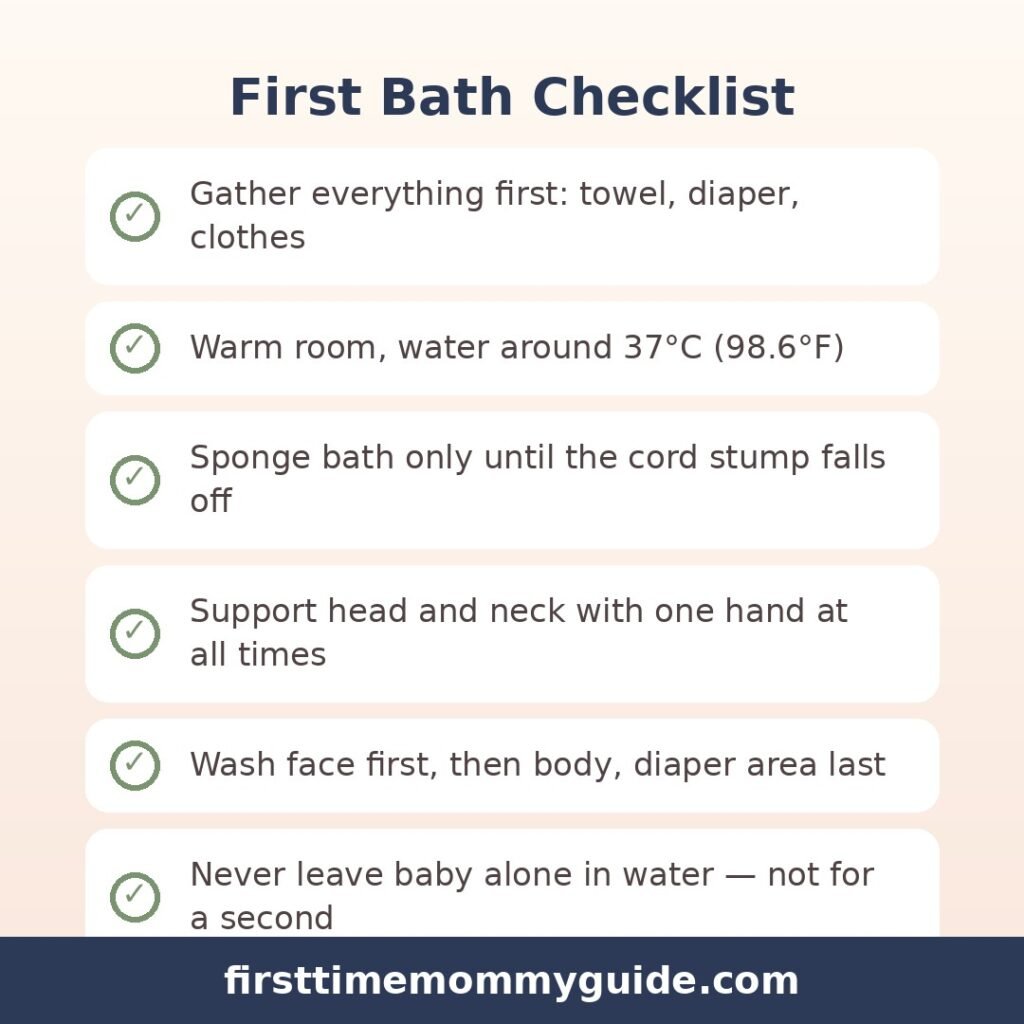
Gather everything before you start. This is not just convenience — it is safety. You cannot leave a wet baby alone to fetch a towel.
- A baby bathtub, basin, or clean sink (for tub baths) or a bowl of warm water (for sponge baths)
- Two soft washcloths — one for washing, one for rinsing, plus a spare
- A hooded towel (or two regular towels — one to dry, one to wrap)
- Mild, fragrance-free baby soap or cleanser — a tiny amount; plain water is fine for most of the body
- A clean diaper and fresh clothes, laid out and ready
- Cotton balls or a soft cloth for eyes and ears
- A bath thermometer (optional but reassuring for first-timers)
- A non-slip mat if using a sink
- Baby lotion or oil (optional, for after the bath if skin is dry)
Keep everything within arm’s reach of where you will bathe. Experienced parents lay it all out like a surgical tray. There is no prize for improvising mid-bath with a wet, crying baby in your arms.
Bath Water Temperature: Getting It Exactly Right
The safe range for newborn bath water is warm, not hot — around 37°C (98.6°F), roughly body temperature. Children’s health guidance (KidsHealth) puts the range at 90–100°F (32–37.8°C) and recommends testing with the inside of your wrist or elbow, which are more sensitive to heat than your hands.
Practical tips:
- Use your elbow or inner wrist to test. Dip it in and hold for a few seconds. The water should feel comfortably warm, not hot.
- Use a bath thermometer if you are nervous. It removes all guesswork and is cheap reassurance for the first weeks.
- Swirl the water before testing — hot and cold spots form in standing water.
- Set your home water heater to 120°F (49°C) or lower. This is an AAP-recommended scald-prevention step that protects the whole household, not just bath time.
- Fill the tub before your baby goes in, and never add hot water while your baby is in the tub.
- Depth: 2–3 inches in a baby tub. That is enough to keep your baby warm and clean without any drowning risk from depth — though depth is never the real risk; inattention is.
If the water cools during the bath (it will, slowly), do not top it up with hot water while your baby is in it. Lift your baby out, adjust, retest, and put them back — or just finish up. Baths should be short anyway.
How to Give a Sponge Bath: Step by Step
Choose a warm room without drafts, and a safe, flat surface — a changing table (with the safety strap on), a bed, or the floor. Lay a thick towel down first.
- Fill a bowl with warm water (around 37°C / 98.6°F). If using soap, add a tiny squirt of mild, fragrance-free baby cleanser to the water — or keep one washcloth soapy and one plain.
- Undress your baby and wrap them in a towel, leaving only the area you are washing exposed. This keeps them warm throughout.
- Start with the eyes. Using a clean cotton ball or a corner of a plain-water washcloth, wipe each eye from the inner corner outward. Use a fresh corner or ball for each eye.
- Wash the face. With plain water only (no soap on the face), gently wipe the forehead, cheeks, nose, and chin, and behind the ears. Pat dry.
- Wash the scalp. Dampen the head with the washcloth and, if needed, use a drop of mild baby shampoo. Rinse with plain water and pat dry. Cradle cap flakes are normal — do not scrub them off. (More on that in our guide to getting rid of cradle cap.)
- Wash the neck, arms, and hands. Milk and lint collect in neck folds — lift each fold gently and wipe. Wash between the fingers.
- Wash the chest and belly. Wipe gently, and avoid getting the umbilical cord stump wet. If it does get damp, pat it dry.
- Wash the legs and feet. Between the toes, behind the knees.
- Wash the diaper area last. Always wash the diaper area last, and for girls, wipe front to back. For boys, clean gently around the penis and scrotum; if circumcised, follow your pediatrician’s specific care instructions until healed.
- Pat completely dry, especially skin folds. Damp folds are a leading cause of irritation and yeast rashes in the first month. Then diaper and dress immediately — newborns chill fast.
The whole process takes 5–10 minutes. If your baby cries throughout, that is normal for the first few sponge baths. Keep your voice calm, work efficiently, and know that most babies learn to tolerate — and then enjoy — baths within a week or two.
How to Give a Tub Bath: Step by Step
Once the cord stump has fallen off and the area is healed, you can graduate to a real bath.
- Prepare everything first. Towel, washcloths, soap, diaper, clothes — all within arm’s reach. Fill the baby tub with 2–3 inches of warm water (around 37°C / 98.6°F) and test it with your elbow or a thermometer.
- Undress your baby and place them in the water right away so they do not get chilly. Lower them feet-first, supporting their head and neck with one hand and their bottom with the other.
- Keep one hand on your baby at all times. This is the single most important bath rule. Your supporting hand stays under their head and shoulders throughout the bath.
- Wash in order: face first, then body, diaper area last. Use a washcloth with plain water for the face, then a little mild soap for the rest of the body. Wash the scalp with a drop of baby shampoo, cupping water over the head carefully so it does not run into their eyes.
- Clean the creases. Neck folds, armpits, behind the ears, between fingers and toes, and the diaper area. These are where milk, lint, and moisture hide.
- Rinse with clean warm water using the washcloth or a small cup, pouring gently over the body (not the face).
- Lift out promptly. Babies cool quickly, and 5–10 minutes is plenty. Wrap immediately in a hooded towel, covering the head to retain warmth.
- Pat dry thoroughly, especially folds. Then diaper, dress, and cuddle. Bath time is done.
Holding a slippery baby: the technique
The fear of dropping a wet baby is universal and almost entirely unfounded once you know the hold: one hand always supports the head and neck from behind, with your forearm along their back, while your other hand does the washing. For very small babies, many parents find it easiest to keep the baby’s head resting in the crook of their supporting arm, like a football hold, with the body in the water. If you feel your grip slipping, do not panic — just hold tighter with the supporting hand, lift the baby slightly out of the water, and reposition. Wet skin is grippy, not frictionless, and you have more control than you think.

Bath Safety Rules Every Parent Must Know
These are non-negotiable, and every children’s hospital and the AAP emphasize them:
- Never leave your baby alone in water. Not for a second. Not to answer the phone, not to grab a towel, not to check the door. If you must leave, take your baby with you, wrapped in a towel. Babies can drown in as little as 1–2 inches of water, and drowning is silent — there is no splashing or crying.
- Keep one hand on your baby at all times during a tub bath.
- Do not use bath seats or bath rings as safety devices. They can tip, and they create a false sense of security. The AAP advises against relying on them.
- Set your water heater to 120°F (49°C) or lower to prevent scalds.
- Test the water every time with your elbow or a thermometer — never assume.
- Never put your baby in a tub while the water is still running. Temperature can change suddenly.
- Keep the room warm and draft-free so your baby does not chill.
- Keep all electrical items away from the bath area — hair dryers, phones on charge, heaters.
- Empty the tub immediately after the bath. Standing water is a hazard for mobile babies later, and a habit worth building now.
How Often Should You Bathe a Newborn?
The AAP advises that about three baths per week during the first year is enough, and most pediatric guidance agrees: 2–3 baths a week is plenty for a newborn. Daily baths are not necessary and can dry out delicate newborn skin, worsening eczema or dryness.

Between baths, keep your baby clean with spot-cleaning: wipe the face, neck folds, hands, and diaper area daily with a damp cloth. That covers the areas that actually get dirty. If your baby has a big spit-up or diaper blowout, a quick extra sponge bath is fine — the 2–3 times a week figure is a guide, not a limit.
As your baby grows and gets messier (solid foods, crawling, outdoor play), bath frequency naturally increases. Follow your baby’s needs and skin condition rather than a rigid schedule.
When to Bathe: Timing Tips
- Choose a calm, alert time — not right after a feed (spit-up risk), not when your baby is overtired or hungry.
- Evening baths work beautifully as a sleep cue. A warm bath, followed by a feed, a swaddle, and a story or song, becomes a powerful bedtime routine that signals “night is coming.” Many parents find the bath-to-bed sequence is the single most effective sleep tool they have.
- Morning baths suit babies who hate evenings or who are calmer earlier in the day. There is no medically better time — pick what fits your baby.
- Skip the bath on a chaotic day. A sponge wipe-down is a fine substitute. Bath time should be calm for both of you; a rushed bath helps no one.
If Your Baby Hates Baths
Many newborns cry through their first baths. This is normal and usually temporary. Strategies that help:
- Keep them warm. Most bath crying is about cold, not water. Warm the room, warm the towel (a quick tumble in the dryer), and move efficiently.
- Try a different time of day or a different bath setup — some babies prefer the sink to a baby tub, or a sponge bath to immersion.
- Lower them in slowly, talking or singing throughout. A sudden dunk is startling.
- Keep a warm washcloth on their tummy during a tub bath — the exposed skin above water gets cold fast, and a warm cloth helps.
- Bathe together. Some parents find that holding their baby in a warm adult bath (with another adult present to help with lifting in and out) calms a bath-hating baby. Never do this alone — you need hands free for safe lifting.
- Give it time. Most babies who hate baths at 2 weeks love them by 2 months. Do not force a long bath on a distressed baby; short and calm beats long and traumatic.
Newborn Skin Care After the Bath
Newborn skin is thin, sensitive, and prone to dryness. After the bath:
- Pat dry, do not rub. Rubbing irritates delicate skin.
- Apply a fragrance-free moisturizer if skin looks dry, especially in winter or dry climates. Plain petroleum jelly or a simple fragrance-free baby lotion works well.
- Leave the vernix alone in the first days — it absorbs naturally and protects the skin.
- Do not use adult soaps, scented products, or powders. Talcum powder is not recommended for babies — inhaled particles irritate little lungs.
- Watch for rashes. Mild newborn rashes (baby acne, milia, erythema toxicum) are common and usually harmless, but a rash with fever, spreading redness, or blisters needs a pediatrician’s look.
- Umbilical cord care: keep the stump clean and dry, fold the diaper below it, and let it fall off on its own. Call your pediatrician for redness spreading from the stump, foul-smelling discharge, or active bleeding.
If your baby’s skin is very dry or eczema-prone, shorter, less frequent baths with lukewarm water and immediate moisturizing (the “soak and seal” approach) usually help — and your pediatrician can recommend specific products.
Bath Time and Sleep: Building the Routine
Bath time earns its place in the bedtime routine because it works on several levels at once: warm water relaxes muscles, the sensory experience tires a baby out in a good way, and the consistent sequence teaches your baby what comes next. A simple version:
- Bath (5–10 minutes, warm room, calm voice)
- Massage (a minute or two of gentle lotion massage while dressing)
- Feed (the post-bath feed is often the calmest of the day)
- Swaddle and song (or story)
- Bed (drowsy but awake, on their back)
If your baby’s sleep is a puzzle overall, our guides to newborn day-night confusion and getting a baby who only sleeps when held into their bassinet cover the wider picture.
Bath Products: What to Buy and What to Skip
The baby aisle is overwhelming, and most of it is unnecessary. Here is what actually earns its place:
Worth buying: a simple baby bathtub (or use a clean sink), a couple of soft washcloths, two hooded towels, a mild fragrance-free baby cleanser, a bath thermometer if you want the reassurance, and a non-slip mat for sink baths. That is the complete list. Everything else is optional.
Nice but optional: a bath kneeler or cushion for your knees, a rinsing cup, a soft sponge, and a gentle baby lotion for after the bath. A baby bathrobe is adorable and genuinely useful in winter for keeping a freshly bathed baby warm while you get the diaper and clothes sorted.
Skip for now: bubble baths and bath toys (your newborn does not need them, and scented products can irritate skin), bath seats and rings (unsafe as a safety device, as covered above), fancy hooded towel sets in multiples (two towels are enough), and any product promising to make bath time “tear-free” beyond a standard mild baby shampoo — a tiny amount of shampoo kept away from the eyes does the job. Also skip powders of any kind; loose powder near a baby’s face is a breathing hazard, and modern guidance advises against it entirely.
One more buying tip: choose fragrance-free everything for the first months. Newborn skin reacts more easily to fragrances and dyes than older babies’ skin, and “gentle” on the label does not always mean fragrance-free. Check the ingredients list, not just the marketing on the front.
Frequently Asked Questions About a Newborn’s First Bath
1. When can I give my newborn their first bath at home?
Sponge baths from day one are fine. Wait for a tub bath until the umbilical cord stump has fallen off and healed, usually 1–2 weeks after birth.
2. What temperature should newborn bath water be?
Around 37°C (98.6°F) — warm, not hot. Test with your elbow or inner wrist, or use a bath thermometer. The safe range is roughly 32–37.8°C (90–100°F).
3. How often should I bathe my newborn?
Two to three times a week is plenty. Spot-clean the face, neck folds, hands, and diaper area daily between baths.
4. Can I bathe my baby before the cord falls off?
Only sponge baths. Do not submerge your baby in water until the cord stump has fallen off and the area has healed.
5. How much water should I put in the baby tub?
Two to three inches is enough. More water does not mean cleaner — it means harder to hold your baby safely.
6. Should I use soap on my newborn?
A tiny amount of mild, fragrance-free baby cleanser is fine for the body. Use plain water only on the face. Most of the time, water alone cleans a newborn perfectly well.
7. What if my baby cries during every bath?
Very common in the first weeks. Keep the room and towel warm, move efficiently, try a different time of day, and keep baths short. Most babies learn to enjoy baths within a few weeks.
8. Can I leave my baby alone in the bath for a few seconds?
No — never, not even for a second. Babies can drown silently in 1–2 inches of water. If you must leave, take your baby with you.
9. Are bath seats safe for newborns?
No — do not rely on bath seats or rings. They can tip and create a false sense of security. Always keep a hand on your baby.
10. Should I bathe my baby in the morning or evening?
Whichever suits your baby. Evening baths work well as a sleep cue, but morning baths suit babies who are calmer earlier. There is no medically better time.
11. What should I do if water gets in my baby’s ears?
Do not worry — a little water in the outer ear is harmless. Tilt the head gently to let it drain and pat the outer ear dry. Never insert cotton swabs into the ear canal.
12. How do I clean my baby’s umbilical cord stump?
Keep it clean and dry, fold the diaper below it, and let it fall off naturally. Call your pediatrician for spreading redness, foul-smelling discharge, or active bleeding.
13. Can I bathe my baby with eczema?
Yes, with adjustments: shorter baths, lukewarm water, gentle fragrance-free cleanser, and moisturizer immediately after patting dry. Ask your pediatrician for product recommendations if eczema is significant.
14. Do I need a special baby bathtub?
Not necessarily — a clean sink with a non-slip towel works well for small babies. A baby tub is convenient and inexpensive, and it gives you a dedicated, safe setup.
15. What if my baby poops in the bath?
It happens to everyone. Lift your baby out, empty and rinse the tub, and start again with fresh water if you like — or call it done for today. No drama required.
16. Should I wash my newborn’s hair every bath?
Not necessary. A gentle wash once or twice a week is plenty unless the scalp is visibly dirty or cradle cap is present. Use a drop of mild baby shampoo and rinse carefully.
17. Can my partner and I bathe the baby together?
Absolutely — and for the first few baths, it is a great idea. One person holds, one washes. It is calmer for everyone, including the baby.
18. When can my baby have a bath in the big tub?
Once your baby can sit up independently (around 6 months) and you can supervise closely, a shallow bath in the big tub with a non-slip mat is fine. The same never-leave-alone rule applies at every age.
Conclusion
Your newborn’s first bath feels like a big deal because it is a first — but it is also just a bath. Sponge baths until the cord heals, warm water around body temperature, everything ready before you start, one hand on your baby always, and never, ever leaving them alone in water. That is the whole system. The first bath may involve crying (theirs, possibly yours), and the tenth bath will feel routine. Before long, bath time will be the warm, giggly, splashy part of the day you both look forward to.
The Bottom Line
Start with sponge baths, graduate to a tub bath once the cord stump heals, keep water at body temperature, and keep baths short, warm, and supervised. Two to three baths a week is plenty, and an evening bath makes a wonderful sleep cue — especially paired with a good swaddle and a calm bedtime routine. For the noisy nights that follow, our guide to newborn grunting in sleep will reassure you, and if bath time reveals cradle cap, see our cradle cap guide.
This article is for general information only and is not medical advice. If you are worried about your baby’s cord stump, skin, or health, contact your pediatrician.

Dilawar Mughal
Founder and editor, First Time Mommy Guide
I research every guide against what the NHS, the AAP and the WHO publish, then write it in plain English — because most new parents are reading with one hand free, not comparing clinical guidelines. I'm not a doctor or a midwife. Every health claim on this site is sourced and linked so you can check it yourself, and anything urgent belongs with your health visitor or GP, not a blog.


