General information, not medical advice. Every baby is different — if anything worries you, speak to your midwife, health visitor or GP rather than waiting.
There is a moment every new parent waits for: the day your baby stops being a milk-only eater and takes their very first taste of real food. It is exciting, messy, and a little nerve-wracking all at once. But how do you know when that moment has actually arrived?
Starting solids too early can strain your baby's developing gut and increase choking risk. Starting too late can delay important nutrition, especially iron, and slow the development of chewing skills. The good news is that babies tell you when they are ready, if you know what to look for.
This guide walks you through every readiness sign, the recommended timing, the best first foods, and the mistakes to avoid.
Quick Answer: When Can Babies Start Solids?
Most babies are ready for solid foods at around 6 months of age. The American Academy of Pediatrics (AAP) and the World Health Organization (WHO) both recommend exclusive breastfeeding for the first six months, then introducing complementary foods while continuing milk feeds. Age alone is not enough, though: your baby should also show the physical readiness signs below.
The key signs are sitting up with minimal support, good head and neck control, showing interest in food, opening their mouth when food approaches, and losing the tongue-thrust reflex that pushes food back out. When several of these signs appear together, usually around six months, your baby is ready to explore food.
The 10 Signs Your Baby Is Ready for Solids
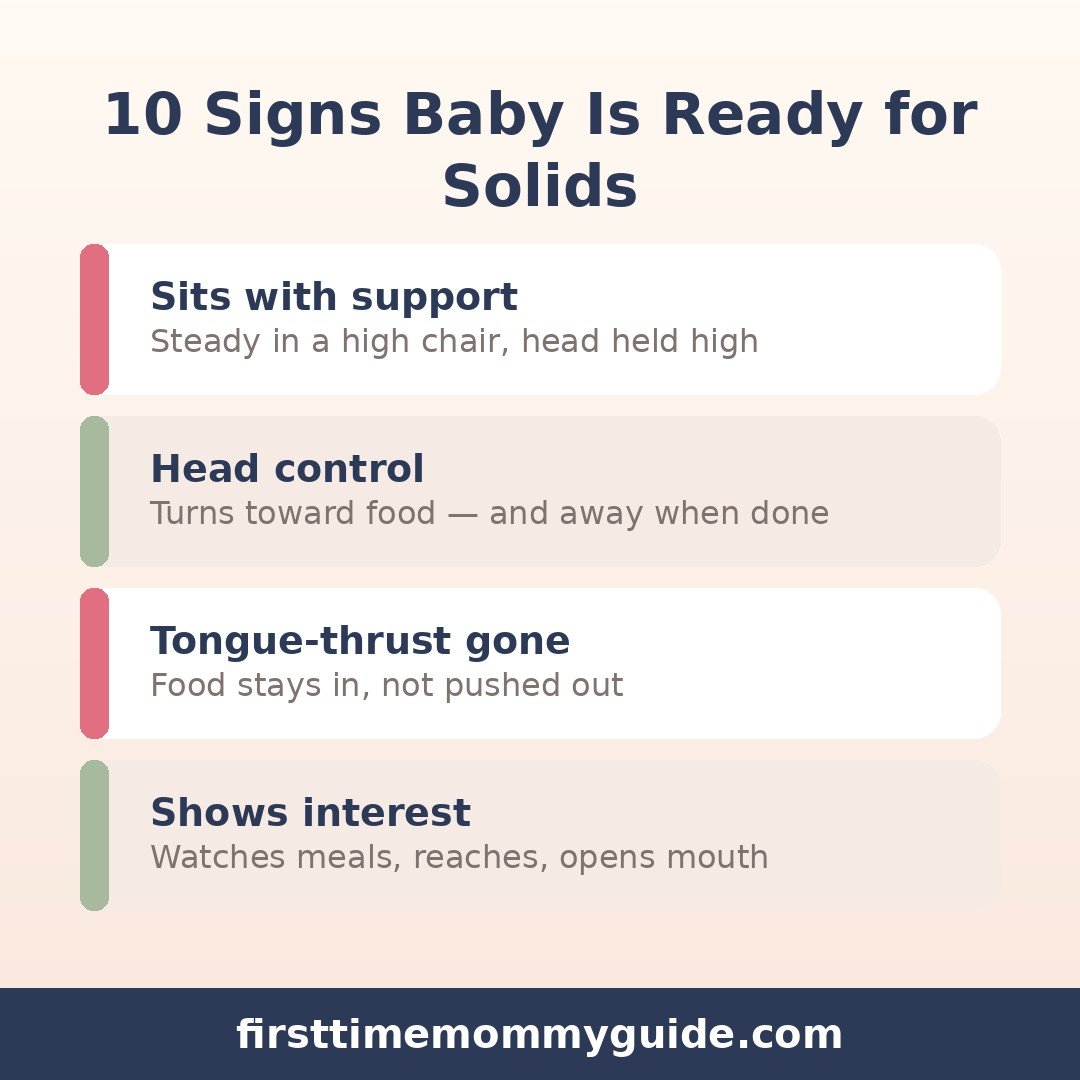
1. Sitting Up With Minimal Support
Your baby should be able to sit in a high chair or supported seat with good posture and hold their head steady. This matters for safety: an upright position lets your baby swallow safely and reduces choking risk. If your baby still slumps to one side or cannot hold their head up, they are not ready yet.
Sitting does not need to be perfect or independent. Sitting with a little support, such as a high chair with good padding, counts. The test is whether your baby can stay upright and steady while eating, not whether they can sit alone on the floor for minutes.
2. Strong Head and Neck Control
Good head control is essential for safe eating. Your baby should hold their head upright and steady, and be able to turn their head toward food or away from it. Turning away is how babies say "no more," and it is an important safety signal.
If your baby's head still wobbles or flops forward when seated, wait a few more weeks. Head control develops quickly at this age, and a short delay costs nothing.
3. Loss of the Tongue-Thrust Reflex
Young babies have a reflex that pushes their tongue forward whenever something touches their lips. This reflex protects them from choking, but it also pushes purees right back out. As babies approach six months, this reflex fades, and they can move food from the front of the mouth to the back to swallow.
If every spoonful comes straight back out on your baby's tongue, the reflex may still be active. Wait a week or two and try again. There is no rush, and forcing food past this reflex only creates frustration.
4. Showing Interest in Your Food
Does your baby watch you eat with wide eyes, reach for your plate, or open their mouth when you take a bite? This interest is one of the most delightful readiness signs. Babies who are ready for solids are often fascinated by mealtimes and lean toward food.
Interest alone is not enough, since babies are curious about everything, including your phone and keys. But combined with the physical signs above, genuine food interest is a strong green light.
5. Opening Their Mouth for the Spoon
A ready baby opens their mouth when food approaches, almost like a little bird. This shows they understand that something is coming and are willing to take it in. Babies who turn away, clamp their mouth shut, or cry at the sight of a spoon are telling you they are not ready.
Respect these signals. Mealtimes should be positive from the start, and pressuring a reluctant baby can create feeding battles that last for months.
6. Ability to Move Food and Swallow
Once food enters the mouth, a ready baby can move it to the back of the tongue and swallow, rather than letting it dribble out. Early attempts will be messy, and that is normal. Some dribbling is expected as babies learn a brand-new skill.
The difference between learning mess and unreadiness is progress. If your baby gradually swallows more over several days, they are learning. If nothing ever stays in, give it more time.
7. Doubled Birth Weight (Roughly)
Many guidelines mention that babies are often ready when they have roughly doubled their birth weight, usually around 13 pounds or more. This is a rough marker, not a strict rule. Some babies double early and are not otherwise ready, while others are ready slightly before doubling.
Use weight as one data point among many, not as the deciding factor. Your pediatrician tracks growth at checkups and can advise on your baby's specific trajectory.
8. Increased Appetite and Milk Feeds Not Satisfying
Some parents notice their baby seems hungrier, feeding more often or finishing bottles quickly and still seeming unsatisfied. This can be a readiness hint, but it is also a normal part of growth spurts. Hunger alone is not a reliable sign.
Be careful here: many parents mistake a growth spurt for readiness. If your baby is under six months and suddenly hungry, they may just need more milk for a few days. Growth spurts pass, and extra milk is the right answer until the other readiness signs appear.
9. Reaching for and Grabbing Objects
The ability to grasp objects and bring them to the mouth is a motor skill that supports self-feeding. Babies who can pick up a soft finger food and guide it to their mouth are showing the coordination needed for baby-led weaning approaches.
This skill develops alongside sitting and head control. If your baby is grabbing everything in sight, they are building the motor foundation that eating requires.
10. Age Around 6 Months
Age matters because the gut and kidneys mature over the first six months. Before four months, a baby's digestive system is not ready for solids, and early introduction is linked to higher allergy and obesity risks in some studies. The AAP advises against solids before four months.
Most babies hit the full set of readiness signs between five and seven months. If your baby shows all the signs at five and a half months, discuss it with your pediatrician. If they are not ready until seven months, that is also perfectly normal.
Readiness Checklist: Is Your Baby Ready?
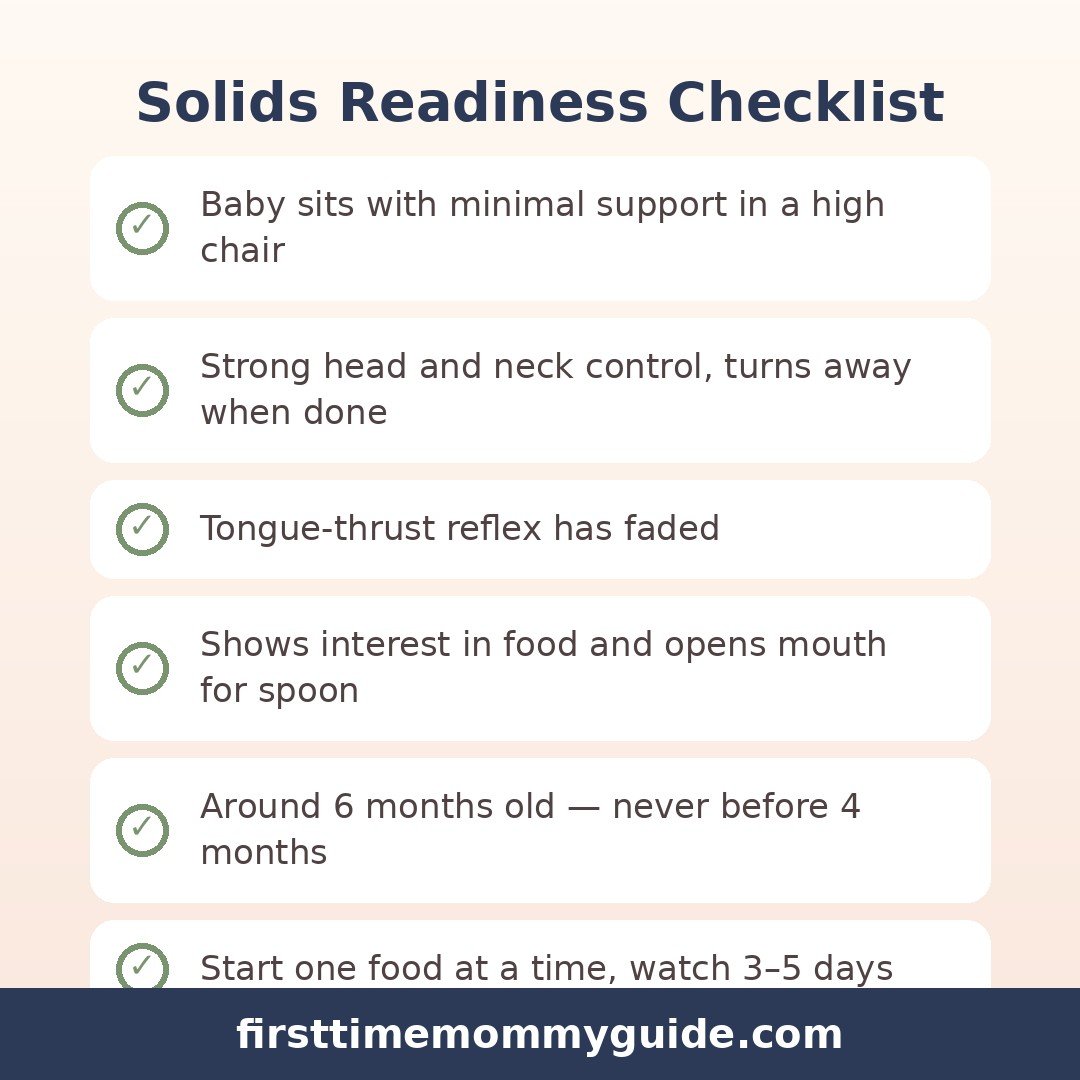
| Sign | Ready? | Notes |
|---|---|---|
| Sits with minimal support | ☐ | Steady in high chair |
| Holds head up steadily | ☐ | Turns head toward and away from food |
| Tongue-thrust reflex faded | ☐ | Food stays in, not pushed out |
| Shows interest in food | ☐ | Watches meals, reaches for food |
| Opens mouth for spoon | ☐ | Willing, not forced |
| Can swallow (with practice) | ☐ | Messy at first is normal |
| Around 6 months old | ☐ | Not before 4 months |
| Doubled birth weight (rough) | ☐ | One data point, not decisive |
If you can check most of these boxes, your baby is likely ready. If only one or two apply, wait and recheck in a couple of weeks. Readiness is a package deal, not a single sign.
Starting Solids Too Early: The Risks
Introducing solids before four months is not recommended by the AAP or WHO. A young baby's gut is more permeable, which may increase allergy risk, and their kidneys cannot yet handle the extra solute load from foods. Early solids can also displace milk, which is your baby's main source of nutrition in the first year.
Choking risk is higher too, since head control and swallowing coordination are still developing. Some studies have also linked very early solids with higher later obesity risk, although the evidence is mixed. The bottom line from pediatric guidance is clear: wait for readiness, and do not start before four months.
There is one exception worth knowing. For babies at high risk of peanut allergy, current guidance recommends introducing peanut-containing foods around four to six months, under pediatric guidance. This is a specific medical recommendation, not a general green light for solids, so discuss it with your doctor.
Starting Solids Too Late: The Risks
Delaying solids well beyond six or seven months carries its own risks. Babies' iron stores, built up before birth, begin to run low around six months. Iron-rich foods become important at this stage, and milk alone no longer meets iron needs.
Late introduction can also delay oral motor development. Babies need practice with textures to learn chewing and swallowing, and late starters sometimes struggle with lumpy foods later. There is also evidence that introducing allergenic foods within a certain window may reduce allergy risk, which is another reason not to delay unnecessarily.
If your baby is approaching seven months and still not showing readiness signs, talk to your pediatrician. Most late starters catch up quickly once they begin, and your doctor can rule out any underlying issue.
First Foods to Try (and What to Avoid)
Best First Foods
Iron-fortified infant cereals, pureed meats, and iron-rich vegetables are excellent first foods. Pureed sweet potato, carrot, squash, and peas are gentle on the stomach and naturally sweet. Mashed avocado and banana are soft, nutritious, and easy to prepare.
Iron-fortified cereals mixed with breast milk or formula are a classic starting point.
Offer one new food at a time and wait three to five days before introducing the next. This makes it easier to spot any reaction. Once several foods are tolerated, you can start combining them into simple meals.
For a deeper look at allergenic foods, read our guide to introducing allergens to baby. It covers peanuts, eggs, and other allergens with current pediatric guidance.
Foods to Avoid in the First Year
Honey is the big one: never give honey to a baby under twelve months, because it can carry spores that cause infant botulism. Whole grapes, nuts, popcorn, raw carrots, and other hard, round foods are choking hazards and should be avoided or prepared safely. Cow's milk as a main drink should wait until twelve months, although small amounts in cooking are fine after six months.
Avoid added sugar and salt, fruit juice, and unpasteurized products. Keep portions small and let your baby guide how much they eat. In the first months of solids, food is about exploration and learning, not calories; milk remains the main nutrition source until around twelve months.
Purees vs Baby-Led Weaning
Purees are the traditional route: smooth, spoon-fed foods that gradually increase in texture. Baby-led weaning skips purees and offers soft finger foods that babies feed themselves from the start. Both approaches can work well, and many families combine them.
Purees give parents more control over intake and are reassuring for nervous first-timers. Baby-led weaning encourages independence and may help babies learn to self-regulate appetite. The evidence does not clearly favor one approach for nutrition or growth, so choose what fits your family and your baby's temperament.
Whichever route you choose, always supervise meals, keep your baby upright, and learn the difference between gagging and choking. Gagging is noisy, involves coughing and retching, and is a normal part of learning. Choking is silent, with no air movement, and needs immediate action.
Consider taking an infant first aid course before starting solids.

A Simple First Week of Solids
Day 1–2: One Taste, Once a Day
Offer a teaspoon or two of a single puree, such as iron-fortified cereal or sweet potato, at a calm time of day. Mid-morning often works well, when your baby is alert but not overtired. Do not worry if most of it ends up on the bib or floor.
Day 3–5: Same Food, Growing Portions
Repeat the same food, gradually increasing to a few tablespoons if your baby is enthusiastic. Watch for reactions such as rash, vomiting, or unusual fussiness. Most reactions appear within hours, though some take a day or two.
Day 6–7: Introduce a Second Food
If the first food was well tolerated, introduce a second one, such as pureed pear or carrot. Continue the first food as well, so your baby's menu grows gradually. By the end of the first month, most babies enjoy several foods across one or two meals a day.
Remember that milk feeds continue unchanged. Solids complement milk in the first year; they do not replace it. Offer solids after a milk feed at first, so your baby is not too hungry or frustrated while learning.
Common Mistakes When Starting Solids
One common mistake is forcing the spoon when a baby turns away. This creates negative associations with mealtimes and can lead to food refusal. Another is starting with fruit juice or sweetened foods, which trains a preference for sweetness and adds empty calories.
Some parents introduce too many foods at once, making it impossible to identify the cause of a reaction. Others delay allergenic foods out of fear, even though current guidance encourages timely introduction under pediatric advice. Still others compare their baby to other babies and panic when a neighbor's child eats more.
Every baby's pace is different, and comparison is the thief of joy in feeding. Focus on your baby's signals, keep mealtimes relaxed, and celebrate small wins like a first successful swallow or a joyful mess.
What If My Baby Refuses Solids?
Refusal is common and usually temporary. Some babies need ten or more exposures to a new food before accepting it. Keep offering without pressure, vary the texture or temperature, and eat together so your baby sees you enjoying food.
Try different times of day, since a tired or overly hungry baby is less willing to experiment. If refusal persists beyond a few weeks, or if your baby gags excessively, loses weight, or shows distress at every meal, discuss it with your pediatrician. Feeding difficulties occasionally signal oral motor issues or reflux that deserve attention.
Also consider whether your baby is dealing with other discomforts. Teething, gas, or a sore bottom can all dampen appetite. Our guides to baby teething signs and remedies and baby gas relief remedies may help you rule out common culprits.
Feeding Gear You Actually Need
You need less gear than the baby industry suggests. A sturdy high chair with a footrest, a few soft-tipped spoons, small bowls, bibs, and a washable splat mat cover the basics. Silicone-tipped spoons are gentle on gums, and shallow bowls make scooping easier.
Skip elaborate gadget collections at first. A fork for mashing, a small steamer or pot, and an ice cube tray for freezing puree portions are genuinely useful. Sippy cups can wait until your baby shows interest, usually around six to nine months.
How Solids Affect Sleep, Stools, and Diapers
Starting solids changes your baby's stools. They become firmer, darker, and smellier, and you may see undigested bits of food. This is normal and not a cause for worry.
Some babies become mildly constipated when solids begin; offering water in small sips and including pureed prunes or pears can help.
Sleep is a mixed bag. The old myth that solids help babies sleep through the night is not supported by evidence. Some babies sleep the same, some wake more due to digestive adjustment, and some settle better once iron needs are met.
If sleep changes, remember that 4-month sleep regression and developmental leaps also affect sleep at this age.
Diaper rash can flare when new foods change stool composition. If you notice redness after starting a food, step up your barrier cream routine and change diapers promptly. Our guide to diaper rash causes and treatment covers this in detail.
Sample Feeding Schedule: Solids and Milk at 6 to 9 Months
A simple rhythm helps more than a rigid timetable. Most babies at this stage take milk feeds on demand and add one or two solid meals a day, gradually building to three meals by nine months. The schedule below is a flexible example, not a prescription, and your baby's appetite will vary day to day.
| Time | What | Notes |
|---|---|---|
| Morning wake-up | Milk feed | Breast milk or formula, on demand |
| Mid-morning | First solid meal | Iron-fortified cereal or puree, a few tablespoons |
| Midday | Milk feed | On demand |
| Afternoon | Second solid meal (from 7 months) | Pureed vegetables, fruit, or soft finger foods |
| Evening | Milk feed | On demand |
| Bedtime | Milk feed | Keep the bedtime feed calming and unhurried |
Do not stress about exact times or amounts. Some days your baby will devour a full bowl, and other days they will smear it everywhere and drink only milk. Both days are fine.
The goal in these early months is exposure, exploration, and learning to eat, not hitting a calorie target.
If you are also working on feeding rhythms, our guide to newborn feeding schedule covers the milk-only months in detail. For older babies, the same principle applies: watch your baby, not the clock.
Frequently Asked Questions
What age should I start my baby on solids?
Most babies are ready at around 6 months, when they show the physical readiness signs in this guide. The AAP and WHO recommend exclusive milk feeding for the first six months. Do not start before 4 months, and discuss timing with your pediatrician if your baby is not ready by 7 months.
Can I start solids at 4 months?
Some babies show readiness signs at 4 to 5 months, and your pediatrician may approve an earlier start in specific cases. In general, though, waiting until around 6 months is recommended. If you are considering an early start, discuss it with your doctor rather than deciding alone.
What is the very best first food for a baby?
Iron-fortified infant cereal, pureed meat, or iron-rich vegetables are all excellent first foods. Sweet potato, carrot, and squash are popular because they are sweet, smooth, and easy to digest. There is no single magic first food; variety and iron content matter more than the exact choice.
How do I know if my baby is allergic to a food?
Watch for hives, swelling of the lips or face, vomiting, or difficulty breathing within minutes to two hours of eating. Mild rashes or loose stools can also occur. If you see signs of a serious reaction, seek medical help immediately.
For mild concerns, stop the food and contact your pediatrician.
Should I start with vegetables before fruit?
This is a popular myth, but there is no evidence that starting with fruit makes babies prefer sweet foods. Babies naturally like sweet tastes, and offering a variety of flavors from the start is what matters. Offer vegetables, fruits, and iron-rich foods in any order that works for your family.
How much solid food should a 6-month-old eat?
Start with a teaspoon or two once a day, building to a few tablespoons over weeks. By 7 to 8 months, most babies eat two to three small meals a day. Let your baby guide the amount; some days they will eat eagerly, other days barely anything, and both are normal.
Does starting solids help my baby sleep through the night?
No, there is no good evidence that solids improve night sleep. Sleep is driven by development, not stomach fullness. Some babies sleep the same after starting solids, and some wake more during digestive adjustment.
Focus on sleep routines rather than solids for sleep.
What is the difference between gagging and choking?
Gagging is noisy and involves coughing, retching, and sometimes vomiting; it is a normal protective reflex while learning to eat. Choking is silent, with little or no air movement, and the baby cannot cry or cough. Learn infant first aid before starting solids so you can respond confidently.
Can I give my baby water when starting solids?
Yes, small sips of water with meals are fine from around 6 months. Offer a few ounces a day in an open or sippy cup. Water should not replace milk feeds, and juice is not recommended for babies under twelve months.
What if my baby only wants milk and refuses solids?
This is common in the early weeks. Keep offering solids without pressure, and keep milk feeds as the main nutrition source. Most babies warm up to solids gradually.
If refusal lasts many weeks or your baby is losing weight, talk to your pediatrician.
Should I make my own baby food or buy jars?
Both are fine. Homemade purees are cheaper and let you control ingredients, while jars are convenient and nutritionally reliable. Many families do a mix.
If you buy jars, check labels for added sugar and salt, which should be avoided.
When can my baby try finger foods?
Soft finger foods can start at around 6 months if your baby shows readiness, especially with baby-led weaning. Start with very soft pieces, such as steamed carrot sticks, banana slices, or avocado strips. Always supervise, and make pieces large enough to grasp but soft enough to mash with gums.
Do I need to wait 3 days between new foods?
The 3-to-5-day wait between new foods is a practical guideline that helps identify reactions. It is especially useful for allergenic foods. Once your baby tolerates several foods, you can introduce new ones more quickly, but keep the wait for high-allergen foods unless your doctor advises otherwise.
Can teething affect starting solids?
Teething can make babies fussier and less interested in food, but it does not prevent starting solids. If your baby is teething, offer cool, soft foods and be patient. Teething discomfort usually passes in a few days, and appetite returns.
What should I do if my baby has a reaction to a food?
Stop the food immediately. For mild symptoms such as a small rash, contact your pediatrician for advice. For serious symptoms such as swelling, breathing difficulty, or widespread hives, seek emergency help right away.
Keep a simple food diary to share with your doctor.
Is baby-led weaning safe?
Baby-led weaning can be safe when done correctly, with soft foods, upright seating, and constant supervision. It is not suitable for babies who cannot sit well or who have swallowing difficulties. Discuss it with your pediatrician, and learn the difference between gagging and choking before you begin.
How do I store homemade baby food safely?
Refrigerate purees for up to 48 hours, or freeze them in ice cube trays for up to a month. Thaw in the refrigerator, not at room temperature, and discard any uneaten food from your baby's bowl. Never refreeze thawed puree.
Should I still breastfeed or formula-feed after starting solids?
Yes, milk remains your baby's main source of nutrition until around twelve months. Solids complement milk; they do not replace it. Continue breastfeeding or formula feeding on demand, and offer solids after milk feeds in the early months.
Conclusion: Trust the Signs, Not the Calendar
The decision to start solids is not about hitting an exact birthday. It is about watching your baby: the steady sitting, the curious eyes at your plate, the open mouth, the fading tongue-thrust reflex. When those signs arrive together, usually around six months, your baby is ready for the delicious, messy adventure of real food.
Start slowly, offer one food at a time, and keep mealtimes joyful and pressure-free. Milk stays the star of the show for now, and solids are the supporting act. If you are ever unsure about timing, allergies, or your baby's progress, your pediatrician is the best guide.
For what comes next, explore our guides on introducing allergens to baby and how to swaddle a newborn for the earliest months.
And if your baby's new diet brings tummy troubles, baby gas relief remedies and colic symptoms and soothing are there to help.
This article is for general information only and is not medical advice. If you have concerns about your baby's feeding or development, talk to your pediatrician.

Dilawar Mughal
Founder and editor, First Time Mommy Guide
I research every guide against what the NHS, the AAP and the WHO publish, then write it in plain English — because most new parents are reading with one hand free, not comparing clinical guidelines. I'm not a doctor or a midwife. Every health claim on this site is sourced and linked so you can check it yourself, and anything urgent belongs with your health visitor or GP, not a blog.


