
General information, not medical advice. Every baby is different — if anything worries you, speak to your midwife, health visitor or GP rather than waiting.
Every parent waits for it. That one magical moment when your baby looks up at you and says something that sounds, unmistakably, like a real word.
For many families, it is “mama” or “dada.” For others, it is “ball,” “dog,” or even “no.” Whenever it arrives, it feels enormous, because it is the first proof that all those months of talking, singing, and reading aloud have been sinking in.
But the waiting can also bring worry. Your friend’s baby said “mama” at nine months. Yours is eleven months and still mostly babbling. Is that normal? Is something wrong? Should you be doing more?
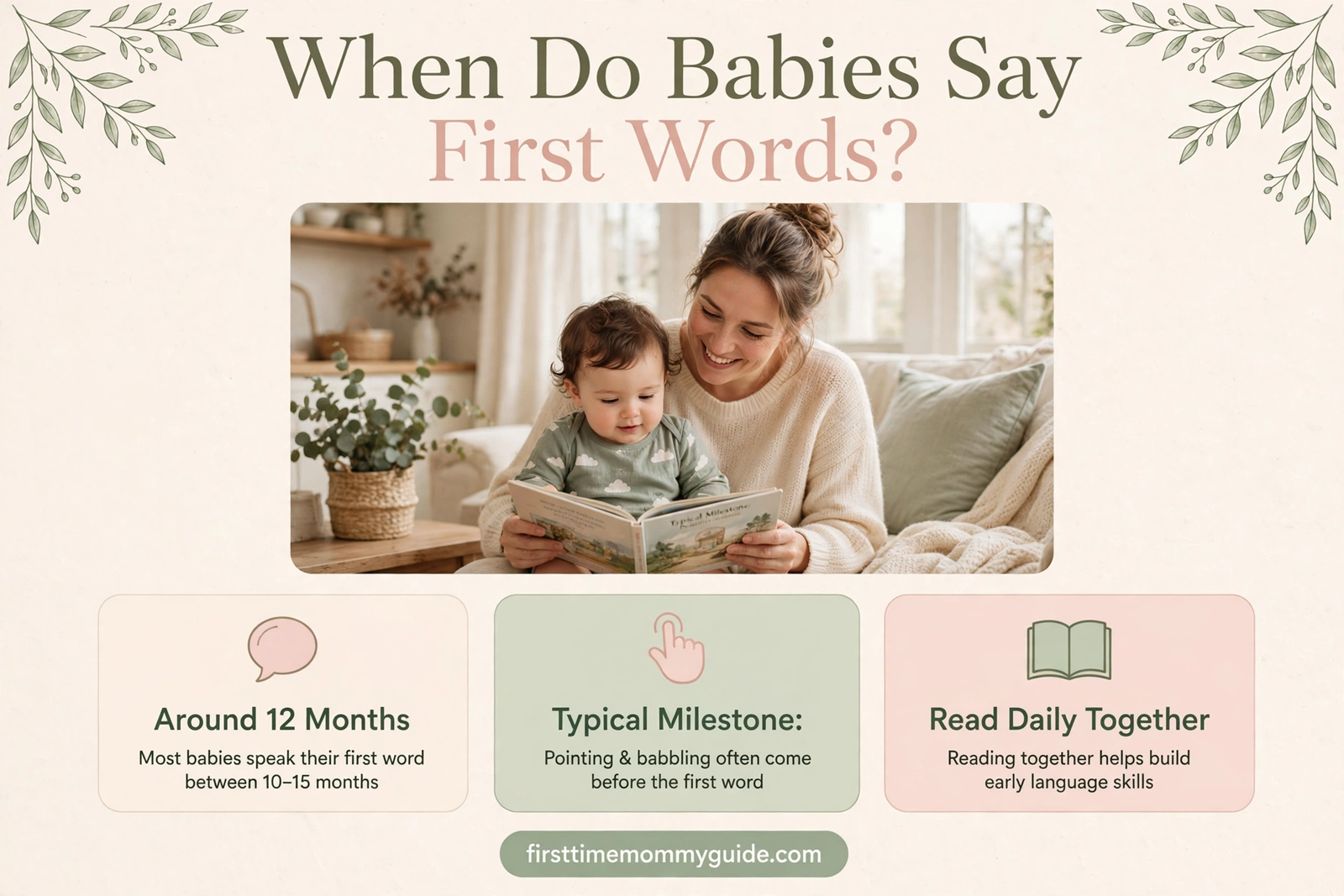
The short answer is reassuring: most babies say their first real word around their first birthday, usually between 10 and 14 months, and there is a very wide range of normal. Babbling, gestures, and understanding words all count as language development long before that first word arrives.
This guide walks you through the whole journey, month by month. You will learn what counts as a first word, what the typical timeline looks like, how hearing, gestures, and play all feed into speech, and simple, evidence-based ways to encourage talking at home.
You will also learn the red flags worth raising with your doctor, and how to tell the difference between a late talker who just needs time and a child who would benefit from extra support.
The Short Answer: When Do Babies Say First Words?
Most babies say their first meaningful word between 10 and 14 months of age. The average is around 12 months, right around the first birthday.
By “meaningful,” experts mean a word your baby uses on purpose, consistently, for the same thing. Saying “mama” while crying at 3 a.m. is not quite the same as looking at you and saying “mama” to get your attention. Both are lovely, but only the second counts as a true first word.
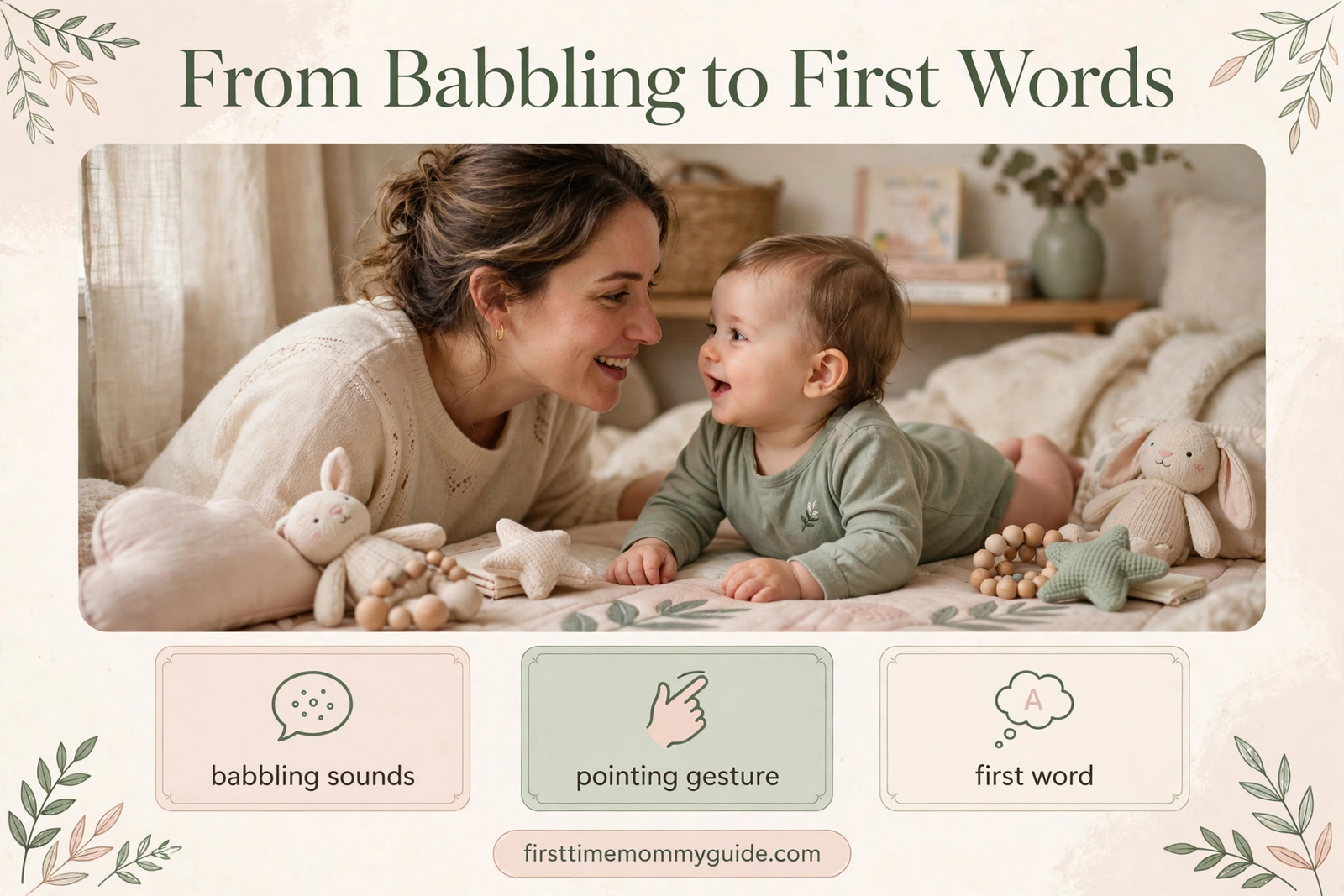
Before that first word, babies go through months of preparation. They coo, they babble, they imitate sounds, they point, wave, and shake their heads. All of that is language learning, even though it does not sound like English yet.
Some babies say a first word as early as 9 months. Others do not say one until 15 or 16 months and then suddenly explode into dozens of words within weeks. Both patterns can be completely normal, especially if understanding, gestures, and babbling are all progressing.
What matters most is the overall pattern, not a single date on the calendar. A baby who understands a lot, points, waves, and babbles with varied sounds is usually on track, even if the first clear word is a little late.
If you remember only one thing from this article, let it be this: first words are the tip of the iceberg. The months of listening, babbling, and gesturing underneath them matter just as much.
What Actually Counts as a First Word?
This question causes more confusion than almost any other milestone. Parents often wonder whether “dadada” counts, or whether a word only counts if strangers can understand it.
Speech-language experts generally count a sound as a word when it meets three tests. First, your baby says it consistently for the same person, object, or action. Second, they say it on purpose, not just by accident while babbling. Third, it sounds roughly the same each time, even if the pronunciation is not perfect.
By that test, “ba” for ball counts, if your baby says “ba” every time they see their ball. “Nana” for banana counts. “Mama” counts when it clearly means you, not just a sound made while hungry or tired.
Babble strings like “dadadada” or “mamamama” usually do not count on their own. Babies practise those sounds for months before they attach meaning to them. The moment meaning attaches is the moment babble becomes a word.
Pronunciation does not need to be perfect. Toddlers simplify words because their mouths are still learning to coordinate. “Wawa” for water, “gog” for dog, and “tup” for cup are all real words in a toddler’s world.
It also helps to keep a little list. Write down each new word and the date you first heard it used meaningfully. It is a lovely keepsake, and it is genuinely useful at check-ups if your doctor ever asks about vocabulary size.
The Language Timeline: Birth to 24 Months
Language development starts at birth, long before any words. Here is what typically happens, stage by stage, so you can see where your baby fits.
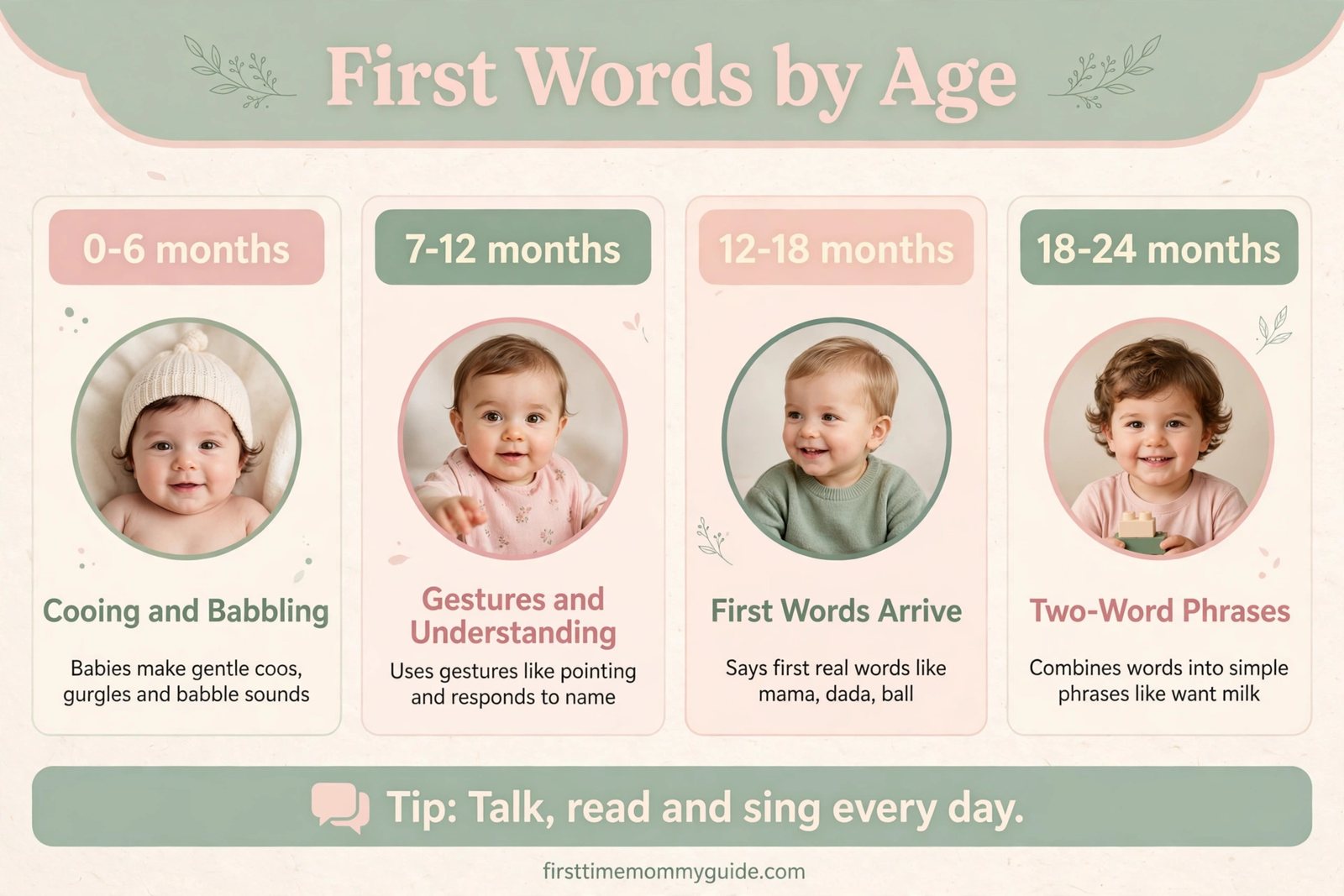
Birth to 3 months: listening and cooing
Newborns cry to communicate, and within weeks they start to coo. Cooing sounds like soft vowel sounds: “ooh,” “aah,” “eeh.” Babies also startle at loud sounds, calm when they hear a familiar voice, and turn toward sounds.
This is also when bonding through voice begins. Your baby learns your voice, your rhythm, and your tone. Talking to your newborn is never wasted, even though they cannot answer yet. If you enjoyed reading about early bonding, our guide to baby first smile development covers another early milestone that grows out of this same back-and-forth interaction.
4 to 6 months: babbling begins
Between 4 and 6 months, most babies start babbling. Early babbling is single syllables repeated: “ba-ba-ba,” “da-da-da,” “ma-ma-ma.” They also laugh, squeal, and make raspberries.
Babies at this age begin to respond to their name some of the time, and they enjoy vocal play. Copy their sounds back to them. That imitation game is one of the earliest conversations you will ever have.
7 to 12 months: real communication takes off
This is the busiest period for pre-word language. Babies combine syllables in new ways, imitate sounds and intonation, and begin to understand simple words like “no,” “bye-bye,” and their own name.
Gestures explode during this stage. Babies wave, point, clap, reach to be picked up, and shake their heads. Pointing is especially important: it shows your baby wants to share attention with you, which is a foundation for language.
Many babies say their first word in this window, often around 11 or 12 months. But many do not, and that is still normal. What matters is that babbling is varied, gestures are growing, and understanding is clearly improving.
This period overlaps with other big milestones. Just as babies learn to move, as described in our guide on when do babies start crawling, they also learn to communicate about the world they can now explore.
12 to 18 months: the first words arrive
By 15 months, most toddlers can say a handful of words besides “mama” and “dada.” By 18 months, many have around 10 to 20 words, though the range is wide: some have 5, some have 50.
Toddlers at this age understand far more than they can say. They follow simple instructions like “bring me the ball” or “wave bye-bye,” point to body parts when asked, and try to imitate new words, even if the attempt comes out garbled.
Word learning is often slow at first, then suddenly fast. Parents sometimes call this the “word explosion,” and it often happens between 18 and 24 months rather than right at the first birthday.
18 to 24 months: vocabulary grows fast
By 24 months, many toddlers use around 50 words and start joining two words together: “more milk,” “daddy go,” “big dog.” They can point to familiar objects in a book, follow two-step instructions, and name a few pictures.
Two-word phrases are the next big milestone after first words. They show your child is not just labelling things but starting to combine ideas, which is the beginning of grammar.
If your toddler is still mostly using single words at 24 months, that alone is not a reason to panic, but it is worth mentioning at their check-up, especially if understanding or gestures seem limited too.
Why “Mama” and “Dada” Usually Come First
There is a reason “mama” and “dada” dominate first-word lists around the world. They are built from the easiest sounds for a baby’s mouth to make.
The sounds “m,” “b,” “p,” and “d” are made with the lips and the front of the mouth, and they are among the first consonants babies can control. Add an open vowel like “ah,” and you get “ma-ma” and “da-da” almost for free during babbling.
Parents also reinforce these words constantly. When a baby babbles “mamama” and a delighted mum scoops them up, the baby learns that this sound gets a big reaction. Repetition and joy do the rest.
It is worth noting that early “mama” and “dada” are not always used correctly at first. Many babies call every adult “dada” for a while, or say “mama” when they want comfort from anyone. That is normal. Precise use comes with time and practice.
Other common early words include names for favourite people, pets, foods, and objects: “ball,” “dog,” “cat,” “milk,” “more,” “up,” “bye,” and “no.” Words for things a baby sees and wants every day are learned fastest, because they are practised most.
If your baby’s first word is something unexpected, like “car” or “duck,” enjoy it. It simply means that object captured their attention, and attention is the engine of word learning.
Babbling: The Rehearsal Before Words
Babbling deserves far more credit than it usually gets. It is not random noise. It is your baby rehearsing the sounds, rhythms, and mouth movements of speech.
Early babbling, around 4 to 6 months, is mostly single syllables. Later babbling, around 7 to 10 months, becomes more varied: babies mix consonants and vowels, change pitch, and start to sound as if they are having a conversation, even though no real words are in there yet. Experts call this “jargon babbling.”
You can support babbling simply by answering it. When your baby babbles, pause, look at them, and babble or talk back. This teaches turn-taking, which is the structure of every conversation they will ever have.
Try narrating babble back with a real word attached. If your baby says “ba-ba-ba” while looking at a ball, you can say, “Yes! Ball! Big ball!” You are giving meaning to their sound, which is exactly how words are born.
A baby who babbles less over time, or whose babbling suddenly stops, is worth mentioning to your doctor. Babbling should generally grow more varied with age, not shrink. A quiet baby who is also not gesturing or responding to sounds deserves a hearing check sooner rather than later.
Gestures Matter as Much as Words
Before babies talk, they gesture. And gestures are not a detour from language. They are part of it.
Pointing, waving, clapping, reaching, nodding, and shaking the head all show that a baby understands communication: that they can direct your attention, request something, or share excitement about something they see.
Research consistently finds that gesture use predicts later vocabulary. Babies who point a lot tend to learn words faster, because pointing creates moments when a parent naturally names the thing being pointed at. “Yes, that’s a bird! A big bird!”
Encourage gestures deliberately. Wave when you say bye-bye. Point at objects while naming them. Clap during songs. Use simple baby signs if you like them, such as signs for “more,” “milk,” “all done,” and “eat.”
Baby signing does not delay speech, despite an old myth that it might. Children who sign still learn spoken words on the usual timeline, and signing can reduce frustration in the meantime because it gives them a way to ask for things before their mouths can keep up.
If your baby is 12 months old and not yet pointing, waving, or using other gestures, mention it at their next check-up. Gestures, understanding, and babbling together give a fuller picture than words alone.
Understanding Words Comes Before Saying Them
One of the most reassuring facts about language development is that understanding always runs ahead of speaking. A 12-month-old who says only two words may understand fifty.
This gap is called receptive language (what a child understands) versus expressive language (what a child can say). Receptive language develops first, and it is a strong sign of progress.
You can test understanding gently at home. Ask your baby to “wave bye-bye,” “clap hands,” or “give me the cup” while offering choices. Do they look at the right object when you name it? Do they turn when you call their name? Do they follow a simple instruction with a gesture to help?
By 12 months, most babies understand “no” and respond to their name. By 18 months, many follow simple one-step instructions and point to familiar objects or body parts on request.
If understanding seems limited, for example your baby rarely responds to their name by 12 months or does not seem to recognise familiar words, raise it with your doctor. Hearing is the first thing to check, because even mild, temporary hearing loss from repeated ear infections can slow language learning.
For reassurance about typical development, the American Academy of Pediatrics publishes milestone guidance for 12 to 14 month olds, and the Centers for Disease Control and Prevention milestone checklists cover language, social, and cognitive skills by age.
What Can Delay First Words?
Most variation in first-word timing is normal. Babies develop at different speeds, just as they walk and cut teeth at different times. But some factors genuinely influence when words arrive.
Hearing is the biggest one. Babies learn speech by hearing it. Fluid in the ears, repeated ear infections, or undetected hearing loss can all muffle the sounds a baby needs to copy. That is why newborn hearing screening matters, and why a hearing check is often the first step if speech seems delayed.
Prematurity also matters. Babies born early often reach milestones a little later, and doctors usually adjust expectations for their corrected age, at least in the first two years. A baby born two months early saying a first word at 14 months may be right on track for their corrected age of 12 months.
Bilingual homes sometimes worry parents, because bilingual toddlers may mix languages or seem slower in each one. In fact, bilingual children typically reach milestones on the same schedule as monolingual children, and their total vocabulary across both languages is usually similar. Mixing languages is normal and not a sign of confusion.
Other factors include limited opportunities to hear and practise language, frequent dummy or pacifier use during waking play, and a lot of passive screen time replacing conversation. None of these alone causes a delay, but together they can reduce the daily language input a baby receives.
Finally, some children are simply late talkers. Around 10 to 15 percent of toddlers are late to talk but catch up by age three without intervention. The challenge is telling a late talker from a child who needs support, which is why monitoring understanding, gestures, hearing, and social interaction matters more than counting words alone.
How to Encourage Your Baby to Talk
You do not need special equipment, apps, or flashcards. The most powerful language teaching happens in everyday moments: nappy changes, meals, baths, walks, and play.
Talk through what you are doing. “Now we put on your socks. One sock, two socks. Where is your other sock?” This running commentary, sometimes called “sportscasting,” surrounds your baby with words tied to things they can see and touch.
Read aloud every day, even for a few minutes. Point at pictures, name them, and let your baby turn pages, pat pictures, or babble along. Board books with one clear picture per page work brilliantly for babies under one. Repetition is your friend: babies learn words by hearing them many times in context.
Sing songs and rhymes with actions. “The Wheels on the Bus,” “Twinkle Twinkle,” and clapping games pair sounds with movement, which helps babies remember words. Pause before the last word of a familiar song and let your baby try to fill it in.
Follow your baby’s lead. If they are staring at a dog, talk about the dog. If they are banging a spoon, talk about the spoon. Words learned during moments of genuine interest stick far better than words drilled from a list.
Expand on what your baby says. If they say “ball,” you say, “Yes! Big red ball! You found the ball!” You are modelling the next step up without correcting or pressuring them.
Give them time to answer. After you ask a question or name something, pause for several seconds. Babies need time to process and attempt a response. Jumping in too quickly teaches them that someone else will always fill the silence.
Limit background television and passive screen time for babies under 18 months. The American Academy of Pediatrics advises avoiding screen media other than video calls for children under 18 months, because babies learn language from live, responsive people, not from a screen talking at them.
And protect conversation time from the dummy. A pacifier is fine for sleep and soothing, but during awake play it physically blocks the mouth movements babies need to practise. Take it out for chatty play sessions.
A simple daily language checklist
- Talk during at least three routines: meals, nappy changes, and bath time.
- Read one book together, even briefly, every day.
- Sing one action song and play one imitation game, like copying sounds.
- Follow your baby’s gaze and name what they are looking at, five times a day.
- Pause and wait for a response after questions, instead of answering yourself.
- Keep the television off during play, and take the dummy out for chatty time.
Small, repeated moments beat occasional big efforts. Ten minutes of responsive talking, spread across the day, does more than an hour of flashcards once a week.
What About Screen Time and Speech?
Parents often ask whether educational videos can teach babies words. The honest answer is: not really, at least not for babies.
Babies learn language through social interaction: eye contact, turn-taking, and a partner who responds to their sounds and gestures. A screen cannot do that. Studies of so-called baby videos have repeatedly found that babies learn fewer words from screens than from the same words taught by a live person.
That does not mean you must ban all screens forever, or feel guilty about a video call with grandparents. Video calls are genuinely interactive, and the paediatric guidance makes an exception for them. What matters is the balance: screens should not replace the everyday talking, reading, and play that drive language.
If your baby watches a lot of television during the day, try swapping even part of that time for talking, singing, or reading together. You do not need to be perfect. A few extra conversational moments each day add up to thousands of extra words heard over a year.
Bilingual Babies and First Words
If your home uses two languages, your baby’s first words may come in either language, or a mix of both. That is completely normal.
Bilingual babies may say their first word in the language they hear most, or they may use words from both languages from the start. They may also go through phases of preferring one language, especially if one is used more at nursery or with one parent.
Do not worry if your bilingual toddler’s vocabulary in one language looks smaller than a monolingual child’s. Count words across both languages together. A child who knows 20 words in English and 20 in another language knows 40 words in total, which is right in the expected range.
What helps bilingual babies most is consistency and plenty of exposure to each language from real people. One parent, one language, works for some families. Others mix freely and it works just as well. There is no single correct method, and mixing languages does not confuse children.
If you are raising a bilingual child and have concerns about speech, mention both languages to your doctor. An assessment should consider the child’s total language skills, not just one language in isolation.
When to Call the Doctor: Red Flags
Most late first words resolve on their own. But some signs are worth raising promptly, because early support makes a real difference when it is needed.
Contact your doctor or health visitor if your baby:
- Does not babble by around 9 to 12 months, or babbling decreases over time.
- Does not respond to their name by 12 months, or does not seem to hear well.
- Is not using gestures like pointing or waving by 12 months.
- Does not say any meaningful words by around 15 to 16 months.
- Does not understand simple words like “no,” “bye-bye,” or “milk” by 12 to 15 months.
- Loses words or skills they previously had, at any age.
- Does not try to imitate sounds or interact socially, such as smiling back or seeking your attention.
A loss of skills is the most urgent red flag on that list. If your child stops babbling, stops saying words they used to say, or becomes less socially responsive, seek advice promptly rather than waiting for the next routine check-up.
At a check-up, your doctor will usually start with a hearing test and a developmental screen. If needed, they may refer your child to a speech and language therapist for a full assessment. A referral is not a diagnosis and it is not a judgement on your parenting. It is simply a way to find out whether extra support would help, and to give you strategies tailored to your child.
Early intervention works best when it starts early. If you are worried, asking is always the right move. Doctors and health visitors would much rather reassure a worried parent than miss a child who needs help.
For general guidance on what to expect at each stage, the NHS Start for Life service offers age-by-age information on talking, playing, and learning, and your health visitor can talk through any specific concerns at routine reviews.
Common Questions Parents Ask
My baby is 13 months and has no words yet. Should I worry?
Probably not yet, especially if your baby babbles, gestures, understands simple words, and responds to their name. Many babies say their first word between 13 and 15 months. Mention it at your next check-up, and ask for a hearing check if one has not been done recently. If understanding or gestures are also limited, raise it sooner.
My baby says “dada” but not “mama.” Does that mean they prefer dad?
Almost certainly not. “Dada” is often easier to say, and babies may attach it to dad first simply because it came out first. It says nothing about love or preference. Keep responding warmly to both, and “mama” will usually follow.
Will a dummy delay speech?
A dummy used constantly during waking hours can reduce babbling practice, because the mouth is busy. It will not by itself cause a speech disorder. Use dummies mainly for sleep and soothing, and take them out during play and conversation.
Do I need to buy special toys or apps?
No. Everyday objects, books, songs, and conversation teach language better than electronic toys. Toys that light up and talk at your baby are less useful than simple toys that invite you to play together: blocks, cups, balls, dolls, and picture books.
My toddler understands everything but barely talks. Is that normal?
Yes, this is very common. Understanding runs ahead of speaking for most children. A toddler who follows instructions, points to pictures, and communicates with gestures is showing strong language foundations. If the gap is very large, or vocabulary stays under about 10 words at 18 months, discuss it at a check-up.
Should I correct my baby’s pronunciation?
Gently modelling the correct word is better than direct correction. If your baby says “wawa,” reply, “Yes, water! Here’s your water.” You model the right pronunciation without making them feel wrong, and they will gradually refine their own version.
First Words and Other Milestones
Language does not develop in isolation. It grows alongside movement, social skills, and feeding milestones, and each area supports the others.
A baby who can sit, reach, and explore can point at and ask about more things. A baby who shares meals with the family hears words for foods and actions many times a day. A baby who plays peekaboo learns turn-taking, which is the rhythm of conversation.
That is why a rounded view matters. If your baby is progressing well in social interaction, play, movement, and understanding, a slightly late first word is much less concerning than a delay across several areas at once.
Our guides to related milestones can help you see the bigger picture. For feeding milestones, see signs baby ready for solid foods, and for the emotional side of this age, see baby separation anxiety signs and soothing — both from the same period when first words typically emerge. Growth spurts can also briefly change sleep and appetite, as explained in our baby growth spurts guide, which sometimes makes parents worry that development has stalled when it is actually surging.
A Gentle Word About Comparison
It is almost impossible not to compare. Baby groups, social media, and well-meaning relatives all offer a running commentary on whose baby did what, and when.
Try to remember that milestones are ranges, not deadlines. The range for first words spans many months, and a baby who talks at 10 months is not smarter than a baby who talks at 15 months. Early talkers are not guaranteed to stay ahead, and late talkers often catch up completely.
What you can control is the language environment: talking, reading, singing, listening, and responding. Those daily habits matter far more than any single date.
Celebrate the small steps too. The first babble, the first wave, the first point, the first time your baby looks at you and clearly means “mama” — each one is a milestone in its own right.
Frequently Asked Questions
What is the average age for a baby’s first word?
Most babies say their first meaningful word around 12 months, with a typical range of 10 to 14 months. Some say a word at 9 months, and some not until 15 or 16 months, and both can be within the normal range if babbling, gestures, and understanding are progressing.
What are the most common first words?
“Mama” and “dada” are the most common, followed by names for favourite people, pets, foods, and objects: “ball,” “dog,” “milk,” “more,” “up,” “bye,” and “no.” Words for things a baby encounters daily are learned first.
How many words should a baby say by 18 months?
Many toddlers say around 10 to 20 words by 18 months, but the range is wide. Some say fewer than 10 and some say 50 or more. Understanding, gestures, and word attempts matter as much as the exact count.
How many words should a toddler say by age 2?
By 24 months, many toddlers use around 50 words and begin joining two words together, such as “more milk” or “daddy go.” If a 2-year-old has very few words, limited understanding, or no two-word phrases, it is worth discussing with their doctor.
Does babbling count as talking?
Babbling is a vital stage of speech development, but it only counts as a word once your baby uses a sound consistently and meaningfully for the same person or thing. Babbling with varied sounds is itself a strong sign that speech is developing well.
When should I worry about my baby not talking?
Seek advice if your baby is not babbling by 12 months, not gesturing by 12 months, not saying any words by 15 to 16 months, not understanding simple words, or if they lose words or skills they previously had. A hearing check is usually the first step.
Conclusion
So, when do babies say first words? For most babies, the answer is around their first birthday, between 10 and 14 months, with a wide and normal range on either side.
The journey matters as much as the destination. Cooing, babbling, pointing, waving, and understanding words are all language milestones in their own right, and they build the foundation that first word stands on.
Keep talking, reading, singing, and listening. Follow your baby’s interests, expand on their sounds, and give them time to answer. Those simple habits are the most powerful speech support you can give.
And when that first word finally comes — whether it is “mama,” “dada,” “ball,” or something completely unexpected — enjoy it fully. You have been building toward it together since the day they were born.
This article is general information only and is not a substitute for medical advice. If you have concerns about your baby’s speech, hearing, or development, speak to your doctor or health visitor.

Dilawar Mughal
Founder and editor, First Time Mommy Guide
I research every guide against what the NHS, the AAP and the WHO publish, then write it in plain English — because most new parents are reading with one hand free, not comparing clinical guidelines. I'm not a doctor or a midwife. Every health claim on this site is sourced and linked so you can check it yourself, and anything urgent belongs with your health visitor or GP, not a blog.


