
General information, not medical advice. Every baby is different — if anything worries you, speak to your midwife, health visitor or GP rather than waiting.
Your baby is crying, and nothing you have tried is working. Your arms ache, your heart races, and a small voice in your head asks whether you are doing something wrong. You are not. Crying is how babies communicate, and learning how to soothe a crying baby is a skill every new parent builds one hard evening at a time.
This guide gives you a calm, practical system to use in the moment. You will learn why babies cry, what to check first, the evidence-based 5 S’s, and age-by-age techniques that work for newborns, babies aged 3 to 6 months, and babies aged 6 to 12 months. You will also learn when crying is normal, when to call the doctor, and how to cope safely when you feel overwhelmed.
Keep this guide close during those long evenings. Work through the checklist in order, try one soothing technique at a time, and give each technique a few minutes before you switch. Most crying has a simple cause, and most babies settle once that need is met.
Quick answer: To soothe a crying baby, first check hunger, a wet or dirty nappy, temperature, tiredness, and discomfort. Then try the 5 S’s: swaddle, side or stomach hold (only while you are holding your baby, never for sleep), shush, swing, and suck. Offer a feed, a clean nappy, a dark quiet room, or a walk outside if the crying continues. Call your doctor promptly if your baby has a fever, is unusually sleepy or hard to wake, refuses feeds, has fewer wet nappies than usual, vomits repeatedly, has blood in the stool, or cries inconsolably for hours.
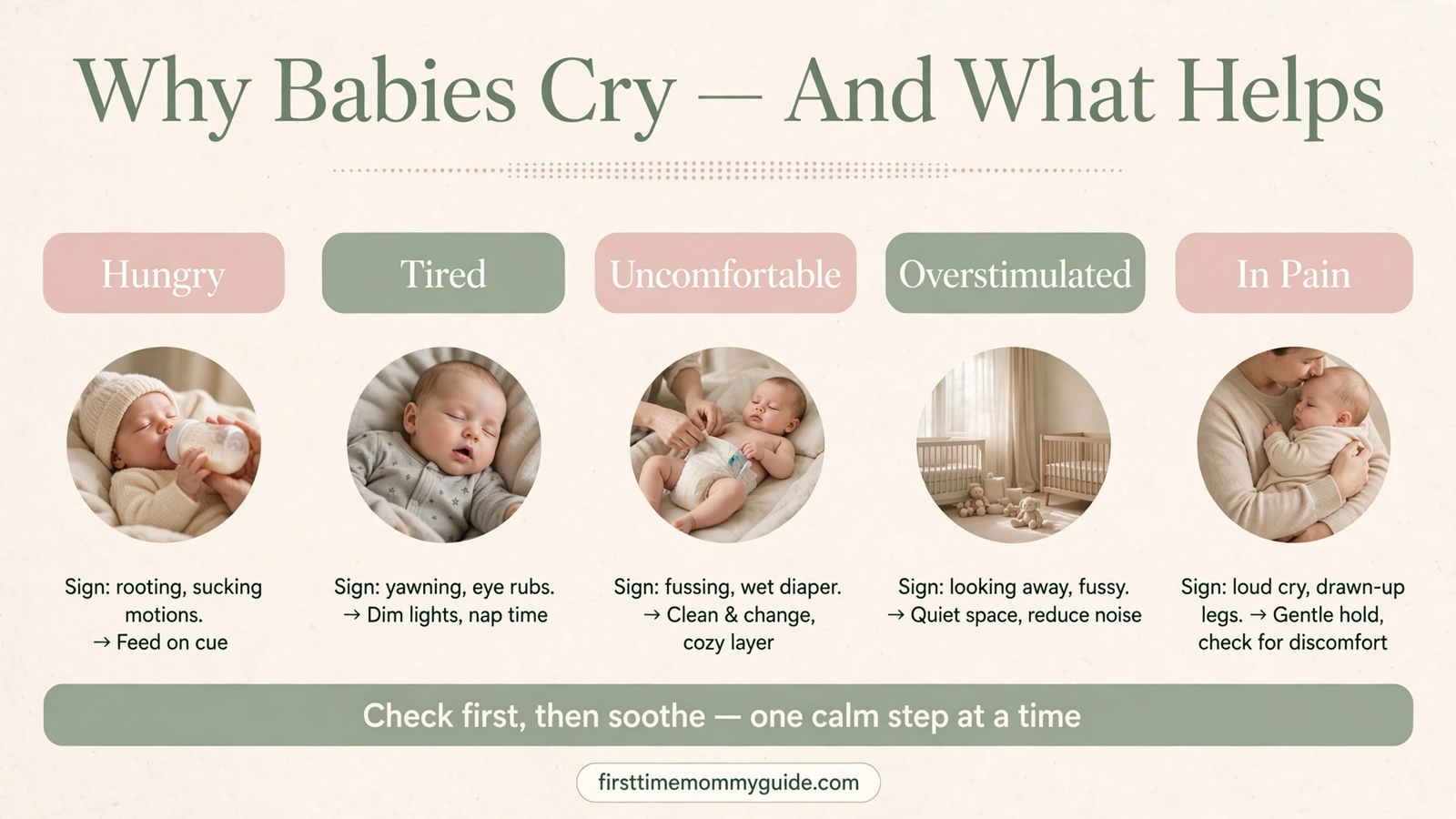
Why Babies Cry
Crying is a baby’s first language. A newborn cannot say “I am hungry” or “My tummy hurts,” so crying carries every message. Healthy babies cry for a total of about two to three hours a day in the first six weeks, often more in the late afternoon and evening. That pattern, sometimes called the period of PURPLE crying, peaks around six to eight weeks and usually eases by three to four months.
Crying does not mean you have failed. It means your baby needs something, and your job is to work through the likely causes calmly. Babies also cry when they are overstimulated, overtired, or simply need closeness. A baby who cries in your arms is not manipulating you. A baby who settles when held is learning that the world is safe and that help comes when they call.
Understanding the common causes helps you respond faster. The sections below explain each cause, what it looks like, and what to try first. Keep the checklist in the next section handy, because in a crying moment you do not want to rely on memory alone.
Hunger
Hunger is the most common reason a young baby cries. Newborns feed little and often, sometimes every two to three hours, and sometimes more during growth spurts. Early hunger cues come before crying: rooting, turning toward your chest, sucking on hands, lip smacking, and restlessness.
If your baby shows these signs, offer a feed straight away. Do not wait for full crying, because a very hungry baby may latch poorly and swallow more air. If you are breastfeeding, offer the breast and let your baby feed until they come off on their own. If you are bottle feeding, prepare a fresh bottle and check that the milk is at a comfortable temperature.
A baby who feeds well and then settles has probably been hungry. A baby who feeds briefly, pulls away, and cries again may have wind, reflux, or another discomfort. Burp your baby midway through and after the feed, and keep them upright for a short while afterwards. Our guide to a newborn feeding schedule explains how often most newborns feed and how to spot a good feeding rhythm.
Discomfort: Wet Nappy, Temperature, and Clothing
A wet or dirty nappy is uncomfortable, and some babies protest loudly about it. Check the nappy first, even if you changed it recently. A nappy that feels heavy, smells strong, or has caused redness needs changing right away. Gentle cleaning, a barrier cream, and nappy-free time can help if the skin looks sore. If redness, spots, or broken skin keep returning, read our guide to baby diaper rash causes, treatment, and prevention.
Temperature matters too. Feel your baby’s chest or back, not their hands or feet, which are often cooler. Your baby should feel warm but not hot or sweaty. Remove a layer if they are flushed or sweaty, and add a light layer if their chest feels cool. A room temperature of around 16 to 20 degrees Celsius is comfortable for most babies at night.
Clothing can also cause distress. Check for a scratchy label, a tight elastic, a twisted sleeve, or a hair wrapped around a finger or toe. A hair tourniquet is rare but painful, so check fingers and toes if your baby cries suddenly and nothing else explains it.
Tiredness and Overtiredness
An overtired baby is often harder to settle than a mildly tired baby. Sleepy cues include yawning, rubbing eyes, looking away, jerking movements, and a glazed stare. Once a baby passes that window, stress hormones rise and crying can escalate quickly.
The fix is a calm, dark, quiet wind-down. Dim the lights, reduce noise, hold your baby close, and use slow rhythmic movement. A short, predictable routine helps: nappy change, sleep sack or swaddle if your baby is young enough, a lullaby, and a dark room. Try to start the routine at the first sleepy sign rather than waiting for crying.
A consistent daily rhythm makes this easier over time. Our newborn sleep routine guide walks through wake windows, bedtime routines, and how to build a pattern that fits your baby’s age.
Overstimulation
Babies take in the world through every sense, and too much input can overwhelm them. A busy shopping trip, a house full of visitors, bright lights, loud music, and lots of face-to-face play can all add up. An overstimulated baby may cry, turn away, arch their back, or become suddenly fussy after a lively period.
The answer is less, not more. Move to a quiet room, dim the lights, and hold your baby against your chest. Stop talking, stop bouncing, and let the quiet do the work. Skin-to-skin contact is especially calming for newborns. Give your baby a break from stimulation before you try a new soothing technique.
Watch for your baby’s signals during play. Looking away, yawning, and fussing are requests for a pause. Short, calm play sessions with breaks in between work better than one long, exciting session.
Pain: Gas, Reflux, Teething, and Illness
Pain is a common cause of intense crying. Gas can make a baby draw their knees up, pass wind, and cry in bursts. Burping, bicycle legs, tummy time, and gentle tummy massage can help. Our guide to baby gas relief remedies covers these techniques step by step.
Reflux can cause crying during or after feeds, arching, and frequent spit-up. Keep your baby upright after feeds, offer smaller feeds more often, and burp frequently. If spit-up is frequent, forceful, or paired with poor weight gain, speak to your doctor. Our guide to baby reflux symptoms and remedies explains what is normal and what needs medical advice. For everyday spit-up, see baby spit-up causes and remedies.
Teething can cause drooling, chewing, sore gums, and irritability from around four to six months. A clean teething ring, a cool washcloth, or gentle gum massage can help. Learn the signs in our guide to baby teething signs and remedies.
Illness can also cause crying. A fever, a new rash, unusual sleepiness, or a change in feeding should prompt a call to your doctor. The red-flag list later in this guide tells you exactly when to seek help promptly.
Colic
Colic is crying that follows a pattern: it starts in the first few weeks, happens most days, lasts for three or more hours a day, and continues for three or more weeks. The baby is otherwise healthy and gaining weight well. The cause of colic is not fully understood, and that uncertainty is frustrating for parents.
Colicky crying often starts in the late afternoon or evening. Your baby may clench their fists, draw up their legs, pass wind, and seem inconsolable. The 5 S’s, white noise, a warm bath, and a walk in the pram can all help some babies. What works one evening may not work the next, so keep several options ready.
Colic usually improves by three to four months. If your baby’s crying fits this pattern, read our detailed guide to colic in babies: symptoms and soothing. If you are worried that something else is wrong, trust your instinct and call your doctor. Colic is a diagnosis made after other causes have been ruled out.
What to Check First: The Soothing Checklist
When your baby starts crying, run through this checklist in order. It takes less than two minutes and catches most causes.
- Hunger: Offer a feed. Check for rooting, hand sucking, and lip smacking.
- Nappy: Check for wetness, stool, redness, or a nappy that is too tight.
- Temperature: Feel the chest or back. Remove or add a layer as needed.
- Wind: Burp your baby. Try bicycle legs or a gentle tummy massage. Our guide to how to burp a newborn shows the positions that work best.
- Tiredness: Look for yawning, eye rubbing, and looking away. Move to a dark, quiet room.
- Overstimulation: Reduce light, noise, and handling. Hold your baby close and stay still.
- Pain or illness: Check for fever, rash, vomiting, or unusual sleepiness. Check fingers and toes for a wrapped hair.
- Closeness: Sometimes your baby simply needs to be held. Pick them up, hold them against your chest, and breathe slowly.
If you have checked everything and your baby is still crying, move on to the 5 S’s below. Try each technique for at least a few minutes. Switching every thirty seconds makes it harder for your baby to settle and harder for you to know what helped.

The 5 S’s: Evidence-Based Soothing Techniques
The 5 S’s were described by paediatrician Dr Harvey Karp as a way to recreate the sensations of the womb: a snug, warm, rhythmic, noisy environment. Used together, they trigger a baby’s calming reflex. They work best for newborns up to about three to four months, but several of them remain useful well beyond that age.
Use all five together for the strongest effect. If one technique does not help on its own, add the next. Keep your movements gentle and rhythmic, never vigorous or jerky. Always place your baby on their back to sleep, even if the side or stomach hold helped them settle while you were holding them.
1. Swaddle
Swaddling wraps your baby snugly in a light blanket, with arms close to the body and legs free to bend. The snug feeling reduces the startle reflex and helps a newborn feel secure. Use a thin, breathable blanket or a swaddle sack, and keep the wrap snug around the chest but loose around the hips and legs.
Stop swaddling as soon as your baby shows signs of rolling, usually around three to four months. Never swaddle a baby who can roll, and never place a swaddled baby on their stomach or side to sleep. Learn the safe technique in our guide to how to swaddle a newborn.
If your baby resists the swaddle or seems hotter than usual, try a sleep sack instead. Some babies prefer one arm free, and that is fine. The goal is comfort, not a perfect wrap.
2. Side or Stomach Hold
Hold your baby on their side or stomach while they are in your arms. This position can calm a fussy baby quickly, especially one with gas or colic. Support the head and neck, keep the baby’s face clear, and stay with them the whole time.
This hold is for soothing only. It is not a sleep position. When your baby is drowsy or asleep, always place them on their back in a safe sleep space. The American Academy of Pediatrics (AAP) and the NHS both advise back sleeping for every sleep, and our guide to safe sleep for newborns explains the full safe-sleep checklist.
A variation is the “football hold,” with your baby lying along your forearm, tummy down, head near your elbow. Many parents find this hold helps with gas. Keep your baby’s head higher than their tummy if reflux is a problem.
3. Shush
Shushing recreates the constant whooshing sound your baby heard in the womb. Hold your baby close to your ear and make a steady “shhh” sound, or use a white-noise machine, a fan, or a white-noise app. The sound should be as loud as your baby’s cry at first, then gradually quieter as they settle.
Keep white noise at a safe level. The AAP advises keeping white-noise machines as far from your baby’s head as possible, at a low volume, and turning them off once your baby is asleep. A constant low hum is safer and more soothing than a loud, sudden noise.
You can also hum, sing softly, or play a lullaby. The rhythm matters more than the tune. A slow, steady sound tells your baby’s nervous system that it is safe to calm down.
4. Swing
Gentle rhythmic movement soothes most babies. Rock in a chair, sway from side to side, walk around the room, or bounce gently on an exercise ball. Keep the movement small, smooth, and rhythmic — about one sway per second works well for many babies.
A pram walk, a car ride, or a baby swing can also help, especially in the evening. If you use a swing or bouncer, keep sessions short and never let your baby sleep unsupervised in a seat that is not designed for sleep. Always move a sleeping baby to a flat, firm sleep surface on their back.
If your arms are tired, sit down and rock. You do not need to stand and bounce for an hour. A rocking chair, a slow walk around the house, or a gentle sway while you sit can be enough.
5. Suck
Sucking is deeply calming for babies. Offer the breast, a bottle, or a pacifier. Non-nutritive sucking helps a baby regulate their own state, and many babies settle quickly once they have something to suck.
If you are breastfeeding, wait until breastfeeding is well established before introducing a pacifier, usually around three to four weeks, unless your doctor advises otherwise. Keep the pacifier clean, check it regularly for damage, and do not dip it in anything sweet. If your baby spits the pacifier out, do not force it back in.
Sucking also helps with wind. A baby who sucks and swallows in a calm rhythm is less likely to gulp air. If your baby refuses the pacifier, try a clean finger, offered with the nail facing down, as a short-term comfort.
Using the 5 S’s Together
The real power of the 5 S’s is in the combination. Swaddle your baby, hold them on their side, shush loudly near their ear, swing gently, and offer a pacifier. Most newborns settle within a few minutes when several S’s are used together.
If your baby does not settle, check the basics again. A hungry baby will not be soothed by shushing alone. A baby with a dirty nappy will not settle until the nappy is changed. The 5 S’s calm the nervous system, but they do not replace food, a clean nappy, or medical care when it is needed.
Practice the 5 S’s when your baby is calm, so the movements feel natural when crying starts. Ask your partner, a grandparent, or another caregiver to learn them too. A second pair of arms, and a second calm voice, can make a hard evening much easier.
Other Calm Techniques That Work
The 5 S’s are a strong starting point, but they are not the only tools. Different babies respond to different techniques, and the same baby may need a different approach on different days. Build a small toolkit of calm techniques and rotate through them.
Skin-to-Skin Contact
Place your baby, wearing only a nappy, against your bare chest and cover you both with a blanket. Skin-to-skin contact steadies your baby’s heart rate, breathing, and temperature, and it lowers stress hormones for both of you. It is especially helpful for newborns, premature babies, and babies who are struggling to settle after a feed.
You do not need a special setup. Sit in a comfortable chair, hold your baby securely, and stay still for ten to fifteen minutes. Breathe slowly. Your calm breathing helps your baby’s breathing slow down too.
A Warm Bath
A warm bath can relax a tense, crying baby. Fill the bath to a comfortable depth, test the water with your elbow, and hold your baby securely throughout. Talk softly, pour warm water gently over their tummy, and keep the room warm so your baby does not chill when you lift them out.
Some babies love baths and settle immediately. Others dislike them and cry more. If your baby hates baths, skip this technique and try a warm washcloth on the tummy instead. Never leave a baby unattended in water, even for a moment.
Movement: Walking, Dancing, and the Pram
Movement is one of the oldest soothing tools. Walk around the house, step outside for fresh air, or take a pram walk around the block. The change of scenery helps you too, and many babies fall asleep within minutes of a steady walk.
Try a slow dance in the kitchen, a gentle bounce on an exercise ball, or a drive around the block. If you drive to soothe your baby, make sure they are safely secured in a correctly fitted car seat, and never drive when you are exhausted. A short drive is a tool, not a nightly habit.
Singing, Talking, and Your Voice
Your voice is the most familiar sound your baby knows. Talk softly, sing a lullaby, or simply narrate what you are doing. A low, steady voice is more calming than a high, anxious one. If you feel tense, lower your voice deliberately and slow your breathing.
You do not need to be a good singer. Your baby does not judge your pitch. They respond to rhythm, warmth, and familiarity. A simple repeated song, hummed the same way each time, can become a powerful sleep cue.
Tummy Massage and Bicycle Legs
Gentle tummy massage can ease gas and help a baby pass wind. Lay your baby on their back, warm your hands, and use slow clockwise circles on the tummy. Bicycle legs — gently moving your baby’s legs as if they are pedalling — can also help trapped wind move through.
Stop if your baby arches, cries harder, or seems in pain. Massage should be gentle and pleasant, never forceful. If gas is a frequent problem, read our guide to baby gas relief remedies for a fuller set of techniques.
A Change of Scene
Sometimes the best soothing technique is a change of room. Step outside, open a window, move to a quieter room, or hand your baby to another caregiver for a few minutes. A new sound, a new smell, or a new face can break a crying cycle.
Fresh air helps many babies settle. A short walk outside, even just to the front step, can calm both of you. If it is cold, dress your baby warmly and keep the walk short. If it is hot, stay in the shade and offer a feed afterwards.

Age-by-Age Soothing: Newborn vs 3–6 Months vs 6–12 Months
Soothing changes as your baby grows. A technique that works perfectly at three weeks may stop working at four months, and that is normal. Your baby’s nervous system, senses, and needs all develop quickly in the first year.
Newborns: 0 to 3 Months
Newborns are adjusting to life outside the womb. They need closeness, warmth, rhythm, and frequent feeds. The 5 S’s are at their most effective in this stage, because they mimic the womb environment your baby has just left.
Feed on demand, respond quickly to crying, and hold your baby often. You cannot spoil a newborn by holding them too much. Responsive care in the first months builds trust and secure attachment, and it does not create bad habits.
Expect crying to peak around six to eight weeks. Evening fussiness is common and does not mean you are doing anything wrong. Keep evenings calm, dim the lights early, and have a simple routine ready. If your baby cries for hours most evenings, read our colic guide at colic in babies: symptoms and soothing.
Hiccups are common in newborns and usually harmless, though they can unsettle a baby. Burping, a short feed, or simply waiting often helps. Our guide to newborn hiccups remedies explains when hiccups need attention and when they do not.
Babies Aged 3 to 6 Months
By three to six months, your baby is more alert, more social, and more interested in the world. Crying often has a clearer cause, and your baby may respond to distraction as well as to soothing. A toy, a song, a change of position, or a look out of the window can interrupt a crying spell.
This is also the age when sleep patterns begin to shift. Many babies experience a sleep regression around four months, when their sleep cycles mature and they wake more often. Night waking and fussiness can increase for a few weeks. Our guide to the 4-month sleep regression explains what is happening and how to get through it gently.
Teething may begin in this window. Drooling, chewing, and sore gums can cause fussiness, especially in the evening. Offer a clean teething ring or a cool washcloth, and check our teething guide at baby teething signs and remedies.
Separation anxiety can also start to appear toward the end of this stage. Your baby may cry when you leave the room, even for a moment. Peekaboo, short separations with a calm return, and a consistent goodbye routine help. Our guide to baby separation anxiety signs and soothing covers this in detail.
Keep using the 5 S’s, but adapt them. Stop swaddling once your baby rolls, and replace the swaddle with a sleep sack. White noise, rocking, and sucking still work well. Add play, tummy time, and social interaction during wake windows so your baby is tired and content at sleep time.
Babies Aged 6 to 12 Months
From six to twelve months, your baby is mobile, curious, and developing strong preferences. Crying may be about frustration, boredom, hunger, tiredness, or a wish to be held. Your baby may also cry because they want something they cannot have, or because a routine has changed.
Distraction works well at this age. Offer a toy, a book, a snack, or a change of activity. Get down on the floor and play. A baby who is engaged is often a baby who stops crying. Keep a few favourite toys, books, and snacks ready for difficult moments.
Separation anxiety often peaks between eight and ten months. Your baby may cry when you leave, cling to you, and wake at night. Stay calm, keep goodbyes short and warm, and return when you say you will. Consistency builds trust faster than long, anxious farewells.
Teething continues in this stage, with new teeth bringing new fussiness. Feeding changes too, as solids are introduced and milk feeds shift. Constipation can become a problem as diet changes, and straining or hard stools can cause crying. Our guide to baby constipation signs and remedies explains what is normal and when to seek advice.
Routine matters more than ever. A predictable pattern of meals, naps, play, and bedtime helps your baby feel secure. When the routine breaks — during travel, illness, or a house move — expect more crying, and respond with extra patience and closeness.
When Crying Is Normal vs When to Call the Doctor
Most crying is normal, even when it feels endless. A healthy baby who feeds well, gains weight, has regular wet and dirty nappies, and settles between crying spells is usually fine. Crying that follows a pattern, peaks in the evening, and eases by three to four months is also common.
Trust your instinct. You know your baby better than anyone. If the crying sounds different from usual, if your baby seems unwell, or if you are worried, call your doctor. It is always better to ask than to wait and worry.
Normal Crying
Normal crying has these features: your baby feeds well and gains weight, has six or more wet nappies a day after the first week, passes stools regularly, is alert and responsive between crying spells, and has no fever or rash. The crying may be intense, but your baby settles eventually and sleeps between episodes.
The period of PURPLE crying is a normal developmental phase. Crying peaks around two months, often happens in the evening, and can be resistant to soothing. The letters of PURPLE stand for Peak of crying, Unexpected, Resists soothing, Pain-like face, Long lasting, and Evening. Knowing that this phase is normal, and that it passes, can help you get through it.
Red Flags: Call Your Doctor Promptly
Call your doctor or seek medical advice promptly if your baby has any of these signs:
- A fever of 38 degrees Celsius or higher in a baby under three months, or a fever that does not come down in an older baby.
- Unusual sleepiness, difficulty waking, or a baby who is much less responsive than usual.
- Refusing feeds, taking much less milk than usual, or vomiting repeatedly.
- Fewer wet nappies than usual, no wet nappy for eight hours, or very dark urine.
- Blood in the stool, black stools, or stools that look very pale.
- A rash that does not fade when pressed, swelling, or a bulging soft spot on the head.
- Breathing that is fast, laboured, noisy, or has long pauses.
- Crying that is high-pitched, inconsolable for hours, or very different from your baby’s usual cry.
- Signs of dehydration: a dry mouth, no tears when crying, or a sunken soft spot.
- A recent fall, injury, or possible ingestion of something harmful.
The NHS advises seeking urgent help if a baby under three months has a temperature of 38 degrees Celsius or higher, or if any baby has a stiff neck, a rash that does not fade, difficulty breathing, or a seizure. The CDC also advises prompt medical care for a baby who is unusually sleepy, hard to wake, or not feeding well. When in doubt, call. Doctors and nurses expect these calls, and they would rather reassure you than have you wait at home.
When to Seek Urgent Care
Seek urgent care or call emergency services if your baby is struggling to breathe, turns blue or very pale, has a seizure, is unresponsive, or has a serious injury. Do not wait to see if it improves. Keep your doctor’s number and your local emergency number saved in your phone, and share them with anyone who cares for your baby.
Write down what you notice before you call: when the crying started, what you have tried, how many feeds and wet nappies your baby has had, and whether there is a fever. Clear notes help the doctor assess your baby quickly.
Mistakes to Avoid When Soothing a Crying Baby
Good intentions can lead to mistakes when you are tired and stressed. Avoiding these common errors makes soothing easier and keeps your baby safe.
Switching techniques too quickly. Give each technique at least three to five minutes. Constant switching overstimulates your baby and leaves you exhausted. Pick one approach, stay calm, and give it time.
Overstimulation when your baby needs calm. More bouncing, more talking, more toys, and more handling can make crying worse. When your baby is overstimulated or overtired, do less: dim the lights, lower your voice, and hold still.
Feeding every time without checking other causes. Hunger is common, but not every cry means hunger. Overfeeding can cause wind, spit-up, and discomfort. Run through the checklist first, and offer a feed when hunger signs are present.
Using unsafe sleep positions to settle your baby. The side or stomach hold is for soothing in your arms only. Never place a baby to sleep on their side or stomach, on a sofa, in a swing, or in an adult bed. Always place your baby on their back on a firm, flat surface. See safe sleep for newborns for the full guidance.
Swaddling too tightly or for too long. A swaddle should be snug around the chest and loose around the hips. Stop swaddling when your baby shows signs of rolling. Never use a weighted swaddle or blanket.
Leaving a crying baby alone for long periods. Crying it out is not recommended for newborns, and it is not a soothing technique. Young babies need a responsive caregiver. If you need a break, place your baby safely on their back in the cot and step away for a few minutes, then return.
Shaking your baby, even gently. Never shake a baby, even for a second. Shaking can cause serious brain injury. If you feel yourself losing control, put your baby down safely and walk away. This is covered in detail in the next section.
Ignoring your own exhaustion. You cannot soothe well when you are running on empty. Accept help, trade shifts with your partner, and rest when your baby rests. A rested parent is a calmer parent.
Coping When You Feel Overwhelmed
A crying baby can push even the calmest parent to the edge, especially at 3 a.m. after several sleepless nights. Feeling frustrated, angry, or tearful does not make you a bad parent. It makes you a tired human caring for a demanding newborn. What matters is what you do with those feelings.
Put Your Baby Down Safely and Step Away
If you feel overwhelmed, angry, or afraid you might lose control, put your baby down on their back in a safe place, such as the cot or bassinet. Make sure the space is clear of pillows, blankets, and toys. Walk into another room, breathe deeply, splash water on your face, and give yourself a few minutes to calm down.
Your baby will be safe for those few minutes. A short break is far safer than holding a baby while you are shaking with frustration. Return when you feel calmer, and try soothing again. If you are alone and cannot calm down, call your partner, a family member, a friend, or your doctor for support.
Never Shake a Baby
Never shake a baby, even gently, even for a second. Shaking can cause bleeding in the brain, brain injury, blindness, and death. This is known as abusive head trauma or shaken baby syndrome. It can happen in a moment of frustration, and the damage can be permanent.
If you feel the urge to shake your baby, put them down immediately and walk away. Call someone for help. There is no shame in asking for support. The AAP, the NHS, and the CDC all stress this message: crying is normal, shaking is never safe, and stepping away is the right choice.
Safe Coping Strategies
Try these strategies when the crying feels endless:
- Trade shifts. Take turns with your partner so each of you gets a block of sleep. Even two hours of unbroken sleep helps.
- Use a mantra. Repeat a short phrase: “This will pass. My baby is safe. I am doing my best.” It sounds simple, but it can steady you in a hard moment.
- Breathe slowly. Inhale for four counts, hold for four, exhale for four. Slow breathing lowers your heart rate and helps your baby settle too.
- Call someone. A friend, a parent, a health visitor, or a support line can listen and help. You do not have to carry this alone.
- Go outside. Fresh air and a change of scene help you as much as your baby. A short walk can break a crying cycle for both of you.
- Lower the bar. The house does not need to be tidy. Dinner can be simple. Rest matters more than chores right now.
- Write it down. Keep a simple log of feeds, nappies, sleep, and crying. Patterns become clearer on paper, and a log helps your doctor if you seek advice.
When to Seek Support for Yourself
Postpartum depression and anxiety are common, and they can make crying feel unbearable. If you feel sad, anxious, numb, or overwhelmed most days, if you cannot sleep even when your baby sleeps, or if you have thoughts of harming yourself or your baby, seek help right away. Talk to your doctor, your health visitor, or a mental health professional. These feelings are treatable, and support is available.
You deserve care too. A parent who is supported can support their baby better. Asking for help is not a weakness. It is one of the strongest things you can do for your family.
A Simple Evening Plan for Fussy Babies
Evenings are often the hardest time. A simple plan, used every evening, can reduce the chaos. Start the plan before the crying peaks, ideally in the late afternoon.
First, feed your baby and burp them well. Change the nappy and dress them in comfortable clothes. Dim the lights, close the curtains, and turn off the television. Second, try the 5 S’s: swaddle if your baby is young enough, hold them close, shush, swing gently, and offer a pacifier or a feed.
Third, move. Walk around the house, step outside, or take a pram walk. Movement and fresh air help many babies settle. Fourth, if your baby is still crying after thirty minutes of calm soothing, run through the checklist again. Check for fever, rash, or other red flags, and call your doctor if you are worried.
Finally, trade off. If your partner is home, hand over the baby and take a break. If you are alone, put your baby down safely for a few minutes and breathe. A calm parent soothes better than an exhausted one. Keep the routine the same each evening, so your baby learns that evenings mean calm, closeness, and sleep.
Key Takeaways
- Crying is communication, not failure. Most babies cry two to three hours a day in the first weeks, often more in the evening.
- Check hunger, nappy, temperature, wind, tiredness, and overstimulation first. Most crying has a simple cause.
- The 5 S’s — swaddle, side or stomach hold, shush, swing, and suck — work best together, especially for newborns.
- Soothing changes with age. Newborns need womb-like comfort, older babies respond to distraction, routine, and play.
- Call your doctor promptly for fever in a baby under three months, unusual sleepiness, refusal to feed, fewer wet nappies, repeated vomiting, blood in the stool, or inconsolable crying.
- Never shake a baby. If you feel overwhelmed, put your baby down safely, step away, and call for help.
FAQs: How to Soothe a Crying Baby
1. How can I soothe a crying baby quickly?
Check hunger, nappy, temperature, and wind first, then use the 5 S’s together: swaddle, hold on the side, shush loudly, swing gently, and offer a pacifier or feed. Most newborns settle within a few minutes when several techniques are combined.
2. Why is my baby crying for no reason?
There is usually a reason, even if it is not obvious. Hunger, tiredness, overstimulation, gas, or a need for closeness are the most common causes. Work through the checklist in order, and try a calm, dark, quiet room if nothing else explains the crying.
3. What are the 5 S’s for soothing a baby?
The 5 S’s are swaddle, side or stomach hold, shush, swing, and suck. They recreate the sensations of the womb and trigger a baby’s calming reflex. They work best together and are most effective for newborns up to about three to four months.
4. Is it okay to let a baby cry it out?
Crying it out is not recommended for newborns. Young babies need responsive care to build trust and feel safe. If you need a break, put your baby down safely for a few minutes, then return and try soothing again.
5. How long is normal for a baby to cry?
Healthy babies cry for a total of about two to three hours a day in the first six weeks, often in the evening. Crying usually peaks at six to eight weeks and eases by three to four months. Crying that lasts for hours most days, or that is very different from usual, should be checked by a doctor.
6. What is colic, and how do I soothe a colicky baby?
Colic is crying for three or more hours a day, three or more days a week, for three or more weeks, in an otherwise healthy baby. Try the 5 S’s, white noise, a warm bath, a pram walk, and tummy massage. Colic usually improves by three to four months. See our guide to colic in babies: symptoms and soothing.
7. How do I soothe a crying baby at night?
Keep the room dark and quiet, use a low voice, and avoid bright lights and play. Feed, burp, and change the nappy, then use the 5 S’s and a dark room. A consistent bedtime routine helps your baby learn that night is for sleep.
8. Can I spoil my baby by holding them too much?
No. You cannot spoil a newborn by holding them. Responsive holding builds secure attachment and trust. Babies who are held and comforted in the first months often become more independent later, not less.
9. What should I do if my baby will not stop crying?
Run through the checklist again, try a change of scene, and ask another caregiver to take over for a while. If the crying is inconsolable for hours, or if there are red flags such as fever, vomiting, or unusual sleepiness, call your doctor promptly.
10. Does white noise help a crying baby?
Yes, white noise can help many babies settle, because it mimics the sounds of the womb. Keep the volume low, place the machine away from your baby’s head, and turn it off once your baby is asleep.
11. Is swaddling safe for soothing?
Swaddling is safe when done correctly: snug around the chest, loose around the hips, with a light breathable blanket. Stop swaddling as soon as your baby shows signs of rolling, and never place a swaddled baby on their stomach or side to sleep.
12. How do I soothe a baby with gas?
Burp your baby during and after feeds, try bicycle legs, and use gentle clockwise tummy massage. Keep your baby upright after feeds. Our guide to baby gas relief remedies explains these techniques in detail.
13. What if my baby cries during feeds?
Crying during feeds can mean wind, reflux, a fast milk flow, or a poor latch. Burp your baby, try a different feeding position, and slow the feed down. If crying during feeds is frequent, or paired with poor weight gain, speak to your doctor.
14. How do I soothe a teething baby?
Offer a clean teething ring, a cool washcloth, or gentle gum massage. Keep your baby comfortable, offer extra cuddles, and check for other causes if the crying is severe. See baby teething signs and remedies.
15. Can overstimulation make my baby cry?
Yes. Too much noise, light, handling, or play can overwhelm a baby. Move to a quiet, dim room, hold your baby close, and stay still. Short, calm play sessions with breaks work better than long, exciting ones.
16. How do I know if my baby is hungry or tired?
Hunger cues include rooting, hand sucking, lip smacking, and restlessness. Tired cues include yawning, eye rubbing, looking away, and a glazed stare. A hungry baby often settles after a feed, while a tired baby settles in a dark, quiet room.
17. Should I use a pacifier to soothe my baby?
A pacifier can be a helpful soothing tool. Offer it after breastfeeding is established, keep it clean, and do not force it if your baby refuses it. Sucking is calming, and many babies settle quickly with a pacifier.
18. What is the best position to hold a crying baby?
Try holding your baby upright against your chest, on their side in your arms, or in the football hold along your forearm. Support the head and neck, keep the face clear, and choose the position your baby responds to best. Remember that side and stomach holds are for soothing in your arms only, never for sleep.
19. When should I call the doctor about crying?
Call promptly for a fever in a baby under three months, unusual sleepiness, refusal to feed, fewer wet nappies, repeated vomiting, blood in the stool, a rash that does not fade, difficulty breathing, or crying that is inconsolable for hours.
20. How do I cope when I feel overwhelmed by crying?
Put your baby down safely on their back in the cot, step away for a few minutes, breathe slowly, and call someone for support. Trade shifts with your partner, go outside for fresh air, and lower your expectations for the day. Never shake a baby.
21. Does a warm bath help a crying baby?
A warm bath can relax many babies, especially in the evening. Keep the water warm, hold your baby securely, and keep the room warm. If your baby dislikes baths, try a warm washcloth on the tummy instead.
22. How can I soothe a baby with reflux?
Keep your baby upright after feeds, offer smaller feeds more often, burp frequently, and avoid tight clothing around the tummy. If reflux is frequent or paired with poor weight gain, speak to your doctor. See baby reflux symptoms and remedies.
Conclusion
Learning how to soothe a crying baby takes time, patience, and practice. There is no single trick that works every time, and there is no perfect parent who never feels overwhelmed. What matters is that you keep showing up, work through the checklist calmly, and try the techniques in this guide one at a time.
Start with the basics: hunger, nappy, temperature, wind, and tiredness. Add the 5 S’s, use skin-to-skin contact, try movement and fresh air, and adapt your approach as your baby grows. Trust your instinct, and call your doctor when something feels wrong. You know your baby best.
Most of all, be kind to yourself. The crying will ease, the nights will get shorter, and the skills you are building now will carry you through the next stage. Your baby does not need a perfect parent. They need a present, patient, and loving one — and by reading this guide, you are already showing up for them.
This article is for general information only and is not a substitute for medical advice. If you are worried about your baby, contact your doctor, health visitor, or local health service promptly. For trusted guidance, see the American Academy of Pediatrics at HealthyChildren.org, the NHS guide to soothing a crying baby, and the CDC guidance on infant care and safe sleep.

Dilawar Mughal
Founder and editor, First Time Mommy Guide
I research every guide against what the NHS, the AAP and the WHO publish, then write it in plain English — because most new parents are reading with one hand free, not comparing clinical guidelines. I'm not a doctor or a midwife. Every health claim on this site is sourced and linked so you can check it yourself, and anything urgent belongs with your health visitor or GP, not a blog.


