
General information, not medical advice. Every baby is different — if anything worries you, speak to your midwife, health visitor or GP rather than waiting.
If you are reading this at 3 a.m. with a baby in your arms, you are not failing. You are tired, and you are looking for a kinder, clearer way forward. Sleep training does not mean leaving your baby to cry alone all night, and it does not mean you must choose one rigid method and never look back. It means teaching your baby, step by step, how to fall asleep and fall back asleep with less help.
This guide explains the most common baby sleep training methods in plain language. You will learn how each one works, who it suits, what a realistic first week looks like, and how to keep sleep safe. You will also find a step-by-step plan you can adapt, plus answers to the questions first-time parents ask most.
Before we go further, one important note: this article is general information only, not medical advice. Every baby is different. If you have concerns about your baby’s health, growth, breathing, feeding, or development, talk to your paediatrician. The safety guidance here follows the principles shared by the American Academy of Pediatrics on safe sleep and the NHS Start for Life sleep guidance.
What Sleep Training Really Means
Sleep training is the process of helping a baby learn to settle to sleep more independently. Most babies wake briefly between sleep cycles. That is normal. A baby who has learned to fall asleep on their own can often link those cycles and drift back off without a full waking, a feed, or being rocked for a long time.
Sleep training is not about forcing a baby to sleep through the night on a deadline. Some babies do sleep longer stretches early. Others need night feeds for many months, especially if they are breastfed, growing fast, or going through a developmental leap. Progress is rarely a straight line. A good night followed by a hard night does not mean you have undone everything.
It also does not mean stopping comfort. You can be responsive, warm, and present while still giving your baby space to practise. Many modern methods are built around exactly that balance: you stay close, you reassure, and you slowly reduce the amount of help you give.
Think of it this way. You are not teaching your baby that you will not come. You are teaching them that sleep is safe, predictable, and something they can do with a little less help each night.
When Is a Baby Ready for Sleep Training?
There is no single perfect age, but most paediatric sleep experts suggest waiting until a baby is at least four to six months old before formal sleep training. By then, many babies can sleep for longer stretches, have more regular feeding patterns, and are developmentally ready to learn self-settling skills. Younger babies wake often because they genuinely need feeding, comfort, and close contact.
That said, you do not need to wait until six months to build healthy sleep habits. From the first weeks, you can use a calm bedtime routine, a dark room, white noise, and a consistent wake time. Those foundations make later sleep training much easier, even if you do not use a formal method yet.
Signs your baby may be ready include:
- They are at least four months old and your paediatrician is happy with their growth and feeding.
- They can fall asleep with some help but wake frequently and need the same help every time.
- They have a fairly regular day, with feeds and naps that follow a loose pattern.
- You, as the parent, feel ready to be consistent for at least a week or two.
You may want to delay starting if your baby is ill, teething badly, has just had vaccinations, is going through a major change such as starting daycare or moving house, or if you are exhausted to the point where consistency feels impossible. Starting during a calm week gives the method a fair chance. If life is chaotic, a gentle routine is enough for now.
Also consider your own readiness. Sleep training asks for patience at night, and that is hard when you are already sleep-deprived. Choose a method you can actually follow. A gentle method you stick with beats a strict method you abandon after two nights.
The Main Sleep Training Methods Compared
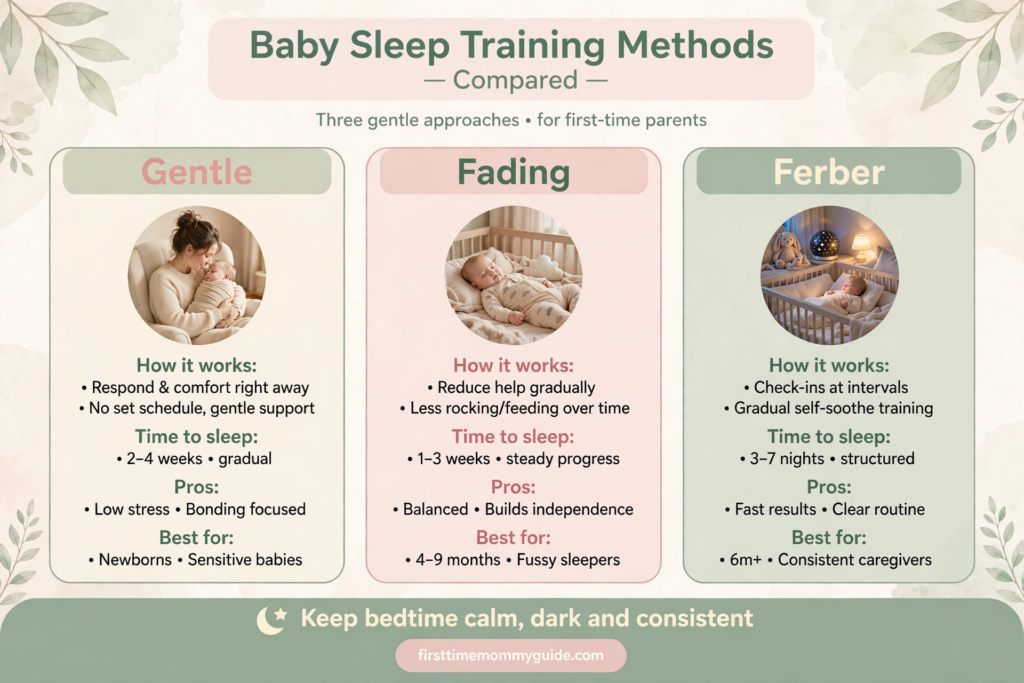
The table below gives a quick overview. The sections that follow explain each method in detail, including what it looks like in practice and what to watch out for.
| Method | How it works | Parent involvement | Typical pace | Best for |
|---|---|---|---|---|
| Gentle / no-cry methods | Gradual withdrawal, lots of reassurance | High at first, then less | Slower, often 2–4 weeks | Parents who want minimal crying |
| Fading / gradual retreat | Parent moves further away over nights | High, then gradually lower | 1–3 weeks | Babies who settle with presence |
| Ferber / graduated extinction | Timed check-ins at increasing intervals | Check-ins, no picking up | Often 3–7 nights to improve | Parents who want structure |
| Cry it out / extinction | Baby settles without check-ins | Low after bedtime | Often fastest, hardest emotionally | Parents comfortable with crying |
| Pick up, put down | Pick up to calm, put down awake | Very high | Slow, can take weeks | Younger babies, gentle approach |
| Bedtime fading | Moves bedtime later to build sleep pressure | Moderate | 1–2 weeks | Babies who fight bedtime |
No method is morally better than another. What matters is safety, consistency, and whether it fits your baby’s temperament and your family’s values. If one method feels wrong for you, it probably is, even if it worked for a friend.
1. Gentle Sleep Training and the Chair Method
Gentle methods keep you close. In the chair method, you sit beside the cot while your baby falls asleep. You may pat, shush, or speak softly, but you avoid rocking them fully to sleep or feeding them to sleep every time. Every few nights, you move the chair a little further away: beside the cot, then halfway to the door, then by the door, then outside the room.
The advantage is clear. Your baby never feels abandoned, and many parents find this much easier emotionally. The drawback is time. It can take several weeks, and some babies become more upset when they can see you but you are not picking them up. If that happens, try sitting where your baby can hear you but not see you, or use a consistent phrase such as “Mummy is here, time to sleep.”
Gentle methods work best when you are patient and your baby is not highly distressed by your presence without being held. They also work well for babies who are anxious about separation or who have just moved to their own room.
2. Fading and Gradual Withdrawal
Fading is similar to the chair method but focuses on reducing one sleep association at a time. For example, if your baby falls asleep while being rocked, you rock a little less each night. If they fall asleep while you hold their hand, you move from holding to resting your hand nearby, then to just being in the room.
This method is practical because it starts from what your baby already knows. You are not removing everything at once. You change one small thing, let your baby adjust, then change the next. It suits parents who like a step-by-step plan and babies who are sensitive to big changes.
Keep a simple log for the first week. Note bedtime, how long settling took, how many night wakings happened, and what helped. Patterns become visible quickly, and that makes the next step easier to choose.
3. The Ferber Method (Graduated Extinction)
The Ferber method, named after Dr Richard Ferber, uses timed check-ins. You put your baby down awake, leave the room, and return at set intervals to reassure them briefly without picking them up, feeding them, or turning on bright lights. The intervals get longer over successive nights.
A common starting pattern is to check after 3 minutes, then 5 minutes, then 10 minutes on night one. On night two, the intervals might be 5, 10, and 12 minutes, and so on. You can adjust the timings to suit your comfort, but the key is that check-ins are short, calm, and boring. A soft voice, a gentle pat, and a phrase like “It’s sleep time” is enough. Long, stimulating check-ins can wake a baby further and make settling harder.
Many parents choose Ferber because it gives structure. You know exactly when to go in, which reduces the panic of listening to crying with no plan. Research and clinical experience suggest many babies improve within three to seven nights, though full progress can take longer. If crying becomes intense, your baby is unwell, or you feel you cannot continue, pause and talk to your paediatrician. You can always switch to a gentler method.
4. Cry It Out (Extinction)
Cry it out means putting your baby down awake at bedtime and not going in until morning, except for genuine needs such as illness, a dirty nappy, or a scheduled night feed you have decided to keep. There are no check-ins. The idea is that without new stimulation, the baby learns to self-settle.
This method is often the fastest, but it is also the hardest for many parents to hear. It is not suitable for every family, and it is not recommended for babies under four to six months. If you try it, make sure the room is safe, your baby is well, fed, and dry, and you have support. Some parents use a video monitor so they can see their baby is safe without intervening.
It is worth saying plainly: choosing cry it out does not make you a cold parent, and choosing not to does not make you a soft one. What matters is that you can follow through calmly. If you start and then give in after an hour of crying with a feed and a rock to sleep, your baby learns that longer crying brings the old help back. That can make the next night harder, not easier.
5. Pick Up, Put Down
Pick up, put down is a gentle, hands-on method often used with younger babies. You put your baby down drowsy but awake. If they cry, you pick them up, calm them until they are settled but not asleep, then put them down again. You repeat as needed.
This method gives a lot of reassurance, but it can be exhausting, especially if your baby needs many repetitions. Some babies get more upset by the repeated picking up and putting down. If you notice that pattern, a calmer approach such as staying beside the cot and patting may work better. Pick up, put down is best seen as a short-term teaching tool, not a permanent routine.
6. Bedtime Fading
Bedtime fading is useful when your baby lies awake for a long time at bedtime, even though they seem tired. Instead of an early bedtime that leads to an hour of fussing, you temporarily move bedtime later, to a time when your baby is genuinely sleepy. Once they fall asleep quickly at that time for a few nights, you move bedtime earlier by 15 minutes every few nights until you reach your target.
This method builds sleep pressure in a helpful way. It does not mean keeping your baby up too late for weeks. It is a short adjustment, usually over one to two weeks, and it works best combined with a consistent morning wake time and a calm wind-down routine.
A Step-by-Step Plan You Can Start This Week
You do not need to buy anything special to begin. Use the plan below as a template, then adjust it to your baby, your method, and your home.
Step 1: Fix the sleep environment first
Make the room dark, cool, and quiet. Blackout curtains help enormously, especially in summer. A room temperature around 18 to 20 degrees Celsius is comfortable for most babies. White noise, played continuously at a low volume and placed away from the cot, can mask household sounds.
Keep the cot clear. No pillows, blankets, bumpers, or soft toys for babies under one year. Your baby should sleep on their back, on a firm, flat mattress, in their own cot or crib. The NHS safer sleep guidance explains these principles clearly, and the World Health Organization also highlights safe sleep positioning.
If you are still room-sharing, that is fine. Sleep training can happen in your room too. The method matters more than the room.
Step 2: Build a short, repeatable bedtime routine
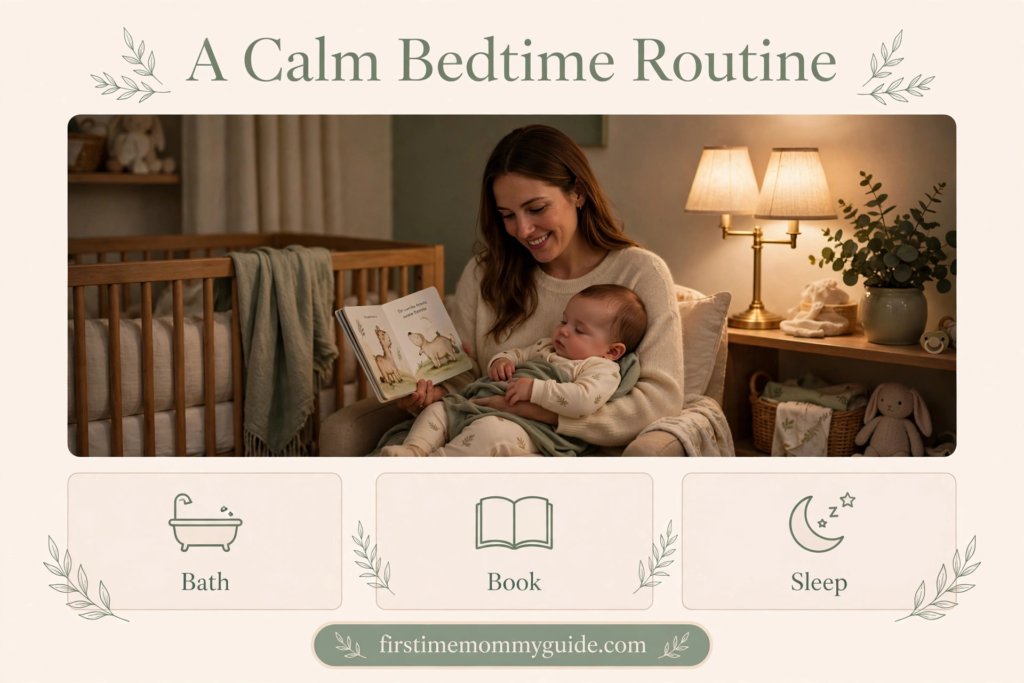
Aim for 20 to 30 minutes, in the same order every night. For example: bath, pyjamas, feed, book or song, sleep sack, white noise on, lights low, into the cot awake, goodnight phrase. The routine is a signal. After a few nights, your baby begins to relax as soon as the routine starts, because they know what comes next.
Avoid screens and bright, exciting play in the last hour before bed. Keep the feed earlier in the routine if you want to break the feed-to-sleep link. That small change alone helps many babies.
Step 3: Choose one method and one start night
Pick the method that feels most sustainable, not the one that promises the fastest result. Choose a start night when your baby is well, you have no early morning the next day if possible, and another adult can help if needed. Tell your partner or support person the plan, including when you will check in and what you will say.
Write the plan down. At 2 a.m., tired brains forget plans. A note on the fridge that says “Check at 3, 5, 10 minutes. Short, calm, no lights” is genuinely useful.
Step 4: Set a consistent wake time and daytime rhythm
A regular morning wake time anchors the whole day. From there, naps follow age-appropriate wake windows. A baby who naps too late or too long in the afternoon may not be sleepy at bedtime. A baby who is overtired from missed naps may also fight sleep. Both problems look similar at bedtime, so a simple daytime log helps you tell them apart.
For a rough guide, many four- to six-month-olds manage about two hours awake between naps, while older babies manage longer. These are guides, not rules. Watch your baby’s sleepy cues: slower movements, less interest in play, eye rubbing, and zoning out.
Step 5: Handle night wakings the same way every time
Consistency at night matters more than perfection at bedtime. Decide in advance how you will handle a waking. For example, you may pause for a minute to see if your baby resettles, then use the same check-in pattern as bedtime. Keep lights low, voices soft, and nappy changes quick and boring.
If you are still doing night feeds, keep them calm and dark, and put your baby back down awake where possible. If you are weaning night feeds, do it gradually and with your paediatrician’s guidance, especially for younger or smaller babies. For more on safe night routines, our guide to safe sleep for newborns covers the basics in detail.
Step 6: Track progress, not just bad nights
Keep a simple chart for two weeks: bedtime, time to fall asleep, number of wakings, longest stretch, and morning wake time. You will often see progress you would miss if you only remembered the worst night. A baby who took 45 minutes to settle on night one and 20 minutes on night five is improving, even if they still woke twice.
Expect some ups and downs. Illness, teething, travel, and developmental leaps can temporarily disrupt sleep. That does not mean the method failed. Return to your routine once your baby is well, and progress usually returns quickly.
What a Realistic First Week Looks Like
Night one is usually the hardest. Your baby may cry more than usual because the routine has changed. That is not a sign you are harming them, but it is a sign to check that your plan is safe, your baby is well, and you have support.
By nights three to five, many families notice shorter settling times, even if night wakings remain. By the end of week one, bedtime often feels calmer. By week two, many babies have longer first stretches of sleep. Gentle methods may take three to four weeks to show the same change, and that is normal too.
If after two consistent weeks there is no improvement at all, pause and reassess. Check for hidden issues: reflux, ear discomfort, hunger, an uncomfortable room temperature, or a daytime schedule that does not fit. Talk to your paediatrician or a certified sleep consultant. Sometimes a small change, such as an earlier bedtime or a different nap pattern, unlocks progress.
Naps, Wake Windows, and Daytime Sleep
Sleep training is not only about nights. Daytime sleep shapes night sleep. A baby who is well-rested in the day usually settles better at night. That sounds counterintuitive, but overtired babies often sleep worse, not better.
A loose daytime structure helps. Start the day at a similar time, offer naps when sleepy cues appear, and keep nap routines short versions of the bedtime routine: dim light, sleep sack, white noise, same goodnight phrase. Short naps are common in the first months. A 30-minute nap is not a failure. Some babies take short naps for months and still sleep well at night.
If naps are very short and your baby is cranky, try extending one nap by helping them back to sleep, or try an earlier bedtime for a few nights. Do not try to fix naps and nights at exactly the same time if that feels overwhelming. Many parents start with bedtime, then work on naps once nights improve.
Common Problems and How to Handle Them
Early morning waking. If your baby wakes at 5 a.m. and will not go back to sleep, check light, noise, and hunger first. Blackout curtains, white noise, and a slightly later bedtime can help. Avoid starting the day before 6 a.m. if you can, and keep early wakings dark and boring for a few days.
Split nights. A split night is when your baby wakes for a long stretch in the middle of the night, often happily awake. This can be caused by too much daytime sleep, a bedtime that is too late, or a schedule that needs adjusting. Review nap lengths and bedtime, and keep split nights calm and dark.
Standing up in the cot. Once babies can pull to stand, bedtime can become a game of standing and crying to be laid down. Practise standing and sitting during the day so your baby learns to sit back down. At night, lay them down calmly once, then use your chosen method. Lower the mattress to the lowest setting as soon as they can pull up.
Teething and illness. Pause formal training during illness. Comfort your baby as needed, keep fluids and feeds up, and seek medical advice if you are worried. Once they recover, return to the routine. A few nights of extra help during illness does not erase learning.
Travel and visitors. Travel disrupts sleep for most babies. Keep the routine as similar as possible, bring the sleep sack and white noise, and accept that progress may pause. Return to your normal routine at home, and sleep usually settles again within a few nights.
Sleep Safety: The Non-Negotiables
No sleep training method should override safe sleep. Keep these rules every night, whether you are training or not:
- Always place your baby on their back to sleep.
- Use a firm, flat mattress with a fitted sheet, and keep the cot clear.
- Keep the room at a comfortable temperature and avoid overheating. A sleep sack is safer than loose blankets.
- Do not share a bed if you smoke, have consumed alcohol, or are extremely tired, and follow local safe-sleep guidance for bed-sharing if you choose it.
- Keep cords, monitors, and toys away from the cot.
The American Academy of Pediatrics recommends room-sharing, ideally for the first year, and avoiding soft bedding. If you are unsure about any part of your setup, ask your health visitor or paediatrician to review it with you. Safe sleep is the foundation; training is built on top of it.
What Is Normal, and When to Call the Doctor
Frequent waking is normal in the first year. Babies wake for hunger, comfort, wet nappies, teething pain, and developmental changes. Short crying at bedtime during training is also common. What is not normal is a sudden change that comes with other symptoms.
Call your doctor promptly if your baby has a fever, breathing difficulty, persistent vomiting, poor feeding, fewer wet nappies, unusual sleepiness, or a rash that does not fade when pressed. Seek urgent care if your baby is struggling to breathe, is floppy or unresponsive, or has a seizure.
Also seek advice if your baby snores loudly, pauses in breathing during sleep, or seems exhausted despite long sleep, as these can be signs of sleep-disordered breathing. Trust your instincts. If something feels wrong, it is always better to ask than to wait. This section is general information, not a substitute for medical advice for your child.
New parents often worry that asking for help means they are overreacting. It does not. Health professionals expect questions about baby sleep, and they would rather reassure you early than see you worry alone at night.
Sleep Training for Different Family Situations
Breastfeeding families. You can sleep train and continue breastfeeding. Many families keep one or two night feeds while teaching independent settling at bedtime. If you want to reduce night feeds, do it gradually, and make sure daytime feeds are full and frequent.
Two parents, different views. It is common for one parent to be ready for sleep training and the other to be unsure. Talk through the plan before you start, agree on check-in times, and take turns so neither parent is awake all night. If you disagree strongly, start with the gentlest method you both accept.
Single parents and night shifts. If you are parenting alone, choose the simplest method you can follow when tired. Prepare everything before bed, keep the plan written down, and ask a friend or family member to help with an early morning so you can catch up on sleep. Your rest matters too.
Twins and siblings. Sleep train twins together where possible, with a consistent routine and white noise to mask each other’s sounds. It may feel chaotic at first, but separate schedules often create more work. For older siblings, explain the plan simply and give them a role, such as choosing the bedtime book.
Babies in daycare. Share your routine with caregivers so naps follow a similar pattern. Daycare naps may be shorter or noisier, and that is okay. Focus on a consistent bedtime routine at home, and sleep usually improves even if daycare naps vary.
A Gentle Reminder for Tired Parents
Sleep deprivation changes how everything feels. Small problems feel huge at 3 a.m. If you feel overwhelmed, low, or unable to cope, reach out. Talk to your partner, a friend, your health visitor, or your doctor. Postnatal mood changes are common and treatable, and asking for help is a strength, not a weakness. You can read more about the early weeks in our guide to postpartum recovery in the first weeks.
You do not need to be a perfect sleeper to be a good parent. You need rest, support, and a plan you can live with. Some nights will still be hard. That is parenting, not failure.
Frequently Asked Questions
1. What is the best sleep training method for first-time parents?
There is no single best method. Gentle methods and fading suit parents who want minimal crying, while Ferber suits parents who want clear structure. Choose the method you can follow consistently for at least two weeks.
2. When can I start sleep training my baby?
Most experts suggest four to six months for formal methods, once growth and feeding are established. Gentle routines and good sleep habits can start much earlier, from the first weeks.
3. Is sleep training harmful for my baby?
When done safely, with a well, fed baby in a safe sleep space, sleep training is not shown to harm attachment. Responsive methods keep you close and reassuring throughout. If you are worried, discuss your plan with your paediatrician.
4. How long does sleep training take?
Many families see improvement in three to seven nights with structured methods, and in two to four weeks with gentle methods. Full, stable progress can take longer, and regressions are normal.
5. Will my baby still need night feeds after sleep training?
Possibly, yes. Sleep training teaches settling, not necessarily weaning. Many babies still need one or two night feeds for months. You can train settling at bedtime while keeping planned night feeds.
6. What if my baby cries for a long time?
Check that your baby is safe, well, fed, and dry. Use your planned check-ins, keep them short and calm, and pause the method if crying is intense or your baby seems unwell. Talk to your doctor if you are concerned.
7. Can I sleep train while room-sharing?
Yes. Use white noise, a consistent routine, and your chosen method. Some parents use a room divider or place the cot so the baby cannot see them easily, which can help with gradual withdrawal.
8. Do I need to stop rocking or feeding to sleep completely?
Not necessarily. Many families keep a feed or cuddle in the routine but move it earlier, so the last step before sleep is being placed in the cot awake. Small changes often make a big difference.
9. What about sleep regressions?
Regressions at four, eight, and twelve months are common and linked to development. Keep the routine steady, offer extra comfort, and avoid introducing a completely new sleep association if you can. Sleep usually improves again within a few weeks.
10. Is it too late to sleep train a toddler?
No. Toddlers can learn new sleep habits too, often with a clear routine, a toddler clock, and consistent boundaries. The methods differ slightly, but the principles of consistency and safety remain the same.
11. Should both parents use the same method?
Yes, as far as possible. Consistency helps your baby learn faster. Agree on the plan, the check-in times, and the goodnight phrase before you start, and review progress together after a week.
12. What if sleep training is not working after two weeks?
Reassess the schedule, the room, and your baby’s health. Talk to your paediatrician or a sleep consultant. Sometimes an earlier bedtime, a different nap pattern, or treating reflux or discomfort makes the difference.
Conclusion
Sleep training is a tool, not a test. The best method is the one that helps your baby sleep better while letting you stay responsive, safe, and sane. Start with a calm routine, a safe sleep space, and one method you can follow consistently. Track progress over weeks, not single nights, and be kind to yourself on the hard nights.
If you are preparing your home for safer nights too, our baby-proofing home checklist is a useful next read, and if you are choosing gear for daytime outings, see how to choose a baby stroller. Rest well, and remember: you are learning together, one night at a time.

Dilawar Mughal
Founder and editor, First Time Mommy Guide
I research every guide against what the NHS, the AAP and the WHO publish, then write it in plain English — because most new parents are reading with one hand free, not comparing clinical guidelines. I'm not a doctor or a midwife. Every health claim on this site is sourced and linked so you can check it yourself, and anything urgent belongs with your health visitor or GP, not a blog.


