General information, not medical advice. Every baby is different — if anything worries you, speak to your midwife, health visitor or GP rather than waiting.
Quick answer: To burp a newborn, hold them upright — over your shoulder, sitting on your lap leaning slightly forward, or face-down across your lap — and gently pat or rub their back with a cupped hand. Burp breastfed babies when switching breasts and again at the end of the feed; burp bottle-fed babies every 2–3 ounces and at the end. Try for a few minutes per position. If no burp comes after 10–15 minutes, move on — not every baby burps every time, and that is perfectly normal.
There is a particular kind of 2 a.m. panic that only new parents know: your baby has finished feeding, she is squirming and fussing, and everyone — the nurse, your mother, the internet — has told you she needs to burp. So you pat. And pat. And pat. Nothing happens. You switch positions. Still nothing. Now you are wondering whether you are doing it wrong, whether she is in pain, and whether you should keep going until something happens or give up and put her down.
Here is the reassuring truth first: burping is one of the simplest, lowest-stakes skills in newborn care, and almost every worry about it is bigger than the problem itself. Babies swallow air when they feed. That air can make them uncomfortable, fussy, or spitty. Burping releases it. That is the whole story. This guide will teach you the three positions that work, exactly when to burp, how long to try, what to do when nothing comes up, and how burping connects to spit-up, hiccups, and gassiness — so you can stop worrying and start feeling confident at every feed.
Why Do Newborns Need to Be Burped?
When a baby feeds, they do not just swallow milk — they swallow air too. That air collects in the stomach as a bubble sitting on top of the milk. Until it comes back up as a burp, it takes up space, pushes on the stomach, and can make a baby feel full before they have actually finished eating, or uncomfortable and fussy afterward.
The American Academy of Pediatrics (AAP) explains that young babies naturally fuss and get cranky when they swallow air during feedings, and that burping helps release that trapped air. Their guidance on baby burping, hiccups, and spit-up recommends burping frequently — even if your baby shows no discomfort — because the pause and position change alone slow down gulping and reduce the amount of air swallowed. The NHS similarly describes winding, or burping, as an important part of feeding, noting that air bubbles trapped in a baby’s tummy can cause a lot of discomfort, and that some babies burp easily while others need a helping hand (NHS: burping your baby).
Why some babies swallow more air than others
Not all babies are equally gassy, and the differences usually come down to feeding mechanics:
- Bottle-fed babies tend to swallow more air. Milk flows from a bottle faster and more steadily than from a breast, and if the nipple is not full of milk, or the flow is too fast for your baby, they gulp air along with it. The AAP notes that burping is seen more often with bottle feeding for exactly this reason.
- Breastfed babies often swallow less air because the breast fills the mouth more completely and the flow is controlled by the baby’s sucking. Many breastfed babies barely burp at all — and that is normal, not a problem to fix.
- A shallow latch increases air intake. When a baby is not latched deeply, they suck in air around the nipple. If you are struggling with latch, our guide to breastfeeding latch problems covers fixes that help with feeding comfort overall.
- Crying babies swallow air. A baby who cries hard before or during a feed gulps air, which is why a fussy feed often ends with a fussy baby. Calming first, then feeding, reduces the air load.
- Fast, hungry feeding means more gulping. A very hungry baby feeds frantically. If your baby is cluster feeding in the evenings, paced, calm feeds help; see how long newborn cluster feeding lasts for what is normal in those intense stretches.
None of this means you are doing anything wrong. Newborn digestive systems are immature — the muscles that move gas through the gut are still learning their job. That is why wind and gassiness are so common in the first three to four months and why they almost always improve on their own as your baby grows.
When Should You Burp Your Newborn?
There are no rigid rules here — the NHS is explicit that there are no rules on when you should burp your baby, and that your baby’s cues matter more than any schedule. That said, these are the widely recommended rhythms that work for most families:
| Feeding type | When to burp |
|---|---|
| Breastfeeding | When switching breasts, and again at the end of the feed |
| Bottle feeding | After every 2–3 ounces (60–90 ml), and at the end of the feed |
| Baby fussing mid-feed | Pause the feed, burp, then resume |
| Sleepy baby | Burp gently at the end; do not wake a peacefully sleeping baby just to burp |
Watch for the “I need to burp” cues
Rather than watching the clock, watch your baby. Signs that trapped air is bothering them include:
- Squirming, wriggling, or pulling away from the breast or bottle mid-feed
- Arching their back or going stiff
- Fussing or crying shortly after a feed, despite being fed, dry, and comfortable
- Pulling their legs up toward their tummy
- Gulping noisily or clicking while feeding
- Spitting up more than usual
If you see these cues mid-feed, stop and burp before continuing. The AAP points out that continued fussing while feeding only makes a baby swallow more air, which increases discomfort and spit-up — so a burping break is genuinely more productive than pushing through.
Do you need to burp at every feed?
In the early weeks, yes — try at every feed. It is a good habit, and it costs you only a few minutes. But “try” is the operative word. If your baby is calm, content, and falls asleep peacefully after a feed without burping, you do not need to wake them or force the issue. A baby who is comfortable does not have a painful air bubble demanding release. Over time you will learn your own baby’s pattern: some babies burp loudly twice a feed, others rarely burp at all, and both are normal.
If your baby sleeps through the night in longer stretches, you may wonder about nighttime burping specifically. At night, keep it gentle and brief: a few minutes over the shoulder, and if nothing comes, lay them down. Night feeds are covered in more depth in our guide to newborn day-night confusion, which helps with the wider sleep puzzle.
The 3 Burping Positions, Step by Step

There are three classic positions, recommended by both the AAP and the NHS. Every baby has a favorite, and it may change week to week, so learn all three. In every position, the essentials are the same: support your baby’s head and neck, keep their tummy and back fairly straight (not curled up), keep a burp cloth handy, and pat or rub gently with a cupped hand — a cupped hand is softer than a flat palm and works just as well.
Position 1: Over your shoulder (the classic)
This is the one most people picture, and it works beautifully for many babies because the upright posture lets air rise naturally.
- Drape a burp cloth over your shoulder — spit-up is likely, and it always lands on your favorite shirt otherwise.
- Hold your baby upright against your chest, with their chin resting on your shoulder. Their head should be high enough that their nose and mouth are free.
- Support their bottom and back with one hand.
- With your other hand, gently pat or rub their back in slow, steady circles. A rhythmic, medium-firm pat works better than hard thumping — you are coaxing air up, not drumming it out.
- Try walking slowly around the room as you pat. The gentle bouncing motion helps many babies burp faster.
Best for: babies who like being upright, post-feed cuddles, and parents who want a hands-simple method. Watch out for: slumping — if your baby slides down your chest, their tummy compresses and air stays trapped. Keep them high on your shoulder.
Position 2: Sitting on your lap (the lap sit)
This is the best position for babies who do not burp easily over the shoulder, and for parents who want to see their baby’s face while they work.
- Sit your baby on your lap facing away from you (or sideways, whichever is comfortable).
- Place the palm of one hand flat against their chest, and cradle their chin and jaw in the web of that hand between your thumb and forefinger. This supports the head without pressing on the throat — never squeeze the neck.
- Lean your baby slightly forward so their weight rests gently against your supporting hand.
- With your free hand, pat or rub their back in steady circles.
- Try leaning them a little further forward and then back upright — the change of angle often shifts the air bubble.
Best for: sleepy babies (it helps wake them gently to finish a feed), babies who need a bit more tummy pressure, and smaller babies whose heads need more support. Watch out for: pressing on the throat instead of the jaw — keep your fingers on the chin and jawbone only.
Position 3: Face-down across your lap (the tummy-down hold)
The gentle pressure on your baby’s tummy in this position can be the most effective of all for stubborn air.
- Lay your baby face-down across your knees, with their head turned to one side and supported so it sits higher than their chest.
- Support their head and jaw with one hand, making sure their nose and mouth are clear.
- With your other hand, pat or rub their back gently.
- Keep the pressure light — your knees do the work of pressing the tummy; your hand just coaxes the air up.
Best for: babies who will not burp in the other two positions, and gassy babies who also need tummy pressure. Watch out for: this position is for burping only, awake and supervised — never for sleep. Babies must always sleep on their backs.
Pat or rub — which is better?
Both work, and most parents end up combining them: a few pats, then a slow circular rub, then a few more pats. Rubbing in slow upward circles is often gentler and works well for sensitive babies; rhythmic patting is better for babies who need a bit more encouragement. There is no evidence that one is superior — the “best” technique is the one your baby responds to. If you have been patting for two minutes with no result, switch to rubbing, or switch positions entirely. Changing the angle of the stomach is usually what releases the bubble, more than the patting itself.
How hard should you pat?
Firm enough to feel like a steady, rhythmic tap through your hand — not a slap, not a tickle. Think of the pressure you would use to pat a ripe peach without bruising it. If your baby cries harder when you pat, you are patting too hard, or they are telling you they are done and want to be held differently. Listen to that.
How Long Should You Try to Burp a Baby?
The NHS advises that a couple of minutes per position is usually enough, and that you do not need to spend ages trying to force a burp. A practical rhythm that works for most families:
- Try one position for 2–3 minutes.
- If nothing comes, switch to a second position for another 2–3 minutes.
- Try a third position if you like.
- After 10–15 minutes total, stop. Keep your baby upright for another 10–20 minutes (on your shoulder, in a bouncer, or in your arms), then carry on with your day.
That upright time after feeding matters more than people realize. The AAP recommends keeping your baby upright for 10–15 minutes after a feed to reduce spit-up, and many parents find that a “late” burp escapes on its own during that upright cuddle — no patting required.
What if your baby never burps?
Some babies rarely burp, and this is one of the most common unnecessary worries in new parenthood. Reasons a baby may not burp include:
- They did not swallow much air. Breastfed babies with a good latch often fall into this group. No air in means no burp out.
- They passed the air the other way. Air travels down as well as up. A baby who farts happily may not need to burp.
- They burped silently. Not every burp is a dramatic belch. Small, quiet releases happen during position changes and you may never notice them.
- They are deeply asleep. A sleeping baby’s muscles are relaxed, and air may stay put until they wake and move.
The rule is simple: if your baby is comfortable, feeding well, gaining weight, and producing plenty of wet and dirty diapers, a missing burp is not a problem. Do not keep a comfortable baby upright and patting for 30 minutes chasing a burp that may not exist.
Burping, Spit-Up, and Hiccups: What’s Normal?
Spit-up (including “wet burps”)
Spit-up is the single most common companion to burping. When a burp pushes air up, a little milk often comes with it — the classic “wet burp.” This is normal and not a sign of illness. The AAP notes that spitting up is common in the early months and usually improves as the muscle between the stomach and esophagus matures.
Ways to reduce spit-up:
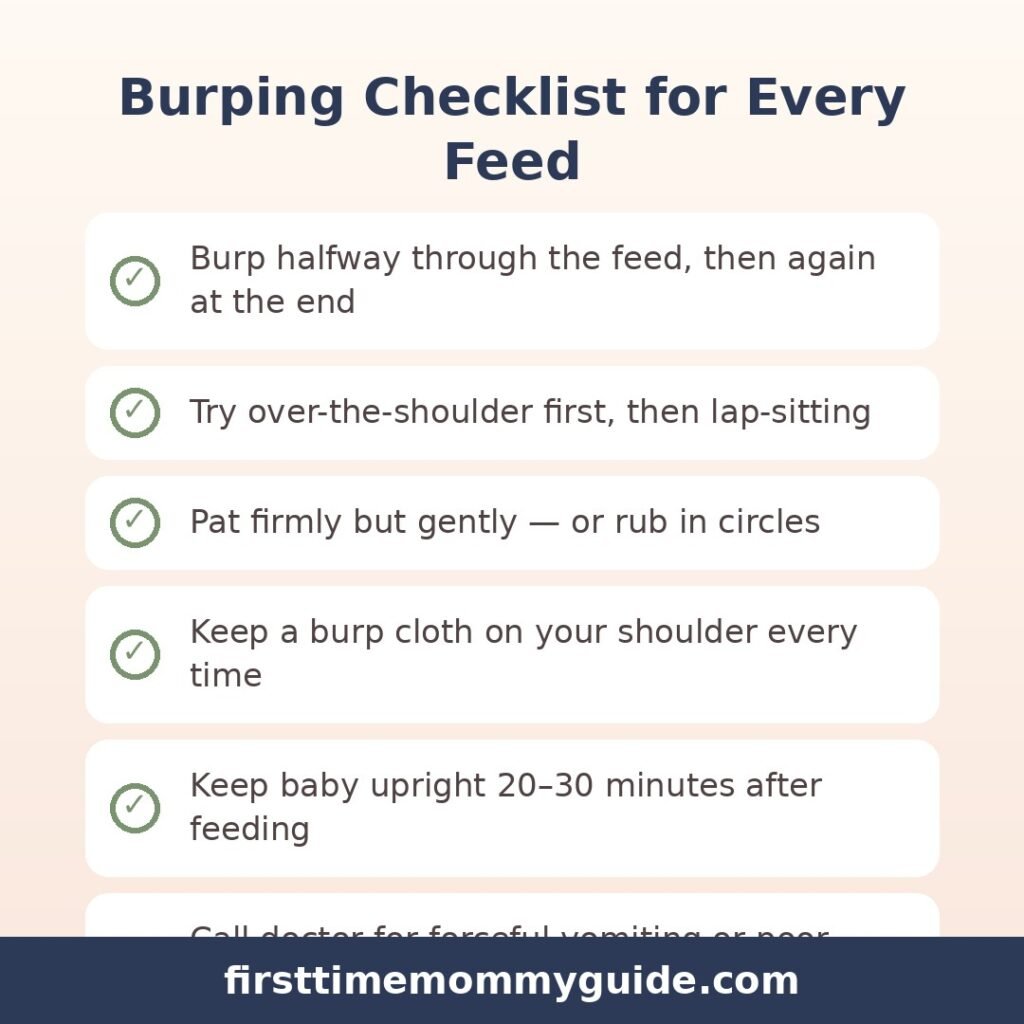
- Burp during the feed, not just at the end, so air does not build up.
- Keep your baby upright for 20–30 minutes after feeding.
- Avoid bouncing, jiggling, or tummy play right after a feed.
- Feed smaller amounts more often if your baby regularly spits up large volumes.
- Check the bottle nipple flow — too fast a flow means gulping, air, and spit-up.
Spit-up vs. vomiting — know the difference. Spit-up flows out gently, usually a tablespoon or two, and your baby is unbothered. Vomiting is forceful, projects, involves larger volumes, and often comes with distress, poor feeding, or illness. Forceful vomiting, especially if it happens at most feeds, or vomit that is green or bloody, needs a prompt call to your pediatrician.
Hiccups
Hiccups after feeding are extremely common and almost always harmless — they happen when the diaphragm is irritated by a full stomach or swallowed air, and they usually pass on their own within a few minutes. Burping sometimes helps, and sometimes it does not. You do not need to treat hiccups; they do not hurt your baby the way they annoy adults. If hiccups are frequent and paired with feeding difficulty, fussiness, or poor weight gain, mention them to your pediatrician, as they can occasionally be linked to reflux.
Burping and reflux
Babies with gastroesophageal reflux (GER) spit up more and fuss more, and burping matters even more for them — but it is not a cure. If your baby arches their back during feeds, cries inconsolably after most feeds, refuses to feed, or is not gaining weight well, talk to your pediatrician. Reflux is common and usually improves with time, but it deserves a proper assessment rather than home experimentation. Keep a note of patterns (when fussing happens, how much spit-up, feeding amounts) to show the doctor — it makes the appointment far more useful.
7 Mistakes to Avoid When Burping a Newborn
- Patting too hard. More force does not equal more burps. Gentle, rhythmic patting or circular rubbing works better and will not upset your baby.
- Laying baby flat right after a feed. Gravity is your friend. Keep your baby upright for 20–30 minutes after feeding to let air rise and milk settle.
- Forcing a burp for 20+ minutes. If nothing comes after 10–15 minutes across positions, stop. An unhappy, overtired baby is worse than an unburped one.
- Forgetting the burp cloth. Every parent learns this exactly once. Keep cloths on your shoulder, on the changing table, and in the diaper bag.
- Pressing on the throat in the lap-sit position. Support the chin and jaw, never the throat. Fingers on the jawbone, palm on the chest.
- Bouncing a full baby. Vigorous bouncing right after a feed turns a small burp into a large spit-up. Gentle rocking is fine; trampoline impressions are not.
- Skipping burps during night feeds entirely. A quick, gentle burp at night prevents the 3 a.m. wake-up from trapped wind. Keep it brief and dimly lit so everyone gets back to sleep.
Troubleshooting: Quick Reference Table
| Problem | Likely cause | What to try |
|---|---|---|
| Baby won’t burp at all | Little air swallowed, or air passed the other way | Switch positions twice, then stop if baby is comfortable |
| Burp comes with lots of spit-up | Air built up during feed, baby laid flat too soon | Burp mid-feed, keep upright 20–30 min after |
| Baby fusses right after every feed | Trapped wind, or reflux | Burp during and after feeds; if persistent, ask pediatrician |
| Baby falls asleep before burping | Normal sleepiness, especially at night | Gentle shoulder burp for a few minutes; don’t force it |
| Hiccups after every feed | Full stomach, swallowed air | Burp gently; hiccups usually pass on their own |
| Baby cries when you pat | Patting too hard, or baby wants a different hold | Soften to a rub, switch position, or just hold upright |
| Gulping and clicking while feeding | Fast flow, shallow latch | Check nipple flow, review latch, try paced feeding |
Burping on the Go, and Burping Twins

Burping does not only happen in your nursing chair. In the car, at a restaurant, or at grandma’s house, the same three positions work — the over-the-shoulder hold is the most discreet and needs no equipment beyond a burp cloth tucked in your diaper bag. If you are out without a cloth, a muslin swaddle blanket doubles as one, and a clean receiving blanket works in a pinch. The key rule for out-and-about burping is the same as at home: keep your baby upright afterward. A car seat counts as upright, but do not rush a just-fed baby into a car seat and drive off if they are still squirming — give them five minutes on your shoulder first, since a scrunched car-seat position can trap air and increase spit-up.
Parents of twins face the obvious question: how do you burp two babies at once? The honest answer is that you usually do not, at least not in the early weeks. Most twin parents burp one baby while the other waits in a bouncer or on a play mat, then switch. As the babies gain head control, the lap-sit position lets you burp one on each knee, but do not rush that milestone — safe head support comes first. Tandem feeding systems and twin nursing pillows help with feeding, but burping stays a one-at-a-time job for most families, and that is perfectly fine. If both babies are fussy at once, prioritize the one showing wind cues and let the other wait; a few minutes will not harm them.
One more scenario worth planning for: burping after a dream feed or a feed where your baby barely woke. Keep the lights low, skip the position changes, and use the gentlest version of the shoulder hold. The goal of a dream-feed burp is not a dramatic belch — it is a quiet insurance policy against a 3 a.m. wake-up. A minute or two is enough, and if nothing comes, lay them straight back down.
When Can You Stop Burping Your Baby?
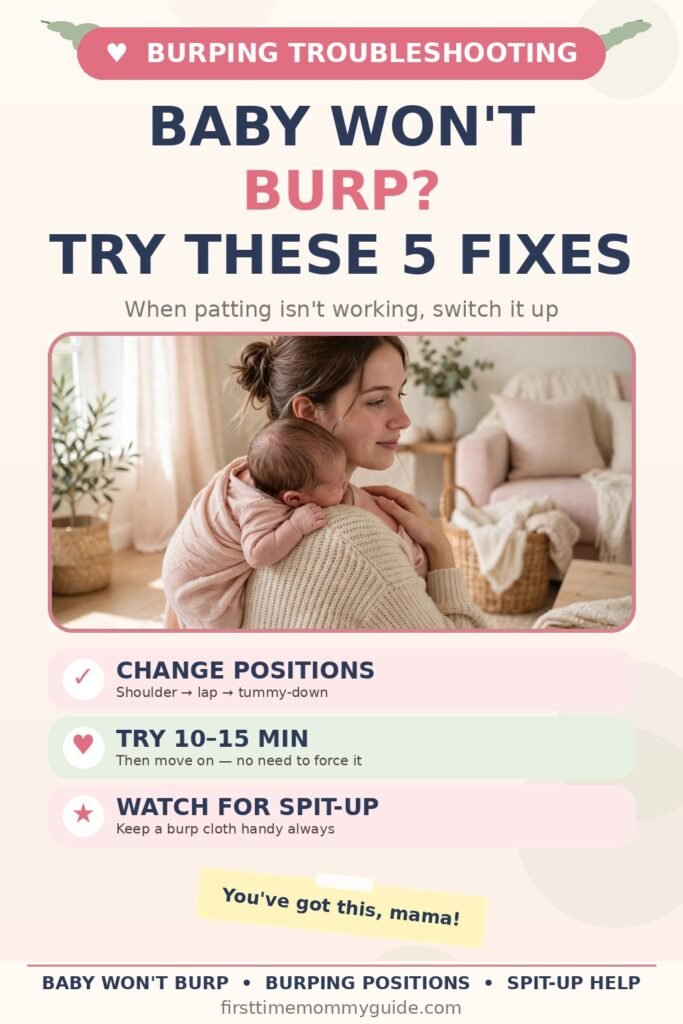
Most babies need less burping help as they grow. Around 4–6 months, babies sit up on their own, move more, eat more efficiently, and their digestive systems mature — so they release air on their own without assistance. There is no official “stop burping” date, and you do not need to quit cold turkey. The signs your baby is outgrowing burping:
- They burp on their own during play or position changes.
- They no longer fuss after feeds when you skip burping.
- They sit up independently and move their own air around.
- Feeds become calmer, with less gulping.
If you are still burping a 7- or 8-month-old who clearly does not need it, no harm is done — it is just a cuddle at that point. Follow your baby’s lead. And remember, burping is one small piece of the newborn care puzzle: once your baby is burped and settled, swaddling for sleep and a calm bedtime routine do the rest of the heavy lifting.
Frequently Asked Questions About Burping a Newborn
1. How do you burp a newborn who won’t burp?
Try all three positions — over the shoulder, sitting on your lap, and face-down across your lap — for 2–3 minutes each. Change the angle, switch from patting to rubbing, and try walking around. If nothing comes after 10–15 minutes and your baby is comfortable, stop. Not every baby burps every time.
2. How long should I burp my baby after feeding?
A few minutes per position, up to 10–15 minutes total. Then keep your baby upright for another 10–20 minutes. You do not need to burp for half an hour.
3. Do breastfed babies need to be burped?
Often less than bottle-fed babies, but yes, try. Burp when switching breasts and again at the end of the feed. Some breastfed babies rarely burp, which is normal if they are comfortable and gaining weight.
4. How often should I burp a bottle-fed baby?
After every 2–3 ounces (60–90 ml) and again when the bottle is finished, per AAP guidance. If your baby fusses mid-bottle, pause and burp sooner.
5. What if my baby falls asleep before I can burp them?
Try a gentle shoulder burp for a few minutes. If they stay asleep and peaceful, lay them down. A sleeping, comfortable baby is not in distress from trapped air.
6. Is it OK if my baby doesn’t burp after every feed?
Yes. If your baby is feeding well, gaining weight, and seems comfortable, a missing burp is not a problem. Some babies swallow very little air.
7. Why does my baby spit up when burping?
A “wet burp” is normal — air pushing up carries a little milk with it. Burping mid-feed, keeping baby upright afterward, and avoiding bouncing right after feeds all reduce it.
8. Should I burp my baby in the middle of the night?
Yes, briefly. A quick 2–3 minute burp prevents trapped-wind wake-ups. Keep lights low and the burp gentle so everyone gets back to sleep faster.
9. Can burping hurt my baby?
No, when done gently. Pat with a cupped hand at moderate pressure, support the head and neck, and never press on the throat. If your baby cries harder during patting, soften your touch or switch holds.
10. What’s the best burping position for a newborn?
There is no single best position — it varies by baby. Over-the-shoulder works for most, the lap-sit helps stubborn burps, and the face-down lap hold uses tummy pressure for the most resistant air. Try all three and learn your baby’s favorite.
11. Does my baby need burping after every single feed?
Try at every feed in the early weeks, but do not stress about perfection. A calm, content baby who missed a burp is fine.
12. Why does my baby cry during burping?
They may be overtired, still hungry, uncomfortable from wind, or disliking the position. Try a different hold, soften your patting, or pause and cuddle. Persistent crying after most feeds deserves a pediatrician’s input.
13. Can I burp my baby too much?
You cannot really “over-burp” a baby, but you can overdo the session. Long, fruitless patting sessions overtire everyone. Cap attempts at 10–15 minutes.
14. When do babies stop needing to be burped?
Most babies need less help around 4–6 months, when they sit up, move more, and feed more efficiently. Follow your baby’s cues rather than a calendar date.
15. Is it normal for burping to make my baby hiccup?
Yes. Hiccups after feeding are common and harmless, caused by a full stomach or swallowed air irritating the diaphragm. They usually pass within minutes.
16. Should I burp a baby with reflux differently?
Burp more often — smaller, more frequent burping breaks during feeds — and keep your baby upright longer afterward (20–30 minutes). If reflux symptoms are severe, talk to your pediatrician rather than relying on burping alone.
17. My baby burps but still seems gassy. Why?
Burping releases air from the stomach; gas lower in the gut is a different problem. For that, see our guide to baby gas relief remedies — bicycle legs, tummy massage, and tummy time all help lower-gut gas.
18. Do I need a special burp cloth?
No — any soft, absorbent cloth works. Muslin squares are popular because they are large, soft, and wash well. Keep several within arm’s reach of every feeding spot.
Conclusion
Burping a newborn is a small skill with an outsized effect on everyone’s comfort. Learn the three positions, burp during and after feeds, keep your baby upright afterward, and stop chasing a burp that is not coming. Most of the anxiety around burping comes from the idea that there is one right way and one right result — there is not. Your baby will teach you their preferences within a week or two, and what feels clumsy today will feel automatic by next month.
The Bottom Line
Hold your baby upright, pat or rub gently with a cupped hand, try a second position if the first fails, and move on after 10–15 minutes if nothing comes. A comfortable baby who skipped a burp is a fine baby. If fussiness after feeds is constant, or you notice forceful vomiting, poor weight gain, or feeding refusal, talk to your pediatrician — and for the gassiness that burping does not fix, read baby gas relief remedies. For calmer feeds overall, a good newborn feeding schedule and a solid swaddling routine for sleep complete the picture.
This article is for general information only and is not medical advice. If you are worried about your baby’s feeding, weight gain, or comfort, contact your pediatrician.

Dilawar Mughal
Founder and editor, First Time Mommy Guide
I research every guide against what the NHS, the AAP and the WHO publish, then write it in plain English — because most new parents are reading with one hand free, not comparing clinical guidelines. I'm not a doctor or a midwife. Every health claim on this site is sourced and linked so you can check it yourself, and anything urgent belongs with your health visitor or GP, not a blog.