
General information, not medical advice. Every baby is different — if anything worries you, speak to your midwife, health visitor or GP rather than waiting.
It is 2 a.m. Your baby, who usually sleeps in long stretches, is awake and inconsolable. They are crying in a way that sounds different — sharper, more urgent. They keep tugging at one ear. They feel warm. You have checked the nappy, offered a feed, and rocked them for twenty minutes, and nothing is working.
If this sounds familiar, an ear infection may be the cause. Ear infections are one of the most common reasons babies visit the doctor in their first two years. They are painful, they are frightening for a first-time mum, and — the reassuring part — they are usually very treatable.
This guide covers everything you need to know. You will learn the signs of an ear infection in a baby, what causes them, how doctors diagnose and treat them, what you can safely do at home, the mistakes to avoid, and exactly when to call the doctor or seek urgent care.
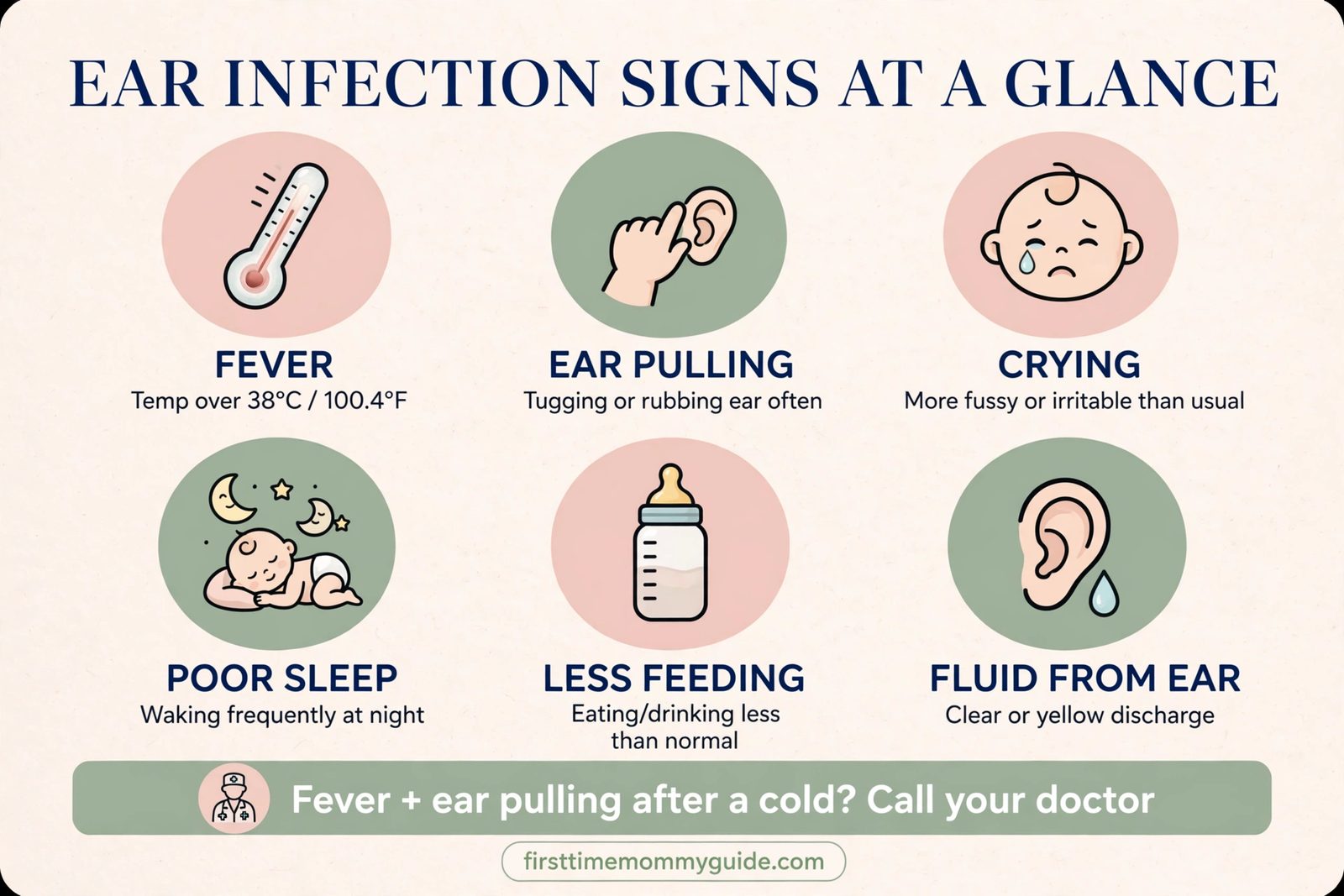
Quick answer: The most common signs of a baby ear infection are fever (often 38°C / 100.4°F or higher), tugging or pulling at one ear, unusual crying or irritability, trouble sleeping, reduced appetite, fluid draining from the ear, and difficulty hearing or responding to sounds. Ear infections usually follow a cold and are caused by fluid building up behind the eardrum. Many mild infections clear on their own, but babies under 6 months, or any baby with a high fever, should be seen by a doctor promptly.
What Is a Baby Ear Infection?
An ear infection in a baby is usually acute otitis media — an infection of the middle ear, the space behind the eardrum. It happens when fluid builds up in that space and germs (usually bacteria, sometimes viruses) grow in it.
Here is how it develops. Your baby's middle ear connects to the back of the throat through a narrow passage called the Eustachian tube. In babies and young children, this tube is short, narrow, and almost horizontal. That shape makes it easy for fluid to get trapped and hard for it to drain. When your baby has a cold, the lining of the nose and throat swells, the tube gets blocked, fluid collects behind the eardrum, and bacteria can multiply in that warm, still fluid. Pressure builds, the eardrum becomes inflamed, and your baby feels pain.
The American Academy of Pediatrics (AAP), through HealthyChildren.org, explains that ear infections are most common between 6 months and 2 years, and that most children will have at least one by their third birthday. The NHS notes the same pattern and stresses that ear infections are very common in young children and usually get better within a few days.
Types of ear infection
Not every ear problem is the same. Knowing the types helps you understand what the doctor is describing:
| Type | Where it is | Typical cause | Key signs |
|---|---|---|---|
| Acute otitis media | Middle ear, behind the eardrum | Bacteria or virus after a cold | Fever, ear pain, crying, poor sleep |
| Otitis media with effusion | Middle ear fluid, no active infection | Fluid left over after a cold or infection | Mild hearing difficulty, no fever, no pain |
| Swimmer's ear (otitis externa) | Outer ear canal | Water, irritation, bacteria in the ear canal | Pain when touching or moving the ear, itching, discharge |
| Chronic otitis media | Middle ear, recurring or long-lasting | Repeated infections, persistent fluid | Repeated infections, hearing problems |
This guide focuses on acute otitis media, the most common type in babies. Swimmer's ear is less common in babies who are not yet swimming, but the distinction matters: pain when you touch or gently move the outer ear points toward the outer ear, while deep pain with fever after a cold points toward the middle ear.
Why Are Babies So Prone to Ear Infections?
Babies get ear infections far more often than adults, and the reasons are mostly anatomical:
- Short, narrow Eustachian tubes. A baby's Eustachian tube is shorter and more horizontal than an adult's. Fluid drains poorly, and germs travel up easily.
- Frequent colds. Babies catch many colds in their first two years, especially once they start nursery or have older siblings. Every cold is a chance for fluid to collect behind the eardrum.
- Immature immune systems. A baby's immune system is still learning. It fights infections more slowly and less effectively than an adult's.
- Bottle feeding while lying flat. Feeding a baby lying flat can let milk flow into the Eustachian tube. Holding your baby more upright for feeds reduces this risk. Breastfeeding, which involves a more upright position and immune factors in breast milk, is associated with fewer ear infections.
- Dummy (pacifier) use after 6 months. Research has linked prolonged dummy use beyond 6 months to a slightly higher rate of ear infections, possibly because sucking changes pressure in the middle ear.
- Exposure to smoke. Secondhand smoke irritates the lining of the nose and Eustachian tube and increases infection risk. Babies in smoke-free homes get fewer ear infections.
- Nursery and group childcare. More contact with other children means more colds, and more colds mean more ear infections.
- Season. Ear infections peak in autumn and winter, when colds and flu circulate most.
None of this means you have done anything wrong. Ear infections are a normal part of early childhood for most families. Understanding the risk factors simply helps you reduce the ones you can control.
Baby Ear Infection Signs: What to Look For
Babies cannot tell you their ear hurts. They show you instead. The signs below are the ones paediatricians look for, and the ones parents most often report.
The most common signs
- Fever. A temperature of 38°C (100.4°F) or higher is common with a middle ear infection. The fever often starts suddenly and may be the first sign. Not every ear infection causes a fever, but most do.
- Ear pulling or tugging. Your baby repeatedly pulls, rubs, or scratches at one ear. This is one of the most recognisable signs. Note that babies also tug their ears when teething or when tired, so ear pulling alone does not prove an infection — it matters most alongside other signs.
- Unusual crying or irritability. Your baby cries more than usual, is harder to console, and seems uncomfortable, especially when lying down. Lying flat increases pressure in the middle ear, which is why ear pain often worsens at night.
- Trouble sleeping. Your baby wakes frequently, struggles to settle, or sleeps much less than usual. Night waking that starts suddenly after a cold is a classic pattern.
- Reduced appetite or difficulty feeding. Sucking and swallowing change pressure in the ear and can increase pain. Your baby may feed less, refuse the breast or bottle, or cry during feeds.
- Fluid draining from the ear. Yellow, white, or slightly bloody fluid leaking from the ear can mean the eardrum has burst (perforated). This often brings sudden relief from pain as pressure releases. A burst eardrum usually heals on its own, but your baby still needs to be seen by a doctor.
- Difficulty hearing or responding. Your baby seems not to notice sounds, does not turn toward your voice, or responds less to their name. Fluid behind the eardrum muffles hearing temporarily.
- Balance problems. The middle ear helps with balance. A baby with an ear infection may seem unsteady when sitting or crawling, or may be more clumsy than usual.
- Cold symptoms that get worse. Ear infections usually follow a cold. If your baby's cold seemed to be improving and then the fever returns, or symptoms worsen after a few days, an ear infection may have developed.
Signs by age
| Age | Signs you are most likely to see |
|---|---|
| 0–6 months | Fever, inconsolable crying, poor feeding, unusual sleepiness or irritability |
| 6–12 months | Ear pulling, fever, night waking, refusing feeds, crying when lying down |
| 12–24 months | Ear pulling, pointing at the ear, saying "ear" or "owie", fever, hearing difficulty |
Ear pulling: when it means infection and when it does not
Ear pulling worries many parents, but it is not a reliable sign on its own. Babies tug their ears for many reasons: teething, tiredness, curiosity, or simply because they discovered their ears. Ear pulling is most meaningful when it appears with other signs — fever, crying, poor sleep, or a recent cold. If your baby is pulling their ear but is otherwise happy, feeding well, and has no fever, it is most likely teething or exploration. Our guide to baby teething signs and remedies covers the teething signs that overlap with ear infection symptoms, and our guide to can teething cause a low-grade fever explains the fever question in detail.
How Doctors Diagnose an Ear Infection
When you take your baby to the doctor, the diagnosis is usually quick and straightforward:
- History. The doctor will ask about symptoms, how long they have lasted, recent colds, fever, feeding, and sleep.
- Ear examination (otoscopy). The doctor looks inside the ear with an otoscope — a small lighted instrument. An infected eardrum looks red, swollen, or bulging, sometimes with fluid visible behind it. A healthy eardrum is pearly grey and slightly transparent.
- Temperature and general check. The doctor checks your baby's temperature, breathing, and overall condition.
- Sometimes a hearing check. If fluid persists after the infection, the doctor may check hearing later.
The examination takes seconds and is usually painless, though babies often dislike having the otoscope in their ear. You can help by holding your baby still and calm during the look.
What if it is not an ear infection?
Several conditions mimic ear infections: teething, a cold without ear involvement, a sore throat, or reflux. This is why a doctor's examination matters — the treatment differs, and guessing wrong means your baby stays uncomfortable for longer. If you are unsure, it is always better to have the ear checked than to wait and worry.
Causes of Ear Infections in Babies
The immediate cause is almost always a cold or upper respiratory infection. The germs that cause the cold — usually viruses — inflame the nose and throat, block the Eustachian tube, and allow fluid to build up. Bacteria then grow in that fluid. The most common bacteria involved are Streptococcus pneumoniae, Haemophilus influenzae, and Moraxella catarrhalis.
Less common causes include:
- Allergies. Chronic nasal congestion from allergies can keep the Eustachian tube blocked.
- Enlarged adenoids. Adenoids are tissue at the back of the nose. When they are enlarged, they can block the Eustachian tube opening.
- Reflux. Stomach acid reaching the throat may irritate the Eustachian tube. See our guide to baby reflux symptoms and remedies if reflux is a concern.
- Cleft palate or craniofacial differences. Babies with a cleft palate have a higher rate of ear infections because the muscles that open the Eustachian tube work differently.
Are ear infections contagious?
The ear infection itself is not contagious. You cannot catch an ear infection from a baby. But the cold that caused it is contagious, so good hand hygiene still matters, especially if you have other children.
Treatment: What the Doctor May Do
Treatment depends on your baby's age, the severity of symptoms, and whether one or both ears are affected. The AAP guidelines recommend different approaches for different ages:
| Situation | Usual approach |
|---|---|
| Baby under 6 months with a suspected ear infection | Antibiotics are almost always prescribed; the baby should be seen promptly |
| Baby 6–23 months, severe symptoms (high fever, severe pain, both ears) | Antibiotics usually prescribed |
| Baby 6–23 months, mild symptoms, one ear | Doctor may choose antibiotics or watchful waiting with a follow-up in 48–72 hours |
| Child 2 years and older, mild symptoms | Watchful waiting is often appropriate, with antibiotics if symptoms worsen |
Antibiotics
When antibiotics are prescribed, the usual first choice is amoxicillin. The course typically lasts 7–10 days for babies under 2 years. It is important to finish the whole course, even if your baby seems better after two days. Stopping early can allow the infection to return and can contribute to antibiotic resistance.
If your baby vomits the medicine, or develops a rash, diarrhoea, or worsening symptoms, call the doctor. Do not stop the antibiotic without medical advice unless the doctor tells you to.
Pain relief
Pain relief is the most important part of home care, and the doctor will usually recommend it whether or not antibiotics are prescribed:
- Paracetamol (acetaminophen) or ibuprofen (for babies over 6 months, or over 3 months if advised by a doctor) dosed by weight. Always follow the dosing instructions on the packet or the doctor's advice, and never give adult medicines.
- Do not give aspirin to a baby or young child. Aspirin is linked to Reye's syndrome, a rare but serious condition.
- Do not use over-the-counter cold medicines in babies under 2 years unless a doctor advises it. They do not help ear infections and can cause side effects.
What about ear drops?
Ear drops are generally not used for middle ear infections, because drops cannot reach the middle ear through an intact eardrum. They may be prescribed for outer ear infections (swimmer's ear). Do not put any drops, oil, or home remedy into your baby's ear unless a doctor tells you to.
Follow-up
The doctor may ask you to return in a few days, or to call if symptoms do not improve within 48–72 hours. A follow-up visit is especially important if fluid remains behind the eardrum, because persistent fluid can temporarily affect hearing. Most fluid clears within a few weeks, but if it lasts more than 3 months, the doctor may refer your baby to an ear, nose, and throat (ENT) specialist.
Home Care: How to Comfort Your Baby With an Ear Infection
While the medicine works, there is a lot you can do at home to ease your baby's pain and help them rest.
1. Give pain relief on schedule
Do not wait for your baby to be in obvious pain before giving paracetamol or ibuprofen. Keeping pain relief regular for the first day or two helps your baby sleep and feed. Set an alarm for night doses if the doctor advised it, and always dose by weight, not by age alone.
2. Keep your baby upright
Lying flat increases pressure in the middle ear. Hold your baby upright, use a slightly elevated position for naps (in your arms or a safe inclined hold, never with pillows in the cot), and keep feeds upright. This simple change often brings visible relief.
3. Warm compress
A warm, damp flannel held gently against the affected ear for 10–15 minutes can soothe pain. Make sure it is warm, not hot — test it on the inside of your wrist first. Never put anything hot against a baby's skin.
4. Offer fluids and feeds
Keep offering the breast or bottle. Swallowing helps open the Eustachian tube and drain fluid. If your baby refuses feeds, offer smaller amounts more often, and watch for signs of dehydration (fewer wet nappies, dry mouth, no tears when crying, unusual sleepiness).
5. Comfort and closeness
Skin-to-skin contact, gentle rocking, and singing all help. Your baby is in pain and wants you close. This is not spoiling — it is comfort, and it helps them settle and sleep, which is when healing happens.
6. Saline nasal drops
If your baby has a blocked nose from the cold that caused the infection, saline nasal drops can help them breathe and feed more comfortably. Use them before feeds. Do not use medicated nasal sprays in babies unless a doctor advises it.
7. Keep the ear dry
Do not let water get into the affected ear during baths. If there is fluid draining from the ear, gently wipe the outside with a clean cloth. Never insert cotton buds or any object into the ear canal.
8. Help them sleep
Ear pain is worse at night. Keep the room calm and dark, maintain the bedtime routine, and be prepared for extra waking for a night or two. Most babies improve noticeably within 48 hours of starting treatment. For general sleep help, see our guide to newborn sleep routines and our guide to safe sleep for newborns.

What NOT to Do
- Do not put oil, garlic, breast milk, or home remedies into the ear. These do not treat a middle ear infection and can cause irritation or further infection.
- Do not use cotton buds inside the ear. They push wax deeper, can scratch the ear canal, and can damage the eardrum.
- Do not give leftover antibiotics from a previous illness, or antibiotics prescribed for someone else. The dose and type may be wrong, and unnecessary antibiotics contribute to resistance.
- Do not give cough or cold medicine to a baby under 2 unless a doctor advises it.
- Do not ignore a high fever in a baby under 3 months. Any fever of 38°C (100.4°F) or higher in a baby under 3 months needs same-day medical assessment.
- Do not delay seeing a doctor if your baby is under 6 months, has a high fever, is unusually sleepy or hard to wake, or is not feeding.
- Do not stop antibiotics early once they are prescribed, even if your baby seems better.
When to Call the Doctor — and When to Seek Urgent Care
Call the doctor the same day if:
- Your baby is under 6 months old and you suspect an ear infection.
- Your baby has a fever of 38°C (100.4°F) or higher.
- Symptoms do not improve after 48–72 hours of treatment.
- Fluid is draining from the ear.
- Your baby is not feeding or has far fewer wet nappies than usual.
- The infection keeps coming back (3 or more in 6 months, or 4 or more in a year).
- You are worried, even if you cannot name why. Parental instinct matters, and doctors would rather see a baby who turns out to be fine than miss one who needs help.
Seek urgent care or go to A&E / the emergency department if:
- Your baby is under 3 months old with a fever of 38°C (100.4°F) or higher.
- Your baby is unusually sleepy, difficult to wake, or limp.
- Your baby has a stiff neck, a rash that does not fade when pressed, or a bulging soft spot (fontanelle).
- Your baby is working hard to breathe or breathing very fast.
- There is swelling, redness, or tenderness behind the ear, or the ear sticks out more than usual (this can signal mastoiditis, a serious infection of the bone behind the ear).
- Your baby has a seizure.
- Your baby is inconsolably crying for hours despite pain relief.
These are uncommon, but they are the situations where speed matters. Trust your instincts and seek help immediately.
Recurring Ear Infections: What If It Keeps Happening?
Some babies get ear infections again and again. Recurrent infections are usually defined as 3 or more in 6 months, or 4 or more in a year. If this is your baby, the doctor may:
- Check for underlying causes, such as allergies, enlarged adenoids, or persistent fluid.
- Consider a longer course of antibiotics or a different antibiotic.
- Refer to an ENT specialist, who may discuss ear tubes (tympanostomy tubes, also called grommets). These are tiny tubes placed in the eardrum to ventilate the middle ear and reduce fluid build-up. The procedure is quick and common, and the tubes usually fall out on their own within 6–12 months.
- Review feeding and environment factors, such as dummy use, smoke exposure, and nursery attendance.
Recurring infections do not mean you are doing anything wrong. Some babies are simply more prone, and the tendency usually fades as the Eustachian tube grows longer and more vertical with age. Most children outgrow frequent ear infections by age 5 or 6.
Will ear infections affect my baby's hearing or speech?
A single ear infection rarely causes lasting harm. The fluid behind the eardrum muffles hearing temporarily, and hearing returns to normal once the fluid clears. But repeated infections, or fluid that stays for months, can delay speech and language development, because babies learn language by hearing it clearly. This is why follow-up matters: if fluid persists, the doctor will monitor hearing and speech, and early support (such as speech and language input) makes a real difference.
Prevention: How to Reduce the Risk
You cannot prevent every ear infection, but several steps reduce the risk:
- Breastfeed if you can. Breastfeeding for at least 6 months is associated with fewer ear infections, partly because of immune factors in breast milk and partly because of the upright feeding position.
- Feed upright. Hold your baby in a semi-upright position for feeds, and never prop a bottle.
- Keep your home smoke-free. Secondhand smoke is one of the strongest modifiable risk factors.
- Vaccinate on schedule. The pneumococcal vaccine and the annual flu vaccine (from 6 months) protect against germs that commonly cause ear infections.
- Limit dummy use after 6 months. If your baby uses a dummy, consider weaning off it after 6 months, when the risk of sudden infant death syndrome (SIDS) protection is less relevant and the ear infection link becomes more important. Discuss the timing with your doctor.
- Wash hands often. Frequent handwashing reduces colds, which reduces ear infections. This matters most if your baby attends nursery or has older siblings.
- Avoid colds where possible. This is easier said than done, but limiting close contact with people who have colds, and keeping your baby away from crowded indoor spaces during peak cold season, can help.
Ear Infection vs Teething: How to Tell the Difference
Teething and ear infections share several signs — ear pulling, irritability, poor sleep, and a low-grade temperature — which is why they are so often confused. Here is how to separate them:
| Feature | Teething | Ear infection |
|---|---|---|
| Fever | Low-grade, usually below 38°C (100.4°F), or none | Often 38°C or higher |
| Ear pulling | Common, both ears, comes and goes | Often one ear, persistent, with crying |
| Gum signs | Swollen, red gums; drooling; chewing on everything | Gums look normal |
| Cold symptoms | Usually none | Often a recent or current cold, blocked nose |
| Pain pattern | Comes and goes, worse when a tooth is cutting | Constant, worse when lying down, worse at night |
| Feeding | May chew the bottle or bite the nipple | Refuses feeds or cries during feeding |
| Duration | Days to a week per tooth | Improves within 48–72 hours of treatment |
When in doubt, have the ear checked. Teething does not cause a high fever, a draining ear, or a baby who will not feed. If you see those signs, it is not teething.
Common Mistakes Parents Make
Mistake 1: Assuming every ear tug is an infection
Ear pulling alone, without fever or other signs, is usually teething, tiredness, or curiosity. Rushing to the doctor for every tug is stressful and unnecessary — but so is ignoring a fever. Judge the whole picture, not one sign.
Mistake 2: Waiting too long with a young baby
Babies under 6 months should be seen promptly for any suspected ear infection. Their immune systems are immature, and infections can progress faster. Do not try watchful waiting at home with a very young baby.
Mistake 3: Using home remedies in the ear
Putting oil, garlic, or breast milk in the ear does not reach the middle ear and can cause irritation. Warm compresses on the outside of the ear are safe; anything inside the ear is not.
Mistake 4: Stopping antibiotics early
Your baby may feel better after two days, but the bacteria are not all gone. Stopping early risks a relapse and encourages antibiotic resistance. Always finish the course.
Mistake 5: Confusing ear infection with teething and missing the real problem
Teething is the default explanation many parents reach for, because it is common and reassuring. But teething does not cause high fever, fluid draining from the ear, or refusal to feed. If those signs are present, get the ear checked.
Mistake 6: Forgetting the follow-up
If fluid stays behind the eardrum, hearing can be muffled for weeks. The follow-up visit checks whether the fluid has cleared. Skipping it means a hearing problem can go unnoticed during a key period of language development.
FAQs: Baby Ear Infection Signs and Care
1. What are the first signs of an ear infection in a baby?
The earliest signs are usually a sudden fever, increased crying or irritability, trouble sleeping, and tugging at one ear — often starting a few days into a cold.
2. How do I know if my baby has an ear infection or is teething?
Ear infections usually come with a fever of 38°C or higher, a recent cold, and crying that worsens when lying down. Teething usually brings swollen gums, drooling, chewing, and only a low-grade temperature. A doctor can confirm with a quick ear examination.
3. Can a baby ear infection go away on its own?
Yes, some mild infections clear without antibiotics, especially in babies over 6 months. But babies under 6 months, or any baby with a high fever or severe pain, should be seen by a doctor, who may recommend antibiotics or watchful waiting with a follow-up.
4. How long does a baby ear infection last?
With antibiotics, most babies improve within 48–72 hours, though full recovery takes 7–10 days. Without antibiotics, mild infections often improve within a few days. Fluid behind the eardrum can take 2–4 weeks to clear fully.
5. Is it safe to fly with a baby who has an ear infection?
Flying with an ear infection can be painful because cabin pressure changes increase middle ear pressure. Many doctors advise delaying a flight if your baby has an active ear infection, especially if the eardrum is bulging. Ask your doctor before travelling.
6. Can I bathe my baby with an ear infection?
Yes, a normal bath is fine as long as you keep water out of the affected ear. Avoid swimming until the infection has cleared and the doctor says it is safe.
7. Does breastfeeding prevent ear infections?
Breastfeeding reduces the risk but does not eliminate it. Breast milk contains antibodies, and the upright feeding position helps fluid drain from the middle ear.
8. Why does my baby's ear infection get worse at night?
Lying flat increases pressure in the middle ear, which increases pain. Keeping your baby more upright, and giving pain relief before bed, can help.
9. What does fluid draining from my baby's ear mean?
It often means the eardrum has burst (perforated) from pressure. This usually relieves pain quickly and the eardrum usually heals on its own within a few weeks, but your baby still needs to be seen by a doctor.
10. Can ear infections cause hearing loss?
Temporary hearing loss from fluid is common during an infection and usually resolves. Permanent hearing loss is rare after a single infection, but repeated infections or long-standing fluid can affect hearing and speech development, which is why follow-up matters.
11. How can I soothe my baby's ear pain at night?
Give paracetamol or ibuprofen as directed by your doctor, hold your baby upright, apply a warm (not hot) compress to the ear, and keep the room calm and dark. Extra comfort and closeness help.
12. Should I take my baby to the doctor for every ear infection?
Any baby under 6 months with a suspected ear infection should be seen promptly. Older babies with mild symptoms and no fever can sometimes be monitored at home, but if you are unsure, or symptoms worsen, see the doctor.
13. Are ear infections contagious?
The ear infection itself is not contagious, but the cold that caused it is. Wash hands often and keep your baby away from people with colds where possible.
14. Can a baby get an ear infection from bath water?
Bath water can cause an outer ear infection (swimmer's ear), but middle ear infections come from colds and blocked Eustachian tubes, not from bath water. Keep water out of an infected ear until it has healed.
15. What antibiotics are used for baby ear infections?
Amoxicillin is the usual first choice. The course typically lasts 7–10 days for babies under 2 years. Your doctor may choose a different antibiotic if your baby is allergic to penicillin or has had amoxicillin recently.
16. My baby keeps getting ear infections. Is something wrong?
Some babies are simply more prone, especially if they attend nursery, have older siblings, or were exposed to smoke. Recurrent infections (3 or more in 6 months, or 4 or more in a year) deserve a medical review and possibly an ENT referral.
17. Can ear infections affect speech development?
Repeated infections or fluid that stays for months can muffle hearing during a key period of language learning, which may delay speech. Early follow-up and hearing checks help catch this.
18. Is it normal for my baby to be clingy during an ear infection?
Yes. Ear infections are painful, and babies in pain want their parents close. Extra clinginess is normal and usually settles as the infection clears.
19. When can my baby go back to nursery after an ear infection?
Once the fever has gone and your baby feels well enough, usually 24–48 hours after starting antibiotics if they were prescribed. Check your nursery's policy, as some require a set period after antibiotics begin.
20. What is the difference between an ear infection and fluid in the ear?
An ear infection (acute otitis media) is an active infection with pain, fever, and a red, bulging eardrum. Fluid in the ear (otitis media with effusion) is fluid left behind after the infection or a cold, without active infection or pain, but it can still muffle hearing.
21. Can teething cause a baby ear infection?
No. Teething does not cause ear infections, but the two often happen at the same age, and the symptoms overlap. A baby can also be teething and have an ear infection at the same time.
22. Should I use a warm or cold compress for ear pain?
A warm compress is usually more soothing for middle ear pain. Make sure it is warm, not hot, and hold it gently against the outside of the ear for 10–15 minutes.
23. How do doctors check a baby's ear?
The doctor uses an otoscope, a small lighted instrument, to look at the eardrum. An infected eardrum looks red, swollen, or bulging. The check takes seconds and is usually painless.
24. My baby's ear smells bad. Is that an ear infection?
A bad smell from the ear, especially with discharge, can signal an infection and should be checked by a doctor, particularly if there is also fever or pain.
25. Can I prevent ear infections by cleaning my baby's ears?
No. Cleaning the outer ear with a damp cloth is fine, but do not insert cotton buds or anything into the ear canal. Earwax is protective, and cleaning inside the ear does not prevent infections — and can cause injury.
Conclusion
A baby ear infection is painful, scary, and very common. The signs to remember are fever, ear pulling, unusual crying, trouble sleeping, and difficulty feeding — especially when they appear a few days into a cold. Trust your instincts: if your baby seems in pain or unusually unwell, have the ear checked.
Most infections clear quickly with pain relief and, when needed, antibiotics. Home care — upright holding, warm compresses, regular pain relief, and plenty of closeness — makes the worst nights bearable. And if infections keep coming back, ask for a review and a hearing check, because early support protects your baby's language development.
Your baby will get through this, and so will you. The 2 a.m. cries will pass, the fever will break, and the next morning will feel like a different world.
Medical disclaimer: This article is for general information only and is not a substitute for professional medical advice. If your baby has a fever, is in pain, is not feeding, or you are worried, contact your paediatrician, health visitor, or GP promptly. Seek urgent care for a baby under 3 months with a fever of 38°C (100.4°F) or higher, unusual sleepiness, difficulty breathing, or any of the red-flag signs listed above.
Sources: HealthyChildren.org (AAP) — Ear Infection Information · NHS — Ear Infections · AAP Clinical Practice Guideline — Acute Otitis Media · CDC — Ear Infection

Dilawar Mughal
Founder and editor, First Time Mommy Guide
I research every guide against what the NHS, the AAP and the WHO publish, then write it in plain English — because most new parents are reading with one hand free, not comparing clinical guidelines. I'm not a doctor or a midwife. Every health claim on this site is sourced and linked so you can check it yourself, and anything urgent belongs with your health visitor or GP, not a blog.