
General information, not medical advice. Every baby is different — if anything worries you, speak to your midwife, health visitor or GP rather than waiting.
Your baby feeds well, then brings milk straight back up. Or your baby arches, cries, and swallows hard, yet nothing ever comes out. Both moments can feel frightening, especially in the first weeks at home.
This guide explains baby reflux symptoms and remedies in full. You will learn what reflux is, how it differs from normal spit-up, what silent reflux looks like, which feeding and burping habits help, and exactly when to seek medical care.
It is written for first-time moms in plain language. It gives general information only. It does not replace advice from your own clinician, and it does not diagnose your baby. If you are worried, contact your health visitor, GP, or pediatrician.
Medical disclaimer: This article is for general information only and is not medical advice. Reflux can overlap with other conditions, including allergy, infection, and feeding problems. Never start, stop, or change a medicine, formula, or feeding plan because of something you read online. Always discuss concerns, medicines, and feeding changes with your baby’s own clinician. Seek prompt care for the red-flag symptoms listed in this guide.
Quick Answer
Baby reflux happens when milk flows back from the stomach into the food pipe. It is common in young babies because the muscle at the top of the stomach is still maturing.
Normal spit-up is usually small, painless, and does not stop a baby feeding or gaining weight. Reflux becomes a concern when a baby is distressed, feeds poorly, gains weight slowly, coughs or chokes often, or shows signs of pain with feeds.
Helpful habits at home include smaller, more frequent feeds, keeping your baby upright during and after feeds, burping often and gently, avoiding overfeeding, and not bouncing or laying your baby flat straight after a feed. Thickened feeds and medicines are only used when a clinician advises them.
Call your doctor promptly if your baby vomits forcefully, has blood in vomit or stool, refuses feeds, loses weight or gains weight slowly, has breathing difficulty, or seems in severe pain.
Key Takeaways
- Reflux is milk flowing back into the food pipe. Spit-up alone, without distress, is often normal.
- Silent reflux brings milk partway up without visible spit-up, so crying, arching, and gulping matter.
- Feeding position, burping, and an upright pause after feeds help many babies.
- Never thicken feeds, change formula, or give medicine without clinician advice.
- Most reflux improves as babies grow, sit up, and start solids, and the stomach muscle matures.
- Forceful vomiting, blood, poor weight gain, breathing difficulty, and refusal to feed need prompt medical review.
- Keep a simple log of feeds, spit-up, crying, and weight checks to share with your clinician.
What Is Baby Reflux?
Reflux, also called gastro-oesophageal reflux, happens when stomach contents flow back up the oesophagus, the tube between the mouth and the stomach. In babies, the ring of muscle that should keep the stomach closed is still developing. It relaxes more easily, so milk can escape upward.
The NHS guidance on reflux in babies explains that reflux is very common in babies, that it usually starts before 8 weeks, and that it often improves by itself. The NHS advises seeking advice if reflux seems severe, if your baby is not gaining weight, or if you are worried. That advice is a useful starting point, not a diagnosis for your baby.
Reflux is not the same as vomiting an illness. Illness vomiting often comes with fever, diarrhoea, or unusual sleepiness. Reflux tends to follow feeds, is linked to lying flat or pressure on the tummy, and often happens again and again in a pattern you can recognise.
Understanding that pattern helps you describe it clearly. Note when it happens, how much comes up, whether your baby cries, and how feeds and sleep are affected. A clear description helps your clinician far more than the word reflux alone.
How the stomach valve works in babies
Think of the stomach as a pouch with a one-way door at the top. In adults, that door usually stays shut after swallowing. In young babies, the door is looser and shorter. It opens easily when the stomach is full, when pressure rises, or when a baby lies flat.
Premature babies often have more reflux. Their digestive system is less mature, and they may feed in positions that make reflux more likely. Babies with certain health conditions may also reflux more. Your clinician will consider your baby’s whole history, not reflux alone.
As babies grow, the door strengthens, the food pipe lengthens, and babies spend more time upright. Sitting, crawling, and eating thicker foods all reduce the chance of milk flowing back. That is why time itself is often part of the treatment plan.
Reflux vs. normal spit-up
All babies bring up some milk. A small mouthful after a feed, with no crying and a happy baby, is usually called spit-up or posseting. It looks dramatic on a muslin cloth, but the amount is often smaller than it seems.
Reflux is the name for the backward flow itself. Doctors use the term gastro-oesophageal reflux disease, or GORD, when reflux causes distress, feeding difficulty, poor growth, or damage to the food pipe. The distinction matters because normal spit-up needs reassurance and simple habits, while GORD needs medical assessment.
The table below helps you compare the two patterns. Use it as a guide, not a diagnosis. If your baby sits between the two columns, or you are unsure, ask your clinician.
| Feature | Normal spit-up | Reflux that needs review |
|---|---|---|
| Amount | Small mouthful, often a dribble | Larger amounts, or frequent large vomits |
| Baby’s mood | Settled, content after spitting up | Crying, arching, fussiness around feeds |
| Feeding | Feeds eagerly, finishes feeds | Refuses feeds, pulls away, feeds briefly |
| Weight gain | Steady weight gain | Slow gain, weight loss, or falling off growth curve |
| Sleep | Sleeps reasonably between feeds | Wakes crying, hard to settle, prefers upright sleep |
| Breathing | No coughing or choking | Frequent cough, gag, choke, or wheeze with feeds |
| Frequency | Occasional, mainly after large feeds | Most feeds, most days, with distress |

When does baby reflux start, and when does it go away?
Reflux often starts in the first weeks of life, commonly before 8 weeks. It may peak around 4 months, when babies take larger feeds and are still mostly lying down. Many parents notice it improves once a baby sits up, starts solids, and takes smaller milk feeds.
Most babies outgrow reflux by 12 to 18 months. That does not mean you should simply wait if your baby is distressed. Feeding habits, positioning, and medical review can make the waiting period much more comfortable.
If reflux continues beyond the first year, is severe, or returns after improving, seek review. Persistent reflux in an older baby or toddler deserves a fresh assessment, because other causes need to be considered.
Baby Reflux Symptoms
Reflux symptoms vary. Some babies spit up visibly. Others show no milk at all. Some feed happily and grow well despite frequent spit-up. Others cry through most feeds. Look at the whole pattern, not one symptom alone.
The most common symptoms
Frequent spit-up after feeds is the most recognised sign. Milk may dribble from the mouth, or come up in a larger rush. Some babies bring up milk an hour or more after a feed, not only straight away.
Crying during or after feeds is common. Your baby may pull off the breast or bottle, cry, then want to feed again. That cycle can look like hunger, but it may be discomfort. A baby may feed for comfort, then bring milk up again, which restarts the cycle.
Arching the back, stiffening, and turning the head away are also common. Your baby may seem uncomfortable when laid flat, especially after a feed. Some babies prefer to be held upright and cry when put down in a cot or pram.
Hiccups, wet burps, and gurgling sounds happen often. Your baby may swallow repeatedly, as if swallowing milk back down. Coughing, gagging, or a hoarse cry after feeds can also occur. These signs alone do not prove reflux, but together they build a picture worth discussing.
Silent reflux in babies
Silent reflux is reflux without visible spit-up. Milk flows partway up the food pipe, then is swallowed back down. Because nothing comes out, parents and sometimes clinicians can miss it at first.
Signs of silent reflux can include crying during or after feeds, arching, refusing the breast or bottle, frequent swallowing or gulping, a wet or rattly sound in the throat, coughing when laid flat, and poor sleep. Some babies with silent reflux feed little and often, because small feeds hurt less.
Silent reflux is not a formal diagnosis you can make at home. It is a description of a pattern. If you suspect it, describe the pattern in detail to your clinician. Note the timing, the positions that help or worsen it, and how feeding and sleep are affected.
Silent reflux can be confused with colic, allergy, or feeding difficulty. Our guide to colic in babies, symptoms and soothing explains the colic pattern, which tends to cluster at predictable times in an otherwise healthy baby. Reflux, by contrast, is usually tied closely to feeds and lying flat.
Reflux and feeding behaviour
Watch how your baby starts a feed, not only how the feed ends. A baby with reflux may latch eagerly, feed briefly, pull away crying, and then root again. That stop-start pattern often confuses parents, who wonder whether the problem is milk supply or hunger.
Some babies feed better when sleepy, when upright, or when walking around. Others feed better in a quiet room with fewer distractions. A calm, upright feed can reduce the amount of air swallowed and the pressure on the stomach.
Refusal to feed, or taking much less than usual, is a more serious sign. If your baby consistently refuses feeds, takes very short feeds, or seems hungry but will not feed, seek advice promptly. Do not assume refusal is fussiness.
Reflux and sleep
Many babies with reflux sleep in short stretches and wake crying. Lying flat can let milk flow back, so a baby may settle in arms and wake as soon as they are put down. That pattern is exhausting, and it can make parents consider unsafe sleep positions.
Do not raise the cot mattress, use a sleep positioner, or let your baby sleep in a car seat, bouncer, or inclined device to manage reflux, unless your clinician specifically advises it and explains safe sleep. The American Academy of Pediatrics safe sleep guidance, summarised by HealthyChildren.org, recommends a flat, firm sleep surface on the back, with no pillows, blankets, or positioners. Safe sleep protects against sudden infant death syndrome, and that risk outweighs unproven reflux benefits from inclines.
Instead, focus on upright time while awake, good burping, and a calm wind-down. If sleep is severely disrupted, discuss it with your clinician. Sleep disruption alone is a valid reason to seek help, even if weight gain is steady.
What Causes Baby Reflux?
Most baby reflux has no serious underlying cause. It reflects an immature stomach valve, a full stomach, swallowed air, and a mostly horizontal life. Understanding the triggers helps you choose habits that actually help, rather than changing everything at once.
An immature valve and a full stomach
A young baby’s stomach is small, and feeds are frequent. When the stomach fills quickly, pressure rises and the loose valve opens. Overfeeding, even slightly, can therefore worsen reflux. So can feeding very fast, which fills the stomach before fullness signals catch up.
Babies who take large feeds less often may reflux more than babies who take smaller feeds more often. That does not mean you should restrict feeds. It means pacing matters. Offer feeds responsively, pause to burp, and watch for fullness cues such as slowing down, turning away, or falling asleep.
A baby who feeds to sleep and then lies flat may also reflux more. The stomach is full, the baby is horizontal, and swallowed air is still trapped. An upright pause after feeds helps the stomach settle before lying down.
Swallowed air and feeding technique
Air swallowed during feeds adds pressure. A shallow latch, a fast-flowing bottle teat, or a crying feed can all increase air intake. Wind trapped in the stomach pushes milk upward when it escapes.
Check the latch and teat flow with your health visitor or lactation supporter if feeds are noisy, clicky, or very fast. A slower flow, a good deep latch, and pauses to burp can reduce air. Our guide on how to burp a newborn gives step-by-step burping positions that work well for reflux-prone babies.
Tongue-tie and other feeding difficulties can also increase air swallowing. If feeding is painful, noisy, or inefficient, seek a feeding assessment. Treating the feeding problem often improves reflux symptoms without any reflux-specific treatment.
Baby Reflux Remedies: Feeding and Positioning
Home remedies for reflux should be gentle, consistent, and age-appropriate. Start with feeding pace, position, and burping. Change one thing at a time, and give it a few days before judging whether it helped.
Step-by-step: a reflux-friendly feed
Feed your baby in a calm, quiet place. Hold your baby more upright than flat, with the head higher than the stomach. For breastfeeding, a laid-back or upright position often helps. For bottle feeding, hold the bottle so the teat is full of milk, not air, and keep your baby semi-upright.
Pause every few minutes to burp. Do not wait until the end of a large feed. Short pauses let air escape before the stomach gets too full. Watch for fullness cues, and stop the feed when your baby shows them, even if milk remains.
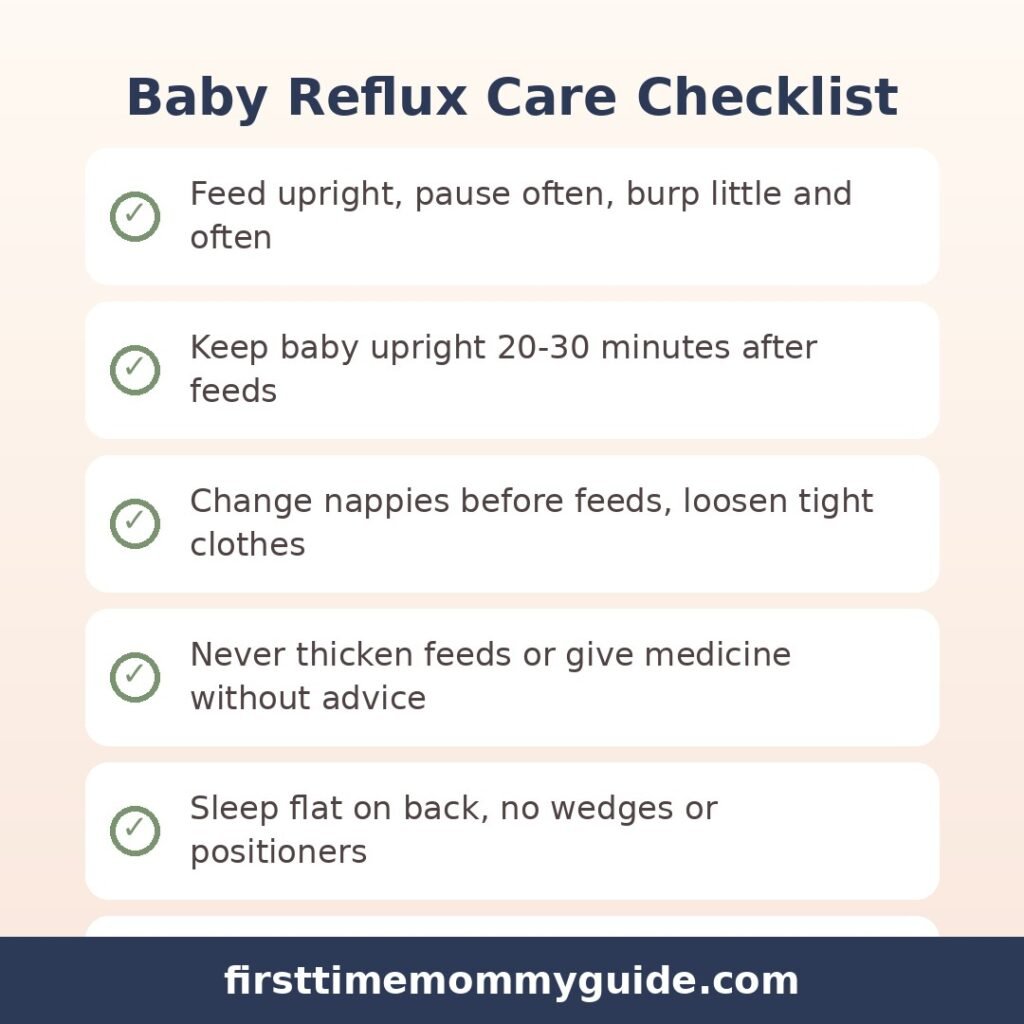
After the feed, keep your baby upright for 20 to 30 minutes. Hold your baby against your chest, in a sling while awake and supervised, or in a bouncer while awake. Avoid bouncing, jiggling, or tummy play straight after a feed. Then lay your baby flat on the back for sleep, as safe sleep guidance requires.
Keep a simple log for a week. Note feed times, amounts, spit-up, crying, and sleep. Patterns emerge quickly. You may see that large evening feeds, fast feeds, or lying flat straight after feeds are the main triggers.
Feeding positions that help
Upright feeding positions use gravity to keep milk down. For breastfeeding, try a koala hold, with your baby sitting upright straddling your thigh, or a laid-back position with your baby’s head above the stomach. Ask a lactation supporter to check the latch in the new position.
For bottle feeding, hold your baby at about 45 degrees, with the head supported and higher than the stomach. Use paced bottle feeding. Hold the bottle horizontal, let your baby draw milk actively, and pause often. Paced feeding mimics breastfeeding rhythm and reduces overfeeding.
Side-lying feeding can help some babies, but it can also make reflux worse if the baby lies flat. If you try side-lying, keep the head slightly raised and burp afterwards. Discuss positions with your health visitor if reflux is severe.
Avoid feeding your baby while they are crying hard. Calm your baby first, with skin-to-skin contact, rocking, or a dummy if you use one. A crying baby swallows more air, which worsens reflux.
How to burp a baby with reflux
Burp little and often, not once at the end. Try three positions. Over the shoulder, with your baby’s tummy against your chest and gentle pats. Sitting on your lap, leaning forward slightly, supporting the chin and chest. Or face down across your lap, with the head turned to one side and gentle rubbing.
Use gentle pats and rubbing, not hard thumps. Some babies burp easily. Others need several minutes. A wet burp, with a small amount of milk, is common in reflux and does not mean you burped wrong.
If your baby falls asleep during a feed, burp gently before putting them down. A sleeping baby can still bring up milk. Keep the upright pause even if your baby seems settled. Our step-by-step guide on how to burp a newborn covers each position with safety notes.

Smaller, more frequent feeds
Smaller feeds reduce stomach pressure. If your baby takes large feeds, try offering slightly less, more often. For breastfed babies, offer the breast more frequently and let your baby decide how long to feed. For formula-fed babies, discuss amounts with your clinician before changing them.
Do not restrict feeds to treat reflux. Babies need regular milk for growth. If your baby is hungry, feed them. The goal is pacing and positioning, not less milk overall.
Watch wet nappies and weight gain. Six or more wet nappies a day, with pale yellow urine, usually means fluid intake is adequate. If wet nappies fall, or weight gain slows, seek advice promptly.
What not to do at home
Do not thicken feeds with cereal, rice, or thickener unless your clinician prescribes it. Thickened feeds can cause choking, constipation, and poor nutrition if used incorrectly. They are sometimes used under medical supervision, but never as a home experiment.
Do not change formula without clinician advice. Switching formulas repeatedly can worsen symptoms and delay diagnosis. If allergy is suspected, your clinician will advise a supervised trial.
Do not give antacids, gripe water, herbal remedies, or over-the-counter reflux medicines without clinician advice. These products are not tested for babies in the same way as prescribed medicines, and some can cause harm. Do not elevate the cot, use wedges, or use sleep positioners without specific medical advice.
Do not smoke around your baby. Tobacco smoke can worsen reflux and breathing problems. Keep your home and car smoke-free, and ask visitors not to smoke near your baby.
Medical Treatment: What Your Clinician May Do
Medical treatment for reflux is stepped. Simple habits come first. Thickened feeds, medicines, and specialist referral follow only when needed. Your clinician will tailor the plan to your baby’s age, weight, feeding type, and symptoms.
Assessment and diagnosis
Your clinician will usually start with questions. They will ask about feed type, amounts, timing, spit-up, crying, sleep, nappies, weight gain, and family history. They will examine your baby’s tummy, mouth, and growth, and check for signs of allergy or other conditions.
In most cases, no tests are needed. Reflux is diagnosed from the history and examination. Tests are reserved for severe, persistent, or unusual cases. They may include checking weight trends, reviewing feeding, or, rarely, imaging or pH studies.
The HealthyChildren.org guidance on reflux in infants from the American Academy of Pediatrics explains that most reflux improves with time and feeding changes, and that medicines are reserved for babies with poor growth, feeding refusal, or breathing problems. That stepped approach protects babies from unnecessary treatment.
Thickened feeds and formula changes
Thickened feeds may be advised for some babies under medical supervision. A thickener or a pre-thickened formula can reduce spit-up in some babies. It does not help every baby, and it can cause constipation or feeding difficulty.
Your clinician will explain the exact product, amount, and duration. Follow those instructions precisely. Do not improvise with cereal or home thickeners. If thickened feeds do not help within the agreed trial period, tell your clinician rather than continuing indefinitely.
Formula changes may be advised if allergy is suspected. An extensively hydrolysed or amino acid formula may be trialled under supervision. These formulas taste different, and babies may need time to accept them. Your clinician will advise on amounts, duration, and review.
Medicines for reflux
Medicines are not first-line treatment for most babies. They are considered when reflux causes poor growth, feeding refusal, breathing problems, or confirmed damage to the food pipe. The decision is made by a clinician, after assessment.
Medicines may include antacids, which neutralise stomach acid, or acid-suppressing medicines, which reduce acid production. They do not stop reflux itself. They reduce the pain from acid. They can have side effects, so they need monitoring and review.
Never share medicines between babies, never use adult medicines, and never continue a medicine beyond the prescribed course without review. If a medicine is prescribed, ask about dose, timing, side effects, and when to return for review. Keep a note of what you give and when.
| Treatment step | When it is used | Key cautions |
|---|---|---|
| Feeding and positioning habits | First step for most babies | Be consistent for at least a week |
| Thickened feeds | Under clinician advice, if spit-up is frequent | Can cause constipation; follow exact instructions |
| Formula or diet trial | If allergy is suspected | Supervised trial only; do not self-prescribe |
| Acid-suppressing medicine | If growth, feeding, or breathing is affected | Needs monitoring; does not stop reflux itself |
| Specialist referral | Severe, persistent, or unusual reflux | Bring feed and symptom log to appointment |
Reflux and Solids, Weaning, and Older Babies
Starting solids often changes reflux. Thicker foods stay down more easily, and upright sitting helps. But new foods, new textures, and changed milk amounts can also trigger symptoms. A gradual, responsive approach works best.
Does starting solids help reflux?
For many babies, solids help. Purees and soft finger foods are thicker than milk, so they flow back less easily. Sitting in a highchair keeps the stomach upright. Smaller milk feeds, replaced gradually by solids, also reduce pressure.
For some babies, solids worsen reflux at first. New foods can cause gas, constipation, or allergy reactions, which increase crying and spit-up. Introduce foods gradually, one at a time, and watch for patterns.
Do not start solids early to treat reflux unless your clinician advises it. Early solids carry risks, including choking, allergy, and poor nutrition. The usual guidance is to start solids around 6 months, when your baby shows readiness signs. Our guide to signs baby is ready for solid foods explains readiness signs in detail.
Weaning foods and habits that help
Offer solids in an upright highchair, with good support. Keep your baby upright for 20 to 30 minutes after meals, just as after milk feeds. Avoid laying your baby down straight after a meal, and avoid vigorous play after eating.
Offer water with meals in a cup, once solids start. Small sips help digestion. Keep portions small and responsive. Follow your baby’s cues. If your baby turns away, do not push more food.
Balance fibre and fluids to avoid constipation, which can worsen reflux. Pears, prunes, sweet potato, and oats help many babies. Our baby food chart for 6 to 12 months gives age-by-age food ideas, textures, and portion guidance.
Foods that may worsen reflux in older babies
Acidic foods, such as citrus and tomato, can irritate the food pipe in some babies. Spicy foods, chocolate, and fizzy drinks are best avoided in babies and toddlers. Large meals late in the evening can also worsen symptoms.
Every baby is different. A food diary helps you spot triggers without cutting out whole food groups unnecessarily. Note foods, amounts, timing, and symptoms for a few days. Share the diary with your clinician or dietitian.
Do not restrict your baby’s diet without advice. Babies need a varied diet for growth and development. If you suspect a food trigger, discuss it with your clinician before removing foods.
When to Call the Doctor
Most reflux improves with habits and time. Some situations need medical review, and a few need urgent care. Knowing the difference helps you act calmly and quickly.
Call your clinician soon if:
- Your baby spits up large amounts at most feeds, most days, with distress.
- Your baby refuses feeds, feeds very briefly, or seems hungry but will not feed.
- Weight gain is slow, weight is static, or your baby is losing weight.
- Your baby cries inconsolably, arches frequently, or seems in pain with feeds.
- Your baby coughs, chokes, gags, or wheezes often with feeds.
- Your baby has blood or mucus in stools, eczema, or other allergy signs.
- Reflux does not improve after a week or two of consistent home habits.
- You are exhausted, anxious, or struggling to cope. Parental wellbeing matters, and support is part of care.
Your clinician may examine your baby, check growth, review feeding, and advise on next steps. They may prescribe a trial of treatment, arrange follow-up, or refer to a specialist.
Seek urgent care if:
- Your baby vomits forcefully, repeatedly, or vomits green or yellow fluid.
- Vomit contains blood, or looks like coffee grounds.
- Your baby has breathing difficulty, turns blue, or stops breathing briefly.
- Your baby is unusually floppy, hard to wake, or inconsolable.
- Your baby has a fever with vomiting and seems unwell.
- Your baby has a swollen, hard, or tender belly.
- Your baby has not passed urine for many hours, or has very few wet nappies.
- Your baby has black, tarry stools, or a large amount of blood in the stool.
If you cannot reach your clinician, contact NHS 111 in the UK, or your local urgent care service. Describe the symptoms clearly, and mention your baby’s age, feeding pattern, and weight trend. In an emergency, call emergency services.
What to tell your clinician
Prepare a short, clear summary. Include your baby’s age, birth history, feed type and amounts, timing of symptoms, spit-up amount and frequency, crying pattern, sleep, nappies, weight checks, and any medicines or remedies tried.
Bring your log, if you kept one. Note what helps and what worsens symptoms. Mention family history of allergy, reflux, or asthma, if relevant. Ask what to watch for, when to return, and how to contact help out of hours.
Preventing Reflux Flare-Ups
Prevention is about steady habits, not perfection. Small daily choices keep the stomach settled and reduce the chance of a bad patch.
Daily habits that help
Feed responsively, in an upright position, with pauses to burp. Keep your baby upright after feeds. Avoid overfeeding, fast feeds, and lying flat straight after milk. Change nappies before feeds, and loosen tight clothing after feeds.
Build movement into the day. Tummy time before feeds, kicking, and crawling all help digestion. Keep routines predictable. Regular meals, play, and sleep help the bowel and stomach develop a rhythm.
Keep your home smoke-free. Avoid strong fragrances and cleaning products near your baby. Wash hands before feeds and nappy changes. Good hygiene reduces illness, which can worsen reflux.
Common mistakes to avoid
The most common mistake is changing everything at once. A new formula, a new teat, a new position, and a new remedy in one day makes it impossible to know what helped. Change one thing at a time, and give it a few days.
Another mistake is feeding more to settle crying. A crying baby may seem hungry, but extra milk can worsen reflux and restart the cycle. Try comfort measures first, then offer a feed if hunger cues persist.
Giving medicines, thickeners, or herbal remedies without advice is also common. These can cause harm and delay proper assessment. Always discuss treatments with your clinician.
Finally, do not delay seeking help. If home steps are not working, or your baby seems unwell, contact your clinician. Early help is simpler and kinder than waiting for a crisis.
Expert Tips and Real-Life Scenarios
Tip 1: Log the pattern, not the panic
Write down feeds, spit-up, crying, and sleep for three days. Patterns emerge quickly. You may see that large evening feeds, fast feeds, or lying flat straight after feeds are the main triggers.
Bring the notes to appointments. Clinicians value concrete detail. It also helps you feel more in control, which matters when you are tired and worried.
Tip 2: Keep the remedy boring and consistent
Pick two or three gentle habits and repeat them for a week. Upright feeds, frequent burping, and an upright pause after feeds are enough for most babies. Add changes only one at a time.
Consistency helps your baby’s stomach settle. It also helps you judge what works. A calm, predictable routine is itself a treatment for reflux.
Scenario: reflux in a breastfed 6-week-old
A breastfed 6-week-old spits up after most feeds, arches, and cries when laid flat. Feeds are fast, with clicking sounds. First, check the latch and feeding position with a lactation supporter. Try upright feeds, paced pauses, and frequent burping.
Keep the baby upright for 20 to 30 minutes after feeds. Change nappies before feeds. If symptoms persist after a week, or weight gain slows, seek medical review. Do not change your diet or give medicines without advice.
Scenario: silent reflux with poor sleep
A 3-month-old rarely spits up, but cries during feeds, gulps, and wakes crying when laid flat. Sleep is broken, and parents are exhausted. Log the pattern for a few days, noting feed timing, positions, and sleep.
Discuss the pattern with your clinician. Bring the log. Ask about feeding assessment, positioning, and whether further review is needed. Focus on safe sleep, even when sleep is broken. A flat, firm surface on the back remains the safest sleep position.
Frequently Asked Questions
What are the first signs of baby reflux?
The first signs are often frequent spit-up after feeds, crying during or after feeds, arching the back, gulping, hiccups, and fussiness when laid flat. Some babies show silent reflux, with no visible spit-up, but cry, refuse feeds, or wake often. Look for a pattern tied to feeds, not one isolated symptom.
Is it normal for babies to spit up?
Yes, small amounts of spit-up after feeds are normal in young babies. The stomach valve is still maturing, and babies take frequent liquid feeds. Spit-up alone, without distress, poor feeding, or slow weight gain, is usually normal. Seek advice if spit-up is large, frequent, and distressing.
What is silent reflux in babies?
Silent reflux is reflux without visible spit-up. Milk flows partway up the food pipe and is swallowed back down. Signs can include crying, arching, gulping, coughing when flat, feeding refusal, and poor sleep. It is a pattern description, not a home diagnosis. Discuss the pattern with your clinician.
How can I tell reflux from colic?
Reflux is usually tied to feeds and lying flat, with spit-up, gulping, and arching. Colic involves prolonged crying at predictable times, often in the evening, in an otherwise healthy baby who feeds and grows well. The two can overlap. If crying is intense, inconsolable, or accompanied by other symptoms, seek medical review.
Does reflux cause pain?
Reflux can cause discomfort when stomach acid irritates the food pipe. Babies may cry, arch, and refuse feeds. Not all spit-up is painful. A settled baby who spits up and feeds well is unlikely to be in significant pain. Persistent crying with feeds deserves medical review.
How do I burp a baby with reflux?
Burp little and often, during and after feeds. Try over the shoulder, sitting on your lap leaning forward, or face down across your lap. Use gentle pats and rubbing. Keep your baby upright for 20 to 30 minutes after feeds. Our guide on how to burp a newborn gives step-by-step positions.
Should I keep my baby upright after feeds?
Yes, keeping your baby upright for 20 to 30 minutes after feeds helps many babies. Hold your baby against your chest or in a sling while awake and supervised. Then lay your baby flat on the back for sleep. Do not use inclined sleep devices, wedges, or positioners unless your clinician specifically advises them.
Can I raise the head of the cot for reflux?
Do not raise the cot mattress or use wedges or positioners without specific medical advice. Safe sleep guidance recommends a flat, firm surface on the back, with no pillows or positioners. Discuss sleep concerns with your clinician, who can advise on safe options for your baby.
What feeding positions help reflux?
Upright positions help most babies. For breastfeeding, try a koala hold or laid-back position with the head above the stomach. For bottle feeding, hold your baby at about 45 degrees and use paced feeding with frequent pauses. Check the latch and teat flow with a feeding supporter if feeds are noisy or very fast.
Should I give smaller, more frequent feeds?
Smaller, more frequent feeds can reduce stomach pressure and help some babies. Offer feeds responsively and watch fullness cues. Do not restrict total milk intake without clinician advice. Babies need regular milk for growth, and slow weight gain needs prompt review.
Can formula cause reflux?
Formula does not cause reflux in most babies, but feeding technique, teat flow, and overfeeding can worsen symptoms. Incorrect formula preparation can also cause problems, so follow tin instructions exactly. Do not change formula without clinician advice. If allergy is suspected, your clinician may advise a supervised trial.
Can breastfeeding cause reflux?
Breast milk does not cause reflux, but fast let-down, overfeeding, and swallowed air can worsen symptoms. Upright feeds, paced pauses, and frequent burping help. Do not cut foods from your diet without clinician advice. A feeding assessment can help if latch or flow is a problem.
When does baby reflux go away?
Most reflux improves as babies grow, sit up, and start solids, and the stomach valve matures. Many babies improve by 12 months, and most by 18 months. If reflux persists beyond that, is severe, or returns after improving, seek review. Persistent reflux deserves fresh assessment.
Is reflux linked to cow’s milk allergy?
Cow’s milk protein allergy can mimic reflux, with crying, vomiting, blood or mucus in stools, eczema, and poor growth. It is less common than simple reflux. Do not trial an elimination diet or change formula without clinician advice. Supervised trials and review are safer.
Should I thicken my baby’s feeds?
Only if your clinician prescribes it. Thickened feeds can help some babies, but they can cause choking, constipation, and poor nutrition if used incorrectly. Follow exact product, amount, and duration instructions. Tell your clinician if thickened feeds do not help within the agreed trial period.
Do reflux medicines work for babies?
Medicines can reduce acid pain, but they do not stop reflux itself. They are reserved for babies with poor growth, feeding refusal, breathing problems, or confirmed food pipe damage. They need monitoring and review. Never give medicines without clinician advice, and never share medicines between babies.
Can reflux affect my baby’s breathing?
Reflux can cause coughing, gagging, choking, and wheezing with feeds, especially when milk flows back into the throat. Frequent breathing symptoms with feeds need medical review. Seek urgent care for breathing difficulty, blue lips, or pauses in breathing.
How can I help my baby sleep with reflux?
Keep feeds calm and upright, burp well, and keep your baby upright for 20 to 30 minutes after feeds while awake. Use a calm wind-down routine. Lay your baby flat on the back for sleep, on a firm surface, with no pillows or positioners. Discuss severe sleep disruption with your clinician.
Does tummy time make reflux worse?
Tummy time straight after a feed can worsen reflux, because pressure on a full stomach pushes milk up. Schedule tummy time before feeds or well after feeds, when the stomach is emptier. Short, frequent sessions while awake and supervised are best. Our guide on newborn feeding schedule helps you plan feeds, play, and sleep across the day.
When should I worry about baby reflux?
Worry if your baby vomits forcefully, has blood in vomit or stool, refuses feeds, gains weight slowly, has breathing difficulty, or seems in severe pain. Seek prompt care for those signs. Also seek help if reflux disrupts feeding, growth, or sleep, even if no red flags are present. Early help is better than waiting.
Conclusion
Baby reflux is common, worrying, and usually manageable with gentle habits and time. The key is to watch the whole pattern, not one spit-up alone. Look at feeding, mood, sleep, nappies, and weight gain together.
Remember the essentials. Normal spit-up is small and painless. Reflux that needs review brings distress, feeding difficulty, poor growth, or breathing symptoms. Silent reflux shows no milk, but brings crying, arching, and gulping tied to feeds.
Helpful habits are simple and consistent. Feed upright, pause to burp, keep your baby upright after feeds, avoid overfeeding and lying flat straight after milk, and change nappies before feeds. Keep sleep flat and safe, on the back, with no inclines or positioners unless your clinician advises them.
Do not thicken feeds, change formula, cut foods from your diet, or give medicines without clinician advice. Those steps need assessment, supervision, and review. They can cause harm if used as home experiments.
Seek help promptly for forceful vomiting, blood, breathing difficulty, refusal to feed, slow weight gain, or severe pain. Seek help too if reflux disrupts feeding, growth, or sleep, even without red flags. Describing what you see, clearly and calmly, helps your clinician help your baby quickly.
Most babies outgrow reflux as they grow, sit up, and start solids. Your calm, consistent care makes that waiting period easier. If you are worried, contact your health visitor, GP, or pediatrician. You do not need to manage reflux alone.
This article is for general information only and does not replace professional medical advice. If you have concerns about your baby’s health, consult your clinician.

Dilawar Mughal
Founder and editor, First Time Mommy Guide
I research every guide against what the NHS, the AAP and the WHO publish, then write it in plain English — because most new parents are reading with one hand free, not comparing clinical guidelines. I'm not a doctor or a midwife. Every health claim on this site is sourced and linked so you can check it yourself, and anything urgent belongs with your health visitor or GP, not a blog.