
General information, not medical advice. Every baby is different — if anything worries you, speak to your midwife, health visitor or GP rather than waiting.
Starting solids is one of the most exciting milestones of your baby’s first year. Between the messy high chair, the funny faces, and the tiny fistfuls of avocado, it feels like a whole new world is opening up. But alongside the excitement comes a very real question every first-time parent asks: which baby first foods should you avoid?
The short answer is that most everyday foods are fine once your baby is ready for solids, usually around six months. A small group of foods, however, carries real risks for babies under one. Honey can cause infant botulism. Whole nuts, grapes, and popcorn can block a tiny airway. Cow’s milk as a main drink can strain immature kidneys and crowd out iron. Raw or undercooked foods can carry bacteria a baby’s immune system is not ready to fight.
This guide covers every food to avoid for babies under one, explains why each one is risky, and gives you safe swaps so you never have to guess at mealtimes. You will also find age-by-age tables, choking hazard lists, and clear advice on what to do if your baby accidentally eats something unsafe.
Key Takeaways
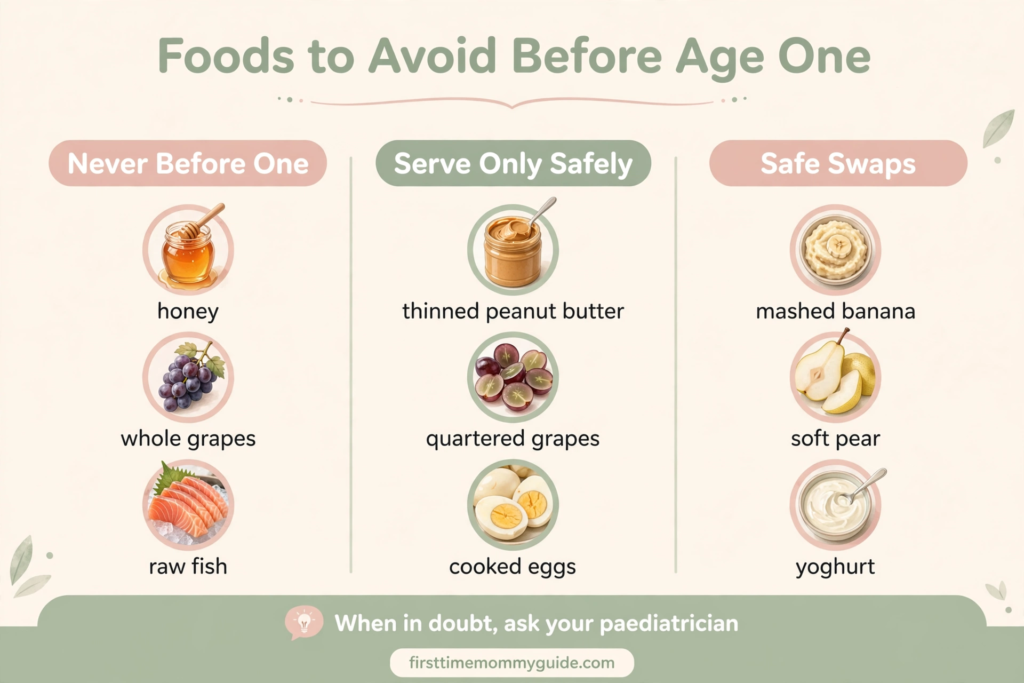
- Honey is the only food that is never safe before age one, even in cooked foods or baked goods, because it can carry spores that cause infant botulism.
- Cow’s milk should not replace breast milk or formula before twelve months, although small amounts in cooking are usually fine after six months.
- Choking hazards matter more than most parents expect. Whole grapes, hot dog rounds, popcorn, whole nuts, raw carrot sticks, and hard candy should be avoided or served only in safe, modified forms.
- Raw and undercooked meat, fish, and eggs carry a higher infection risk for babies. Serve everything fully cooked until at least age one.
- Unpasteurised milk, cheese, and juice should be avoided entirely in the first year.
- Salt and added sugar should be kept to a minimum. Babies do not need either, and their kidneys handle salt poorly.
- High-mercury fish such as shark, swordfish, and king mackerel should be avoided, while low-mercury fish such as salmon and cod are excellent first foods.
- Peanuts and other allergens are different from foods to avoid. Current guidance recommends introducing peanut foods early, in safe forms, rather than delaying them.
Why Some Foods Are Unsafe for Babies Under One
A baby’s body is not a small adult’s body. Four systems are still maturing during the first year, and each one creates a different kind of food risk.
The immune system is still learning. A baby’s defences against bacteria such as Salmonella, Listeria, and E. coli are weaker than an adult’s. Foods that an adult eats without a second thought, such as a soft-boiled egg or a piece of sushi, can cause a serious infection in an infant. That is why fully cooked food matters so much before twelve months.
The gut is more permeable. In the first months of life, the lining of the intestine lets larger molecules through more easily. This is one reason the American Academy of Pediatrics (AAP) recommends waiting until around six months to start solids, when the gut is better prepared.
The kidneys are immature. A baby’s kidneys cannot process large amounts of sodium efficiently. Cow’s milk contains far more protein and minerals than breast milk or formula, which is why it should not be the main drink before one year.
The airway is tiny and the chewing skills are new. A baby’s windpipe is roughly the width of a drinking straw. Round, hard, or sticky foods can lodge there easily. Babies also lack molars, so they cannot grind hard foods. They gum and mash food instead, which works well for soft textures but not for raw carrot, whole nuts, or popcorn.
The NHS Start for Life guidance and the World Health Organization (WHO) both recommend exclusive breastfeeding for the first six months, followed by the introduction of complementary foods alongside breast milk up to two years or beyond. The foods in this guide are the exceptions to that broad, encouraging picture.
Honey: The One Food That Is Never Safe Before Age One
Honey is the single most important food to avoid in your baby’s first year. It is the only common food that carries a risk of infant botulism, a rare but serious illness caused by spores of the bacterium Clostridium botulinum.
These spores can survive in honey even when it is pasteurised or baked into foods. An adult’s gut destroys them easily. A baby’s gut cannot. The spores can grow in the intestine and produce a toxin that affects the nerves and muscles, causing constipation, weak crying, poor feeding, floppiness, and difficulty breathing. Infant botulism is a medical emergency and needs hospital treatment.
What counts as honey
All forms of honey are unsafe before twelve months: raw honey, pasteurised honey, honey in cereal bars, honey in bread, honey in cough syrups, and honey used as a sweetener in cooking. Cooking does not destroy the spores, so a honey-glazed ham or a muffin made with honey is still unsafe.
What to use instead
Babies under one do not need sweeteners at all. Fruit provides all the sweetness a baby needs. Mashed banana, stewed apple, or soft pear gives natural sweetness without any risk. After the first birthday, honey becomes safe, and you can use it in small amounts.
If you are unsure whether a shop-bought baby food or snack contains honey, check the ingredients list. Some teething biscuits and granola-style baby snacks contain honey, so reading labels is a habit worth building now.
When to call the doctor
Call your paediatrician immediately if your baby has eaten honey and then develops constipation lasting more than a day, a weak cry, trouble sucking, drooping eyelids, or unusual floppiness. Early treatment makes a real difference. The Centers for Disease Control and Prevention (CDC) notes that infant botulism is treatable, and most babies recover fully with prompt hospital care.
Cow’s Milk as a Main Drink
Cow’s milk is nutritious for toddlers and adults, but it is not a suitable main drink for babies under twelve months. The problem is not the milk itself. It is the quantity and the role it plays.
Cow’s milk contains about three times as much protein as breast milk or infant formula, along with much higher levels of sodium, potassium, and calcium. A baby’s kidneys have to work hard to clear the extra minerals. Cow’s milk is also very low in iron, and it can irritate the lining of the gut, causing tiny amounts of blood loss that worsen iron deficiency. The AAP recommends breast milk or formula as the main milk drink until twelve months.
What is allowed
Small amounts of cow’s milk in cooking are usually fine from six months. You can mix a little cow’s milk into mashed potato, use it in a sauce, or stir it into porridge. Yoghurt and cheese made from pasteurised cow’s milk are also fine from six months, because the quantities are small and the foods provide calcium and protein without replacing milk feeds.
What to avoid
Do not give cow’s milk as a drink, in a bottle, or as the main milk feed before your baby’s first birthday. The same applies to goat’s milk and sheep’s milk, which have similar mineral loads. Plant-based milks such as oat, almond, and soy drinks are also unsuitable as a main drink before one year, because they are low in protein, energy, and the nutrients a baby needs. Fortified soy formula is the exception, and only when recommended by a doctor for babies who cannot have dairy.
After the first birthday
From twelve months, whole cow’s milk can become the main milk drink. The NHS recommends whole milk rather than semi-skimmed for children under two, because babies and toddlers need the energy and fat for growth and brain development. Offer around 350 ml a day alongside a varied diet, and keep other calcium-rich foods in the rotation.
Whole Nuts, Seeds, and Nut Butters
Nuts are nutritious, but their shape and texture make them dangerous for babies. A whole almond, cashew, peanut, or hazelnut is almost exactly the size and shape of a baby’s airway. If it slips past the tongue, it can block breathing completely. Peanuts are the most common food-related choking hazard in young children.
Safe ways to serve nuts
The risk is about form, not about the nut itself. Current allergy guidance actually encourages early introduction of peanut, in safe forms, because early exposure lowers the risk of peanut allergy. The key is to change the texture completely:
- Smooth nut butter, thinned. Stir a thin layer of smooth peanut butter into porridge, yoghurt, or mashed banana. Never serve a thick spoonful of peanut butter on its own, because it can form a sticky plug in the throat.
- Finely ground nuts. Sprinkle ground almonds or ground walnuts over soft foods.
- Nut flours. Use almond flour in soft pancakes or muffins for older babies.
What to avoid
Avoid whole nuts, whole peanuts, chunks of nut butter, and nut-based snack bars with whole pieces until your child is at least five years old, which is the age the NHS advises for whole nuts. Also avoid giving a baby a spoonful of peanut butter straight from the jar, even if it is smooth. Always spread it thinly or mix it in.
If your baby has severe eczema or a known egg allergy, talk to your paediatrician before introducing peanut, because these babies have a higher risk of peanut allergy and may need testing first. Our guide to introducing allergens to baby explains the step-by-step approach in detail.
Choking Hazards: The Foods That Block Tiny Airways
Choking is one of the leading causes of injury in babies and toddlers, and food is the most common cause. The foods below are dangerous because of their shape, size, hardness, or stickiness. A baby does not need to be eating quickly or unsupervised for a choking accident to happen. Gagging is normal and noisy. Choking is silent, and that is what makes it frightening.
The highest-risk foods
| Food | Why it is risky | Safe alternative |
|---|---|---|
| Whole grapes and cherry tomatoes | Round, smooth, and exactly airway-sized | Quarter lengthways, then halve again |
| Hot dog rounds and sausage slices | Round, firm, and slippery | Slice lengthways into thin strips |
| Popcorn | Irregular shape, hard kernels, light enough to inhale | Avoid entirely until age four or five |
| Whole nuts and seeds | Hard, round, airway-sized | Smooth butter thinned, or finely ground |
| Raw carrot sticks and celery | Hard and difficult to gum | Steam or roast until very soft |
| Hard sweets and boiled lollies | Round, hard, and dissolve slowly | Avoid entirely before age four |
| Whole cherry stones and olives | Round and hard, easy to swallow whole | Remove stones, slice into strips |
| Marshmallows and chewing gum | Soft, sticky, and mould to the airway | Avoid entirely for babies |
| Chunks of raw apple | Hard and easy to bite off in a large piece | Grate, steam, or bake until soft |
| Globs of peanut butter | Sticky and can seal the throat | Spread thinly or mix into foods |
How to reduce choking risk at every meal
- Always sit your baby upright in a high chair for meals and snacks. Never feed a baby lying down, in a bouncer, or in a moving car.
- Stay with your baby for the whole meal. Never leave a baby eating unsupervised, even for a moment.
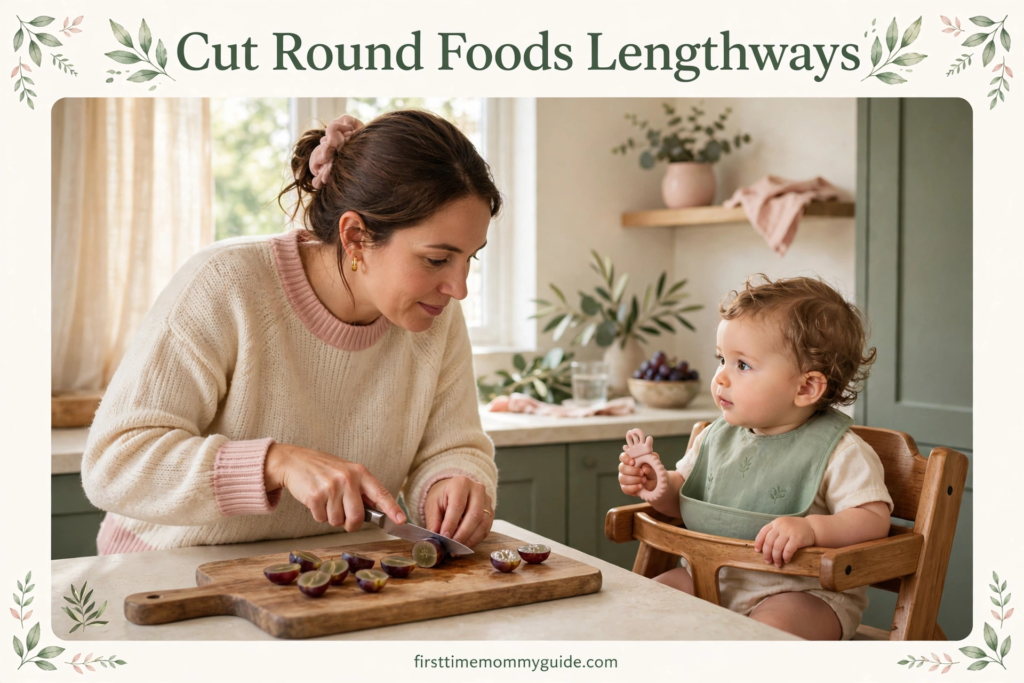
- Cut round foods lengthways, not across. A quartered grape is safe. A halved grape is still round enough to block an airway.
- Offer soft, graspable pieces. Food should be soft enough to squash between your finger and thumb.
- Avoid distractions and rushing. Do not feed a baby who is laughing, crying, or moving around.
- Learn infant first aid. A basic infant choking first aid course is one of the most valuable things a new parent can do. The NHS guide to choking first aid explains back blows and chest thrusts for babies under one.
Gagging is not choking
It helps to know the difference. Gagging is a baby’s built-in safety reflex. The baby coughs, splutters, makes noise, and often brings the food forward. It looks dramatic, but it is the airway protecting itself. Choking is silent. The baby cannot cry, cough, or breathe, and the face may turn blue. If your baby is gagging, stay calm and let them work it out. If your baby is choking, act immediately and call emergency services.
Raw and Undercooked Meat, Fish, and Eggs
Babies are far more vulnerable to food poisoning than adults. Their immune systems are still developing, and a dose of bacteria that would cause a mild stomach upset in an adult can cause dehydration and hospitalisation in a baby.
Meat and poultry
Serve all meat and poultry fully cooked, with no pink in the middle and juices running clear. Avoid rare steak, pink lamb, and undercooked chicken entirely before age one. Processed meats such as ham, bacon, and sausages are also best kept to a minimum. They are high in salt and often contain nitrates, and they add little nutritional value. If you do serve them occasionally, choose low-salt versions and keep portions small.
Fish and shellfish
Fish is an excellent first food. Oily fish such as salmon, mackerel, and sardines provide omega-3 fats that support brain development. Serve fish fully cooked and check carefully for bones. Avoid raw fish, including sushi and sashimi, and avoid raw or lightly cooked shellfish such as oysters, mussels, and prawns. Shellfish can carry bacteria and viruses that a baby’s gut cannot handle.
High-mercury fish to avoid
Mercury builds up in large, long-lived fish, and it can damage a developing nervous system. The U.S. Food and Drug Administration (FDA) advises avoiding these fish entirely for young children: shark, swordfish, king mackerel, tilefish, marlin, and orange roughy. Low-mercury options such as salmon, cod, pollock, canned light tuna, and tilapia are safe two to three times a week in baby-sized portions.
Eggs
Eggs are a wonderful first food and an important allergen to introduce early. Serve them fully cooked until your baby is at least one year old. That means hard-boiled eggs, well-cooked omelette strips, or scrambled eggs cooked until firm. Avoid raw or lightly cooked eggs in foods such as homemade mayonnaise, uncooked cake batter, or soft meringue. In the UK, eggs marked with the British Lion stamp are considered safe lightly cooked for babies over six months, but fully cooked is still the simplest and safest rule to follow.
Unpasteurised Milk, Cheese, and Juice
Pasteurisation is the heat treatment that kills harmful bacteria in milk and juice. Unpasteurised products skip that step, and they can carry Listeria, Salmonella, and E. coli. For an adult, the risk is small. For a baby, it can be serious.
Avoid all unpasteurised milk, including raw cow’s milk and raw goat’s milk. Avoid soft cheeses made from unpasteurised milk, such as some brie, camembert, and blue cheeses. Hard cheeses such as cheddar are safe from six months, as are pasteurised soft cheeses such as cream cheese and cottage cheese. If a cheese label does not say pasteurised, do not serve it to your baby.
The same rule applies to juice. Only serve pasteurised juice, and even then, keep juice to a minimum. The AAP recommends no fruit juice at all before age one. Whole fruit is better in every way: it provides fibre, it is less acidic on tiny teeth, and it does not fill a baby up with sugar before a meal. If you do offer juice after one year, dilute it and serve it with a meal in an open cup, not a bottle.
Salt, Sugar, and Seasoning
Babies are born with a preference for sweet tastes, and they do not need added salt or sugar to enjoy food. Their kidneys cannot handle much salt, and sugar trains a preference for sweet foods while damaging emerging teeth.
Salt
Do not add salt to your baby’s food, and avoid giving foods that are high in salt. That includes stock cubes, gravy granules, soy sauce, ready-made sauces, crisps, and most processed snacks. Ready meals made for adults are usually far too salty for a baby. If you are cooking a family meal, take your baby’s portion out before adding salt. Cheese is naturally salty, so keep portions small. Bread contains some salt too, but a small amount as part of a varied diet is fine.
Sugar
Avoid adding sugar, honey, syrups, and sweet spreads to baby food. Avoid biscuits, cakes, sweets, and sweetened breakfast cereals. Fruit is the best sweetener. A ripe banana or a few stewed apple slices sweeten porridge naturally. Dried fruit such as raisins can be offered from six months, but they are sticky and high in natural sugars, so serve them with meals rather than as snacks, and clean your baby’s teeth afterwards.
Spices and herbs
Mild spices and herbs are fine and even helpful. Babies can enjoy cinnamon, cumin, mild curry powder, garlic, ginger, and fresh herbs from six months. These build a broad palate. Avoid very hot chilli, which can irritate a baby’s mouth and stomach.
Foods to Avoid by Age: A Quick Reference Table
| Age | Avoid completely | Serve only in safe forms | Generally fine |
|---|---|---|---|
| 0–6 months | All solid foods, honey, cow’s milk, juice, water as a drink | Breast milk or formula only | Breast milk or formula |
| 6–9 months | Honey, whole nuts, popcorn, raw fish and meat, unpasteurised foods, juice | Peanut butter thinned, eggs fully cooked, soft fruits and vegetables, yoghurt | Purees, soft finger foods, porridge, well-cooked fish and meat |
| 9–12 months | Honey, whole nuts, popcorn, raw fish and meat, unpasteurised foods, hard sweets | Quartered grapes, soft raw fruit, small pieces of cheese, ground nuts | Most family foods, soft and cut safely, low salt and no added sugar |
| 12 months and over | Whole nuts until age five, popcorn until age four, high-mercury fish | Whole cow’s milk as a drink, honey in small amounts, juice diluted and occasional | A varied family diet with sensible portions |
If you are starting solids and want a refresher on timing and readiness, read our guide to the signs your baby is ready for solid foods.
Allergens Are Not Foods to Avoid
One of the most confusing parts of starting solids is that some foods sound dangerous but are actually recommended early. Peanut, egg, wheat, fish, sesame, and dairy are common allergens, and older advice told parents to delay them. That advice has changed.
Research now shows that introducing allergenic foods early, from around six months, lowers the risk of developing a food allergy. The AAP and the NHS both recommend introducing peanut and egg from six months, in age-appropriate forms, unless your baby has severe eczema or an existing food allergy. In those cases, ask your paediatrician first.
The difference is simple. Honey, whole nuts, and raw fish are unsafe because of infection or choking risk. Peanut butter thinned into porridge is safe and beneficial. Egg that is fully cooked is safe and beneficial. The form matters more than the food.
Introduce one allergen at a time, in a small amount, and watch for reactions over the next two hours. Signs of an allergic reaction include hives, swelling of the lips or face, vomiting, or difficulty breathing. Mild reactions should be reported to your doctor the same day. Severe reactions, especially breathing difficulty or swelling of the tongue, need emergency care immediately.
Our detailed guide to introducing allergens to baby covers the order, the portions, and the warning signs in full.
What to Do If Your Baby Eats Something Unsafe
Even careful parents have accidents. A grandparent offers honey on toast. A toddler shares popcorn. Your baby grabs a grape at a family gathering. Here is what to do for the most common situations.
Honey
If your baby eats honey, do not panic, but do call your paediatrician the same day and describe what happened. Most single exposures do not cause illness, because infant botulism is rare. Watch for constipation, weak crying, poor feeding, or floppiness over the next few days, and seek care immediately if any of these appear.
A choking hazard food
If your baby is coughing and making noise, they are gagging, not choking. Stay calm, keep them upright, and let them clear it. If your baby cannot cry, cough, or breathe, start infant choking first aid: five back blows followed by five chest thrusts, and call emergency services. Take an infant first aid course before you need it, not after.
Raw or undercooked food
A single bite of undercooked chicken or a lick of raw cake batter does not always cause illness. Watch for vomiting, diarrhoea, fever, or unusual sleepiness over the next 24 to 72 hours. Keep your baby hydrated with breast milk or formula and call your doctor if symptoms appear or if your baby refuses feeds.
Cow’s milk as a drink
A few sips of cow’s milk will not harm your baby. The risk comes from replacing breast milk or formula with cow’s milk day after day. If this has been happening, talk to your paediatrician about iron levels and how to transition back to formula or breast milk until twelve months.
Something you are unsure about
When in doubt, call your paediatrician or a nurse advice line. Describe the food, the amount, and the time. Keep the packaging if it was a shop-bought product. It is always better to ask than to worry silently.
Reading Labels Like a Pro
Most unsafe foods for babies hide in ordinary products. A quick label check becomes second nature with practice. Look for these words on ingredients lists:
- Honey in cereals, teething biscuits, granola bars, and some breads.
- Unpasteurised on milk, cheese, and juice labels. If the label does not say pasteurised, assume it is not.
- Salt and sodium in ready meals, sauces, and snacks. Compare brands and choose the lowest-sodium option.
- Added sugars listed as sucrose, glucose syrup, fructose, maltodextrin, or fruit juice concentrate.
- Whole nuts in snack bars, trail mixes, and some breakfast cereals.
Baby food pouches and jars are convenient, but check them too. Some contain added fruit juice concentrate, which is sugar by another name. Some savoury pouches are surprisingly salty. The simplest foods, a steamed carrot or a mashed banana, need no label at all.
Eating Out and Visiting Family
Restaurants and family gatherings are where most accidental exposures happen. A few habits keep your baby safe without making mealtimes stressful.
- Bring your baby’s food with you. A small container of soft foods you prepared at home removes all guesswork.
- Ask about ingredients. Honey glazes, nut toppings, and raw fish are common in restaurant dishes. A quick question to the server is always worth it.
- Skip the shared snacks. Bowls of nuts, popcorn, and crisps on a table are within a baby’s reach faster than you expect. Keep them out of arm’s reach.
- Brief grandparents and carers. Many grandparents grew up with different advice. Honey on a dummy, for example, was once common. A short, friendly conversation about your baby’s food rules prevents awkward moments.
- Use a safe high chair. Eating upright, with an adult watching, is the single most effective choking precaution.
Common Mistakes to Avoid
- Assuming “baby” on the label means safe. Some products marketed for babies contain honey, juice concentrate, or high levels of salt. Read the ingredients, not the marketing.
- Cutting grapes in half instead of quarters. A halved grape is still round enough to block an airway. Always quarter lengthways.
- Serving peanut butter by the spoonful. A thick spoonful can seal the throat. Always spread thinly or mix into another food.
- Giving juice in a bottle. Juice in a bottle pools around emerging teeth and increases tooth decay. Offer water in an open cup instead.
- Delaying allergens out of fear. Avoiding peanut and egg for too long increases allergy risk. Introduce them early, in safe forms.
- Adding salt “for flavour”. Babies do not need it, and their kidneys cannot process it well. Flavour food with herbs and spices instead.
- Leaving a baby eating alone. Choking is silent. An adult should be present and watching for every meal and snack.
Frequently Asked Questions
1. What foods should a baby never eat before age one?
Honey is the only food that is never safe before age one, even in cooked or baked foods, because of infant botulism risk. Also avoid whole nuts, popcorn, hard sweets, raw or undercooked meat and fish, unpasteurised milk and cheese, and high-mercury fish such as shark and swordfish.
2. Can babies eat honey in cooked food?
No. Cooking does not destroy the botulism spores in honey. Honey baked into bread, muffins, or cereal bars is still unsafe for babies under twelve months. Wait until after the first birthday.
3. When can babies eat peanut butter?
Babies can eat smooth peanut butter from around six months, thinned and mixed into porridge, yoghurt, or mashed fruit. Never give a thick spoonful straight from the jar, and avoid whole peanuts until age five.
4. Can babies drink cow’s milk?
Not as a main drink before twelve months. Small amounts in cooking, yoghurt, and cheese are fine from six months. After the first birthday, whole cow’s milk can become the main milk drink.
5. Are grapes safe for babies?
Grapes are safe only when cut into quarters lengthways. Whole grapes and halved grapes are a serious choking hazard because they are round and exactly the size of a baby’s airway.
6. Can babies eat eggs?
Yes, from around six months, as long as they are fully cooked. Hard-boiled eggs, well-cooked omelette strips, and firm scrambled eggs are all safe. Avoid raw or lightly cooked eggs in homemade mayonnaise or uncooked batter.
7. Is fruit juice safe for babies?
The AAP recommends no fruit juice at all before age one. Whole fruit is better because it provides fibre and is gentler on teeth. After one year, offer only small amounts of diluted, pasteurised juice with meals.
8. Can babies eat strawberries?
Yes, strawberries are safe from six months, served soft and cut into safe pieces. They are a common allergen, so introduce them in a small amount and watch for a reaction, as you would with any new food.
9. When can babies eat salt?
Babies do not need added salt before age one. Their kidneys cannot process it well. Avoid adding salt to baby food and limit salty foods such as ready meals, sauces, crisps, and processed meats.
10. Can babies eat cheese?
Yes, pasteurised hard cheeses such as cheddar are safe from six months, in small pieces or grated. Avoid soft cheeses made from unpasteurised milk, such as some brie and camembert, and check labels for the word pasteurised.
11. What fish should babies avoid?
Avoid high-mercury fish: shark, swordfish, king mackerel, tilefish, marlin, and orange roughy. Low-mercury fish such as salmon, cod, pollock, and canned light tuna are excellent first foods when fully cooked and checked for bones.
12. Can babies eat yoghurt?
Yes, plain whole-milk yoghurt made from pasteurised milk is safe from six months. Choose unsweetened varieties and sweeten naturally with mashed fruit if you like. Avoid yoghurts with added honey or large amounts of sugar.
13. Is popcorn safe for babies?
No. Popcorn is a serious choking hazard because of its shape and hard kernels. The NHS advises avoiding popcorn until at least age four or five. Keep it away from babies and toddlers entirely.
14. Can babies eat raw vegetables?
Hard raw vegetables such as carrot sticks, celery, and raw apple chunks are choking hazards. Steam, roast, or bake them until very soft. Soft raw fruits such as banana, avocado, and ripe pear are safe from six months.
15. What should I do if my baby eats honey?
Call your paediatrician the same day and describe what happened. Watch for constipation, a weak cry, poor feeding, or floppiness over the next few days. Most single exposures do not cause illness, but infant botulism needs early treatment, so do not wait if symptoms appear.
16. Can babies eat bread?
Yes, bread is safe from six months, in small pieces and ideally low in salt. Toast fingers with a thin spread of mashed avocado or smooth nut butter make a good finger food. Avoid bread with honey or whole seeds and nuts baked in.
17. Are rice cakes safe for babies?
Plain, unsalted rice cakes are generally safe from around seven to eight months, once your baby can manage foods that dissolve. They break down easily and are low in choking risk. Choose low-salt versions without honey or sweet coatings.
18. Can babies eat chocolate?
Chocolate is not recommended before age one. It contains sugar and caffeine, and it has no nutritional value for a baby. A tiny taste will not cause harm, but there is no reason to offer it. Save chocolate for toddlerhood as an occasional treat.
19. When can babies eat meat?
Babies can eat well-cooked meat from around six months. Offer soft, finely minced or shredded meat, or meat blended into a puree. Make sure it is cooked through with no pink areas. Avoid processed meats such as sausages and bacon as everyday foods because of their salt content.
20. How do I know if a food is a choking risk?
Ask three questions. Is it round and smooth, like a grape? Is it hard, like a raw carrot? Is it sticky, like a spoonful of peanut butter? If the answer is yes to any of these, change the form: cut it lengthways, cook it until soft, or spread it thinly. If you cannot make it safe, leave it out until your child is older.
Conclusion
Starting solids should be joyful, not frightening. The list of baby first foods to avoid is short, and once you know it, mealtimes become simple again. Remember the essentials: no honey before one, no cow’s milk as a main drink before one, no whole nuts, popcorn, or hard sweets, no raw or undercooked foods, and no unpasteurised products. Cut round foods lengthways, cook foods until soft, and stay with your baby for every meal.
Everything else is an invitation to explore. Soft fruits, well-cooked vegetables, fully cooked fish and eggs, yoghurt, and thinned nut butters all help your baby build a broad palate and a healthy relationship with food. Introduce allergens early in safe forms, read labels with confidence, and brief family members on the few firm rules.
If you found this guide helpful, bookmark it and share it with another first-time parent. For more help with the weaning journey, explore our baby food chart for 6 to 12 months and our guide to how to clean your baby’s first teeth, because healthy eating habits and healthy teeth grow together from the very first bite.

Dilawar Mughal
Founder and editor, First Time Mommy Guide
I research every guide against what the NHS, the AAP and the WHO publish, then write it in plain English — because most new parents are reading with one hand free, not comparing clinical guidelines. I'm not a doctor or a midwife. Every health claim on this site is sourced and linked so you can check it yourself, and anything urgent belongs with your health visitor or GP, not a blog.


