
General information, not medical advice. Every baby is different — if anything worries you, speak to your midwife, health visitor or GP rather than waiting.
There is no moment in early parenthood quite like it. You are leaning over your baby, talking softly, and suddenly their whole face lights up. Their eyes crinkle, their mouth curves, and for the first time, they are smiling at you. If you have been waiting for your baby’s first smile, you are not alone. It is one of the most searched baby milestones, and one of the most rewarding.
In this guide, you will learn exactly when babies smile for the first time, the difference between a reflexive smile and a true social smile, what your baby’s smile tells you about their development, and how you can encourage more of those magical grins. You will also learn when a delayed smile is worth mentioning to your paediatrician, and how smiles connect to the wider map of your baby’s early development.
Quick answer: Most babies give their first true social smile between 6 and 8 weeks of age. Before that, newborn smiles are usually reflexive, happening during sleep or after feeding, and are not a response to you. If your baby is not smiling socially by 3 months, mention it at their next check-up.
What Is a Baby’s First Smile, Really?
A baby’s first smile is not one single event. It is a progression, and understanding the stages helps you know what you are seeing and when to celebrate it.
Reflexive smiles: the earliest grins
Newborns smile from birth, and sometimes even before birth on ultrasound scans. These early smiles are called reflexive smiles. They are not social. They happen when your baby is asleep, drifting off, passing wind, or feeling content after a feed.
Reflexive smiles are driven by the nervous system, not by emotion or recognition. Your baby is not smiling because they see you or feel happy. They are smiling because their developing brain is firing off signals as it wires itself up. That does not make those smiles meaningless. They are a normal, healthy sign of a developing nervous system, and they are wonderful to watch.
Social smiles: the real milestone
A social smile is different. It is a smile in response to something or someone. Your baby sees your face, hears your voice, and smiles back on purpose. This is the milestone doctors and developmental checklists mean when they ask whether your baby is smiling.
Social smiles usually appear between 6 and 8 weeks. Some babies get there a little earlier, around 4 to 5 weeks. Others take until 10 or 12 weeks. Both ends of that range are typically normal. What matters most is the direction of travel: your baby is becoming more responsive, more engaged, and more interested in faces over time.
How to tell the difference
The easiest way to tell a social smile from a reflexive one is context. A reflexive smile often happens when your baby is asleep or looking away, and it fades quickly. A social smile happens while your baby is awake and looking at you, and it often comes with other signs of engagement: bright eyes, raised eyebrows, cooing sounds, wiggly arms and legs, and an attempt to hold your gaze.
If your baby smiles while staring into your eyes during a chat, that is a social smile. Write the date down. It is a memory worth keeping.
When Do Babies Smile for the First Time? The Timeline
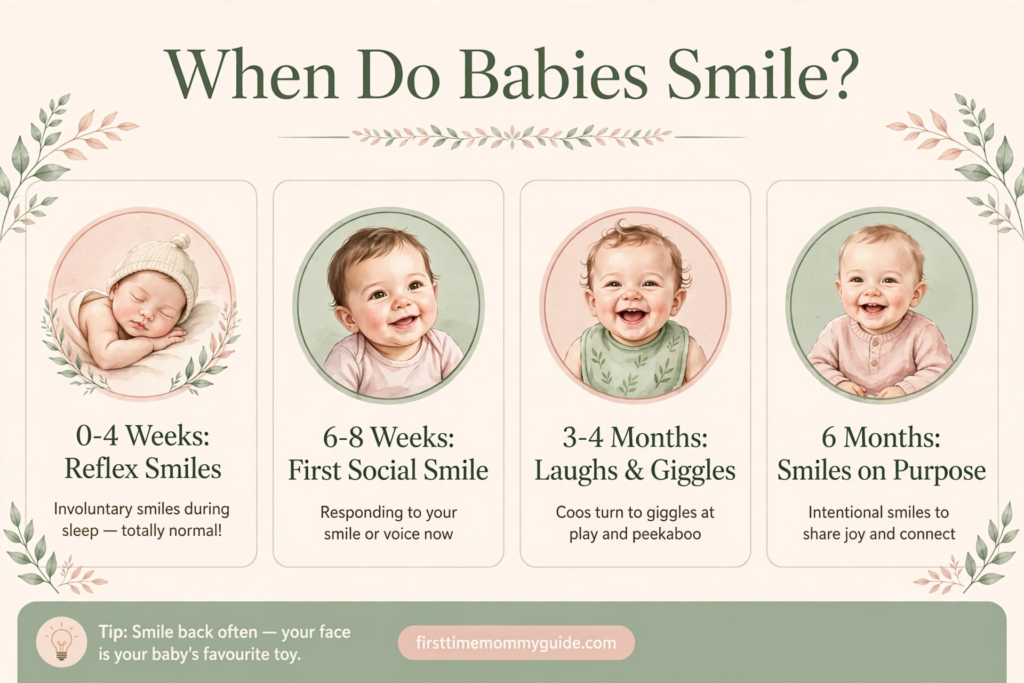
Every baby develops at their own pace, but the broad pattern of smiling follows a fairly predictable path. The table below gives you a realistic picture of what to expect and when.
| Age | What you will usually see |
|---|---|
| Birth to 3 weeks | Reflexive smiles, mostly during sleep or after feeds. No social response yet. |
| 4 to 5 weeks | Longer periods of alertness. Baby begins to study faces closely. Occasional smiles during face-to-face time. |
| 6 to 8 weeks | First true social smiles for most babies. Smiles in response to your face, voice, or gentle play. |
| 2 to 3 months | Frequent, deliberate social smiles. Baby smiles at familiar people and sometimes at strangers too. |
| 3 to 4 months | Smiling becomes a conversation tool. Baby smiles to get your attention, then laughs, coos, and babbles in response. |
| 4 to 6 months | Big, open-mouthed smiles and laughter. Baby smiles at their reflection, at toys, and during games like peekaboo. |
Why 6 to 8 weeks is the typical window
Around 6 weeks, several pieces of development come together. Your baby’s vision is improving, so they can see your face more clearly from a comfortable distance. Their brain is learning to connect a familiar face with a feeling of safety and pleasure. Their muscles are gaining enough control to produce a deliberate smile rather than a random one.
This is also why premature babies often reach this milestone a little later on the calendar. Doctors usually measure milestones from a premature baby’s due date, not their birth date. A baby born 6 weeks early may smile socially at around 12 weeks after birth, which is 6 weeks adjusted age. That is still right on track.
What Your Baby’s First Smile Tells You About Development
A social smile is much more than a cute moment. It is a window into several areas of your baby’s development at once.
Social and emotional development
Smiling is your baby’s first real social skill. It shows they are learning that other people matter, that faces carry meaning, and that they can influence the people around them. When your baby smiles and you smile back, they learn a powerful lesson: my actions affect others. This back-and-forth, often called serve and return, is the foundation of communication, attachment, and later language.
Vision and recognition
To smile at you, your baby must first see you and recognise you. Social smiling therefore tells you their vision is developing and that they are beginning to distinguish familiar faces from unfamiliar ones. At first, your baby will smile at almost anyone who leans in close. Over the next few months, they become more selective, saving their biggest smiles for the people they know best.
Brain development
A deliberate smile requires coordination between vision, emotion, memory, and muscle control. When those systems start working together, it is a sign that your baby’s brain is building connections at a remarkable rate. Researchers sometimes describe the first months as a period of rapid brain wiring, and social smiling is one of the earliest visible signs of that wiring in action.
Communication development
Long before your baby says a first word, they communicate through smiles, cries, coos, and body language. Smiling is one of the first positive signals in that toolkit. Babies who smile socially are practising the turn-taking that will later become conversation. You smile, they smile, you talk, they coo. That rhythm matters enormously for language development.
How to Encourage Your Baby’s First Smile
You cannot force a smile, and you should not try to. But you can create plenty of moments where smiling is likely, and you can respond in ways that make your baby want to do it again.
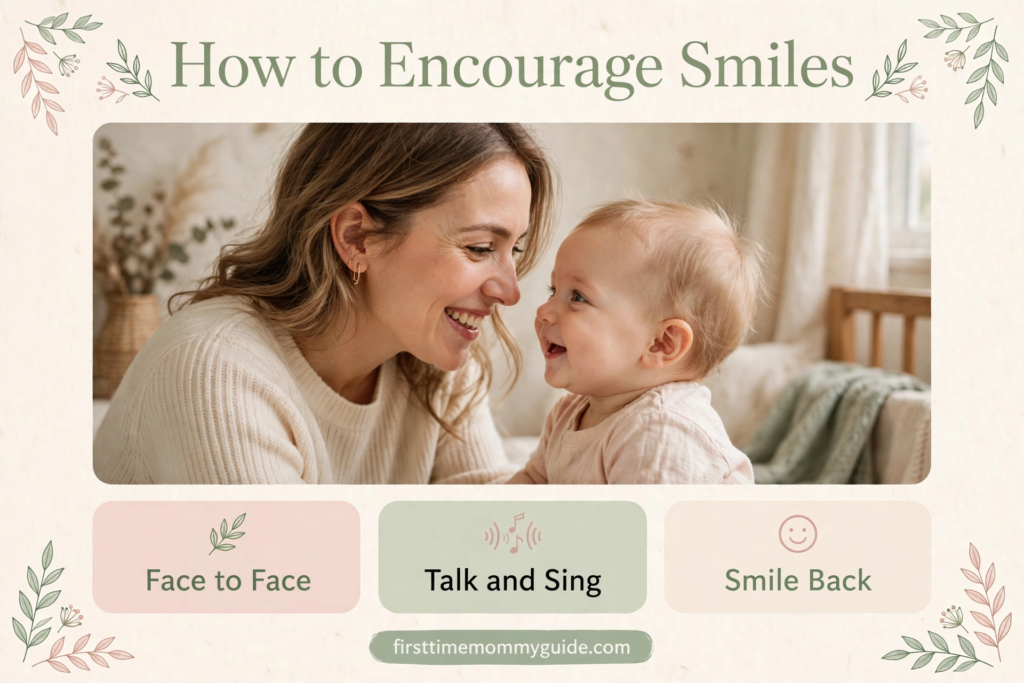
Get face to face
Babies see best at a distance of about 20 to 30 centimetres, roughly the distance between your face and theirs during feeding. Hold your baby so your face is in that range, and give them time to study you. Talk, smile broadly, raise your eyebrows, and pause. Pauses matter. Your baby needs a moment to process your face and respond.
Talk, sing, and narrate
Your voice is one of your baby’s favourite sounds. Talk about what you are doing, sing a simple song, or make gentle, silly sounds. Exaggerated facial expressions help: a big smile, wide eyes, a playful surprised face. Babies are drawn to expressive faces, and they often mirror what they see.
Play simple games
Even very young babies enjoy gentle games. Try slowly moving your face closer and then back, making a soft sound each time. Once your baby is a few months old, peekaboo becomes a favourite. Keep games short and gentle. If your baby looks away, arches their back, or starts to fuss, they are telling you they need a break. That is normal. Overstimulation is common, and a short rest is all they need.
Smile back, every time
When your baby smiles at you, smile back straight away, and say something warm. This teaches your baby that smiling is a way to connect. It also builds their confidence. Babies who get warm, consistent responses to their smiles tend to smile more, and they learn to trust that the people around them will respond to them.
Give it time across the day
Babies are most alert and sociable after a feed and a nap, when they are comfortable and not hungry or tired. That is the best window for face-to-face play. Trying to coax smiles when your baby is hungry, overtired, or uncomfortable usually ends in fussing, and that is nobody’s fault.
What If Your Baby Is Not Smiling Yet?
It is natural to worry when a milestone seems late. Most of the time, a baby who is not yet smiling socially is simply developing on their own schedule. But there are sensible guidelines for when to ask questions.
First, check the basics
Ask yourself a few questions before worrying. Is your baby alert for periods during the day? Do they track your face or a moving object with their eyes? Do they respond to sounds? Are they feeding well and gaining weight? If the answer to most of these is yes, and your baby is simply not smiling yet, patience is usually the right response.
The 3-month marker
Health visitors and paediatricians generally expect social smiling by around 3 months of age. If your baby has not smiled socially by 3 months, or if they seem to smile less over time rather than more, it is worth mentioning at their next routine appointment. This is not a cause for panic. It is a prompt for a professional to check vision, hearing, and general development, and to reassure you or arrange any follow-up that might help.
Signs worth raising sooner
Contact your doctor sooner if you notice any of the following alongside a lack of smiling: your baby does not track objects with their eyes, does not respond to loud sounds, seems unusually floppy or stiff, is not feeding well, or is losing skills they previously had. Regression, losing a skill that was there before, is always worth discussing promptly. You can find more about what to expect at routine appointments in our guide to newborn doctor visits.
Premature babies and adjusted age
If your baby was born prematurely, remember to use their adjusted age for milestones. A baby born 8 weeks early who is 4 months old is developmentally around 2 months old. Judging them against their birth age will make every milestone look late when it is actually on time. Your paediatrician will use adjusted age for the first year or two, and you can too.
Smiling and Other Early Milestones
Smiling does not happen in isolation. It sits in a sequence of early milestones that build on each other. Understanding that sequence helps you see the bigger picture of your baby’s development.
At around the same time as social smiling, most babies begin to coo, making soft vowel sounds like “ah” and “oh”. They also start to hold their head up more steadily during tummy time, follow moving objects with their eyes, and show more interest in their surroundings. Our guide to tummy time explains how that physical milestone supports everything else.
By 3 to 4 months, smiling typically turns into laughter. Your baby may laugh out loud during play, and they will use smiles and sounds together to hold your attention. This is also when many babies begin to recognise familiar people more clearly and may show a preference for their main caregivers.
By 6 months, most babies are smiling, laughing, babbling, reaching for toys, and rolling over. If you want a fuller picture of this stage, our guide to baby milestones at 6 months covers what to expect. Smiling is the thread that runs through all of it: the first social skill, and the one that makes all the hard work of parenting feel worthwhile.
Common Questions Parents Ask About Baby Smiles
Does my baby smile in their sleep?
Yes, and it is completely normal. Smiles during sleep are reflexive. They are thought to be linked to dreaming and to the brain’s internal activity as it processes the day. Sleep smiles are not social, but they are a healthy sign. They tend to become less frequent as your baby gets older and social smiling takes over.
Can newborns smile on purpose?
Newborns under about 4 weeks almost never smile on purpose. Their smiles are reflexive responses of the nervous system. A deliberate, social smile needs vision, recognition, and muscle control that are still developing in the first weeks. If your newborn seems to smile at you, enjoy it fully, but do not worry if it does not happen consistently yet.
Why does my baby smile at strangers but not at me?
This is very common and not a slight. Young babies smile generously at any friendly face that comes into range. It can feel unfair when a visitor gets a huge grin and you get a serious stare, but it does not mean your baby prefers the stranger. As babies grow, they become more selective, and by around 6 to 8 months many develop a clear preference for familiar caregivers, sometimes alongside stranger wariness. That shift is normal too.
Why does my baby smile at the ceiling or at nothing?
Babies smile at things adults cannot see or do not notice: a patch of light, a moving shadow, a fan, a pattern on the wall. Their visual world is full of fascination. A smile at the ceiling is usually a response to something that caught their attention, not a sign of anything unusual. If it happens alongside normal alertness, feeding, and development, there is nothing to worry about.
Do babies smile more at their mother than their father?
Not necessarily. Babies smile at the people they spend the most time with and who respond warmly to them. In many families that is the mother in the early weeks, simply because of time spent together. But babies bond with and smile at fathers, grandparents, and other caregivers just as readily when those people are present and engaged. The key is consistent, responsive interaction, not biology.
What if my baby smiles but never laughs?
Laughter usually follows smiling by a few weeks to a couple of months. Most babies laugh out loud between 3 and 4 months. If your baby is smiling socially but not yet laughing at 4 or 5 months, that is usually still within the normal range. Keep playing, keep being silly, and laughter will usually follow. If you are concerned, raise it at a routine check-up.
Can I teach my baby to smile?
You cannot teach smiling as a lesson, but you can teach it as a relationship. Every time you respond warmly to your baby’s sounds, expressions, and movements, you are teaching them that communication works. Face-to-face time, talking, singing, and playful interaction all build the skills that smiling expresses. The best “teaching” is simply being present and responsive.
Mistakes to Avoid Around Your Baby’s First Smile
It is easy to put pressure on this milestone, especially when other babies seem to be smiling earlier or when social media is full of grinning infants. A few habits are worth avoiding.
First, avoid comparing constantly. Babies develop at different rates, and a baby who smiles at 5 weeks is not ahead in any lasting sense of a baby who smiles at 10 weeks. Milestones are ranges, not races.
Second, avoid overstimulating your baby in pursuit of a smile. Shaking toys in their face, making loud noises, or passing them from person to person can overwhelm a young baby. A calm, quiet face-to-face moment is far more likely to produce a smile than a noisy performance.
Third, avoid worrying in silence. If you are anxious about your baby’s development, ask. Health visitors, paediatricians, and nurses hear these questions every day, and they would much rather reassure you early than have you worry alone for months.
Finally, do not forget to look after yourself. The early weeks are exhausting, and it is hard to be playful when you are running on very little sleep. Our guide to newborn sleep routines may help you find a rhythm that leaves a little more energy for those smiling moments.
How Smiling Fits Into Bonding and Attachment
For first-time parents, the first social smile often feels like a turning point. Before it, caring for a newborn can feel one-sided: you give and give, and your baby’s responses are mostly cries and feeding cues. The first smile changes that. Suddenly, your baby is responding to you as a person, and the relationship feels mutual.
This matters for bonding. Research on attachment consistently shows that responsive, back-and-forth interaction builds secure attachment. Smiling is one of the earliest forms of that interaction. When you respond to your baby’s smile, you are building trust. Your baby learns that you are there, that you notice them, and that you will respond. That lesson, repeated thousands of times in small moments, becomes the foundation of their emotional security.
If you are struggling to bond, or if the early weeks feel harder than you expected, you are not alone and you are not failing. Bonding takes time for many parents, and it does not always happen instantly. If low mood or anxiety is making the early weeks difficult, talk to your doctor or health visitor. Support is available, and asking for it is a sign of good parenting, not weakness.
When Smiling Changes: What Comes Next
Once social smiling is established, it evolves quickly. At first, your baby smiles in response to you. Then they begin to smile to start an interaction, grinning at you to get your attention. Then they add laughter, cooing, and babbling, and the “conversations” get longer and more joyful.
Around 6 to 8 months, many babies go through a phase of stranger anxiety, where they become wary of unfamiliar people and may cry rather than smile at them. This is a normal developmental stage, and it actually shows that your baby now recognises who is familiar and who is not. It is a sign of healthy attachment, even though it can be awkward at family gatherings.
By the first birthday, smiling is a sophisticated social tool. Your baby will use it to greet people, to share jokes, to seek reassurance, and to show affection. That journey starts with one small, tentative grin at around 6 to 8 weeks. It is worth every sleepless night that came before it.
Key Takeaways
- Most babies smile socially for the first time between 6 and 8 weeks of age.
- Early newborn smiles are reflexive, not social, and are completely normal.
- Social smiling shows progress in vision, recognition, emotion, and brain development.
- Face-to-face time, talking, singing, and smiling back are the best ways to encourage smiles.
- Mention a lack of social smiling by 3 months at your baby’s next check-up.
- Premature babies should be judged by their adjusted age, not their birth age.
- Smiling is the start of communication, bonding, and language development.
Frequently Asked Questions About Baby’s First Smile
1. When do babies smile for the first time?
Most babies give their first social smile between 6 and 8 weeks of age. Newborns smile earlier than this, but those early smiles are reflexive rather than social, and they usually happen during sleep or after a feed.
2. What is the difference between a reflexive smile and a social smile?
A reflexive smile is an automatic response of the nervous system, often seen during sleep. A social smile is a deliberate response to a person or stimulus, usually while the baby is awake and looking at someone’s face.
3. Is it normal for a baby not to smile at 2 months?
Yes, it can be. The typical range for social smiling is about 6 to 12 weeks. Some babies take a little longer, and that alone is not usually a concern. If there is no social smile by 3 months, mention it at a routine check-up.
4. Do premature babies smile later?
Often, yes, when measured from their birth date. Milestones for premature babies are usually judged from their due date. A baby born 6 weeks early may smile socially at around 12 weeks after birth, which is on track for their adjusted age.
5. How can I make my baby smile?
Hold your baby face to face at about 20 to 30 centimetres, smile broadly, talk or sing, and pause to give them time to respond. Choose a moment when they are alert, fed, and comfortable. Smile back immediately when they smile at you.
6. Why does my baby smile in their sleep?
Smiles during sleep are reflexive and are thought to be linked to brain activity and dreaming. They are normal and healthy, and they become less common as social smiling develops.
7. Why does my baby smile at strangers?
Young babies smile generously at any friendly face. They have not yet learned to distinguish familiar from unfamiliar people. As they grow, they become more selective, and by 6 to 8 months many show a clear preference for familiar caregivers.
8. When do babies start laughing?
Most babies laugh out loud between 3 and 4 months, a few weeks after social smiling begins. Laughter is encouraged by playful interaction, gentle games, and silly sounds and faces.
9. What if my baby smiles but does not coo?
Smiling and cooing develop around the same time, but not always in perfect step. If your baby is smiling, alert, and responsive, a slight delay in cooing is usually not a concern. Mention it at a check-up if you are unsure.
10. Can a baby smile too much?
No. Frequent smiling is a healthy sign of a happy, engaged baby. There is no such thing as smiling too much in infancy.
11. Does smiling mean my baby is happy?
Smiling is one sign of contentment and engagement, but babies express feelings in many ways. A baby who is not smiling may simply be tired, hungry, or focused on something else. Look at the whole picture, not a single expression.
12. Why does my baby look away when I try to play?
Looking away is a normal way babies manage stimulation. It means they need a short break, not that they are rejecting you. Pause, wait quietly, and they will usually re-engage when they are ready.
13. Should I worry if my baby smiles less than other babies?
Babies have different temperaments. Some are naturally more smiley, others more serious. What matters is whether your baby is becoming more responsive over time, not how they compare with another baby on a given day.
14. Do babies smile at their reflection?
Babies often smile at mirrors from around 3 to 4 months, though they do not yet understand that the reflection is themselves. They treat it as another friendly baby, which they find fascinating.
15. What role does smiling play in language development?
Smiling is early communication. The back-and-forth of smiling, cooing, and responding teaches turn-taking, which is the foundation of conversation and later language. Responsive interaction in the first months supports language development.
16. When should I talk to a doctor about smiling?
Mention it at a routine appointment if there is no social smile by 3 months, if your baby seems to lose smiling or responsiveness they previously had, or if a lack of smiling comes with other concerns such as poor eye contact or not responding to sounds.
17. Do blind babies smile?
Yes. Babies who are blind do smile socially, often in response to voices and touch rather than faces. Smiling is not purely visual. If you have concerns about your baby’s vision, discuss them with your paediatrician.
18. Can illness delay a baby’s first smile?
A baby who is unwell, overtired, or uncomfortable will smile less, and a period of illness can briefly slow social development. Once they recover, smiling usually returns. Persistent concerns should be raised with a doctor.
19. Is it normal for a baby to smile only at one parent?
It can be, especially if one parent spends more time with the baby. Babies smile most at the people they see most. The other parent can build smiling moments through regular face-to-face play, feeding, and bath time.
20. How do I record my baby’s first smile?
Note the date, and if you can, capture a photo or short video. Many parents find that writing down the moment, who was there, and what happened makes it a keepsake. Do not worry if you miss the exact first one. There will be thousands more.
Conclusion
Your baby’s first smile is a milestone worth waiting for, and worth celebrating properly when it arrives. For most babies, it comes between 6 and 8 weeks, as a social response to the faces and voices they love most. Before that, reflexive smiles are a normal and healthy part of early development. After it, smiling becomes a conversation, a bond, and the foundation of everything from language to emotional security.
Give your baby plenty of face-to-face time, respond warmly when they smile, and try not to compare their timeline with anyone else’s. If you have concerns, ask your health visitor or paediatrician. They are there for exactly these questions.
And when that first real smile comes, and it will, put your phone down for a moment and just enjoy it. Those early smiles are fleeting, but the connection they build lasts a lifetime.
This article is for general information only and is not a substitute for medical advice. If you have concerns about your baby’s development, vision, or hearing, speak to your paediatrician or health visitor. For further reading, see the American Academy of Pediatrics at healthychildren.org and the NHS guidance on baby development at nhs.uk.

Dilawar Mughal
Founder and editor, First Time Mommy Guide
I research every guide against what the NHS, the AAP and the WHO publish, then write it in plain English — because most new parents are reading with one hand free, not comparing clinical guidelines. I'm not a doctor or a midwife. Every health claim on this site is sourced and linked so you can check it yourself, and anything urgent belongs with your health visitor or GP, not a blog.


