
General information, not medical advice. Every baby is different — if anything worries you, speak to your midwife, health visitor or GP rather than waiting.
If you have ever finished a feed, settled your baby lovingly on your shoulder, and then felt a warm trickle down your back, you know spit-up. It is messy, it is frequent, and for first-time mums it is often worrying.
Here is the reassuring truth first: most spit-up is completely normal. Around half of all babies spit up regularly in the early months, and for most of them it is a laundry problem, not a health problem. Babies spit up because their digestive systems are still maturing, not because something is wrong with your milk or your feeding.
That said, spit-up exists on a spectrum. At one end is the happy spitter: a baby who spits up often, gains weight well, and seems unbothered. At the other end is a baby whose spit-up comes with pain, poor weight gain, or forceful vomiting, and who needs medical attention.
This guide helps you tell the difference. You will learn why babies spit up, what normal spit-up looks like, practical remedies that genuinely help, feeding and burping techniques, and the red flags that mean it is time to call your doctor.
By the end, you will know what to do after the next spit-up, what to change at the next feed, and when to stop managing it at home and seek advice.

What Is Spit-Up, and Is It Normal?
Spit-up is the easy, gentle return of a small amount of milk from a baby’s stomach into the mouth. It usually happens during or shortly after a feed, often with a burp, and it flows out rather than being forced out.
It is different from vomiting. Vomiting is forceful, it involves stomach contractions, and it usually brings up a larger volume. Spit-up is passive. Milk simply comes back up, often without your baby seeming distressed at all.
Spit-up is extremely common. It peaks around 2 to 4 months of age, when babies are drinking large volumes relative to their stomach size, and it usually improves as babies start solids, sit up more, and spend less of the day lying flat. Most babies outgrow frequent spit-up by 12 months, and almost all by 18 months.
The reason is anatomy. The muscle ring between the stomach and the food pipe, called the lower oesophageal sphincter, is still maturing in young babies. It does not close as tightly as an adult’s, so milk can slip back up, especially when the stomach is full or when a baby is lying down, coughing, or straining.
Babies also swallow air during feeds, and that air needs to come out. When it does, it often brings a little milk with it. That is why spit-up so often arrives with a burp.
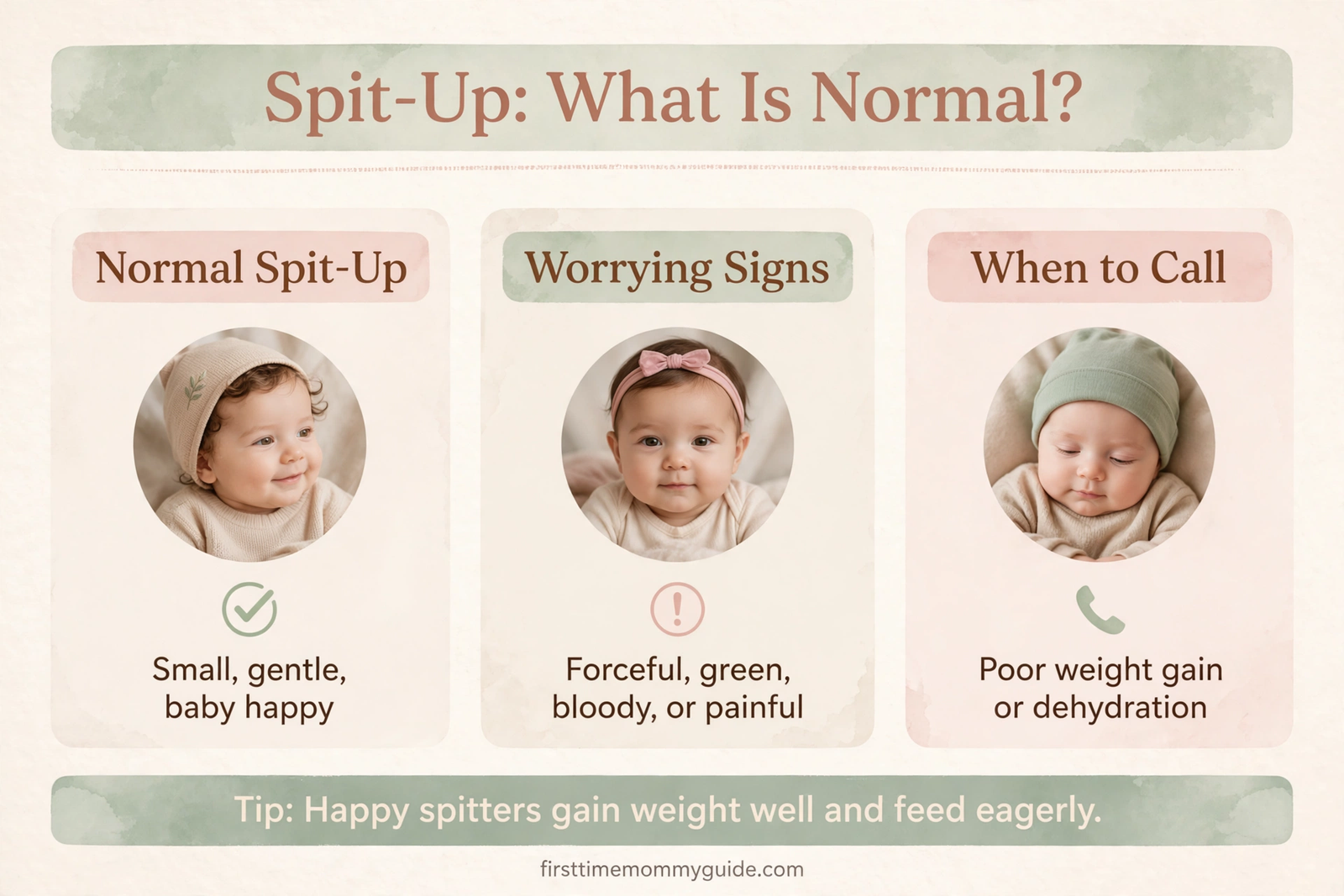
A baby who spits up but is otherwise well, feeding eagerly, gaining weight, and producing plenty of wet nappies, is usually what doctors call a “happy spitter.” The spit-up is inconvenient, but it is not harmful.
For a clear medical overview, the American Academy of Pediatrics explains that spitting up is normal in infants and usually resolves on its own, and NHS Start for Life offers practical feeding guidance for the early months.
The Main Causes of Baby Spit-Up
Spit-up rarely has a single cause. Usually several small factors combine at a feed. Understanding them helps you choose remedies that actually address your baby’s pattern.
An immature stomach valve
The most common cause is simply immaturity. The valve between stomach and food pipe strengthens with age, which is why spit-up improves over the first year without any treatment. You cannot rush this maturation, but you can reduce the pressure on the valve by feeding smaller amounts more often and keeping your baby upright after feeds.
Overfeeding
Babies who drink more than their stomach can comfortably hold are more likely to spit up. This can happen with bottle feeding, where it is easier to encourage a baby to finish a set amount, and it can happen with breastfeeding too, especially during growth spurts when babies feed very frequently.
Signs of overfeeding include very frequent large spit-ups, discomfort after feeds, and weight gain well above the expected curve. If you suspect overfeeding, talk to your doctor or health visitor before cutting feeds, because babies do need plenty of milk to grow.
Swallowed air
Babies swallow air when they cry, when they latch poorly, when a bottle teat flows too fast or too slow, or when they gulp during a let-down. That air forms a bubble in the stomach, and when it rises, milk rises with it.
Good latch, a correctly sized teat, paced bottle feeding, and thorough burping all reduce swallowed air. Our guide on how to burp a newborn covers burping positions and techniques in detail, and it is worth reading alongside this article if burping is a struggle.
Lying flat too soon after a feed
Gravity is your ally with spit-up. When a baby lies flat immediately after a feed, milk can flow back more easily. Car seats, bouncy chairs, and nappy changes that involve lifting legs high can all squeeze the stomach and trigger spit-up in the first half hour after a feed.
Keeping your baby upright for 20 to 30 minutes after a feed is one of the simplest and most effective remedies. It does not need to be rigid: upright on your shoulder, in your arms, or in a supported seat all count.
Coughing, crying, and straining
Anything that increases pressure in the tummy can push milk up. Vigorous crying, coughing, hiccups, straining to pass wind or stool, and even a tight nappy or waistband can all trigger spit-up. This is why spit-up sometimes appears long after a feed, during a crying bout or a nappy change.
You cannot prevent all of these, and you do not need to. A spit-up triggered by a cough is still usually normal, as long as the overall pattern is a happy, thriving baby.
Teething, illness, and developmental leaps
Teething increases drooling and swallowing, which can increase spit-up slightly. Colds and ear infections can increase coughing and crying, which also increase spit-up. Growth spurts increase appetite and intake, which can increase spit-up too.
These are temporary. If spit-up worsens for a few days during a cold or a growth spurt and then settles, that pattern fits normal variation. Our baby growth spurts guide explains why appetite and fussiness surge during these periods, and our guide to baby teething signs and remedies covers the drooling and discomfort that often accompany teething.
Food sensitivities and reflux disease
A smaller number of babies spit up because of cow’s milk protein allergy or gastro-oesophageal reflux disease, often called GORD. These are different from normal spit-up, and they usually come with other signs: eczema, blood or mucus in stools, poor weight gain, or significant pain and distress with feeds.
Food sensitivity is not the first explanation to reach for, and it should not be assumed without medical advice. Changing formula or restricting your own diet while breastfeeding without guidance can cause more problems than it solves. If you suspect a sensitivity, discuss it with your doctor, who can advise on testing or a supervised trial.
Spit-Up vs Vomiting vs Reflux: How to Tell Them Apart
Parents often use these words interchangeably, but doctors use them differently, and the difference matters for deciding what to do.
Spit-up is gentle, small in volume, and usually painless. Your baby may not even notice it. It often happens with a burp and does not disturb feeding.
Vomiting is forceful. The stomach contracts, milk is projected, and the volume is larger. Vomiting is often accompanied by distress, and it can be a sign of illness, especially if it is repeated, contains bile (green-yellow fluid), or comes with fever, diarrhoea, or lethargy.
Reflux is the medical term for milk flowing back from the stomach into the food pipe. Mild reflux is what causes ordinary spit-up, and it is normal. Reflux disease, or GORD, is reflux that causes troublesome symptoms: pain, feeding refusal, poor weight gain, breathing problems, or damage to the food pipe. Most babies with reflux have the mild, normal kind. Only a minority have reflux disease that needs treatment.
A useful rule of thumb: spit-up that does not bother your baby, and does not affect growth, is usually normal. Spit-up that causes pain, disrupts feeding, or affects growth deserves medical review.
If your baby’s spit-up seems painful or persistent, our guide to baby reflux symptoms and remedies goes deeper into reflux signs and management, and it is a good companion to this article.
Practical Remedies That Actually Help
There is no magic cure for normal spit-up, because the underlying cause is maturation. But several practical steps reliably reduce how often and how much babies spit up.
Feed smaller amounts more often
If your baby regularly spits up large amounts, try slightly smaller feeds at shorter intervals, keeping the total daily intake similar. For bottle-fed babies, this might mean offering a smaller bottle more often. For breastfed babies, it might mean shorter feeds on each side, or feeding on demand but watching for signs of fullness rather than encouraging extra minutes at the breast.
Do not restrict milk without medical advice. The goal is to avoid overfilling the stomach at a single feed, not to reduce overall nutrition.
Keep your baby upright during and after feeds
Feed your baby in a semi-upright position, not lying flat. After the feed, keep them upright for 20 to 30 minutes: on your shoulder, in your arms, or in a supported seat where their head is above their stomach.
Avoid bouncing, vigorous play, car seats, and tight nappy changes immediately after a feed. If you need to change a nappy soon after feeding, do it gently, without lifting the legs high or pressing on the tummy.
Do not prop your baby on pillows to sleep, and do not raise the head of the cot unless your doctor advises it. Safe sleep guidance is clear: babies should sleep on their backs on a firm, flat surface. Upright holding is for awake time after feeds, not for sleep positioning.
Burp thoroughly, and burp during feeds too
Burp your baby during the feed, not just at the end. For bottle-fed babies, burp halfway through the bottle and again at the end. For breastfed babies, burp when switching sides and again at the end.
Try different positions: over the shoulder, sitting on your lap leaning slightly forward with your hand supporting their chest and chin, or face down across your lap. Some babies burp easily in one position and not at all in another.
A good burp removes air before it can bring milk up with it. It will not eliminate spit-up entirely, but it often reduces it noticeably.
Check latch and bottle flow
A poor latch lets in air and causes gulping. If breastfeeding is painful, if your baby clicks or slips off frequently, or if feeds are very noisy, ask a lactation consultant or health visitor to check the latch. Small adjustments often make a big difference.
For bottle feeding, check the teat flow. A flow that is too fast overwhelms your baby and causes gulping. A flow that is too slow causes frustrated sucking and air swallowing. Your baby should feed steadily, with pauses, and finish a feed in roughly 15 to 20 minutes, not in five frantic minutes or forty exhausting ones.
Paced bottle feeding helps: hold the bottle horizontally, let your baby draw milk at their own pace, and pause regularly for burps. This mimics breastfeeding more closely and gives your baby control over intake.
Avoid over-tight clothing and pressure on the tummy
Loose clothing around the waist helps. Avoid tight nappies pulled up high, tight waistbands, and carriers that compress the stomach tightly straight after a feed. If your baby spits up mainly when lifted or carried in a particular way, try a gentler hold for the first half hour after feeds.
Thicken feeds only on medical advice
You may hear about thickening milk with rice cereal or using anti-reflux formula. These approaches can help some babies with reflux disease, but they are not appropriate for ordinary spit-up, and they carry risks, including excess calories, constipation, and, for very young babies, safety concerns.
Do not thicken feeds or switch formula without discussing it with your doctor. If your doctor does recommend a change, they will advise on the right product and amount for your baby’s age and weight.
What about gripe water, probiotics, and home remedies?
Gripe water, herbal remedies, and probiotics are widely marketed for spit-up and colic, but evidence for them is limited, and some products are not suitable for young babies. Herbal products in particular can contain ingredients that are not tested for infants.
Do not give any supplement, remedy, or medication for spit-up without medical advice. For normal spit-up, the remedies above — smaller feeds, upright positioning, burping, and patience — are safer and more effective than any bottle from a pharmacy shelf.

Managing Spit-Up Day to Day
Even when spit-up is normal, it is a lot of laundry. A few practical habits make daily life easier and less stressful.
Keep muslin cloths everywhere: on your shoulder for burping, on the changing table, in the car, in your changing bag, and by your bed for night feeds. A large muslin is more useful than a small bib for catching spit-up, because spit-up rarely lands neatly in front.
Dress your baby in easy layers. A vest plus a sleepsuit is easier to change than a complicated outfit, and it means a spit-up does not ruin the only clean outfit you had ready for an outing. Keep a spare outfit for you, too, in your changing bag, at least for the first few months.
Protect your bedding and your baby’s. A muslin under your baby’s head in the cot or Moses basket catches night-time spit-up and is easier to wash than a sheet. Do not add pillows, bumpers, or loose bedding to the cot to manage spit-up, as these increase sleep risks.
Track the pattern, not every episode. Note roughly how often your baby spits up, whether it is small or large, and whether it seems painful. A pattern of small, painless spit-ups in a thriving baby is reassuring. A change in pattern — suddenly much more frequent, larger, or painful — is worth mentioning to your doctor.
And be kind to yourself. Spit-up on your best top, in your hair, or down your back at 3 a.m. is not a sign you are doing something wrong. It is a sign you are feeding a normal, healthy baby whose digestive system is still learning its job.
Feeding Tips for Breastfed Babies
Breastfed babies spit up too, and the remedies are similar, with a few breastfeeding-specific notes.
Watch for a fast let-down. If milk flows very quickly at the start of a feed, your baby may gulp and swallow air. If this happens, try feeding in a laid-back position, where gravity slows the flow, or express a little milk before latching so the initial rush passes.
Let your baby finish one breast before offering the other, unless your health visitor advises otherwise. Switching too quickly can mean your baby gets a lot of foremilk and less hindmilk, which can increase wind and fussiness for some babies.
Burp between sides and at the end, even if your baby seems settled. Some breastfed babies burp quietly and easily. Others need a few minutes of gentle patting in different positions.
Do not restrict your own diet on suspicion alone. Dairy, caffeine, spicy foods, and other foods are often blamed for spit-up, but for most babies they make no difference. If you suspect a food is affecting your baby, keep a simple diary for a week and discuss it with your doctor or dietitian before cutting out major food groups, which can affect your own nutrition.
Feeding Tips for Bottle-Fed Babies
Bottle-fed babies can spit up more when feeds are rushed or when the bottle encourages overfeeding. Paced feeding is the single most useful technique.
Hold your baby semi-upright and hold the bottle horizontally, so milk only flows when your baby sucks actively. Pause every few minutes, tip the bottle down, and burp. Let your baby signal when they want more and when they are done, rather than aiming to finish a set volume.
Choose the right teat size for your baby’s age and feeding style, and replace teats regularly. A worn teat can flow too fast. If milk pours out when the bottle is tipped without sucking, the flow is too fast.
Prepare formula exactly as directed. Do not add extra water to stretch formula, and do not add cereal or other thickeners unless your doctor advises it. Incorrectly mixed formula can cause feeding problems and nutritional issues.
Keep the total daily formula intake in line with your doctor’s guidance for your baby’s weight and age. If your baby consistently wants much more than that, or consistently leaves much less, discuss it at a check-up rather than adjusting volumes on your own.
When Spit-Up Needs Medical Attention
Most spit-up is normal. But some signs should prompt a call to your doctor, and a few need urgent care. Knowing the difference helps you act calmly and quickly.
Call your doctor promptly if your baby:
- Spits up forcefully, with milk projected across a distance, repeatedly.
- Spits up green or yellow bile-coloured fluid, or fluid that looks like coffee grounds.
- Has blood in their spit-up or vomit, even a small amount.
- Refuses feeds, feeds much less than usual, or seems in pain during or after feeds.
- Cries inconsolably during feeds, arches their back, or pulls away from the breast or bottle repeatedly.
- Is not gaining weight, or is losing weight, or has fewer wet nappies than usual.
- Has spit-up that suddenly becomes much more frequent or larger after a period of improvement.
- Has a fever, diarrhoea, lethargy, or unusual sleepiness alongside vomiting.
- Is under 12 weeks old and vomits repeatedly, even without other symptoms.
Seek urgent care if your baby:
- Vomits repeatedly and cannot keep any fluids down.
- Shows signs of dehydration: very few wet nappies, dry mouth, no tears, sunken soft spot, or unusual sleepiness.
- Has a swollen or tender abdomen, or severe abdominal pain.
- Is difficult to wake, very floppy, or unusually pale or mottled.
- Has projectile vomiting in the first weeks of life, which can occasionally signal a condition called pyloric stenosis, where the stomach outlet narrows and needs prompt medical assessment.
Pyloric stenosis is uncommon, affecting roughly 2 to 4 babies in every 1,000, but it is important to know about because it is treatable and because its main symptom is forceful, projectile vomiting, usually starting around 3 to 6 weeks of age. If your young baby develops forceful vomiting, seek medical advice the same day.
For authoritative guidance on when vomiting in infants needs evaluation, the American Academy of Pediatrics and the World Health Organization infant feeding resources are useful starting points, but they do not replace advice from your own doctor, who knows your baby.
What the Doctor May Do
If you seek advice for spit-up, your doctor will usually start with questions and an examination. They will ask about feeding, weight gain, nappies, and whether spit-up seems painful. They will weigh your baby and check growth against previous measurements.
Often, reassurance and feeding advice are all that is needed. Your doctor may suggest smaller, more frequent feeds, upright positioning, and a review in a few weeks to check that weight gain remains on track.
If reflux disease is suspected, your doctor may try feeding changes first, such as a different formula or, for breastfed babies, a supervised maternal diet trial. Medication is usually reserved for babies with troublesome reflux disease, not for ordinary spit-up, and it is prescribed only after assessment.
If allergy is suspected, your doctor may recommend a supervised trial of a hypoallergenic formula or a maternal elimination diet, with dietitian support. Do not start these on your own, because they need monitoring to ensure your baby still gets adequate nutrition.
In rare cases, tests such as a pH study or an ultrasound may be arranged, but most babies with spit-up never need tests. The history and growth pattern usually tell the story.
A referral to a paediatrician or a feeding specialist is not a sign that something is seriously wrong. It is a way to get expert feeding support and to rule out less common causes with confidence.
Spit-Up and Sleep: What Parents Ask Most
Spit-up at night worries parents more than daytime spit-up, because you cannot watch your baby constantly. The guidance here is reassuring and clear.
Babies should sleep on their backs on a firm, flat surface, even if they spit up. This is the safest sleep position, and it actually protects against choking, because a baby on their back can cough or swallow spit-up more easily than a baby on their front. Do not put your baby to sleep on their side or front to manage spit-up, and do not raise the head of the cot unless your doctor specifically advises it for a medical reason.
If your baby spits up in their sleep, they will usually cough, stir, or cry, and you can sit them up, comfort them, and change their bedding. Keep a muslin under their head and a spare set of bedding nearby for night changes.
Night feeds deserve the same upright time as day feeds, even when you are tired. Twenty minutes upright on your shoulder, in a dim room, is enough. You do not need to keep your baby upright for hours, and you should not fall asleep holding your baby upright on a sofa or chair, as that carries its own risks.
If your baby spits up very frequently at night and it disrupts sleep badly, or if night-time spit-up seems painful, mention it to your doctor. Night-time symptoms can be a clue to reflux disease, but they are also common in happy spitters who simply drink a large feed before bed.
Frequently Asked Questions
Why does my baby spit up after every feed?
Frequent spit-up is common in the first months because the stomach valve is immature and babies drink large volumes relative to stomach size. If your baby is gaining weight well, feeding eagerly, and seems comfortable, frequent small spit-ups are usually normal and improve with age.
How much spit-up is too much?
Volume is hard to judge, because spit-up spreads and looks like more than it is. A tablespoon of milk on a muslin can look like a flood. What matters more is the pattern: small, painless spit-ups in a thriving baby are normal, while large, forceful, painful, or bloody spit-ups, or spit-up with poor weight gain, need medical review.
Is spit-up the same as reflux?
Mild reflux causes ordinary spit-up, and it is normal. Reflux disease is reflux with troublesome symptoms such as pain, feeding refusal, or poor growth, and it needs medical assessment. Most babies have the mild kind.
Should I change formula if my baby spits up?
Not without medical advice. Ordinary spit-up does not usually mean the formula is wrong. Switching formula repeatedly can cause more digestive upset. If you suspect allergy or reflux disease, discuss a supervised trial with your doctor.
Does burping prevent spit-up?
Burping helps reduce spit-up by removing swallowed air, but it will not prevent it entirely. Burp during and after feeds, try different positions, and accept that some spit-up will still happen while the stomach valve matures.
When do babies stop spitting up?
Spit-up peaks around 2 to 4 months and usually improves steadily from 6 months, as babies eat solids, sit up, and spend less time lying flat. Most babies outgrow frequent spit-up by 12 months, and almost all by 18 months.
Can I give my baby medicine for spit-up?
Do not give medication, gripe water, or herbal remedies for spit-up without medical advice. Medication is reserved for reflux disease diagnosed by a doctor, not for normal spit-up. Feeding and positioning changes are the first-line approach.
Conclusion
Baby spit-up is messy, frequent, and usually normal. It happens because your baby’s stomach valve is still maturing, because they swallow air, and because they drink a lot relative to their tiny stomach size. For most babies, it is a laundry problem that improves steadily over the first year.
The remedies that help most are simple: smaller, more frequent feeds, upright positioning during and after feeds, thorough burping, paced bottle feeding, and a good latch. Patience helps too, because time and maturation do more than any product on a shelf.
Know the red flags, and act on them promptly: forceful or bloody vomiting, bile-coloured fluid, feeding refusal, pain with feeds, poor weight gain, dehydration, or any loss of skills. For everything else, keep muslins handy, keep feeds calm, and trust that this phase, like so many in the first year, will pass.
Your baby is not spitting up to test you. They are learning to eat, and their body is learning to keep food down. With a few small adjustments and a lot of muslins, you will get through the spitty months together.
This article is general information only and is not a substitute for medical advice. If you have concerns about your baby’s feeding, growth, or health, speak to your doctor or health visitor.

Dilawar Mughal
Founder and editor, First Time Mommy Guide
I research every guide against what the NHS, the AAP and the WHO publish, then write it in plain English — because most new parents are reading with one hand free, not comparing clinical guidelines. I'm not a doctor or a midwife. Every health claim on this site is sourced and linked so you can check it yourself, and anything urgent belongs with your health visitor or GP, not a blog.