
General information, not medical advice. Every baby is different — if anything worries you, speak to your midwife, health visitor or GP rather than waiting.
Introduction
You bring your baby home, and within a day or two, you notice something unsettling. Their skin looks a little yellow. The whites of their eyes seem tinted. You wonder whether this is normal, whether you missed something, and whether you should call someone right now.
That worry is understandable, and it is also very common. Newborn jaundice affects many babies in the first days of life. In most cases it is mild, temporary, and manageable with close monitoring and good feeding. In a smaller number of cases, it needs prompt medical assessment and treatment.
This guide explains newborn jaundice in plain language. You will learn what causes it, what signs to look for, how doctors check it, and exactly when to call your doctor. You will also find practical home checks, feeding guidance, and answers to the questions new parents ask most often.
It is important to be clear from the start. This article is for information only and does not replace medical advice. If you are worried about your baby at any point, contact your doctor, midwife, health visitor, or paediatrician promptly. Trusting your instinct is part of good newborn care.
What Is Newborn Jaundice?
Newborn jaundice is a yellowing of a baby’s skin and the whites of their eyes. It happens when a substance called bilirubin builds up in the blood. Bilirubin is a yellow pigment produced when red blood cells break down at the end of their natural life.
Adults also produce bilirubin every day. A mature liver processes it and removes it from the body, mainly through stool. A newborn’s liver is still learning to do this job efficiently. When bilirubin is produced faster than the liver can clear it, levels rise and the yellow colour becomes visible.
Jaundice usually appears on the second or third day after birth. It often peaks around day three to five in babies born at full term. It then fades gradually over one to two weeks as the liver matures and feeding becomes well established.
Doctors describe jaundice by how high the bilirubin level is and by how old the baby is in hours and days. A level that is safe on day five may need closer attention on day one. That is why timing matters so much, and why early checks are routine.
Most jaundice in healthy, full-term babies is called physiological jaundice. Physiological means it follows the normal pattern of a newborn body adjusting to life outside the womb. It is not caused by an illness, and it usually resolves without specific treatment beyond monitoring and feeding support.
Other types of jaundice have different causes and different timelines. Breastfeeding jaundice, breast milk jaundice, and jaundice linked to blood group differences or infection behave differently. Your doctor will consider the timing, the pattern, and your baby’s overall health before deciding what kind of jaundice is present.
How Common Is Newborn Jaundice?
Newborn jaundice is one of the most common conditions doctors see in the first week of life. Health services such as the NHS and the American Academy of Pediatrics (AAP) describe it as very common in newborns, particularly in the first few days after birth.
It is more likely in babies born before 37 weeks. Premature babies have livers that are even less mature, and they may feed less effectively at first. Babies who have difficulty feeding, lose more weight than expected, or have a sibling who needed treatment for jaundice are also watched more closely.
Skin tone affects how easy jaundice is to see. Yellowing may be more obvious on lighter skin and harder to spot on darker skin. In babies with darker skin, check the whites of the eyes, the gums, the palms, and the soles of the feet. Pressing the skin gently on the forehead or chest can also help reveal a yellow tint.
Because jaundice is so common, hospitals and community midwives check for it routinely. Many babies are examined before discharge, and follow-up checks are arranged in the first week. That routine does not mean something is wrong. It means the health team wants to catch the few cases that need treatment early.
Signs of Newborn Jaundice: What to Look For
Yellowing of the skin
The most recognisable sign is yellow skin. It often starts on the face and head, then spreads down the body to the chest, tummy, arms, and legs. Jaundice that reaches the legs or feet, or that looks deep yellow or orange, deserves a prompt call to your doctor.
Check your baby in good natural daylight, not under yellow indoor lighting. Undress your baby briefly and look at the chest and tummy as well as the face. Compare the colour over time rather than relying on a single glance. If the yellow colour is spreading or deepening, note when you first saw it and call for advice.
Yellowing of the eyes
The whites of the eyes, called the sclera, often turn yellow when bilirubin rises. This can be easier to see than skin changes, especially in babies with darker skin tones. Look when your baby is awake and looking around, and check both eyes.
Eye yellowing alone does not tell you how high the bilirubin level is. Only a blood test or a skin measurement can do that. Eye colour is a useful prompt to seek a check, not a way to grade severity at home.
Changes in stool and urine
A healthy newborn usually passes dark, tarry stools in the first day or two, then yellow, seedy stools. Very pale or chalky stools can be a warning sign, particularly if they persist. Dark, tea-coloured urine in a newborn is also worth reporting.
Keep a simple note of wet and dirty nappies in the first week. Most healthy newborns pass urine frequently once feeding is established, and they pass several stools a day. A sharp drop in wet nappies, very dark urine, or pale stools should be mentioned to your doctor the same day.
Sleepiness and feeding changes
Mild jaundice does not usually change behaviour much. Higher bilirubin levels, however, can make a baby unusually sleepy and hard to wake for feeds. A baby who is difficult to rouse, feeds poorly, or takes much less than usual needs medical review promptly.
Watch for a baby who seems floppy, has a weak cry, or is hard to settle in a different way from usual. These are not signs to watch and wait on. They are reasons to call your doctor or seek urgent care the same day.
Other signs that need attention
Some babies with jaundice develop a high-pitched cry, arch their back, or become irritable and hard to console. These signs are uncommon, and they can indicate a more serious problem. Seek urgent medical help immediately if you notice them.
Fever, poor feeding, vomiting, or a baby who looks unwell in any way should also prompt a call. Jaundice plus illness is always taken more seriously than jaundice alone. Do not try to judge severity by colour alone when your baby also seems unwell.
A Quick Visual Check You Can Do at Home
Home checks are helpful, but they do not replace a professional measurement. Use this simple routine once or twice a day in the first week, and more often if your health team asks you to.
First, check in natural daylight near a window. Artificial yellow light can make skin look more yellow than it is, while dim light can hide changes. Second, look at the face, chest, and tummy with your baby undressed. Third, check the whites of the eyes and the gums.
Fourth, press the skin gently on the forehead or chest with a fingertip, then release. The skin briefly turns paler, which can make a yellow tint easier to see. Fifth, note what you see: where the yellowing reaches, whether it is lighter or darker than yesterday, and how your baby is feeding and waking.
Write down the time and what you observed. A short note helps your doctor or midwife judge the trend. It also helps you notice spreading or deepening colour that might otherwise feel vague.
Causes of Newborn Jaundice
An immature liver
The main cause of most newborn jaundice is a liver that is still maturing. Before birth, the placenta helped clear bilirubin from the baby’s blood. After birth, the baby’s own liver must take over that job. It takes days to reach full efficiency.
At the same time, newborns break down red blood cells faster than adults. They are born with more red blood cells, and those cells have a shorter lifespan. More breakdown means more bilirubin to clear, at exactly the time the liver is least ready.
This combination explains physiological jaundice. It is a normal adjustment, not a sign that you did something wrong. Feeding well helps because regular stools remove bilirubin from the body. Poor feeding, by contrast, slows that clearance and can make jaundice worse.
Breastfeeding jaundice
Breastfeeding jaundice appears in the first week and is linked to low intake rather than to breast milk itself. When a baby is not yet feeding effectively, they take in less milk, pass fewer stools, and clear bilirubin more slowly. Weight loss and fewer wet nappies often accompany it.
This type of jaundice is usually managed by supporting feeding, not by stopping breastfeeding. A lactation consultant, midwife, or health visitor can check latch, positioning, and feeding frequency. More frequent, effective feeds often improve the situation quickly.
It is important not to confuse breastfeeding jaundice with a failure of breastfeeding. Early feeding is a learning process for both mother and baby. Support in the first days makes a real difference, and asking for help early is a strength, not a weakness.
Breast milk jaundice
Breast milk jaundice tends to appear later, often after the first week, and can last several weeks. It is thought to relate to substances in breast milk that slow bilirubin processing in some babies. It usually occurs in babies who are otherwise feeding well and gaining weight.
Breast milk jaundice is generally mild and does not usually require stopping breastfeeding. Your doctor may monitor bilirubin levels and your baby’s growth to be sure. If levels are high or rising, they will advise on next steps. Do not stop breastfeeding because of jaundice unless your doctor specifically advises it.
Blood group differences
Sometimes a mother and baby have different blood groups, and the mother’s antibodies break down the baby’s red blood cells faster than usual. The most well-known examples involve Rh incompatibility and ABO incompatibility. These situations are usually identified during pregnancy or at birth.
Babies affected by blood group differences may develop jaundice very early, sometimes within the first day. Early jaundice is always taken seriously. If your baby becomes yellow within 24 hours of birth, seek medical review the same day, even if they seem well.
Prematurity and other medical causes
Babies born early are more likely to develop jaundice and to need treatment. Their livers are less mature, they may feed less well, and they may have other conditions that increase bilirubin production. Hospital teams monitor premature babies closely for this reason.
Less common causes include infection, liver or bile duct problems, bruising from birth, and inherited conditions affecting red blood cells. A large bruise or a swelling on the head from birth, called a cephalohaematoma, can increase bilirubin as the collected blood breaks down. Infection can also impair the liver’s ability to clear bilirubin.
These causes are less common, but they are why doctors ask about fever, feeding, birth history, and family history. A thorough check
helps them distinguish simple physiological jaundice from something that needs specific treatment.
Jaundice Types at a Glance
| Type | Typical timing | Common features | Usual approach |
|---|---|---|---|
| Physiological jaundice | Day 2–3, peaks day 3–5 | Mild, baby otherwise well, feeding normally | Monitoring, good feeding, rechecks |
| Breastfeeding jaundice | First week | Low intake, fewer stools, weight loss | Feeding support, more frequent feeds |
| Breast milk jaundice | After first week, lasts weeks | Baby well, gaining weight, mild levels | Monitoring, usually continues breastfeeding |
| Blood group jaundice | Within first 24 hours | Early, may rise quickly | Urgent assessment, often treatment |
| Prematurity-related | First days | Higher risk, may rise faster | Close hospital monitoring, often treatment |
| Infection or liver cause | Variable | Baby unwell, pale stools, dark urine | Urgent investigation and treatment |
This table is a guide only. Only a clinician who has examined your baby and checked bilirubin levels can say which type applies. Timing and overall health matter as much as colour.

When to Call the Doctor: The Safety Section
Call your doctor, midwife, health visitor, or paediatrician promptly if you notice any of the following. Do not wait for the next routine appointment if you are worried.
Call the same day if jaundice appears within the first 24 hours after birth. Early jaundice is always assessed urgently. Call the same day if yellowing spreads to the legs or feet, looks deep yellow or orange, or is getting darker rather than lighter.
Call the same day if your baby is unusually sleepy, hard to wake for feeds, feeding poorly, or taking much less milk than usual. Call the same day if wet nappies drop sharply, urine looks dark brown or tea-coloured, or stools are pale or chalky.
Seek urgent care immediately if your baby has a fever, a high-pitched cry, arching of the back, unusual irritability, floppiness, or a weak cry. Seek urgent care if your baby vomits repeatedly, looks unwell, or you feel something is seriously wrong. Parents often sense a change before any single sign becomes obvious, and clinicians take that seriously.
If you cannot reach your usual doctor, contact your local urgent care service, maternity unit, or emergency number. Explain that your newborn has jaundice and describe the signs you see. Note your baby’s age in days, when the yellowing started, and how feeding has been. That information helps the clinician prioritise your call.
You do not need to feel certain before calling. A call that leads to a reassuring check is a good outcome. Waiting when you are worried is rarely the safer choice with a newborn.
How Doctors Check Jaundice
Doctors usually start with a physical examination and a history. They will ask when jaundice appeared, how feeding is going, how many wet and dirty nappies your baby has, and whether there is a family history of jaundice or blood conditions. They will examine the skin, eyes, and general health of your baby.
A common first test is a transcutaneous bilirubin measurement. A small device is pressed gently against the skin, usually on the forehead or chest. It estimates bilirubin by measuring how light reflects from the skin. It is painless and gives a quick result.
If that reading is high or borderline, a blood test is usually done. A small blood sample, often from the heel, measures total serum bilirubin accurately. Blood tests may also check blood group, haemoglobin, and signs of infection when needed.
Doctors interpret the result against your baby’s age in hours, their gestational age at birth, and their risk factors. Charts called nomograms help them decide whether the level is in a safe range, needs rechecking, or needs treatment. The same number can mean different things on day one and day five, which is why age matters so much.
Some babies need repeated checks over several days. That does not necessarily mean the situation is worsening. It often means the team is tracking the trend carefully until levels clearly fall. Keep every follow-up appointment, even if your baby looks better.
Treatment for Newborn Jaundice
Monitoring and feeding support
Many babies need no treatment beyond monitoring and feeding support. Regular checks confirm that bilirubin is falling, and good feeding helps clear bilirubin through stools. Your health team will tell you how often to return and what to watch for at home.
Feeding support may include help with latch, more frequent feeds, or waking your baby for feeds at set intervals. For formula-fed babies, it may mean checking amounts and frequency. The goal is steady intake, regular stools, and steady weight gain.
Phototherapy
Phototherapy is the most common treatment for jaundice that needs intervention. Your baby lies under special blue lights, usually with eye protection, while the light changes bilirubin in the skin into a form the body can remove more easily. Phototherapy is widely used and generally safe.
Treatment may happen in hospital, and in some areas, at home with a portable unit and regular checks. During phototherapy, feeding continues normally. Your baby’s temperature, hydration, and bilirubin levels are monitored closely. Treatment usually continues until levels fall safely, then stops, with a recheck to ensure levels do not rebound.
Parents often worry about the lights and eye covers. The eye protection is important and is checked regularly. Staff will explain how to hold and feed your baby during breaks. Ask questions whenever you are unsure; understanding the treatment makes it less frightening.
Exchange transfusion and other treatments
In rare, severe cases, phototherapy alone is not enough. An exchange transfusion, where a baby’s blood is gradually replaced with donor blood, can lower bilirubin quickly. This is an intensive hospital procedure reserved for very high or rapidly rising levels.
Other treatments depend on the underlying cause. Infection is treated with antibiotics. Blood group problems may need additional monitoring and treatment. Liver or bile duct problems are referred to specialists. These situations are uncommon, but early recognition is why jaundice checks matter.
Most parents will never need to know the details of intensive treatments. They are included here so you understand why doctors act promptly when levels are high. Early treatment prevents complications, and that is the whole purpose of screening.
Why High Bilirubin Needs Treatment
Very high bilirubin levels can, in rare cases, affect the brain. This serious condition is called kernicterus. It is rare precisely because jaundice is monitored and treated early in modern health systems. The risk rises when high levels go unrecognised or untreated.
Kernicterus is preventable in most cases. That is why clinicians emphasise early checks, follow-up appointments, and prompt calls when warning signs appear. It is also why jaundice in the first 24 hours, deep yellowing, and sleepiness are treated as urgent.
This section is not meant to frighten you. It is meant to explain why a condition that is usually mild still deserves careful attention. Good monitoring turns a rare risk into a manageable one. Your role is simple: watch, feed well, keep appointments, and call early if worried.
Home Care While Jaundice Is Being Monitored
Feed your baby frequently, following your health team’s guidance. Breastfed newborns often feed eight to twelve times in 24 hours in the early days. Wake a sleepy baby for feeds if advised, and seek feeding support early if latch or intake is difficult.
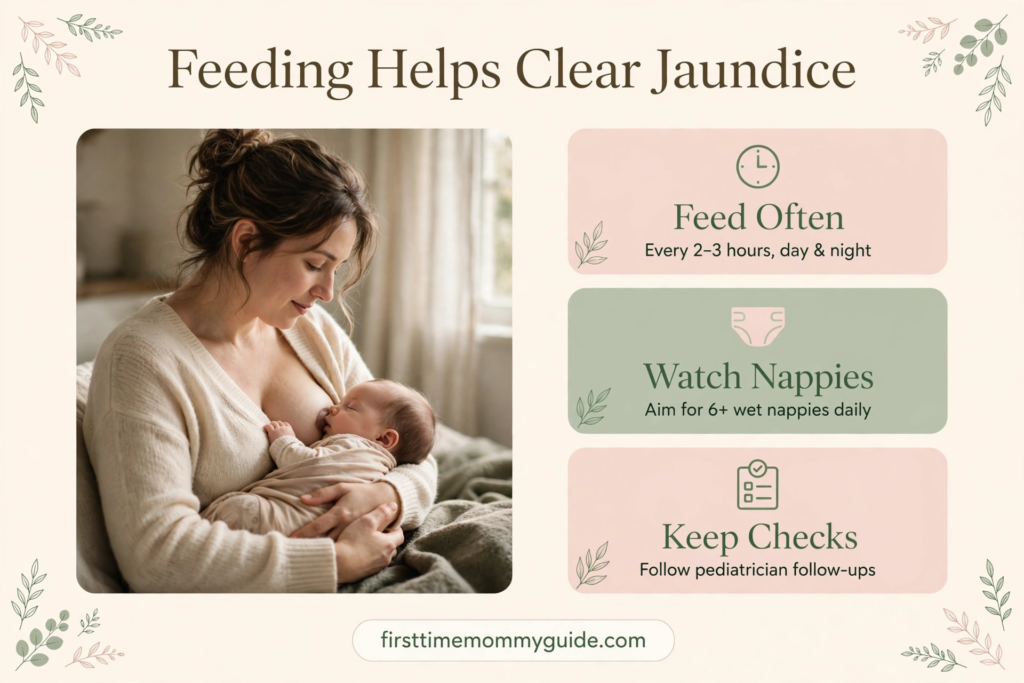
Keep a simple daily log for the first week or two. Note feeding times, wet nappies, dirty nappies, and what the yellowing looks like. A log makes trends visible and gives your doctor useful information. It also reduces the mental load of trying to remember everything during sleepless nights.
Do not try to treat jaundice with sunlight at home. Direct sunlight is not a safe or controlled treatment, and it risks sunburn, overheating, and dehydration. It also does not provide the specific light wavelength used in phototherapy. Follow medical advice, not home remedies found online.
Avoid extra water, herbal remedies, or over-the-counter products unless your doctor recommends them. Newborns do not need water in addition to milk in the early days, and unproven remedies can interfere with feeding. If someone suggests a home treatment, check with your doctor first.
Keep routine appointments even if jaundice seems to be fading. Bilirubin can rise again after an initial fall, particularly after phototherapy stops. A recheck confirms the improvement is sustained. If an appointment is missed, rearrange it promptly.
Feeding and Jaundice: Practical Guidance
Good feeding is one of the most powerful tools against jaundice. Milk intake drives stooling, and stooling removes bilirubin. A baby who feeds well and stools regularly usually clears bilirubin faster than a baby who feeds poorly.
For breastfeeding mothers, focus on latch and frequency in the first days. A deep latch, a baby who swallows audibly, and a softening breast after feeds are reassuring signs. Sore nipples, clicking sounds, or a baby who falls asleep quickly at the breast may signal a need for support.
Do not restrict feeds to a rigid schedule in the early days unless your health team advises it. Responsive feeding, with attention to early hunger cues such as rooting, lip smacking, and hand-to-mouth movements, usually works better than waiting for crying. Crying is a late hunger cue.
For formula feeding, follow the preparation and amount guidance given by your health team. Keep bottles and equipment clean, and note how much your baby takes at each feed. If your baby consistently takes much less than expected, or refuses feeds, call for advice.
Weight checks matter in the first weeks. Some weight loss after birth is normal, but excessive loss or slow regain needs review. Your health visitor or paediatrician will track this and advise whether feeding changes are needed.
If you are combining breast and formula feeding, tell your health team. They can help you plan amounts and timing so that jaundice monitoring and feeding support work together. There is no single right feeding plan for every baby, and individual advice is better than general rules.
For more on establishing feeding in the early days, see our guide to the newborn feeding schedule. It covers typical frequencies, hunger cues, and what to expect in the first weeks. You may also find our newborn doctor visits checklist helpful for preparing questions about jaundice checks.
Jaundice and Sleep
Jaundiced babies can be sleepier than usual, which creates a difficult cycle. A sleepy baby feeds less, and feeding less can worsen jaundice. Breaking that cycle often means waking your baby for feeds, even when it feels unkind.
Try undressing your baby to a nappy, changing the nappy before a feed, or gently stroking their feet or back. Keep the room bright during daytime feeds. If your baby still cannot stay awake to feed, tell your health team. Persistent sleepiness is a reason for review, not just a phase to push through.
Safe sleep still applies during jaundice monitoring. Your baby should sleep on their back, on a firm, flat surface, without loose bedding, pillows, or toys. For a full refresher, read our guide to safe sleep for newborns. Sleep safety and jaundice care work together; one does not replace the other.
Night feeds are demanding, especially when you are also recovering from birth. Share night duties where possible, and rest when your baby rests during the day. If exhaustion is affecting your ability to feed or monitor your baby, ask family, friends, or your health team for support.
What to Expect Over Time
In most full-term babies, jaundice improves steadily over one to two weeks. The yellow colour fades from the legs upward, then from the chest, and finally from the face. The eyes may stay slightly yellow a little longer than the skin. This gradual fading is reassuring.
Breast milk jaundice can last longer, sometimes several weeks, while the baby remains well and gains weight. Your doctor will monitor levels to make sure the longer course is still safe. A longer course alone does not mean something is wrong, provided levels are tracked.
If jaundice lasts beyond two weeks in a full-term baby, or beyond three weeks in a premature baby, doctors usually investigate further. Prolonged jaundice can have other causes that need checking, including liver and thyroid conditions. A blood test and examination help rule these out.
After phototherapy, bilirubin may rise slightly before falling again. This rebound is known and is why rechecks are arranged. A small rebound does not mean treatment failed. It means monitoring continues until levels are clearly stable.
Mistakes to Avoid
Do not assume yellow skin is always harmless because jaundice is common. Common does not mean unimportant. Every baby with visible jaundice deserves assessment of timing, extent, and feeding, especially in the first week.
Do not wait until jaundice looks severe before calling. Early assessment is easier and safer than late treatment. A phone call costs nothing and can prevent a hospital admission later. Clinicians would rather reassure you early than treat a high level later.
Do not stop breastfeeding because of jaundice without medical advice. Breastfeeding jaundice is managed by improving feeding, not ending it. Breast milk jaundice usually continues with monitoring. Stopping abruptly can reduce intake and worsen the problem.
Do not use sunlight, herbal treatments, or extra water as substitutes for medical care. These approaches are not controlled, not measured, and can cause harm. They can also delay proper treatment while bilirubin continues to rise.
Do not skip follow-up appointments because your baby looks better. Trends matter, and a single good day does not guarantee levels will stay down. Keep every check until your health team says monitoring can stop.
Do not compare your baby’s jaundice too closely with another baby’s experience. Bilirubin levels, timing, feeding, and birth history all differ. One baby may need phototherapy while another with similar-looking colour does not. Trust your own baby’s assessment, not a comparison.
Checklist: Daily Jaundice Watch in Week One
- Check skin and eyes in natural daylight once or twice daily.
- Note where yellowing reaches: face only, chest, tummy, legs, or feet.
- Count wet nappies and dirty nappies each day.
- Feed frequently and note any difficulty waking your baby or poor intake.
- Watch for dark urine, pale stools, fever, or unusual sleepiness.
- Keep all follow-up appointments and bring your notes.
- Call the same day for early jaundice, spreading colour, or feeding problems.
- Seek urgent care for fever, high-pitched cry, arching, or floppiness.
Print or save this list for the first two weeks. It is easier to follow a short checklist at 3 a.m. than to recall a whole article. Share it with anyone else caring for your baby so everyone watches for the same signs.
Jaundice in Premature Babies
Premature babies need closer jaundice monitoring than full-term babies. Their livers are less mature, their feeding may be less established, and they may spend time in a neonatal unit where bilirubin is checked regularly. Thresholds for treatment are often lower for premature babies.
If your baby was born early, follow the neonatal team’s plan exactly. They will set check intervals and treatment thresholds based on gestational age and weight. Ask them to explain what level would trigger phototherapy and what signs should prompt a call after discharge.
After discharge, premature babies still need prompt review for any new or worsening yellowing. Do not assume hospital monitoring means home monitoring is unnecessary. The transition home is a time when feeding and weight need close attention.
Parents of premature babies often feel anxious about many things at once. Jaundice is one more item on a long list. Keep notes, keep appointments, and ask for written guidance before discharge. Written instructions are easier to follow than remembered advice.
Questions to Ask Your Doctor
Bring these questions to your next appointment if jaundice is being monitored. You do not need to ask them all at once, but having them written down helps.
Ask what your baby’s bilirubin level was and what range is expected at this age. Ask when the next check is due and what would trigger an earlier check. Ask whether feeding changes are needed and who can help with latch or amounts.
Ask what signs should prompt a same-day call versus urgent care. Ask how long jaundice is expected to last for your baby. Ask whether any further tests are needed if jaundice persists beyond two weeks.
If you do not understand an answer, say so. Clinicians expect questions from new parents, and a clear explanation is part of good care. You are your baby’s advocate, and asking questions is part of that role.
Trusted Sources and Further Reading
For authoritative guidance, see the NHS advice on jaundice in newborn babies. The NHS explains signs, tests, and treatments in clear language for parents. The American Academy of Pediatrics offers parent guidance through healthychildren.org on jaundice. The World Health Organization also publishes newborn care guidance that includes jaundice recognition and referral.
These sources are updated by clinical experts and are a good check against social media advice. If online advice conflicts with your doctor’s guidance, follow your doctor. General information cannot replace an examination of your baby.
Related reading on this site includes our guide to how to give your newborn their first bath, which covers gentle handling in the early days, and our baby gas relief remedies guide, which many parents read alongside feeding articles. For feeding support, revisit the newborn feeding schedule and the newborn doctor visits checklist before your next appointment.
Frequently Asked Questions About Newborn Jaundice
Is newborn jaundice normal?
Yes, mild jaundice is very common in the first days of life. Most cases are physiological and fade within one to two weeks. Your doctor will still check timing and levels, because a small number of cases need treatment.
When does newborn jaundice usually appear?
It usually appears on day two or three after birth. It often peaks around day three to five in full-term babies. Jaundice within the first 24 hours is less typical and should be assessed the same day.
How can I tell if my baby has jaundice?
Look for yellowing of the skin and the whites of the eyes in natural daylight. Check the face, chest, and tummy, and note how far down the body the colour reaches. Only a skin or blood test can measure the bilirubin level accurately.
Is jaundice harder to see on darker skin?
Yes, skin yellowing can be harder to spot on darker skin. Check the whites of the eyes, gums, palms, and soles, and press the forehead or chest gently to reveal a yellow tint. If you are unsure, ask for a professional check.
Does breastfeeding cause jaundice?
Breastfeeding itself does not cause harmful jaundice. Breastfeeding jaundice relates to low intake in the first week, while breast milk jaundice appears later and is usually mild. Both are usually managed with feeding support and monitoring, not by stopping breastfeeding.
Should I stop breastfeeding if my baby is jaundiced?
No, do not stop breastfeeding unless your doctor specifically advises it. Improving latch and feeding frequency often helps. Your doctor will monitor levels and weight to decide whether any change is needed.
What is a normal bilirubin level for a newborn?
There is no single normal number for all babies. Safe levels depend on age in hours, gestational age, and risk factors. Your doctor interprets results using age-based charts, so ask what your baby’s result means at their current age.
How is jaundice tested?
Doctors often start with a painless skin device that estimates bilirubin. If the reading is high, a small heel-prick blood test measures it accurately. Further blood tests may check blood group or infection when needed.
What is phototherapy?
Phototherapy uses special blue lights to change bilirubin in the skin into a form the body can remove more easily. Your baby wears eye protection during treatment. It is the most common treatment when bilirubin needs lowering, and feeding continues during treatment.
Can I treat jaundice with sunlight at home?
No. Direct sunlight is not a safe or controlled treatment and risks sunburn, overheating, and dehydration. It does not deliver the specific light used in phototherapy. Follow medical advice and keep follow-up appointments.
How long does newborn jaundice last?
Most physiological jaundice fades within one to two weeks. Breast milk jaundice can last several weeks while the baby remains well. Jaundice lasting beyond two weeks in a full-term baby usually needs further investigation.
When should I call the doctor about jaundice?
Call the same day for jaundice in the first 24 hours, colour spreading to the legs, deep yellowing, poor feeding, unusual sleepiness, dark urine, or pale stools. Seek urgent care for fever, high-pitched cry, arching, floppiness, or a baby who looks seriously unwell.
Can jaundice harm my baby’s brain?
Very high, untreated bilirubin can rarely affect the brain, a condition called kernicterus. It is rare because jaundice is monitored and treated early. Prompt checks and treatment are what keep this risk very low.
Does jaundice affect feeding?
High bilirubin can make a baby sleepy and less interested in feeds. Sleepiness plus poor feeding can worsen jaundice, so waking for feeds may be advised. Tell your doctor if your baby is hard to wake or takes much less milk than usual.
What if my baby had jaundice and it comes back?
Bilirubin can rise again after phototherapy stops, which is why rechecks are arranged. If yellowing returns or deepens after improving, call your doctor for advice. Do not assume a second episode is harmless without a check.
Are premature babies more at risk?
Yes. Premature babies have less mature livers and may feed less effectively, so they are monitored more closely. Treatment thresholds are often lower for them. Follow the neonatal team’s plan and seek review promptly for new yellowing after discharge.
Do I need to keep appointments if my baby looks better?
Yes. Keep every follow-up until your health team says monitoring can stop. A single good day does not guarantee levels will stay down. Rechecks confirm the improvement is sustained.
Can a bruise from birth cause jaundice?
Yes. A large bruise or head swelling from birth can increase bilirubin as the collected blood breaks down. Tell your doctor about any bruising or swelling, especially if jaundice appears early or rises quickly.
Conclusion
Newborn jaundice is common, usually mild, and usually temporary. Knowing the signs, feeding well, and keeping follow-up checks gives your baby the best protection. The yellow colour itself is less important than its timing, its extent, and how your baby is feeding and behaving.
Call early if you are worried. A prompt check is never a waste of time when a newborn is involved. With good monitoring, most babies recover fully within a couple of weeks, and parents gain confidence with each reassuring check.
If jaundice is on your mind today, use the checklist above, note what you see, and contact your doctor or midwife. You are doing the right thing by watching closely and asking questions.
This article is for general information only and is not medical advice. Always seek prompt medical care for a newborn who is jaundiced, unwell, feeding poorly, or showing any warning sign described above.

Dilawar Mughal
Founder and editor, First Time Mommy Guide
I research every guide against what the NHS, the AAP and the WHO publish, then write it in plain English — because most new parents are reading with one hand free, not comparing clinical guidelines. I'm not a doctor or a midwife. Every health claim on this site is sourced and linked so you can check it yourself, and anything urgent belongs with your health visitor or GP, not a blog.


