
General information, not medical advice. Every baby is different — if anything worries you, speak to your midwife, health visitor or GP rather than waiting.
Your baby was happy with grandparents yesterday. Today, you step into the next room and the crying starts before you reach the door. At nursery drop-off, your baby clings, sobs, and reaches for you. At bedtime, a baby who slept well for months now wakes crying for you, again and again.
That is separation anxiety. It is not a sign that you have done something wrong, that your baby is “spoiled,” or that childcare will damage your bond. It is a normal, healthy sign that your baby has formed a strong attachment to you and has learned a new, unsettling idea: you still exist when you leave, and you might not come back at once.
This guide explains baby separation anxiety signs, the ages it starts and peaks, how it differs from stranger anxiety, and gentle, practical soothing strategies for daytime separations, nursery drop-offs, bedtime, and night waking. It also explains when to seek extra support, and how to look after yourself through a clingy phase.
The guidance here draws on the NHS, the Children’s Hospital of Philadelphia (CHOP), and the American Academy of Pediatrics (AAP) via HealthyChildren. It is general information only. It does not replace advice from your own paediatrician or health visitor. If anxiety is severe, prolonged, or affecting your baby’s eating, sleep, or development, talk to a professional sooner rather than later.
Quick answer: Separation anxiety usually starts between 6 and 12 months, often peaks between 10 and 18 months, and eases during the second and third years. Short, predictable goodbyes, practice separations, a comfort object, and calm, consistent returns help most babies. Do not sneak away, and do not prolong goodbyes.
Key takeaways
- Separation anxiety is normal development, not bad behaviour.
- It usually starts at 6–12 months and peaks at 10–18 months.
- Object permanence — knowing you exist when out of sight — drives it.
- Crying at separation does not mean your baby is unhappy all day.
- Short, warm, predictable goodbyes work better than sneaking away or lingering.
- Practice separations at home build confidence for nursery and childcare.
- Bedtime and night waking often flare first, because sleep is the longest separation.
- Seek help if distress is intense, lasts for hours after you leave, or persists well beyond age 3 and interferes with daily life.
What is separation anxiety in babies?
Separation anxiety is distress when a baby is separated from a main caregiver, usually a parent. The baby cries, clings, reaches, or protests when the caregiver leaves the room, hands them to someone else, or puts them down to sleep alone. The distress is real, even if it stops quickly after the caregiver leaves.
It is a sign of healthy attachment, not weak attachment. A baby who protests separation has learned who their safe people are, and prefers them. The NHS puts it plainly: separation anxiety is usually a sign of how well you have bonded with your baby. That does not make the crying easier to hear, but it reframes what it means.
Separation anxiety is also a thinking milestone. Around 6 months, babies develop object permanence: the understanding that people and things still exist when they cannot be seen. Before that, “out of sight” often meant “gone.” After that, your baby knows you are somewhere else, but does not yet understand time, or that you will return soon. That gap — knowing you exist, not knowing when you will return — is what makes separation frightening.
As language, memory, and routine understanding grow, most babies learn the pattern: you leave, you are cared for by someone trusted, you return. Anxiety eases, though it can flare again at times of change, illness, a new sibling, a move, or starting nursery.
When does separation anxiety start, peak, and end?
Every baby’s timeline differs, but the pattern is consistent enough to plan around. Use ages as a guide, not a deadline.
Typical timeline
| Age | What often happens | What helps most |
|---|---|---|
| 4–6 months | More awareness of familiar people, early wariness of strangers | Gentle routines, responsive comforting, low-pressure introductions |
| 6–9 months | First obvious crying when you leave, clinginess, resisting being put down | Brief practice separations, predictable returns, calm goodbyes |
| 10–18 months | Peak: stronger drop-off protests, bedtime resistance, preferred-parent phases | Consistency, short goodbye rituals, comfort objects, practice |
| 18–24 months | Gradual improvement for many, with flare-ups at change | Clear explanations, routine, follow-through, patience |
| 2–3 years | Most children cope better, though new settings can trigger flare-ups | Preparation, visits before starting, goodbye ritual, reunion talk |
| 3 years + | Separation anxiety disorder is considered if distress is severe, persistent, and interferes with daily life | Professional assessment and support if needed |
When does it start?
Separation anxiety usually begins around 6 months of age, according to CHOP, and commonly appears between 6 and 12 months. Some babies show early signs at 4–5 months, especially if they are very aware of familiar faces. Others seem unbothered until 9 or 10 months, when mobility makes separation more noticeable: they can crawl after you, and they notice when you leave.
Starting childcare, a change in caregiver, or a period of illness can bring separation anxiety out earlier or make it stronger. That does not mean childcare caused it. It means a change exposed a developmental stage that was already emerging.
When does it peak?
Separation anxiety is usually at its peak between 10 and 18 months. The AAP, via HealthyChildren, also notes a second highly emotional phase around 15 to 18 months for some children. That is why an 18-month-old who coped well at nursery at 12 months can suddenly protest drop-offs fiercely. The peak is not a single day. It is a phase of weeks to months, with better and worse days inside it.
Mobility, language, and imagination all grow during this window. A toddler who can walk to the door, say “Mummy,” and imagine you being elsewhere will protest more clearly than a 7-month-old who can only cry. Clearer protest is not worse anxiety. It is clearer communication.
When does it end?
For most children, separation anxiety eases during the second and third years as routines, language, and predictability improve. By age 3, most children can separate with preparation and a familiar routine, even if they still prefer a parent at bedtime or in new settings.
It does not end in a straight line. Expect flare-ups after holidays, illness, a house move, a new sibling, starting nursery or preschool, or a change in caregiver. A flare-up after a settled period is normal, not a relapse. Return to the same predictable routine, and most flare-ups settle in a few weeks.
If intense separation anxiety lasts into preschool or beyond, interferes with nursery, school, sleep, or family life, or includes panic symptoms, talk to your paediatrician or health visitor. Early support helps, and asking is not overreacting.
Signs of separation anxiety in babies
Signs vary by age, temperament, and setting. A baby may show all of these, or only one or two. Look for a pattern linked to separation, not a single cry on a tired day.
Core signs
- Crying when you leave the room, even for a minute.
- Clinging to you, or reaching and crawling after you when you move away.
- Crying or clinging especially in new situations or with unfamiliar people.
- Refusing to be held or comforted by other familiar adults, including grandparents.
- Strong preference for one parent, often the main caregiver, and protest when the other parent takes over.
- Distress at drop-off that settles quickly once you are gone, then returns at pick-up time.
- Waking and crying at night after previously sleeping through, or refusing to sleep without a parent nearby.
- Resistance to being put down in a cot, pram, or highchair when you step away.
CHOP lists these as typical responses: crying when you leave the room, clinging or crying in new situations, waking and crying at night after previously sleeping through, and refusal to go to sleep without a parent nearby. If your baby shows several of these together, and they started around 6–12 months, separation anxiety is a likely explanation.
Signs by age
6–9 months: Crying when you leave, reaching for you, wariness of strangers, protest when handed to someone else, fussiness at bedtime. Peek-a-boo becomes both a game and a lesson: you disappear, you return.
10–14 months: Intense clinginess, crawling or walking after you, drop-off protests, preferred-parent behaviour, night waking, and distress when you are visible but not holding them. This is often the hardest window for parents.
15–18 months: Strong verbal protests (“Mummy! No!”), running to the door, bedtime battles, tantrums at separation, and anxiety in new places even when you stay. Language is growing, but time understanding is not. “After lunch” means little to an 18-month-old.
18–24 months: Better coping on familiar days, with flare-ups at change. Your toddler may cope at home but protest at nursery, or cope at nursery but protest at bedtime. They may talk about you while you are gone, and greet you intensely on return.
2–3 years: More ability to understand “Mummy will come back after snack time,” especially with visual routines and preparation. Flare-ups still happen with new settings, new caregivers, or family stress.
Separation anxiety vs stranger anxiety
Stranger anxiety and separation anxiety often appear together, and parents confuse them. They are related but different.
| Feature | Separation anxiety | Stranger anxiety |
|---|---|---|
| Trigger | A caregiver leaves | An unfamiliar person approaches |
| Core fear | “You are gone” | “This person is unknown” |
| Happens with parent present? | Less likely, unless parent is about to leave | Yes, even when parent is holding the baby |
| Typical age | 6 months–3 years, peak 10–18 months | 6–12 months, often eases by 2 years |
| What helps | Predictable goodbyes, practice, comfort object | Gradual introductions, parent staying close, no forced holding |
A baby can have both. A 9-month-old may cry when a stranger reaches for them, and cry again when you leave the room. Both are normal. Gradual introductions help stranger anxiety. Predictable separations help separation anxiety. Do not force a baby to be held by a stranger to “get used to it.” Let the baby watch from your arms, warm up slowly, and choose when to interact.
Separation anxiety vs colic, reflux, and illness
Crying alone does not prove separation anxiety. Check for other causes, especially if crying is new, intense, or accompanied by other symptoms.
- Hunger, tiredness, or discomfort: crying that settles with a feed, nappy change, or sleep is usually a basic need, not anxiety.
- Illness: fever, vomiting, diarrhoea, ear tugging, unusual sleepiness, or poor feeding need medical review, not soothing strategies alone.
- Reflux or pain: arching, feed refusal, and crying during feeds may signal reflux or another medical issue. Our baby reflux guide covers signs and when to call the doctor.
- Colic: prolonged, inconsolable crying in the early months, often in the evening, may be colic rather than separation anxiety. See our colic symptoms and soothing guide.
If crying is linked clearly to you leaving, settles with a trusted caregiver after a few minutes, and follows the age pattern above, separation anxiety is likely. If you are unsure, or crying is severe and persistent, talk to your paediatrician or health visitor. Trust your instincts.
Why separation anxiety happens: attachment, memory, and time
Understanding the “why” helps parents stay calm during the crying. Three developments come together at once.
First, attachment. Your baby has learned that you are the person who feeds, comforts, and soothes them. That bond is strong, and separation threatens it in your baby’s mind. A secure bond does not prevent separation anxiety. It creates it, because your baby has someone worth missing.
Second, object permanence. Your baby now knows you exist when you are gone. That is a cognitive leap. It also means your baby can miss you, worry about you, and imagine you not returning. Before object permanence, absence was less distressing because it was less understood.
Third, time. Babies and toddlers do not understand minutes, hours, or “after lunch” in the way adults do. “Mummy will be back soon” is abstract. What they understand is pattern: you leave after the same song, the same wave, the same caregiver takes over, and you return after snack time, every time. Pattern is how babies learn time.
Temperament also matters. Some babies are naturally more cautious, sensitive to change, or slow to warm up. They may show stronger separation anxiety, and need more practice and more gradual introductions. That is temperament, not a parenting failure. A cautious baby who needs more time is not a “difficult” baby. They are a baby who needs a slower pace.
Family stress, illness, and change amplify anxiety. A baby who coped well at nursery may protest fiercely after a holiday, a move, a parent returning to work, or a new sibling’s arrival. The anxiety is a signal that your baby needs extra predictability, not extra pressure to cope.
Soothing strategies that actually help
No single trick ends separation anxiety overnight. A set of small, consistent habits, repeated daily, teaches your baby that separations are safe and returns are reliable. Start with the habits that fit your daily life, and apply them every time.
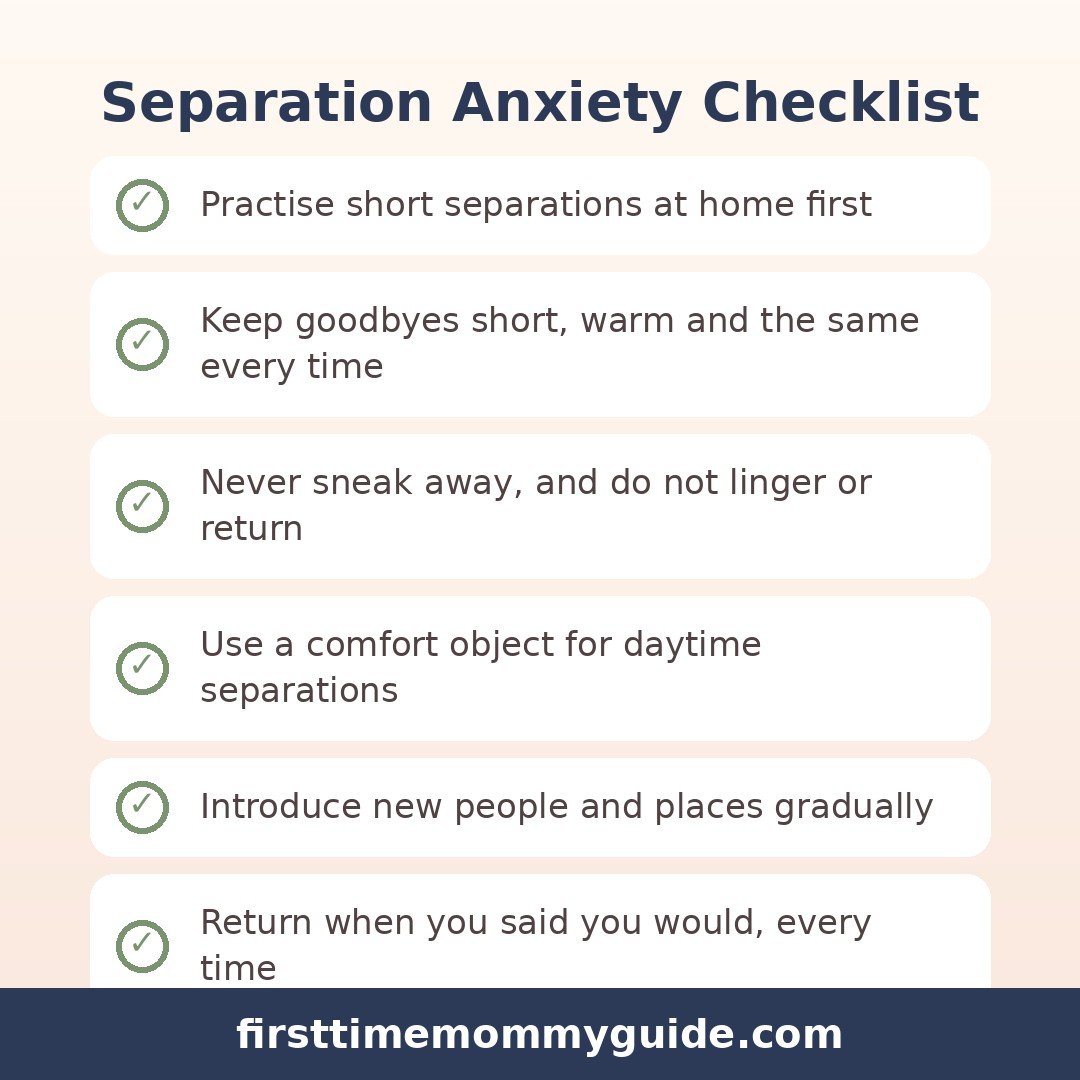
1. Practise short separations at home
Practice is the most effective strategy, and the most overlooked. Do not wait for nursery drop-off to be the first separation of the day.
- Tell your baby you are leaving the room: “Mummy is going to the kitchen. I will be right back.”
- Leave for 30 seconds, then return with a smile and a greeting: “Here I am! Mummy is back.”
- Lengthen the time gradually: 1 minute, 3 minutes, 5 minutes, then a short errand in another room.
- Let your baby hear your voice from the next room. Talk or sing so they learn you are near even when unseen.
- Play peek-a-boo and hide-and-seek games. Cover your face, reappear, hide a toy under a cloth, find it again. These games teach object permanence in a joyful way.
- Let your baby crawl or walk to another safe room alone for a short time, as CHOP suggests, then follow and greet them. Independence grows in safe, small steps.
Keep practice separations short, successful, and frequent. Ten successful 2-minute separations teach more than one distressing 30-minute separation.
2. Keep goodbyes short, warm, and predictable
The goodbye ritual is the heart of soothing separation anxiety. It should be the same every time, take under a minute, and end with you leaving confidently.
A good goodbye ritual has 3–4 steps, always in the same order:
- Cuddle: one hug, eye contact, a calm voice.
- Phrase: the same words every time. “Mummy loves you. I will see you after snack time. Bye-bye!”
- Handover: pass your baby to the trusted caregiver, or place them with their toy.
- Leave: wave, smile, and go. Do not linger, return for “one more kiss,” or watch from the doorway.
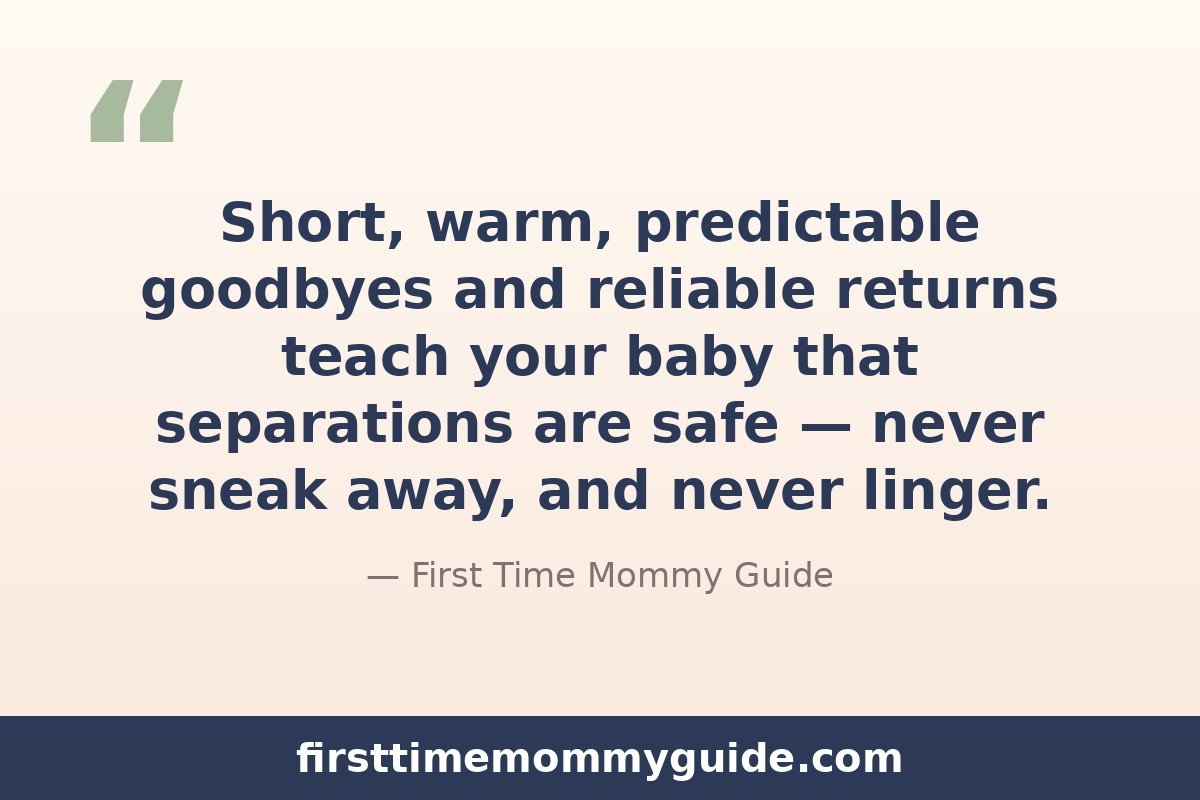
Do not sneak away. Sneaking away avoids tears in the moment, but teaches your baby that you can disappear without warning. That increases anxiety next time, because your baby must watch you constantly to catch the moment you vanish. A visible, predictable goodbye, even with tears, teaches trust.
Do not prolong goodbyes. Lingering, repeated kisses, and apologising signal to your baby that separation is dangerous and that you are unsure. A calm, confident goodbye signals safety. It is normal to feel guilty. Leave anyway, kindly and quickly, and let the caregiver distract and comfort your baby.
Tell your baby where you are going and when you will return, in words they can partly understand. “Mummy is going to work. Grandma will look after you. I will come back after your nap.” For toddlers, link return to an event, not a clock time: “after lunch,” “after story time,” “when the big hand is here” if you use a visual clock.
3. Use a comfort object
A transitional object — a blanket, soft toy, or piece of clothing that smells of you — can ease separations. The object carries your smell and the feeling of comfort into your absence.
Choose one object, keep it for sleep and separations, and do not wash it too often. A scarf with your scent, a small muslin, or a favourite soft toy all work. The NHS suggests leaving something your baby identifies with you, like a scarf with your scent or a favourite toy, close by while you are away.
For sleep, follow safe sleep rules. A comfort object in the cot is not recommended for babies under 12 months, because loose objects in the sleep space increase suffocation risk. Use the comfort object for daytime separations and drop-offs, and keep the cot bare, firm, and flat. From 12 months, a small, safe comfort toy may be used in the cot if your paediatrician agrees and the toy has no loose parts, ribbons, or buttons that could detach.
Keep a spare identical comfort object if you can. A lost comfort toy at bedtime is a crisis you can prevent with a backup kept in a drawer.
4. Introduce new people and places gradually
Do not leave your baby with a stranger in a strange place for the first time and expect calm. Build familiarity in layers.
- Meet first, separate later. Let a new babysitter, childminder, or nursery worker visit while you are present. Let your baby watch them, warm up, and play with them while you stay close.
- Visit the place first. Take your baby to nursery, the childminder’s house, or a grandparent’s home several times with you before the first separation there.
- Keep caregivers few and familiar. The NHS and health visitor guidance both stress keeping the number of different caregivers low while your baby is young. Familiarity builds trust.
- Share the routine. Give the new caregiver your baby’s routine, comfort strategies, favourite toys, and goodbye phrase. Consistency between caregivers helps your baby learn that the pattern holds whoever is there.
- Start short. First separations with a new caregiver should be 20–30 minutes, then an hour, then longer. Build up over days, not hours.
If your baby must start childcare suddenly — for work, illness, or family reasons — do the best you can with the time you have. One or two familiarisation visits, a consistent goodbye ritual from day one, and a trusted caregiver who follows your routine still help, even if the build-up is shorter than ideal.
5. Time separations well
Plan separations when your baby is rested and fed, not hungry, tired, or unwell. CHOP and NHS guidance both make this point. A tired, hungry baby has no resources left to cope with separation. A rested, fed baby can practise coping and learn from it.
Avoid starting childcare, a new routine, or a big separation on a day when your baby is ill, teething badly, or overtired from a disrupted night. If you must separate on a hard day, keep it as short as possible, use the most familiar caregiver, and keep the routine identical.
For working parents, the morning drop-off is often the hardest time because it combines separation, a new place, and a rushed parent. Prepare the night before: bag packed, clothes laid out, goodbye phrase rehearsed. A calm parent makes a calm goodbye. If you are rushed and tense, your baby will pick up on it, as the NHS notes. Smile and wave confidently, even if you feel wobbly inside.
6. Stay calm, consistent, and boring at reunions
Reunions matter as much as goodbyes. Greet your baby warmly, with full attention, and keep the reunion calm. A big, excited reunion can make the next separation harder, because the contrast between “together” and “apart” feels sharper.
- Greet with a hug, a smile, and the same phrase: “Mummy is back! I missed you.”
- Give your baby a few minutes of undivided attention before starting chores or phone calls.
- Talk about what you will do together later, as the NHS suggests: “When Mummy comes back, we will go to the park together.” That gives your toddler something to look forward to.
- Return when you said you would. If you promised “after lunch,” be there after lunch. Reliability builds trust faster than any technique.
Do not punish crying, and do not reward it with extra treats or by cancelling the separation. Crying is communication, not manipulation. Comfort it, keep the boundary, and keep the pattern.
7. Build independence in small steps at home
Independence and attachment grow together. A baby who feels secure explores more, not less. Encourage safe exploration at home:
- Let your baby play on the floor while you sit nearby, then move a little further away.
- Let them crawl to another room and return, as CHOP suggests.
- Respond promptly when they call, so they learn that calling brings you back.
- Offer choices within limits: “Red cup or blue cup?” Choices give toddlers a sense of control during a phase when they feel little control over separations.
- Praise coping, not just absence of crying: “You played with Grandma while Mummy was in the kitchen. Well done!”
Avoid labelling your baby “clingy” in front of them. Labels stick, and they shape how other adults treat your baby. Describe behaviour, not character: “She needs extra comfort at drop-off today” is kinder and more accurate than “She is so clingy.”
Separation anxiety at nursery and childcare drop-off
Drop-off is where separation anxiety is most visible, and where parents feel most judged. A clear plan helps everyone: you, your baby, and the nursery staff.
Before the first day
- Visit the nursery with your baby 2–3 times. Stay for 20–30 minutes, play together, meet the key worker, and learn the room layout.
- Learn the nursery routine: arrival, snack, play, nap, pick-up. Tell your baby about it in simple words and pictures.
- Practise the goodbye ritual at home, with a trusted adult, before you use it at nursery.
- Pack the comfort object, a spare outfit, and a photo of your family if the nursery allows it.
- Tell the nursery about your baby’s routine, sleep cues, feeding, and soothing strategies. The more they know, the better they can comfort your baby in your style.
On drop-off day
- Arrive a few minutes early, not rushed. A rushed drop-off is harder for everyone.
- Do one short play activity together, then start the goodbye ritual.
- Use the same 3–4 steps every day. Do not invent a new ritual on a hard day.
- Hand your baby to the key worker, not to a stranger. A familiar face helps.
- Leave promptly. Most babies settle within 5–15 minutes after a parent leaves, even if they cried hard at the door. Ask the nursery to message or call you after 15–20 minutes to tell you how your baby settled. That call helps you trust the process.
- Do not return if you hear crying from outside. Returning teaches your baby that crying brings you back, and makes the next drop-off harder. Trust the staff to comfort your baby, and check in by phone instead.
If drop-off distress lasts all day
Most drop-off crying settles quickly. If your baby cries for hours, refuses food, cannot be comforted by staff, or is distressed for a long time after you leave, talk to the nursery and your health visitor. The setting, key worker, hours, or start pace may need adjusting. A shorter day, a slower build-up, or a different key worker can help. Do not assume your baby “just needs to get used to it” if distress is severe and unrelenting.
Keep a simple log for 2 weeks: drop-off time, how long crying lasted (ask staff), naps, feeds, and evening behaviour. Patterns emerge quickly. A baby who cries for 10 minutes and plays happily all day needs reassurance, not a change of nursery. A baby who cries all morning, every day, for 3 weeks needs a different plan.
For babies starting solids around the same time as nursery, keep food introductions steady and familiar. Our signs baby is ready for solids and baby-led weaning guide help you separate food changes from separation changes, so you can tell which is causing fussiness.
Separation anxiety at bedtime and night waking
Sleep is the longest separation of the day, so it is often where separation anxiety shows up first and strongest. A baby who slept through may start waking, crying for you, and refusing to settle alone. A toddler may stall bedtime with endless requests: water, story, toilet, “one more hug.”
Bedtime strategies
- Keep the routine identical. Same order, same time, same sleep phrase, every night. Routine is the antidote to bedtime anxiety.
- Put your baby down drowsy but awake. This teaches them to fall asleep in the cot, not in your arms, so waking in the night is less frightening. If your baby currently falls asleep only while feeding or rocking, shift gradually over a week or two.
- Stay briefly, then leave. Sit beside the cot, pat and shush until calm, then leave with the sleep phrase. Lengthen the time you are out of the room gradually if you use a gradual retreat method.
- Use a night light and white noise. A dim light and familiar sound make the room less strange when your baby wakes in the dark.
- Respond to night waking calmly. Pat, soothe, and reassure in the cot. Avoid picking up, feeding, or turning on bright lights unless your baby genuinely needs a feed or nappy change. Keep night interactions boring and brief.
- Do not introduce new sleep habits you do not want to keep. If you start bringing your baby into your bed every wake, expect that habit to continue. That is fine if it is your choice and done safely. It is frustrating if it was a tired-night accident that becomes the new rule. Decide in advance what your night response will be, and share it with your partner.
Our newborn sleep routine guide and 4-month sleep regression guide cover routine building and regression timing. Moving sleep spaces often coincides with separation anxiety peaks, so stagger the changes if you can: settle one, then the other.
When night waking is not separation anxiety
Night waking can also mean hunger, teething, illness, a wet nappy, overheating, or a sleep regression. Check the basics before assuming anxiety. A baby who wakes, feeds hungrily, and settles is hungry. A baby who wakes, cries for you, settles when you pat them, and wakes again when you leave is more likely anxious.
If night waking is new, sudden, and accompanied by fever, vomiting, ear tugging, or poor feeding, seek medical advice. If night waking persists for weeks despite a consistent routine, talk to your health visitor or paediatrician. Sleep deprivation affects the whole family, and support is available.
Separation anxiety and the preferred parent
Many babies in the separation anxiety phase strongly prefer one parent, usually the main caregiver. The other parent may feel rejected, hurt, or useless. That feeling is normal, and it is not a verdict on your parenting.
The preferred-parent phase is a sign of attachment, not favouritism. Your baby prefers the person they associate most with comfort, feeding, and routine. The non-preferred parent can build their own bond with time, routine, and one-to-one care.
Strategies for the non-preferred parent:
- Take over one routine fully: bath time, story time, or weekend breakfast. Consistency builds trust.
- Be the comforter for small upsets, not only the playmate. Comfort builds attachment.
- Use the same goodbye ritual and sleep phrase, so your baby learns the pattern holds with both parents.
- Do not take rejection personally, and do not force cuddles. Stay warm, available, and patient. Your baby will come to you when they feel safe.
- Support each other. The preferred parent needs breaks. The non-preferred parent needs encouragement, not blame.
If the preferred-parent phase is intense and prolonged, and one parent is exhausted by being the only acceptable comforter, talk together about sharing routines and getting support. Parental exhaustion is a real issue, not a weakness.
Separation anxiety after big changes
Change is the most common trigger for flare-ups. A baby who coped well may regress after:
- Starting nursery, preschool, or a new childminder.
- A house move or holiday.
- A new sibling’s arrival.
- A parent returning to work, or a parent travelling.
- Illness, hospital stay, or a period of disrupted sleep.
- A change in caregiver, such as a grandparent moving away.
During change, return to basics: same routine, same goodbye ritual, same comfort object, shorter separations if possible, and extra patience. Do not introduce a second big change at the same time if you can avoid it. If a new sibling and a nursery start coincide, expect a wobble, and plan extra support for yourself as well as your baby.
For new siblings, involve your toddler in baby care in small, safe ways, protect one-to-one time with your older child every day, and keep their routine as steady as you can. Regression — wanting a bottle, a dummy, or to be carried — is normal after a sibling arrives. It usually passes as the new routine settles.
Mistakes to avoid
- Sneaking away. It avoids tears now and increases anxiety later.
- Prolonging goodbyes. Lingering signals danger and makes leaving harder.
- Returning after leaving. Coming back for “one more kiss” teaches your baby that crying brings you back.
- Forcing stranger holding. Let your baby warm up at their own pace. Forced holding increases fear.
- Changing the routine daily. Inconsistency prevents learning. Keep the same ritual, caregiver, and return time.
- Leaving when tired or hungry. Plan separations for rested, fed times when you can.
- Dismissing feelings. “Stop crying, you are fine” does not soothe. Name the feeling: “You feel sad when Mummy leaves. I will come back.”
- Comparing to other babies. Every baby’s temperament and timeline differ. Comparison helps no one.
- Starting too many changes at once. Nursery, crib move, weaning, and a new sibling in the same week overwhelm a baby.
- Ignoring your own exhaustion. A depleted parent cannot soothe calmly. Get support, rest, and ask for help.
Looking after yourself
Separation anxiety is exhausting for parents. Being clung to, cried at, and needed constantly, while also working, running a home, and sleeping poorly, takes a toll. Guilt, frustration, and resentment are normal feelings in this phase. They do not make you a bad parent.
- Share the load. If you have a partner, family member, or friend who can help, let them. A break is not abandonment. It is recovery.
- Talk about it. Tell your partner, health visitor, or a trusted friend how hard drop-offs feel. Naming it reduces its power.
- Keep perspective. Ask nursery staff how your baby settles after you leave. Most babies settle far faster than parents fear. That knowledge helps the next goodbye.
- Watch for low mood. If you feel persistently low, anxious, irritable, or unable to cope, talk to your GP or health visitor. Postnatal depression and anxiety are common, treatable, and not a personal failure. Support is available, and seeking it is a strength.
- Protect sleep where you can. Sleep deprivation worsens everything. Share night duties, nap when you can, and keep bedtime routines simple on hard days.
If you are struggling with feelings towards your baby or partner in this phase, our articles on postpartum emotions and asking for help are a starting point, and your health visitor or GP can direct you to local support. You do not have to cope alone.
When to get help
Separation anxiety is normal, but it is not always mild. Seek help from your paediatrician, GP, or health visitor if:
- Your baby is distressed for a long time after you leave, every time, for more than a few weeks, and cannot be comforted by a trusted caregiver.
- Distress interferes with nursery, childcare, sleep, eating, or family life.
- Your baby shows panic symptoms: vomiting, difficulty breathing, nightmares about separation, or excessive worry about being lost.
- Anxiety persists well beyond age 3, or worsens instead of easing over months.
- Your baby refuses to go to nursery or school, or becomes very withdrawn, fearful, or aggressive in new settings.
- You are worried about your baby’s development, hearing, speech, or social interaction alongside separation anxiety.
- You feel unable to cope, persistently low, or anxious yourself.
The NHS advises talking to your health visitor if separation anxiety causes a lot of distress, your child is upset for a long time after you leave, or it has been going on for more than a few weeks. Early advice is better than waiting. A health visitor can observe, reassure, and refer if needed. For older children, a paediatrician can assess for separation anxiety disorder, which is different from normal developmental separation anxiety and responds to professional support.
See the NHS page on separation anxiety and CHOP’s Separation Anxiety for guidance on when to seek help and what strategies professionals recommend. The NCT guide to separation anxiety and how to cope and the Norfolk NHS Separation Anxiety page add practical practice-separation ideas for home.

Frequently asked questions
1. When does separation anxiety start in babies?
Separation anxiety usually starts between 6 and 12 months, often around 6–9 months when object permanence develops. Some babies show early signs at 4–5 months. Starting childcare or a change in caregiver can make it more noticeable.
2. When does separation anxiety peak?
It usually peaks between 10 and 18 months, with a second emotional phase around 15–18 months for some children. Most children improve during the second and third years, with flare-ups at times of change.
3. How long does separation anxiety last?
For most babies, it lasts months, not years, and eases gradually. Expect better and worse weeks. If intense distress lasts for months without improvement, or persists well beyond age 3, talk to your paediatrician or health visitor.
4. Is separation anxiety a sign of a problem with attachment?
No. Separation anxiety is usually a sign of healthy attachment. Your baby protests because they have bonded strongly with you. A secure bond helps your baby learn, over time, that you return.
5. Should I sneak away to avoid tears at drop-off?
No. Sneaking away may avoid tears in the moment, but it teaches your baby that you can disappear without warning. A short, warm, predictable goodbye, even with tears, builds trust and makes future separations easier.
6. My baby cries at drop-off but settles in 5 minutes. Is that normal?
Yes, very normal. Many babies cry hard at the door and settle quickly once the parent leaves. Ask nursery staff to tell you how long crying lasts. A short settle time is a good sign, even if drop-off itself is hard to watch.
7. How can I help separation anxiety at night?
Keep the bedtime routine identical, put your baby down drowsy but awake, use white noise and a dim light, and respond to waking calmly in the cot. Avoid bright lights, long play sessions, or new habits you do not want to keep. Check for hunger, illness, and teething first.
8. Does a comfort object help separation anxiety?
Yes. A blanket, soft toy, or scarf with your scent can comfort your baby while you are away. Keep it for daytime separations and drop-offs. Do not place loose objects in the cot for babies under 12 months, for safe sleep reasons.
9. My toddler only wants Mummy. What should Dad do?
Take over one routine fully, be the comforter for small upsets, use the same goodbye and bedtime phrases, and stay warm and patient. The preferred-parent phase usually passes. Do not force cuddles or take rejection personally.
10. Is separation anxiety worse for breastfed babies?
Not necessarily. Breastfed and formula-fed babies both develop separation anxiety. Feeding method does not cause it. What matters is predictable routines, responsive comforting, and consistent returns, whatever the feeding method.
11. Can separation anxiety start suddenly at 18 months?
Yes. A second peak around 15–18 months is common, and change — nursery, a move, a new sibling, illness — can trigger a sudden flare. Return to the same routine and goodbye ritual, and give it a few weeks to settle.
12. What is the difference between separation anxiety and stranger anxiety?
Separation anxiety is distress when a caregiver leaves. Stranger anxiety is wariness of unfamiliar people, even when a parent is present. They often occur together at 6–12 months. Gradual introductions help stranger anxiety; predictable separations help separation anxiety.
13. Should I delay nursery if my baby has separation anxiety?
Usually no. Most babies settle in nursery with a gradual start, a consistent key worker, and a predictable goodbye ritual. Delaying indefinitely can make the first separation harder, not easier. If distress is severe and unrelenting, talk to the nursery and your health visitor about pacing.
14. How do I practise separation anxiety at home?
Tell your baby you are leaving the room, leave briefly, and return with a greeting. Lengthen the time gradually. Play peek-a-boo, let your baby hear your voice from the next room, and let them explore safe rooms alone for short periods.
15. When should I worry about separation anxiety?
Worry and seek advice if distress is intense, lasts for hours after you leave, cannot be soothed by a trusted caregiver, interferes with daily life, includes panic symptoms, or persists well beyond age 3. Talk to your health visitor or paediatrician sooner rather than later if you are concerned.
16. Can separation anxiety affect sleep and appetite?
Yes. Night waking, bedtime resistance, and changes in feeding are common during separation anxiety phases. Feeding may shift, with more comfort feeding on reunion or bottle refusal with other caregivers. If eating or sleep changes are severe or persistent, seek advice.
17. Will going back to work make separation anxiety worse?
Returning to work can trigger a flare-up, because it brings regular separations and a new routine. A gradual start, a familiar caregiver, a consistent goodbye ritual, and reliable return times help most babies adjust within a few weeks. Guilt is normal, but regular, predictable separations also teach your baby that you return.
18. How do I say goodbye without making it worse?
Keep it short, warm, and the same every time: one cuddle, the same phrase, handover to the caregiver, and leave smiling. Do not linger, apologise repeatedly, or return after leaving. Tell your baby when you will return in event terms: “after snack time.”
Conclusion
Separation anxiety feels like a step backwards. Your baby was independent, then suddenly they cling, cry, and will not let you out of sight. In fact, it is a step forwards: your baby has learned that you exist when you leave, that you matter more than anyone else, and that losing you, even briefly, is worth protesting.
Your job is not to prevent the crying. It is to make separations predictable, goodbyes short and warm, returns reliable, and practice frequent and successful. Peek-a-boo, short separations at home, a comfort object, a consistent nursery ritual, and a steady bedtime routine all teach the same lesson: you leave, you are cared for, you return.
Most babies move through this phase in months, with flare-ups at change and improvement as language and routine understanding grow. Stay consistent, stay calm, and get support when you need it — for your baby, and for yourself. The clingy phase is hard, and it is also a sign of a bond that is working exactly as it should.
When to seek help: Intense distress that lasts for hours after you leave, distress that interferes with nursery, sleep, or eating, panic symptoms, or anxiety that persists well beyond age 3. Talk to your health visitor, GP, or paediatrician. You do not have to wait for it to pass on its own.
This article is for general information only and does not replace medical advice. Talk to your paediatrician, GP, or health visitor about separation anxiety, sleep, or behaviour concerns for your baby, especially if distress is severe or prolonged.

Dilawar Mughal
Founder and editor, First Time Mommy Guide
I research every guide against what the NHS, the AAP and the WHO publish, then write it in plain English — because most new parents are reading with one hand free, not comparing clinical guidelines. I'm not a doctor or a midwife. Every health claim on this site is sourced and linked so you can check it yourself, and anything urgent belongs with your health visitor or GP, not a blog.


