General information, not medical advice. Every baby is different — if anything worries you, speak to your midwife, health visitor or GP rather than waiting.
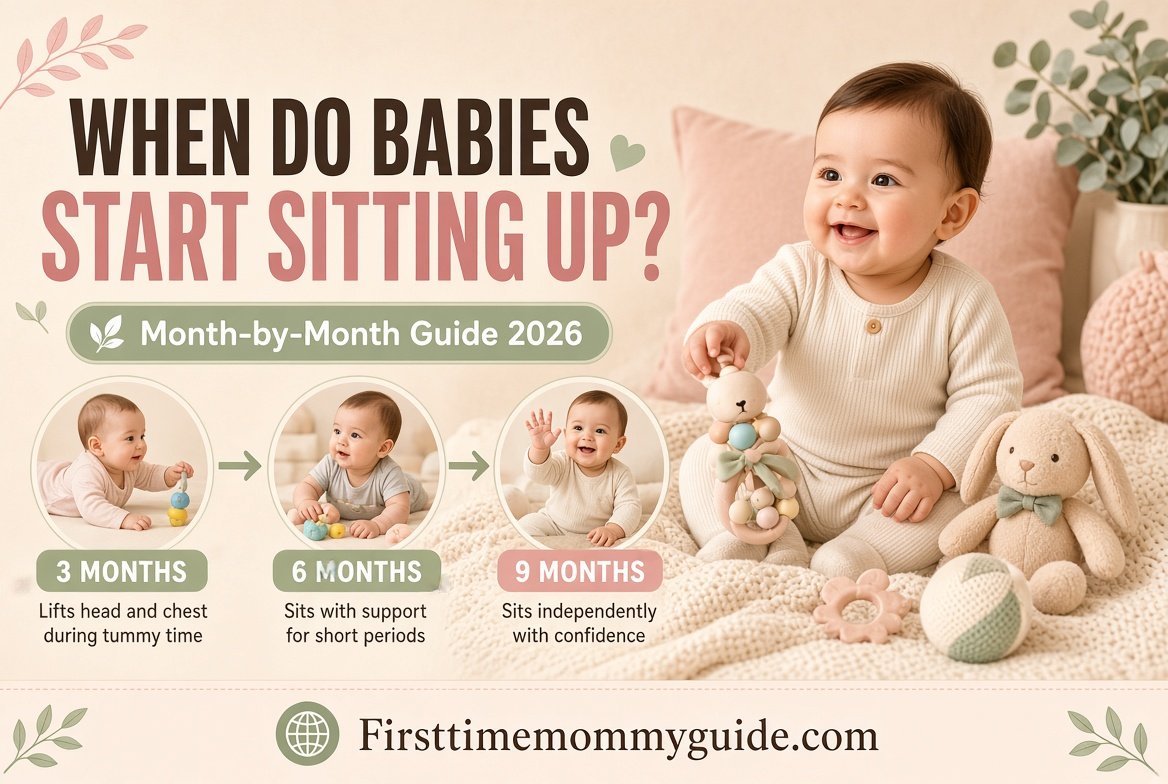
When Do Babies Start Sitting Up? Most babies start sitting with support around 4 to 6 months, and most sit fully on their own between 6 and 9 months. Full independent sitting is now considered a 9-month checkpoint by the CDC.
Every baby moves through this milestone at their own pace, and a few weeks either side of these ranges is completely normal.
Table of Contents
When Do Babies Start Sitting Up?

Babies typically sit with support around 4 to 6 months and sit independently between 6 and 9 months.
The CDC’s 2022 milestone update moved “sits without support” to the 9-month checkpoint, so a 7-month-old still using their hands to balance is well within the normal range.
The Sitting Milestone Timeline
Sitting develops in stages rather than all at once. Your baby builds the strength for it long before they can hold the position alone.
| Age Range | What to Expect |
|---|---|
| 3–4 months | Stronger head control; pushes up during tummy time |
| 4–6 months | Sits with support; may lean on hands (tripod sit) |
| 6–8 months | Sits briefly without support, may still topple |
| 7–9 months | Sits steadily without support for several minutes |
| 9 months | Can get into a sitting position by themselves |
These ranges come from guidance published by the CDC and the American Academy of Pediatrics, and they describe a typical window rather than a fixed deadline.
Why the Age Range Is So Wide
Sitting depends on core, neck, and back strength that every baby builds at a different rate. A baby who had more tummy time often reaches this stage sooner.
Premature babies usually reach milestones later, based on their adjusted age rather than their birth date. Adjusted age means counting from the original due date, not the actual birthday.
Genetics, muscle tone, and how much floor time a baby gets during the day all play a role too. None of these factors are something a parent did wrong.
Signs Your Baby Is Getting Ready to Sit
- Holds their head steady and upright without wobbling
- Pushes up onto straight arms during tummy time
- Rolls from tummy to back and sometimes back to tummy
- Reaches for toys while propped up on their hands
- Bears weight through their legs when held standing
If you’re seeing two or three of these signs together, supported sitting practice is usually a good next step.
How to Help Your Baby Practice Sitting
- Start with tummy time daily. This builds the neck and shoulder strength sitting depends on, and it should begin from the newborn stage.
- Try supported sitting from around 4 months. Prop your baby against a couch cushion or your own legs for short, supervised sessions.
- Use hip support, not armpit support. Holding your baby at the hips forces the trunk muscles to engage, rather than letting them hang.
- Give plenty of floor time. Floor play builds real core strength far more effectively than seats or positioners.
- Let them practice falling safely. A soft, padded surface lets your baby learn balance through gentle trial and error.
Products to Use Sparingly
Positioning seats like the Bumbo are popular, but pediatric physical therapists generally advise limiting how often they’re used.
These seats hold a baby’s trunk in place without requiring any muscle engagement, so relying on them too heavily can actually slow core strength development.
Floor-based practice, with a parent nearby for support, remains the option most therapists recommend over positioning products.
Common Mistakes to Avoid
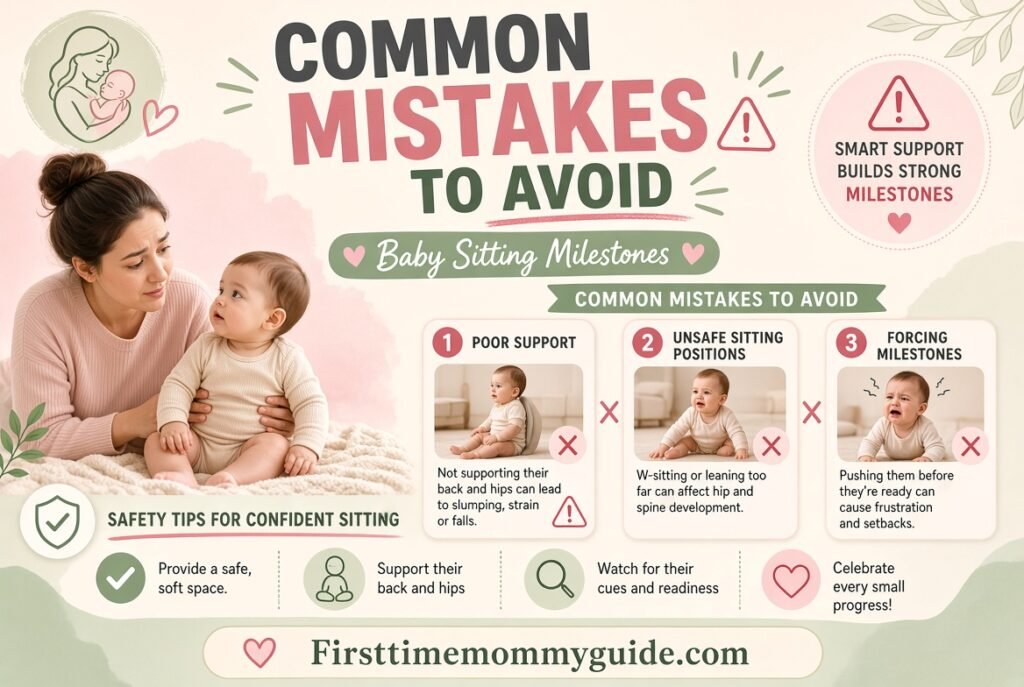
- Skipping tummy time because a baby fusses during it at first.
- Leaving a baby propped in a seat for long stretches instead of the floor.
- Comparing your baby’s timeline to a sibling’s or another baby’s.
- Assuming a slightly later start automatically means a problem.
- Ignoring a true loss of a previously mastered skill, which always warrants a call to the pediatrician.
Sitting With Support vs. Sitting Independently
These two stages get mixed up often, but they mark very different points in development.
| Aspect | Sitting With Support | Sitting Independently |
|---|---|---|
| Typical age | 4 to 6 months | 6 to 9 months |
| Hands needed? | Yes, for balance | No |
| Duration | A few seconds to a minute | Several minutes or more |
| What it shows | Early trunk strength | Full core and balance control |
When to Talk to Your Pediatrician
Reach out if your baby isn’t sitting with any support by 6 months, or isn’t sitting independently by 9 months.
Also mention it if your baby seems very stiff or very floppy, favors one side of their body, or has lost a skill they previously had.
The CDC recommends acting early rather than waiting, since early intervention services are most effective when started sooner rather than later.
Real-World Example
A baby who rolled early at 4 months but seemed uninterested in tummy time may sit later than a baby who rolled at 6 months but loved floor play.
Motor milestones don’t always arrive in a strict order, and one skill lagging slightly doesn’t predict how the others will go.
Expert Tip
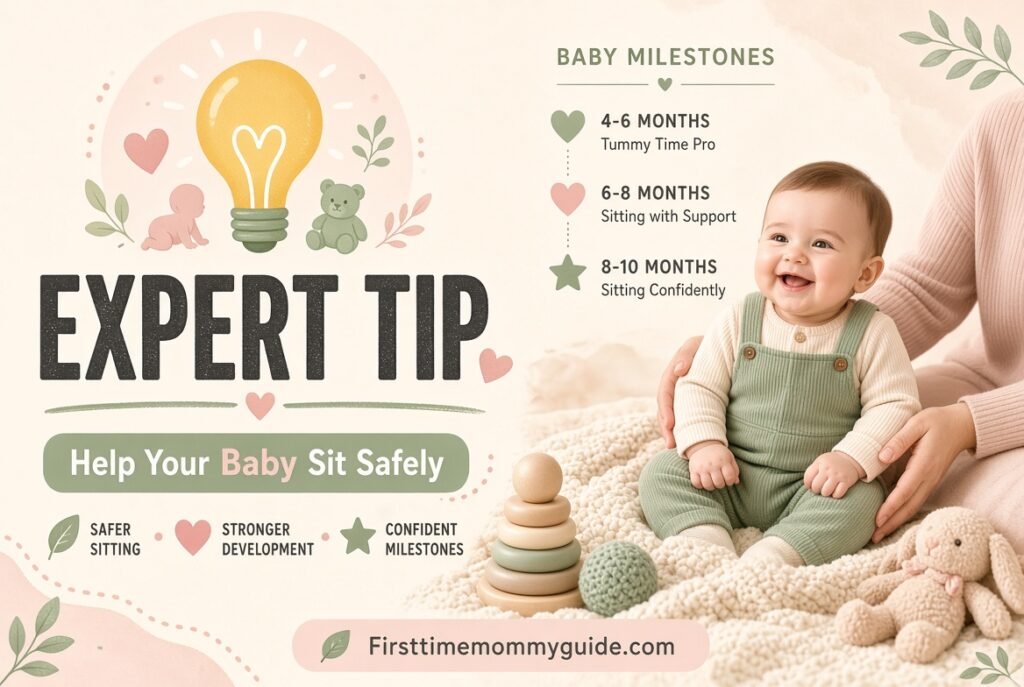
Watch for the tripod position, where your baby braces with one or both hands on the floor while sitting. It’s one of the clearest signs that independent sitting is close.
Also Read:
- When Do Babies Start Rolling Over? (2026 Guide)
- When Do Babies Start Smiling? Signs & Milestones
- Baby Sleep Guide, Honestly
- Baby Sleep Guide for New Moms: Safe Sleep & Schedules
- Baby Essentials, 0–3 Months
- Baby Essentials Checklist 0–3 Months (Complete Guide)
- Baby Essentials Checklist: What New Parents Actually Need
- Starting Solids, 6–12 Months
- Baby Food Chart 6 to 12 Months: Free Feeding Chart
- First Foods for Baby at 6 Months: A Complete Guide
- Fruit Purees for 6 Month Old Babies: Safe Recipes & Guide
- Best Vegetable Purees for Baby: A Complete Age-by-Age Guide
- Sweet Potato Puree for Baby: Easy Recipe & Age Guide
- Apple Puree for Baby: Easy Recipe & Safety Guide
- Blueberry Puree for Baby: Easy Recipe & Choking Safety Guide
- Spinach Puree for Baby: Safe Recipe & Age Guide
- Homemade Pumpkin Puree for Baby: Easy, Safe Recipe
- Zucchini Puree for Baby: Easy Recipe & Age Guide
- Pregnancy, Month by Month
- 33 Weeks Pregnant: Symptoms, Baby Development & What to Expect
- 25 Weeks Pregnant: Symptoms, Baby Size & What to Expect
- 17 Weeks Pregnant: Symptoms, Baby Size & What to Expect
- Pregnancy Week By Week 7: Symptoms & Baby Size
- FBS Test for Pregnant: Normal Range, Purpose & Next Steps
Frequently Asked Questions (FAQs)
When do babies start sitting up?
Most babies sit with support around 4 to 6 months and sit independently between 6 and 9 months, with 9 months marking the current CDC checkpoint for unsupported sitting.
What is the earliest a baby might sit up?
Some babies begin brief supported sitting as early as 3 to 4 months, though this is on the earlier end of the typical range.
Is it normal for a 7-month-old to still need support while sitting?
Yes. Since the CDC’s 2022 update, independent sitting is a 9-month milestone, so a 7-month-old who still balances with their hands is developing normally.
What helps a baby learn to sit up faster?
Daily tummy time, supported floor practice from around 4 months, and hip-supported sitting all help build the core and back strength sitting requires.
Should I use a Bumbo seat to help my baby sit?
Positioning seats can be used occasionally, but pediatric physical therapists generally recommend floor-based practice instead, since seats don’t require active muscle engagement.
What is tripod sitting?
Tripod sitting is when a baby braces themselves with one or both hands on the floor while sitting, using their arms like a third leg for balance.
When should I worry if my baby isn’t sitting yet?
Talk to your pediatrician if your baby isn’t sitting with support by 6 months or isn’t sitting independently by 9 months.
Do premature babies sit up later?
Often, yes. Premature babies are usually assessed using their adjusted age, which is calculated from their original due date rather than their birth date.
Can a baby sit up before they can roll over?
It’s less common but does happen. Milestones don’t always follow the exact same order for every baby, and slight variation is normal.
What comes after sitting up in the milestone timeline?
After sitting, most babies begin scooting, crawling, and pulling up to stand, usually somewhere between 7 and 12 months.
Does tummy time really matter for sitting?
Yes. Tummy time builds the neck, shoulder, and upper back strength that sitting, and later crawling, both depend on.
How long should a baby be able to sit before it counts as independent sitting?
Pediatricians generally look for a baby holding a steady seated position for several minutes without using their hands for balance.
Is it bad if my baby prefers being propped up in a seat?
Occasional use is fine, but too much time in seats can reduce the floor practice a baby needs to build core strength naturally.
What if my baby sits well but leans to one side?
A persistent lean to one side is worth mentioning at your next pediatrician visit, since it can sometimes point to a muscle tone difference.
Are boys and girls different in when they start sitting?
There’s no medically significant difference between boys and girls for this particular milestone; the typical range applies to both.
What should I put around my baby once they start sitting?
Clear the area of small objects, sharp corners, and anything that could tip over, since a newly sitting baby will reach for everything nearby.
Can I give my baby toys while they practice sitting?
Yes, and it helps. Reaching for a toy while propped up encourages the exact trunk and balance control sitting requires.
Is losing the sitting skill after achieving it ever normal?
No. Losing a previously mastered skill at any age is always worth an immediate call to your pediatrician.
How does the CDC’s 2022 milestone update change what parents should expect?
The update moved several skills, including unsupported sitting, to slightly later checkpoint ages, reflecting the range in which most healthy babies actually reach them.
What’s the difference between the CDC and AAP guidance on sitting?
Both track a similar overall range, but the CDC lists sitting without support as a 9-month checkpoint, while some AAP materials describe supported sitting starting closer to 4 to 6 months.
Conclusion
Most babies move from supported sitting around 4 to 6 months to full independent sitting somewhere between 6 and 9 months, with 9 months as the current checkpoint pediatricians watch for.
Daily tummy time, plenty of floor practice, and hip-supported sitting sessions are the most reliable ways to help your baby build the strength this milestone requires.
If your baby hasn’t reached these markers within the typical windows, or ever loses a skill they’d already gained, it’s always worth a conversation with your pediatrician rather than waiting it out.

Dilawar Mughal
Founder and editor, First Time Mommy Guide
I research every guide against what the NHS, the AAP and the WHO publish, then write it in plain English — because most new parents are reading with one hand free, not comparing clinical guidelines. I'm not a doctor or a midwife. Every health claim on this site is sourced and linked so you can check it yourself, and anything urgent belongs with your health visitor or GP, not a blog.