
General information, not medical advice. Every baby is different — if anything worries you, speak to your midwife, health visitor or GP rather than waiting.

Introduction
If you are reading this at 3 a.m. with a baby in your arms, you are not alone. Learning how to stop night feeds is one of the most common questions new parents ask, and it is also one of the most emotional. You want more sleep, but you also want to be sure your baby is ready, fed, and safe.
This guide explains how to stop night feeds gently, when night weaning is usually appropriate, and how to build a plan that fits your baby's age, feeding history, and temperament. You will find a night feed schedule by age, seven gentle night weaning methods, a practical seven-to-fourteen-day plan, and answers to the questions parents ask most.
Night weaning is not the same as sleep training, and it is not about ignoring hunger. It is about gradually helping a baby who no longer needs milk at night to fall back to sleep without a feed. For most healthy babies, that shift happens somewhere between four and twelve months, but the right time depends on your baby, not on a calendar alone.
Before you begin, talk with your paediatrician if you have any doubts. This is especially important if your baby was born early, is not gaining weight well, has reflux or another medical condition, or still needs frequent night feeds for growth. The general guidance in this article cannot replace advice about your individual baby.
A note on safety: Always follow safe sleep guidance. Put your baby to sleep on their back, on a firm, flat surface, in their own sleep space, without pillows, blankets, bumpers, or soft toys. The CDC safe sleep guidance explains these steps clearly, and the NHS also offers practical help for settling a baby at night.
What Is Night Weaning?
Definition box — Night weaning: Night weaning means gradually reducing and then stopping milk feeds during the night, while keeping daytime feeds the same or increasing them. The goal is for a baby who is old enough and growing well to sleep for longer stretches without waking for milk, and to learn other ways to settle back to sleep.
Night weaning is different from weaning from breast milk or formula altogether. Your baby still needs milk during the day. You are only changing when milk is offered. Daytime feeds, solids where age-appropriate, and comfort at bedtime all stay in place.
It is also different from night-time sleep training. Sleep training focuses on how a baby falls asleep at the start of the night. Night weaning focuses on what happens when a baby wakes in the middle of the night. The two often work together, but you can night wean without a strict sleep-training method, and you can improve bedtime settling without night weaning first.
Many parents use the terms "stop night feeds" and "night weaning baby" to mean the same thing. In this guide, they mean a gradual, responsive process. You reduce feeds step by step, watch how your baby responds, and pause or slow down if your baby is unwell, teething badly, or going through a big change.
Quick answer: When can I stop night feeds?
Most healthy babies can begin night weaning between four and six months, when their paediatrician agrees they are gaining weight well and taking enough milk during the day. Many babies still need one night feed until six to nine months. Some babies drop night feeds on their own by six months. Others need gentle help until nine to twelve months. There is no single age that is right for every baby.
Is Your Baby Ready to Stop Night Feeds?
Readiness is not only about age. It is about growth, daytime intake, sleep patterns, and health. Look for several of these signs together, rather than one sign alone.
Signs your baby may be ready
- Your baby is at least four to six months old and your paediatrician says growth is on track.
- Your baby takes full feeds during the day and is interested in solids, if started.
- Night feeds are short, sleepy, or comfort-driven rather than long, hungry feeds.
- Your baby falls back to sleep quickly after a small feed, or sometimes settles without one.
- Your baby wakes at roughly the same times each night, out of habit rather than hunger.
- Your baby can self-soothe briefly, for example by sucking fingers, shifting position, or babbling quietly before crying.
- Night wakings have stayed the same for several weeks, with no illness, teething, or travel to explain them.
Signs your baby is probably not ready yet
- Your baby is under four months old. Newborns need night feeds for growth and should not be night weaned.
- Your baby is not gaining weight well, has dropped centiles, or your paediatrician has advised extra feeds.
- Your baby was born prematurely and is still catching up, unless your paediatrician advises otherwise.
- Your baby takes very little milk during the day because of illness, reflux, distraction, or a feeding difficulty.
- Your baby is currently ill, has a fever, is vomiting, has diarrhoea, or has just had vaccinations and is unsettled.
- You have just moved house, started nursery, or made another big change. Wait until life is settled again.
If you are unsure, ask your paediatrician before you start. A quick check can give you confidence and rule out a medical reason for frequent waking. It is always better to wait a few weeks than to start too early and feel you have to stop and restart.
Key takeaway
Readiness is a pattern, not a birthday. Age, weight gain, daytime feeding, and your paediatrician's advice together tell you when to begin. If in doubt, wait and check.
When to Stop Night Feeds Baby: Age-by-Age Guidance
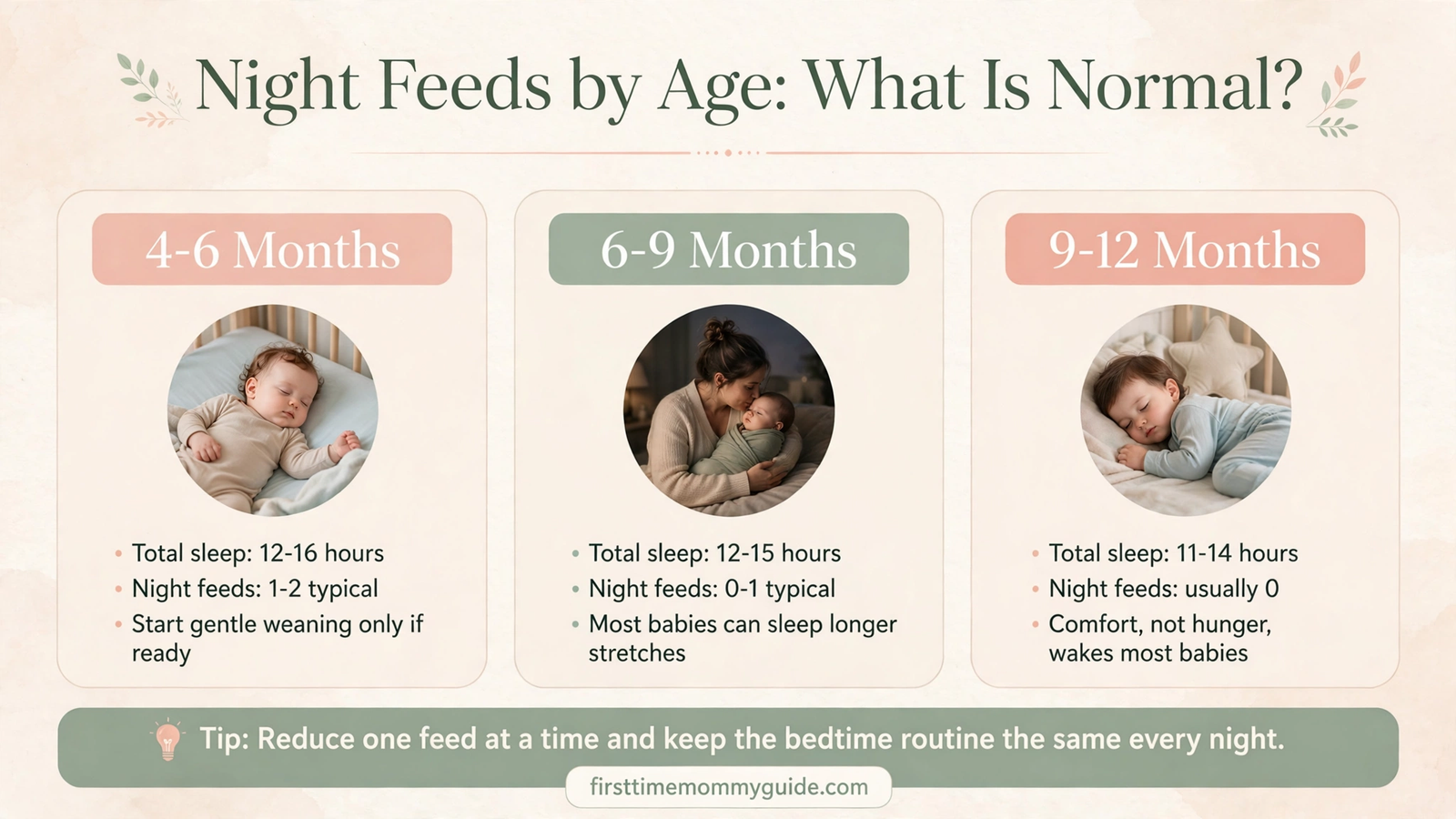
Every baby is different, but paediatric guidance gives a useful framework. The table below shows what is typical, not what is compulsory. Use it to set expectations, then adjust for your baby.
| Age | Typical night feeds | What is normal | What to aim for |
|---|---|---|---|
| 0–3 months | 2–4 feeds | Frequent waking is normal and needed for growth | Respond promptly; do not night wean |
| 4–6 months | 1–2 feeds | Many babies still need one feed; some drop to none | Talk to your paediatrician; gentle reduction may begin |
| 6–9 months | 0–1 feeds | One feed is still common, especially for breastfed babies | Most families can night wean with a gentle plan |
| 9–12 months | 0 feeds for many babies | Most healthy babies can sleep 10–12 hours without milk | Night weaning is usually complete or nearly complete |
| 12 months and over | 0 feeds | Waking is usually about habit, comfort, or sleep associations | Focus on settling skills, not milk |
A baby who wakes once at night at eight months is not behind. A baby who sleeps through at five months is not ahead. Sleep is developmental, and feeding history, temperament, and family routines all play a part. The aim is steady progress, not a race to zero feeds.
Why age alone does not decide it
Two babies of the same age can need very different things. A baby who takes large daytime feeds and eats solids well may drop night feeds easily. A baby who is a distracted daytime feeder, or who has recently been ill, may still genuinely need a night feed. Weight, health, and daytime intake matter as much as months.
Breastfed babies often take longer to night wean than formula-fed babies, because breast milk digests more quickly and breastfeeding is also comfort. That does not mean breastfeeding causes night waking. It means the plan may need to be slower, with more emphasis on daytime feeds and on other settling methods.
Night Feed Schedule by Age
A clear schedule helps you see whether your baby's waking is hunger or habit. The table below is a guide for healthy babies. Your baby's exact times will differ, and that is fine.
| Age | Daytime feeds | Night feeds | Longest sleep stretch | Notes |
|---|---|---|---|---|
| Newborn (0–6 weeks) | 8–12 feeds in 24 hours | Every 2–3 hours | 2–4 hours | Feed on demand; wake to feed if advised |
| 2–3 months | 7–9 feeds | 2–3 feeds | 4–5 hours | A longer first stretch often appears |
| 4–6 months | 6–8 feeds | 1–2 feeds | 5–8 hours | Solids may start around 6 months |
| 6–9 months | 5–6 feeds plus solids | 0–1 feeds | 8–10 hours | Daytime calories should rise |
| 9–12 months | 4–5 feeds plus 3 meals | 0 feeds for most | 10–12 hours | Milk remains important in the day |
If your baby wakes every two hours all night at eight months, that pattern is worth looking at closely. It may be habit, a sleep association, or a need for more daytime calories. If your baby wakes once, feeds well, and settles, that single feed may still be needed for a while longer.
Keep a simple log for three to five nights before you start. Note the time of each waking, how long the feed lasted, and how quickly your baby settled. The pattern will show you which waking is the hungriest and which is the most habitual. Start with the most habitual waking, not the hungriest one.
Why Is My Baby Waking for Milk at Night?
Understanding the cause helps you choose the right method. Babies wake at night for several reasons, and milk is only one of them.
Hunger
True hunger is most likely in younger babies, during growth spurts, or when daytime intake has dropped. A hungry baby usually feeds vigorously, takes a full feed, and settles deeply afterwards. If your baby drains a full feed and falls asleep content, hunger may still be real.
Habit
Habit waking is very common after six months. Your baby wakes at the same time, expects milk, and cries until it arrives. The feed may be short, with lots of dozing and flutter sucking. Your baby may fall asleep after only a few minutes. That is a strong clue that comfort and habit, rather than hunger, are driving the waking.
Sleep associations
If your baby only falls asleep while feeding, rocking, or being held, they may need the same help to fall back to sleep after each sleep cycle. Babies cycle through light and deep sleep every 45 to 90 minutes. At the end of a cycle, they stir briefly. A baby who can self-soothe will drift back off. A baby who needs feeding to fall asleep will call for it.
This is why bedtime matters so much for night weaning. Helping your baby fall asleep at bedtime with less feeding often reduces night waking too. A consistent newborn sleep routine guide and a calm wind-down can make a real difference, even for older babies.
Developmental changes
Rolling, crawling, pulling up, and learning new sounds can all disrupt sleep for a few nights. So can the 4-month sleep regression, when sleep cycles mature and babies wake more often. These phases pass, but they can look like a sudden return to night feeds. Wait until the phase settles before you judge whether night weaning is working.
Discomfort, teething, and illness
Teething pain, a stuffy nose, ear discomfort, reflux, or a wet nappy can all wake a baby. Milk may soothe the discomfort, which makes it look like hunger. If waking suddenly increases, check for illness or pain first. Night weaning should pause while your baby is unwell.
Too little daytime milk or food
A baby who is distracted during daytime feeds, or who is busy practising new skills, may take in less milk by day and try to make up for it at night. This is sometimes called reverse cycling. The fix is to protect daytime feeds: feed in a quiet room, offer feeds before naps rather than after, and make sure solids do not replace milk too early.
How to Wean Night Feeds: The Principles That Make It Gentle
Gentle night weaning is not about letting your baby cry alone. It is about small, predictable changes, lots of reassurance, and a plan you can stick to for at least a week. These principles apply whichever method you choose.
Go gradually
Reduce one feed at a time, or reduce the size of feeds slowly. A sudden stop is harder for your baby and harder for you, especially if you are breastfeeding and need to avoid engorgement or blocked ducts. Gradual change gives your baby time to shift calories to the daytime.
Keep daytime feeds strong
Night weaning only works if daytime intake rises to compensate. Offer full feeds during the day, and do not skip a daytime feed to "save" milk for the night. If your baby is six months or older, offer solids at regular mealtimes, but keep milk as the main source of nutrition until twelve months.
Be consistent for at least a week
Babies learn from repetition. If you reduce a feed on Monday, offer a full feed on Tuesday, and skip it on Wednesday, your baby cannot learn the new pattern. Pick a plan, follow it for seven to ten nights, and only then judge whether it is working. Consistency matters more than the exact method.
Respond, do not ignore
Gentle methods still involve responding to crying. You can comfort, pat, shush, hold, or rock your baby without offering milk. The difference is that milk is no longer the first response to every waking. Your baby still knows you are there.
Choose a calm week
Do not start during illness, travel, moving house, starting nursery, or a major developmental leap. Pick a week when you and your partner can share the night wakings, when you have no early starts, and when you can be patient. A calm start makes the whole process easier.
Share the load
If possible, let your partner handle the first waking, or the waking you are trying to drop. Babies often associate one parent, usually the breastfeeding parent, with milk. A different parent offering cuddles, water where age-appropriate, or a gentle pat can break that association more easily. It also protects the breastfeeding parent's sleep.
Gentle Night Weaning Methods: Seven Options Compared
There is no single best method. The right one depends on your baby's age, feeding style, temperament, and your own comfort level. Compare the options below, then pick one and commit to it for a week.
| Method | How it works | Best for | Pace | Effort at night |
|---|---|---|---|---|
| Gradual reduction | Shorten feeds by 1–2 minutes, or reduce ounces, every few nights | Breastfed and bottle-fed babies, 4–12 months | Slow, 2–3 weeks | Low to medium |
| Drop one feed at a time | Remove the easiest waking first, keep the others | Babies with 2+ night feeds | Medium, 1–2 weeks per feed | Medium |
| Dream feed then drop | Offer a late feed before you sleep, then reduce night feeds | Babies who wake early in the night | Medium | Low at first |
| Partner settling | Non-feeding parent settles wakings with cuddles and patting | Breastfed babies, strong feed association | Medium to fast | Medium |
| Water instead of milk | Offer a small amount of water for older babies, where advised | Babies over 6 months, habitual waking | Medium | Low |
| Scheduled waking | Wake baby gently before the usual waking time, then settle | Very regular habitual waking | Slow | Medium |
| Cold turkey with comfort | Stop night feeds, comfort in other ways | Older babies, 9–12 months, with paediatrician agreement | Fast, 3–5 nights | High at first |
1. Gradual reduction: the gentlest starting point
Gradual reduction is the method most health visitors and paediatricians recommend first. You make the night feed slightly smaller every few nights, so your baby gradually takes in less milk and learns to sleep through that waking.
For a breastfed baby, shorten the feed by one to two minutes every two to three nights. If a feed usually lasts ten minutes, offer eight minutes for two nights, then six, then four, then two, then stop. Keep the feed calm and dim, and settle your baby back to sleep in the cot afterwards.
For a bottle-fed baby, reduce the amount by 30 ml (about one ounce) every two to three nights. If your baby usually takes 120 ml at night, offer 90 ml, then 60 ml, then 30 ml, then water or no feed. Shake the bottle well and keep the teat flow the same, so the only change is the amount.
Gradual reduction works best when you also increase daytime feeds. Offer an extra feed in the late afternoon or early evening, or make sure your baby finishes daytime feeds without rushing. The aim is to move calories from night to day, not to cut calories overall.
This method is slow, but it is kind, predictable, and easy to reverse if your baby is unwell. Many families find it the least stressful, because the change is so small that crying increases only slightly, if at all.
2. Drop one feed at a time
If your baby wakes twice at night, do not try to drop both feeds at once. Pick the waking that is easiest to settle without milk, usually the later one or the one where your baby feeds least, and work on that first.
For the chosen waking, use settling instead of milk: cuddles, patting, shushing, or a dummy if your baby already uses one. Keep the other waking as a full feed for now. Once your baby settles without milk at the first waking for three to four nights in a row, move on to the next waking.
This method gives you a clear win early, which builds confidence. It also respects hunger: if your baby wakes earlier and feeds hungrily, that feed stays until your baby is ready to drop it.
3. Dream feed and then drop
A dream feed is a feed given while your baby is still mostly asleep, usually between 10 p.m. and 11 p.m., before you go to bed. You lift your baby gently, offer milk, and put them back down without fully waking them. Some families find it stretches the first part of the night.
A dream feed can help in the short term, but it can also become another feed to drop later. If you use it, plan to phase it out after a few weeks, by gradually making it earlier or smaller. Do not use a dream feed if it fully wakes your baby or makes settling harder.
For babies who wake very early, around 1 a.m. or 2 a.m., a dream feed at 10.30 p.m. sometimes shifts the first waking later. For babies who already sleep until 2 a.m. or 3 a.m., a dream feed may not add much and can be skipped.
4. Partner settling
Babies are clever. They know who usually feeds them, and they may cry harder for that parent. If your partner takes over the waking you are trying to drop, your baby may settle more quickly with cuddles, rocking, or patting, because milk is not on offer from that parent.
Agree the plan in advance. The feeding parent should stay out of the room, or at least out of sight, for that waking, so your baby does not smell milk and become more upset. The settling parent should stay calm, keep the room dark, and use the same settling words or sounds each time.
This method works well for breastfed babies, but it needs teamwork. Take turns, agree who responds to which waking, and be kind to each other when nights are hard. Sleep deprivation makes everything feel bigger than it is.
5. Water instead of milk
For babies over six months, some families offer a small amount of cooled, boiled water instead of milk at a habitual waking. The idea is that your baby learns that waking no longer brings milk, and the waking fades. Only use this method if your paediatrician agrees, and never offer water instead of milk to a baby under six months.
Water is not a substitute for milk if your baby is genuinely hungry. If your baby drinks the water eagerly and still cries, or wakes again soon after, hunger may still be present. In that case, offer milk and revisit the plan in a few weeks. Do not offer juice, sweetened water, or large amounts of water at night.
6. Scheduled waking
Scheduled waking sounds counterintuitive, but it can help with very regular habitual waking. If your baby wakes every night at 2 a.m., you gently wake them at 1.45 a.m., change the nappy if needed, offer a brief cuddle, and settle them back to sleep without a feed. Over several nights, the 2 a.m. waking often fades, because the sleep cycle is interrupted before the habitual waking point.
This method needs careful timing and a calm approach. Do not fully wake your baby or turn on bright lights. Keep everything dim and quiet. It is not the right method for babies whose waking times vary a lot, or for babies who are hard to settle once woken.
7. Stopping night feeds more quickly, with comfort
Some families, usually with older babies between nine and twelve months, choose to stop night feeds in one step, while still comforting their baby in other ways. This is sometimes called cold turkey, but gentle cold turkey still means responding, holding, and soothing. It does not mean leaving your baby to cry alone.
If you choose this route, make sure your paediatrician agrees, your baby is eating well during the day, and you have a clear settling plan. Expect two to four hard nights, with more crying at first, then improvement. This method is not suitable for younger babies, for babies who are unwell, or for families who are not comfortable with more crying.
Whichever method you choose, do not combine three methods at once. Pick one, follow it consistently, and give it time. Mixing methods makes it hard to know what is working and confuses your baby.

A Step-by-Step Plan to Stop Night Feeds in 7 to 14 Days
This plan uses gradual reduction, the gentlest method, and works for most babies between six and twelve months. Adapt the timing to your baby's age and your paediatrician's advice. If your baby is four to six months, go more slowly, and keep one feed for longer if needed.
Days 1 to 3: Prepare
- Keep a night log for three nights: waking times, feed length or amount, and settling time.
- Strengthen daytime feeds. Offer a full feed on waking, before naps, and in the early evening.
- Build a calm bedtime routine: bath or wash, pyjamas, story or song, feed, then into the cot drowsy but awake.
- Check the sleep environment: dark room, comfortable temperature, white noise if you use it, and safe sleep setup.
- Agree with your partner who will respond to which waking, and what settling you will use instead of milk.
- Talk to your paediatrician if you have not already, especially about weight gain and readiness.
A good bedtime routine is the foundation for night weaning. If you need ideas, the baby sleep training methods guide explains different settling approaches, and the safe sleep for newborns guide covers the safety basics that still apply as your baby grows.
Days 4 to 6: Reduce the first feed
- Choose the waking to reduce first. Start with the least hungry waking, often the second waking or the one closest to morning.
- Shorten breastfeeds by two minutes, or reduce bottle feeds by 30 ml.
- After the smaller feed, settle your baby back in the cot with patting, shushing, or cuddling.
- Keep other night feeds the same for now.
- Expect some protest. Stay calm, keep the room dark, and use the same words each time.
Days 7 to 9: Reduce further
- Shorten the same feed by another two minutes, or another 30 ml.
- If your baby settles after the smaller feed, keep going. If your baby is very distressed and does not settle within 20 to 30 minutes, offer a little more milk and try again in two nights.
- Add a dream feed if it helps, or add an extra daytime feed if your baby seems hungry in the evening.
- Watch daytime behaviour. A baby who is happy, feeding well, and napping normally is coping well with the change.
Days 10 to 14: Drop the feed
- When the feed is down to two to three minutes, or 30 ml, try settling without milk instead.
- Use your chosen settling method: pick up and put down, patting in the cot, rocking, or partner settling.
- Stay with your baby until they are calm, then leave quietly. Return if they cry again, and repeat the same calm settling.
- Once this waking is settled without milk for three nights, start the same process for the next waking, if there is one.
Most families see real progress within a week, and most babies drop one feed within two weeks. Dropping a second feed takes another one to two weeks. Do not rush the second feed. Let your baby consolidate the first change before you start the next one.
Baby Sleeping Through the Night: What It Really Means
"Sleeping through the night" is a phrase that causes a lot of pressure. In research and in paediatric guidance, it usually means sleeping for five to six hours without waking, not twelve hours. By six months, many babies can sleep for a five-to-six-hour stretch. By nine to twelve months, many can sleep for eight to ten hours or more.
A baby who wakes once, feeds, and settles is still sleeping well. A baby who wakes briefly, babbles, and falls back asleep on their own is also sleeping through, even if you hear them on the monitor. The goal is not silence all night. It is longer stretches, less feeding, and a baby who can resettle with a little help.
How long will it take?
- Gradual reduction: two to four weeks to drop one to two feeds.
- Drop one feed at a time: one to two weeks per feed.
- Partner settling: three to seven nights to see a change, with full effect in two weeks.
- Faster methods: three to five nights of harder settling, then improvement.
Setbacks are normal. Illness, teething, travel, and developmental leaps can bring back night waking for a few nights. That does not mean you have failed. Go back to offering a feed if your baby needs it, settle them kindly, and restart the plan when they are well again.
Helping Your Baby Self-Soothe at Night
Baby self-soothing at night is a skill, not a trait your baby either has or does not have. It develops over time, with practice and with a consistent environment. You can support it without leaving your baby to cry alone.
What self-soothing looks like
- Sucking on fingers, a thumb, or a dummy.
- Shifting position, rolling, or snuggling into a sleep sack.
- Babbling, sighing, or making soft noises, then falling quiet.
- Briefly opening eyes, looking around, and drifting back off.
These behaviours are normal and healthy. If your baby does these things and settles, give them a moment before you rush in. A short pause of two to three minutes lets you see whether your baby can resettle alone. If crying escalates, go in and help.
How to build self-soothing skills
- Put your baby down drowsy but awake at bedtime, at least sometimes. This gives them practice falling asleep without feeding.
- Keep the cot environment the same all night: same sleep sack, same white noise, same darkness. Familiarity helps resettling.
- Use a consistent settling phrase or sound, such as "shh, it's sleep time," so your baby learns what it means.
- Offer a comfort object only if it is safe and age-appropriate, and only if your paediatrician or health visitor agrees. Loose blankets and soft toys are not safe for young babies.
- Avoid introducing a new sleep association, such as rocking to sleep every time, while you are trying to remove feeding as a sleep association.
Self-soothing takes time. Some babies learn quickly. Others need weeks of gentle practice. Both are normal. Your job is to give your baby the chance to practise, and to be there when they need help.
Breastfed Babies and Night Weaning
Night weaning a breastfed baby needs extra care, for your baby and for your body. Breast milk is food and comfort, and your baby may be used to falling asleep at the breast. A gradual plan protects your milk supply during the day and avoids engorgement at night.
Protect your supply
- Keep daytime breastfeeds frequent and full. Do not cut daytime feeds while you night wean.
- Reduce night feeds slowly, by a few minutes at a time, so your breasts adjust gradually.
- If you feel full or uncomfortable, hand express a small amount for comfort, but do not empty the breast fully at night.
- Watch for signs of a blocked duct or mastitis: a hard, painful area, redness, fever, or flu-like symptoms. Seek medical advice promptly if these appear.
Break the feed-to-sleep link gently
- Move the last feed earlier in the bedtime routine, so feeding is not the final step before sleep.
- After the feed, read a story, sing a song, or cuddle, then put your baby in the cot drowsy but awake.
- At night, try settling first with patting or rocking, and offer the breast only if settling does not work and your baby is clearly hungry.
- Let your partner settle some wakings, so your baby learns that comfort can come without the breast.
Night weaning and milk supply
Many mothers worry that night weaning will reduce their milk supply. If your baby is over six months and eating solids, daytime feeds usually keep supply steady. If your baby is younger, or if you are concerned about supply, talk to a lactation consultant or your paediatrician before you start. You can also pump in the morning if you feel supply dipping, but most families do not need to.
Bottle-Fed Babies and Night Weaning
Bottle-fed babies often night wean a little more easily, because the amount of milk is visible and easy to reduce. The same principles apply: go gradually, keep daytime feeds strong, and settle without milk when you can.
- Reduce the amount by 30 ml every two to three nights, as described above.
- Keep the bottle warm and the room dark, so the feed stays sleepy.
- Do not add cereal or other foods to the bottle to try to make your baby sleep longer. This is not recommended and can be unsafe.
- Once the bottle is down to 30 ml, try offering water or settling without a bottle.
- Clean and sterilise bottles as usual, and do not leave a bottle in the cot with your baby.
If your baby takes a full bottle at night and still wakes hungry, check daytime intake first. Your baby may need an extra daytime bottle, or larger daytime bottles, before night feeds can drop.
Common Mistakes When You Stop Night Feeds
Avoiding these mistakes makes night weaning smoother and kinder for everyone.
| Mistake | Why it causes problems | What to do instead |
|---|---|---|
| Starting too early | Baby is genuinely hungry; crying increases; weight may suffer | Wait until 4–6 months and paediatrician agreement |
| Stopping all feeds at once | Baby is distressed; mother may get engorged; plan fails | Drop one feed at a time, gradually |
| Being inconsistent | Baby cannot learn the new pattern; waking continues | Follow one plan for 7–10 nights |
| Cutting daytime feeds too | Baby is hungrier at night, not less | Increase daytime feeds and solids where appropriate |
| Starting during illness or travel | Baby needs extra comfort and milk; plan feels harsh | Wait until baby is well and life is settled |
| Using milk as the only settling tool | Baby never learns other ways to settle | Practise patting, shushing, rocking, and partner settling |
| Comparing to other babies | Every baby is different; comparison adds pressure | Track your own baby's progress, not a neighbour's |
| Giving up after one bad night | One bad night is normal; progress is rarely linear | Give the plan at least a week before you judge it |
What to Do When Your Baby Cries During Night Weaning
Crying is hard to hear, especially at night when you are tired. It does not mean you are doing something wrong, and it does not mean your baby is harmed. It means your baby is protesting a change and asking for reassurance. How you respond matters more than whether your baby cries at all.
A calm response plan
- Pause for a minute or two, unless crying is intense. Your baby may resettle alone.
- Go in, keep the lights low, and speak softly. Pick up your baby if they need it.
- Check the basics: nappy, temperature, comfort, and whether they are in pain or unwell.
- Try settling without milk: pat, rock, shush, or cuddle until calm, then put your baby back in the cot.
- If settling does not work after 20 to 30 minutes, and your baby seems hungry, offer a small feed. It is not a failure. Try again tomorrow night.
- Stay consistent the next night. One feed does not undo a week of progress.
If crying is intense, prolonged, or different from usual, check your baby carefully and seek medical advice if you are worried. Trust your instincts. You know your baby best.
Night Weaning During Regressions, Teething, and Illness
Life does not pause for night weaning. Regressions, teething, and illness will happen, and they will disrupt sleep. The key is to pause the plan, support your baby, and restart when they are ready.
The 4-month sleep regression
Around four months, sleep cycles mature and babies wake more often. This is a developmental step, not a problem you caused. Many parents find night feeds increase during this time. Focus on settling skills and a consistent routine, and wait until the regression passes before you start night weaning in earnest. The 4-month sleep regression guide explains what to expect and how to cope.
Teething
Teething can cause discomfort, drooling, and broken sleep for a few nights. Offer comfort, and use teething remedies approved by your paediatrician or pharmacist if needed. If your baby is in pain, offer milk if it soothes them. Resume night weaning once the worst of the teething pain has passed.
Illness
When your baby is ill, night weaning stops. Offer feeds, fluids, and comfort as needed, and follow your paediatrician's advice. Babies need extra milk and closeness when they are unwell. Restart the plan a few nights after your baby is fully recovered.
Growth spurts
Growth spurts, often around three weeks, six weeks, three months, and six months, can bring a few days of extra hunger and more frequent feeding. This is temporary. Feed on demand during a growth spurt, and do not try to night wean through it. The baby growth spurts guide explains how to spot a spurt and how long it usually lasts.
Travel and nursery starts
Travel, time-zone changes, and starting nursery can all disrupt sleep for a week or two. Keep the bedtime routine as familiar as possible, and expect some extra night waking. Wait until your baby has settled into the new routine before you restart night weaning.
Feeding, Sleep, and Daytime Routines That Support Night Weaning
Night weaning works best when the whole day supports it. A baby who is well fed, well rested, and settled at bedtime is more likely to sleep longer at night.
Daytime feeding
- Offer milk feeds at regular intervals, not just when your baby cries.
- For babies over six months, offer three meals of solids plus milk feeds, with a regular mealtime pattern.
- Do not let solids replace milk too early. Milk remains the main nutrition until twelve months.
- If your baby is distracted, feed in a quiet room with low stimulation.
A clear newborn feeding schedule can help in the early months, and the principles of regular, full feeds carry through as your baby grows.
Naps
- Overtired babies wake more at night, not less. Protect daytime naps.
- Keep naps regular, but avoid very late naps that push bedtime too late.
- A baby who naps well during the day is more likely to settle well at night.
Bedtime routine
- Keep bedtime at a similar time each night.
- Use the same steps in the same order: bath, pyjamas, story, feed, cot.
- Dim the lights in the last 30 minutes before bed.
- Put your baby in the cot drowsy but awake, so they practise falling asleep without milk.
Day and night confusion
In the early months, some babies mix up day and night. Keeping days bright and active, and nights dark and quiet, helps their body clock develop. If your baby still seems confused about day and night, the guide on how long newborn day-night confusion lasts explains what is normal and how to help.
Safe Sleep: The Basics That Always Apply
Night weaning should never come before safe sleep. The NHS and the CDC both stress the same core steps, and they apply at every age in the first year.
- Place your baby on their back to sleep, for naps and at night.
- Use a firm, flat mattress in a cot or Moses basket, with no pillows, duvets, bumpers, or soft toys.
- Keep your baby's sleep space in your room for the first six months, where possible.
- Keep the room at a comfortable temperature, and do not overdress your baby.
- Do not smoke around your baby, and do not share a bed if you have been drinking, smoking, or taking medicines that make you drowsy.
- Offer a dummy at sleep times if your baby uses one, once breastfeeding is established.
For more detail, see the NHS guidance on helping your baby sleep and the CDC safe sleep information. The NHS page is available at nhs.uk, HealthyChildren.org offers practical settling advice at healthychildren.org, and the CDC safe sleep page is at cdc.gov. If you are ever unsure about safe sleep, ask your health visitor or paediatrician.
When to Seek Extra Help
Most families can night wean with a gentle plan and patience. Seek extra help if any of the following apply.
- Your baby is not gaining weight well, or has lost weight.
- Your baby wakes every hour all night, even after several weeks of a consistent plan.
- Your baby snores loudly, pauses in breathing, or struggles to breathe during sleep.
- Your baby has reflux, eczema, allergies, or another condition that affects feeding or sleep.
- You feel very low, anxious, or unable to cope with broken sleep. Postnatal depression and anxiety are common and treatable. Talk to your GP or health visitor.
- Night weaning is causing severe distress for you or your baby, and you are unsure how to proceed.
A health visitor, paediatrician, lactation consultant, or sleep consultant can look at your baby's feeding, growth, and sleep together, and help you adjust the plan. There is no shame in asking for help. Sleep deprivation is hard, and support makes it easier.
FAQs: How to Stop Night Feeds
1. How do I stop night feeds gently?
Reduce feeds gradually, one at a time. Shorten breastfeeds by one to two minutes, or reduce bottle feeds by 30 ml, every two to three nights. Increase daytime feeds, use settling instead of milk for the waking you are dropping, and stay consistent for at least a week.
2. When should I stop night feeds?
Most healthy babies can start night weaning between four and six months, with your paediatrician's agreement. Many still need one feed until six to nine months. Most can sleep without milk by nine to twelve months. The right time depends on growth, daytime intake, and health, not age alone.
3. Is it OK to stop night feeds at 4 months?
It can be, if your paediatrician agrees your baby is gaining weight well and taking enough milk during the day. Some four-month-olds still need a night feed. Do not night wean a four-month-old without checking first, and go very slowly if you do start.
4. How long does night weaning take?
Gradual reduction usually takes two to four weeks to drop one to two feeds. Dropping one feed at a time takes one to two weeks per feed. Faster methods may work in three to five nights, but with more crying at first. Expect setbacks during illness or regressions.
5. Will my baby cry during night weaning?
Some crying is likely, especially in the first few nights. Gentle methods keep crying low by reducing feeds slowly and by comforting your baby in other ways. You can respond, hold, and soothe your baby without offering milk. If crying is intense or prolonged, pause and check your baby.
6. Should I stop night feeds cold turkey?
Cold turkey can work for older babies, usually nine to twelve months, with paediatrician agreement and a clear settling plan. It is not recommended for younger babies, for babies who are unwell, or for families who are not comfortable with more crying. Gradual reduction is gentler and more often successful.
7. How do I night wean a breastfed baby?
Shorten night breastfeeds by one to two minutes every few nights, keep daytime feeds frequent, and move the last feed earlier in the bedtime routine. Let your partner settle some wakings. Hand express a little milk if you feel full, and watch for blocked ducts.
8. How do I night wean a bottle-fed baby?
Reduce the bottle by 30 ml every two to three nights, until it is down to 30 ml. Then try settling without a bottle. Increase daytime bottles or feeds, and do not add cereal to the bottle. Offer water only for babies over six months, if your paediatrician agrees.
9. What if my baby wakes every 2 hours at night?
Frequent waking can mean habit, a sleep association, too little daytime milk, overtiredness, or a developmental phase. Keep a log for a few nights, strengthen daytime feeds and naps, and work on bedtime settling. If it continues for weeks, talk to your paediatrician or health visitor.
10. Can I give water at night instead of milk?
For babies over six months, a small amount of cooled, boiled water may be offered at a habitual waking, if your paediatrician agrees. Never offer water instead of milk to a baby under six months. If your baby is genuinely hungry, water will not settle them, and you should offer milk.
11. Will night weaning affect my milk supply?
If your baby is over six months and feeding well during the day, supply usually stays steady. Keep daytime feeds frequent and full. If you are concerned, talk to a lactation consultant. Gradual reduction protects supply better than stopping suddenly.
12. Should I use a dream feed?
A dream feed can help some families by stretching the first sleep stretch. Offer it between 10 p.m. and 11 p.m., while your baby is still sleepy. Plan to phase it out after a few weeks. Skip it if it fully wakes your baby or makes settling harder.
13. What if my baby only falls asleep while feeding?
This is a common sleep association. Move the last feed earlier in the bedtime routine, then add a story, song, or cuddle before putting your baby in the cot drowsy but awake. Practise this at bedtime first, then use the same settling at night wakings.
14. How do I handle night weaning during a sleep regression?
Pause night weaning during a regression, especially the four-month regression. Focus on a consistent routine and settling skills. Resume the plan once sleep has settled again for a few nights. Trying to night wean through a regression often makes both harder.
15. What if my baby is teething?
Offer comfort and approved teething relief, and offer milk if it soothes your baby. Teething pain usually lasts a few nights. Resume night weaning once your baby is comfortable again. Do not judge the plan by teething nights.
16. Can my partner help with night weaning?
Yes, and it often helps a lot. Babies associate the breastfeeding parent with milk. A partner who settles with cuddles, patting, or rocking can break that link more easily. Agree the plan together, and share the wakings fairly.
17. Will my baby sleep through the night after night weaning?
Many babies sleep for longer stretches after night weaning, but "sleeping through" usually means five to six hours at first, not twelve. Some babies still wake briefly and resettle alone. That is normal and healthy. Longer stretches develop over time.
18. What if night weaning is not working after two weeks?
Check daytime intake, naps, bedtime routine, and whether your baby is unwell or going through a developmental phase. Make sure you have been consistent with one method. If nothing has changed, pause, talk to your paediatrician or health visitor, and try again in a few weeks.
19. Is it safe to stop night feeds for a baby who is not gaining weight?
No. If your baby is not gaining weight well, do not night wean without medical advice. Your baby may still need night feeds for growth. Your paediatrician can advise on feeding frequency and check for any underlying cause.
20. How do I know if my baby is hungry or just waking out of habit?
A hungry baby usually feeds vigorously, takes a full feed, and settles deeply. A habitual waking is often short, sleepy, and at the same time each night, with lots of dozing and flutter sucking. A log of waking times and feed lengths over a few nights will show the pattern clearly.
21. Should I stop night feeds if my baby has reflux?
Talk to your paediatrician first. Reflux can cause discomfort and frequent waking, and milk may soothe it. Night weaning may need to wait until reflux is better managed. Do not stop night feeds for a baby with reflux without medical advice.
22. What is the best age to stop night feeds?
There is no single best age. Four to six months is the earliest most paediatricians consider it, six to nine months is common, and nine to twelve months is typical for full night weaning. Your baby's growth, health, and daytime feeding matter more than the calendar.
Conclusion
Learning how to stop night feeds is a gradual process, not a single night of change. The gentlest path is to wait until your baby is ready, strengthen daytime feeds, reduce night feeds little by little, and comfort your baby in other ways when they wake. Consistency, patience, and a calm bedtime routine matter more than any single method.
Start with one feed, give the plan at least a week, and watch how your baby responds. If your baby is unwell, teething, or going through a big change, pause and try again later. If you are ever unsure about readiness, weight gain, or health, check with your paediatrician. You know your baby best, and a plan that respects their needs will work better than one that rushes them.
You will get your sleep back. It may take a few weeks, and there may be hard nights along the way, but most families find that gentle night weaning brings longer stretches, calmer nights, and a baby who can settle with a cuddle instead of a feed. Take it one waking at a time, be kind to yourself, and celebrate the small wins.
This article offers general guidance only and is not medical advice. Always check with your paediatrician or health visitor about your baby's individual feeding and sleep needs, especially if your baby was born early, is not gaining weight well, or has a medical condition.

Dilawar Mughal
Founder and editor, First Time Mommy Guide
I research every guide against what the NHS, the AAP and the WHO publish, then write it in plain English — because most new parents are reading with one hand free, not comparing clinical guidelines. I'm not a doctor or a midwife. Every health claim on this site is sourced and linked so you can check it yourself, and anything urgent belongs with your health visitor or GP, not a blog.


