General information, not medical advice. Every baby is different — if anything worries you, speak to your midwife, health visitor or GP rather than waiting.
Why does my newborn wake up every time I put him down? It is one of the most common questions new parents ask, usually at 2 a.m. while standing over a bassinet with aching arms.
The short answer is that your baby is not being difficult. Newborn sleep is light, the startle reflex is strong and the jump from your warm arms to a flat mattress is a big change.
Table of Contents
Why Newborns Wake Up When You Put Them Down

Most newborns wake when set down because of five overlapping causes. They are still in light or active sleep, the startle reflex fires, the surface feels cold and flat, they lose your touch and smell, or they are hungry or uncomfortable.
The fix is usually timing and comfort. Wait for deep sleep, lower your baby slowly, keep a hand on them and make the bassinet warm, dim and quiet.
Always place your baby on their back on a flat, firm sleep surface. Never use a sofa, armchair or inclined product to keep a baby asleep.
Key Takeaways
- Waking when put down is normal and does not mean you are doing anything wrong.
- Newborn sleep cycles are short, roughly 40 to 60 minutes, and about half of sleep is light, active sleep.
- The Moro, or startle, reflex can jolt a baby awake when they feel a drop in support.
- Cold sheets, hunger, gas and loss of contact are common triggers.
- Waiting 10 to 20 minutes after your baby falls asleep helps many transfers succeed.
- Swaddling, white noise and a hand on the chest help the transition.
- Safe sleep rules from the American Academy of Pediatrics apply to every transfer.
The Short Version: What Is Actually Happening
When you hold your baby, you give them warmth, motion, sound and gentle pressure. When you lower them, all of that changes in about three seconds.
Your baby’s brain notices the change even in sleep. Because newborn sleep is light, the change is often enough to wake them.
It Is Not a Habit
Many parents worry they have created a bad habit by holding their baby. Newborns simply do not have the skills yet to cope with sudden change.
Holding your baby in the first weeks does not spoil them.
It Is a Sign of Healthy Reflexes
The startle reflex and light sleep show that your baby’s nervous system is working as expected. They are protective features, not flaws.
It Will Change
As the nervous system matures, babies handle transfers better. Many become easier at around 3 to 4 months, though the timeline varies.
Reason 1: Your Baby Is Still in Light Sleep
The most common reason babies wake on transfer is simple timing. They were not yet in deep sleep.
How Newborn Sleep Works
Babies drift into sleep through a light phase before sinking into a deeper one. The first several minutes after they doze off are the easiest to interrupt.
A baby who looks asleep may still be in that light phase.
Short Sleep Cycles
Newborn sleep cycles are much shorter than adult cycles. They typically last about 40 to 60 minutes.
Each cycle ends with a light phase, which gives your baby a chance to wake up.
What You Can Do
Hold your baby a little longer after they fall asleep. Many parents find that 10 to 20 minutes works well.
Look for heavy, floppy arms and a fully relaxed face before moving them.
Reason 2: Active Sleep Makes Babies Easy to Wake
Newborns spend a large share of their sleep in active sleep, which is similar to REM sleep in adults. In this stage they twitch, grunt, flutter their eyes and breathe unevenly.
Active sleep looks restless, but it is normal.
Signs of Active Sleep
- Eyelids fluttering
- Small jerks of arms and legs
- Facial grimaces or smiles
- Irregular breathing
- Grunting or squeaking sounds
If you wonder whether these sounds are normal, read our guide on newborn grunting in sleep.
Why Active Sleep Matters for Transfers
A baby in active sleep wakes easily from small disturbances. Placing them down in this stage makes waking more likely.
Signs of Quiet Sleep
- Body is still and heavy
- Breathing is slow and regular
- Face and jaw look soft
- Arms feel limp when lifted
- Sucking movements stop
Quiet sleep is a better window for the transfer.
Reason 3: The Startle (Moro) Reflex
The Moro reflex is an automatic response present from birth. When a baby feels a sudden loss of support, they fling out their arms and legs, arch their back and then curl in.
This reflex can wake them in an instant.
Why Putting Them Down Triggers It
Lowering your baby can feel like falling. If the head drops backward or the body shifts suddenly, the reflex may fire.
That is why a slow, supported lowering matters.
How Long It Lasts
The Moro reflex usually fades around 3 to 6 months of age. As it softens, transfers often get easier.
How to Soften Its Effect
- Swaddle your baby snugly before the transfer
- Keep their body curled and close to yours
- Keep the head and neck supported the whole way down
- Lower them smoothly without a sudden drop
- Keep a hand on their chest after laying them down
The AAP says swaddling is acceptable, but you should stop as soon as your baby starts learning to roll.
Reason 4: Loss of Contact, Smell and Sound
Your baby knows your smell, heartbeat and voice. Being held means all three are right there.
When you set your baby down, that stream of information stops. Even sleeping babies can notice.
The “Back Sensor” Effect
Parents often joke that babies have a built-in sensor that detects the mattress. The real cause is a mix of reflexes, temperature and contact loss.
Warmth and Pressure
Your arms provide gentle pressure that feels like the womb. A flat mattress does not.
A hand on the chest after laying them down can replace some of that pressure.
Sound and Rhythm
Your heartbeat and breathing give a steady rhythm. White noise can fill that gap in the bassinet.
Reason 5: The Bassinet Feels Cold
You have been holding your baby against your warm body. A cool sheet can feel like a shock.
Temperature changes can trigger waking or fussing.
Warm the Surface Safely
Rest your warm hands on the mattress for a minute before laying your baby down. This takes the chill off.
Do not use heating pads, hot water bottles or any heat source in the bassinet. They can cause burns and overheating.
Dress for Safe Sleep
Dress your baby in light layers and avoid overheating. The AAP warns that dressing a baby too warmly increases the risk of sleep-related infant death.
Check the chest or back of the neck. If your baby feels hot or sweaty, remove a layer.
Reason 6: Hunger

A hungry baby will not stay asleep for long. Newborns have tiny stomachs and need to feed often.
Many babies fall asleep while nursing or drinking a bottle, then wake as soon as they are put down because they did not finish the feed.
Signs of Hunger
- Rooting and turning the head
- Lip smacking
- Sucking on hands or fingers
- Fussing that builds
- Putting hands to the mouth
Cluster Feeding
In the evenings, many newborns feed very often. If your baby wakes repeatedly when set down in the evening, they may be cluster feeding.
Learn more in our guide on how long newborn cluster feeding lasts each night.
Make Sure the Feed Was Full
If your baby falls asleep mid-feed, gently wake them to finish. A full tummy gives longer sleep.
Reason 7: Gas and Trapped Air
Swallowing air during feeds is common. When your baby lies flat, trapped air can feel uncomfortable and may wake them.
Signs of Gas
- Squirming or pulling up the legs
- Grunting or straining
- Passing wind
- Fussiness after feeds
- A tight, round tummy
How to Help
Burp your baby during and after the feed. Hold them upright against your shoulder for a few minutes before the transfer.
Gentle bicycle leg movements during awake time may also help.
When to Call the Doctor
Call if your baby has a very hard or swollen belly, vomiting, blood in the stool or seems to be in severe pain.
Reason 8: Reflux and Spit-Up
Many babies spit up because the muscle at the top of the stomach is still immature. It is common and usually not harmful.
For some babies, lying flat after a feed makes discomfort worse.
Signs That Reflux May Be an Issue
| Sign | What You May Notice |
|---|---|
| Frequent spit-up | Large or repeated spit-ups |
| Arching | Stiffens or arches during or after feeds |
| Crying with feeds | Cries or pulls away from the breast or bottle |
| Poor sleep when flat | Wakes soon after laying down |
| Wet burps or hiccups | Sour smelling or frequent |
What Not to Do
Do not use wedges, inclined sleepers or pillows to raise your baby’s head. The AAP advises a flat sleep surface that does not incline, because inclined products have been linked to infant deaths.
What to Do Instead
Keep your baby upright for 15 to 20 minutes after feeds, feed in smaller amounts more often and burp well. Talk to your pediatrician about next steps.
Reason 9: A Wet or Dirty Diaper
Some babies sleep through anything. Others wake as soon as a diaper is wet or full.
Cooler wetness against the skin can feel uncomfortable once the warmth of your arms is gone.
When to Change
Change the diaper before the last feed if your baby falls asleep at the breast or bottle. Newborns often pass stool during or after feeds.
Keep It Gentle
Use warm wipes and dim lights for night changes. Keep talking and handling to a minimum.
Watch for Skin Irritation
Redness or rash can make lying down uncomfortable. Use a thin layer of fragrance-free barrier cream if needed.
Reason 10: Overtiredness
It may seem odd, but a baby who is too tired often sleeps badly. Overtired babies produce stress hormones that make settling harder.
They may fall asleep fast in your arms, then wake the moment they are moved.
How Long Can Newborns Stay Awake?
Newborns often need to sleep again after roughly 45 to 90 minutes of being awake. Some need less.
Watch your baby, not the clock.
Early Tired Signs
- Yawning
- Staring into space
- Slower movements
- Redness around the eyebrows
- Less interest in people or toys
Late Tired Signs
- Arching and crying
- Jerky movements
- Fists clenched
- Hard-to-soothe crying
What to Do
Start your wind-down routine at the first signs. A baby who is calm and mildly tired transfers much more easily.
Reason 11: Not Tired Enough
The opposite problem also happens. A baby who naps in your arms for a long stretch may not be tired when you lay them down.
Signs of Undertiredness
- Wakes cheerful and alert after a short nap
- Plays quietly when put down
- Does not seem sleepy at normal times
What to Try
Offer a full feed, a short period of calm play and then the wind-down routine. A bit more awake time before sleep can help some babies.
Check with your pediatrician if you are unsure what is normal for your baby’s age.
Reason 12: Noise and Light
Newborns are sensitive. Sudden sounds or bright lights can wake a baby who is lightly asleep.
Noise
A door click, a cough or a creaky floorboard can trigger the startle reflex. Steady white noise covers many of these sounds.
Light
Bright light signals wake time. Use a dim night light for night feeds and transfers.
Keep It Calm, Not Silent
A completely silent house can make small noises feel louder. A low, steady background sound often helps babies stay asleep.
Reason 13: Swaddling Problems
A good swaddle calms the startle reflex. A poor one can make things worse.
Common Swaddling Problems
- Too loose, so arms pop out
- Too tight around the hips
- Wrap rides up near the face
- Baby is overheated
- Wrapping a sleeping baby wakes them
How to Fix It
Swaddle before the last feed or in a calm moment. Keep the wrap snug at the chest, loose at the hips and well below the chin.
Use a lightweight fabric and dress your baby lightly underneath.
Know When to Stop
The AAP says to stop swaddling as soon as your baby starts learning to roll. Switch to a wearable blanket or sleep sack.
Reason 14: Congestion and Mild Discomfort
A stuffy nose can make lying flat uncomfortable. Newborns breathe mostly through the nose, so even small blockages matter.
What You May Notice
- Snuffly or noisy breathing
- Trouble feeding
- Waking soon after being laid down
- Sneezing
What You Can Do
Keep the room comfortable and use saline drops or a bulb syringe if your pediatrician recommends it. Do not use medicines or inclined products without medical advice.
When to Call the Doctor
Call right away if your baby has trouble breathing, flared nostrils, retractions between the ribs or a blue color around the lips.
Reason 15: Day-Night Confusion
Newborns do not know the difference between day and night at first. They may sleep long in the day and wake often at night.
This is normal and usually settles within a few weeks.
Helpful Habits
- Keep days bright and active
- Keep nights dim and quiet
- Avoid long play sessions at night
- Open curtains and expose your baby to daylight in the morning
- Keep feeds calm and low-lit at night
Be Patient
It takes time for your baby’s body clock to develop. Gentle habits help it along.
Reason 16: Overstimulation
Busy days, visitors and lots of handing around can overwhelm a newborn. An overstimulated baby may sleep in your arms then wake as soon as they are set down.
Signs of Overstimulation
- Turning the head away
- Fussiness after visits
- Glazed, fixed gaze
- Frantic crying
- Difficulty settling
What Helps
Keep the environment calm. Reduce visitors, dim lights and give your baby time on a quiet chest.
Reason 17: Developmental Changes and Growth Spurts
Around certain ages, babies grow quickly and become more alert. Sleep can become less predictable.
Growth Spurts
Extra hunger and frequent feeds are common in growth spurts. They often last a few days.
Increased Awareness
As your baby notices more of the world, they may resist sleep or wake more easily.
New Skills
Practicing new movements can wake babies. They may twist, kick or stretch more as they get stronger.
How to Respond
Keep routines steady and respond to your baby’s needs. These phases pass.
Reason 18: Illness or Pain
Sometimes waking is a sign that something is wrong. This is not common, but it is important to notice.
Warning Signs
- Fever of 100.4°F (38°C) or higher
- Poor feeding or fewer wet diapers
- Unusual sleepiness or difficulty waking
- Constant crying that does not settle
- Vomiting that is forceful or green
- Rapid or labored breathing
What to Do
Call your pediatrician right away if you notice any of these signs. A fever in a young baby needs prompt medical care.
Reason 19: Temperament and Sensitivity
Some babies are naturally more sensitive to touch, sound and change. They may wake at the smallest shift.
What It Looks Like
A sensitive baby startles easily, dislikes sudden movement and needs more help settling. They may also be very alert.
What Helps
Predictable routines, slow movement and a calm environment help sensitive babies. Extra holding is not a problem.
It Is Not a Flaw
Sensitivity can become a strength. Many sensitive babies grow into thoughtful, aware children.
Quick Diagnosis Table: What Is Waking Your Newborn?
Use this table to match what you see with the most likely cause. Many babies have more than one.
| What Happens | Most Likely Cause | First Thing to Try |
|---|---|---|
| Wakes within seconds of touching the mattress | Startle reflex or cold surface | Swaddle, warm the sheet, keep a hand on chest |
| Wakes within 5 minutes | Light sleep transfer | Hold 10 to 20 minutes longer |
| Wakes after about 30 to 45 minutes | End of sleep cycle | White noise and gentle pat |
| Wakes hungry and rooting | Not enough milk at last feed | Offer a full feed |
| Squirms and grunts | Gas | Burp and hold upright |
| Arches and spits up | Reflux | Keep upright after feeds and call your pediatrician |
| Cries and cannot settle | Overtired | Shorten awake time and calm the room |
| Snuffly and restless | Congestion | Ask your pediatrician about safe relief |
| Fever, poor feeding, lethargy | Possible illness | Call your pediatrician right away |
How to Use the Table
Pick the row that sounds most like your baby. Try that fix for two or three days before changing something else.
Change One Thing at a Time
If you change everything at once, you will not know what helped. Small, steady adjustments work best.
How to Put Your Newborn Down Without Waking Them: A Step-by-Step Method
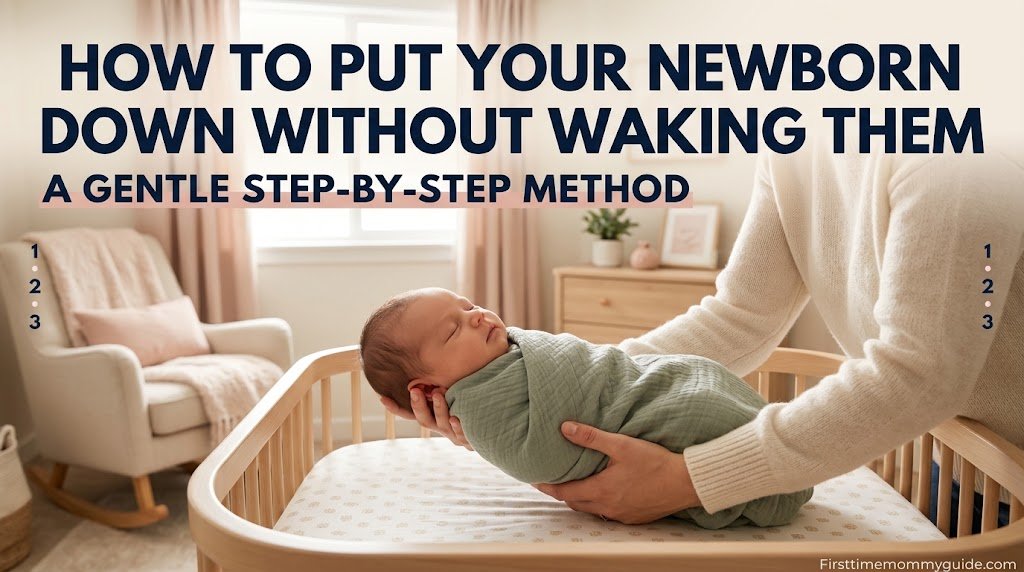
Once you know why babies wake, the fixes make more sense. This method brings the most useful tricks together in one routine.
Step 1: Get the Sleep Space Ready
Smooth the fitted sheet and remove anything else from the bassinet. Turn on soft white noise and lower the lights.
Warm the mattress with your hands for a minute.
Step 2: Feed, Burp and Check the Diaper
A full tummy, a clean diaper and a good burp remove the most common reasons for waking. Do these before your baby falls asleep.
Step 3: Swaddle Before Sleep
Swaddle your baby while they are calm and awake. Wrapping a sleeping baby often wakes them.
Make sure the wrap is snug on the arms and loose around the hips.
Step 4: Hold Until Deep Sleep
Keep your baby close for about 10 to 20 minutes after they fall asleep. Wait until their arms feel heavy and their breathing is slow and even.
Step 5: Support the Head and Bottom
Place one hand under your baby’s head and neck and the other under the bottom. Keep their body curled like a “C” so nothing flops backward.
A sudden backward tilt of the head is a common startle trigger.
Step 6: Lower Bottom First
Bring your baby close to your chest and bend your knees. Lower the bottom to the mattress first, then the back, and the head last.
This keeps the head supported for as long as possible.
Step 7: Keep Contact for a Minute
Leave a hand on the chest or tummy with gentle, steady pressure. Keep the other hand cradling the head until it rests fully.
Wait 30 to 60 seconds before moving.
Step 8: Withdraw Gradually
Lift one hand an inch, pause, then lift the other. If your baby stirs, return your hand and pat or shush softly.
Step 9: Stay Nearby
Stand or sit close for a few minutes. If your baby settles, slip away quietly.
If they wake, pick them up, soothe them and try again.
The Head-Support Trick: Why the Neck Angle Matters
Many transfers fail because of what happens to the head. The Moro reflex is often triggered when the head drops backward.
Keep the Chin Tucked Slightly
Hold your baby so the head stays level with the body. Avoid letting it tip back as you lower.
Slide Rather Than Drop
Think of sliding your baby onto the mattress rather than placing them from above. Slow, flowing movement keeps the reflex quiet.
Practice With a Soft Toy First
Some parents rehearse the lowering motion with a soft doll or rolled towel to practice smooth movement. It builds muscle memory for the real thing.
The 10 to 20 Minute Rule and the Arm Lift Test
Timing is the simplest and most powerful fix. Many babies move into deeper sleep about 10 to 20 minutes after falling asleep.
The Arm Lift Test
Lift your baby’s arm a few inches and let go gently. If it drops limp and heavy, your baby is likely in deep sleep.
If the arm stiffens or twitches, wait longer.
Other Signs of Deep Sleep
- Mouth falls slightly open
- Sucking movements stop
- Eyes are still under the lids
- Breathing is slow and regular
- Face looks soft and smooth
Do Not Wait Too Long
If you hold for an hour or more, you may fall asleep yourself or miss the window. Try after about 20 minutes, then reassess.
White Noise, Shushing and Gentle Pats
Sound and rhythm can fill the gap left by your heartbeat and breathing.
White Noise
Choose a steady, low sound and play it for the whole sleep. Place the machine across the room, at a gentle volume.
Shushing
Make a long, slow shush near your baby’s ear as you lower them. Fade it out as your baby relaxes.
Pat and Rhythm
Pat the chest or hip slowly, close to the pace of a resting heartbeat. Slow down as your baby settles.
Avoid Overstimulating
Fast, hard patting can wake a nearly asleep baby. Keep it light and steady.
Using a Pacifier to Help Your Baby Stay Settled
Sucking is a natural calming reflex. A pacifier can help your baby stay relaxed after the transfer.
What the AAP Says
The AAP suggests offering a pacifier at nap time and bedtime. If it falls out once your baby is asleep, you do not need to replace it.
Offer It Calmly
Give it once your baby is calm. Do not force it.
Stay Safe
Use a one-piece pacifier and never attach it to clothing with long cords. Wash and check it regularly.
Swaddles, Sleep Sacks and Wearable Blankets Compared
The right wrap depends on your baby’s age and development. Compare your options here.
| Option | Best For | Notes |
|---|---|---|
| Traditional blanket swaddle | Newborns with a strong startle reflex | Needs practice to wrap safely |
| Velcro or zip swaddle | Quick, easy wrapping | Pick the right size |
| Arms-up swaddle | Babies who fight having arms held down | Check fit and safety instructions |
| Wearable blanket or sleep sack | Babies who are starting to roll | Replaces swaddling for safe sleep |
| Weighted swaddle | Not recommended | The AAP does not recommend weighted sleepwear |
Check the Fit
Make sure the wrap does not cover the face or restrict the hips. Hips should be able to bend and spread naturally.
Always Lay Baby on Their Back
A swaddle does not change the rule. Place your baby on their back for every sleep.
Safe Sleep Rules to Follow During Every Transfer
When you are tired and desperate, safety can slip. These rules from the AAP keep your baby protected.
| Rule | What It Means |
|---|---|
| Back to sleep | Place your baby on their back for every nap and night |
| Flat, firm surface | Use a bassinet, crib or play yard with a firm, flat mattress |
| Bare space | No blankets, pillows, bumpers or toys |
| Room-share | Keep the bassinet in your room for at least the first 6 months |
| Separate surface | Your baby should sleep alone, not in your bed |
| No couches | Never put your baby to sleep on a couch, sofa or armchair |
| Avoid overheating | Dress in light layers |
Move Babies From Car Seats and Swings
The AAP says that if your baby falls asleep in a car seat, stroller, swing or carrier, move them to a firm sleep surface as soon as you can.
Inclined Sleepers Are Not Safe
Avoid inclined sleepers, nests, loungers and positioners. A sleep surface that is angled more than 10 degrees is not recommended.
What to Do When Your Baby Wakes Anyway
Even with perfect technique, some transfers fail. Stay calm and try a simple resettling sequence.
Resettling Steps
- Keep your hand on your baby’s chest and apply gentle pressure.
- Make slow, low shushing sounds.
- Pat rhythmically for a minute or two.
- Offer a pacifier or finger to suck.
- Pick your baby up if they keep crying.
- Soothe in your arms, then try again after deep sleep.
How Long to Try
Give each method a minute or two. If your baby escalates into hard crying, pick them up and comfort them.
Newborns are too young to be left to cry.
Do Not Feel Like You Failed
A failed transfer is not a failure. It means your baby needs a little more help today.
Contact Naps and Holding: Are They a Problem?
Holding your baby for naps is normal and safe if you stay awake. Many families use contact naps to rest or to get things done with a baby on their chest or in a carrier.
When Contact Naps Are Fine
- You are awake and alert
- You are sitting upright on a firm surface
- Your baby’s face is clear and airway open
- Another adult is nearby if you feel drowsy
When to Stop
Place your baby in the bassinet if you feel sleepy. Never fall asleep with your baby on a sofa or armchair.
They Do Not Create Lifelong Habits
Holding your newborn is not creating a problem you cannot fix later. As babies grow, they gradually learn to sleep in other places.
Babywearing for Naps
A carrier can free your hands while your baby naps close to you. It is a helpful tool for parents who need to move around.
Safety Tips
- Keep your baby’s face visible and uncovered
- Keep their chin off the chest
- Position your baby high and snug on your chest
- Follow the carrier’s age and weight guidance
- Stay awake and watch them
Moving From Carrier to Bassinet
Wait until your baby is in deep sleep. Unbuckle slowly, keep one hand under the head and lower bottom first.
Move them to a flat surface as soon as you can, as the AAP advises.
Daytime vs Nighttime: Different Strategies for Different Sleeps
Naps and night sleep follow different patterns. Use each to your advantage.
Daytime Naps
Naps are the best time to practice. You are rested, the house is bright and your baby is usually more alert.
Try the bassinet for the first nap of the day, when your baby is best rested. Use contact naps for the others if you need to.
Night Sleep
Night is when you are most tired and your baby is most sensitive to change. Focus on safety, comfort and survival.
Keep the lights dim, feed quietly and transfer carefully. Do not expect perfection.
Evening Fussiness
Many newborns are fussy in the evening. This is often called the witching hour and usually peaks around the second month.
Cluster feeding, holding and calm routines get most families through.
Feeding and Sleep: Getting the Timing Right
Feeding affects how well your baby sleeps after the transfer. A few small changes can help.
Offer Full Feeds
Make sure your baby finishes the feed. Gently stroke the cheek or tickle the feet if they doze early.
Burp Thoroughly
Burp midway and again at the end. A burp can make the difference between a short and a long sleep.
Keep Upright After Feeds
Hold your baby upright for 10 to 15 minutes after feeding. This helps with gas and reflux.
For Breastfeeding Parents
If you are worried that your baby is not getting enough milk, read our guide on low milk supply signs and fixes.
For Bottle Feeding
Pace bottle feeds and watch hunger cues. Our bottle feeding schedule newborn guide explains typical volumes and timing.
How This Changes From Newborn to 4 Months
Transfers usually get easier with age. Here is what to expect.
| Age | What Is Happening | What Helps |
|---|---|---|
| 0 to 4 weeks | Very light sleep, strong startle reflex, frequent feeds | Swaddle, hold for deep sleep, feed often |
| 1 to 2 months | Slightly longer stretches, more alertness | Consistent routine, white noise |
| 2 to 3 months | Startle reflex starts to fade for many babies | Try more bassinet naps |
| 3 to 4 months | Sleep cycles mature, easier transfers for many | Keep routine, stop swaddling at rolling |
| 4 months and later | Sleep patterns change again | Follow safe sleep and ask your pediatrician for guidance |
Do Not Rush It
Every baby develops at their own pace. Some babies handle transfers by 6 weeks, while others take longer.
Keep Notes
A simple log of naps and transfers can show you progress that is hard to see day to day.
Sleep Associations: Should You Worry About Holding?
A sleep association is anything your baby links with falling asleep, such as rocking, feeding or sucking. Newborns form them naturally.
Newborns Are Too Young to Worry
In the first months, comfort and safety matter more than independence. Responding to your baby builds trust.
Gentle Changes Later
As your baby grows, you can add new associations such as a lullaby, white noise or a consistent routine. These build slowly and gently.
Talk to Your Pediatrician
If you feel unsure about sleep habits, ask your pediatrician what is right for your baby’s age.
How to Survive the Weeks of Constant Waking
Broken sleep takes a toll. Looking after yourself is part of caring for your baby.
Share Shifts
If you have a partner, split the night. One adult holds the baby while the other sleeps, then swap.
Sleep When You Can
Rest whenever your baby is safely in the bassinet. Even short naps help.
Accept Help
Let friends and family cook, clean or hold the baby while you rest. Be specific about what you need.
Eat and Drink
Keep snacks and water near your feeding spot. Tiredness feels worse when you are hungry or thirsty.
Lower Your Standards
The house does not need to be spotless. Focus on feeding, rest and safety.
Protecting Your Mental Health
Exhaustion can affect your mood. It is normal to feel tearful or overwhelmed sometimes.
Signs to Take Seriously
- Persistent sadness or hopelessness
- Constant anxiety or racing thoughts
- Trouble sleeping even when the baby sleeps
- Loss of interest in things you enjoy
- Thoughts of harming yourself or your baby
What to Do
Tell your doctor or midwife how you feel. Postpartum depression and anxiety are common and treatable.
If you ever think about harming yourself or your baby, seek emergency help right away.
You Are Not Alone
Many new parents struggle in the early weeks. Asking for help shows strength.
Common Mistakes Parents Make When Baby Wakes on Transfer
Small errors can make waking more likely or less safe. Most are easy to fix.
Putting Baby Down Too Early
Transferring in the first few minutes of sleep usually fails. Wait for deep sleep.
Dropping Rather Than Sliding
Fast, jerky movements trigger the startle reflex. Move slowly and smoothly.
Letting the Head Fall Back
A backward head tilt is a classic trigger. Keep the head supported and level.
Forgetting to Warm the Mattress
A cold sheet makes many babies wake. A warm hand on the mattress helps.
Using Unsafe Shortcuts
Sofas, armchairs, inclined sleepers and nursing pillows are not safe for sleep. Stick with a flat, firm surface.
Giving Up on the Bassinet Entirely
One bad night does not mean the bassinet will never work. Keep trying small steps.
Comparing Your Baby to Others
Babies differ. Your baby’s pace is the right pace for them.
Myths About Newborns Waking When Put Down
Plenty of advice online is misleading. Knowing the myths helps you stay calm.
Myth: Your Baby Is Manipulating You
Newborns cannot manipulate. They act on needs and reflexes.
Myth: Holding Creates a Bad Habit
Holding a newborn builds security. It does not ruin sleep forever.
Myth: A Strict Schedule Fixes It
Newborns cannot follow a strict schedule. They need responsive care.
Myth: A Special Product Will Solve It
No gadget replaces safe sleep and good timing. Be wary of products that promise to keep babies asleep.
Myth: Letting Them Cry It Out Works for Newborns
Newborns need a response. They are not ready for sleep training.
When to Call the Pediatrician
Most waking is normal. Still, a few signs mean you should get advice.
Call Your Doctor If
- Your baby has a fever of 100.4°F (38°C) or higher
- Your baby feeds poorly or has fewer wet diapers
- Your baby spits up forcefully or often
- Your baby arches and cries during feeds
- Your baby is gaining weight slowly
- Your baby breathes noisily or fast
- Your baby cries for long periods and cannot settle
- You feel something is wrong
Get Emergency Help If
- Your baby is struggling to breathe
- Your baby has blue or gray lips or skin
- Your baby is limp or very hard to wake
- Your baby has a seizure
Trust Your Instincts
You know your baby best. A quick call is always better than worrying alone.
What to Expect at the Pediatrician Visit
The doctor will check your baby’s growth, feeding and overall health. Most of the time, they will reassure you.
Questions the Doctor May Ask
- How often does your baby feed?
- How many wet and dirty diapers are there each day?
- Does your baby spit up often?
- How does your baby sleep and where?
- Are there any signs of illness?
How to Prepare
Bring a short log of feeds, sleep and diapers for a few days. Photos or videos of your baby’s behavior can help.
Real-Life Examples: What Each Cause Looks Like
Seeing the patterns in everyday situations makes it easier to spot your own baby’s trigger.
Example 1: Wakes the Second the Back Touches the Mattress
A baby drifts off in your arms, then startles awake as soon as you lower them. The likely cause is the Moro reflex plus a cold sheet.
A snug swaddle, a warmed mattress and a bottom-first lowering usually help.
Example 2: Wakes About Five Minutes After a Smooth Transfer
The lowering was perfect, but your baby wakes soon after. This often means the transfer happened in light sleep.
Hold for 10 to 20 more minutes next time and check the arm lift test.
Example 3: Wakes Squirming and Grunting
Your baby sleeps, then twists, pulls up the legs and grunts. Gas is a strong possibility.
Burp thoroughly, hold upright after the feed and try again.
Example 4: Wakes Hungry Within an Hour
Your baby fell asleep mid-feed and woke when the milk ran out. Try to finish the feed, even if it means gently waking them.
Example 5: Wakes Crying and Hard to Soothe
Your baby was awake too long and became overtired. Shorten the next awake window and begin the wind-down earlier.
The 3 A.M. Transfer: A Quick-Start Plan
At night you do not have energy for long routines. Use this simple plan.
Before the Feed
Turn on white noise and a dim light. Have a clean diaper and swaddle within reach.
During the Feed
Keep your baby awake enough to finish. Burp once in the middle and once at the end.
After the Feed
Hold your baby upright for a few minutes. Swaddle and settle them.
The Transfer
Wait until the arms go limp, lower bottom first, keep a hand on the chest and slide away slowly.
If It Fails
Pick your baby up, comfort them and try again after another 15 minutes. Do not fall asleep on the sofa while waiting.
A Cheat Sheet for Partners and Helpers
Everyone who cares for your baby should know the basics. Print or write these points where helpers can see them.
| Do | Do Not |
|---|---|
| Wait for floppy arms before lowering | Lay baby down in the first few minutes of sleep |
| Support the head and neck | Let the head drop back |
| Lower bottom first | Drop the baby onto the mattress |
| Warm the mattress with your hands | Use heating pads or hot water bottles |
| Keep a hand on the chest briefly | Pull away at once |
| Use the back sleeping position | Place baby on the side or tummy |
| Stay awake while holding | Doze on a sofa or armchair |
Keep the Tone Kind
Every adult has a different touch. Encourage helpers and share what works rather than criticizing.
Setting Up the Bassinet Area for Easier Transfers
A little preparation makes every transfer smoother. Think about comfort, safety and speed.
Position and Access
Place the bassinet within easy reach of your bed or feeding chair. You should be able to lower your baby without twisting your back.
Lighting
Use a dim, warm night light for night feeds. Avoid bright overhead lights.
Sound
Place a white noise machine across the room and test the volume. It should be soothing, not loud.
Supplies Nearby
Keep swaddles, diapers, wipes and burp cloths within reach. You do not want to walk away from a nearly asleep baby.
Keep the Sleep Surface Bare
Everything else stays outside. Use only the firm mattress and fitted sheet.
Why Your Baby Seems to Sleep Better Only on You
It can feel personal when your baby sleeps peacefully on your chest and wakes the moment they are alone. In reality, your body is a very good sleep environment for a newborn.
Your Body Regulates Theirs
Your warmth, breathing and heartbeat help your baby keep a steady temperature and calm rhythm. A mattress cannot copy that.
Constant Gentle Movement
Even when you sit still, your breathing moves your baby slightly. That slow rocking is soothing.
Familiar Smell and Voice
Newborns recognize their parents quickly. Being close to a familiar scent helps them stay relaxed.
What This Means for You
It does not mean the bassinet is bad or that your baby will never sleep there. It means the bassinet needs a little help to feel as comforting as you do.
Comfort Tricks That Mimic Being Held
You cannot copy everything about your arms, but you can borrow some of the comfort.
Gentle Pressure
A hand resting on the chest gives soft, steady pressure. A snug swaddle gives similar all-over containment.
Rhythm
Slow patting, shushing and white noise bring back the steady rhythm of your heartbeat and breathing.
Warmth
A warmed mattress surface helps with the temperature change. Remember that no heat source should stay in the bassinet.
Closeness
Place the bassinet right next to your bed so your baby can sense you nearby. The AAP recommends room-sharing for at least the first 6 months.
Keeping a Simple Transfer Journal
Patterns are easier to see on paper than in a sleep-deprived memory. A short journal can show what works.
| What to Note | Example |
|---|---|
| Time asleep in arms | 20 minutes |
| Sleep depth | Arms limp, face soft |
| How you lowered | Bottom first, hand on chest |
| Sleep aids used | Swaddle, white noise, pacifier |
| Result | Slept 45 minutes |
| Possible cause if woke | Gas, hungry, cold sheet |
How Long to Keep It
Track for a week. You will often spot a clear pattern, such as better transfers after a full feed.
Share It With Your Doctor
If you do speak with your pediatrician, a brief log makes the conversation faster and more useful.
How Long Newborns Typically Sleep in One Stretch
Many parents expect long stretches too soon. Newborns sleep in short bursts because they need frequent feeds.
What Is Typical
Newborns often sleep about 14 to 17 hours a day in total, spread across many short periods. Stretches of two to four hours are common in the early weeks.
Why Short Stretches Are Healthy
Frequent waking helps babies get the calories they need while their stomachs are small. The AAP notes that frequent waking is normal and temporary.
What Changes
As your baby grows, stretches gradually lengthen. Many babies sleep longer at night by 3 to 4 months, though the exact timing varies.
A Gentle Mindset for the Hard Weeks
Your baby is not trying to make life difficult. They are adjusting to a very big world with a very small nervous system.
Think of It as Training Wheels
Holding, swaddling and rocking are training wheels. They help your baby feel safe while they learn to sleep in new ways.
Do What Works Safely
If a contact nap while you are awake helps your baby rest, that is a reasonable choice. Just keep every sleep safe.
Let Go of Guilt
You are not creating problems. You are meeting your baby’s needs in the best way you can.
Remember: This Will Pass
One day soon your baby will sleep in the bassinet without a fuss. You may even miss the cuddles.
Quick Reference: Why Newborns Wake When Put Down
Use this summary when you need a fast reminder.
| Question | Short Answer |
|---|---|
| Why does my newborn wake when I put them down? | Light sleep, startle reflex, cold surface, loss of contact, hunger or discomfort |
| How long should I wait before transferring? | About 10 to 20 minutes after they fall asleep |
| What helps the startle reflex? | Swaddling, supported head, slow lowering |
| Is it a bad habit? | No, it is normal newborn behavior |
| What surface is safest? | Flat, firm bassinet or crib |
| Should I let my baby cry? | No, newborns need comfort |
| When does it get easier? | Often around 3 to 4 months, but it varies |
| When to call a doctor? | Fever, poor feeding, breathing trouble or constant crying |
Trusted Sources for Newborn Sleep Information
Reliable medical sources help you double-check advice. Look for guidance from pediatric organizations.
Where to Read More
- American Academy of Pediatrics safe sleep recommendations
- AAP HealthyChildren.org safe sleep fact sheet
- Safe to Sleep campaign resources
- U.S. Consumer Product Safety Commission infant sleep product rules
- Your own pediatrician
Also Read:
- Baby Sleep Guide for New Moms: Safe Sleep & Schedules (2026)
- Baby Sleep, Honestly: The Complete Baby Sleep Guide
- Newborn Grunting in Sleep Normal or Should I Call the Doctor? A Complete Parent Guide 2026
- How Long Does Newborn Cluster Feeding Last Each Night? A Complete Guide for New Parents 2026
- Signs of Cluster Feeding: Complete Guide for New Parents 2026
- Bottle Feeding Schedule Newborn: Complete Age-by-Age Guide 2026
- Low Milk Supply Signs and Fixes: What Every Breastfeeding Mom Should Know 2026
- Breastfed Baby Hasn’t Pooped in 5 Days but Passing Gas: Is It Normal? Causes and Safe Relief 2026
- Baby Won’t Eat? Common Reasons, Fixes & When to Worry 2026
- When Can I Sleep on My Side After C Section? Safe Timeline, Positions & Tips 2026
- Baby Essentials Checklist: 0 to 3 Months
- Hospital Bag Checklist for Baby: The Complete Packing List 2026
- Newborn Coming Home Outfit: What to Pick, What to Skip, and How to Keep Baby Safe
- Is It Normal for Umbilical Cord Stump to Bleed After Falling Off? What Parents Should Know 2026
- Can Teething Cause a Low Grade Fever in Babies? Temperature Range, Symptoms and Remedies 2026
- When Can My Baby Start Eating Real Food? Age, Signs & First Foods 2026
- Baby Food Guide: Starting Solids 6 to 12 Months
- Baby Food Chart 6 to 12 Months: Free Month-by-Month Feeding 2026
- Fruit Purees for 6 Month Old Babies: Safe Recipes & Guide (2026)
- Best Vegetable Purees for Baby: A Complete Age-by-Age Guide 2026
- Best Baby Food Combinations: A Complete Age-by-Age Guide for Parents 2026
- Pregnancy Guide: Month by Month
Frequently Asked Questions (FAQs)
Why does my newborn wake up every time I put him down?
Newborn sleep is light, and the startle reflex can jolt babies awake when they feel a loss of support. A cold, flat mattress and the loss of your touch add to it.
Hunger, gas and overtiredness can also play a part.
Is it normal for a newborn to wake up when put down?
Yes, it is very normal. It reflects immature reflexes, short sleep cycles and a strong need for closeness.
Most babies become easier to transfer over the first few months.
How long should I hold my baby before putting them down?
Many babies do best after 10 to 20 minutes of sleep in your arms. Check that their arms feel heavy and their face is relaxed.
If they wake right away, hold a little longer next time.
What is the Moro reflex?
The Moro, or startle, reflex makes a baby fling out their arms and legs when they feel a sudden loss of support. It is a normal newborn reflex.
It usually fades around 3 to 6 months.
Does swaddling help my baby stay asleep when put down?
Often, yes. A snug swaddle helps calm the startle reflex and feels like being held.
The AAP says to stop swaddling as soon as your baby starts learning to roll.
Why does my baby wake up as soon as their back touches the mattress?
The change from warm arms to a cool, flat surface can startle them. The Moro reflex and loss of contact also play a part.
Warm the mattress with your hands, lower bottom first and keep a hand on their chest.
Should I put my baby down drowsy or asleep?
Newborns usually do better when transferred in deep sleep. You can try drowsy-but-awake once your baby is rested, fed and calm.
Do what works for your baby and keep safe sleep rules.
Why does my newborn wake up after 20 or 30 minutes?
Newborn sleep cycles are short, often 40 to 60 minutes. Your baby may wake at the end of a cycle or when they are lightly asleep.
White noise and gentle patting can help them reconnect cycles.
Is my baby hungry when they wake up after being put down?
Possibly. Newborns feed often, and a baby who dozed during a feed may not have taken enough.
Look for hunger cues such as rooting and lip smacking, and offer a full feed.
Could gas be waking my baby?
Yes. Trapped air can make lying flat uncomfortable.
Burp during and after feeds and hold your baby upright for a few minutes before the transfer.
Could reflux be waking my baby?
It can. Signs include frequent spit-up, arching, crying with feeds and waking soon after lying flat.
Talk to your pediatrician and do not use inclined products or wedges.
Should I warm the bassinet before putting my baby down?
You can warm the surface with your hands for a minute. Do not use heating pads, hot water bottles or other heat sources.
They are burn and overheating hazards.
Is it safe to let my newborn sleep in my arms?
It is safe while you stay awake and alert. It is not safe if you might fall asleep, especially on a sofa or armchair.
The AAP advises moving your baby to a separate, flat, firm surface when you are ready to sleep.
Can I let my newborn sleep on my chest?
If you are awake and sitting upright, yes. If you feel drowsy, move your baby to the bassinet.
Never fall asleep with your baby on a couch or armchair.
Is my baby spoiled if I hold them all the time?
No. Newborns cannot be spoiled. Holding builds attachment and helps them feel safe.
Babies gradually become more independent as they grow.
How can I put my baby down without waking them?
Wait for deep sleep, support the head and neck and lower bottom first. Keep a hand on their chest for a minute before pulling away.
A swaddle, white noise and a warm mattress help.
What is the best position to lay a baby down?
Always place your baby on their back, on a flat, firm surface. This is the safest position for sleep.
Never use the side or tummy position for sleep.
Why does my baby wake up when I leave the room?
Babies notice when you move away. Your smell, sound and warmth disappear.
Stay nearby for a few minutes after laying them down and leave quietly once they settle.
Should I let my baby cry when put down?
No. Newborns need comfort because they cannot self-soothe yet.
Pick them up, soothe them and try again later.
Does white noise help newborns stay asleep?
Many babies settle more easily with steady, low white noise. It covers sudden sounds and mimics the womb.
Keep the machine across the room and the volume gentle.
Can a pacifier help my baby stay asleep?
It can. The AAP suggests offering a pacifier at nap time and bedtime.
If it falls out after your baby is asleep, you do not need to replace it.
Are inclined sleepers safe for a baby who wakes when laid flat?
No. The AAP advises a flat, firm surface that does not incline, and inclined sleepers have been linked to infant deaths.
If your baby seems uncomfortable flat, ask your pediatrician about reflux or congestion.
Can I use a swing or bouncer for sleep?
Swings and bouncers are not safe for unsupervised sleep. The AAP says to move a baby who falls asleep in one to a flat, firm surface.
Use them only while you are awake and watching.
Is it okay to put my baby down on the sofa?
No. The AAP says never to place your baby to sleep on a couch, sofa or armchair.
These surfaces carry serious suffocation risks.
How long will my newborn keep waking when put down?
It varies, but many babies improve around 3 to 4 months as sleep cycles mature and the startle reflex fades.
Some take longer, and that is also normal.
Does my baby wake up because of overtiredness?
It can. Overtired babies often sleep lightly and wake easily.
Watch for early sleepy cues and start settling before your baby becomes frantic.
Could my baby be waking because they are not tired enough?
Yes. A baby who has had a long nap in your arms may not be tired when you lay them down.
Adjust awake time and offer a calm wind-down routine.
Can noise or light wake my baby when I put them down?
Yes. Sudden sounds and bright lights can trigger waking.
Use steady white noise and dim lights for night feeds and transfers.
Should I start sleep training my newborn?
No. Newborns are too young for structured sleep training.
Focus on safe sleep, responsive care and a gentle routine, and ask your pediatrician when to start.
When should I be concerned about my baby waking a lot?
Call your pediatrician if your baby has a fever, poor feeding, fewer wet diapers, breathing trouble or constant crying.
Also call if you are worried or exhausted and need support.
What can I do to cope with the exhaustion?
Share night shifts, accept help and rest whenever your baby sleeps safely in the bassinet. Keep snacks and water nearby.
Tell your doctor if you feel persistently sad, anxious or overwhelmed.
Conclusion
So, why does your newborn wake up every time you put him down? Usually it is a mix of light sleep, the startle reflex, a cool mattress, loss of your touch and sometimes hunger or gas. None of these mean you are doing something wrong.
Wait for deep sleep, support the head, lower bottom first and keep a hand on your baby’s chest. Add a swaddle, white noise and a warm mattress, and always place your baby on their back on a flat, firm surface.
Be patient with yourself, share the night shifts and call your pediatrician if you notice fever, feeding trouble or breathing concerns. Most babies become much easier to settle as their reflexes and sleep cycles mature.

Dilawar Mughal
Founder and editor, First Time Mommy Guide
I research every guide against what the NHS, the AAP and the WHO publish, then write it in plain English — because most new parents are reading with one hand free, not comparing clinical guidelines. I'm not a doctor or a midwife. Every health claim on this site is sourced and linked so you can check it yourself, and anything urgent belongs with your health visitor or GP, not a blog.