General information, not medical advice. Every baby is different — if anything worries you, speak to your midwife, health visitor or GP rather than waiting.
One minute your baby is flat on their back, the next you turn around and they are on their tummy. It genuinely happens that fast.
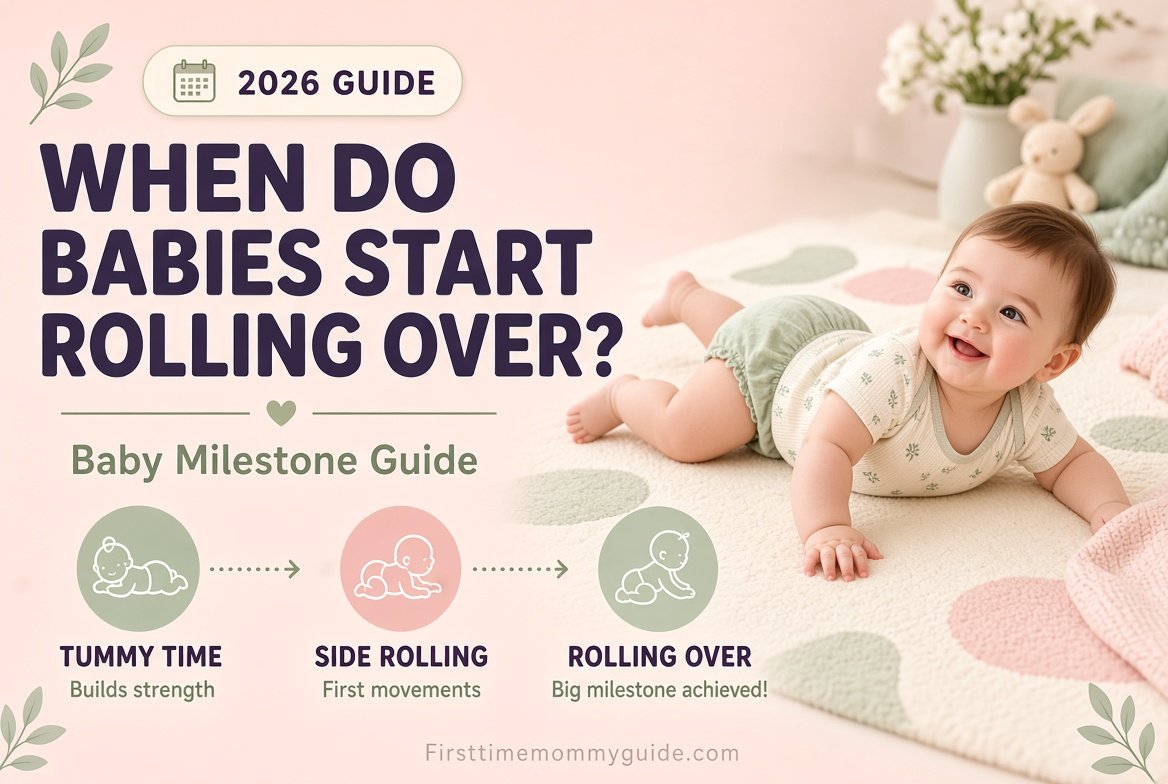
Rolling over is usually the first big “wow, they’re mobile now” moment, and it naturally makes parents ask exactly When Do Babies Start Rolling Over? when it should happen.
Table of Contents
When Do Babies Start Rolling Over?

Most babies start rolling over between 3 and 6 months old. Tummy-to-back rolling usually comes first, often around 4 months, because it requires less coordination.
Back-to-tummy rolling typically follows a few weeks to a couple of months later. By 6 months, most babies can roll confidently in both directions.
What Does Rolling Over Actually Look Like?
Rolling is not one single skill. It is really a chain of smaller movements that come together once your baby’s neck, shoulders, and core are strong enough.
The First Sign: Rocking Side to Side
Babies often start rolling over as early as 4 months old, and they will rock from side to side as a motion that becomes the foundation for a full roll.
That rocking motion is your baby practicing weight shifting, which is the exact skill needed to tip themselves all the way over.
The First Real Roll: Tummy to Back
Rolling from tummy to back usually comes first, because it requires less coordination than rolling the other way around.
This direction often happens accidentally at first, as a stronger push during tummy time tips the baby right over.
The Harder Skill: Back to Tummy
Rolling from back to tummy takes more strength and coordination, since your baby has to lift and twist against gravity rather than falling with it.
Most babies master this direction a few weeks after they master tummy-to-back rolling, though the timing varies quite a bit.
Rolling Over Timeline by Age
| Age | What’s Typically Happening |
|---|---|
| 0-2 months | Tummy time begins; head and neck strength start building |
| 3 months | Some babies begin light, momentum-based rolling to the side |
| 4 months | Rocking side to side; many babies achieve their first tummy-to-back roll |
| 5 months | Rolling becomes more intentional and controlled |
| 6 months | Most babies roll confidently in both directions |
Rolling at 3 Months
Rolling at 3 months is considered slightly early, though still within the normal range. At this age, some rolls may simply be accidental or momentum-based rather than a fully controlled movement.
Rolling at 4 Months
Four months is the age most commonly cited as the true starting point for rolling over, particularly for the tummy-to-back direction.
Rolling at 5 to 6 Months
By 6 months, most babies can roll from front to back reliably, and many are working on, or have mastered, back-to-tummy rolling as well.
Signs Your Baby Is Getting Ready to Roll
Before the actual roll happens, most babies show a few clear “pre-gaming” cues during play and tummy time.
- Holding their head up steadily and pushing up on their arms during tummy time.
- Rocking side to side or kicking their legs while lying on their tummy.
- Grabbing their feet or crossing one leg over the other while on their back.
- Spending more time lying on their side during play.
- Reaching for toys just out of arm’s reach, which builds twisting strength.
How to Encourage Rolling Over Safely
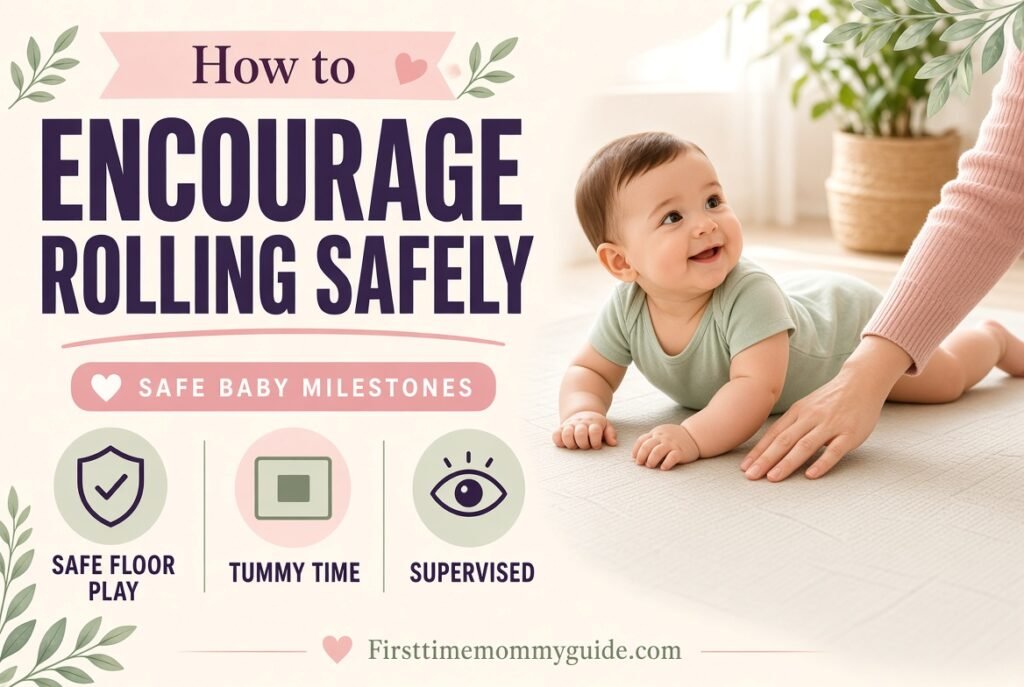
You cannot force a roll before your baby’s body is ready, but you can absolutely create the right conditions for it.
- Give your baby daily tummy time on a firm, flat surface, starting in small stretches from birth.
- Place a favorite toy slightly out of reach to one side to encourage reaching and twisting.
- Let your baby practice on a soft blanket on the floor rather than an elevated or soft surface.
- Get down on the floor with them, since face-to-face interaction motivates movement.
- Keep sessions short and playful, stopping before your baby gets frustrated.
Rolling Over and Safe Sleep
This is the part every parent needs to know, not just the milestone itself. The American Academy of Pediatrics recommends always placing babies on their backs at the start of sleep.
Once a baby can roll independently in both directions, most guidance shifts toward keeping the sleep space itself safe rather than repositioning them all night. A firm mattress, an empty crib, and no loose blankets or pillows matter more at this stage.
Swaddling should stop as soon as your baby shows signs of being able to roll, generally between 4 and 6 months, since a swaddled baby who rolls onto their tummy cannot free their arms.
What If My Baby Hasn’t Rolled Over Yet?
Babies develop at genuinely different speeds, and rolling is one of the milestones with the widest normal range. A baby who rolls at 3 months and one who rolls at 6 months can both be perfectly on track.
Premature babies typically reach this milestone later when measured by their actual birth date, so pediatricians usually track progress using adjusted age instead.
When to Talk to Your Pediatrician
Bring it up at your next checkup, or sooner, if your baby shows any of these signs alongside not rolling by around 6 months.
- Very stiff or very floppy muscle tone.
- No head control by 4 months.
- Little interest in tummy time or reaching for objects.
- No progress at all in movement skills over several weeks.
Rolling Over vs Other Motor Milestones
| Milestone | Typical Age Range | Comes Before/After Rolling |
|---|---|---|
| Head control | 2-4 months | Before |
| Rolling over | 3-6 months | — |
| Sitting with support | 4-6 months | Around the same time |
| Sitting without support | 6-8 months | After |
| Crawling | 7-10 months | After |
Common Mistakes Parents Make
- Skipping daily tummy time because the baby fusses at first.
- Comparing one baby’s timeline too strictly against another baby’s.
- Leaving a rolling baby swaddled or on a soft, elevated surface unattended.
- Assuming a later roll always signals a developmental problem.
- Not adjusting expectations for a baby who was born early.
Expert Tips for Parents

- Treat tummy time as a daily habit, not a one-time event, building up gradually as your baby tolerates it.
- Watch for the “pre-rolling” cues rather than just waiting for the roll itself.
- Once rolling starts, shift your safe-sleep focus from repositioning to the overall sleep environment.
- Track progress using your baby’s own pattern over weeks, not single days.
Also Read:
- When Do Babies Start Smiling? Signs & Milestones 2026
- Baby Sleep Guide for New Moms: Safe Sleep & Schedules (2026)
- Baby Sleep, Honestly
- Baby Essentials, 0–3 Months
- Baby Essentials Checklist 0–3 Months (Complete Guide)
- Baby Essentials Checklist: What New Parents Actually Need
- Starting Solids, 6–12 Months
- First Foods for Baby at 6 Months: A Complete Guide to Starting Solids 2026
- Baby Food Chart 6 to 12 Months: Free Month-by-Month Feeding 2026
- Fruit Purees for 6 Month Old Babies: Safe Recipes & Guide (2026)
- Best Vegetable Purees for Baby: A Complete Age-by-Age Guide 2026
- Sweet Potato Puree for Baby: Easy Recipe, Age Guide & Storage Tips
- Apple Puree for Baby: Easy Recipe & Safety Guide (2026)
- Blueberry Puree for Baby: Easy Recipe & Choking Safety Guide
- Spinach Puree for Baby: Safe Recipe, Nitrate Facts & Age Guide
- Homemade Pumpkin Puree for Baby: Easy, Safe Recipe (6+ Months)
- Zucchini Puree for Baby: Easy Recipe & Age Guide
- Pregnancy, Month by Month
- 33 Weeks Pregnant: Symptoms, Baby Development & What to Expect 2026
- 25 Weeks Pregnant: Symptoms, Baby Size & What to Expect 2026
- 17 Weeks Pregnant: Symptoms, Baby Size & What to Expect 2026
- Pregnancy Week By Week 7: Symptoms & Baby Size 2026
- FBS Test for Pregnant: Normal Range, Purpose & Next Steps 2026
- Maternity Leggings: The Complete Guide for Every Trimester 2026
- Leggings in Pregnancy: Is It Safe to Wear Them Every Trimester? 2026
Frequently Asked Questions (FAQs)
When do babies start rolling over?
Most babies start rolling over between 3 and 6 months old, with tummy-to-back rolling typically coming first around 4 months.
What is the first direction babies usually roll?
Babies usually roll from tummy to back first, since that direction takes less coordination than rolling from back to tummy.
Is it normal for a baby to roll over at 2 months?
It is rare, but not impossible, for a baby to roll at 2 months. Full rolling in both directions usually develops closer to 4 to 6 months.
Can a 3-month-old baby roll over?
Yes, some babies begin light, momentum-based rolling around 3 months, though this is on the earlier end of the normal range.
By what age should babies roll in both directions?
Most babies can roll in both directions by around 6 months, though some take a bit longer to master the back-to-tummy roll.
What if my baby hasn’t rolled over by 6 months?
Mention it to your pediatrician at your next checkup. Many babies are simply on a slower timeline, but your doctor can rule out other concerns.
Does tummy time help babies roll over sooner?
Yes. Tummy time builds the neck, shoulder, and core strength that rolling depends on, so regular daily practice supports the milestone.
Is rolling over a sign of a developmental delay if it’s late?
Not on its own. Rolling has a wide normal range, and a late roll only becomes a concern alongside other missing motor signs.
Should I stop swaddling once my baby starts rolling?
Yes. Swaddling should stop as soon as your baby shows signs of rolling, because a swaddled baby cannot free their arms if they roll onto their tummy.
Is it safe for my baby to sleep on their tummy once they can roll?
Once a baby can roll both ways on their own, most guidance shifts to keeping the crib itself safe rather than repositioning them overnight, but always check current pediatrician guidance for your baby.
What are the first signs a baby is about to roll?
Rocking side to side, pushing up during tummy time, and grabbing their feet while on their back are all early signs.
Do premature babies roll over later?
Often, yes. Premature babies are usually tracked using adjusted age rather than actual birth date, which shifts most milestones later.
Can I encourage my baby to roll over faster?
You can support the process with daily tummy time and floor play, but you cannot force a roll before your baby’s body is ready.
Does rolling over come before or after sitting up?
Rolling typically develops around the same time as early supported sitting, usually a few weeks before independent sitting begins.
Why does my baby only roll one way?
It is very common for babies to master one direction, usually tummy to back, weeks before mastering the other direction.
Is rolling over painful for babies?
No. Rolling is a natural motor milestone and is not painful, though babies may fuss briefly out of frustration while learning it.
What surface is safest for practicing rolling?
A firm, flat surface like a play mat on the floor is safest, rather than a couch, bed, or elevated changing table.
How long does it take babies to master rolling both ways?
It varies, but many babies take a few weeks to a couple of months between mastering the first direction and the second.
Can rolling over happen suddenly overnight?
Yes. Many parents report their baby going from no rolling at all to rolling repeatedly within just a day or two.
Does rolling over mean my baby will crawl soon?
Not immediately. Rolling is an early motor milestone, but crawling typically follows several months later, closer to 7 to 10 months.
What should I do once my baby starts rolling in the crib?
Focus on the sleep environment itself: a firm mattress, no loose bedding, and no swaddle, rather than repositioning your baby repeatedly overnight.
Conclusion
When do babies start rolling over comes down to one simple range: most babies roll between 3 and 6 months, tummy to back first.
Every baby moves at their own pace, so focus on the signs of readiness and safe daily tummy time rather than a single exact date.
If your baby hasn’t rolled by 6 months, or you notice other delayed signs, your pediatrician is the right person to talk it through with.

Dilawar Mughal
Founder and editor, First Time Mommy Guide
I research every guide against what the NHS, the AAP and the WHO publish, then write it in plain English — because most new parents are reading with one hand free, not comparing clinical guidelines. I'm not a doctor or a midwife. Every health claim on this site is sourced and linked so you can check it yourself, and anything urgent belongs with your health visitor or GP, not a blog.